
- Home
- »
- Next Generation Technologies
- »
-
Digital Badges Market Size, Share, Growth Report 2026-2033GVR Report cover

Digital Badges Market (2026 - 2033)
Size, Share & Trends Analysis Report By Offering (Platform, Services), By Type (Certification Badges, Skill/Competency Badges, Achievement Badges, Participation Badges), By End-use (Academic) By Region, and Segment Forecasts
Market Size, 2025
$269.9MMarket Estimate, 2026
$307.4MMarket Forecast, 2033
$1,032.5MCAGR, 2026–2033
18.9%Digital Badges Market Summary
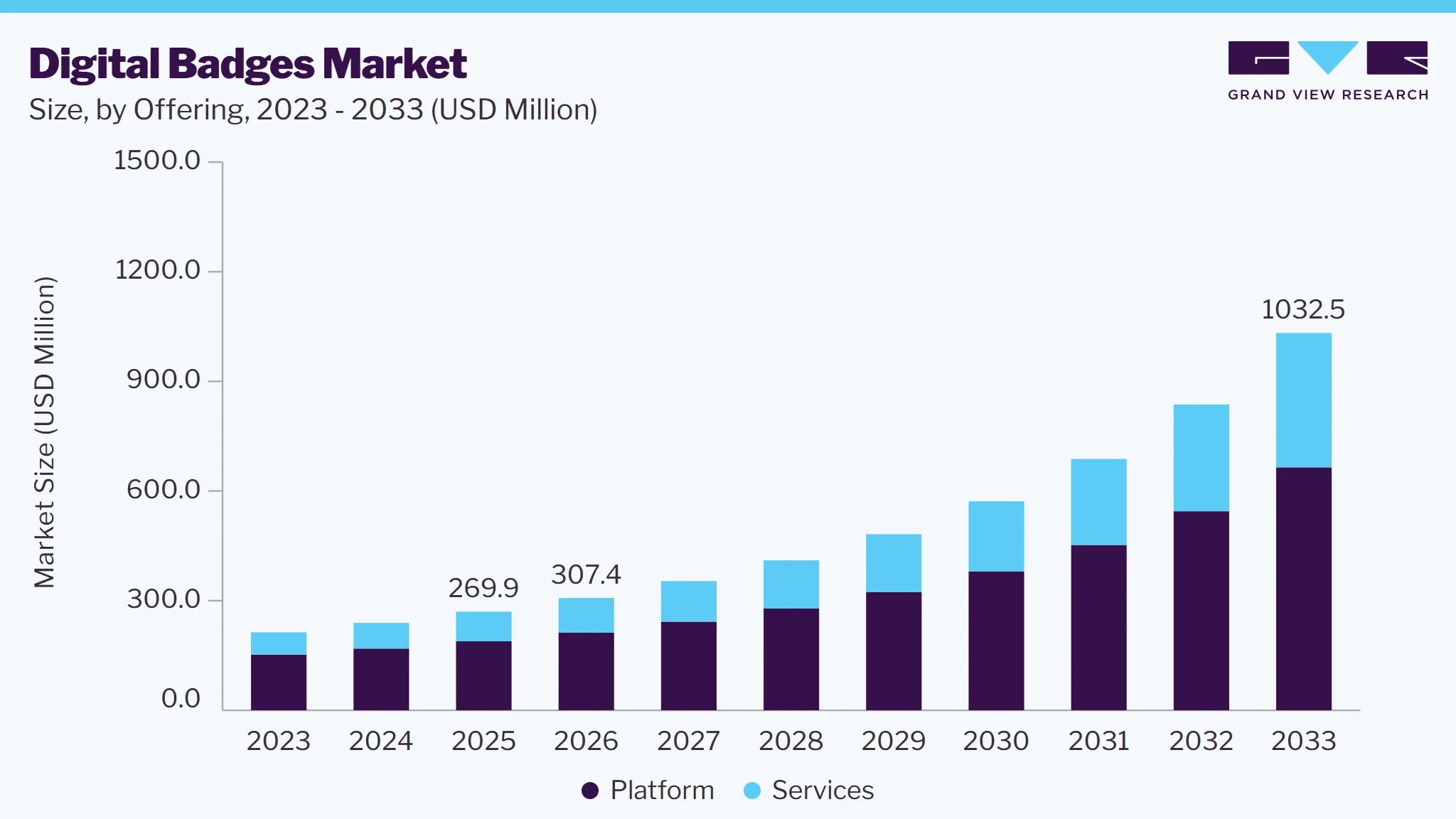
The global digital badges market size was valued at USD 269.9 million in 2025 and is projected to grow from USD 307.4 million in 2026 to USD 1,032.5 million by 2033, at a CAGR of 18.9% from 2026 to 2033. North America dominated the market, accounting for the revenue share of 40.0% in 2025. Market growth is primarily driven by the rapid adoption of micro-credentials and skills-based learning, rising corporate upskilling and reskilling programs, increasing demand for verifiable digital credentials, and the growing use of digital badges for professional certification and workforce recognition.
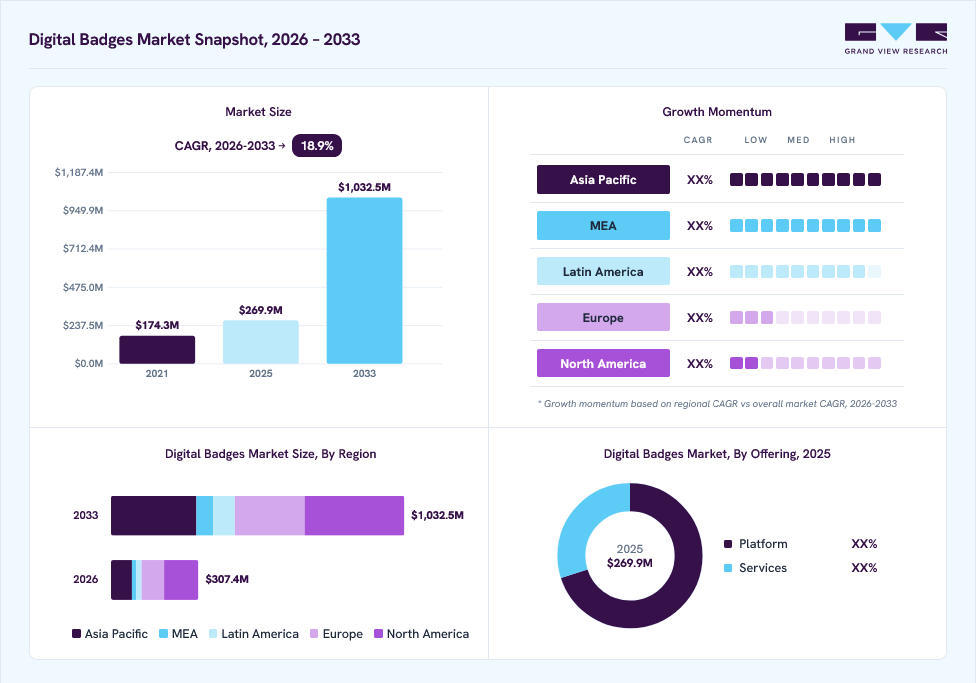 Source: Grand View Research, IR Documents, Primary Interviews, Paid DatabasesTo learn more about this report,
 Download Free Sample Report
 Key Market Trends & Insights
- By offering: Platform segment dominated the market with a share of 69.9% in 2025.
- By type: Certification Badges segment led the market in 2025.
- By end use: Academic segment led the market with a share in 2025.
Regional Highlights
- Largest regional market: North America (40.0% revenue share, 2025)
- Fastest-growing regional market: Asia-Pacific (highest CAGR, 2026-2033)
- By country: The U.S. held the largest share in 2025
Market Size & Forecasts
- Market size in 2025: USD 269.9 Million
- Estimated market size in 2026: USD 307.4 Million
- Projected market size by 2033: USD 1,032.5 Million
- CAGR (2026-2033): 18.9%
Three ways to get this report
Buy it, customize it, or ask a question.Ask an Analyst
A direct answer, usually in 1 working day
- AccessReport author, directly
- Reply timeWithin 1 working day
- No sales callDirect answer only
- FormatEmail reply
- CostFree, no cost
Get the Full Report
What the study covers
- FormatsPDF · Excel · Dashboard
- Timeline2026–2033 annual, 2025 base
- Coverage20+ countries, 5 regions
- Companies10+ key players profiled
Customize the Report
20% free customization
- IncludeCountries, segments, points
- TailorTo your product definition
- ExtendDeeper competitor detail
- OrA fully bespoke study
- Turnaround5–10 working days
The expansion of micro-credentials is creating strong demand for digital badges that can represent specific skills, course modules, and competency milestones without requiring completion of a full academic or professional program. Universities, vocational institutions, and online learning providers are increasingly adopting shorter, stackable learning formats, allowing learners to accumulate multiple credentials over time. This shift toward modular education is positioning digital badges as an important mechanism for documenting granular learning outcomes.Additionally, the growing focus on skills-based hiring is encouraging employers to look beyond traditional degrees and evaluate candidates based on demonstrable competencies. Digital badges provide employers with digitally verifiable evidence of specific technical, professional, and soft skills, while enabling candidates to showcase validated capabilities across professional profiles and recruitment channels. Greater emphasis on skills transparency is therefore strengthening the role of digital badges in connecting learning achievements with employment opportunities.
 To learn more about this report, Download Free Sample Report
 Furthermore, the increasing workforce skill gaps and rapid changes in job requirements are driving companies to expand internal training, reskilling, and continuous learning programs. Digital badges allow organizations to recognize completion of technical training, leadership programs, compliance courses, and role-specific development initiatives while maintaining a digital record of employee competencies. The growing need to track workforce capabilities at an individual skill level is creating sustained demand for digital badges within corporate learning ecosystems.
Moreover, growing developments in digital credential standards are improving the portability, authenticity, and verification of badges across different platforms. Open standards such as Open Badges 3.0, together with verifiable credential technologies and digital wallets, are enabling credentials to carry richer information about the issuer, achievement, evidence, and verification status. Improved interoperability is increasing the practical value of digital badges by allowing credentials to move beyond individual learning platforms and be used across broader education and employment ecosystems. These factors are expected to drive the digital badges industry growth in the coming years.
Market Dynamics
The digital badges market is experiencing significant growth, driven by the increasing adoption of micro-credentials, rising demand for skills-based hiring, expansion of online and hybrid learning, growing corporate upskilling and reskilling programs, and increasing use of verifiable digital credentials. The growing use of digital badges across universities, professional certification bodies, employers, vocational training providers, and online education platforms is driving strong demand for portable, competency-focused credentials. Greater emphasis on lifelong learning and transparent verification of skills is further supporting the transition from conventional certificates toward digitally verifiable credentials.
The increasing emphasis on competency-based education, professional upskilling, and skills-based hiring is accelerating the adoption of digital badges across academic and corporate environments. Digital badges enable institutions and organizations to recognize specific skills, completed courses, certifications, and learning achievements in a portable and digitally verifiable format. Their ability to provide more granular evidence of competencies than conventional certificates is making them increasingly relevant to learners and employers.
The expansion of online education, professional certification programs, workforce development initiatives, and corporate learning platforms is further strengthening demand for digital badges. Universities, employers, and training providers are increasingly using badges to document incremental learning outcomes and communicate verified skills to prospective employers. The growing shift toward skills-based credentialing is therefore expected to remain a key demand driver for digital badges across developed and emerging markets.
The digital badges ecosystem continues to face challenges related to inconsistent credential standards, platform interoperability, identity verification, and badge recognition across employers and educational institutions. Organizations using different credentialing platforms may face difficulties transferring or validating badges across learning management systems, HR platforms, professional networks, and digital wallets. Limited awareness among employers of the value and verification of digital badges can further reduce their acceptance relative to established degrees and conventional professional certificates.
Additional requirements related to data privacy, credential security, issuer authentication, and compliance with evolving digital credential standards can increase implementation complexity and costs. These interoperability and recognition challenges can slow adoption, particularly among organizations transitioning from established certificate-based credentialing systems.
The increasing demand for trusted, portable, and independently verifiable credentials is creating significant growth opportunities for digital badge providers. Advances in Open Badges standards, verifiable credentials, digital wallets, and API-based credential infrastructure are making badges more portable and easier to verify across education, employment, and professional networks. These developments allow learners and employees to maintain a persistent digital record of skills and achievements that can be shared with multiple organizations.
Growing adoption of micro-credentials, workforce reskilling, professional certification, and skills-based recruitment is further expanding the addressable market. Universities can use digital badges to complement degrees with competency-level credentials, while employers can recognize internal training and role-specific skills through verified badges. Providers offering interoperable, secure, and easily verifiable credentials are therefore well-positioned to capture emerging opportunities as digital credentials become increasingly embedded in education and workforce ecosystems.
Market Concentration & Characteristics
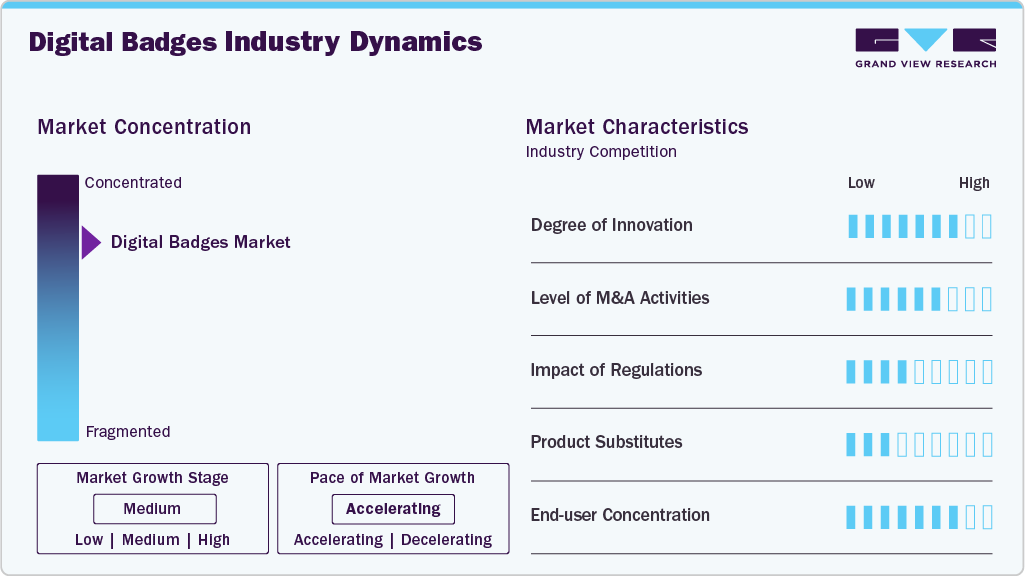
The digital badges market is moderately concentrated, characterized by the presence of established digital credential platforms, credentialing technology providers, learning technology companies, certification organizations, and specialized digital badge providers competing across academic, corporate, professional certification, workforce development, and continuing education applications. The market is characterized by a high degree of platform innovation and credential interoperability, supported by advancements in verifiable credentials, Open Badges standards, credential wallets, automated issuance, blockchain-based verification, API connectivity, and skills-based credentialing.
 To learn more about this report, Download Free Sample Report
 Strategic partnerships with universities, colleges, employers, professional associations, certification bodies, training providers, and learning management system vendors are enabling companies to expand credential coverage and strengthen digital credential ecosystems. Increasing requirements for credential authenticity, data privacy, interoperability, identity verification, and standards compliance are driving demand for secure, portable, and verifiable digital badges, while platform development, integration, and credential-framework costs pose barriers for smaller providers. Competition from traditional certificates, proprietary credentialing systems, and alternative digital credential formats remains a moderate constraint. Growing demand for micro-credentials, skills-based hiring, workforce reskilling, lifelong learning, and portable professional recognition is expected to strengthen product differentiation and competitive positioning across the global digital badges market.
Analyst Perspective
The digital badges market is transitioning from basic digital recognition tools toward broader, verifiable, skills-based credentialing platforms that support academic learning, professional development, and workforce advancement. The convergence of online education, micro-credentials, skills-based hiring, digital learning platforms, credential verification, and interoperable standards is expanding the role of digital badges across academic institutions, corporate training programs, certification bodies, and workforce development ecosystems.
Offering Insights
The platform segment dominated the digital badges market with a share of 69.9% in 2025, driven by the growing need for centralized systems to issue, manage, verify, and distribute credentials across large learner and employee populations. Universities, certification bodies, and enterprises are expanding digital credential programs that require connectivity with learning management systems, HR platforms, and professional profiles, increasing demand for platforms with automated issuance and verification capabilities. The development of connected credential ecosystems is therefore strengthening platform demand across education, certification, and corporate environments.
The services segment is expected to grow at the highest CAGR of 21.4% from 2026 to 2033, fueled by the increasing complexity of designing and deploying digital credential programs across different institutions and workforce environments. Organizations require support for competency mapping, badge framework development, system implementation, platform integration, credential verification, and ongoing program administration, particularly when credentials need to align with institutional or industry standards. The transition toward structured and managed credential programs is therefore creating greater opportunities for specialized digital badge services.
Type Insights
The certification badges segment dominated the market in 2025, driven by the adoption of digital credentials to validate professional qualifications, technical expertise, and industry-specific competencies. Training providers and certification organizations are using digitally verifiable badges to represent completed assessments, professional certifications, and competency attainment, enabling recipients to present validated skills across employment and professional networking channels. The growing focus on independently verifiable, job-relevant qualifications is supporting sustained demand for certification badges.
The achievement badges segment is expected to grow at the highest CAGR from 2026 to 2033, supported by the increasing use of granular digital recognition for completed courses, learning milestones, projects, participation, and demonstrated competencies. Educational institutions and training providers can issue badges for individual accomplishments rather than waiting until completion of an entire program, creating a continuous record of learner progress and engagement. The ability to recognize specific accomplishments is strengthening achievement badges as a complementary credential format across learning and development programs.
End Use Insights
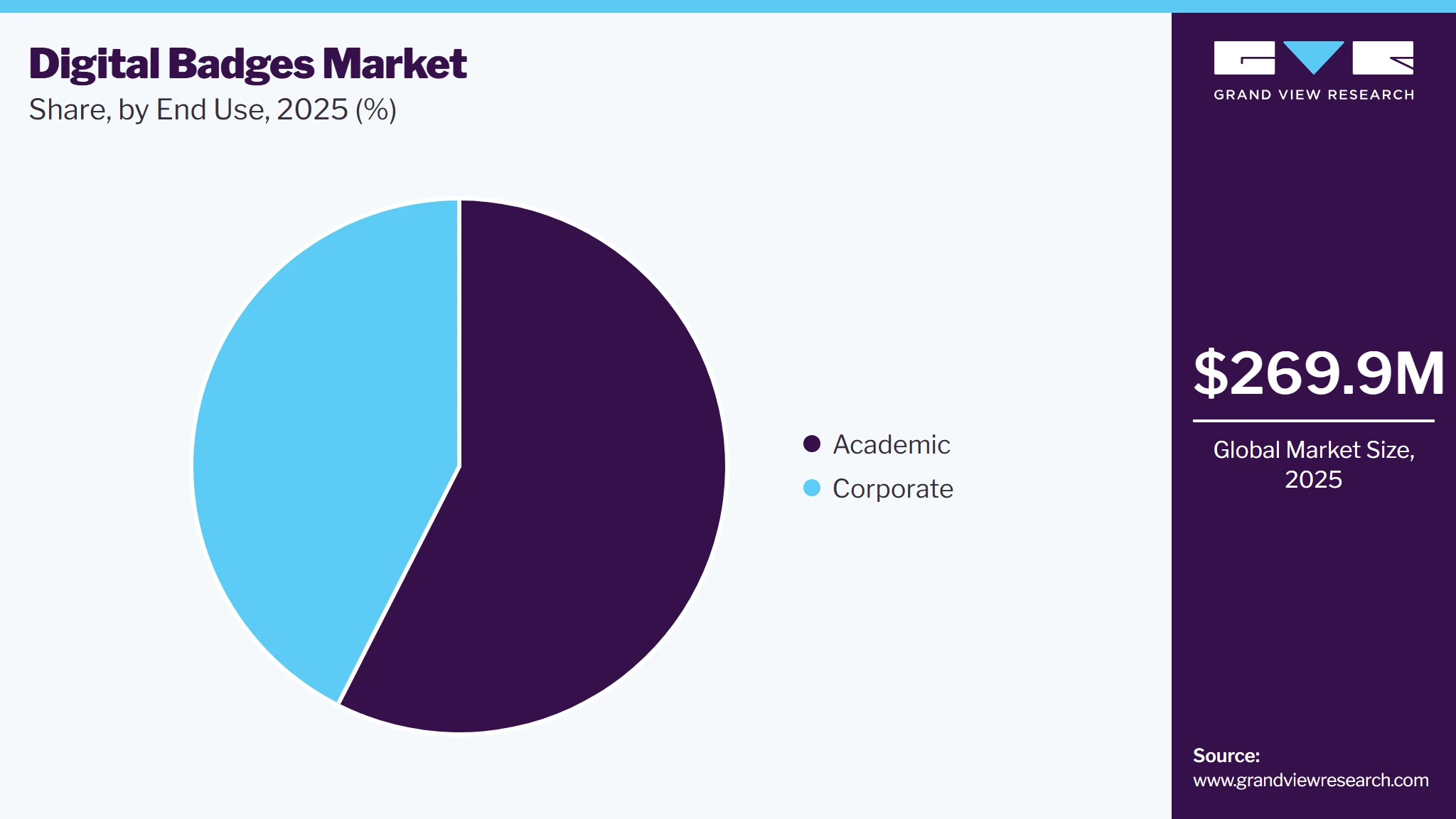
The academic segment dominated the market in 2025, driven by the expansion of micro-credentials, short-form courses, and competency-based education across universities, colleges, and online learning providers. Academic programs increasingly combine traditional qualifications with modular learning units, creating demand for digital badges that can represent individual competencies, course achievements, and extracurricular accomplishments in a portable format. The shift toward flexible and skills-focused academic pathways is consequently creating sustained demand for digital badges across higher education.
 To learn more about this report, Download Free Sample Report
 The corporate segment is expected to grow at the highest CAGR from 2026 to 2033. The segment is expanding as employers increasingly shift toward skills-based workforce development, where training outcomes need to be linked directly with employee capabilities. Companies are using digital badges to recognize internal training, technical certifications, leadership programs, and newly acquired competencies, while HR teams can incorporate these credentials into employee skills inventories and internal mobility initiatives. The increasing emphasis on measurable workforce capabilities and continuous reskilling is therefore strengthening corporate demand for digital badge programs.
Regional Insights
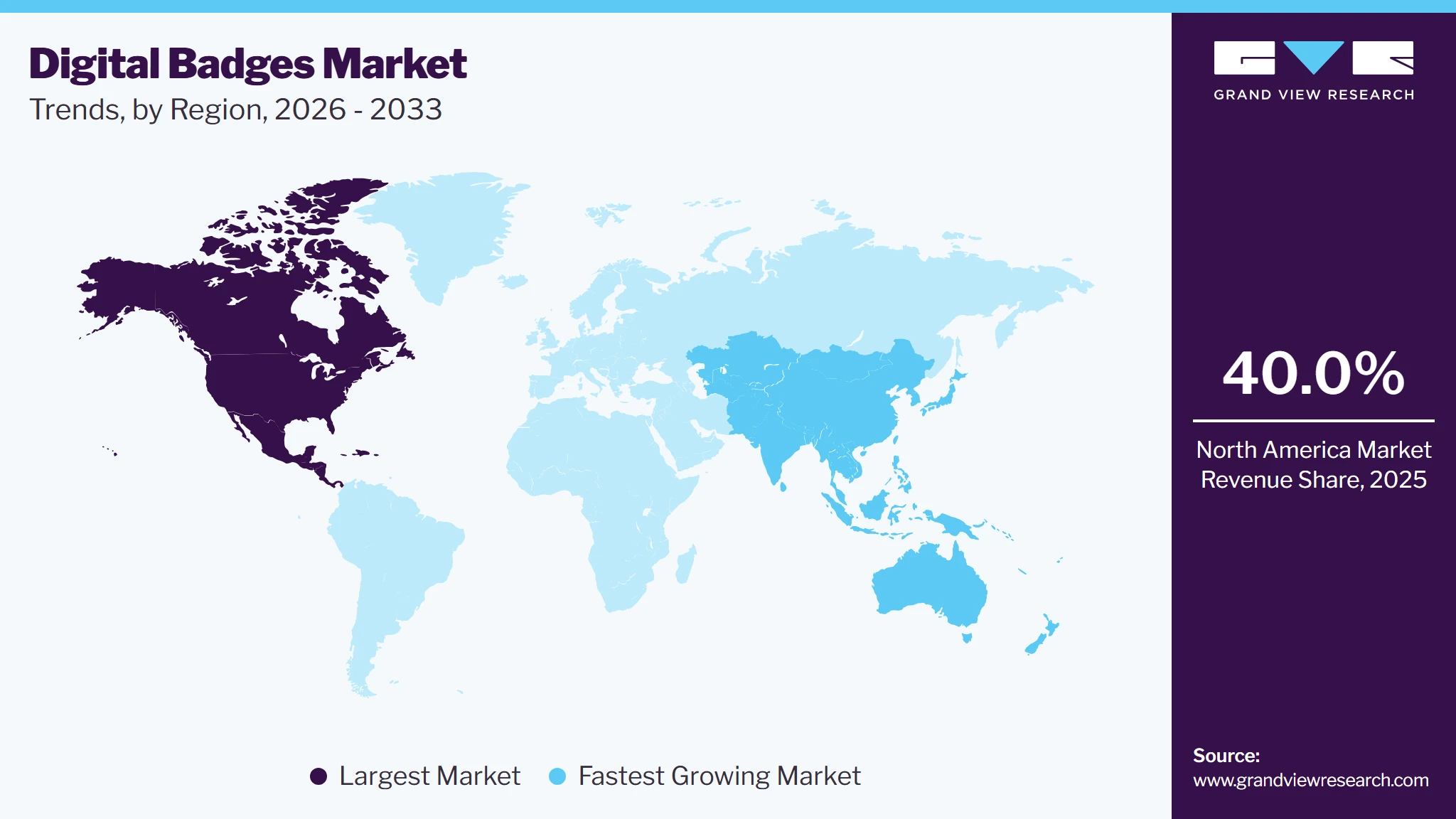
The North America digital badges industry held the largest share of 40.0% in 2025, supported by strong adoption of digital credentials across higher education, professional certification, workforce development, and corporate learning programs. The region benefits from a mature credentialing ecosystem, widespread use of learning management systems, and growing emphasis on skills-based hiring. Universities, employers, and professional organizations are increasingly using verifiable digital badges to document specific competencies, making North America a leading market for portable and skills-based credentials.
 To learn more about this report, Download Free Sample Report
 U.S. Digital Badges Market Trends
The digital badges industry in the U.S. accounted for the largest share of the North American market with a share of 82.3% in 2025, driven by widespread adoption of micro-credentials across universities, technology companies, professional associations, and workforce development initiatives. Growing employer focus on skills-based recruitment is encouraging institutions to issue granular credentials that demonstrate specific technical and professional competencies. The expansion of alternative education pathways, online learning, and industry-recognized certifications is further strengthening demand for verifiable digital badges that can be shared across professional and learning platforms.
Europe Digital Badges Market Trends
The digital badges industry in Europe accounted for a significant share of 26.1% in 2025, supported by increasing emphasis on lifelong learning, digital skills development, and standardized recognition of qualifications across countries. The region's focus on interoperable digital credentials and cross-border recognition is encouraging universities, vocational institutions, and employers to adopt verifiable badges. Growing demand for skills transparency and digital records of learning achievements is further strengthening the role of digital badges within European education and workforce ecosystems.
The UK digital badges industry is gaining traction, owing to increasing adoption of micro-credentials, professional development programs, and skills-based learning across universities and employers. Universities and training providers are using digital badges to recognize short-form learning and industry-specific competencies that may not be captured through conventional degrees or certificates. The expansion of flexible learning and employer-led training is creating additional demand for portable credentials that can demonstrate verified skills throughout an individual's career.
The digital badges industry in Germany is developing alongside the country's strong vocational education and industrial training ecosystem. Manufacturers, universities, and training organizations are increasingly seeking digital methods for documenting technical competencies, professional certifications, and achievements in continuous training. The growing importance of Industry 4.0 skills, including automation, robotics, data analytics, and digital manufacturing, is creating opportunities for competency-based digital credentials that can provide employers with more detailed evidence of workforce capabilities.
Asia Pacific Digital Badges Market Trends
The digital badges industry in the Asia Pacific is expected to register the highest CAGR of 22.3% from 2026 to 2033, supported by the rapid expansion of online education, workforce digitization, and government-led digital skills initiatives. Large populations of students and working professionals are increasing the demand for flexible, short-duration learning programs and credentials that can demonstrate specific competencies. The rapid growth of edtech platforms, corporate training ecosystems, and digital learning infrastructure is creating a favorable environment for large-scale adoption of digital badges.
The digital badges industry in Japan is gaining traction as universities, professional training organizations, and employers increasingly focus on continuous upskilling and recognition of specialized competencies. The country's aging workforce and emphasis on productivity improvement are encouraging greater investment in reskilling and lifelong learning programs. Digital badges provide a practical mechanism for documenting incremental learning achievements, particularly in areas such as digital technologies, engineering, healthcare, and workplace automation.
The China digital badges industry is expanding alongside the country's rapidly developing digital education and workforce training ecosystem. Large-scale adoption of online learning platforms and government emphasis on digital skills development are increasing the demand for digitally verifiable records of training and competency attainment. Technology companies, universities, and vocational institutions are increasingly using digital credentials to document specialized skills in areas such as artificial intelligence, cloud computing, software development, and advanced manufacturing.
Key Digital Badges Company Insights
Some of the key players operating in the market are Credly (Pearson) and Accredible, among others.
-
Credly (Pearson) is a digital credentialing platform that enables organizations to issue, manage, verify, and share digital badges representing learning outcomes, competencies, certifications, and professional achievements. Its platform is built around Open Badges standards and provides credential sharing, verification, skills mapping, and digital profiles that allow learners to communicate validated capabilities to employers. Its broad enterprise customer base, established employer recognition, and extensive credential network position Credly as a mature player in the digital badges market.
-
Accredible provides digital credentialing solutions for education providers, professional organizations, corporations, and certification bodies, supporting the design, issuance, management, verification, and sharing of digital badges and certificates. Its platform offers extensive integrations with LMS, CRM, assessment, event-management, and workforce systems, along with APIs and digital wallets. Its continued expansion into Open Badges 3.0, W3C Verifiable Credentials, skills frameworks, and career-oriented credential pathways strengthens its position as a mature player in the market.
BadgeCert and Sertifier are some of the emerging and established market participants in the digital badges market.
-
BadgeCert is a digital credentialing provider focused on issuing and managing verifiable digital badges and certificates for professional associations, certification bodies, educational institutions, and employers. Its standards-oriented platform supports credential issuance, verification, learner sharing, and digital recognition programs. Its focus on credentialing organizations and Open Badges-based solutions supports its position as an emerging player in the market.
-
Sertifier is a digital credentialing platform that enables organizations to design, issue, manage, and verify digital badges and certificates for education, corporate learning, professional development, and workforce programs. The platform supports Open Badges 3.0, W3C Verifiable Credentials, LMS connectivity, credential design, and recipient sharing. Its focus on self-service credentialing, transparent pricing, and growing interoperability capabilities positions it as an emerging player in the market.
Key Digital Badges Companies
The following key companies have been profiled for this study on the digital badges market.
-
Accredible
-
BadgeCert
-
Credly (Pearson)
-
ForAll Systems
-
Instructure
-
NOCTI Business Solutions
-
Open Badge Factory
-
Parchment
-
Sertifier
-
Skillsoft
Competitive Benchmarking
Operating Strategies
Competitive Edge
Weaknesses
Mature Players: Credly (Pearson), Accredible, Instructure, Parchment
- Focus on enterprise, academic, professional certification, and workforce credentialing applications.
- Invest in interoperable digital credentials, Open Badges standards, credential wallets, skills frameworks, automation, and platform integrations.
- Strong brand recognition and established customer relationships.
- Large credential issuance networks and mature platform capabilities.
- Higher enterprise pricing and implementation requirements can limit adoption among smaller organizations.
- Complex product ecosystems may require greater administrative and technical resources.
Emerging Players: Skillsoft, BadgeCert, Sertifier
- Focus on flexible, standards-based digital credentialing for education, professional associations, corporate training, and workforce programs.
- Develop cost-effective, self-service, and easy-to-deploy badge issuance solution
- Agile product development and faster introduction of credentialing features.
- Flexible solutions for organizations seeking alternatives to large enterprise platforms.
- Smaller customer and credential networks compared with leading platforms.
- Lower brand recognition among large employers and global academic institutions.
Recent Developments
-
In August 2026, Accredible launched Skills Frameworks, enabling issuers to align digital credentials with recognized frameworks, including O*NET, ESCO, and NACE Career Readiness Competencies, or use their own skills taxonomies. The development strengthens the use of digital badges for skills-based hiring and workforce development.
-
In July 2026, Instructure introduced several product updates across its portfolio, with Parchment expanding its digital badge analytics capabilities to help institutions track badges issued, viewed, and shared and assess their effectiveness.
-
In October 2025, Open Badge Factory announced support for the Open Badges 3.0 standard across Open Badge Factory and Open Badge Passport, enhancing the security, portability, and credibility of digital credentials.
Digital Badges Market Report Scope
Report Attribute
Details
Market size in 2025
USD 269.9 million
Estimated market size in 2026
USD 307.4 million
Projected market size by 2033
USD 1,032.5 million
Growth rate
CAGR of 18.9% from 2026 to 2033
Actual data
2021 - 2025
Forecast period
2026 - 2033
Quantitative units
Revenue in USD million and CAGR from 2026 to 2033
Report coverage
Revenue forecast, company share, competitive landscape, growth factors, and trends
Segments covered
Offering, type, end use, region
Regional scope
North America; Europe; Asia Pacific; Latin America; Middle East & Africa
Country scope
U.S.; Canada; Mexico; UK; Germany; France; China; Japan; India; South Korea; Australia; Brazil; UAE; KSA; South Africa
Key companies profiled
Accredible; BadgeCert; Credly (Pearson); ForAll Systems; Instructure; NOCTI Business Solutions; Open Badge Factory; Parchment; Sertifier; Skillsoft
Customization scope
Free report customization (equivalent to up to 8 analyst working days) with purchase. Addition or alteration to country, regional & segment scope.
Pricing and purchase options
Avail customized purchase options to meet your exact research needs. Explore purchase options
Global Digital Badges Market Report Segmentation
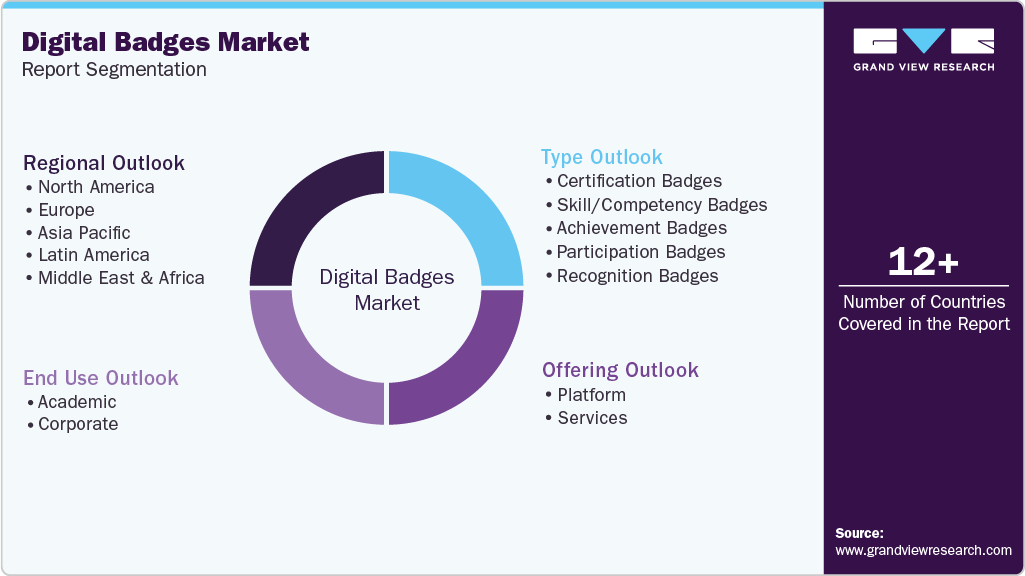
This report forecasts revenue growth at global, regional, and country levels and provides an analysis of the latest industry trends in each of the sub-segments from 2021 to 2033. For this study, Grand View Research has segmented the global digital badges market report based on offering, type, end use, and region:
 To learn more about this report, Download Free Sample Report
 -
Offering Outlook (Revenue, USD Million, 2021 - 2033)
-
Platform
-
Services
-
-
Type Outlook (Revenue, USD Million, 2021 - 2033)
-
Certification Badges
-
Skill/Competency Badges
-
Achievement Badges
-
Participation Badges
-
Recognition Badges
-
-
End Use Outlook (Revenue, USD Million, 2021 - 2033)
-
Academic
-
Corporate
-
-
Regional Outlook (Revenue, USD Million, 2021 - 2033)
-
North America
-
U.S.
-
Canada
-
Mexico
-
-
Europe
-
UK
-
Germany
-
France
-
-
Asia Pacific
-
China
-
Japan
-
India
-
South Korea
-
Australia
-
-
Latin America
-
Brazil
-
-
Middle East and Africa
-
UAE
-
KSA
-
South Africa
-
-
Research Methodology
The digital badges market figures in this report are based on a proven research process that combines executive interviews with secondary research from proprietary databases, company filings, and recognized regulatory and institutional sources. Market size is built through value-chain sizing - reconciling supply-side and demand-side estimates - and triangulated with bottom-up and top-down approaches. Every estimate passes multiple levels of expert validation before publication, with each digital badges segment quantified using the revenue-capture definitions in the table below.
Segment Definition
Offering
Revenue Capture Definition
Platform
Revenue is generated through subscription fees, licensing charges, and usage-based fees for digital badge platforms used to create, issue, manage, store, and verify digital credentials.
Services
Revenue is generated through implementation, customization, integration, consulting, credential-program design, technical support, and maintenance services associated with digital badge solutions.
Type
Revenue Capture Definition
Certification Badges
Revenue is generated through the issuance and management of digital badges that validate completion of formal certifications, qualifications, or credentialing programs.
Skill/Competency Badges
Revenue is generated through digital credentials that validate specific skills, competencies, or demonstrated capabilities acquired through education, training, or professional development.
Achievement Badges
Revenue is generated through badges issued to recognize the successful completion of courses, projects, milestones, assessments, or other defined accomplishments.
Participation Badges
Revenue is generated through badges issued to recognize participation in courses, workshops, events, programs, communities, or learning activities.
Recognition Badges
Revenue is generated through badges that formally recognize contributions, performance, leadership, professional accomplishments, or other forms of distinction.
End Use
Revenue Capture Definition
Academic
Revenue is generated through digital badge platforms, issuance, and related services purchased by schools, colleges, universities, vocational institutions, and other academic organizations for student and learner credentialing.
Corporate
Revenue is generated through digital badge platforms, issuance, and related services purchased by businesses and employers for employee training, professional development, skills validation, workforce recognition, and talent management.
Estimation Model
Layer
Key Question
Description
End-User Adoption Layer
Who are the potential adopters?
Identifies universities, colleges, schools, professional training institutions, corporations, employers, certification bodies, and workforce development organizations that use digital badges to recognize learning, skills, competencies, achievements, and participation.
Credential Enablement Layer
Who supplies digital badge solutions?
Evaluates digital badge platforms, credentialing providers, learning technology companies, certification organizations, and technology partners that provide badge creation, issuance, management, verification, and credential infrastructure.
Credential Deployment Layer
Where are digital badges being used?
Maps digital badge deployment across academic programs, professional certifications, corporate learning and development, employee upskilling, workforce training, continuing education, workshops, events, and competency-based learning programs.
Technology & Standards Layer
What technologies influence adoption?
Evaluates Open Badges standards, digital wallets, credential verification technologies, APIs, learning management system connectivity, blockchain-enabled verification, skills taxonomies, data portability, and interoperability capabilities that support digital credential ecosystems.
Revenue Generation Layer
How is market revenue generated?
Estimates revenue through digital badge platform subscriptions and licensing, badge issuance and verification fees, credential management services, implementation and integration services, customization, consulting, technical support, and enterprise credentialing programs.
Delivered Customizations
This report has been delivered with the following in-depth customizations
Client Request
Customization Delivered
Value Adds
Market Sizing, Segmentation & Growth Opportunity Assessment
Assessed the global digital badges market size, historical trends, forecast growth outlook, and detailed segmentation by offering (Platform, Services), type (Certification Badges, Skill/Competency Badges, Achievement Badges, Participation Badges, Recognition Badges), and end use (Academic, Corporate). Evaluated the expansion of online learning, micro-credentials, skills-based education, workforce upskilling, professional certification, digital credentialing, and demand for verifiable and portable recognition of skills and achievements influencing market expansion.
Enables digital badge platform providers, credentialing companies, educational institutions, certification bodies, corporate learning providers, and workforce development organizations to identify high-growth credential types and end-use opportunities, prioritize platform development and service capabilities, optimize credential portfolios, and capture emerging revenue opportunities across academic and corporate learning ecosystems.
Regional Market Demand & Growth Opportunity Assessment
Assessed regional digital badges demand across North America, Europe, Asia Pacific, Latin America, and Middle East & Africa, considering digital education adoption, online learning penetration, higher-education modernization, workforce development initiatives, professional certification activity, corporate training expenditure, skills-based hiring, and government-led digital-skills programs.
Provides actionable insights into regional growth opportunities, market-entry priorities, investment hotspots, and competitive positioning, enabling stakeholders to align expansion strategies, establish partnerships with educational institutions and employers, localize credential offerings, and capture demand across established and emerging digital credentialing markets.
Competitive Landscape & Strategic Positioning Analysis
Evaluated the competitive environment across major digital badge platforms, credentialing providers, learning technology companies, certification organizations, and workforce credentialing platforms, comparing platform capabilities, credential management functionality, verification features, standards compliance, integrations, application coverage, geographic presence, strategic partnerships, and recent product developments.
Enables companies to benchmark their market position, identify platform and service gaps, assess differentiation opportunities, prioritize technology and product investments, and strengthen competitive positioning across academic credentialing, corporate learning, professional certification, employee development, and workforce skills validation applications.
About the Author(s)
Next Generation Technologies Research Team
Technology · Next Generation TechnologiesThis report was authored by the next generation technologies research team at Grand View Research - comprising two research analysts, one senior research analyst, and one industry expert - with specialized expertise in the next generation technologies segment of the technology industry. All findings are based on proprietary technology databases, executive interviews, and regulatory analysis, subject to internal peer review prior to publication.
Last Updated:
Speak to Analyst

Customize this report to your needs - add regions, segments, or data points, with 20% free customization.
Or view our licence options:


ISO 9001:2015 & 27001:2022 Certified
We are GDPR and CCPA compliant! Your transaction & personal information is safe and secure. For more details, please read our privacy policy.


