
- Home
- »
- Next Generation Technologies
- »
-
Digital Legacy Market Size & Share Report, 2025-2030GVR Report cover

Digital Legacy Market (2025 - 2030)
Size, Share & Trends Analysis Report By Storage Capacity (upto 500 MB, 500 MB to 5 GB, upto 30 GB), By End-use (Entertainment & Media, Healthcare, BFSI, Retail), By Region, And Segment Forecasts
Market Size, 2024
$12.9BMarket Estimate, 2026
$17.2BMarket Forecast, 2030
$30.8BCAGR, 2025–2030
17.7%Digital Legacy Market Size & Trends
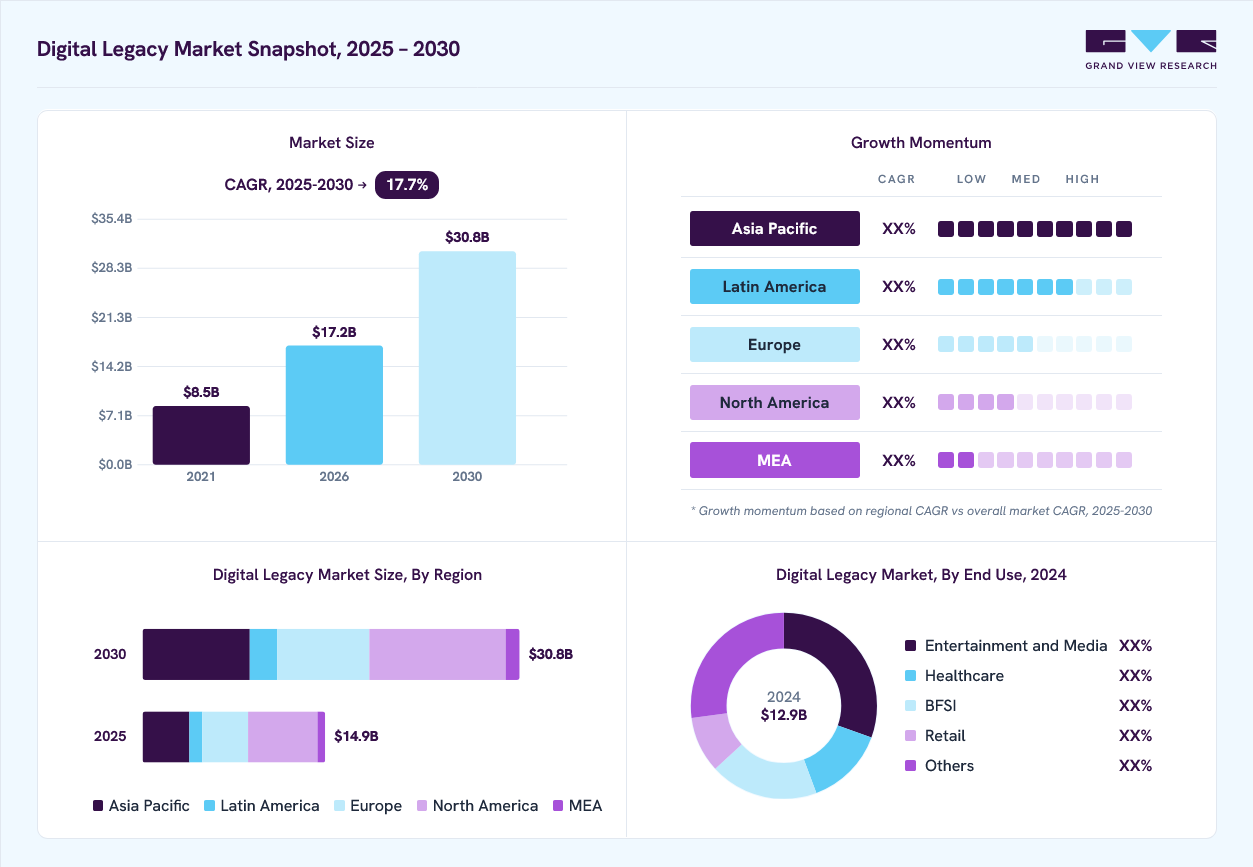
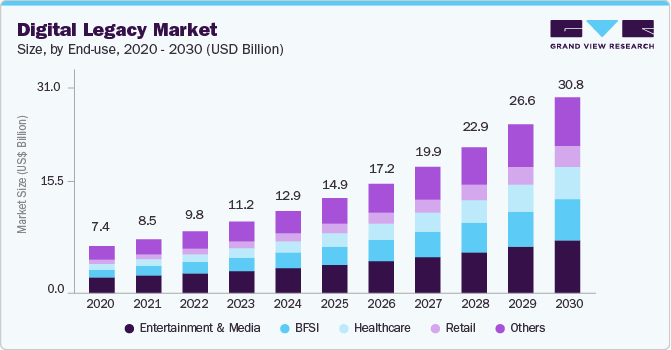
The global digital legacy market size was valued at USD 12.9 billion in 2024 and is projected to grow from USD 17.2 billion in 2026 to USD 30.8 billion by 2030, at a CAGR of 17.7% from 2025 to 2030. North America dominated the market, accounting for a revenue share of 37% in 2024. This significant growth is driven by the increasing digitalization of personal and professional lives, accumulating vast amounts of digital assets that require secure and organized posthumous management.
 Source: Grand View Research, IR Documents, Primary Interviews, Paid DatabasesTo learn more about this report,
 Download Free Sample Report
 Key Market Highlights:
- The entertainment and media segment led the market revenue share in 2024 due to the growing demand for innovative and cost-effective content production solutions.
- The 5 GB to 10 GB segment is anticipated to grow at the highest CAGR during the forecast period.
- North America represented a significant market share of over 37% in 2024.
Three ways to get this report
Buy it, customize it, or ask a question.Ask an Analyst
Analyst response in 1 business day
- AccessReport author, directly
- Reply timeWithin 1 working day
- No sales callDirect answer only
- FormatEmail reply
- CostFree, no cost
Get the Full Report
What the study covers
- FormatsPDF · Excel · Dashboard
- Timeline2025–2030 annual, 2024 base
- Coverage20+ countries, 5 regions
- Companies10+ key players profiled
Customize the Report
20% free customization
- IncludeCountries, segments, points
- TailorTo your product definition
- ExtendDeeper competitor detail
- OrA fully bespoke study
- Turnaround5–10 working days
 To learn more about this report, Download Free Sample Report
 Rising awareness around digital wills, asset inheritance, and the importance of safeguarding online identities is fueling the demand for digital legacy solutions. In addition, the expansion of cloud storage, the proliferation of social media accounts, and the growing value of cryptocurrencies and NFTs contribute to this market’s momentum. Industries such as BFSI, healthcare, and media & entertainment are seeing growing adoption due to their high volume of sensitive or high-value digital data. As people accumulate a growing volume of digital assets, including social media profiles, cloud-stored documents, financial credentials, cryptocurrencies, and multimedia content, managing, transferring, and preserving these assets beyond one's lifetime has become necessary. Moreover, the widespread use of smartphones and cloud computing has made digital storage more accessible, encouraging users to store sensitive information online, increasing the demand for secure posthumous management tools. The shift toward digital estate planning is especially evident among tech-savvy individuals and younger demographics, who are more likely to consider long-term digital footprint management.
In addition, rising concerns around data privacy, identity theft, and unauthorized access to digital content after death are compelling individuals and institutions to adopt structured digital legacy solutions. Integrating technologies such as blockchain, AI, and encryption in digital legacy platforms enhances trust, security, and automation, making these services more appealing and efficient. Simultaneously, regulatory frameworks like the EU's General Data Protection Regulation (GDPR) and emerging digital estate laws in various countries push service providers to offer compliant and transparent digital legacy management systems.
End-use Insights
The entertainment and media segment led the market revenue share in 2024 due to the growing demand for innovative and cost-effective content production solutions. AI-driven tools are increasingly used to generate music, scripts, animations, video effects, and even personalized content for streaming platforms, allowing companies to reduce production costs and timelines. The entertainment industry has been an early adopter of generative AI, leveraging it for creative processes, including film and game development and media production. AI-generated content also allows for high levels of customization, enabling targeted marketing campaigns and personalized viewer experiences, which is valuable for platforms such as Netflix, YouTube, and Spotify. As content consumption continues to rise globally in the form of video, there is greater demand for scalable content creation solutions that generative AI can efficiently provide.
The healthcare segment is poised for significant growth due to the rising adoption of digital health records, genomic data, personal health monitoring devices, and telemedicine platforms, all generating sensitive and valuable digital assets. As individuals accumulate comprehensive medical histories online, there is a growing need to preserve and securely transfer this information to family members or healthcare proxies after death. This is relevant for elder care, end-of-life planning, and hereditary medical conditions, where access to historical health data can be critical for ongoing treatment or research. Increasing awareness around health data privacy and the need for secure digital continuity pushes consumers and healthcare providers to explore legacy planning solutions.
Storage Capacity Insights
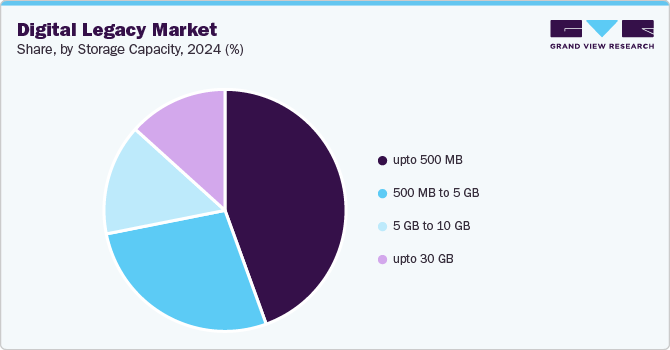
Upto 30 GB is estimated to hold a leading share of 27.6% in 2024. This dominance is attributed to the segment’s ability to meet the needs of a wide user base, mainly individuals and families storing diverse digital assets such as photos, videos, important documents, email backups, and social media archives. As users increasingly preserve multimedia memories and essential personal data online, storage capacities beyond basic tiers, such as 500 MB or 5 GB, are becoming the standard. The 10-30 GB range balances affordability and capacity, making it attractive for entry-level and moderately advanced users. Furthermore, service providers are increasingly bundling this tier with value-added features such as encryption, sharing permissions, and automated inheritance tools, enhancing user demand.
 To learn more about this report, Download Free Sample Report
 The 5 GB to 10 GB segment is anticipated to grow at the highest CAGR during the forecast period. This growth is largely driven by the increasing volume of digital content generated by everyday users who require more than minimal storage but do not yet need premium or enterprise-level plans. As individuals increasingly store personal documents, email records, social media archives, and moderate volumes of multimedia content, this mid-tier segment offers an optimal balance between cost and capacity. In addition, the availability of affordable subscription pricing and flexible upgrade options has made this tier a preferred entry point for paid digital legacy services.
Regional Insights
North America represented a significant market share of over 37% in 2024. This dominance is largely attributed to the region's high digital adoption rate, widespread use of cloud storage, and early uptake of digital estate planning services. The presence of major technology providers and startups offering specialized digital legacy platforms has also fueled market penetration. Furthermore, awareness around digital asset inheritance in the U.S. and Canada is prompting individuals to proactively manage their online identities, social media accounts, and financial information. Legal developments surrounding digital wills and posthumous data access, evolving state-level legislation in the U.S., have further supported the region's growth.
 To learn more about this report, Download Free Sample Report
 U.S. Digital Legacy Market Trends
The digital legacy market in the U.S. is expected to grow substantially over the forecast period. The increasing digitalization of personal assets, including social media profiles, financial records, and digital media, has created a need for secure and organized posthumous management. As individuals accumulate vast amounts of digital content, the demand for services to preserve and transfer these assets to heirs is rising. Furthermore, the growing awareness of data privacy and the importance of safeguarding online identities has prompted individuals and institutions to invest in digital legacy solutions. Cloud storage expansion and the proliferation of cryptocurrencies and non-fungible tokens (NFTs) have added complexity to digital estates, necessitating specialized management tools.
Europe Digital Legacy Market Trends
The digital legacy industry in Europe is expected to witness significant growth over the forecast period. This widespread digitalization has led to an increase in the accumulation of digital assets such as personal data, financial records, and digital content, necessitating the need for secure and structured digital legacy solutions. Moreover, Europe's aging population and the rise in digital health records have further emphasized the importance of managing digital estates effectively. Regulatory frameworks, such as the EU's Digital Decade policy, also encourage the adoption of digital legacy services by setting concrete targets for digital transformation and data governance.
Asia Pacific Digital Legacy Market Trends
The digital legacy industry in the Asia Pacific region is anticipated to register the highest CAGR over the forecast period. The increasing adoption of digital technologies in countries such as India, China, and Japan contributes to accumulating digital assets, necessitating digital legacy solutions. In addition, government initiatives promoting digital literacy and the establishment of legal frameworks for digital asset inheritance are further driving the market's growth in the region.
Key Digital Legacy Company Insights
Some key companies in the digital legacy industry are Tresorit, MEGA, pCloud International AG,and SpiderOak Inc.
-
Tresorit is a key player in the digital legacy market, offering highly secure cloud storage and file-sharing services with end-to-end encryption. Its focus on data privacy and security aligns with the growing demand for protecting digital assets, including sensitive personal information, financial records, and digital content, which are crucial for digital legacy planning. As individuals increasingly seek ways to preserve their digital lives for future generations, Tresorit's encrypted platform provides a secure environment for storing these valuable assets. With its zero-knowledge policy, Tresorit ensures that only authorized individuals can access digital legacy files, which is essential for managing inheritance and posthumous data distribution
-
MEGA is a prominent player in the digital legacy market, offering cloud storage solutions with a strong emphasis on privacy and security. Its end-to-end encryption ensures that only users can access their data, making it a reliable platform for preserving digital assets such as photos, documents, and personal files. With features such as MEGA Backup and MEGA S4 Object Storage, users can securely store and manage their digital content, facilitating the organization and transfer of digital legacies to heirs or designated individuals.
Key Digital Legacy Companies:
The following are the leading companies in the digital legacy market. These companies collectively hold the largest market share and dictate industry trends.
- Apple Inc
- Backblaze
- ETER
- MEGA
- pCloud International AG
- Tresorit
- SpiderOak Inc.
- Secomba GmbH i.L.
- Sync.com, Inc.
- Tuta
Recent Developments
-
In April 2025, Canva launched Visual Suite 2.0, introducing a new era of AI-powered design to enhance team creativity, communication, and productivity. The update includes advanced tools such as visual spreadsheets, data visualization, conversational design, and personalized content creation at scale. This launch reinforces Canva’s position as a leader in visual communication, supporting everything from everyday design tasks to complex team workflows.
-
In September 2024, SafeTech BV launched Inheriti 2.0, a decentralized digital legacy solution designed to securely transfer digital assets such as social media accounts, cryptocurrencies, and personal data. The product addresses the growing need for comprehensive digital legacy planning, offering a secure and lasting way to manage and pass down online accounts and sensitive information.
-
In November 2023, DGLegacy launched its first AI-driven mobile app for digital legacy planning and asset protection. The app, available on iOS and Android, enables users to securely record and assign their digital and physical assets for inheritance. Key features include a user-friendly, secure interface, AI-based alive/fatal event detection to trigger asset transfer, and proactive notifications to inform loved ones, ensuring a smooth and transparent inheritance process.
Digital Legacy Market Report Scope
Report Attribute
Details
Market size in 2024
USD 12.9 billion
Estimated Market size in 2026
USD 17.2 billion
Projected Market size by 2030
USD 30.8 billion
Growth rate
CAGR of 15.6% from 2025 to 2030
Actual data
2017 - 2024
Forecast period
2025 - 2030
Quantitative units
Revenue in USD million/billion and CAGR from 2025 to 2030
Report coverage
Revenue forecast, company ranking, competitive landscape, growth factors, and trends
Segments covered
Storage capacity, end-use, region
Regional scope
North America; Europe; Asia Pacific; Latin America; MEA
Country scope
U.S.; Canada; Mexico; Germany; UK; France; China; India; Japan; Australia; South Korea; Brazil; UAE; South Africa; KSA
Key companies profiled
Tresorit; MEGA; pCloud International AG; SpiderOak Inc.; Secomba GmbH i.L.; Tuta; Sync.com, Inc.; Backblaze; ETER; Apple Inc
Customization scope
Free report customization (equivalent up to 8 analysts working days) with purchase. Addition or alteration to country, regional & segment scope.
Pricing and purchase options
Avail customized purchase options to meet your exact research needs. Explore purchase options
Global Digital Legacy Market Report Segmentation
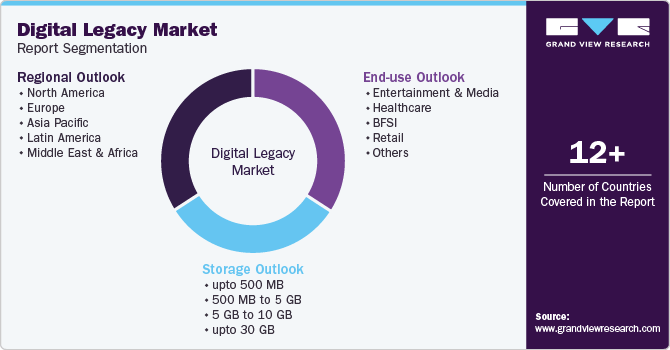
This report forecasts revenue growth at the global, regional, and country levels and provides an analysis of the latest industry trends in each of the sub-segments from 2017 to 2030. For this study, Grand View Research has segmented the global digital legacy market report based on storage capacity, end-use, and region:
 To learn more about this report, Download Free Sample Report
 -
Storage Capacity Outlook (Revenue, USD Million, 2017 - 2030)
-
upto 500 MB
-
500 MB to 5 GB
-
5 GB to 10 GB
-
upto 30 GB
-
-
End-use Outlook (Revenue, USD Million, 2017 - 2030)
-
Entertainment and Media
-
Healthcare
-
BFSI
-
Retail
-
Others
-
-
Regional Outlook (Revenue, USD Million, 2017 - 2030)
-
North America
-
U.S.
-
Canada
-
Mexico
-
-
Europe
-
UK
-
Germany
-
France
-
-
Asia Pacific
-
China
-
India
-
Japan
-
Australia
-
South Korea
-
-
Latin America
-
Brazil
-
-
MEA
-
UAE
-
South Africa
-
KSA
-
-
Frequently Asked Questions About This Report
The global digital legacy market size was valued at USD 12.9 billion in 2024 and is estimated at USD 17.2 billion for 2026.
The global digital legacy market is expected to grow at a CAGR of 17.7% from 2025 to 2030, reaching USD 30.8 billion by 2030.
North America dominated the market in 2024, accounting for over 37.0% share of the global revenue. This dominance is largely attributed to the region's high digital adoption rate, widespread use of cloud storage, and early uptake of digital estate planning services.
Some key players operating in the digital legacy market include Tresorit; MEGA; pCloud International AG; SpiderOak Inc.; Secomba GmbH i.L.; Tuta; Sync.com, Inc.; Backblaze; ETER; Apple Inc.
Key factors driving the digital legacy market growth include the growing volume of digital assets and increasing ownership of digital assets like cryptocurrencies and NFTs
About the Author(s)
Next Generation Technologies Research Team
Technology · Next Generation TechnologiesThis report was authored by the next generation technologies research team at Grand View Research - comprising two research analysts, one senior research analyst, and one industry expert - with specialized expertise in the next generation technologies segment of the technology industry. All findings are based on proprietary technology databases, executive interviews, and regulatory analysis, subject to internal peer review prior to publication.
Last Updated:
Speak to Analyst

Customize this report to your needs - add regions, segments, or data points, with 20% free customization.
Or view our licence options:


ISO 9001:2015 & 27001:2022 Certified
We are GDPR and CCPA compliant! Your transaction & personal information is safe and secure. For more details, please read our privacy policy.


