
- Home
- »
- Digital Media
- »
-
Digital Marketing Software Market Size Report, 2026-2033GVR Report cover

Digital Marketing Software Market (2026 - 2033)
Size, Share & Trends Analysis Report By Type (Software, Services), By Software (CRM Software, Email Marketing), By Service, By Deployment, By Enterprise Size, By End-use, By Region, And Segment Forecasts
Market Size, 2025
$86.3BMarket Estimate, 2026
$99.3BMarket Forecast, 2033
$321.8BCAGR, 2026–2033
18.3%Digital Marketing Software Market Summary
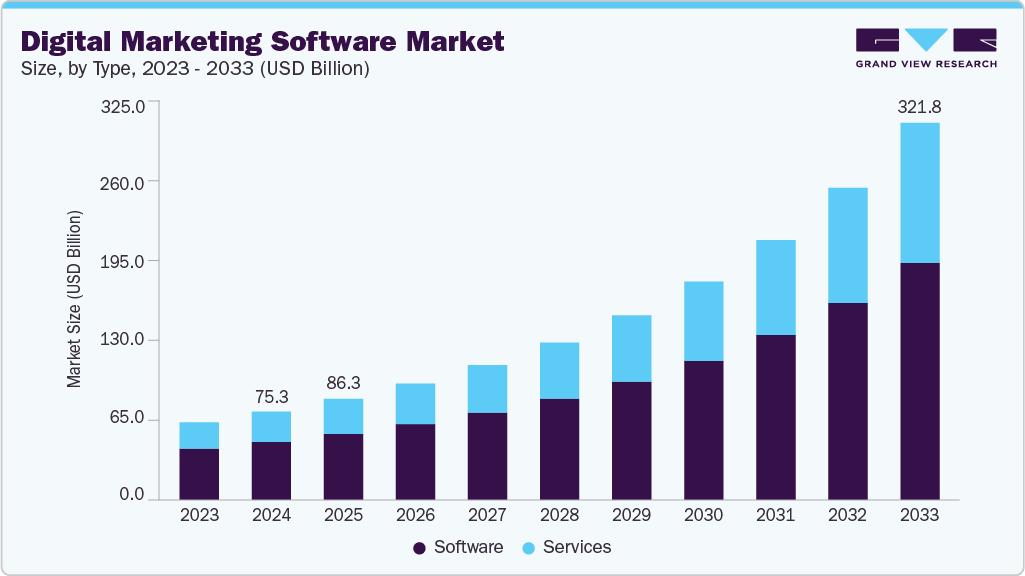
The global digital marketing software market size was valued at USD 86.3 billion in 2025 and is projected to grow from USD 99.3 billion in 2026 to USD 321.8 billion by 2033, growing at a CAGR of 18.3% from 2026 to 2033. North America dominated the market with the largest revenue share of 44.1% in 2025. This market growth is driven by the rapid shift of businesses toward digital platforms for customer engagement and revenue generation.
 Source: Grand View Research, IR Documents, Primary Interviews, Paid DatabasesTo learn more about this report,
 Download Free Sample Report
 Key Market Trends & Insights
- By type: Software segment led the market with the largest revenue share of 65.4% in 2025.
- By software:CRM software segment led the market with the largest revenue share of 22.7% in 2025.
- By services: Professional services segment led the market with the largest revenue share of 64.9% in 2025.
- By deployment: Cloud segment led the market with the largest revenue share of 60.6% in 2025.
- By enterprise size: SMEs segment led the market with the largest revenue share of 51.0% in 2025.
Regional Highlights
- Largest regional market: North America (44.1% revenue share, 2025)
- Fastest-growing regional market: Asia Pacific (highest CAGR, 2026-2033)
- By country: The U.S. held the largest market share in 2025
Market Size & Forecast
- Market size in 2025: USD 86.3 Billion
- Estimated market size in 2026: USD 99.3 Billion
- Projected market size by 2033: USD 321.8 Billion
- CAGR (2026-2033): 18.3%
Three ways to get this report
Buy it, customize it, or ask a question.Ask an Analyst
Analyst response in 1 business day
- AccessReport author, directly
- Reply timeWithin 1 working day
- No sales callDirect answer only
- FormatEmail reply
- CostFree, no cost
Get the Full Report
What the study covers
- FormatsPDF · Excel · Dashboard
- Timeline2026–2033 annual, 2025 base
- Coverage20+ countries, 5 regions
- Companies10+ key players profiled
Customize the Report
20% free customization
- IncludeCountries, segments, points
- TailorTo your product definition
- ExtendDeeper competitor detail
- OrA fully bespoke study
- Turnaround5–10 working days
With consumers spending more time online on social media, e-commerce sites, or content platforms, businesses are compelled to invest in digital tools to enhance visibility, brand awareness, and personalized communication. This shift has accelerated in the post-pandemic era, where online interactions have become essential for business continuity and customer retention.The widespread penetration of smartphones and high-speed internet globally has fueled the demand for digital marketing solutions. Mobile-first strategies are now integral to marketing campaigns, prompting software providers to offer mobile-optimized solutions for campaign management, customer analytics, and real-time engagement. The increasing time consumers spend on mobile applications and social platforms has made targeted mobile advertising a crucial focus, thereby boosting demand for advanced digital marketing tools.
 To learn more about this report, Download Free Sample Report
 The integration of artificial intelligence (AI) and machine learning (ML) technologies into digital marketing software is transforming the way businesses understand and interact with their audiences. Predictive analytics, real-time personalization, and automated content generation are enabling marketers to improve ROI and customer experience significantly. These technologies also allow businesses to process vast volumes of customer data to uncover trends, improve targeting, and optimize ad spend. For instance, in October 2024, LiveRamp announced the integration of its first artificial intelligence (AI) connections into its global network. This strategic move allows marketers to harness the capabilities of AI more effectively within LiveRamp’s expansive ecosystem, enhancing their ability to personalize and measure consumer interactions. The goal is to provide marketers with maximum flexibility, seamless interoperability, and access to cutting-edge AI tools to optimize campaign outcomes.
Market Dynamics
The digital marketing software market is experiencing strong growth as businesses increasingly prioritize data-driven customer engagement, omnichannel marketing, and personalized customer experiences. Digital marketing software enables organizations to manage, automate, analyze, and optimize marketing activities across channels such as search engines, social media, email, mobile applications, websites, and online advertising platforms. The rapid expansion of e-commerce, growing internet penetration, increasing digital content consumption, and widespread adoption of artificial intelligence (AI) and marketing automation technologies are significantly accelerating market demand.
The growing emphasis on personalized customer engagement and data-driven marketing is a major driver of the digital marketing software market. Organizations across industries are increasingly investing in marketing automation, customer data platforms (CDPs), analytics tools, and AI-powered campaign management solutions to deliver highly targeted content and advertisements. The proliferation of digital touchpoints, including websites, mobile applications, social media platforms, and e-commerce channels, has generated vast amounts of customer data that marketers utilize to optimize campaigns and improve conversion rates. Furthermore, advancements in AI, machine learning, predictive analytics, and customer journey orchestration are enabling businesses to enhance customer experiences, strengthen brand loyalty, and improve marketing efficiency. As companies continue to shift advertising budgets toward digital channels, demand for advanced digital marketing software solutions is expected to rise significantly.
For instance, in April 2026, GrowthLoop launched its Composable AI Decisioning Platform, a data cloud-native solution that helps marketers understand customer behavior and automatically optimize campaign execution in real time. The platform continuously allocates customers across channels, offers, and tactics based on performance outcomes, enabling highly personalized and data-driven marketing campaigns. This development highlights the growing adoption of AI-powered marketing automation and real-time campaign optimization solutions, supporting the expansion of the digital marketing software market.
Data privacy concerns and evolving regulatory requirements remain significant restraints for the digital marketing software market. Governments and regulatory bodies worldwide are implementing stricter data protection laws governing the collection, storage, processing, and usage of consumer information. Regulations related to consumer consent, cookie tracking, cross-border data transfers, and digital advertising transparency are increasing compliance complexity for software vendors and end users alike.
Moreover, the gradual elimination of third-party cookies and growing consumer awareness regarding digital privacy are forcing marketers to redesign targeting and measurement strategies. Organizations must invest in privacy-compliant technologies, first-party data management systems, cybersecurity measures, and governance frameworks, increasing operational costs and implementation complexity. Failure to comply with regulatory requirements can result in substantial financial penalties and reputational damage, potentially limiting market growth.
The rapid advancement of artificial intelligence, generative AI, marketing automation, and omnichannel customer engagement platforms is creating substantial opportunities for the digital marketing software market. AI-powered solutions are enabling marketers to automate content creation, customer segmentation, campaign optimization, lead scoring, chatbots, and predictive analytics, significantly improving operational efficiency and campaign performance.
Additionally, businesses are increasingly adopting omnichannel marketing strategies that integrate customer interactions across websites, social media, email, mobile applications, connected devices, and e-commerce platforms. This trend is driving demand for unified digital marketing platforms capable of delivering consistent customer experiences across multiple touchpoints. The continued growth of social commerce, influencer marketing, retail media networks, and AI-driven customer engagement solutions is expected to create significant long-term growth opportunities for digital marketing software providers worldwide.
Analyst Perspective
The digital marketing software market sits at the center of several powerful growth trends, including accelerating digital transformation, rising adoption of AI-driven marketing, expanding e-commerce activity, and increasing demand for personalized customer experiences. Organizations are shifting marketing budgets toward data-driven and omnichannel engagement strategies, creating sustained demand for platforms that can unify customer data, automate campaigns, and optimize marketing performance across channels. The strongest competitive advantage will belong to vendors that can consolidate CRM, analytics, content management, marketing automation, and customer journey orchestration into a single integrated platform transforming fragmented marketing operations into a unified ecosystem that delivers measurable business outcomes and long-term customer value.
Type Insights
Based on type, the software segment led the market with the largest revenue share of 65.4% in 2025. The integration of AI and machine learning into digital marketing software is changing campaign management and customer engagement. AI-powered tools are being used for predictive analytics, dynamic pricing, content personalization, and even automated content creation. These technologies enhance the efficiency of marketing processes and provide deep insights into consumer preferences, making them indispensable in the software stack of modern marketing departments. The services segment is anticipated to grow at a significant CAGR during the forecast period. With the rise of multichannel marketing and real-time customer engagement needs, businesses prefer to outsource their digital marketing operations to managed service providers (MSPs). These providers handle campaign from execution and content creation to performance monitoring and optimization. This allows companies to focus on core operations while leveraging support to run high-performance digital
Software Insights
Based on software, the CRM software segment led the market with the largest revenue share of 22.7% in 2025. As organizations increasingly shift toward customer-centric business models, CRM software has become a component of digital marketing strategies. CRM platforms enable businesses to collect, store, and analyze customer data to deliver personalized and timely marketing messages. The ability to track customer interactions across multiple touchpoints, email, social media, web, and mobile, has made CRM tools indispensable for creating cohesive and effective marketing campaigns that enhance customer engagement and loyalty.
The social media segment is anticipated to grow at a significant CAGR during the forecast period. The exponential growth of global social media users is a fundamental driver of the social media software segment within the digital marketing landscape. Platforms such as Facebook, Instagram, LinkedIn, TikTok, and X now serve as critical channels for brand engagement, customer service, and product discovery. Businesses across industries are increasingly leveraging these platforms to reach their audiences where they are most active, resulting in growing demand for software that can manage, schedule, and analyze social media campaigns effectively.
Services Insights
Based on services, the professional services segment led the market with the largest revenue share of 64.9% in 2025. Enterprises aiming to scale their digital marketing operations across geographies or business units often require structured change management and rollout plans. Professional service providers support this growth by offering scalable deployment models, organizational training, and change adoption frameworks. Their involvement helps reduce implementation risks and ensures smoother transitions to digital-first marketing strategies, especially in large organizations with complex hierarchies and diverse customer bases.
The managed services segment is expected to grow at a significant CAGR over the forecast period driven by the growing preference among businesses to outsource the management of their digital marketing software and operations. As digital marketing becomes more complex, with the need for constant optimization, content creation, platform integration, and data analysis, many companies, particularly SMEs and non-tech enterprises, are turning to managed service providers (MSPs) to handle day-to-day operations efficiently. This allows organizations to focus on core business functions while still leveraging advanced marketing technologies and strategies.
Deployment Insights
Based on deployment, the cloud segment led the market with the largest revenue share of 60.6% in 2025. The rapid digital transformation across industries is propelling the adoption of cloud-based digital marketing software. Businesses are increasingly favoring cloud solutions due to their scalability, flexibility, and cost-effectiveness compared to traditional on-premises systems. Cloud-based platforms enable organizations to quickly deploy marketing tools, update features in real-time, and eliminate the need for extensive hardware or IT infrastructure. This shift has significantly broadened the market base, allowing even small and mid-sized enterprises to adopt sophisticated marketing technologies.
The on-premise segment is expected to grow at a significant CAGR over the forecast period owing to the continued preference among certain enterprises, particularly in highly regulated industries, for complete control over their data, infrastructure, and digital marketing environments. On-premise deployments provide businesses with the ability to customize systems deeply and manage security protocols directly, which is especially important for organizations dealing with sensitive customer information or operating in regions with strict data sovereignty laws.
Enterprise Size Insights
Based on enterprise size, the SMEs segment led the market with the largest revenue share of 51.0% in 2025. Large organizations typically operate within complex IT environments that include ERP, CRM, customer service platforms, and data warehouses. Digital marketing software that can seamlessly integrate into these broader ecosystems is in high demand. The need for synchronized operations, cross-functional data sharing, and unified customer profiles drives large enterprises to adopt enterprise-grade marketing platforms that support API integrations, data interoperability, and centralized campaign management.
The SMEs segment is expected to grow at a significant CAGR during the forecast period. Many SMEs operate in local or niche markets and seek tools that help them engage with specific customer segments effectively. Digital marketing platforms that offer geo-targeting, local SEO tools, and region-specific campaign customization are particularly valuable. The ability to reach targeted audiences with personalized messaging-while managing ad spend efficiently,makes these tools an attractive proposition for SMEs looking to maximize impact within limited budgets.
End Use Insights
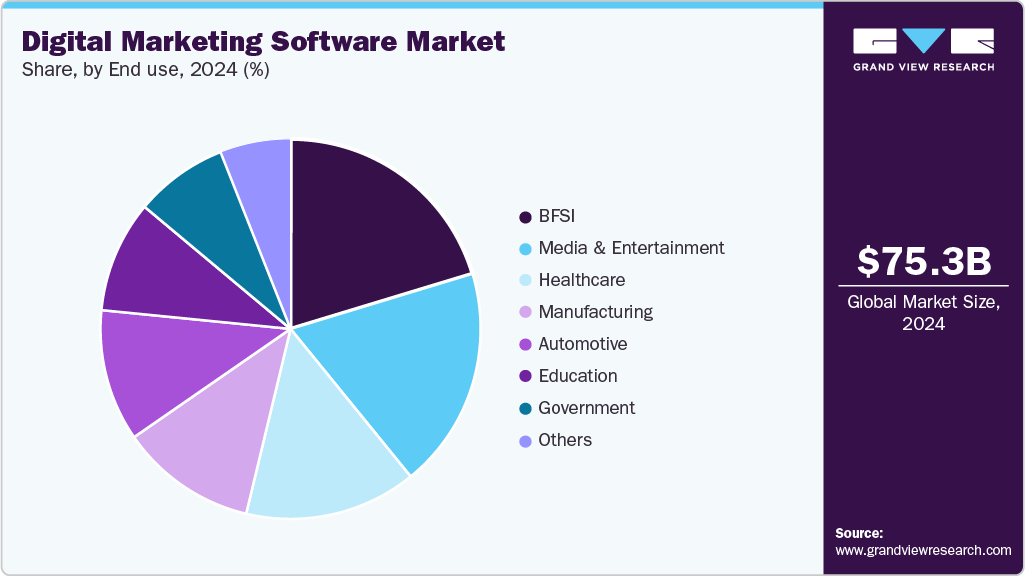
Based on end use, the BFSI segment led the market with the largest revenue share of 20.3% in 2025. The emergence of digital-native fintech players is reshaping customer expectations for convenience, speed, and digital experience. In response, traditional banks and insurers are accelerating their digital marketing capabilities to remain competitive. This includes adopting AI-powered chatbots, real-time push notifications, dynamic content, and hyper-targeted ads, which are enabled by advanced digital marketing software. The fintech disruption has thus become a catalyst for broader digital adoption across the BFSI sector.
 To learn more about this report, Download Free Sample Report
 The media & entertainment segment is expected to grow at a significant CAGR over the forecast period. As content-driven business models continue to dominate the media and entertainment landscape, measuring the performance of marketing campaigns and ensuring monetization are top priorities. Digital marketing software provides tools for tracking ad performance, measuring content reach, and analyzing user engagement metrics, enabling businesses to determine the effectiveness of their campaigns. For advertising-supported platforms, tools that offer ad optimization, programmatic advertising, and audience segmentation are particularly valuable in maximizing ad revenue and improving ROI.
Regional Insights
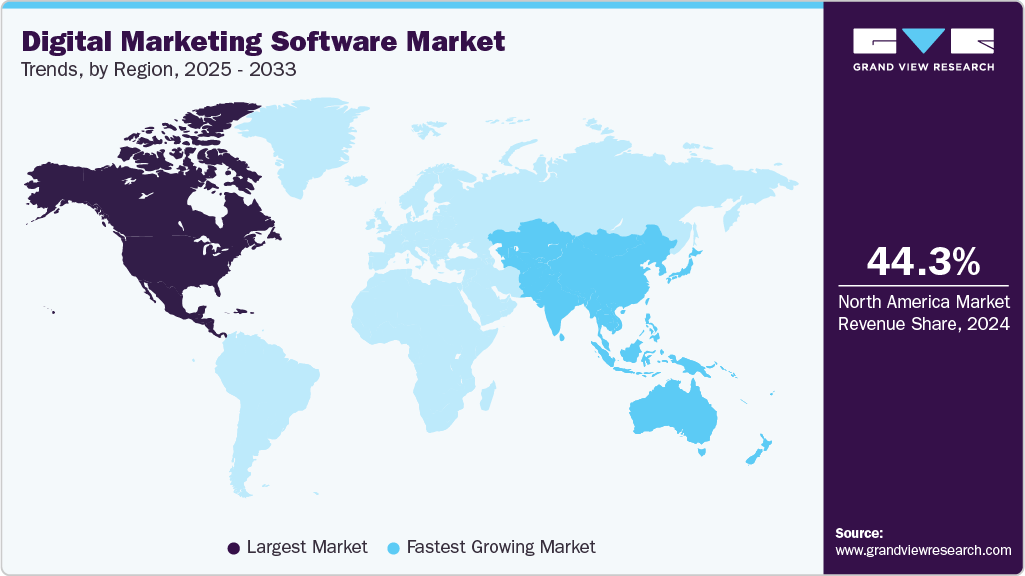
North America dominated the digital marketing software market with the largest revenue share of 44.1% in 2025, driven by the increasing digitalization of businesses across industries, particularly in sectors such as retail, healthcare, and finance. North American companies are heavily investing in advanced marketing technologies such as AI, machine learning, and big data analytics to enhance personalization, optimize customer engagement, and streamline marketing operations. The region also benefits from the presence of numerous technology-driven startups and established players in the marketing technology space, fostering innovation and adoption of cutting-edge solutions.
 To learn more about this report, Download Free Sample Report
 U.S. Digital Marketing Software Market Trends
The digital marketing software market in the U.S. held the largest share in the North America region in 2025, driven by a highly competitive business environment and the increasing emphasis on customer-centric marketing strategies. With a high penetration of internet users, mobile devices, and social media platforms, U.S. companies are heavily relying on digital marketing software to target diverse consumer segments across multiple channels. The rise of e-commerce, along with data privacy regulations like CCPA, is driving demand for advanced analytics and automation tools that ensure compliance while optimizing marketing efforts.
Europe Digital Marketing Software Market Trends
The digital marketing software industry in Europe is anticipated to register a considerable growth from 2026 to 2033 due to the region's strong emphasis on data privacy and compliance, particularly with the implementation of GDPR. European businesses are adopting digital marketing technologies that align with strict regulatory requirements while leveraging tools for customer segmentation, content personalization, and cross-channel marketing. The growing popularity of e-commerce and the shift toward digital-first strategies among traditional industries such as automotive and luxury goods are also contributing to market growth.
The UK digital marketing software industry is expected to grow rapidly in the coming years owing to the increasing adoption of digital marketing technologies across small and medium-sized enterprises (SMEs) and large corporations. With a strong focus on digital transformation, UK businesses are investing in software solutions that enable data-driven decision-making, customer journey optimization, and marketing automation. In addition, the UK's strong digital infrastructure and high internet penetration are driving demand for cloud-based solutions that provide scalability and flexibility for businesses of all sizes.
The Germany digital marketing software industry held a substantial market share in 2024, driven by the country’s thriving automotive, manufacturing, and retail sectors, which are increasingly relying on digital marketing solutions to engage customers and build brand loyalty. The focus on automation, AI-powered marketing, and data analytics is transforming traditional marketing approaches in Germany, enabling companies to target customers more effectively across multiple channels.
Asia Pacific Digital Marketing Software Market Trends
Asia Pacific digital marketing software industry is projected to witness the fastest CAGR during the forecast period, due to the region’s accelerating digital transformation, particularly in emerging economies such as India, Southeast Asia, and Australia. The increasing adoption of smartphones, social media, and e-commerce is driving demand for digital marketing solutions that facilitate personalized marketing campaigns, customer engagement, and real-time analytics.
The Japan digital marketing software industry is expected to grow rapidly in the coming years driven by the nation’s technological advancements and high level of internet penetration, particularly among tech-savvy consumers. Japanese companies, especially in sectors such as electronics, automotive, and entertainment, are leveraging digital marketing software to enhance customer engagement through personalized campaigns, AI-driven insights, and automation tools.
The China digital marketing software industry held a substantial market share in 2024, due to the country’s massive consumer base, high mobile internet penetration, and the widespread use of e-commerce platforms. With companies looking to target vast and diverse consumer segments, there is growing demand for digital marketing solutions that enable hyper-targeted advertising, social media integration, and data analytics.
Key Digital Marketing Software Company Insights
Key players operating in the digital marketing software industry are Adobe, Salesforce.com, Inc., Oracle Corporation, Microsoft, and SAP SE. The companies are focusing on various strategic initiatives, including new product development, partnerships & collaborations, and agreements to gain a competitive advantage over their rivals. The following are some instances of such initiatives.
-
In March 2025, Adobe launched the Adobe Experience Platform Agent Orchestrator, enabling businesses to use AI agents for optimizing websites, automating content production, refining audiences, and scaling digital media. The company also introduced Brand Concierge, an AI-driven app that delivers personalized, brand-centric customer experiences by leveraging a company's unique attributes and customer data.
-
In May 2024, Salesforce, Inc. expanded its Einstein Copilot capabilities with new features aimed at assisting merchants and marketers. The conversational AI assistant now supports businesses of all sizes in managing marketing and merchandising tasks, with its existing sales and service functionalities. Moreover, Salesforce, Inc. introduced new tools for integrating commerce and business data, along with an AI-powered personalization decision engine, enabling companies to tailor customer interactions across all touchpoints using data from any source.
Key Digital Marketing Software Companies
The following key companies have been profiled for this study on the digital marketing software market.
-
Adobe
-
Hewlett-Packard Enterprise Company
-
Hubspot, Inc.
-
IBM Corporation
-
Marketo, Inc.
-
Microsoft
-
Oracle Corporation
-
Salesforce.com, Inc.
-
SAP SE
-
SAS Institute, Inc.
Competitive Benchmarking
Category
Operating Strategies
Competitive Edge
Weakness
Established Players (Adobe, IBM Corporation, Microsoft, Oracle Corporation, Salesforce.com, Inc., SAP SE, SAS Institute, Inc.)
- Invest in AI-driven marketing automation and customer analytics.
- Expand integrated MarTech ecosystems through partnerships and acquisitions.
- Strong global brand recognition and enterprise customer base.
- Comprehensive end-to-end marketing and customer experience platforms.
- High implementation and subscription costs.
- Longer product development and deployment cycles.
Emerging Players (HubSpot, Inc., Marketo, Inc.)
- Focus on marketing automation and customer engagement innovation.
- Leverage cloud-native platforms and flexible pricing models.
- Faster innovation and product enhancement cycles.
- User-friendly platforms with lower total cost of ownership.
- Limited global reach and financial resources.
- Smaller enterprise customer base and partner ecosystem.
Digital Marketing Software Market Report Scope
Report Attribute
Details
Market size in 2025
USD 86.3 billion
Estimated market size in 2026
USD 99.3 billion
Projected market size by 2033
USD 321.8 billion
Growth rate
CAGR of 18.3% from 2026 to 2033
Base year for estimation
2025
Historical data
2021 - 2024
Forecast period
2026 - 2033
Quantitative units
Revenue in USD million/billion and CAGR from 2026 to 2033
Report coverage
Revenue forecast, company ranking, competitive landscape, growth factors, and trends
Segments covered
Type, software, services, deployment, enterprise size, end use region
Regional scope
North America; Europe; Asia Pacific; Latin America; MEA
Country scope
U.S.; Canada; Mexico; UK; Germany; France; China; India; Japan; Australia; South Korea; Brazil; UAE; Kingdom of Saudi Arabia; South Africa
Key companies profiled
Adobe; Hewlett Packard Enterprise Company; Hubspot, Inc.; IBM Corporation; Marketo, Inc.; Microsoft; Oracle Corporation; Salesforce, Inc.; SAP SE; SAS Institute, Inc.
Customization scope
Free report customization (equivalent up to 8 analysts' working days) with purchase. Addition or alteration to country, regional & segment scope.
Pricing and purchase options
Avail customized purchase options to meet your exact research needs. Explore purchase options
Global Digital Marketing Software Market Report Segmentation
This report forecasts revenue growth at global, regional, and country levels and provides an analysis of the latest industry trends in each of the sub-segments from 2021 to 2033. For this study, Grand View Research has segmented the global digital marketing software market report based on type, software, services, deployment, enterprise size, end use, and region.
-
Type Outlook (Revenue, USD Billion, 2021 - 2033)
-
Software
-
Services
-
-
Software Outlook (Revenue, USD Billion, 2021 - 2033)
-
CRM Software
-
Email Marketing
-
Social Media
-
Search Marketing
-
Content Management
-
Marketing Automation
-
Campaign Management
-
Others
-
-
Services Outlook (Revenue, USD Billion, 2021 - 2033)
-
Professional Services
-
Managed Services
-
-
Deployment Outlook (Revenue, USD Billion, 2021 - 2033)
-
Cloud
-
On-premise
-
-
Enterprise Size Outlook (Revenue, USD Billion, 2021 - 2033)
-
Large Enterprises
-
SMEs
-
-
End Use Outlook (Revenue, USD Billion, 2021 - 2033)
-
Automotive
-
BFSI
-
Education
-
Government
-
Healthcare
-
Manufacturing
-
Media & Entertainment
-
Others
-
-
Regional Outlook (Revenue, USD Billion, 2021 - 2033)
-
North America
-
U.S.
-
Canada
-
Mexico
-
-
Europe
-
UK
-
Germany
-
France
-
-
Asia Pacific
-
China
-
India
-
Japan
-
South Korea
-
Australia
-
-
Latin America
-
Brazil
-
-
Middle East & Africa
-
UAE
-
Saudi Arabia
-
South Africa
-
-
Research Methodology
Segment Definition
Segment - Type
Revenue capture definition
Software
Revenue is primarily generated through recurring SaaS subscription fees, usage-based pricing, enterprise licensing agreements, and premium feature upgrades for campaign management, analytics, customer engagement, and marketing automation platforms. Additional revenue is derived from API access, data integration modules, AI-powered functionality, and multi-channel marketing capabilities.
Services
Revenue is captured through consulting, implementation, system integration, training, optimization, and managed marketing services that help organizations deploy, customize, and maximize the value of digital marketing software investments.
Segment - Software
Revenue capture definition
CRM Software
The dominant revenue channel, generating income through subscription-based customer relationship management platforms that integrate customer data, lead management, sales automation, customer journey orchestration, and marketing campaign execution across digital channels.
Email Marketing
Revenue is generated through subscription plans based on contact database size, email volume, campaign frequency, deliverability services, AI-powered personalization, and marketing automation capabilities.
Social Media
Revenue is captured through platform subscriptions for social media publishing, engagement monitoring, influencer management, social listening, analytics, advertising optimization, and cross-platform campaign management.
Search Marketing
Revenue is derived from software subscriptions that support search engine optimization (SEO), pay-per-click (PPC) campaign management, keyword intelligence, competitive analysis, and search performance analytics.
Content Management
Revenue is generated through licensing and subscription fees for content creation, digital asset management, web content publishing, personalization, workflow automation, and omnichannel content delivery platforms.
Marketing Automation
Revenue is captured through SaaS subscriptions for lead nurturing, customer segmentation, workflow automation, predictive analytics, AI-powered recommendations, and personalized customer engagement campaigns.
Campaign Management
Revenue is generated from platforms that enable planning, execution, tracking, attribution, and optimization of multi-channel marketing campaigns across email, social, mobile, web, and advertising channels.
Others
Revenue is derived from specialized digital marketing solutions such as customer data platforms (CDPs), affiliate marketing software, web analytics, conversion rate optimization tools, influencer marketing platforms, and advertising technology solutions.
Segment - Services
Revenue capture definition
Professional Services
The dominant service revenue channel, generating income through consulting, strategy development, implementation, integration, customization, migration, training, and technical support services associated with digital marketing software deployment.
Managed Services
Revenue is captured through recurring contracts for outsourced campaign management, platform administration, performance optimization, data analytics, content management, and ongoing digital marketing operations.
Segment - Deployment
Revenue capture definition
Cloud
The dominant revenue channel, generating income through recurring SaaS subscriptions, consumption-based pricing, cloud-hosted marketing platforms, and scalable licensing models that provide remote access, continuous updates, and rapid deployment capabilities.
On-premise
Revenue is captured through perpetual software licenses, annual maintenance agreements, infrastructure support contracts, system upgrades, and enterprise deployment services for organizations requiring greater control over data and compliance environments.
Segment - Enterprise Size
Revenue capture definition
Large Enterprises
Revenue is captured through enterprise-wide licensing agreements, multi-user subscriptions, advanced analytics packages, AI-driven marketing solutions, customer data platforms, and long-term service contracts supporting large-scale marketing operations.
SMEs
The dominant revenue channel, affordable subscription packages, modular pricing models, freemium-to-paid upgrades, and cloud-based marketing solutions that provide scalable digital marketing capabilities with lower upfront investment requirements.
Segment - End Use
Revenue capture definition
Automotive
Revenue is generated through software solutions supporting lead generation, dealership marketing, customer engagement, vehicle promotion campaigns, and personalized digital advertising initiatives.
BFSI
Revenue is captured through digital marketing platforms used for customer acquisition, personalized financial product promotion, omnichannel engagement, regulatory-compliant communications, and customer retention campaigns.
Education
Revenue is derived from solutions that support student recruitment, enrollment marketing, alumni engagement, content marketing, and digital outreach initiatives across educational institutions.
Government
Revenue is generated through digital communication platforms used for public awareness campaigns, citizen engagement, information dissemination, and digital service promotion initiatives.
Healthcare
Revenue is captured through marketing software supporting patient engagement, healthcare awareness campaigns, appointment acquisition, provider branding, and personalized communication programs while maintaining regulatory compliance.
Manufacturing
Revenue is generated through B2B marketing automation, account-based marketing, lead nurturing, distributor engagement, and digital demand-generation campaigns targeting industrial customers.
Media & Entertainment
Revenue is captured through audience engagement platforms, subscription marketing, content promotion, advertising campaign management, fan engagement initiatives, and digital audience analytics solutions.
Others
Revenue is derived from retail, e-commerce, travel, hospitality, telecommunications, and other sectors utilizing digital marketing software to improve customer acquisition, engagement, retention, and brand visibility.
Estimation Model
Digital Marketing Software Addressable Layer
Technology Access Layer
Adoption & Utilization Layer
Monetisation Layer
“ Who can benefit from digital marketing software? ”
“ Who can deploy digital marketing software solutions? ”
“ Who actively uses digital marketing software? ” “ How much revenue is generated? ”
Identify total businesses, brands, e-commerce companies, SMEs, large enterprises, and marketing agencies globally to define the potential user base for digital marketing software and customer engagement solutions.
Apply cloud infrastructure availability, internet penetration, digital maturity, MarTech ecosystem development, and skilled workforce availability to determine the technologically and operationally reachable market.
Apply digital transformation adoption rates, marketing automation utilization benchmarks, omnichannel marketing implementation, and enterprise-size-based deployment trends to convert reachable organizations into active software users.
Assess revenue generation potential by analyzing expenditure on digital marketing software subscriptions, CRM platforms, analytics tools, campaign management solutions, professional services, and recurring SaaS contracts across the active user base.
Delivered Customizations
This report has been delivered with the following In-depth customizations
Client Request
Customization Delivered
Value Adds
AI-Powered Marketing Automation & Personalization Trends
Conducted a focused analysis of AI-driven marketing automation applications, including predictive customer analytics, content personalisation, lead scoring, customer segmentation, conversational AI, and real-time campaign optimization across major end-use industries.
Helps stakeholders identify high-growth AI use cases, evaluate automation adoption trends, and assess revenue opportunities in intelligent customer engagement and campaign management solutions.
Customer Data Platform (CDP) & First-Party Data Strategy Analysis
Analyzed enterprise adoption of customer data platforms, first-party data collection frameworks, identity resolution technologies, and privacy-centric marketing strategies in response to evolving data regulations and third-party cookie deprecation.
Enables stakeholders to understand future data monetization opportunities, customer intelligence capabilities, and regulatory-compliant marketing strategies.
Competitive Benchmarking & Innovation Strategy Assessment
Conducted benchmarking of leading digital marketing software vendors based on AI capabilities, platform breadth, pricing models, ecosystem partnerships, acquisition strategies, and product innovation initiatives.
Supports strategic decision-making by identifying competitive strengths, market gaps, partnership opportunities, and areas for product differentiation.
Frequently Asked Questions About This Report
The global digital marketing software market size was estimated at USD 86.3 billion in 2025 and is expected to reach USD 99.3 billion in 2026.
The global digital marketing software market is expected to grow at a compound annual growth rate of 18.3% from 2026 to 2033 to reach USD 321.8 billion by 2033.
The digital marketing software market in North America dominated the global market with the largest revenue share of 44.1% in 2025, driven by the increasing digitalization of businesses across industries, particularly in sectors like retail, healthcare, and finance.
Some key players operating in the digital marketing software market include Adobe, Hewlett Packard Enterprise Company, Hubspot, Inc., IBM Corporation, Marketo, Inc., Microsoft, Oracle Corporation, Salesforce, inc., SAP SE, SAS Institute, Inc.
Key factors that are driving the digital marketing software market growth include the rapid shift of businesses toward digital platforms for customer engagement and revenue generation. With consumers spending more time online, on social media, e-commerce sites, or content platforms, businesses are compelled to invest in digital tools to enhance visibility, brand awareness, and personalized communication.
Asia Pacific is the fastest-growing region over the forecast period.
The software segment led with a 65.4% revenue share in 2025, while the services segment is the fastest-growing segment.
The CRM software segment led with a 22.7% revenue share in 2025, while the social media segment is the fastest-growing segment.
The professional services segment led with a 64.9% revenue share in 2025, while the managed services segment is the fastest-growing segment.
About the Author(s)
Digital Media Research Team
Technology · Digital MediaThis report was authored by the digital media research team at Grand View Research - comprising two research analysts, one senior research analyst, and one industry expert - with specialized expertise in the digital media segment of the technology industry. All findings are based on proprietary technology databases, executive interviews, and regulatory analysis, subject to internal peer review prior to publication.
Last Updated:
Speak to Analyst

Customize this report to your needs - add regions, segments, or data points, with 20% free customization.
Or view our licence options:


ISO 9001:2015 & 27001:2022 Certified
We are GDPR and CCPA compliant! Your transaction & personal information is safe and secure. For more details, please read our privacy policy.


