
- Home
- »
- Next Generation Technologies
- »
-
Digital Remittance Market Size And Share Report, 2026-2033GVR Report cover

Digital Remittance Market (2026 - 2033)
Size, Share & Trends Analysis Report By Type (Inward Digital Remittance, Outward Digital Remittance), By Channel (Banks, Money Transfer Operators, Online Platforms), By End Use, By Region, And Segment Forecasts
Market Size, 2025
$27.7BMarket Estimate, 2026
$31.7BMarket Forecast, 2033
$108.5BCAGR, 2026–2033
19.2%Digital Remittance Market Summary
The global digital remittance market size was valued at USD 27.7 billion in 2025 and is projected to grow from USD 31.7 billion in 2026 to USD 108.5 billion by 2033, at a CAGR of 19.2% from 2026 to 2033. North America dominated the digital remittance market with the largest revenue share of 27.4% in 2025. The market growth can be attributed to the increasing fund transfers from migrant workers to their families.
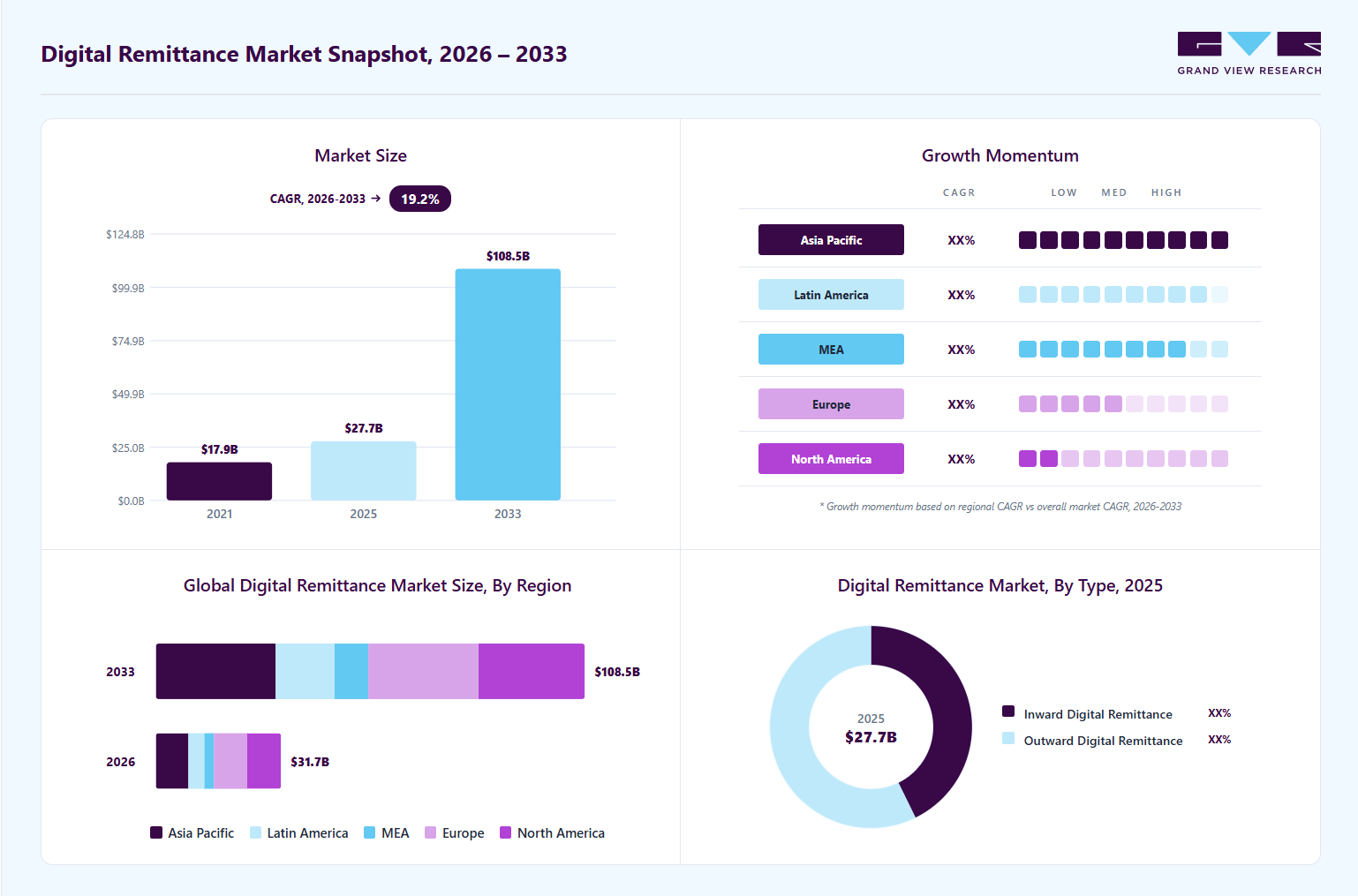 Source: Grand View Research, IR Documents, Primary Interviews, Paid DatabasesTo learn more about this report,
 Download Free Sample Report
 Key Market Trends & Insights
- By type: Outward digital remittance segment led the market with the largest revenue share of 57.2% in 2025.
- By channel: Money transfer operators segment led the market with the largest revenue share of 40.4% in 2025.
- By end use: Personal segment led the market with the largest revenue share of 45.5% in 2025.
Regional Highlights
- Largest regional market: North America (27.4% revenue share, 2025)
- By country: The U.S. held the largest market share in 2025.
Market Size & Forecast
- Market size in 2025: USD 27.7 Billion
- Estimated market size in 2026: USD 31.7 Billion
- Projected market size by 2033: USD 108.5 Billion
- CAGR (2026-2033): 27.4%
Three ways to get this report
Buy it, customize it, or ask a question.Ask an Analyst
Analyst response in 1 business day
- AccessReport author, directly
- Reply timeWithin 1 working day
- No sales callDirect answer only
- FormatEmail reply
- CostFree, no cost
Get the Full Report
What the study covers
- FormatsPDF · Excel · Dashboard
- Timeline2026–2033 annual, 2025 base
- Coverage20+ countries, 5 regions
- Companies10+ key players profiled
Customize the Report
20% free customization
- IncludeCountries, segments, points
- TailorTo your product definition
- ExtendDeeper competitor detail
- OrA fully bespoke study
- Turnaround5–10 working days
Moreover, the increasing number of cross-border transactions and the growing adoption of mobile-based payment channels are further expected to propel market growth over the forecast period. The proliferation of the digital platform for remittance is expected to encourage customers to move toward online transactions. Moreover, the rising penetration of mobile devices across the globe in recent years has encouraged the adoption of digital technology in remittance services and cross-border payments. Customers across the globe are also shifting toward digital remittance services as they help reduce the money transfer time and remittance costs. Moreover, digital remittance services offer high privacy and protection for consumers’ money.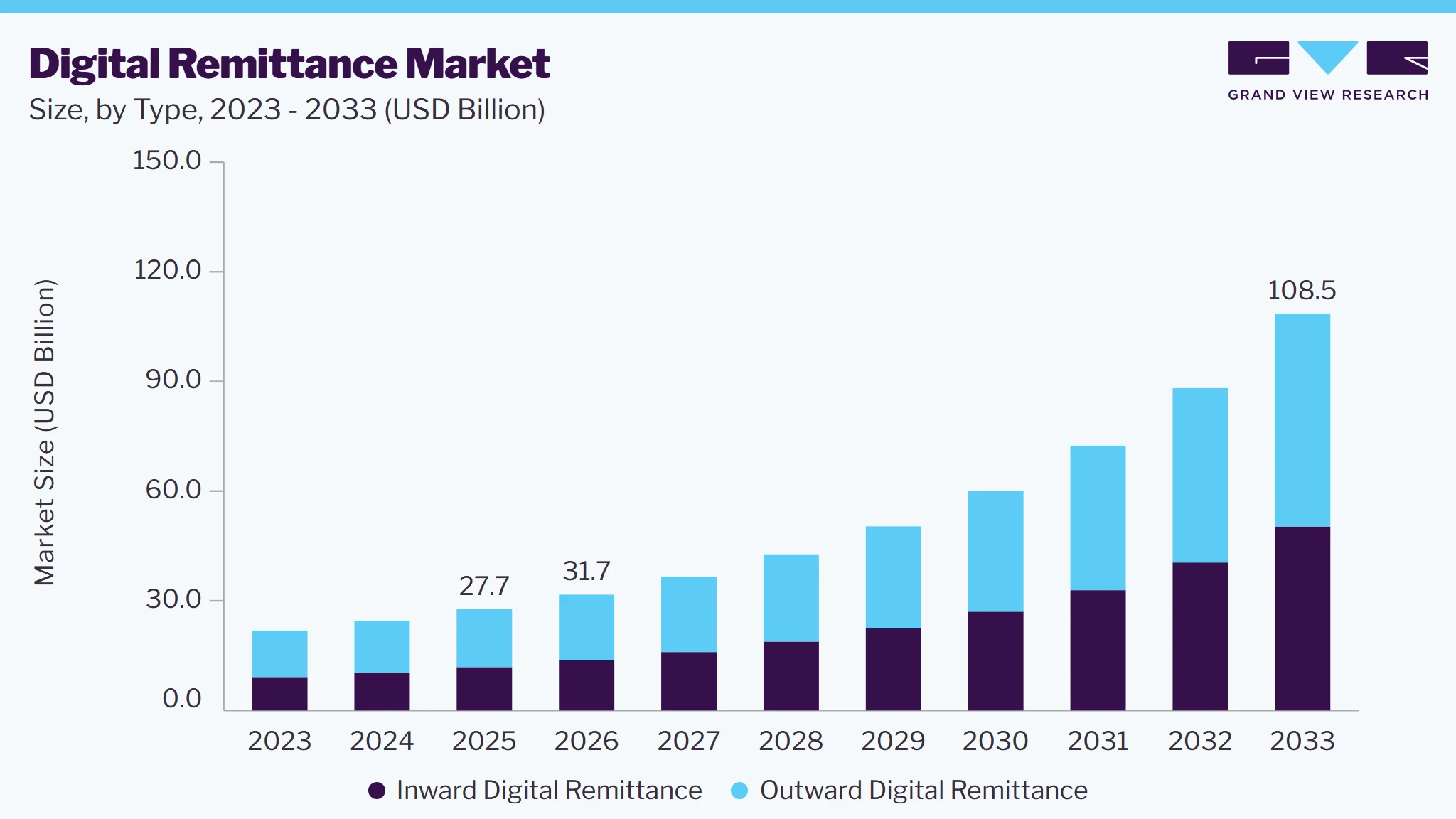 To learn more about this report, Download Free Sample Report
 The endless chains of mediators, hidden charges, and paperwork involved in money transfers made the process costly and arduous. However, the adoption of digital remittance services has helped businesses and customers enjoy more affordable, faster, and value-added money transfer services. The costs involved in transferring money have reduced drastically as a result of healthier competition between market players.
The rising popularity of digital remittance services among low-wage migrant workers, who use these services to send money to their families, is compelling several governing bodies to pay attention to and regulate the digital remittance industry. Moreover, foreign remittances play an important role in the economic development of emerging markets. Due to this, authorized regulators control and monitor money transfer fees to encourage customers to continue using digital remittance services and effectively contribute to their home country’s economic growth. These factors are expected to contribute to market growth over the forecast period.
The increasing adoption and ease of digital payments are expected to create growth opportunities for the market over the forecast period. However, the lack of awareness about digital remittance services and high remittance prices are expected to hinder market growth. Moreover, security hindrances such as terrorist financing and money laundering could also negatively impact the market growth over the forecast period.
Market Dynamics
The digital remittance market is growing rapidly, driven by increased cross-border transactions, digitization, expanding e-commerce, and greater global business participation in international trade. Demand for fast, efficient international payments is accelerating the adoption of digital remittance platforms by individuals, enterprises, and financial institutions. In addition, blockchain technology is enabling faster, more secure, and cost-effective cross-border payments by reducing intermediaries, improving transparency, and shortening settlement times, which further enhances the efficiency of digital remittance services.
Factors such as digitization and cross-border e-commerce are responsible for the increase in cross-border transactions. Cross-border transactions involve a sender and receiver based in different countries and can be carried out between individuals, businesses, or banking institutions. Companies that provide software-as-a-service globally also depend upon cross-border transactions to receive payments from their customers.
Many businesses and companies face challenges while making instant payments to clients overseas. When an overseas company initiates a software purchase transaction through a bank transfer, the settlement time is higher, which slows down the buying process. Additionally, banks accept a limited number of currencies for international fund transfers. For instance, CLS Bank, a forex settlement bank in New York, allows international money transfer in only 18 currencies, whereas an online money transfer operator supports international money transfer in more than 70 currencies. All these factors are propelling the need for digital remittance solutions for cross-border transactions.
Concerns over data security, cyberattacks, and online payment fraud are expected to restrain the growth of the digital remittance market. Digital remittances involve electronic fund transfers and are increasingly exposed to risks such as data breaches, unauthorized access, and fraudulent transactions. Rising incidents of digital fraud across financial services have heightened concerns among users and service providers, thereby eroding trust and hindering the adoption of online money transfer platforms.
Moreover, stringent regulatory requirements related to data protection, know-your-customer (KYC), anti-money laundering (AML), and other compliance norms are also acting as a restraint on market growth. The increasing prevalence of identity-related fraud further compounds these challenges, compelling digital remittance providers to strengthen their verification systems, enhance cybersecurity measures, and invest in advanced fraud-detection technologies to ensure secure, compliant transactions.
Increasing use of blockchain technology for cross-border payments is expected to create significant growth opportunities for the digital remittance market. Blockchain enables faster, more secure, and more cost-efficient transactions than traditional cross-border payment systems. Unlike conventional methods that rely on multiple intermediary banks and settlement networks, blockchain uses a distributed, encrypted ledger that enables real-time verification and greater transaction transparency.
In addition, blockchain-based payment systems reduce transaction costs by eliminating multiple intermediaries involved in international money transfers. They also significantly reduce settlement times, enabling near-real-time fund transfers across borders. The increasing adoption of blockchain by financial institutions and fintech companies is further enhancing the efficiency of cross-border remittances, making it a key growth driver for the global digital remittance market.
Analyst Perspective
The digital remittance market is evolving as cross-border transactions become increasingly digitized and demand for faster, more transparent payments grows. Established providers maintain their positions by leveraging global payout networks and regulatory expertise. Meanwhile, digital-first entrants are gaining market share with low-cost models, real-time transfers, and mobile platforms. Advances in API integration, embedded finance, and blockchain are improving transaction efficiency and reducing settlement times.
Type Insights
Based on type, the outward digital remittance segment led the market with the largest revenue share of 57.2% in 2025. People living in other countries are sending money home to support their families. Financial institutions and banks are helping these people in sending money home quickly and safely. International banks and financial institutions are focusing on charging low fees and increasing their customer network. International outward remittances are done on a safe banking network, thereby limiting the chances of financial harm and fraud to both the sender and the recipient.
The inward digital remittance segment is expected to grow at a significant CAGR during the forecast period. Increasing adoption of mobile payment technology for money transfer among migrants is anticipated to propel the segment growth over the forecast period. Numerous financial institutions and banks across the globe are focusing on adopting real-time banking technology to leverage Immediate Payment Service (IMPS). Furthermore, this technology enables banks to offer services to both non-resident and resident customers of the banks. Migrant workers are focusing on using wire transfer services for inward remittances as these services are considered the safest, fastest, and most popular modes of fund transfer.
Channel Insights
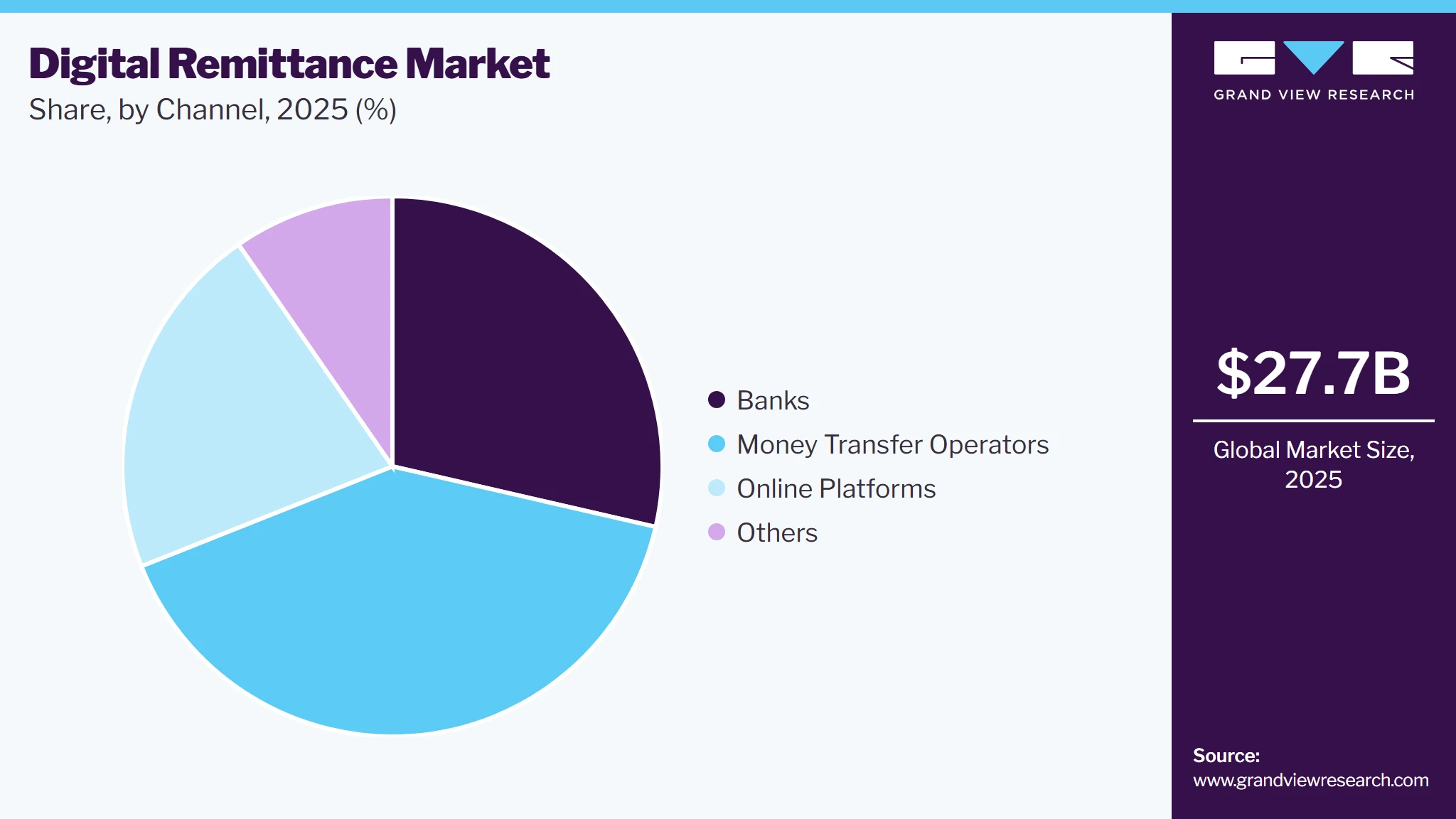
Based on channel, the money transfer operators segment led the market with the largest revenue share of 40.4% in 2025. Money transfer operators are regularly able to provide lower transfer costs than banks. Moreover, these money transfer companies offer the same level of reliability and security as banks. The speed of the money transaction is one of the significant benefits offered by money transfer operators. Money transfers can be initiated immediately and processed within a day or two. The introduction of digital-first money transfer operators and the rapid introduction of funding and digital initiation capabilities from established money transfer operators are expected to drive the segment growth over the forecast period.
 To learn more about this report, Download Free Sample Report
 The online platform segment is expected to register at the fastest CAGR during the forecast period. Online money transfer platforms efficiently manage transfers of funds between organizations as well as organizations and their customers. These platforms allow users to have access to money transactions directly and execute the fund transfer process more easily. Numerous online money transfer platforms are focusing on offering user-friendly services to their clients. These platforms are helping clients navigate their sites easily. Furthermore, the increasing adoption of digital wallets is expected to accentuate the segment growth. Digital wallets enable customers to track their funds from their digital wallet application.
End Use Insights
Based on end use, the personal segment led the market with the largest revenue share of 45.5% in 2025. New products and services are being widely developed to facilitate convenient usage of financial customer accounts. Moreover, increasing global migration is expected to drive the adoption of digital remittance services by personnel to send money to their home country. Growing smartphone and internet penetration across the globe is anticipated to propel the personal segment growth over the forecast period. Innovative solutions are already beginning to change the landscape of remittance services by increasing convenience and reducing costs for senders of remittances and their families.
The migrant labor workforce is projected to grow at a significant CAGR over the forecast period. The digital remittance service helps the migrant labor workforce to compare fund transfer costs and effectively locate support organizations. Moreover, this service has made it easier and more affordable for migrant workers to send money home. Advances in fintech and innovation in cross-border payments are further expected to drive the segment growth.
Regional Insights
North America dominated the digital remittance market with the largest revenue share of 27.4% in 2025. The region is home to prominent financial service and communication companies, such as Continental Exchange Solutions, Inc.; Western Union Holdings, Inc., and MoneyGram. Numerous people migrate to the North American region in search of better education and job opportunities as well as for business purposes. The rising number of immigrants in the region is expected to create growth opportunities for the digital remittance service providers in the region.
 To learn more about this report, Download Free Sample Report
 U.S. Digital Remittance Market Trends
The digital remittance market in the U.S. held the largest share in the North America region in 2025 due to the increasing migrant population and cross-border payment needs. According to The World Bank Group, U.S. personal remittance received stood at USD 7.74 billion in 2023. This level of transactions creates a significant demand for digital remittance in the country.
Europe Digital Remittance Industry Trends
The Europe digital remittance market was identified as a lucrative region in 2025. The favorable regulatory environment in the region fuels the growth of the market. The European Union (EU) has implemented regulations to promote transparency, security, and competition in financial services. Policies like the Revised Payment Services Directive (PSD2) encourage innovation and competition in the payments market, enabling fintech companies to thrive. These regulations ensure that digital remittance platforms operate with high levels of consumer protection, instilling trust among users and driving adoption.
The UK digital remittance market is expected to grow at a rapid CAGR during the forecast period, due to the increasing focus on speed and convenience. The modern customer prioritizes speed and convenience in financial transactions, and digital remittance platforms are meeting these expectations with instant or same-day transfers. Unlike traditional methods that could take several days, digital solutions offer seamless user experiences with features like one-tap transfers, transaction tracking, and integration with e-wallets.
The Germany digital remittance market held a substantial market share in 2025, owing to the substantial immigrant population, with workers and families hailing from countries such as Turkey, Poland, Romania, and Syria. Many of these individuals regularly send remittances to their home countries to support their families. The high demand for cross-border money transfers makes Germany a key market for digital remittance services.
Asia Pacific Digital Remittance Industry Trends
The digital remittance market in Asia Pacific is anticipated to grow at a significant CAGR during the forecast period. Numerous citizens from the Asia Pacific region send thousands of trillion dollars in remittances yearly to colleagues, business partners, and families in foreign countries. Growth in the adoption of banking and financial services in the region is expected to propel regional market growth over the forecast period.
The Japan digital remittance market is expected to grow at a rapid CAGR during the forecast period, due to the increasing adoption of Fintech solutions. The fintech industry in Japan has been growing rapidly, with startups and established players investing in digital remittance services. Providers like PayPay and Rakuten Remit leverage advanced technologies to improve user experiences. These companies offer multilingual customer support, integrations with digital wallets, and partnerships with global remittance networks, further driving market growth.
The digital remittance market in China held a substantial market share in 2025, owing to high smartphone penetration in the country, providing a solid foundation for the growth of digital remittance services. The widespread use of smartphones enables consumers to access user-friendly mobile applications for instant cross-border money transfers.
Key Digital Remittance Company Insights
Some of the key companies in the digital remittance industry include MoneyGram, PayPal Holdings, Inc., Digital Wallet Corporation, WorldRemit Ltd., and others. Organizations are focusing on increasing customer base to gain a competitive edge in the industry. Therefore, key players are taking several strategic initiatives, such as mergers and acquisitions, and partnerships with other major companies.
-
MoneyGram International, Inc. is a money transfer and payment services company. The company offers a range of financial services, including money transfers, bill payment solutions, and mobile payments, operating through a vast network of agents and retail locations across more than 200 countries and territories. MoneyGram is particularly known for its ability to provide fast and reliable remittance services, catering to the needs of immigrants and expatriates sending money back home.
-
WorldRemit Ltd. is an online money transfer service that enables users to send money internationally to over 100 countries. The company has revolutionized the remittance industry by providing a fast, secure, and convenient alternative to traditional cash-based money transfer methods. WorldRemit allows customers to send money using various methods, including bank transfers, mobile money, airtime top-ups, and cash pickups, catering to a diverse clientele of over 5.7 million users.
Key Digital Remittance Companies:
The following key companies have been profiled for this study on the digital remittance market.
-
Azimo Limited
-
Digital Wallet Corporation
-
InstaReM Pvt. Ltd.
-
MoneyGram
-
PayPal Holdings, Inc.
-
Ria Financial Services Ltd.
-
TransferGo Ltd.
-
TransferWise Ltd.
-
Western Union Holdings, Inc.
-
WorldRemit Ltd.
Competitive Benchmarking
Category
Operating Strategies
Competitive Edge
Weakness
Established Players (Western Union Holdings, Inc., MoneyGram, PayPal Holdings, Inc., Ria Financial Services Ltd.)
- Expand global payout networks and strengthen partnerships with banks, fintech firms, and mobile wallet providers
- Invest in omnichannel capabilities (online, mobile, agent-based)
- Focus on compliance, security, and faster settlement systems
- Strong global brand recognition with high customer trust
- Extensive payout infrastructure supported by strong regulatory compliance capabilities
- High operational and compliance costs due to large global scale
- Legacy systems may limit speed of full digital transformation
Emerging Players (Wise (TransferWise Ltd.), Remitly, WorldRemit Ltd., TransferGo Ltd., Azimo Limited, InstaReM Pvt. Ltd., Digital Wallet Corporation)
- Focus on mobile-first and fully digital cross-border payment solutions
- Offer low-cost, transparent pricing models
- Expand through API integrations, partnerships, and digital marketing strategies
- Agile innovation and faster product development cycles
- Lower-cost and user-friendly digital remittance solutions
- Limited physical presence in certain markets
- Dependence on banking and payout partners for settlement and coverage
Recent Developments
-
In April 2024, MoneyGram International formed a partnership with Tencent Financial Technology to facilitate digital remittances directly to Weixin Pay wallet users in China. This collaboration enables consumers to send funds through MoneyGram's online platform, allowing seamless transactions to one of the most popular payment services in the country.
-
In October 2023, IndusInd Bank announced a strategic partnership with Viamericas Corporation to enhance its remittance services through the re-launched Indus Fast Remit (IFR) platform. This partnership aims to facilitate digital inward remittances specifically for Non-Resident Indians (NRIs) residing in the U.S., allowing them to send money back to India with greater ease and efficiency. The IFR platform will enable users to execute remittance transactions using automated debit payment methods and overseas bank accounts. It will leverage Viamericas' established infrastructure and its Rupee Drawing Arrangement (RDA) with the Reserve Bank of India.
Digital Remittance Market Report Scope
Report Attribute
Details
Market size in 2025
USD 27.7 billion
Estimated Market size in 2026
USD 31.7 billion
Projected Market size by 2033
USD 108.5 billion
Growth rate
CAGR of 19.2% from 2026 to 2033
Base year for estimation
2025
Historical data
2021 - 2024
Forecast period
2026 - 2033
Quantitative units
Revenue in USD million/billion and CAGR from 2026 to 2033
Report coverage
Revenue forecast, company ranking, competitive landscape, growth factors, and trends
Segments covered
Type, channel, end use, region
Regional scope
North America; Europe; Asia Pacific; Latin America; MEA
Country scope
U.S.; Canada; Mexico; Germany; UK; France; Italy; Spain; Norway; Denmark; Sweden; Russia; Iceland; Finland; China; Japan; India; South Korea; Australia; Thailand; Singapore; Brazil; Argentina; Saudi Arabia; South Africa; UAE; Kuwait; Israel
Key companies profiled
Azimo Limited; Digital Wallet Corporation; InstaReM Pvt. Ltd.; MoneyGram; PayPal Holdings, Inc.; Ria Financial Services Ltd.; TransferGo Ltd.; TransferWise Ltd.; Western Union Holdings, Inc.; WorldRemit Ltd.
Customization scope
Free report customization (equivalent up to 8 analysts' working days) with purchase. Addition or alteration to country, regional & segment scope.
Pricing and purchase options
Avail customized purchase options to meet your exact research needs. Explore purchase options
Global Digital Remittance Market Report Segmentation
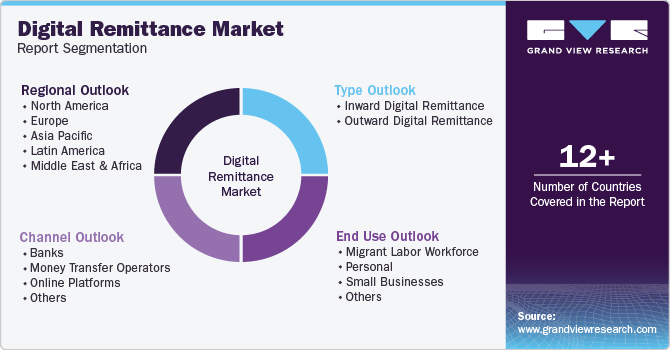
This report forecasts revenue growth at global, regional, and country levels and provides an analysis of the latest industry trends in each of the sub-segments from 2021 to 2033. For this study, Grand View Research has segmented the global digital remittance market report based on type, channel, end use, and region.
 To learn more about this report, Download Free Sample Report
 -
Type Outlook (Revenue, USD Billion, 2021 - 2033)
-
Inward Digital Remittance
-
Outward Digital Remittance
-
-
Channel Outlook (Revenue, USD Billion, 2021 - 2033)
-
Banks
-
Money Transfer Operators
-
Online Platforms
-
Others
-
-
End Use Outlook (Revenue, USD Billion, 2021 - 2033)
-
Migrant Labor Workforce
-
Personal
-
Small Businesses
-
Others
-
-
Regional Outlook (Revenue, USD Billion, 2021 - 2033)
-
North America
-
U.S.
-
Canada
-
Mexico
-
-
Europe
-
Germany
-
UK
-
France
-
-
Asia Pacific
-
China
-
Japan
-
India
-
South Korea
-
Australia
-
-
Latin America
-
Brazil
-
-
Middle East and Africa (MEA)
-
KSA
-
UAE
-
South Africa
-
-
Research Methodology
Segment Definition
Segment - Type
Revenue capture definition
Inward Digital Remittance
Inward digital remittance refers to money received by a user from a foreign country. The money can be received through various channels, such as banks, money transfer operators, and online platforms.
Outward Digital Remittance
Outward digital remittance refers to money sent by the sender from a foreign country. Many people use outward digital remittance to send money back to their homes.
Segment - Channel
Revenue capture definition
Banks
Digital remittances done through banks enable safe and secure international fund transfers. The process requires bank accounts for the sender and receiver. For initiating the transaction, the sender must have a dedicated amount present in the bank account. Digital remittance through banks can also be initiated via a third party or partner bank, which may require an additional fee to transfer the funds.
Money Transfer Operators
Money transfer operators are service providers that facilitate the international transfer of funds using their internal system or through a network of agents. For every fund transfer, money transfer operators charge a transaction cost to the sender.
Online Platforms
Online platforms provide digital remittance through web-based platforms and mobile-based apps. Online platforms offer multiple payment modes to the sender to initiate the transaction. They also offer greater exchange rates and lower transfer fees for international fund transfers.
Others
The others segment covers wire transfers for international funds. Wire transfer generally includes the transfer of money from one bank account to another. It is done through the SWIFT technology, which acts as a messenger between the sending and receiving banks.
Segment - End Use
Revenue capture definition
Migrant Labor Workforce
Numerous citizens migrate to developed countries for better employment opportunities. Most migrants use digital remittance services to transfer international funds to their families owing to benefits such as real-time tracking and instant day transfer of international funds.
Personal
The personal segment consists of migrants that study overseas. They use digital remittance services to transfer funds for personal use. Factors such as better mobile-based payment technology and digitization allow migrants to use digital remittance services from their mobile devices conveniently.
Small Businesses
Small businesses are non-subsidiary, independent firms with an employee strength of under 500 people. They are increasingly adopting digital remittance solutions to provide payments to international clients and improve organizational productivity.
Others
This segment covers larger business and government transactions. A commercial company with an employee strength of 500 people is termed as a large enterprise. These enterprises opt for digital remittances services to streamline their business process and align their organizational objectives with the clients’ needs. Government to Government transactions takes place between two countries through central bank foreign exchange for the international aids and development of a country.
Estimation Model
Remittance Population Layer
Digital Adoption Layer
Transaction Activity Layer
Monetization Layer
Key Question:Who needs to send money?
Key Question:Who can use digital remittance services?
Key Question:Who actively sends money digitally?
Key Question:How much revenue is generated from digital remittances?
Establish the total pool of individuals and businesses who send money domestically or internationally. This forms the foundation of the market by identifying potential remittance users.
Refine the potential user base by identifying those with access to digital channels such as smartphones, internet connectivity, banking services, and digital wallets.
Estimate active digital remittance users by applying adoption rates, usage frequency, transaction value, and channel preference rates. This converts the addressable population into actual transaction activity.
Convert transaction activity into market revenue by applying service fees, foreign exchange spreads, commissions, and value-added service revenues.
Delivered Customizations
This report has been delivered with the following In-depth customizations
Client Request
Customization Delivered
Value Adds
Digital Remittance Market Overview
Assessment of cross-border remittance flows across key corridors
Analysis of digital wallet, bank-led, and fintech-driven remittance channels
Identified high-growth corridors and underserved regions
Supported strategic market entry prioritization
Customer Behavior & Adoption Study
Evaluation of migrant worker remittance preferences and usage patterns
Analysis of transaction frequency, cost sensitivity, and platform trust factors
Improved customer segmentation strategy
Supported product design and pricing optimization
Competitive Landscape Assessment
Benchmarking of leading remittance service providers and fintech platforms
Comparison of pricing, speed, and service coverage models
Strengthened competitive intelligence
Identified differentiation opportunities in pricing, speed, and UX
Frequently Asked Questions About This Report
The global digital remittance market size was estimated at USD 27.7 billion in 2025 and is expected to reach USD 31.7 billion in 2026.
The global digital remittance market is expected to grow at a compound annual growth rate of 19.2% from 2026 to 2033 to reach USD 108.5 billion by 2033.
Some key players operating in the digital remittance market include Azimo Limited; Digital Wallet Corporation; InstaReM Pvt. Ltd.; MoneyGram; PayPal Holdings, Inc.; Ria Financial Services Ltd.; TransferGo Ltd.; TransferWise Ltd.; Western Union Holdings, Inc.; WorldRemit Ltd.
The digital remittance market is growing rapidly, driven by increased cross-border transactions, digitization, expanding e-commerce, and greater global business participation in international trade.
North America dominated with a 27.4% revenue share in 2025.
The outward digital remittance segment led with a 57.2% revenue share in 2025.
The money transfer operators segment led with a 40.4% revenue share in 2025, and online platforms is the fastest growing segment.
The personal segment led with a 45.5% revenue share in 2025, and is the fastest growing segment.
About the Author(s)
Next Generation Technologies Research Team
Technology · Next Generation TechnologiesThis report was authored by the next generation technologies research team at Grand View Research - comprising two research analysts, one senior research analyst, and one industry expert - with specialized expertise in the next generation technologies segment of the technology industry. All findings are based on proprietary technology databases, executive interviews, and regulatory analysis, subject to internal peer review prior to publication.
Last Updated:
Speak to Analyst

Customize this report to your needs - add regions, segments, or data points, with 20% free customization.
Or view our licence options:


ISO 9001:2015 & 27001:2022 Certified
We are GDPR and CCPA compliant! Your transaction & personal information is safe and secure. For more details, please read our privacy policy.


