- Home
- »
- Renewable Energy
- »
-
Distributed Solar Market Size, Share & Trends Report, 2033GVR Report cover
![Distributed Solar Market (2026 - 2033)Report]()
Distributed Solar Market (2026 - 2033)
Size, Share & Trends Analysis Report By Product Type (Mono-Si, p-Si, a-Si, CPV), By End User (Residential, Commercial, Industrial, Utility), By Region (North America, Europe, Asia Pacific, MEA), And Segment Forecasts
Market Size, 2025
$273.6BMarket Estimate, 2026
$301.0BMarket Forecast, 2033
$632.7BCAGR, 2026–2033
11.2%Distributed Solar Market Summary
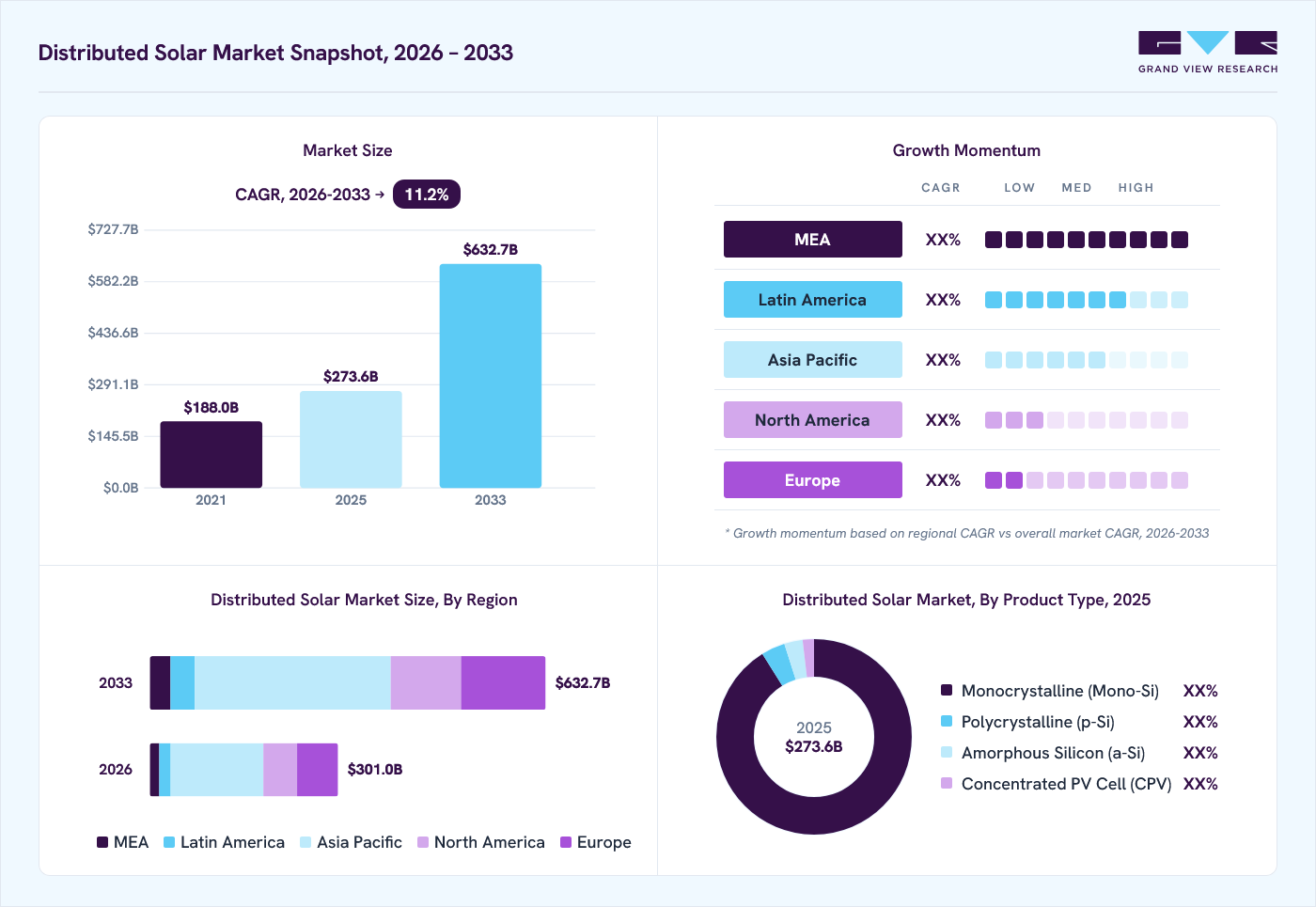
The global distributed solar market size was valued at USD 273.6 billion in 2025 and is projected to grow from USD 301.0 billion in 2026 to USD 632.7 billion by 2033, at a CAGR of 11.2% from 2026 to 2033. Asia Pacific dominated the market, accounting for a revenue share of 49.2% in 2025. Market expansion is supported by rising electricity costs, growing consumer demand for decentralized clean power, and favorable policy frameworks across major economies.
Key Market Trends & Insights
- By product type: Monocrystalline (Mono-Si) segment led the market with the largest revenue share of 91.1% in 2025.
- By end use: Residential segment led the market with the largest revenue share of 37.0% in 2025.
Regional Highlights
- Largest regional market: Asia Pacific (49.2% revenue share, 2025)
- By country: China held the largest market share in 2025.
Market Size & Forecast
- Market size in 2025: USD 273.6 Billion
- Estimated market size in 2026: USD 301.0 Billion
- Projected market size by 2033: USD 632.7 Billion
- CAGR (2026-2033): 11.2%
Adoption is accelerating as commercial, industrial, and residential users increasingly deploy rooftop and onsite solar systems, benefiting from improvements in module efficiency, smart inverters, and the integration of energy storage. Government incentives, net-metering programs, and declining installation costs continue to improve the economic viability of distributed solar solutions. These developments, combined with advancements in digital energy management and grid-interactive technologies, are positioning distributed solar as a key enabler of long-term grid resilience and global renewable energy transition goals.In North America, the distributed solar market is expanding steadily, supported by strong federal and state-level clean energy policies, declining solar installation costs, and rising demand for resilient, decentralized power systems. The U.S. continues to lead regional adoption through Department of Energy (DOE) initiatives, net metering programs, investment tax credits (ITC), and utility-backed distributed generation strategies aimed at enhancing grid reliability. Growing participation from commercial and industrial users, along with corporate renewable procurement commitments and virtual power plant (VPP) programs, is further accelerating deployment.
The Asia Pacific region dominates the global distributed solar market, propelled by rapid urbanization, robust government targets for renewable energy expansion, and strong investment in decentralized power infrastructure. Countries such as China, India, Japan, and Australia are leading large-scale deployment through favorable rooftop solar policies, capital subsidies, time-of-day tariffs, and supportive net-metering regulations. China continues to set the pace with its extensive residential PV rollout, distributed energy trading pilots, and integration of distributed solar into smart grid modernization efforts. India is accelerating growth through rooftop solar schemes, corporate renewable power purchase agreements (PPAs), and large-scale solarization of commercial and industrial facilities. Japan and Australia are advancing the adoption of solar energy through high electricity prices, feed-in premium programs, and strong consumer demand for home solar-plus-storage systems.
Market Dynamics
The distributed solar market is expanding as households, commercial establishments, and industrial users increasingly invest in localized renewable energy solutions to reduce electricity costs and improve energy reliability. Favorable government policies, declining solar installation costs, and greater focus on sustainability continue to support market growth. Technological advancements in high-efficiency solar modules, battery energy storage, and digital energy management systems are further improving system performance and user value. An emerging trend in the market is the rising adoption of integrated solar-plus-storage systems, which help consumers optimize energy usage and strengthen energy independence.
Increasing electricity prices and the growing need to reduce long-term energy expenses are encouraging households, commercial buildings, and industries to invest in distributed solar systems. At the same time, government incentives such as capital subsidies, net metering, tax benefits, and simplified installation processes are making rooftop solar more financially attractive. These measures shorten payback periods, improve return on investment, and accelerate the adoption of decentralized clean energy systems across both developed and emerging economies.
In 2025, the European Union continued to strengthen distributed solar deployment through its European Solar Rooftops Initiative and updated building regulations, while the EU's total installed solar capacity reached approximately 406 GW. The initiative promotes wider rooftop solar adoption across residential, commercial, and public buildings, highlighting how supportive policies are driving the expansion of distributed solar across the region.
The expansion of distributed solar is often constrained by the limited ability of existing electricity distribution networks to accommodate large volumes of decentralized power generation. Many grids were originally designed for one-way electricity flow from centralized power plants, making it difficult to manage fluctuations in solar generation and maintain grid stability. In several regions, utilities are facing connection delays, capacity constraints, and rising costs for network upgrades. These challenges can slow new installations, increase project timelines, and limit the pace of distributed solar adoption, particularly in areas with high rooftop solar penetration.
The increasing integration of battery energy storage with distributed solar systems presents a significant growth opportunity for the market. Solar-plus-storage solutions allow consumers to store excess electricity generated during the day and use it during peak demand periods, power outages, or at night, improving energy reliability and reducing dependence on the grid. As battery costs continue to decline and demand for energy resilience grows, residential, commercial, and industrial users are increasingly adopting integrated systems. This trend is creating new opportunities for solar developers, battery manufacturers, and energy management solution providers to offer comprehensive distributed energy solutions.
Analyst Perspective
The distributed solar market is becoming increasingly driven by cost savings and the growing need for reliable, locally generated electricity, rather than relying only on government incentives. Falling solar system costs and rising electricity prices are encouraging more residential, commercial, and industrial users to invest in distributed solar. A key market trend is the growing adoption of solar-plus-storage systems, which help users improve energy reliability and maximize the use of self-generated power. Going forward, companies that offer efficient products, dependable service, and integrated energy solutions are expected to strengthen their position in the market.
Product Type Insights
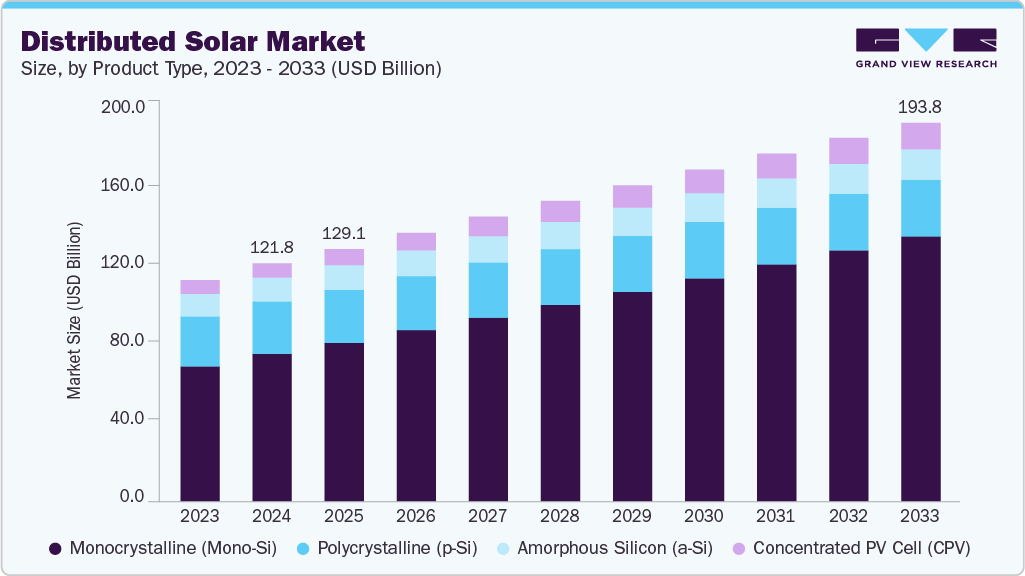
market with the largest revenue share of 91.1% in 2025, owing to its high efficiency, superior performance in limited rooftop space, and longer operational lifespan compared to other photovoltaic technologies. Continued advancements in cell architectures such as PERC, TOPCon, and heterojunction technologies are further enhancing module efficiency, making monocrystalline panels the preferred choice for residential, commercial, and industrial installations. Their declining production costs, driven by economies of scale in Asia Pacific manufacturing hubs, have also strengthened global adoption. As consumers and businesses increasingly prioritize high-output, space-efficient solar solutions, the monocrystalline segment is expected to maintain its dominance throughout the forecast period.
The concentrated PV cell (CPV) segment is expected to witness significant growth, registering a robust CAGR of 6.56% from 2025 to 2033, driven by its ability to deliver exceptionally high conversion efficiencies through advanced optical concentrators and multi-junction solar cells. The increasing demand for high-performance solar technologies in regions with strong direct normal irradiance (DNI), such as parts of the Asia Pacific, the Middle East, and North America, is further supporting market expansion. Technological improvements in tracking systems, thermal management, and module durability are also enhancing CPV reliability and reducing the levelized cost of electricity (LCOE). As global efforts intensify toward clean energy diversification and high-efficiency solar solutions, CPV is poised to emerge as a promising growth segment in the distributed solar landscape.
End User Insights
Based on end user, the residential segment led the market with the largest revenue share of 37.0% in 2025, driven by the rising adoption of rooftop solar systems among households, attractive government incentives, and increasing consumer demand for energy independence. Declining solar module prices, simplified installation processes, and the growing availability of financing options such as solar loans, leases, and zero-down payment schemes have made residential solar more accessible to a wider customer base. Supportive policies, such as net-metering, feed-in tariffs, and residential tax credits, continue to strengthen uptake across major markets.

The commercial segment is anticipated to experience significant growth, with a CAGR of 4.8% from 2025 to 2033, driven by the increasing adoption of rooftop and onsite solar systems among businesses seeking to reduce operational costs and meet their corporate sustainability goals. Growing interest in long-term power purchase agreements (PPAs), coupled with rising electricity tariffs and the need for predictable energy expenses, is further accelerating commercial installations. Supportive policies, including investment tax credits, accelerated depreciation benefits, and utility-supported distributed generation programs, are strengthening the business case for commercial solar. As companies prioritize carbon reduction, energy security, and operational optimization, the commercial segment is positioned to remain a key driver of distributed solar market expansion.
Regional Insights
Asia Pacific dominated the distributed solar market with the largest revenue share of 49.2% in 2025, driven by rapid urbanization, strong government-backed renewable energy targets, and extensive deployment of rooftop and distributed PV systems across major economies. China continues to lead the region with large-scale residential solar rollouts, supportive subsidies, and accelerated efforts to modernize its grid. India is also a significant contributor, driven by national rooftop solar initiatives, favorable net-metering regulations, and increasing demand from commercial and industrial (C&I) sectors for low-cost, clean power. Markets such as Japan and Australia further strengthen regional dominance through high electricity prices, mature rooftop solar ecosystems, and strong consumer preference for home solar-plus-storage solutions. Growing investments in smart grids, digital energy management, and community solar programs are reinforcing the Asia Pacific’s leadership in distributed solar adoption.
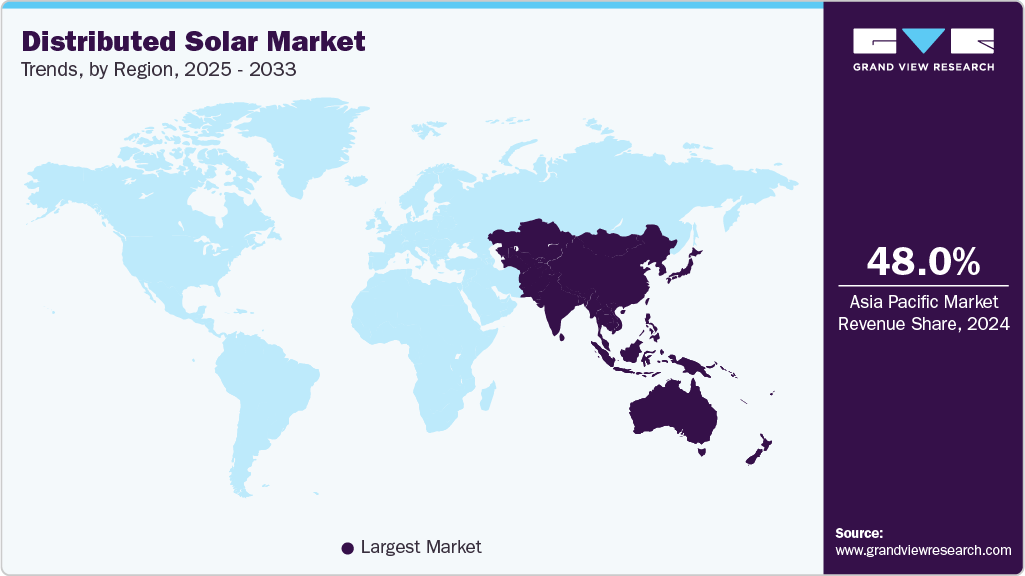
The distributed solar market in China held the largest share in the Asia Pacific region in 2025.
North America Distributed Solar Market Trends
The North America distributed solar market continues to expand steadily, supported by favorable policy frameworks, declining installation costs, and rising demand for resilient, decentralized clean energy solutions. The U.S. remains the regional leader, driven by federal incentives such as the Investment Tax Credit (ITC), state-level net-metering programs, and growing adoption of community solar and virtual power plant (VPP) models. Increasing participation from commercial and industrial consumers, along with strong corporate sustainability commitments, is further boosting distributed solar deployment across key states.
The U.S. distributed solar market is growing rapidly, driven by federal incentives such as the Investment Tax Credit (ITC), strong state-level net-metering programs, and rising consumer demand for reliable and affordable clean energy. Higher electricity prices, interest in solar-plus-storage systems, and ongoing grid modernization efforts are strengthening the value proposition for households and businesses. With utilities expanding distributed generation programs and corporations pursuing ambitious sustainability commitments, the U.S. remains one of the most dynamic markets for distributed solar globally.
Europe Distributed Solar Market Trends
The Europe distributed solar market is growing rapidly, driven by strong decarbonization policies, rising electricity prices, and heightened energy-security priorities. Supportive measures, such as RED III, EU rooftop solar mandates, and national incentives, including feed-in tariffs and self-consumption schemes, are accelerating the adoption of residential and commercial PV. Germany, the Netherlands, Italy, and Spain continue to lead the way in installations through robust rooftop programs, community solar initiatives, and smart grid integration. The increasing uptake of solar-plus-storage systems, digital energy management, and peer-to-peer trading pilots is further boosting deployment. As Europe moves toward its 2030 and 2050 climate goals, distributed solar is solidifying its role in building a decentralized, resilient, low-carbon energy landscape.
Latin America Distributed Solar Market Trends
The Latin America distributed solar market is expanding steadily, driven by high solar resources, rising electricity costs, and supportive distributed generation policies. Brazil leads the region with a robust regulatory framework for micro- and mini-generation, rapid adoption across both residential and commercial sectors, and enhanced access to financing. Mexico is witnessing an increase in rooftop solar adoption among commercial and industrial users, who seek cost savings and enhanced energy security, while Chile continues to promote distributed solar through community energy projects and progressive clean energy targets. As grid modernization advances and solar-plus-storage solutions become more affordable, the adoption of distributed solar across Latin America is expected to accelerate.
Middle East & Africa Distributed Solar Market Trends
The Middle East & Africa distributed solar market is growing steadily, supported by abundant solar resources, rising energy demand, and government initiatives to diversify power generation away from fossil fuels. Countries such as the UAE, Saudi Arabia, and South Africa are leading adoption through rooftop solar programs, net-metering frameworks, and incentives aimed at promoting distributed generation for homes, businesses, and industrial facilities. In the Gulf region, high electricity consumption and ambitious national renewable energy targets are driving increased investment in commercial and industrial rooftop systems. In Africa, distributed solar energy is expanding rapidly in off-grid and rural areas, where mini-grids and solar home systems are providing reliable and affordable electricity access. As solar-plus-storage technologies become more accessible and policy frameworks strengthen, the region is positioned for continued growth in decentralized clean energy solutions.
Key Distributed Solar Company Insights
Some of the key players operating in the global distributed solar market include First Solar and SunPower Corporation, among others.
-
First Solar is a leading American solar technology company recognized for its advanced thin-film photovoltaic (PV) modules, which are widely used in both utility-scale and distributed solar applications. The company specializes in cadmium telluride (CdTe) solar technology, offering high energy yield, strong performance in high-temperature and low-light conditions, and a competitive cost structure. With vertically integrated manufacturing, rigorous sustainability practices, and a strong global footprint, First Solar delivers reliable, bankable solar solutions to commercial, industrial, and energy service providers. The company’s commitment to innovation, large-scale production capacity, and environmentally responsible manufacturing processes positions it as a major player in the global distributed solar market.
-
SunPower Corporation is a leading U.S.-based solar technology and energy services provider known for its high-efficiency photovoltaic modules and integrated residential solar solutions. With a strong focus on the distributed solar segment, the company offers advanced solar panels, energy storage systems, and smart energy management platforms designed to optimize home energy production and consumption. SunPower leverages its extensive dealer network, innovative system designs, and premium product portfolio to serve residential customers across North America. The company’s long-standing expertise in solar technology, combined with its emphasis on sustainability, performance, and customer-centric services, positions it as a key player in the global distributed solar market.
Key Distributed Solar Companies
The following key companies have been profiled for this study on the distributed solar market.
-
First Solar
-
JinkoSolar
-
Trina Solar
-
Canadian Solar
-
LONGi Green Energy
-
JA Solar
-
Hanwha Q CELLS
-
SunPower Corporation
-
Enphase Energy
-
SMA Solar Technology
Competitive Benchmarking
Category
Operating Strategies
Competitive Edge
Weakness
Established Players (JinkoSolar, Trina Solar, Canadian Solar, LONGi Green Energy, JA Solar, Hanwha Q CELLS)
- Expand manufacturing capacity and global distribution networks to meet growing residential and commercial demand.
- Invest in high-efficiency solar technologies and advanced module designs to improve energy output and reduce system costs.
- Strengthen partnerships with EPC contractors, distributors, and installers to expand project execution capabilities across key markets.
- Benefit from strong global brand recognition, large production capacity, and well-established customer relationships.
- Offer broad product portfolios supported by advanced R&D capabilities and continuous technology innovation.
- Leverage economies of scale to maintain competitive pricing while ensuring reliable product availability.
- Face significant exposure to raw material price volatility and intense competition from low-cost manufacturers.
- Require substantial capital investment to expand manufacturing facilities and maintain technological leadership.
- Experience slower decision-making and product customization due to complex global operations.
Specialized Players (Enphase Energy, SMA Solar Technology, SolarEdge)
- Focus on smart inverters, energy storage, and energy management solutions for distributed solar applications.
- Develop integrated solar-plus-storage platforms that enhance energy independence and system performance.
- Expand installer partnerships and digital service offerings to strengthen customer engagement and market penetration.
- Deliver advanced digital monitoring, energy optimization, and intelligent system control capabilities.
- Respond quickly to changing market trends through agile product development and innovation.
- Build differentiated value by offering integrated hardware, software, and energy management solutions.
- Depend heavily on continued growth in residential and commercial distributed solar installations.
- Operate with narrower product portfolios compared to vertically integrated solar manufacturers.
- Face increasing competition from larger companies expanding into smart energy and storage solutions
Recent Developments
- In July 2025, the U.S.-based First Solar entered a long-term partnership with UbiQD to integrate quantum-dot materials into its panels, enhancing module efficiency, supporting large-scale commercialization, and advancing the country’s competitiveness in next-generation distributed solar technologies.
Distributed Solar Market Report Scope
Report Attribute
Details
Market Definition
The distributed solar market represents the revenue generated from the sale of distributed solar PV systems installed at the point of consumption.
Market size in 2025
USD 273.6 billion
Estimated market size in 2026
USD 301.0 billion
Projected market size by 2033
USD 632.7 billion
Growth rate
CAGR of 11.2% from 2026 to 2033
Base year for estimation
2025
Historical data
2021 - 2024
Forecast period
2026 - 2033
Quantitative units
Revenue in USD Billion and CAGR from 2026 to 2033
Report coverage
Revenue forecast, company ranking, competitive landscape, growth factors, and trends
Segments covered
Product type, end use, region
Regional scope
North America, Europe, Asia Pacific, Latin America, Middle East & Africa
Country scope
U.S.; Canada; Mexico; Germany; UK; France; China; India; Japan; South Korea; Brazil; Saudi Arabia; UAE
Key companies profiled
JinkoSolar; Trina Solar; Canadian Solar; LONGi Green Energy; JA Solar; Hanwha Q CELLS; Enphase Energy; SMA Solar Technology; SolarEdge
Customization scope
Free report customization (equivalent up to 8 analysts' working days) with purchase. Addition or alteration to country, regional & segment scope.
Pricing and purchase options
Avail customized purchase options to meet your exact research needs. Explore purchase options
Global Distributed Solar Market Report Segmentation
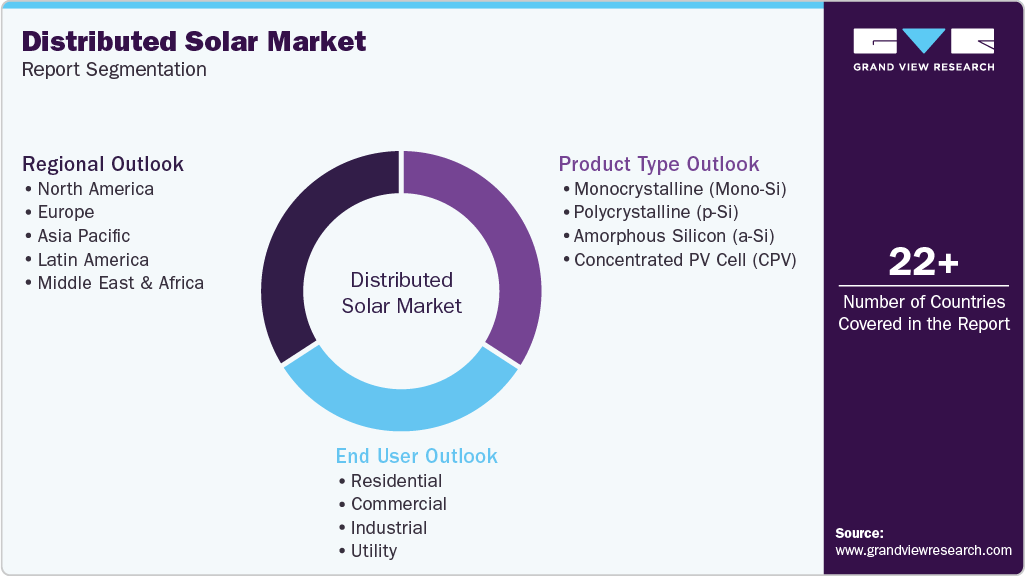
This report forecasts revenue growth at global, regional, and country levels and provides an analysis of the latest industry trends in each of the sub-segments from 2021 to 2033. For this study, Grand View Research has segmented the global distributed solar market report on the basis of product type, end user, and region.
-
Product Type Outlook (Revenue, USD Million, 2021 - 2033)
-
Monocrystalline (Mono-Si)
-
Polycrystalline (p-Si)
-
Amorphous Silicon (a-Si)
-
Concentrated PV Cell (CPV)
-
-
End User Outlook (Revenue, USD Million, 2021 - 2033)
-
Residential
-
Commercial
-
Industrial
-
Utility
-
-
Regional Outlook (Revenue, USD Million, 2021 - 2033)
-
North America
-
U.S.
-
Canada
-
Mexico
-
-
Europe
-
Germany
-
UK
-
France
-
-
Asia Pacific
-
China
-
India
-
Japan
-
South Korea
-
-
Latin America
-
Brazil
-
-
Middle East & Africa
-
Saudi Arabia
-
UAE
-
-
Research Methodology
The distributed solar market figures in this report are based on a proven research process that combines executive interviews with secondary research from proprietary databases, company filings, and recognized regulatory and institutional sources. Market size is built through value-chain sizing - reconciling supply-side and demand-side estimates - and triangulated with bottom-up and top-down approaches. Every estimate passes multiple levels of expert validation before publication, with each distributed solar segment quantified using the revenue-capture definitions in the table below.
Segment Definition
Segment - Type
Revenue capture definition
Monocrystalline (Mono-Si)
Monocrystalline solar panels are widely used in distributed solar systems due to their high efficiency, long operational life, and superior performance in limited installation space. Revenue is generated through the sale of monocrystalline solar modules for distributed solar installations.
Polycrystalline (p-Si)
Polycrystalline solar panels offer a cost-effective solution for distributed solar installations across residential, commercial, and industrial applications. Revenue is generated through the sale of polycrystalline solar modules for distributed solar systems.
Amorphous Silicon (a-Si)
Amorphous silicon solar panels are lightweight and perform well under low-light conditions, making them suitable for niche distributed solar applications. Revenue is generated through the sale of amorphous silicon solar modules for distributed solar installations.
Concentrated PV Cell (CPV)
Concentrated photovoltaic (CPV) systems use optical components to increase solar energy conversion efficiency in high-irradiance locations. Revenue is generated through the sale of CPV modules and systems for distributed solar applications.
Segment - End User
Revenue capture definition
Residential
Residential distributed solar systems enable homeowners to generate electricity for self-consumption, reduce utility bills, and improve energy independence. Revenue is generated through the sale of distributed solar systems for residential installations.
Commercial
Commercial facilities deploy distributed solar systems to lower electricity costs, meet sustainability goals, and reduce dependence on grid power. Revenue is generated through the sale of distributed solar systems for commercial buildings.
Industrial
Industrial facilities utilize distributed solar systems to offset high electricity consumption, improve energy efficiency, and lower operating costs. Revenue is generated through the sale of distributed solar systems for industrial end users.
Utility
Utilities deploy distributed solar systems through community solar projects and localized generation assets to strengthen grid reliability and expand clean energy access. Revenue is generated through the sale of distributed solar systems for utility-owned and utility-managed distributed energy projects.
Estimation Model
Layer Name
Key Question
Description
Distributed Solar Installation Layer
What forms the demand base for distributed solar systems?
Assess residential, commercial, industrial, and utility-scale distributed solar installations. Evaluate electricity prices, solar resource availability, rooftop suitability, government incentives, net metering policies, grid reliability, and consumer adoption of decentralized energy systems to determine the underlying demand for distributed solar.
Solar Technology Adoption Layer
Which solar technologies are being deployed?
Analyze the adoption of monocrystalline, polycrystalline, amorphous silicon, and concentrated photovoltaic (CPV) technologies across distributed solar installations. Assess module efficiency, installation cost, durability, space requirements, energy yield, and suitability for different end users to determine product-wise market demand.
End-Use Deployment Layer
Where are distributed solar systems being deployed?
Evaluate deployment across residential homes, commercial buildings, industrial facilities, and utility-owned distributed generation projects. Analyze applications such as self-consumption, electricity cost savings, peak load reduction, community solar, grid support, and renewable energy compliance to estimate end-user contribution.
Revenue Layer
How is market revenue generated?
Market revenue is quantified through the sale of distributed solar photovoltaic (PV) systems and related components. The overall market value is determined by module technology, system capacity, installation volume, end-user adoption, module pricing, inverter and balance-of-system components, and demand across residential, commercial, industrial, and utility applications.
Delivered Customizations
This report has been delivered with the following In-depth customizations
Client Request
Customization Delivered
Value Adds
Technology Benchmarking Assessment
Compared monocrystalline, polycrystalline, amorphous silicon, and concentrated PV technologies based on efficiency, installation cost, lifespan, energy yield, and application suitability. Assessed technology adoption across residential, commercial, industrial, and utility distributed solar installations.
Helped identify the most suitable solar technologies for different end-use applications and investment strategies.
Competitive Landscape Assessment
Evaluated major distributed solar companies based on product portfolio, regional presence, manufacturing capacity, technology focus, strategic partnerships, and recent business developments. Assessed competitive positioning and market strategies across established and emerging players.
Helped benchmark key competitors, identify market leaders, and understand competitive differentiation across the distributed solar value chain.
Regional Policy & Deployment Assessment
Assessed distributed solar adoption across major regions by analyzing government incentives, net metering policies, installation trends, electricity pricing, and distributed generation targets. Evaluated how policy frameworks influence market growth and investment opportunities.
Helped identify high-growth regional markets and understand the impact of regulatory support on distributed solar adoption.
Frequently Asked Questions About This Report
Asia Pacific region dominated the distributed solar market with a revenue share of 49.2% in 2025.
Based on end use, the residential segment accounted for largest revenue share of 37.0% in 2025.
The key players operating in the distributed solar market are First Solar; JinkoSolar; Trina Solar; Canadian Solar; LONGi Green Energy; JA Solar; Hanwha Q CELLS; Enphase Energy; SMA Solar Technology; SolarEdge, and others.
The distributed solar market size was estimated at USD 273.6 billion in 2025 and is expected to reach USD 301.0 billion in 2026.
The distributed solar market is expected to grow at a CAGR of 11.2% from 2026 to 2033 to reach USD 632.7 billion by 2033.
The distributed solar market is primarily driven by rising electricity prices, supportive government incentives, declining solar system costs, and growing demand for clean, decentralized energy solutions.
Based on type, the monocrystalline (Mono-Si) segment accounted for the largest revenue share of 91.1% in 2025.
Middle East & Africa region is expected to register the fastest CAGR of 11.6% over the forecast period.
About the Author(s)
Renewable Energy Research Team
Energy & Power · Renewable EnergyThis report was authored by the renewable energy research team at Grand View Research - comprising two research analysts, one senior research analyst, and one industry expert - with specialized expertise in the renewable energy segment of the energy & power industry. All findings are based on proprietary energy & power databases, executive interviews, and regulatory analysis, subject to internal peer review prior to publication.
Last Updated:
Speak to Analyst


Customize this report to your needs — add regions, segments, or data points, with 20% free customization.
Or view our licence options:


ISO 9001:2015 & 27001:2022 Certified
We are GDPR and CCPA compliant! Your transaction & personal information is safe and secure. For more details, please read our privacy policy.