
- Home
- »
- Power Generation & Storage
- »
-
District Energy Systems Market Size & Share Report, 2033GVR Report cover

District Energy Systems Market (2026 - 2033)
Size, Share & Trends Analysis Report By System Type (District Heating, District Cooling), By Application (Commercial, Industrial, Residential), By Region (North America, Europe, Asia Pacific), And Segment Forecasts
Market Size, 2025
$94.8BMarket Estimate, 2026
$100.0BMarket Forecast, 2033
$145.0BCAGR, 2026–2033
5.5%District Energy Systems Market Summary
The global district energy systems market size was valued at USD 94.8 billion in 2025 and is projected to grow from USD 100.0 billion in 2026 to USD 145.0 billion by 2033, at a CAGR of 5.5% from 2026 to 2033. Asia Pacific dominated the market, accounting for a revenue share of 39.0% in 2025. The market is driven by rapid urbanization, rising heating and cooling demand, increasing emphasis on energy efficiency, and decarbonization initiatives.
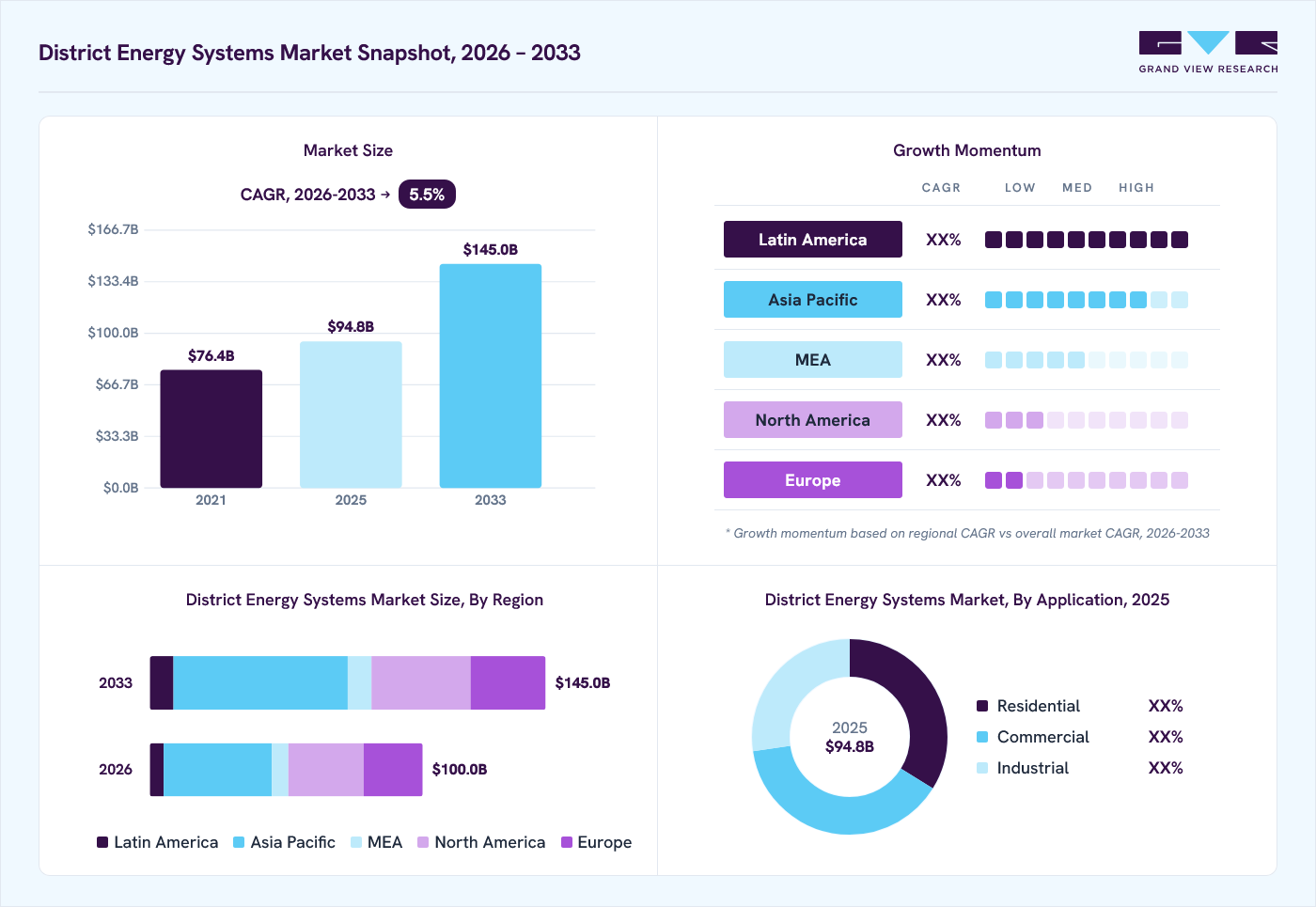 Source: Grand View Research, IR Documents, Primary Interviews, Paid DatabasesTo learn more about this report,
 Download Free Sample Report
 Key Market Trends & Insights
- By application: Commercial segment held the largest revenue share of 38.8% in 2025.
- By system type: The district heating segment held the largest revenue share of 65.6% in 2025.
Regional Highlights
- Largest regional market: Asia Pacific (39.0% revenue share, 2025)
- Fastest-growing regional market: Latin America (highest CAGR, 2026-2033)
- By country: China held the largest market share in 2025.
Market Size & Forecast
- Market size in 2025: USD 94.8 Billion
- Estimated market size in 2026: USD 100.0 Billion
- Projected market size by 2033: USD 145.0 Billion
- CAGR (2026-2033): 5.5%
Three ways to get this report
Buy it, customize it, or ask a question.Ask an Analyst
A direct answer, usually in 1 working day
- AccessReport author, directly
- Reply timeWithin 1 working day
- No sales callDirect answer only
- FormatEmail reply
- CostFree, no cost
Get the Full Report
What the study covers
- FormatsPDF · Excel · Dashboard
- Timeline2026–2033 annual, 2025 base
- Coverage20+ countries, 5 regions
- Companies10+ key players profiled
Customize the Report
20% free customization
- IncludeCountries, segments, points
- TailorTo your product definition
- ExtendDeeper competitor detail
- OrA fully bespoke study
- Turnaround5–10 working days
The integration of renewable energy, waste heat, thermal energy storage, and large scale heat pumps is further supporting the adoption of district energy systems. The growing need for centralized, reliable, and energy efficient heating and cooling solutions in urban and densely populated areas is contributing to market growth.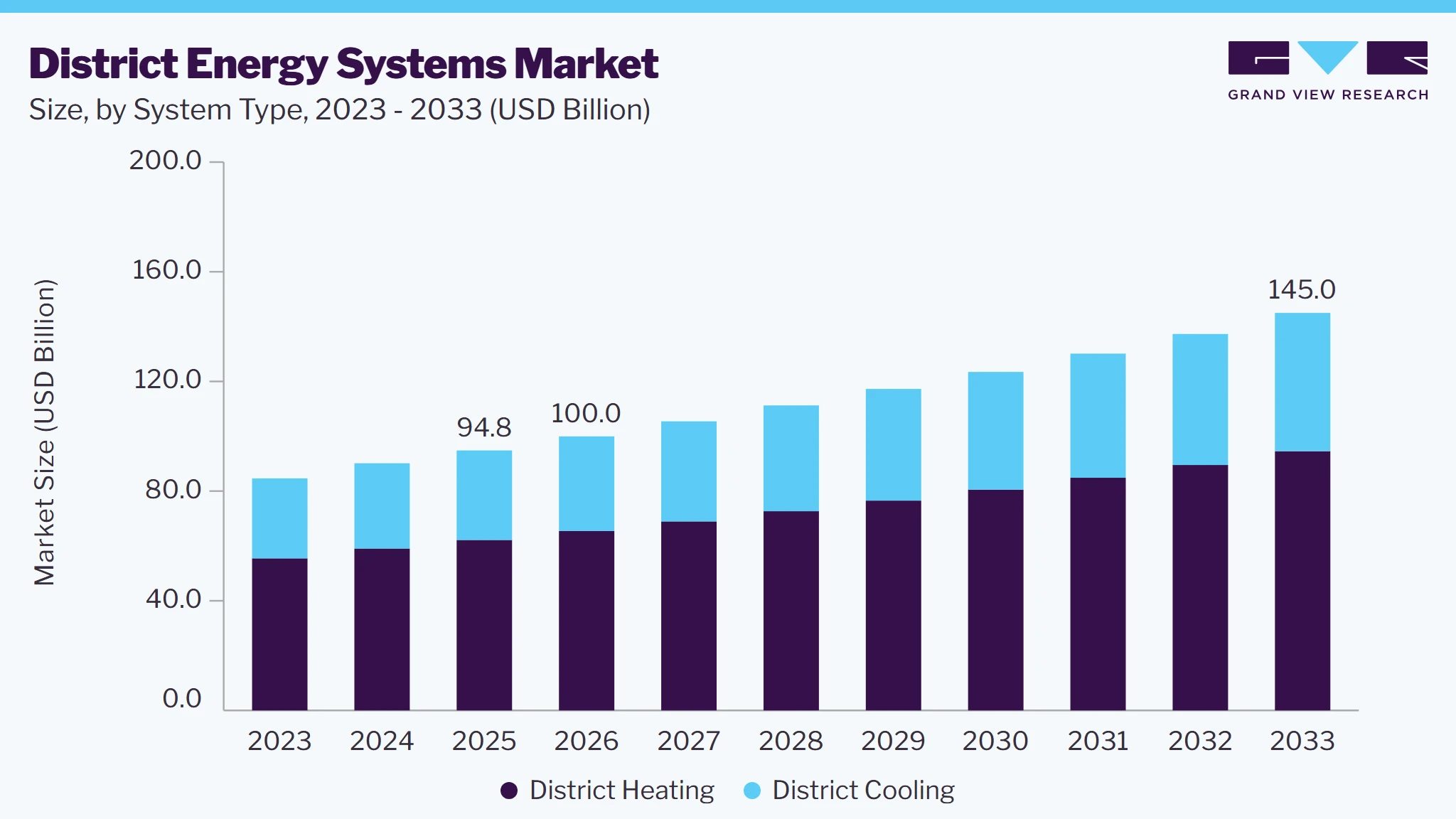 To learn more about this report, Download Free Sample Report
 Market Dynamics
The district energy systems market is supported by rising heating and cooling requirements, urban development, increasing energy-efficiency priorities, and the transition toward lower-carbon thermal infrastructure. Government policies and investment in modern energy networks are further supporting market development. However, high upfront infrastructure costs, complex network development, and long project payback periods can constrain adoption, particularly in markets where district energy infrastructure is still developing.
Government decarbonization policies, net-zero targets, and corporate sustainability commitments are driving the transition from fossil-fuel-based boilers and individual heating/cooling systems toward centralized, low-carbon district energy networks. District energy systems can integrate renewable energy, waste heat, large-scale heat pumps, thermal storage, and other low-emission sources, enabling buildings and urban areas to reduce carbon emissions while improving energy efficiency. The IEA highlights thermal networks as an important pathway for integrating low-carbon heat sources and supporting the transition to net zero.
In November 2025, Vicinity Energy commenced construction of a 35 MW river based industrial-scale heat pump complex in Boston, replacing a natural-gas boiler and using heat from the Charles River to produce carbon-free thermal energy for its district energy network. The project is designed to serve more than 70 million square feet of building space, demonstrating how decarbonization goals are driving investment in electrified district energy infrastructure.
District energy systems require substantial upfront investment in centralized generation plants, thermal storage, distribution pipelines, substations, and customer connections, making them significantly more capital-intensive than many decentralized heating and cooling solutions. The front-loaded nature of these costs can create financing challenges, extend project payback periods, and discourage investment, particularly in emerging markets or areas where the customer base has not yet been secured.
The growing need to decarbonize heating and cooling is creating opportunities to integrate industrial waste heat, data-center heat, geothermal energy, solar thermal energy, renewable electricity, and large-scale heat pumps into district energy networks. This enables operators to utilize locally available low-carbon energy sources, improve system efficiency, and reduce dependence on fossil-fuel-based generation. The IEA identifies waste heat, large-scale heat pumps, renewable energy, and thermal energy storage as key emerging opportunities for district energy systems. For instance, in May 2026, Fortum started heat production at two large data-center heat pump plants in Finland, enabling waste heat recovery for district heating.
Analyst Perspective
The district energy systems market is transitioning from conventional centralized thermal infrastructure toward more integrated and flexible energy networks. Market development is increasingly influenced by the modernization of existing systems, the need to improve network efficiency, and the ability to accommodate changing heating and cooling loads. Mature markets are likely to focus more on upgrading established networks, while emerging markets offer opportunities for new district energy developments linked to urban expansion. Project economics, infrastructure requirements, and regulatory conditions will remain important factors in determining deployment. As competition increases, market participants are expected to differentiate through efficient system design, network optimization, integrated energy services, and the ability to deliver reliable thermal energy at competitive lifecycle costs.
System Type Insights
The district heating segment held the largest revenue share of 65.6% in 2025. Its leading position reflects the established use of centralized heating networks across residential, commercial, and industrial buildings, particularly in regions with significant seasonal heating requirements. The segment is also benefiting from the modernization of existing networks, the replacement of aging infrastructure, and upgrades to improve network efficiency and system reliability. Integration of alternative heat sources is further creating opportunities to improve the performance of established district heating systems.
The district cooling segment is anticipated to register the fastest CAGR of 5.6% during the forecast period. Growth is supported by increasing cooling loads, particularly in densely populated urban areas and large commercial developments. District cooling can provide centralized cooling capacity for clusters of buildings while helping manage peak electricity requirements and operating costs. New commercial and mixed-use developments are therefore providing an important addressable market for district cooling infrastructure.
Application Insights
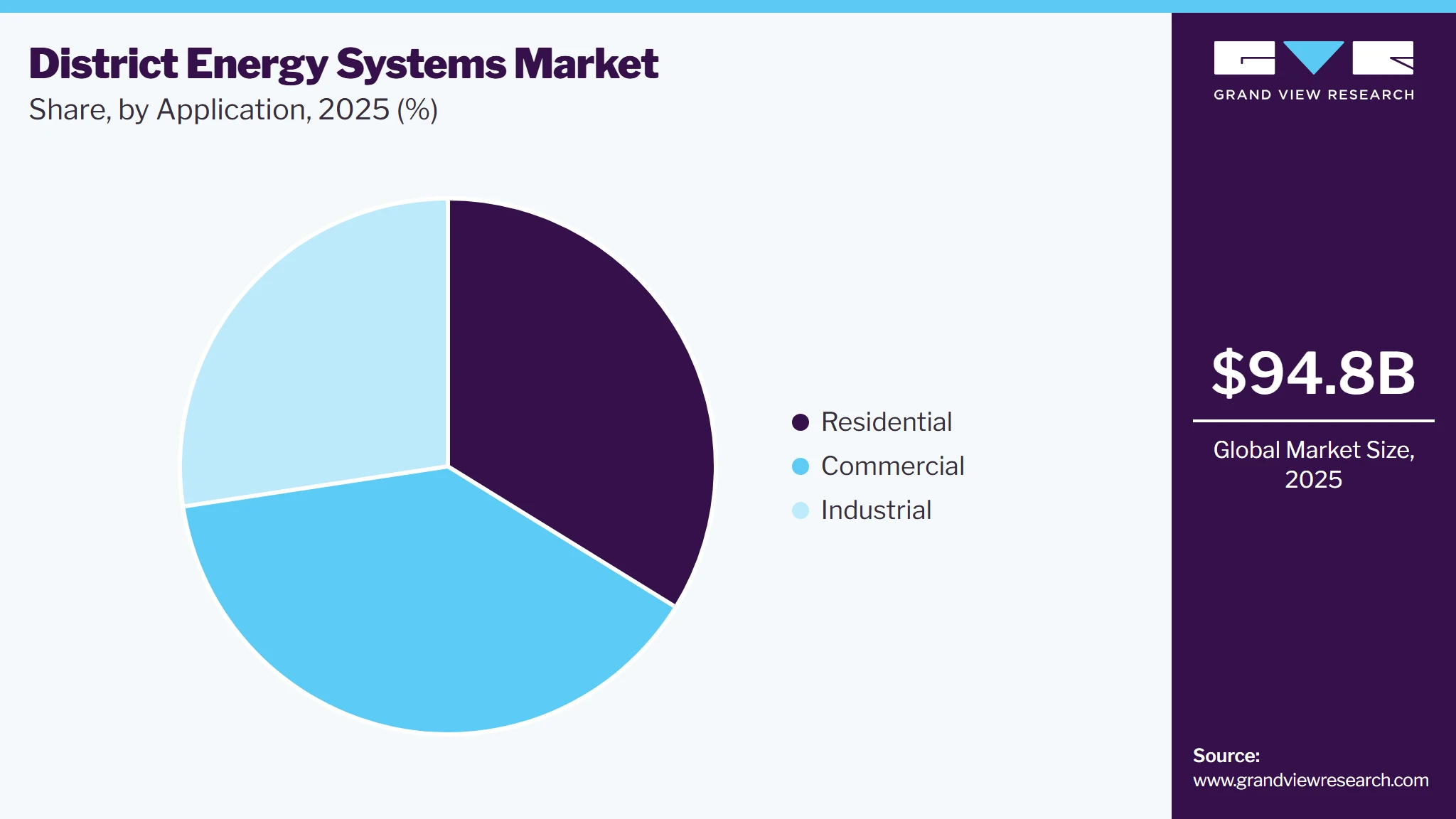
The commercial segment dominated the market with a revenue share of 38.8% in 2025, supported by the growing adoption of district energy systems across office buildings, shopping centers, hotels, hospitals, and other commercial facilities. Rising demand for reliable and energy-efficient heating and cooling solutions is encouraging commercial property developers to adopt centralized energy systems. Increasing urbanization and the expansion of commercial infrastructure are further supporting segment growth. In addition, district energy systems help reduce energy consumption and operating costs, making them attractive for large commercial facilities.
 To learn more about this report, Download Free Sample Report
 The industrial segment is expected to register the second-fastest CAGR of 5.3% from 2026 to 2033. This growth is attributed to increasing industrialization and the expansion of manufacturing and processing facilities requiring reliable heating and cooling solutions. Rising energy costs are encouraging industries to adopt centralized systems that can improve energy efficiency and reduce operating expenses. In addition, growing investments in industrial infrastructure and the need to reduce carbon emissions are supporting the adoption of district energy systems.
Regional Insights
Europe represents a mature and highly developed district energy market, supported by established heating networks, strong decarbonization targets, and government policies promoting renewable and recovered heat. The region has more than 80 million people connected to district heating and cooling networks, while renewable and recovered sources account for 44.1% of supply. Growth is increasingly focused on large-scale heat pumps, waste heat recovery, geothermal energy, thermal storage, and modernization of existing networks.
North America District Energy Systems Market Trends
North America is experiencing steady growth in district energy systems, particularly across urban centers, universities, hospitals, commercial districts, and large mixed-use developments. The market is supported by demand for reliable heating and cooling, energy efficiency, and decarbonization of existing infrastructure. District energy adoption is also expanding through network modernization, heat recovery, electrification, and thermal storage, with 2025 data showing continued additions to connected building space across the region.
U.S. District Energy Systems Market Trends
The U.S. is the largest and most established district energy market in North America, with systems concentrated in commercial clusters, healthcare facilities, universities, government campuses, and downtown areas. Growth is increasingly shifting toward efficient cooling, waste heat recovery, heat pumps, thermal storage, and low-carbon CHP, while existing networks provide opportunities for modernization and fuel switching. The market is also supported by the need to reduce peak electricity demand and improve energy resilience in large urban developments.
Asia Pacific District Energy Systems Market Trends
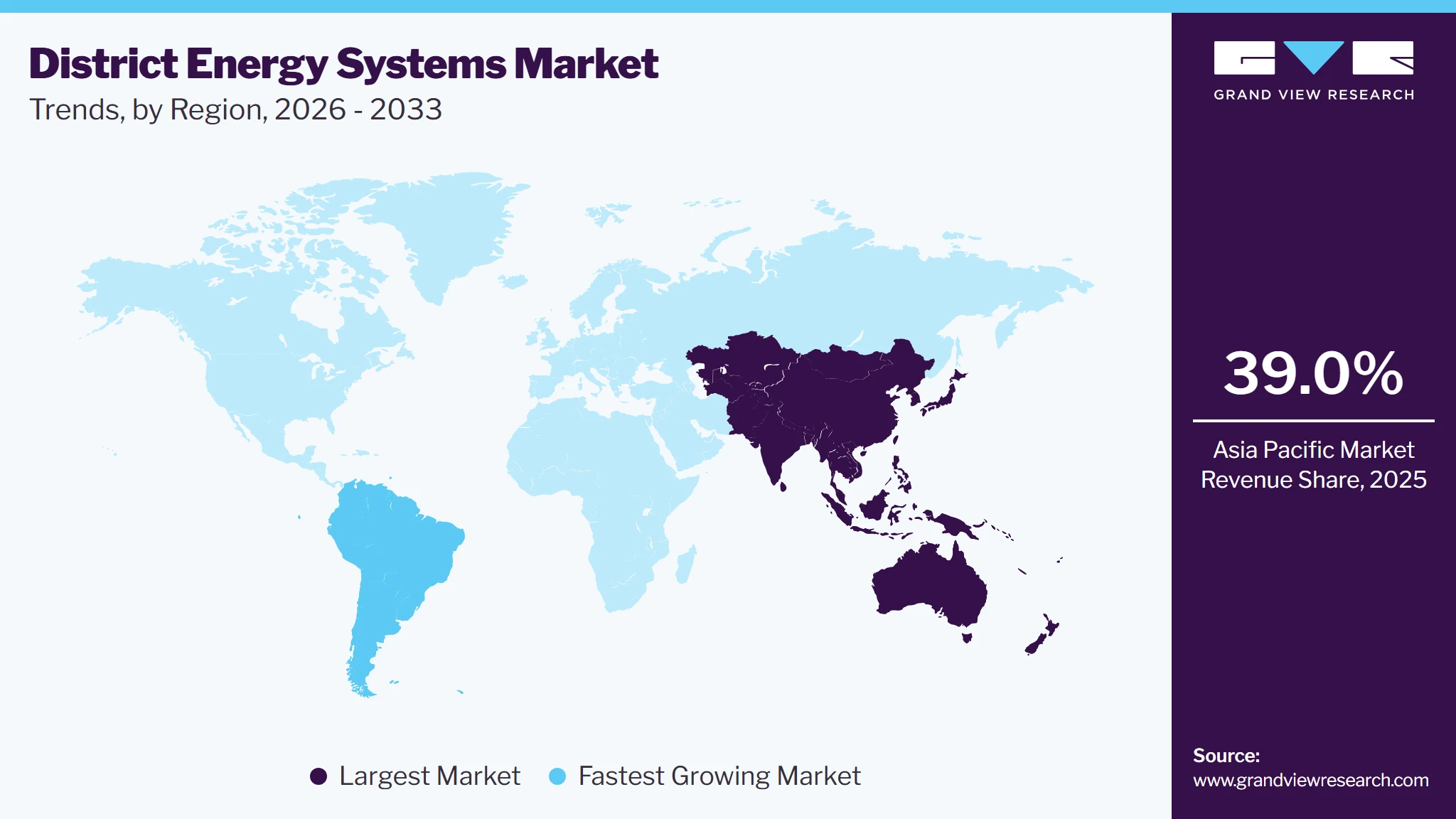
Asia Pacific dominated the global district energy systems market with a revenue share of 39.0% in 2025. The region’s strong position is supported by rapid urbanization, expanding cities, rising cooling demand, and large-scale infrastructure development. China remains the leading district heating market, while Japan and South Korea have advanced technology capabilities and growing adoption of efficient heat pumps and thermal energy systems. The region also offers significant opportunities for renewable heat, waste heat recovery, large-scale heat pumps, and district cooling as cities seek to meet rising energy demand while reducing emissions.
 To learn more about this report, Download Free Sample Report
 China has one of the world's largest district heating networks, particularly across northern and northeastern cities, where district heating is deeply integrated into urban energy infrastructure. However, the sector remains heavily dependent on coal, creating a significant opportunity for fuel switching, waste heat utilization, large-scale heat pumps, and renewable energy integration. China's strong domestic manufacturing base and large-scale deployment capabilities are expected to support modernization and expansion of low-carbon district energy systems.
Latin America District Energy Systems Market Trends
Latin America is expected to register the fastest CAGR of 7.9% from 2026 to 2033. The region remains an emerging market for district energy systems, with adoption concentrated in large urban developments, commercial complexes, airports, hospitals, and other high-density facilities. Rising cooling demand, rapid urbanization, and the need for efficient energy infrastructure are creating opportunities for district cooling and centralized thermal systems. In addition, the region’s growing renewable electricity capacity provides opportunities to integrate low-carbon energy sources into district heating and cooling networks. Market expansion is expected to be influenced by project economics, infrastructure investment, and supportive regulatory frameworks.
Middle East & Africa District Energy Systems Market Trends
The Middle East & Africa market is strongly driven by extreme cooling requirements, rapid urban development, and large-scale commercial and residential projects, making district cooling particularly important across the region. Large centralized cooling plants can improve energy efficiency and reduce electricity demand compared with individual cooling systems, supporting adoption across major urban centers. The region is also moving toward more efficient and sustainable systems through thermal energy storage, renewable energy integration, and advanced controls, supported by the continued expansion of district energy networks.
Key District Energy Systems Company Insights
Some of the key players operating in the global district energy systems market include ENGIE and Siemens, among others.
-
ENGIE is a major player in the district energy systems market, developing and operating district heating and cooling networks, low-carbon heat generation, waste heat recovery, and renewable energy based thermal solutions. The company combines its capabilities in network design, financing, construction, operation, and modernization with energy sources such as geothermal, biomass, solar thermal, seawater, and recovered heat. ENGIE operates hundreds of heating and cooling networks globally and is expanding the use of heat pumps and recovered energy to decarbonize urban thermal infrastructure. Its integrated capabilities across energy production, district networks, decarbonization, and energy management position it as a key participant in the district energy systems market.
-
Siemens is a major technology provider in the district energy systems market, offering district heating and cooling substations, HVAC controls, valves, actuators, sensors, metering, remote monitoring, and digital automation solutions. Through its Climatix portfolio, the company provides scalable automation and digital control solutions that enable operators to monitor equipment, optimize network performance, perform remote diagnostics, and support predictive maintenance. Its Acvatix valves and actuators, Symaro sensors, and metering technologies support efficient control across heating and cooling generation, distribution, and consumption. These capabilities in automation, digitalization, energy monitoring, and intelligent thermal system control position Siemens as a key technology provider in the district energy systems market.
Key District Energy Systems Companies
The following key companies have been profiled for this study on the district energy systems market.
-
ADC Energy Systems
-
Alfa Laval
-
Danfoss
-
ENGIE
-
Fortum
-
Johnson Controls
-
Keppel
-
LOGSTOR Denmark Holding ApS
-
SHINRYO CORPORATION
-
Siemens
-
Trane
-
Veolia
Competitive Benchmarking
Category
Operating Strategies
Competitive Edge
Weakness
Established Players (Alfa Laval, Danfoss, ENGIE, Fortum, Johnson Controls, LOGSTOR Denmark Holding ApS, Siemens, Trane, Veolia)
- Leverage established global operations, utility relationships, and extensive district energy portfolios to deliver integrated heating and cooling solutions.
- Invest in high-efficiency heat exchangers, HVAC systems, heat pumps, thermal storage, digital controls, heat recovery, and low-carbon district energy technologies.
- Pursue large-scale district heating and cooling projects, long-term energy service contracts, and partnerships with utilities, municipalities, and real-estate developers.
- Strong brand recognition and long-standing relationships with utilities, municipalities, developers, and industrial customers.
- Extensive experience in district heating and cooling system design, equipment supply, engineering, project execution, and network management.
- Greater financial resources and global infrastructure support large-scale projects, R&D, technology investments, and international expansion.
- High organizational and operating costs can make solutions less competitive in price-sensitive district energy projects.
- Large corporate structures can result in slower decision-making and longer project development and commercialization cycles.
- Broad global portfolios may provide less flexibility than specialized regional players in adapting solutions to highly localized market requirements.
Emerging Players (ADC Energy Systems, Keppel, SHINRYO CORPORATION)
- Focus on specialized district heating and cooling applications, particularly turnkey district cooling plants, chilled-water networks, energy infrastructure, and integrated energy services.
- Target high-growth markets such as the Middle East and Asia-Pacific, where urbanization, high cooling demand, and large-scale developments support district energy adoption.
- Develop partnerships with utilities, developers, government entities, and technology providers to expand project pipelines and strengthen regional market access.
- · Strong regional expertise and localized relationships enable faster adaptation to climatic, regulatory, and infrastructure requirements.
- Greater specialization in district cooling and energy infrastructure can support focused project execution and customer-specific solutions.
- More agile organizational structures can enable faster decision-making and adaptation to changing district energy requirements.
- More limited geographic reach and project portfolios compared with large global district energy companies.
- Smaller financial and operational resources can constrain large-scale international expansion and major infrastructure investments.
- Greater dependence on regional construction activity, infrastructure development, and government or developer-led projects can create market concentration risks.
Recent Developments
-
In November 2025, Keppel Ltd. and JTC Corporation signed an MOU to advance low-carbon energy infrastructure on Jurong Island, Singapore, including district energy and digital optimization. The collaboration covers research, pilot studies, and proof-of-value initiatives for integrated multi-energy systems and district energy, with Jurong Island being positioned as a testbed for scalable low-carbon energy infrastructure. This supports Keppel’s expansion into integrated district energy solutions and demonstrates the increasing integration of district energy with digital optimization and low-carbon technologies.
District Energy Systems Report Scope
Report Attribute
Details
Market Definition
The District Energy Systems Market includes revenue generated from centralized district heating and district cooling systems that supply thermal energy to multiple residential, commercial, and industrial customers through a distribution network.
Market size in 2025
USD 94.8 billion
Estimated market size in 2026
USD 100.0 billion
Projected market size by 2033
USD 145.0 billion
Growth rate
CAGR of 5.5% from 2026 to 2033
Base year for estimation
2025
Historical data
2021 - 2024
Forecast period
2026 - 2033
Quantitative units
Revenue in USD million/billion and CAGR from 2026 to 2033
Report coverage
Revenue forecast, competitive landscape, growth factors, and trends
Segments covered
System type, application, region
Regional scope
North America; Europe; Asia Pacific; Latin America; Middle East & Africa
Country scope
U.S.; Canada; Mexico; Germany; UK; France; Italy; Spain; China; India; Japan; South Korea; Australia; Brazil; Argentina; UAE; Saudi Arabia; South Africa
Key companies profiled
ADC Energy Systems; Alfa Laval; Danfoss; ENGIE; Fortum; Johnson Controls; Keppel; LOGSTOR Denmark Holding ApS; SHINRYO CORPORATION; Siemens; Trane; Veolia
Customization scope
Free report customization (equivalent up to 8 analysts working days) with purchase. Addition or alteration to country, regional & segment scope.
Pricing and purchase options
Avail customized purchase options to meet your exact research needs. Explore purchase options
Global District Energy Systems Market Report Segmentation
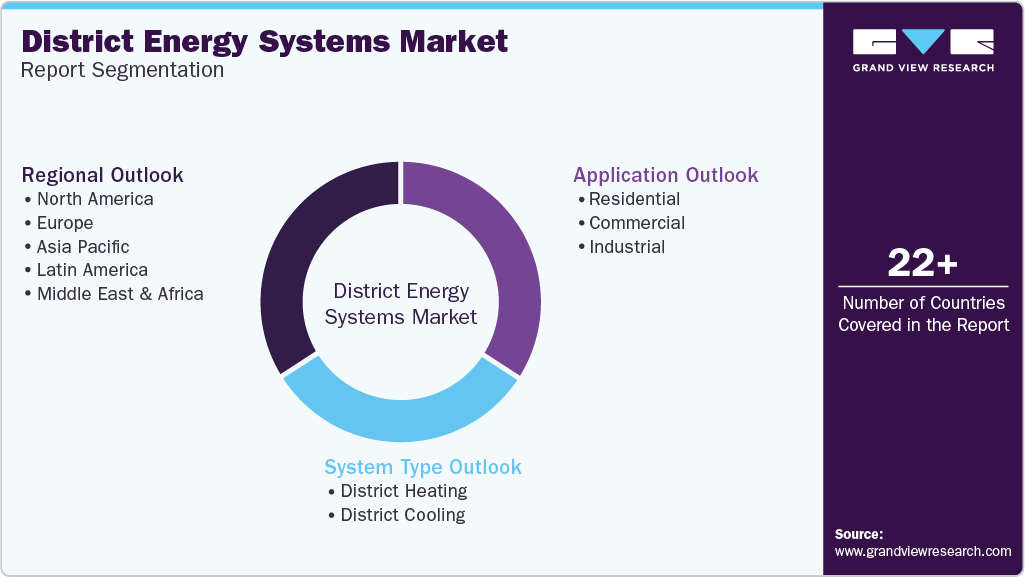
This report forecasts revenue growth at global, regional, and country levels and provides an analysis of the latest industry trends in each of the sub-segments from 2021 to 2033. For this study, Grand View Research has segmented the global district energy systems market report on the basis of system type, application, and region:
 To learn more about this report, Download Free Sample Report
 -
System Type Outlook (Revenue, USD Million, 2021 - 2033)
-
District Heating
-
District Cooling
-
-
Application Outlook (Revenue, USD Million, 2021 - 2033)
-
Residential
-
Commercial
-
Industrial
-
-
Regional Outlook (Revenue, USD Million, 2021 - 2033)
-
North America
-
U.S.
-
Canada
-
Mexico
-
-
Europe
-
Germany
-
UK
-
France
-
Italy
-
Spain
-
-
Asia Pacific
-
China
-
India
-
Japan
-
South Korea
-
Australia
-
-
Latin America
-
Brazil
-
Argentina
-
-
Middle East & Africa
-
Saudi Arabia
-
UAE
-
South Africa
-
-
Research Methodology
The district energy systems market figures in this report are based on a proven research process that combines executive interviews with secondary research from proprietary databases, company filings, and recognized regulatory and institutional sources. Market size is built through value-chain sizing - reconciling supply-side and demand-side estimates - and triangulated with bottom-up and top-down approaches. Every estimate passes multiple levels of expert validation before publication, with each district energy systems segment quantified using the revenue-capture definitions in the table below.
Segment Definition
System Type
Revenue capture definition
District Heating
Revenue from sales of district heating systems that centrally produce and distribute hot water or steam to connected buildings and facilities.
District Cooling
Revenue from sales of district cooling systems that centrally produce and distribute chilled water through networks to connected buildings and facilities.
Application
Revenue capture definition
Residential
Revenue from district heating and cooling systems sold for serving residential buildings, housing developments, apartments, and residential communities.
Commercial
Revenue from district heating and cooling systems sold for commercial and institutional buildings, including offices, retail, hotels, hospitals, and campuses.
Industrial
Revenue from district heating and cooling systems sold for industrial facilities and clusters requiring space heating, process heat, or process cooling.
Estimation Model
Layer No.
Layer Name
Key Question
Description
01
Demand Layer
Which factors generate demand for district energy systems?
Assess demand arising from urbanization, population growth, increasing heating and cooling requirements, energy-efficiency targets, decarbonization initiatives, and development of large residential, commercial, and industrial facilities.
02
System Type Layer
Which district energy systems generate market revenue?
Evaluate revenue across district heating and district cooling based on system capacity, thermal energy requirements, network configuration, energy sources, and climatic conditions.
03
Application Layer
Which applications generate market revenue?
Assess revenue across residential, commercial, and industrial applications based on their requirements for space heating, space cooling, hot water, process heating, and process cooling.
04
Revenue Layer
How is market revenue generated?
Market revenue is quantified through the sales of district heating and district cooling systems. Revenue varies by system type, application, system capacity, project size, and geographic market.
Delivered Customizations
This report has been delivered with the following In-depth customizations
Client Request
Customization Delivered
Value Adds
System Type Opportunity Assessment
Market analysis was performed across District Heating and District Cooling systems by evaluating thermal energy demand, system capacity, network requirements, energy efficiency, climatic conditions, and adoption across different markets.
Enabled identification of high-potential system types based on demand growth, application suitability, infrastructure development, energy-efficiency requirements, and future market opportunities.
Application Opportunity Assessment
Market analysis was conducted across Residential, Commercial, and Industrial applications by assessing heating and cooling requirements, building development, industrial energy demand, infrastructure investments, and adoption of centralized thermal energy systems.
Identified high-potential application segments based on demand growth, thermal energy requirements, project development, infrastructure needs, and future revenue opportunities.
Regional Opportunity Assessment
Country level analysis was conducted to assess district energy system adoption based on urbanization, heating and cooling demand, climate conditions, energy efficiency initiatives, decarbonization targets, infrastructure investments, and district energy development across key regions.
Identified high growth countries and regions with strong district heating and cooling demand, expanding urban infrastructure, supportive energy policies, and favorable commercialization opportunities.
About the Author(s)
Power Generation & Storage Research Team
Energy & Power · Power Generation & StorageThis report was authored by the power generation & storage research team at Grand View Research - comprising two research analysts, one senior research analyst, and one industry expert - with specialized expertise in the power generation & storage segment of the energy & power industry. All findings are based on proprietary energy & power databases, executive interviews, and regulatory analysis, subject to internal peer review prior to publication.
Last Updated:
Speak to Analyst

Customize this report to your needs - add regions, segments, or data points, with 20% free customization.
Or view our licence options:


ISO 9001:2015 & 27001:2022 Certified
We are GDPR and CCPA compliant! Your transaction & personal information is safe and secure. For more details, please read our privacy policy.


