
- Home
- »
- Next Generation Technologies
- »
-
Domain-Specific LLM Platforms Market Size Report, 2033GVR Report cover

Domain-Specific LLM Platforms Market (2026 - 2033) Size, Share & Trends Analysis Report By Component (Software, Services), By Deployment Model (Cloud-based, On-premise, Hybrid), By Enterprise Size, By Industry Vertical (BFSI), By Region, And Segment Forecasts
Market Size, 2025
$1.8BMarket Estimate, 2026
$2.4BMarket Forecast, 2033
$15.5BCAGR, 2026–2033
30.3%Domain-Specific LLM Platforms Market Summary
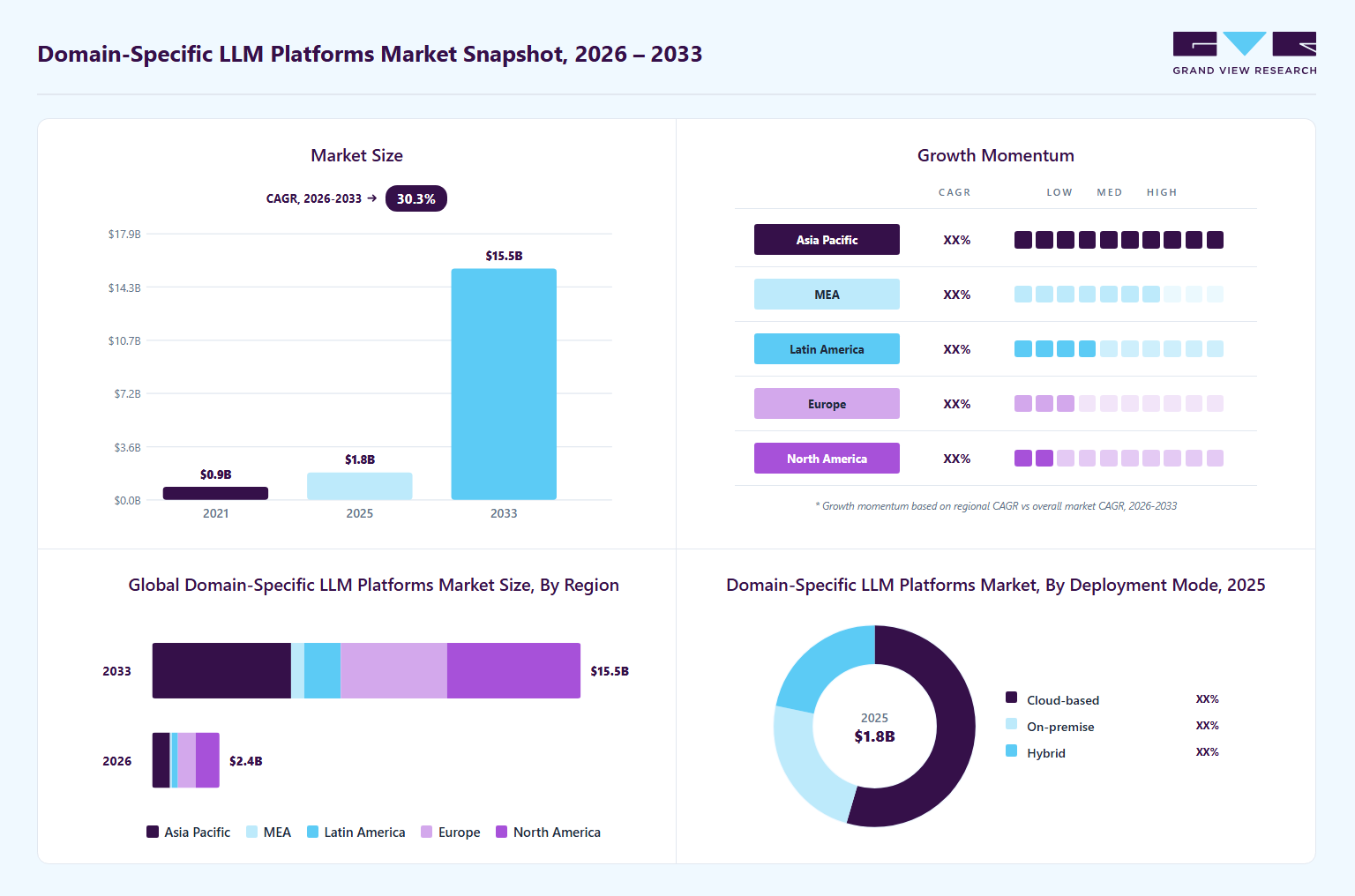
The global domain-specific LLM platforms market size was valued at USD 1.83 billion in 2025 and is projected to grow from USD 2.44 billion in 2026 to USD 15.54 billion by 2033, growing at a CAGR of 30.3% from 2026 to 2033. North America dominated the domain-specific LLM platforms industry with the largest revenue share of over 35.0% in 2025. The global market growth is driven by the rising enterprise demand for highly accurate, context-aware AI models tailored to specific industries.
 Source: Grand View Research, IR Documents, Primary Interviews, Paid DatabasesTo learn more about this report,
 Download Free Sample Report
 Key Market Trends & Insights
- The domain-specific LLM platforms market in North America accounted for the largest revenue share of over 35.0% in 2025.
- The U.S. domain-specific LLM platforms industry dominated North America with a share of over 70.0% in 2025.
- Based on component, the software segment accounted for the largest revenue share of over 70.0% in 2025.
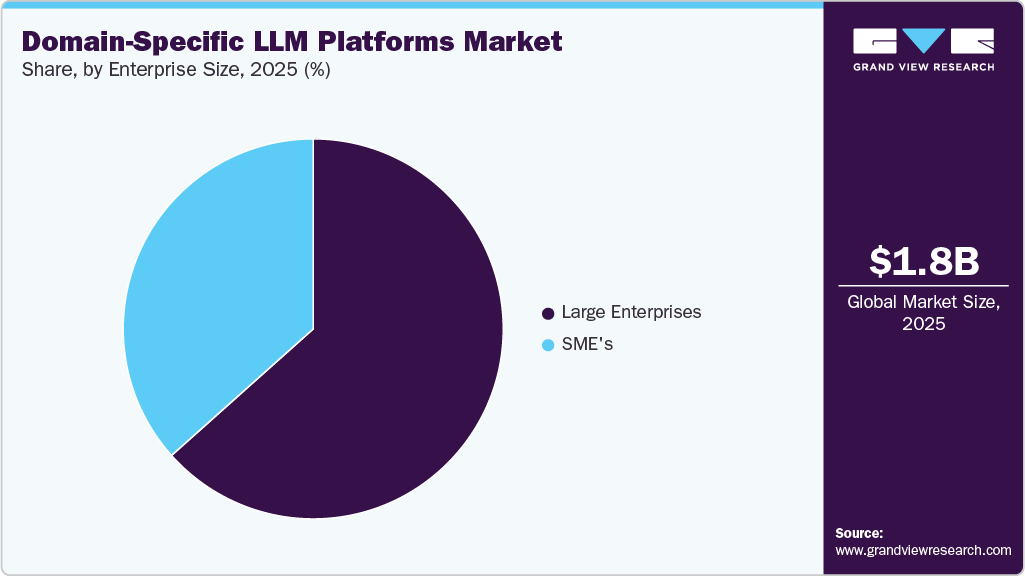
- Based on enterprise size, the large enterprises segment holds a substantial share of over 63.0% in 2025.
- Based on industry vertical, the healthcare & life sciences segment is expected to grow at the fastest CAGR of over 33.0% from 2026 to 2033.
Market Size & Forecast
- 2025 Market Size: USD 1.83 Billion
- 2033 Projected Market Size: USD 15.54 Billion
- CAGR (2026-2033): 30.3%
- North America: Largest market in 2025
Three ways to get this report
Buy it, customize it, or ask a question.Ask an Analyst
A direct answer, usually in 1 working day
- AccessReport author, directly
- Reply timeWithin 1 working day
- No sales callDirect answer only
- FormatEmail reply
- CostFree, no cost
Get the Full Report
What the study covers
- FormatsPDF · Excel · Dashboard
- Timeline2026–2033 annual, 2025 base
- Coverage20+ countries, 5 regions
- Companies10+ key players profiled
Customize the Report
20% free customization
- IncludeCountries, segments, points
- TailorTo your product definition
- ExtendDeeper competitor detail
- OrA fully bespoke study
- Turnaround5–10 working days
Organizations across BFSI, healthcare, legal, and manufacturing are increasingly shifting from general-purpose LLMs to specialized models to improve decision-making, automation, and operational efficiency. This shift is further fueled by the need for greater accuracy, reduced hallucinations, and more domain-relevant AI outputs. Rapid digital transformation initiatives further accelerate adoption across enterprises globally.The rapid expansion of enterprise AI adoption is supported by cloud computing and API-based AI ecosystems. Hyperscalers and AI platforms are enabling organizations to deploy domain-specific LLMs without heavy infrastructure investments, significantly lowering entry barriers. This is encouraging adoption among both large enterprises and SMEs. The increasing integration of LLMs into enterprise workflows such as customer support, analytics, and knowledge management is further boosting demand.
 To learn more about this report, Download Free Sample Report
 Additionally, the growing importance of data security, regulatory compliance, and AI governance is also propelling market growth. Industries handling sensitive data, such as BFSI and healthcare, are adopting domain-specific LLMs to ensure controlled, compliant, and explainable AI outputs. Rising concerns over data privacy and intellectual property protection are pushing enterprises toward secure, enterprise-grade AI platforms. This is strengthening demand for government and transparent LLM ecosystems.
Furthermore, advancements in technologies such as retrieval-augmented generation (RAG), fine-tuning frameworks, and multimodal AI are significantly enhancing the performance of domain-specific LLM platforms. These innovations enable better contextual understanding, real-time knowledge retrieval, and improved accuracy in industry-specific applications. Continuous improvements in AI infrastructure, including GPUs and vector databases, are further accelerating deployment capabilities. This is expanding use cases across multiple industry verticals.
Moreover, the increasing enterprise focus on productivity improvement and cost optimization is driving the adoption of domain-specific LLM platforms. Organizations are leveraging AI to automate repetitive tasks, streamline workflows, and enhance decision-making processes. The growing need for intelligent automation across business functions is creating strong demand for customized AI solutions. Combined with rising investments in digital transformation, this is expected to sustain long-term market growth.
Market Dynamics
The growing need for highly accurate, context-aware AI models is driving the adoption of domain-specific LLM platforms across industries. Enterprises are seeking specialized language models tailored for sectors such as healthcare, BFSI, legal, manufacturing, and telecom to improve operational efficiency, decision-making, and customer engagement.
Domain-specific LLMs offer greater accuracy, regulatory alignment, and industry-focused insights than general-purpose AI models. Organizations are increasingly investing in customized AI platforms to automate workflows, enhance knowledge management, and enable intelligent enterprise applications.
Furthermore, the rapid growth of generative AI adoption and the rising demand for secure enterprise AI deployments are accelerating investments in specialized LLM infrastructure. Businesses are prioritizing domain-trained models to achieve higher reliability, lower hallucination risks, and improved business outcomes. The continued expansion of enterprise AI adoption and the increasing preference for industry-focused intelligent automation solutions are expected to drive strong long-term growth in the domain-specific LLM platforms market.
The high cost of developing, training, and deploying domain-specific LLM platforms remains a major challenge to market growth. Building industry-focused models requires substantial investment in computing infrastructure, high-quality proprietary datasets, and AI expertise.
In addition, concerns related to data privacy, model bias, regulatory compliance, and cybersecurity increase operational complexity for enterprises adopting domain-specific AI platforms. Integration with existing enterprise systems and legacy workflows can also create implementation barriers.
Limited availability of skilled AI professionals and the ongoing cost of model fine-tuning, monitoring, and updates further constrain adoption, particularly among small and medium-sized enterprises. These factors may slow deployment rates in cost-sensitive markets.
The growing use of AI-driven automation across enterprise operations is creating significant opportunities for the domain-specific LLM platforms market. Organizations are increasingly adopting specialized LLMs for intelligent document processing, customer support automation, compliance management, coding assistance, and industry-specific analytics.
The rising adoption of cloud-based AI infrastructure and API-driven AI platforms is enabling faster deployment and scalability of domain-specific models across industries. The increasing demand for personalized AI applications and real-time decision intelligence is further supporting market expansion.
Moreover, advancements in multimodal AI, retrieval-augmented generation (RAG), and edge AI deployment are expected to enhance the capabilities of domain-specific LLM platforms. Growing investments in enterprise AI transformation and vertical-specific AI ecosystems are anticipated to create substantial long-term growth opportunities globally.
Market Concentration & Characteristics
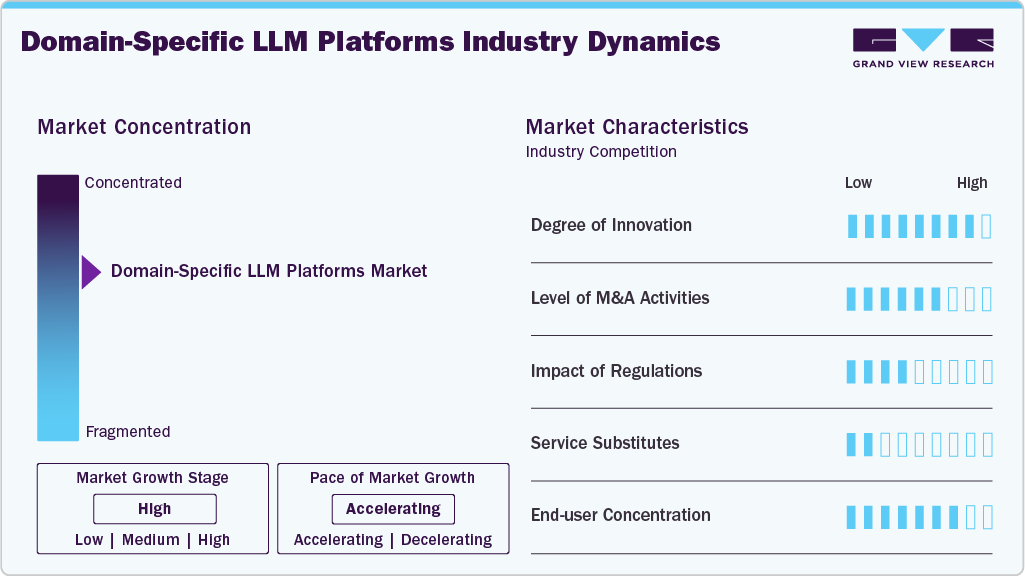
The global domain-specific LLM platforms market is moderately concentrated, with major AI technology providers, cloud infrastructure companies, enterprise software vendors, and emerging generative AI startups shaping the competitive landscape. A limited number of established players dominate large-scale enterprise deployments through strong AI infrastructure capabilities, proprietary datasets, advanced model development expertise, and integrated cloud-based AI ecosystems.
The domain-specific LLM platforms industry is characterized by rapid innovation in large language model architectures, retrieval-augmented generation (RAG), multimodal AI, and fine-tuning technologies designed for industry-specific use cases. Mergers and acquisitions activity remains moderately high as technology companies seek to strengthen their AI capabilities, expand vertical-specific offerings, and enhance competitive positioning in the evolving generative AI ecosystem.
 To learn more about this report, Download Free Sample Report
 The market exhibits limited service substitutes, primarily from general-purpose LLM APIs, traditional AI systems, and in-house enterprise AI solutions. Regulatory influence is growing, primarily driven by concerns related to AI governance, data privacy, model transparency, intellectual property protection, and industry-specific compliance requirements. End-user concentration is moderate to high, with strong adoption from large enterprises in BFSI, healthcare, and IT services, while SMEs are rapidly emerging as a growing user base driven by increasing accessibility of cloud-based domain-specific LLM platforms.
Component Insights
The software segment dominated the domain-specific LLM platforms market, accounting for the largest revenue share of over 70.0% in 2025, driven by the increasing demand for scalable, secure, and flexible AI deployment models. Enterprises are adopting hybrid infrastructure approaches to balance data security, regulatory compliance, and cloud scalability. Sensitive workloads are often retained on-premise, while cloud environments support high-performance AI model training and inference. This deployment model enables seamless integration of domain-specific LLM applications across enterprise workflows. Additionally, the growing demand for customizable, industry-focused AI platforms is accelerating software adoption.
The services segment is expected to grow at a significant CAGR of over 27% from 2026 to 2033, driven by increasing demand for customization, integration, consulting, and managed AI services. Enterprises are increasingly dependent on external expertise to deploy, fine-tune, and operationalize domain-specific LLM solutions. Rising deployment complexity around data governance, model lifecycle management, and continuous optimization is reinforcing this reliance. Ongoing needs for model retraining, monitoring, and performance enhancement are further accelerating service adoption.
Deployment Mode Insights
The cloud-based segment accounted for the largest share of the domain-specific LLM platforms market in 2025. This growth can be attributed to high scalability, flexibility, and seamless enterprise integration. Organizations increasingly prefer cloud deployment due to reduced infrastructure costs and rapid access to advanced domain-specific LLM capabilities. Continuous model updates, managed services, and simplified deployment cycles further enhance adoption. Strong demand for real-time processing, remote accessibility, and distributed workforce support is reinforcing cloud preference, thereby driving the segmental growth in the coming years.
The hybrid is expected to grow at the fastest CAGR from 2026 to 2033, driven by the growing need to balance data security, regulatory compliance, and scalable AI performance. Enterprises are increasingly adopting hybrid architectures to optimize workload distribution between on-premise infrastructure and cloud environments. Sensitive and regulated data is retained locally, while compute-intensive AI workloads are executed in the cloud. This structure enhances flexibility, security, and operational efficiency across enterprise environments. Rising demand for compliant yet scalable AI infrastructure is accelerating the segmental growth.
Enterprise Size Insights
The large enterprises segment accounted for the largest market share in 2025, owing to strong financial capacity, advanced digital infrastructure, and early adoption of generative AI technologies. They utilize domain-specific LLMs for workflow automation, knowledge management, and enterprise analytics. Additionally, the high focus on productivity improvement and operational efficiency supports widespread deployment, which is significantly boosting the segmental growth. Furthermore, the ongoing investments in digital transformation initiatives are expected to accelerate the market growth in the coming years.
 To learn more about this report, Download Free Sample Report
 The SMEs segment is expected to grow at the fastest CAGR from 2026 to 2033, supported by the increasing accessibility of cloud-based AI platforms and cost-effective API-based LLM solutions. They are adopting domain-specific LLMs to enhance customer engagement, automate business processes, and improve decision-making. Low-code/no-code platforms are enabling easy deployment without technical expertise. Competitive pressure is accelerating AI adoption. Falling implementation costs are further supporting growth.
Industry Vertical Insights
The BFSI segment accounted for the largest share of the domain-specific LLM platforms industry in 2025, driven by strong demand for fraud detection, risk management, compliance automation, and customer service enhancement through AI-driven insights. Financial institutions are increasingly adopting domain-specific LLM platforms to improve real-time decision-making and personalized banking experiences. Regulatory compliance requirements are further pushing the need for accurate and explainable AI systems. Moreover, continuous focus on operational efficiency and cost reduction further supports market growth.
The healthcare & life sciences segment is expected to grow at the fastest CAGR from 2026 to 2033, driven by growing adoption of AI for clinical documentation, drug discovery, diagnostics support, and patient engagement solutions. Domain-specific LLMs enable more effective handling of complex medical data and improve the accuracy of medical decision-making. Increasing pressure on healthcare systems to reduce costs and improve outcomes is accelerating adoption. Integration with electronic health records (EHR) systems further enhances usability. Rising investments in AI-powered medical research and precision medicine are boosting growth.
Regional Insights
North America dominated the domain-specific LLM platforms market, with a share of over 35.0% in 2025, driven by strong enterprise AI adoption, advanced cloud infrastructure, and early commercialization of these platforms. The region benefits from the presence of leading AI and cloud providers, enabling rapid deployment of industry-focused AI solutions. High investments in digital transformation across BFSI, healthcare, and IT services further accelerate demand. Increasing focus on productivity automation and generative AI integration also supports sustained market growth.
 To learn more about this report, Download Free Sample Report
 U.S. Domain-Specific LLM Platforms Market Trends
The U.S. domain-specific LLM platforms industry dominated North America with a revenue share of over 70.0% in 2025, owing to the strong AI innovation ecosystems, high enterprise spending, and rapid adoption of generative AI technologies. The large-scale deployment of domain-specific LLMs across the finance, healthcare, and technology sectors is a key growth driver. The presence of hyperscalers and AI-native companies enhances model availability and customization capabilities. Continuous investments in AI R&D and enterprise automation further strengthen market expansion.
Europe Domain-Specific LLM Platforms Market Trends
The Europe domain-specific LLM platforms industry is expected to grow at a CAGR of 29% from 2026 to 2033, driven by the increasing adoption of AI in the industrial automation, BFSI, and manufacturing sectors. Strong regulatory frameworks, such as AI governance and data privacy laws, are driving demand for compliant, transparent domain-specific LLM solutions. Enterprises are focusing on digital transformation and operational efficiency improvements. Growing investments in sovereign AI and cloud infrastructure also support market growth.
The domain-specific LLM platforms market in Germany is expected to grow significantly in the coming years, supported by strong industrial automation, manufacturing digitization, and Industry 4.0 initiatives. Enterprises are increasingly adopting domain-specific LLMs for engineering, logistics, and production optimization. Demand for secure, compliant AI solutions is high due to stringent data protection standards. Integration of AI into smart factories and enterprise systems further drives adoption.
The UK domain-specific LLM platforms market is witnessing rapid expansion driven by the rapid adoption of AI in financial services, legal tech, and public sector modernization. Strong fintech ecosystem and enterprise digitalization initiatives are boosting demand for domain-specific LLM platforms. Government support for AI innovation and research accelerates deployment across industries. Increasing focus on productivity enhancement and automation further drives growth.
Asia Pacific Domain-Specific LLM Platforms Market Trends
The Asia Pacific domain-specific LLM platforms industry is expected to grow at the fastest CAGR of over 34.0% from 2026 to 2033, driven by rapid digitalization, expanding cloud infrastructure, and strong enterprise adoption of AI technologies. Large-scale demand from emerging economies and technology hubs accelerates the deployment of domain-specific LLM platforms. Growing investments in smart cities, e-commerce, and telecom sectors further fuel growth. Increasing availability of cost-effective AI solutions enhances regional adoption.
The China domain-specific LLM platforms market is being accelerated by strong government support for AI leadership, massive digital ecosystem expansion, and rapid enterprise AI integration. Large technology companies are heavily investing in domain-specific LLM development across industries. High adoption in e-commerce, manufacturing, and financial services supports growth. Focus on self-reliant AI infrastructure further accelerates domestic innovation.
The domain-specific LLM platforms market in Japan is expanding steadily, driven by aging population, labor shortages, and strong demand for automation across industries. Enterprises are increasingly adopting domain-specific LLMs for robotics, manufacturing, and customer service optimization. Strong industrial base and advanced technology adoption support market expansion. Government initiatives promoting AI and digital transformation further enhance growth.
Key Domain-Specific LLM Platforms Company Insights
Some of the key players operating in the market include Microsoft Corporation and Google LLC.
-
Microsoft Corporation provides enterprise-grade domain-specific LLM platforms through its Azure AI ecosystem, enabling organizations to build, fine-tune, and deploy industry-focused generative AI solutions integrated with productivity, cloud, and business applications. It further strengthens enterprise adoption through copilots embedded across workflows such as coding, analytics, and business operations, making it a leading end-to-end AI platform provider in regulated and large-scale industries.
-
Google LLC provides advanced domain-specific LLM capabilities through its Gemini models and Google Cloud AI platform, enabling enterprises to develop industry-tailored AI solutions for search, analytics, automation, and real-time decision intelligence. It also offers strong data integration and multimodal AI capabilities, helping enterprises build highly contextual, scalable AI-driven applications across digital ecosystems.
Cohere, Inc. and Databricks Inc. are some of the emerging participants in the domain-specific LLM platforms market.
-
Cohere Inc. provides enterprise-focused domain-specific LLM platforms specializing in retrieval-augmented generation (RAG) and natural language understanding, enabling organizations to build secure and customizable AI applications. It differentiates itself with enterprise-grade privacy, multilingual capabilities, and a strong focus on business document intelligence.
-
Databricks Inc. provides data-driven domain-specific LLM platforms through its Lakehouse AI architecture, enabling enterprises to unify data, analytics, and model training for industry-specific generative AI solutions. It also enhances AI performance by tightly integrating data engineering, governance, and machine learning workflows within a single unified platform.
Key Domain-Specific LLM Platforms Companies
The following key companies have been profiled for this study on the domain-specific LLM platforms market.
-
Microsoft Corporation
-
Google LLC
-
Amazon Web Services (AWS)
-
IBM Corporation
-
OpenAI
-
Anthropic
-
Meta Platforms Inc.
-
NVIDIA Corporation
-
Cohere Inc.
-
Databricks Inc.
Competitive Benchmarking
Operating Strategies
Competitive Edge
Weaknesses
Mature Players: Microsoft Corporation; Google LLC; Amazon Web Services.
- Focus on end-to-end enterprise AI ecosystems combining cloud infrastructure, model development, and domain-specific application layers.
- Expand through long-term enterprise contracts, platform integration, and strategic acquisitions to strengthen AI and data capabilities.
- Strong global cloud infrastructure, large enterprise customer base, and deep integration across business workflows.
- Advanced R&D capabilities enabling scalable, secure, and compliant deployment of domain-specific LLM solutions.
- High operational complexity and slower innovation cycles due to legacy systems and large organizational structures.
- Premium pricing models and heavy infrastructure dependence limit accessibility for smaller enterprises.
Emerging Players: Cohere Inc.; Anthropic; Databricks Inc.
- Focus on developing specialized LLMs optimized for specific industries using proprietary or fine-tuned datasets.
- Leverage partnerships, API-first models, and cloud-native architectures to accelerate enterprise adoption and scalability.
- High agility and faster innovation cycles enabling rapid adaptation to evolving enterprise AI requirements.
- Strong specialization in areas like retrieval-augmented generation (RAG), safety-focused AI, and domain customization.
- Limited global infrastructure and smaller enterprise customer base compared to established platform providers.
- Dependence on external cloud providers and funding constraints impacting large-scale deployment capabilities.
Recent Developments
-
In April 2026, Amazon Web Services announced expansion of its partnership with OpenAI, enabling GPT-5.5 and Codex models to run on AWS Bedrock. This marks a major shift in enterprise AI ecosystems, allowing customers to access multiple frontier models within AWS’s governed cloud environment for building domain-specific LLM applications.
-
In April 2026, Cohere Inc. announced a strategic expansion move through the acquisition of Aleph Alpha, strengthening its position in regulated and enterprise-focused domain-specific LLM solutions across Europe and global markets. The deal enhances Cohere’s ability to deliver customized, privacy-first AI models for industries such as finance, healthcare, and government.
-
In Sept 2025, Databricks and OpenAI announced a $100 million multi-year partnership to integrate OpenAI’s advanced models, including GPT-5, into the Databricks Data Intelligence Platform and Agent Bricks, enabling enterprises to build and deploy domain-specific AI applications on governed enterprise data at scale.
Domain-Specific LLM Platforms Market Report Scope
Report Attribute
Details
Market size value in 2025
USD 1.83 billion
Market size value in 2026
USD 2.44 billion
Revenue forecast in 2033
USD 15.54 billion
Growth rate
CAGR of 30.3% from 2026 to 2033
Base year of estimation
2025
Actual data
2021 - 2024
Forecast period
2026 - 2033
Quantitative units
Revenue in USD million/billion and CAGR from 2026 to 2033
Report coverage
Revenue forecast, company ranking, competitive landscape, growth factors, and trends
Segments covered
Component, deployment mode, enterprise size, industry vertical, region
Regional scope
North America; Europe; Asia Pacific; Latin America; Middle East & Africa
Country scope
U.S.; Canada; Mexico; Germany; UK; France; China; Japan; India; South Korea; Australia; Brazil; UAE; Saudi Arabia; South Africa
Key companies profiled
Microsoft Corporation; Google LLC; Amazon Web Services (AWS); IBM Corporation; OpenAI; Anthropic; Meta Platforms Inc.; NVIDIA Corporation; Cohere Inc.; Databricks Inc.
Customization scope
Free report customization (equivalent up to 8 analysts working days) with purchase. Addition or alteration to country, regional & segment scope.
Global Domain-Specific LLM Platforms Market Report Segmentation
This report forecasts revenue growth at the global, regional, and country levels and provides an analysis of the latest industry trends in each of the sub-segments from 2021 to 2033. For this study, Grand View Research has segmented the global domain-specific LLM platforms market report based on component, deployment mode, enterprise size, industry vertical, and region:
-
Component Outlook (Revenue, USD Million/Billion, 2021 - 2033)
-
Software
-
Services
-
-
Deployment Mode Outlook (Revenue, USD Million/Billion, 2021 - 2033)
-
Cloud-based
-
On-premise
-
Hybrid
-
-
Enterprise Size Outlook (Revenue, USD Million/Billion, 2021 - 2033)
-
Large Enterprises
-
SME's
-
-
Industry Vertical Outlook (Revenue, USD Million/Billion, 2021 - 2033)
-
BFSI
-
Healthcare & Life Sciences
-
Manufacturing & Industrial
-
Retail & E-commerce
-
Telecom & IT Services
-
Government & Defense
-
Others
-
-
Regional Outlook (Revenue, USD Million/Billion, 2021 - 2033)
-
North America
-
U.S.
-
Canada
-
Mexico
-
-
Europe
-
Germany
-
UK
-
France
-
-
Asia Pacific
-
China
-
Japan
-
India
-
South Korea
-
Australia
-
-
Latin America
-
Brazil
-
-
Middle East and Africa (MEA)
-
UAE
-
Saudi Arabia
-
South Africa
-
-
Delivered Customizations
This report has been delivered with the following In-depth customizations
Client Objective
Custom Research Modules Delivered
Strategic Value / Business Impact
Product Positioning & Competitive Intelligence
Benchmarking of domain-specific LLM platforms for accuracy, fine-tuning, and integration capabilities
Analysis of pricing models, value delivery, and enterprise AI positioning strategies
Study of brand reputation and adoption trends across key industry verticals
Evaluation of competitor strategies in LLM customization, RAG, and API ecosystems
Improved differentiation through vertical-specific optimization and higher model accuracy Enabled pricing strategies aligned with enterprise AI usage and cloud deployment models
Identified gaps in interoperability, data privacy, and real-time knowledge integration
Strengthened positioning in the evolving domain-specific LLM ecosystem
Technology & Innovation Assessment
Emerging technology trend analysis
Innovation pipeline and patent review
Technology adoption readiness assessment
Ecosystem and partnership mapping
Identified future growth areas Supported innovation roadmap planning
Evaluated commercialization potential
Strengthened strategic partnership decisions
Frequently Asked Questions About This Report
The global domain-specific LLM platforms market size was valued at USD 1.83 billion in 2025 and is projected to reach 2.44 billion in 2026.
The global domain-specific LLM platforms market is expected to grow at a compound annual growth rate of 30.3% from 2026 to 2033, reaching USD 15.54 billion by 2033.
The software segment accounted for the largest market share of over 70% in 2025, driven by the increasing demand for scalable, secure, and flexible AI deployment models.
Key players operating in the market include Microsoft Corporation, Google LLC, Amazon Web Services (AWS), IBM Corporation, OpenAI, Anthropic, Meta Platforms Inc., NVIDIA Corporation, Cohere Inc., and Databricks Inc.
Key factors driving the market growth include the rising demand for highly accurate, industry-specific AI solutions driven by enterprise adoption, data privacy needs, and improved performance over general-purpose LLMs.
About the Author(s)
Next Generation Technologies Research Team
Technology · Next Generation TechnologiesThis report was authored by the next generation technologies research team at Grand View Research - comprising two research analysts, one senior research analyst, and one industry expert - with specialized expertise in the next generation technologies segment of the technology industry. All findings are based on proprietary technology databases, executive interviews, and regulatory analysis, subject to internal peer review prior to publication.
Last Updated:
Speak to Analyst

Customize this report to your needs - add regions, segments, or data points, with 20% free customization.
Or view our licence options:


ISO 9001:2015 & 27001:2022 Certified
We are GDPR and CCPA compliant! Your transaction & personal information is safe and secure. For more details, please read our privacy policy.


