
- Home
- »
- Drilling & Extraction Equipments
- »
-
Drilling Fluids Market Size & Share Report, 2026-2033GVR Report cover

Drilling Fluids Market (2026 - 2033)
Size, Share & Trends Analysis Report By Product (OBF, SBF, WBF), By End-use (Onshore, Offshore), By Region (North America, Europe, Asia Pacific, Latin America), And Segment Forecasts
Market Size, 2025
$9.1BMarket Estimate, 2026
$9.5BMarket Forecast, 2033
$12.8BCAGR, 2026–2033
4.4%Drilling Fluids Market Summary
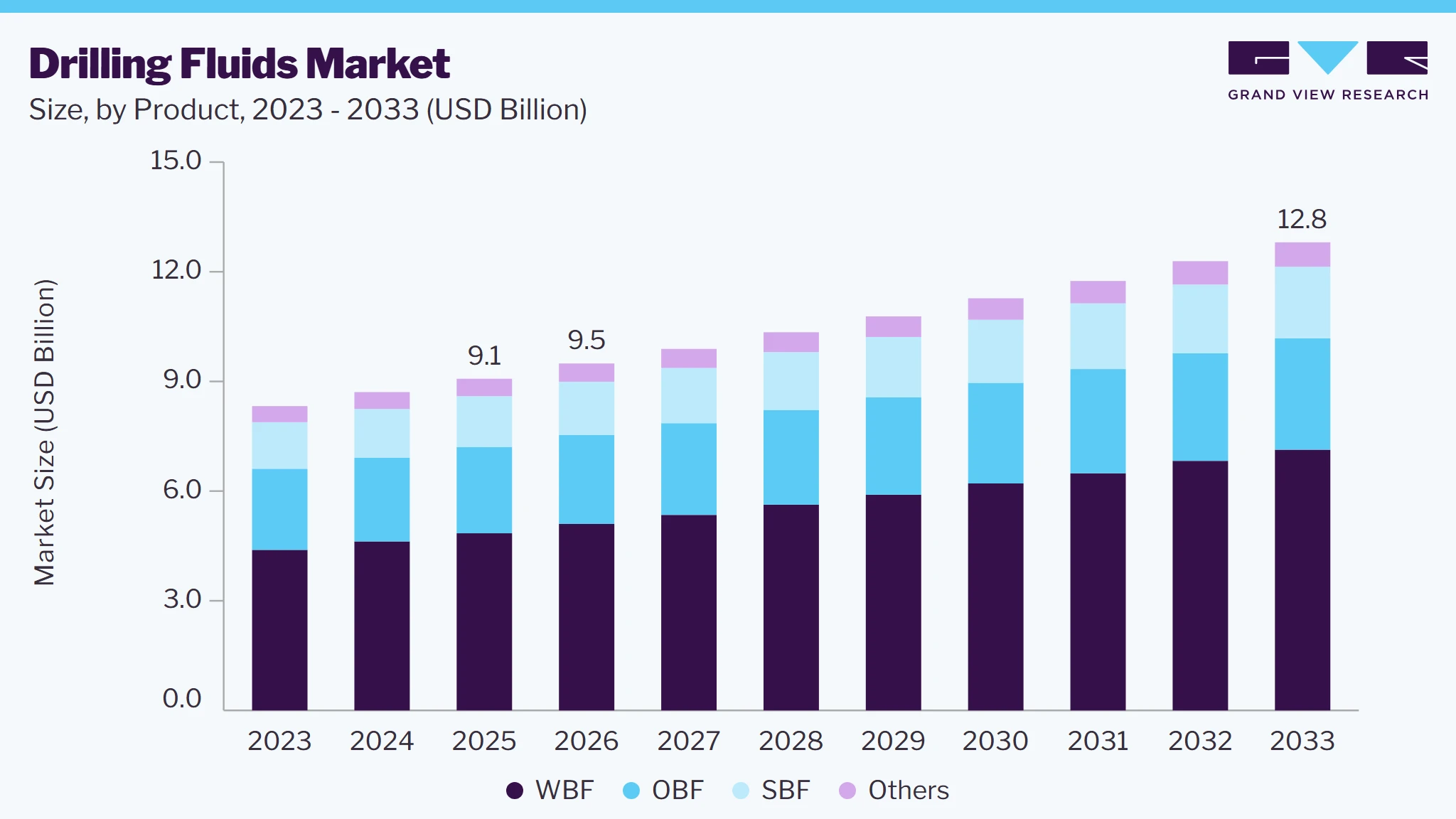
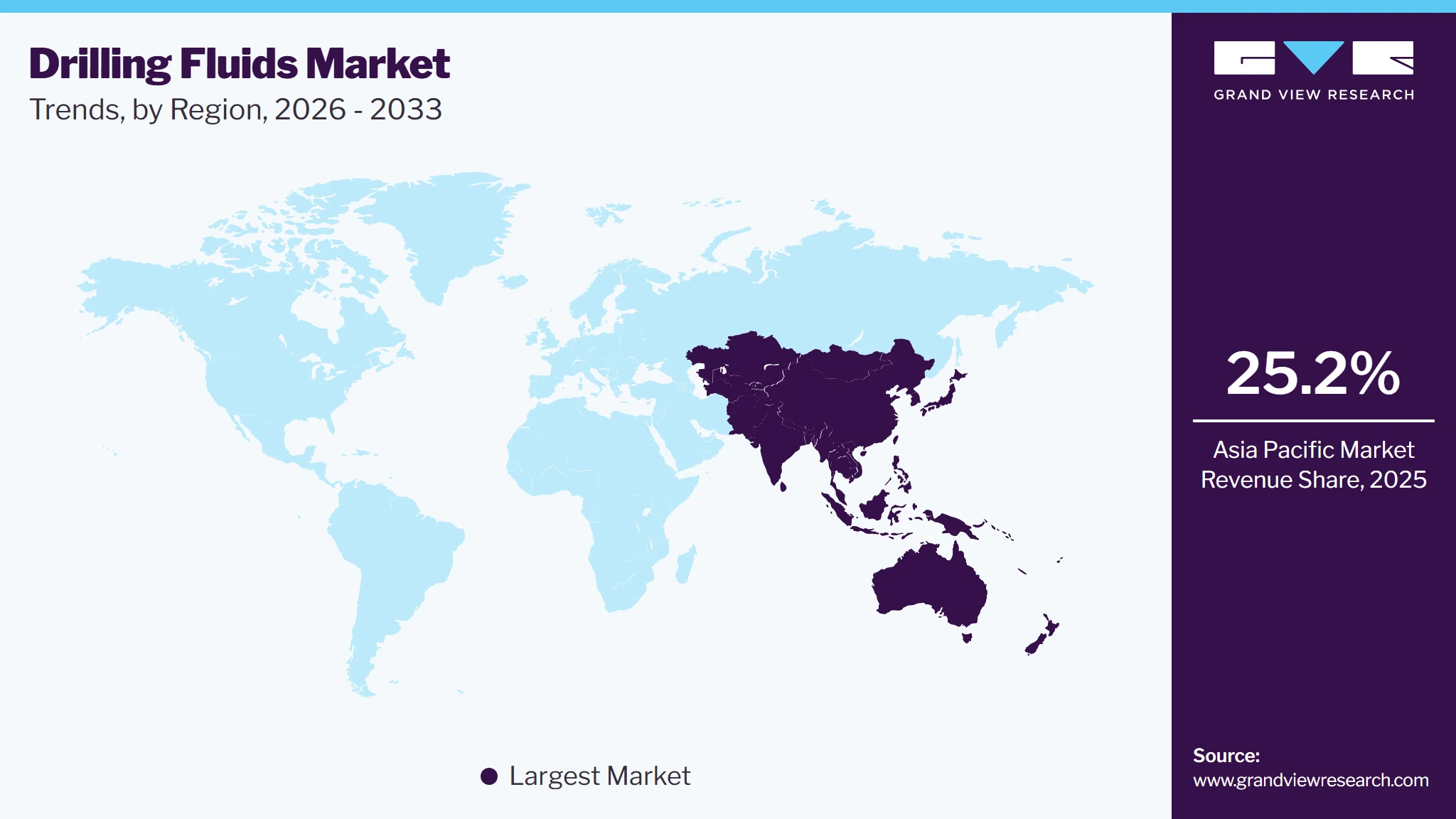
The global drilling fluids market size was valued at USD 9.1 billion in 2025 and is projected to grow from USD 9.5 billion in 2026 to USD 12.8 billion by 2033, at a CAGR of 4.4% from 2026 to 2033. Asia Pacific dominated the market, accounting for a revenue share of 25.2% in 2025. The growth of the oil and gas market, mainly driven by increasing demand from the energy sector, is expected to fuel the global market expansion during the forecast period.
 Source: Grand View Research, IR Documents, Primary Interviews, Paid DatabasesTo learn more about this report,
 Download Free Sample Report
Key Market Trends & Insights
- By product: Water-based accounted for the highest market share, representing 53.4% of total revenue in 2025.
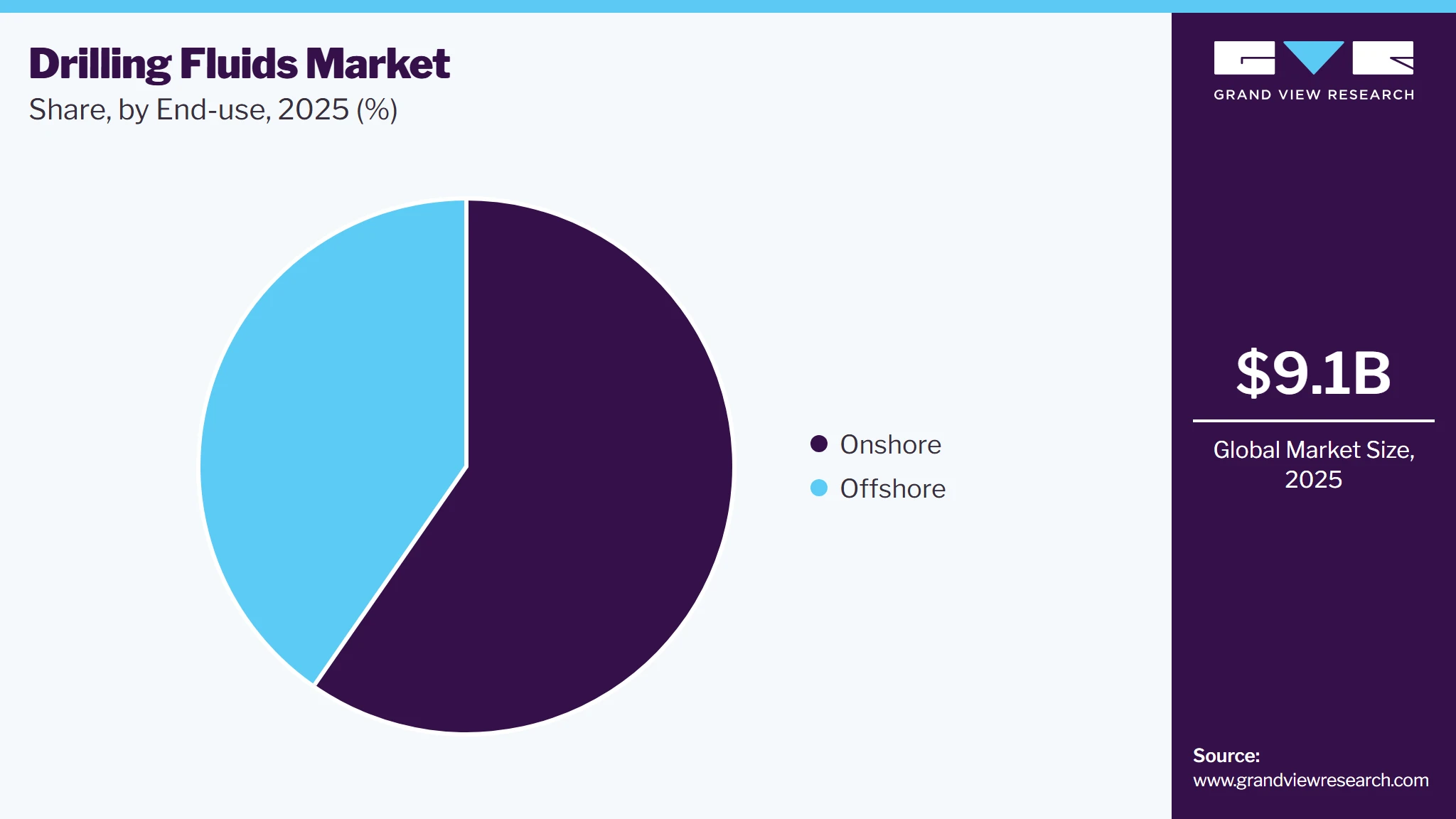
- By end use: Onshore held a dominant position, contributing 59.7% of total revenue in 2025.
Regional Highlights
- Largest regional market: Asia Pacific (25.2% revenue share, 2025)
- By country: The China held the largest market share in 2025.
Market Size & Forecast
- Market size in 2025: USD 9.1 Billion
- Estimated market size in 2026: USD 9.5 Billion
- Projected market size by 2033: USD 12.8 Billion
- CAGR (2026-2033): 4.4%
Three ways to get this report
Buy it, customize it, or ask a question.Ask an Analyst
Analyst response in 1 business day
- AccessReport author, directly
- Reply timeWithin 1 working day
- No sales callDirect answer only
- FormatEmail reply
- CostFree, no cost
Get the Full Report
What the study covers
- FormatsPDF · Excel · Dashboard
- Timeline2026–2033 annual, 2025 base
- Coverage20+ countries, 5 regions
- Companies10+ key players profiled
Customize the Report
20% free customization
- IncludeCountries, segments, points
- TailorTo your product definition
- ExtendDeeper competitor detail
- OrA fully bespoke study
- Turnaround5–10 working days
Additionally, various industrial sectors, including power plants and transportation, contribute to the rising demand for gas and crude oil. Concerns about managing solid waste, spill containment, and deteriorating boreholes are anticipated to create new opportunities for the drilling oil market throughout this period. The industry is anticipated to significantly increase product demand due to its crucial role in oil and gas operations. The growing offshore sector, particularly in the Persian Gulf, is anticipated to drive growth in the market. The rising demand for advanced oil drilling chemicals will likely create considerable opportunities, especially due to their comprehensive use in horizontal drilling, such as well.
 To learn more about this report, Download Free Sample Report
The U.S., Saudi Arabia, Russia, China, Canada, the UAE, Iran, Iraq, and Brazil were among the largest consumers of product market and drilling equipment, owing to the increasing E&P in the region. A large number of ongoing operations in major oilfields such as Ghawar, Bolivar Coastal Field, Burgan, Safaniya, Prudhoe Bay, and Cantarell Field are expected to play a key role in oil & gas industry growth across the globe.
Market Dynamics
The drilling fluids market is supported by increasing exploration and production activities across conventional and unconventional oil and gas reserves. Rising investments in deepwater and ultra-deepwater drilling projects are driving demand for high-performance fluid systems capable of operating under challenging geological conditions. Technological advancements in fluid formulations, including environmentally responsible and high-temperature-resistant solutions, are enhancing drilling efficiency, wellbore stability, and equipment protection. At the same time, stringent environmental regulations governing waste disposal and chemical usage are encouraging manufacturers to develop sustainable and low-toxicity drilling fluids. Volatility in crude oil prices, however, continues to influence upstream capital expenditure, creating fluctuations in drilling activity and product demand. Growing emphasis on optimizing drilling performance, reducing non-productive time, and lowering operational costs is accelerating the adoption of advanced fluid management solutions.
The expansion of oil and gas exploration and production activities is a primary driver of the drilling fluids market. Increasing global energy demand has encouraged operators to invest in the development of conventional, unconventional, and deepwater hydrocarbon reserves to strengthen long-term supply security. As drilling operations become more technically demanding, there is a growing need for advanced drilling fluids that improve wellbore stability, enhance lubrication, regulate downhole pressure, and facilitate efficient cuttings removal. These performance requirements are supporting sustained demand for specialized fluid systems across both onshore and offshore projects.
National oil companies and independent exploration firms are increasing investments in field development, well reactivation, and enhanced recovery initiatives to maximize production from existing assets. The expansion of horizontal and directional drilling techniques further increases the consumption of high-performance drilling fluids designed for complex geological formations. Continuous improvements in drilling technologies and greater focus on operational efficiency are encouraging operators to adopt customized fluid solutions that minimize non-productive time, improve drilling accuracy, and optimize overall well economics, thereby reinforcing market growth.
The high cost associated with the disposal and treatment of used drilling fluids is a significant restraint for the drilling fluids market. During drilling operations, spent fluids become contaminated with drill cuttings, hydrocarbons, heavy metals, and other formation materials, requiring specialized treatment and disposal procedures before they can be reused or discharged. Compliance with environmental regulations governing waste handling, transportation, and disposal increases operational expenses for drilling contractors and exploration companies. These costs are particularly substantial for offshore operations, where waste management processes are more complex due to limited disposal options and stringent environmental standards. As a result, operators face increased project costs that can affect overall drilling economics.
The growing adoption of horizontal and directional drilling techniques presents a significant opportunity for the drilling fluids market. As oil and gas operators increasingly target unconventional reservoirs, complex geological formations, and mature fields, these advanced drilling methods have become essential for maximizing hydrocarbon recovery and improving productivity. Horizontal and directional wells require drilling fluids with superior lubrication, wellbore stabilization, pressure control, and cuttings transport capabilities to ensure efficient drilling operations. This trend is driving demand for high-performance drilling fluid systems that can withstand extended drilling intervals and challenging downhole conditions while enhancing operational reliability.
Service providers are focusing on developing advanced fluid formulations that minimize friction, reduce non-productive time, and improve drilling efficiency in extended-reach wells. The increasing emphasis on optimizing reservoir access while lowering development costs is encouraging operators to adopt customized drilling fluid solutions, creating substantial opportunities for product innovation, technology advancement, and long-term market growth.
Analyst Perspective
The drilling fluids market is influenced by rising upstream investments and increasing exploration of complex oil and gas reserves. Demand is shifting toward high-performance fluid systems that improve drilling efficiency, wellbore stability, and operational reliability while meeting stricter environmental standards. Offshore developments and unconventional resource extraction are creating opportunities for advanced and customized drilling fluid formulations. At the same time, manufacturers are focusing on sustainable chemistries and digital fluid management solutions to enhance operational performance. Companies that combine technical innovation with cost-effective and environmentally compliant products are expected to strengthen their competitive position in the evolving drilling fluids market.
Product Insights
“WBF held the revenue share of over 53.4% in 2025.”
Based on product, the water-based accounted for the highest market share, representing 53.4% of total revenue in 2025. This is due to their use in drilling over 75% of wells worldwide. The choice of fluid for the operation depends on the conditions of the well, which may include saturated brine, formate brine, or fresh water. Increasing concerns about the toxicity and biodegradability of other drilling fluids are expected to drive demand for these products in the coming years. Water-based oil is anticipated to gain importance due to its ease of use and ability to discharge during offshore activities. The growing need for an effective fluid system in high-temperature and high-pressure wells will likely increase the demand for water-based oils.
Oil-based products are the second-largest contributors to revenue in the global product market. Oil-based drilling fluid, used in drilling engineering, consists of a combination of oil and water in both continuous and dispersed phases. The significance of oil-based products is expected to increase due to their enhanced lubricity. As the demand for reduced corrosion of drilling tools and improved thermal stability rises, the use of these products is projected to grow significantly during the forecast period. However, despite this anticipated growth, the environmental impact of oil-based fluids has led to strict government regulations regarding their use.
End-use Insights
“Offshore segment is anticipated to register a revenue CAGR of 59.7% over the forecast period.”
By end-use, onshore held a dominant position, contributing 59.7% of total revenue in 2025. The rising energy demands primarily drive the increase in oil drilling activities. As research efforts focus on developing abandoned oil wells and reinvigorating projects in various onshore oilfields, the global oil and gas production volume is anticipated to rise significantly. Enhanced oil and gas exploration in countries such as Saudi Arabia, the United States, China, and Russia is expected to boost awareness and demand throughout the forecast period.
 To learn more about this report, Download Free Sample Report
The global offshore rig count increase, combined with the significant development of existing offshore wells in deep and ultra-deep waters, especially in the South China Sea, North Sea, Persian Gulf, and Gulf of Mexico, is expected to drive demand during the forecast period. The rising number of ongoing projects and implementations in the Middle East and Africa will likely create substantial demand opportunities for offshore drilling fluids.
Regional Insights
“U.S. held over 25.2% revenue share of the overall North America Drilling Fluids market.”
North America dominated the drilling fluids market with the highest revenue share of 25.2% in 2025. the rising exploration of shale gas in Canada and the U.S. is expected to significantly influence the market. Due to increased drilling activity in offshore areas of the U.S., Mexico, and Canada, the demand for drilling fluids in the region is projected to grow.
U.S. Drilling Fluids Market Trends
U.S. dominated the North America drilling fluids market in 2025. In the U.S. drilling fluids market, Significant oilfield development, including in Texas, North Dakota, and the Gulf of Mexico, along with significant Federal government support for unconventional hydrocarbon resource development, is expected to boost industry expansion.
Asia Pacific Drilling Fluids Market Trends
The Asia Pacific drilling fluids market is anticipated to experience significant growth as it explores deep water and tight oil reserves. Implementing advanced technologies aimed at reducing production costs and improving efficiency plays a crucial role in the growth of the regional market.
 To learn more about this report, Download Free Sample Report
Europe Drilling Fluids Market
Europe drilling fluids market is expected to experience rapid growth. The significant demand for drilling fluids in horizontal wells is especially notable in Norway, Italy, the Netherlands, Denmark, the UK, and France. The increasing need for crude oil has prompted European exploration and production (E&P) companies to engage in extensive drilling activities in both onshore and offshore locations.
Latin America Drilling Fluids Market
The discovery of untapped oil and gas reserves primarily drives the market in Latin America. During the forecast period, drilling activities in the region are expected to increase, supported by significant deposits of hydrocarbon unconventional reserves such as tight oil, shale gas, and oil sands. Additionally, substantial investments from multinational oil and gas companies are anticipated to further contribute to this growth.
Middle East & Africa Drilling Fluids Market
The Middle East and African drilling fluids market is expected to grow significantly over the forecast period. Gas well and oil refineries production is increasing in Saudi Arabia and Oman, and the trend is steady for South Africa, Kuwait, and Qatar.
Key Drilling Fluids Company Insights
Some of the key players operating in the market include Clariant, Dow, and Solvay
-
Baker International and Hughes Tool Company. The company is headquarters in Neartown and offers oil field services in 90 countries. The company’s oilfield operation comprises two segments, namely drilling & evaluation and completion & production. Drilling & completion fluids are managed under the drilling & evaluation segment. Its drilling, evaluation, & fluids division manages the tricone & PDC drill bit, casing drilling, and ream-while-drilling technology.
-
Halliburton Inc.'s business portfolio comprises two divisions: drilling and evaluation and completion and production. The company caters for its product portfolio to the demand in the upstream oil and gas sectors. Major products and services offered by the company include exploration, technology development, formation evaluation, drilling, well construction, and completion.
Key Drilling Fluids Companies
The following key companies have been profiled for this study on the drilling fluids market.
-
AkzoNobel N.V.
-
China Oilfield Services Ltd.
-
Baker Hughes, Inc.
-
CES Energy Solutions Corp.
-
Halliburton, Inc.
-
Newpark Resources, Inc.
-
Petrochem Performance Chemical Ltd. LLC
-
Schlumberger Ltd.
-
Scomi Group Bhd
-
Weatherford International
-
Chevron Phillips Chemical Company
-
BASF SE
-
DuPont
-
Dow
Competitive Benchmarking
Category
Operating Strategies
Competitive Edge
Weakness
Established Players (Baker Hughes, Inc., Halliburton, Inc., Schlumberger Ltd., Weatherford International, China Oilfield Services Ltd., AkzoNobel N.V., BASF SE, Dow, DuPont, Chevron Phillips Chemical Company)
- Invest heavily in research and development to introduce advanced drilling fluid technologies for complex drilling environments.
- Strengthen integrated service offerings by combining drilling fluids with broader oilfield solutions.
- Expand global manufacturing and distribution networks to ensure reliable product availability across key energy-producing regions.
- Establish long-term partnerships with major exploration and production companies through multi-year service agreements.
- Extensive technical expertise supported by decades of operational experience in upstream oil and gas projects.
- Broad product portfolios capable of serving onshore, offshore, deepwater, and unconventional drilling applications.
- Strong global presence with well-established supply chains and customer relationships.
- High financial capacity to invest in innovation, digital technologies, and sustainable drilling fluid development.
- Higher operating and administrative costs compared to regional competitors.
- Greater exposure to fluctuations in global upstream investment cycles.
- Complex organizational structures that may slow decision-making and product commercialization.
- Significant compliance costs associated with operating across multiple regulatory jurisdictions.
Emerging Players (CES Energy Solutions Corp., Newpark Resources, Inc., Petrochem Performance Chemical Ltd. LLC, Scomi Group Bhd)
- Focus on niche drilling fluid formulations tailored to specific reservoir and regional requirements.
- Expand market presence through strategic collaborations with local drilling contractors and distributors.
- Compete through flexible manufacturing and responsive customer support services.
- Increase investments in environmentally compatible and cost-effective drilling fluid technologies to strengthen market positioning.
- Greater operational flexibility in responding to changing customer requirements.
- Competitive pricing supported by lean organizational structures.
- Ability to develop customized formulations for specialized drilling conditions.
- Strong regional market knowledge enabling faster service delivery and localized technical support.
- Limited global footprint and lower brand recognition than established industry leaders.
- Smaller research and development budgets that may constrain product innovation.
- Dependence on regional markets and a narrower customer base.
- Limited financial resources for large-scale capacity expansion and international growth initiatives.
Recent Developments
-
In April 2023, ADNOC Drilling secured a contract to provide drilling services for ADNOC's largest producing offshore field, the Upper Zakum field. This agreement includes the deployment of advanced drilling units and aims to increase production capacity. The collaboration reflects ADNOC's strategy to enhance operational efficiency and boost production from its offshore assets while maintaining a focus on sustainable practices. The project underscores the importance of advanced technologies and experienced service providers in optimizing oil and gas extraction in the region.
-
In March 2022, Repsol implemented an enhanced riserless mud recovery system at the Yme field, aimed at improving drilling efficiency and environmental safety. This innovative technology allows for the recovery and recycling of drilling fluids without the need for a riser, which reduces potential environmental impacts associated with conventional drilling methods. The system also facilitates a more streamlined drilling process, minimizing operational downtime.
Drilling Fluids Market Report Scope
Report Attribute
Details
Market size in 2025
USD 9.1 billion
Estimated market size in 2026
USD 9.5 billion
Projected market size by 2033
USD 12.8 billion
Growth rate
CAGR of 4.4% from 2026 to 2033
Base year for estimation
2025
Historical data
2021 - 2024
Forecast period
2026 - 2033
Quantitative units
Revenue in USD billion/million, and CAGR from 2026 to 2033
Report coverage
Revenue forecast, company ranking, competitive landscape, growth factors, and trends
Segments covered
Product, End-use, region
Regional scope
North America; Europe; Asia Pacific; Latin America; Middle East & Africa
Country scope
U.S.; Canada; Mexico; Germany; UK; France; Italy; Spain; Russia; Norway; China; India; Japan; South Korea; Brazil; Argentina; Saudi Arabia; South Africa.
Key companies profiled
AkzoNobel N.V.; China Oilfield Services Ltd.; Baker Hughes, Inc.; CES Energy Solutions Corp.; Halliburton, Inc.; Newpark Resources, Inc.; Petrochem Performance Chemical Ltd. LLC; Schlumberger Ltd.; Scomi Group Bhd; Weatherford International; Chevron Phillips; Chemical Company; BASF SE; DuPont; Dow
Customization scope
Free report customization (equivalent up to 8 analysts' working days) with purchase. Addition or alteration to country, regional & segment scope.
Pricing and purchase options
Avail customized purchase options to meet your exact research needs. Explore purchase options
Global Drilling Fluids Market Report Segmentation
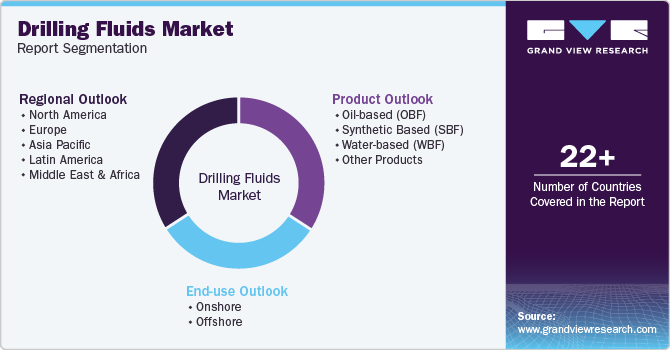
This report forecasts revenue and volume growth at global, regional, and country levels and provides an analysis of the latest industry trends in each of the sub-segments from 2021 to 2033. For the purpose of this study, Grand View Research has segmented the global drilling fluids market report on the basis of product, end-use, and region:
 To learn more about this report, Download Free Sample Report
-
Product Outlook (Revenue, USD Million, 2021 - 2033)
-
Oil-based (OBF)
-
Synthetic Based (SBF)
-
Water-based (WBF)
-
Other Products
-
-
End-use Outlook (Revenue, USD Million, 2021 - 2033)
-
Onshore
-
Offshore
-
-
Regional Outlook (Revenue, USD Million, 2021 - 2033)
-
North America
-
U.S.
-
Canada
-
Mexico
-
-
Europe
-
Germany
-
UK
-
France
-
Italy
-
Spain
-
Russia
-
Norway
-
-
Asia Pacific
-
China
-
India
-
Japan
-
South Korea
-
-
Latin America
-
Brazil
-
Argentina
-
-
Middle East & Africa
-
Saudi Arabia
-
South Africa
-
-
Research Methodology
The drilling fluids market figures in this report are based on a proven research process that combines executive interviews with secondary research from proprietary databases, company filings, and recognized regulatory and institutional sources. Market size is built through value-chain sizing - reconciling supply-side and demand-side estimates - and triangulated with bottom-up and top-down approaches. Every estimate passes multiple levels of expert validation before publication, with each drilling fluids segment quantified using the revenue-capture definitions in the table below.
Segment Definition
Segment – Product
Revenue capture definition
Oil-Based
Revenue generation is supported by increasing deployment in high-pressure and high-temperature drilling environments where superior lubrication, shale inhibition, and wellbore stability are essential for efficient hydrocarbon extraction.
Synthetic Based
Market expansion is driven by growing preference for environmentally compatible fluid systems that deliver high drilling performance, improved thermal stability, and reduced environmental impact in offshore and technically demanding operations.
Water-Based
Commercial growth is fueled by widespread utilization in conventional onshore drilling projects due to cost efficiency, regulatory acceptance, effective cuttings transport, and compatibility with a broad range of geological formations.
Other Products
Industry advancement is reinforced by demand for specialty drilling fluid formulations and performance-enhancing additives that optimize rheology, fluid loss control, corrosion protection, and drilling efficiency under diverse operating conditions.
Segment – End Use
Revenue capture definition
Onshore
Market demand is supported by extensive drilling activities across conventional and unconventional oil and gas fields, where fluid systems improve drilling performance, well integrity, and operational productivity while managing overall project costs.
Offshore
Business opportunities are strengthened by increasing investments in deepwater and ultra-deepwater developments requiring advanced drilling fluids capable of maintaining well control, thermal stability, and reliable performance under complex offshore conditions.
Estimation Model
Layer No.
Layer Name
Key Question
Description
01
Raw Material & Production Layer
What forms the supply base?
Assess global drilling fluids production based on the availability of base oils, synthetic fluids, water, bentonite, barite, polymers, emulsifiers, viscosifiers, lubricants, weighting agents, and specialty chemical additives. Evaluate fluid formulation, blending, quality control, storage, and distribution operations while analyzing raw material sourcing, production costs, formulation technologies, manufacturing capacity, and regional production hubs influencing global supply.
02
Application Adoption Layer
Where are drilling fluids consumed?
Examine the adoption of drilling fluids across major drilling environments, including onshore, offshore, deepwater, ultra-deepwater, conventional, and unconventional oil and gas operations. Market penetration is influenced by increasing drilling activity, demand for wellbore stability, efficient cuttings transport, pressure management, lubrication, thermal stability, and compliance with evolving environmental and operational standards.
03
Consumption Intensity Layer
How much drilling fluids are utilized?
Analyze utilization patterns by evaluating drilling fluid consumption across exploration, development, appraisal, and production wells. The assessment considers drilling depth, well complexity, rig activity, drilling techniques, fluid replacement cycles, regional exploration investments, and upstream development trends to estimate overall market consumption.
04
Revenue Layer
How is market revenue generated?
Market value is generated through the supply of oil-based, synthetic-based, water-based, and specialty drilling fluid systems to exploration and production companies, drilling contractors, and oilfield service providers. Commercial expansion is supported by increasing upstream investments, growing offshore and unconventional drilling activities, continuous innovation in high-performance fluid formulations, rising demand for operational efficiency, and the adoption of environmentally compliant drilling solutions that enhance well performance and long-term project economics.
Delivered Customizations
This report has been delivered with the following In-depth customizations
Client Request
Customization Delivered
Value Adds
Regional Segmentation
The study delivers detailed country-level analysis across major drilling fluids production and consumption markets. It evaluates raw material availability, blending capacity, supply chain dynamics, import-export trends, regulatory frameworks, pricing outlook, upstream oil and gas investments, and adoption across onshore, offshore, conventional, unconventional, deepwater, and ultra-deepwater drilling operations.
Enables stakeholders to identify high-growth regional markets, assess production competitiveness, understand regulatory requirements, optimize sourcing strategies, and prioritize investments based on drilling activity, exploration trends, and regional energy developments.
Competitive Benchmarking
The report provides a comprehensive benchmarking assessment of leading drilling fluids manufacturers, covering product portfolios, formulation capabilities, geographic presence, distribution networks, research and development initiatives, sustainability strategies, operational strengths, and recent strategic developments.
Helps businesses evaluate competitive positioning, identify technology gaps, benchmark innovation capabilities, support strategic collaborations, and strengthen long-term market expansion and product differentiation strategies.
Opportunity Assessment
The study evaluates emerging growth opportunities across environmentally compatible drilling fluids, high-performance fluid formulations, deepwater and ultra-deepwater exploration, horizontal and directional drilling, digital fluid monitoring technologies, and advanced waste management solutions. It also examines opportunities arising from unconventional resource development, stricter environmental standards, and investments in next-generation drilling technologies.
Assists companies in identifying high-growth application areas, aligning product innovation with industry requirements, optimizing investment decisions, accelerating technology commercialization, and enhancing long-term competitive advantage.
Frequently Asked Questions About This Report
Based on product, the water-based accounted for the highest market share, representing 53.4% of total revenue in 2025, due to its cost-effectiveness, ease of disposal, regulatory compliance, and widespread use across conventional onshore drilling operations requiring reliable wellbore stability and efficient cuttings transport.
By end-use, onshore held a dominant position, contributing 59.7% of total revenue in 2025, supported by extensive drilling activity across conventional and unconventional oil and gas fields, lower operational costs compared to offshore projects, and continuous investments in onshore exploration and production.
Asia Pacific is the fastest growing region with a CAGR of 5.2% in the forecast period. Increasing investments in offshore exploration, unconventional resource development, and expanding energy infrastructure across countries such as China, India, Indonesia, and Australia continue to accelerate drilling activities, strengthening regional demand for advanced drilling fluid solutions.
Water-Based is the fastest growing product segment with a CAGR of 4.9% in the forecast period. The segment is benefiting from increasing preference for environmentally compliant, cost-effective drilling solutions that offer efficient wellbore cleaning, effective pressure control, and compatibility with a wide range of geological formations across onshore and offshore operations.
Key market players in the global market include AkzoNobel N.V.; China Oilfield Services Ltd.; Baker Hughes, Inc.; CES Energy Solutions Corp.; Halliburton, Inc.; Newpark Resources, Inc. and others.
The drilling fluids market is primarily driven by increasing oil and gas exploration and production activities, particularly in offshore and unconventional reserves. Rising adoption of horizontal and directional drilling, coupled with the growing need for high-performance fluid systems that enhance drilling efficiency, wellbore stability, and operational safety, is further supporting market growth.
North America dominated the drilling fluids market with the highest revenue share of 25.2% in 2025, supported by extensive shale oil and gas development, high drilling activity, and continued investments in advanced onshore and offshore exploration projects.
The global drilling fluids market size was valued at USD 9.1 billion in 2025 and is estimated at USD 9.5 billion in 2026.
The global drilling fluids market is expected to grow at a CAGR of 4.4% from 2026 to 2033, reaching USD 12.8 billion by 2033.
About the Author(s)
Drilling & Extraction Equipments Research Team
Bulk Chemicals · Drilling & Extraction EquipmentsThis report was authored by the drilling & extraction equipments research team at Grand View Research - comprising two research analysts, one senior research analyst, and one industry expert - with specialized expertise in the drilling & extraction equipments segment of the bulk chemicals industry. All findings are based on proprietary bulk chemicals databases, executive interviews, and regulatory analysis, subject to internal peer review prior to publication.
Last Updated:
Speak to Analyst

Customize this report to your needs - add regions, segments, or data points, with 20% free customization.
Or view our licence options:


ISO 9001:2015 & 27001:2022 Certified
We are GDPR and CCPA compliant! Your transaction & personal information is safe and secure. For more details, please read our privacy policy.


