
- Home
- »
- Renewable Energy
- »
-
Dye Sensitized Solar Cell Market Size Report, 2026-2033GVR Report cover

Dye Sensitized Solar Cell Market (2026 - 2033)
Size, Share & Trends Analysis Report By Application (Portable Charging, BIPV/BAPV, Embedded Electronics, AIPV, Outdoor Advertising), By Region (North America, Europe, Asia Pacific, Latin America, Middle East & Africa), And Segment Forecasts
Market Size, 2025
$183.1MMarket Estimate, 2026
$205.4MMarket Forecast, 2033
$468.5MCAGR, 2026–2033
12.5%Dye Sensitized Solar Cell Market Summary
The global dye sensitized solar cell market size was valued at USD 183.1 million in 2025 and is projected to grow from USD 205.4 million in 2026 to USD 468.5 million by 2033, at a CAGR of 12.5% from 2026 to 2033. The market in Europe dominated with a revenue share of 37.8% in 2025. The increasing demand for renewable energy solutions is a primary driver for the adoption of dye-sensitized solar cells (DSSCs) as a viable alternative to traditional solar technologies.
 Source: Grand View Research, IR Documents, Primary Interviews, Paid DatabasesTo learn more about this report,
 Download Free Sample Report
 Key Market Trends & Insights
- By application: Portable charging segment held the largest market share of 33.5% in 2025.
- By application: BIPV/BAPV segment is projected to grow at the fastest CAGR over the forecast period.
Regional Highlights
- Largest regional market: Europe (37.8% revenue share, 2025)
- Fastest-growing regional market: Asia Pacific (highest CAGR, 2026-2033)
- By country: Germany held the largest market share in 2025.
Market Size & Forecast
- Market size in 2025: USD 183.1 Million
- Estimated market size in 2026: USD 205.4 Million
- Projected market size by 2033: USD 468.5 Million
- CAGR (2026-2033): 12.5%
Three ways to get this report
Buy it, customize it, or ask a question.Ask an Analyst
Analyst response in 1 business day
- AccessReport author, directly
- Reply timeWithin 1 working day
- No sales callDirect answer only
- FormatEmail reply
- CostFree, no cost
Get the Full Report
What the study covers
- FormatsPDF · Excel · Dashboard
- Timeline2026–2033 annual, 2025 base
- Coverage20+ countries, 5 regions
- Companies10+ key players profiled
Customize the Report
20% free customization
- IncludeCountries, segments, points
- TailorTo your product definition
- ExtendDeeper competitor detail
- OrA fully bespoke study
- Turnaround5–10 working days
Heightened awareness of climate change challenges has intensified the need for sustainable energy sources. In response, governments and organizations are encouraging investments in renewable energy technologies, underscoring the potential of DSSCs as an essential component in the transition towards greener energy solutions. To learn more about this report, Download Free Sample Report
 Technological advancements further bolster the DSSC market by enhancing efficiency and reducing production costs. Ongoing research and development efforts are pivotal in making DSSCs more competitive within the solar energy landscape. These improvements position DSSCs as an appealing option for consumers and businesses seeking to adopt innovative solar solutions. Moreover, the lightweight and flexible nature of DSSCs allows for seamless integration into diverse applications, such as building materials and portable devices, opening new avenues for growth.
Supportive government initiatives play a critical role in driving the adoption of DSSCs. For instance, the European Union aims to achieve a 55% reduction in greenhouse gas emissions by 2030, with initiatives such as the Green Deal promoting investments in renewable energy technologies, including solar solutions such as DSSCs. Similarly, Norway's government has announced plans to invest approximately USD 100 million in renewable energy projects, underlining its commitment to achieving carbon neutrality by 2030.
The Department of Energy’s Solar Energy Technologies Office in the U.S. has announced a funding opportunity of USD 50 million for solar technology research, which includes innovative solar cell technologies such as DSSCs. Such financial backing demonstrates the growing recognition of the importance of advancing solar technologies to enhance efficiency and cost-effectiveness. Moreover, the aesthetic appeal of DSSCs, with their potential for various colors and designs, makes them particularly suitable for applications where visual integration is critical, such as building-integrated photovoltaics (BIPV). This combination of factors positions the DSSC market for significant growth in the coming years.
Market Dynamics
The dye-sensitized solar cell (DSSC) market is primarily driven by the growing demand for efficient photovoltaic technologies for indoor energy harvesting, building-integrated photovoltaics (BIPV), and low-light applications. Unlike conventional silicon solar cells, DSSCs perform effectively under diffuse and artificial lighting conditions, making them suitable for powering Internet of Things (IoT) devices, wearable electronics, smart sensors, and portable consumer products. Increasing investments in renewable energy technologies, rising emphasis on energy-efficient buildings, and expanding adoption of self-powered electronic devices are supporting market growth. Furthermore, ongoing advancements in dye materials, solid-state electrolytes, flexible substrates, and manufacturing techniques are improving the efficiency, durability, and commercial viability of DSSCs, thereby creating favorable growth prospects across residential, commercial, and industrial applications.
The increasing deployment of IoT devices, wireless sensors, electronic shelf labels, wearable electronics, and smart consumer products is a major driver of the dye-sensitized solar cell market. Unlike conventional silicon solar cells, DSSCs can efficiently generate electricity under low-light and indoor illumination, including LED and fluorescent lighting. This unique capability enables continuous, maintenance-free power for low-energy electronic devices, reducing dependence on disposable batteries and supporting the growing trend toward self-powered systems. As industries accelerate digitalization and the development of smart infrastructure, the demand for reliable indoor photovoltaic technologies continues to grow.
Furthermore, the expansion of smart buildings, industrial automation, healthcare monitoring devices, and connected consumer electronics is creating significant opportunities for DSSC adoption. Governments and businesses are increasingly investing in energy-efficient technologies and sustainable building solutions, encouraging the integration of indoor photovoltaic systems into commercial and residential environments. Continuous advancements in dye materials, solid-state electrolytes, flexible substrates, and module design are further improving the efficiency, durability, and design flexibility of DSSCs, supporting their commercialization across a wider range of low-power applications and contributing to long-term market growth.
Despite their advantages in indoor and low-light applications, dye-sensitized solar cells face limitations due to their relatively lower power conversion efficiency and long-term stability compared to conventional crystalline silicon solar cells. Performance degradation due to electrolyte leakage, moisture ingress, UV exposure, and temperature fluctuations can shorten the operational lifespan of DSSCs, limiting their adoption in large-scale outdoor applications. Furthermore, the commercialization of advanced, solid-state, high-efficiency DSSCs requires continued research and development investments. At the same time, competition from rapidly improving silicon and perovskite solar technologies poses additional challenges to broader market penetration.
The growing adoption of building-integrated photovoltaics (BIPV), transparent solar windows, and flexible electronic devices presents significant growth opportunities for the dye-sensitized solar cell market. DSSCs can be manufactured in semi-transparent, lightweight, and aesthetically customizable designs, making them attractive for architectural glass, facades, skylights, and smart building applications. In addition, increasing demand for sustainable energy solutions in portable electronics, healthcare devices, and smart consumer products is creating new commercialization opportunities. Continuous innovations in solid-state electrolytes, advanced sensitizer dyes, and scalable manufacturing processes are expected to enhance product performance, reduce production costs, and expand the adoption of DSSCs across emerging photovoltaic applications during the forecast period.
Analyst Perspective
The dye-sensitized solar cell market is experiencing steady growth driven by increasing demand for indoor energy harvesting, building-integrated photovoltaics, and self-powered electronic devices. Rising adoption of Internet of Things sensors, wearable electronics, smart buildings, and low-power consumer devices is accelerating the commercialization of DSSC technology, particularly in applications where conventional silicon solar cells are less effective. Although relatively lower conversion efficiency, long-term stability concerns, and competition from silicon and perovskite photovoltaic technologies remain key challenges, continuous advancements in sensitizer dyes, solid-state electrolytes, and flexible photovoltaic designs are improving product performance and expanding commercial opportunities. Over the forecast period, companies that can enhance cell efficiency, improve durability, scale manufacturing, and strengthen partnerships across electronics, automotive, and construction industries are expected to reinforce their competitive position in the market.
Application Insights
Based on application, the portable charging segment led the market with the largest revenue share of 33.5% in 2025. As consumers increasingly seek sustainable options, portable charging devices utilizing DSSCs present a practical solution for harnessing solar energy to charge electronic devices while on the move. Their lightweight and flexible design enhances integration into various applications, meeting the rising demand stemming from smartphone usage and outdoor activities.
The BIPV/BAPV segment is projected to grow at the fastest CAGR of 13.0% over the forecast period. BIPV systems seamlessly incorporate solar technology into building materials such as facades and roofs, enabling energy generation while enhancing aesthetics and functionality. As urbanization and energy costs rise, the demand for BIPV/BAPV solutions increases, supporting global efforts to reduce carbon footprints and promote renewable energy adoption in both residential and commercial sectors.
Regional Insights
North America dye sensitized solar cell market held substantial market share in 2025. As consumers increasingly pursue sustainable solutions, DSSCs present a flexible and visually appealing choice for portable devices and BIPV applications. Government incentives promoting clean energy adoption enhance the efficiency and competitiveness of DSSCs in the region.
 To learn more about this report, Download Free Sample Report
 U.S. Dye Sensitized Solar Cell Market Trends
The dye sensitized solar cell market in the U.S. is expected to grow lucratively in the forecast period. The U.S. Department of Energy has invested in research to advance innovative solar technologies, including DSSCs, focusing on efficiency improvements and cost reductions. Escalating consumer demand for sustainable energy and a heightened emphasis on energy independence and carbon footprint reduction further stimulate market growth.
Europe Dye Sensitized Solar Cell Market Trends
Europe dominated the dye sensitized solar cell market with the largest revenue share of 37.8% in 2025. European countries are substantially investing in innovative solar technologies, including DSSCs, to achieve ambitious climate objectives. The EU's goal of significant greenhouse gas emission reductions by 2030 fuels the demand for aesthetically appealing and efficient solar solutions, particularly in BIPV.
The dye sensitized solar cell market in Germany held the largest share in the Europe region in 2025. Germany's Energiewende policy prioritizes reducing carbon emissions and enhancing renewable energy’s share in the energy mix. This conducive regulatory framework promotes investments in advanced solar technologies, such as DSSCs, while robust R&D capabilities drive innovation in efficiency and architectural integration for diverse applications.
Asia Pacific Dye Sensitized Solar Cell Market Trends
Asia Pacific dye sensitized solar cell market is expected to register the fastest CAGR of 13.6% in the forecast period. Countries such as Japan and South Korea are leading the way in adopting innovative solar technologies, including DSScs, as part of their strategies to reduce carbon emissions and enhance energy efficiency. The lightweight and flexible nature of DSSCs makes them suitable for diverse applications.
The dye sensitized solar cell market in China dominated the Asia Pacific dye sensitized solar cell market in 2025. China is substantially investing in research and development of DSSCs to improve efficiency and lower production costs. The government’s commitment to carbon neutrality by 2060 fosters innovation in clean energy solutions, positioning DSSCs as a viable option for portable electronics and BIPV applications.
Key Dye Sensitized Solar Cell Company Insights
Some key companies operating in the market include Fujikura Ltd., Solaronix SA, Dyenamo AB, Ricoh, SHARP CORPORATION, and DYESOL COLOR WORKS PVT. LTD., among others. Industry players are prioritizing innovation and strategic partnerships, with companies investing in R&D to improve the efficiency and cost-effectiveness of DSSCs while collaborating with research institutions to develop advanced materials.
-
Fujikura Ltd. specializes in advanced solar technologies, including DSSCs, by producing high-quality materials and components that enhance solar cell efficiency and performance. The company's innovations facilitate the integration of DSSCs into diverse applications, fostering the adoption of renewable energy.
-
Ricoh utilizes its expertise in imaging and electronics to create innovative solar solutions. The company explores varied DSSC applications, promoting sustainability and aesthetic integration.
Key Dye Sensitized Solar Cell Companies:
The following key companies have been profiled for this study on the dye sensitized solar cell market.
-
Fujikura Ltd.
-
Solaronix SA
-
Dyenamo AB
-
Ricoh
-
SHARP CORPORATION
-
DYESOL COLOR WORKS PVT. LTD.
-
Peccell Technologies, Inc.
-
National Institute for Materials Science
-
Commonwealth Scientific and Industrial Research Organisation (CSIRO)
-
Everlight Chemical Industrial Co.
-
Nissha Co., Ltd.
-
Exeger Operations AB
Competitive Benchmarking
Category
Operating Strategies
Competitive Edge
Weakness
Established Players (e.g., Exeger Operations AB, Fujikura Ltd., Ricoh Company, Ltd., Sharp Corporation, Nissha Co., Ltd.)
- Focus on the commercialization of dye sensitized solar cells for indoor energy harvesting, building-integrated photovoltaics (BIPV), and consumer electronics.
- Emphasize continuous investments in research and development, strategic partnerships with electronics and automotive manufacturers, large-scale manufacturing capabilities, and proprietary photovoltaic technologies to strengthen market position.
- Benefit from strong technological expertise, extensive intellectual property portfolios, established customer relationships, and advanced manufacturing capabilities.
- Broad commercialization experience, financial resources, and integration capabilities support product innovation, large-scale deployment, and global market expansion.
- Face high research and development costs, lengthy commercialization cycles, and challenges associated with improving efficiency and long-term stability.
- Market growth is constrained by competition from mature silicon and emerging perovskite photovoltaic technologies, as well as relatively limited large-scale commercial adoption.
Emerging & Specialized Players (e.g., Solaronix SA, Peccell Technologies, Inc., Everlight Chemical Industrial Corporation, Dyenamo AB, Greatcell Energy Pty Ltd.)
- Focus on the development of advanced DSSC materials, sensitizing dyes, electrolytes, nanomaterials, and customized photovoltaic solutions for specialized applications.
- Emphasize material innovation, collaborative research projects, customer-specific product development, and supplying critical components to DSSC manufacturers and research institutions.
- Benefit from specialized technical expertise, innovative material technologies, and the flexibility to rapidly develop customized solutions for emerging applications.
- Strong collaboration with research organizations and technology developers supports continuous product innovation and early adoption of next-generation DSSC materials.
- Limited manufacturing scale and narrower commercial reach compared to established companies may restrict market penetration.
- Business growth depends on broader commercialization of DSSC technology, continued research funding, strategic partnerships, and increasing demand across emerging photovoltaic applications.
Recent Developments:
- In September 2023, Exeger announced an exclusive partnership with a leading computer peripherals company, securing its position as the sole supplier of Powerfoyle solar cells to enhance sustainability and product reliability.
Dye Sensitized Solar Cell Market Report Scope
Report Attribute
Details
Market definition
The global Dye Sensitized Solar Cell Market refers to the revenue generated from the sales of dye-sensitized solar cell modules, panels, and integrated photovoltaic products used for indoor energy harvesting, building-integrated photovoltaics, portable electronics, smart sensors, wearable devices, and other low-light power generation applications across residential, commercial, and industrial sectors.
Market size in 2025
USD 183.1 million
Estimated market size in 2026
USD 205.4 million
Projected market size by 2033
USD 468.5 million
Growth rate
CAGR of 12.5% from 2026 to 2033
Base year for estimation
2025
Historical data
2021 - 2024
Forecast period
2026 - 2033
Quantitative units
Revenue in USD million and CAGR from 2026 to 2033
Report coverage
Revenue forecast, company ranking, competitive landscape, growth factors, and trends
Segments covered
Application, region.
Regional scope
North America; Europe; Asia Pacific; Latin America; Middle East & Africa
Country scope
U.S, Germany, UK, France, India, China, Japan, Brazil, South Africa
Key companies profiled
Exeger Operations AB, Fujikura Ltd., Solaronix SA, Ricoh Company, Ltd., Sharp Corporation, Peccell Technologies, Inc., Nissha Co., Ltd., Everlight Chemical Industrial Corporation, Dyenamo AB, and Greatcell Energy Pty Ltd.
Customization scope
Free report customization (equivalent up to 8 analysts' working days) with purchase. Addition or alteration to country, regional & segment scope.
Pricing and purchase options
Avail customized purchase options to meet your exact research needs. Explore purchase options
Global Dye Sensitized Solar Cell Market Report Segmentation
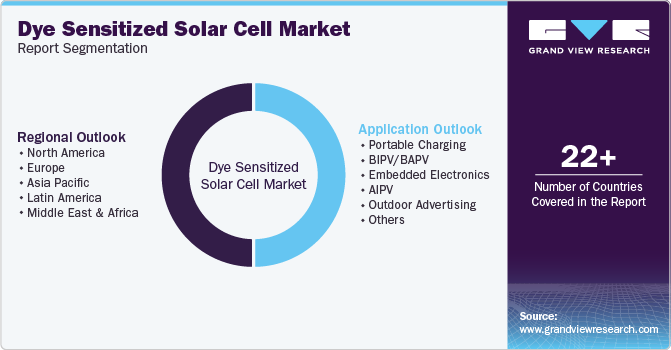
This report forecasts revenue growth at global, regional, and country levels and provides an analysis of the latest industry trends in each of the sub-segments from 2021 to 2033. For this study, Grand View Research has segmented the global dye sensitized solar cell market report based on application and region:
 To learn more about this report, Download Free Sample Report
 -
Application Outlook (Revenue, USD Million, 2021 - 2033)
-
Portable Charging
-
BIPV/BAPV
-
Embedded Electronics
-
AIPV
-
Outdoor Advertising
-
Others
-
-
Regional Outlook (Revenue, USD Million, 2021 - 2033)
-
North America
-
U.S.
-
-
Europe
-
Germany
-
UK
-
France
-
-
Asia Pacific
-
China
-
India
-
Japan
-
-
Latin America
-
Middle East & Africa
-
Research Methodology
The dye sensitized solar cell market figures in this report are based on a proven research process that combines executive interviews with secondary research from proprietary databases, company filings, and recognized regulatory and institutional sources. Market size is built through value-chain sizing - reconciling supply-side and demand-side estimates - and triangulated with bottom-up and top-down approaches. Every estimate passes multiple levels of expert validation before publication, with each dye sensitized solar cell segment quantified using the revenue-capture definitions in the table below.
Segment Definition
Application
Revenue Capture Definition
Portable charging
This segment includes dye-sensitized solar cells integrated into portable chargers, power banks, backpacks, wearable accessories, and other mobile charging solutions. Market revenue is attributable to the manufacturing and sale of DSSC modules, integrated charging products, component supply, product integration, and related commercial sales for portable energy-harvesting applications.
BIPV/BAPV
This segment comprises dye-sensitized solar cells incorporated into Building-Integrated Photovoltaics (BIPV) and Building-Applied Photovoltaics (BAPV), including photovoltaic windows, facades, skylights, and architectural glass. Revenue is generated through the sale of DSSC modules, integrated building materials, system components, project-based product supply, and associated photovoltaic integration solutions.
Embedded electronics
DSSCs are used as integrated power sources for embedded electronics, including IoT sensors, electronic shelf labels, smart cards, medical devices, industrial monitoring systems, and consumer electronics operating under indoor lighting conditions. Revenue capture includes the sale of DSSC cells, customized photovoltaic modules, integrated electronic components, and embedded energy-harvesting solutions.
Outdoor advertising
This segment includes DSSCs integrated into outdoor advertising displays, digital signage, information boards, bus shelters, and illuminated commercial installations that utilize supplemental solar power. Market revenue comprises the sale of DSSC modules, customized photovoltaic panels, integrated display components, and related energy-harvesting solutions for advertising infrastructure.
AIPV
This segment includes Automotive-Integrated Photovoltaics, where dye-sensitized solar cells are integrated into vehicle roofs, sunroofs, body panels, and auxiliary electronic systems to provide supplemental power for automotive applications. Revenue is generated through the sale of DSSC modules, vehicle-integrated photovoltaic components, OEM supply agreements, and related automotive energy-harvesting solutions.
Others
This segment includes other applications of dye-sensitized solar cells, such as agricultural monitoring devices, smart packaging, educational products, aerospace electronics, research applications, and specialty low-power energy-harvesting systems. Revenue is generated through the manufacturing, supply, customization, and commercial sale of DSSC products for niche and emerging applications.
Estimation Model
Layer Name
Key Question
Description
Photovoltaic Application Demand Base Layer
What forms the demand base?
Identify the global demand for dye sensitized solar cells across applications requiring efficient energy harvesting under indoor, low-light, and diffuse lighting conditions. Assess deployment across portable charging devices, building-integrated and building-applied photovoltaics (BIPV/BAPV), embedded electronics, outdoor advertising, automotive-integrated photovoltaics (AIPV), and other emerging applications to establish the addressable market opportunity.
DSSC Manufacturing & Supply Layer
Where are dye sensitized solar cells produced and supplied?
Estimate the production capacity of dye sensitized solar cell modules, panels, and integrated photovoltaic products across key regions. Analyze manufacturing capabilities, material availability, technology providers, supply chain infrastructure, and distribution networks to evaluate product availability and commercial supply dynamics.
Application Adoption Layer
How extensively are dye sensitized solar cells utilized?
Analyze the adoption of dye sensitized solar cells across portable charging, BIPV/BAPV, embedded electronics, outdoor advertising, automotive-integrated photovoltaics (AIPV), and other applications. Evaluate technology suitability, indoor energy harvesting requirements, product integration, efficiency characteristics, and end-user adoption trends influencing DSSC deployment.
Revenue Layer
How is market revenue generated?
Expenditures on dye sensitized solar cell modules, integrated photovoltaic products, customized energy-harvesting solutions, and related system integration activities quantify market revenue. Product shipments, module pricing, commercial deployments, technology integration, and application-specific adoption across end-use industries drive the overall market value.
Delivered Customizations
This report has been delivered with the following In-depth customizations
Client Request
Customization Delivered
Value Adds
Dye Sensitized Solar Cell Competitive Landscape Assessment
Detailed competitive landscape analysis covering manufacturers, technology developers, and material suppliers of dye sensitized solar cells (DSSCs). The study profiled key market participants based on geographic presence, organizational structure, product portfolio, manufacturing capabilities, technology expertise, strategic partnerships, commercialization activities, and investments in product development and production expansion.
Enabled evaluation of competitive positioning, technological capabilities, commercialization strategies, partnership networks, and market participation across the dye sensitized solar cell value chain.
Application & Technology Assessment
Evaluation of global DSSC demand across portable charging, building-integrated/building-applied photovoltaics (BIPV/BAPV), embedded electronics, outdoor advertising, automotive-integrated photovoltaics (AIPV), and other applications. Included assessment of cell architectures, sensitizer materials, indoor energy harvesting technologies, product integration trends, commercialization progress, and regional adoption patterns across key markets.
Highlighted application trends, technology adoption patterns, and regional growth opportunities. Supported strategic planning, product portfolio optimization, technology commercialization strategies, and market entry evaluation across emerging photovoltaic applications.
Opportunity Assessment
Identification of high-growth opportunities associated with indoor photovoltaics, IoT-enabled devices, smart buildings, transparent photovoltaic glazing, wearable electronics, and automotive-integrated photovoltaic solutions. Assessed emerging opportunities arising from advancements in sensitizer dyes, solid-state electrolytes, flexible DSSC designs, and increasing investments in sustainable energy harvesting technologies.
Enabled prioritization of high-growth application areas and emerging commercialization opportunities. Supported long-term business planning, research and development strategies, partnership initiatives, manufacturing expansion, and investment decisions aligned with evolving photovoltaic technology trends.
Frequently Asked Questions About This Report
The global dye sensitized solar cell market size was valued at USD 183.1 million in 2025 and is estimated at USD 205.4 million for 2026.
The key driver of the global dye sensitized solar cell market is the increasing demand for indoor energy harvesting and low-light photovoltaic solutions across IoT devices, embedded electronics, smart buildings, and portable electronic applications.
The portable charging segment led with a 33.5% revenue share in 2025.
Europe dominated the market with revenue share of 37.8% in 2025.
Germany dominated the Europe market with a revenue share of 38.8% in 2025.
Asia Pacific is anticipated to register the fastest CAGR of 13.6% over the forecast period.
Based on application, the BIPV/BAPV segment is projected to be the fastest-growing segment, registering a CAGR of 13.0% during the forecast period.
The global dye sensitized solar cell market is expected to grow at a CAGR of 12.5% from 2026 to 2033, reaching USD 468.5 million by 2033.
The key players operating in the dye-sensitized solar cell market include Exeger Operations AB, Fujikura Ltd., Solaronix SA, Ricoh Company, Ltd., Sharp Corporation, Peccell Technologies, Inc., Nissha Co., Ltd., Everlight Chemical Industrial Corporation, Dyenamo AB, and Greatcell Energy Pty Ltd.
About the Author(s)
Renewable Energy Research Team
Energy & Power · Renewable EnergyThis report was authored by the renewable energy research team at Grand View Research - comprising two research analysts, one senior research analyst, and one industry expert - with specialized expertise in the renewable energy segment of the energy & power industry. All findings are based on proprietary energy & power databases, executive interviews, and regulatory analysis, subject to internal peer review prior to publication.
Last Updated:
Speak to Analyst

Customize this report to your needs - add regions, segments, or data points, with 20% free customization.
Or view our licence options:


ISO 9001:2015 & 27001:2022 Certified
We are GDPR and CCPA compliant! Your transaction & personal information is safe and secure. For more details, please read our privacy policy.


