
- Home
- »
- Automotive & Transportation
- »
-
E-Bike Market Size, Share And Trends Report, 2026-2033GVR Report cover

E-Bike Market (2026 - 2033)
Size, Share & Trends Analysis Report By Drive (Belt Drive, Chain Drive), By Battery (Lead-acid Battery, Lithium-ion Battery), By End Use (Personal, Commercial), By Region (North America, Europe, APAC, Latin America, MEA), And Segment Forecasts
Market Size, 2025
$69.7BMarket Estimate, 2026
$77.9BMarket Forecast, 2033
$144.3BCAGR, 2026–2033
9.2%E-Bike Market Summary
The global e-bike market size was valued at USD 69.7 billion in 2025 and is projected to grow from USD 77.9 billion in 2026 to USD 144.3 billion by 2033, at a CAGR of 9.2% from 2026 to 2033. The Asia Pacific e-bike market accounted for a 58.7% share of the overall market in 2025. The market is expanding rapidly as governments and urban planners increasingly promote sustainable transportation solutions to reduce traffic congestion and carbon emissions.
 Source: Grand View Research, IR Documents, Primary Interviews, Paid DatabasesTo learn more about this report,
 Download Free Sample Report
 Key Market Trends & Insights
- By drive: Chain drive segment accounted for the largest share of 88.9% in 2025.
- By battery type: lithium-ion battery segment held the largest market share in 2025.
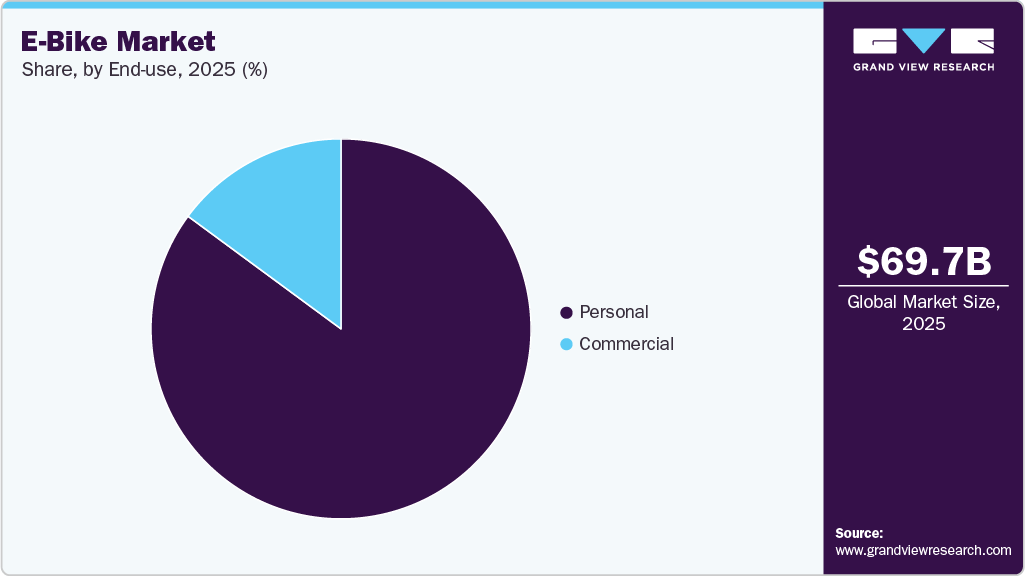
- By end use: Personal segment led the market with the largest revenue share of 85.1% in 2025.
Regional Highlights
- Largest regional market: Asia Pacific (58.7% revenue share, 2025)
- By country: The China held the largest market share in 2025.
Market Size & Forecast
- Market size in 2025: USD 69.7 Billion
- Estimated market size in 2026: USD 77.9 Billion
- Projected market size by 2033: USD 144.3 Billion
- CAGR (2026-2033): 9.2%
GVR research-powered AIAsk Prism AI about the E-Bike marketGet cited answers from GVR research on market growth, segments, regulations and forecasts.Start with✓ Source-linked answers ✓ Market-specific context ✓ Traceable figuresExplore Prism AI ↗
Electric bicycles provide an eco-friendly alternative to conventional vehicles by offering efficient short-distance mobility with significantly lower environmental impact. As cities invest in smart mobility initiatives and low-emission transport networks, the adoption of electric bikes for daily commuting and urban mobility continues to accelerate worldwide. This growing demand for sustainable transportation solutions is expected to remain a key driver for the global e-bike market over the forecast period.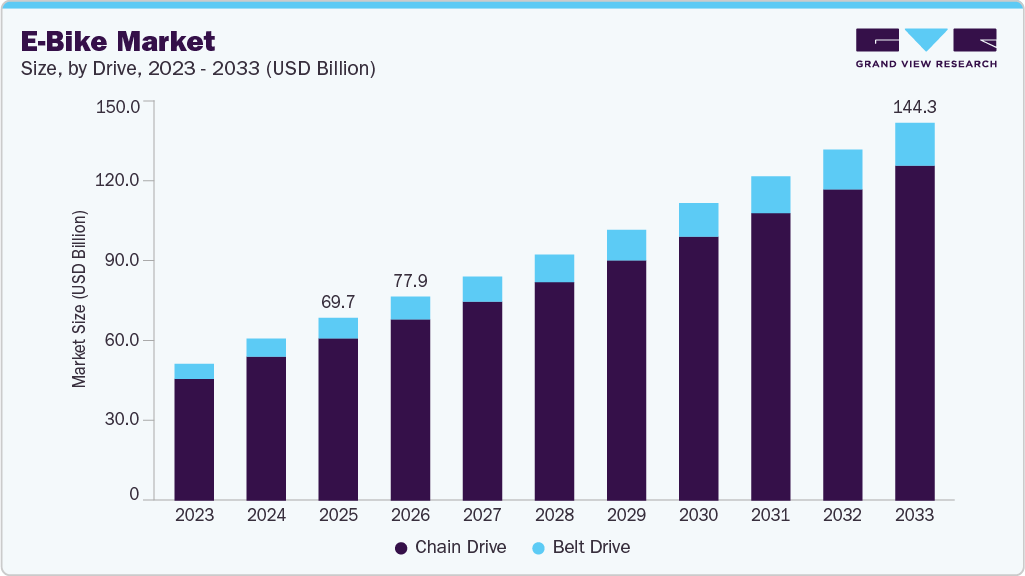 To learn more about this report, Download Free Sample Report
 The rapid growth of micro-mobility services and bike-sharing platforms is significantly accelerating the adoption of electric bicycles across major urban centers. Shared mobility operators are deploying large fleets of e-bikes integrated with mobile applications, enabling commuters to access convenient and affordable transportation options for short-distance travel. The integration of Mobility-as-a-Service (MaaS) platforms, digital payment systems, and GPS-enabled fleet management tools is further increasing the accessibility and utilization of shared e-bikes. As cities adopt integrated transportation ecosystems, the role of shared electric bikes in urban mobility networks is expected to expand substantially.
Continuous advancements in lithium-ion battery technology and electric drive systems are improving the efficiency, performance, and range of modern electric bicycles. Innovations in lightweight batteries, high-torque mid-drive motors, and energy-efficient power management systems enabling e-bikes to travel longer distances with improved durability. In addition, the integration of IoT connectivity and smart monitoring systems allows riders to track battery levels, riding patterns, and maintenance needs through mobile applications. These technological developments are making electric bicycles more reliable and appealing for both recreational riders and urban commuters.
Government policies supporting electric mobility and sustainable transportation are playing a major role in driving the e-bike market worldwide. Several countries have introduced subsidies, tax credits, and purchase incentives to reduce the upfront cost of electric bicycles and encourage consumers to shift toward eco-friendly transportation options. In addition, investments in dedicated cycling lanes, bike-sharing infrastructure, and smart urban mobility systems are improving safety and convenience for riders.
Rising fuel prices and increasing urban congestion are encouraging consumers to adopt cost-efficient personal mobility solutions, further supporting the growth of the e-bike market. Compared with cars and motorcycles, e-bikes offer significantly lower operating and maintenance costs while providing faster travel in congested urban environments. Their affordability, combined with health and lifestyle benefits such as assisted cycling and reduced physical strain, is attracting a broader consumer base. As urban populations grow and commuting patterns evolve, electric bicycles are becoming an increasingly attractive alternative for both daily transportation and recreational cycling.
Market Dynamics
The adoption of advanced battery systems and smart connectivity technologies is driving e-bike market growth, as manufacturers prioritize riding efficiency, safety, and user experience. Modern e-bikes now feature GPS tracking, anti-theft systems, smartphone app integration, and real-time performance monitoring. In 2025, several premium models began incorporating vehicle-to-vehicle (V2X) communication, allowing e-bikes to interact with nearby vehicles to enhance urban safety and navigation. These innovations are increasing consumer interest in connected, technology-enabled electric mobility.
Advancements in battery technology are extending e-bike range and improving charging speed. Various companies introduced solid-state batteries offering over 100 miles of range and greater energy efficiency. For instance, Mihogo Ebikes launched the Air750 Max with a carbon-fiber frame, smart power management, and a 750W motor. Its utility e-bikes support up to 167 miles of range, while compact models like the Mihogo Mini achieve up to 62 miles through efficient energy management. These trends underscore the growing integration of smart connectivity and high-performance batteries in the e-bike industry.
The high initial purchase cost remains a significant barrier to the e-bike market, largely due to the cost of components and advanced engineering. Battery packs are among the most costly components, often accounting for 25–50% of the total product cost, depending on capacity and quality. Premium e-bikes use high-density lithium-ion cells from established suppliers and advanced Battery Management Systems (BMS) to enhance safety and battery life. Additional features such as lightweight aluminum alloy frames, brushless DC motors, smart connectivity, and regenerative braking further increase manufacturing and retail prices.
Moreover, compliance with strict safety and certification standards also increases production costs. Manufacturers invest in certifications and testing to ensure battery safety, electrical system reliability, and product durability, thereby minimizing risks. Features like GPS tracking, anti-theft systems, water-resistant components, and IoT-enabled monitoring further raise prices, particularly for premium models. Thus, despite lower long-term operating costs and environmental benefits, the high upfront investment for advanced e-bikes continues to limit adoption among price-sensitive consumers and in emerging markets.
The growth of last-mile delivery and urban logistics is driving significant opportunities in the e-bike market, fueled by rapid e-commerce expansion and evolving consumer expectations. Online shopping now accounts for more than 20% of global retail sales, significantly increasing the volume of urban deliveries and intensifying demand for fast, efficient, and cost-effective transportation solutions. As consumers expect same-day and rapid delivery, logistics providers are adopting agile mobility solutions that can efficiently navigate dense urban areas.
In addition, companies are increasingly using electric bikes and cargo e-bikes in last-mile delivery to improve speed, reduce costs, and minimize environmental impact. E-bikes lower fuel dependency and require less maintenance than traditional vehicles. Expanding cycling infrastructure and urban mobility initiatives are also supporting e-bike adoption in logistics, food delivery, grocery distribution, and courier services, creating long-term growth opportunities for manufacturers and fleet operators.
Market Concentration & Characteristics
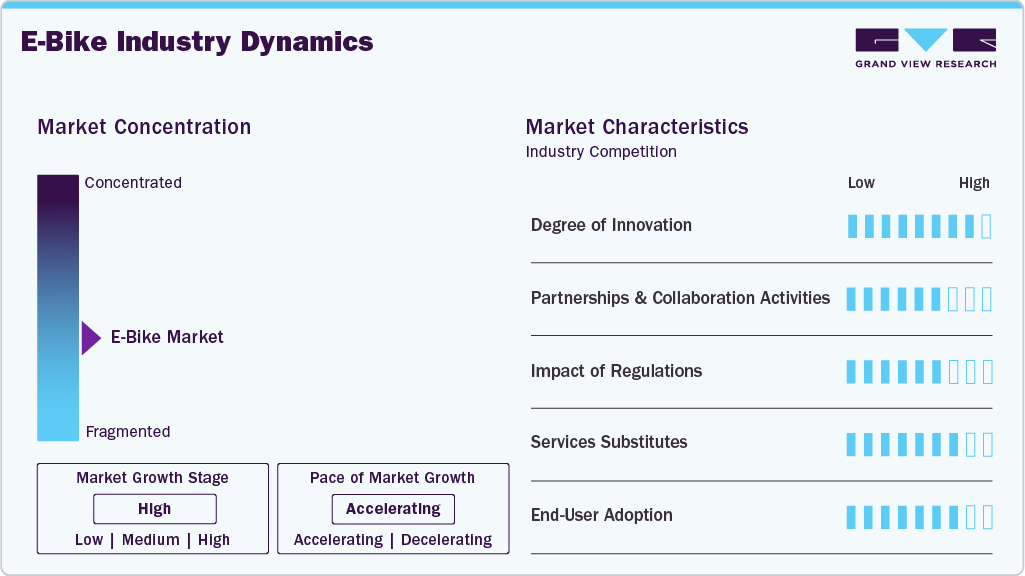
The E-bike market is moderately fragmented, with a mix of global leaders, established bicycle manufacturers, and fast-growing regional electric mobility players. Companies such as Giant Manufacturing Co. Ltd., Yadea Group Holdings Ltd., Merida Industry Co. Ltd, and Trek Bicycle Corporation hold strong positions in the global market due to their extensive product portfolios and strong brand recognition. Similarly, players such as Accell Group N.V., Brompton Bicycle Ltd., Yamaha Motor Company, Pedego Electric Bikes, and Aima Technology Group Co., Ltd. further diversify the competitive landscape across premium, urban mobility, and mass-market segments. This broad participation across multiple price points and geographies contributes to a balanced and competitive market structure.
 To learn more about this report, Download Free Sample Report
 The e-bike industry is highly innovation-led and consumer-driven, with continuous advancements in battery efficiency and smart connectivity features shaping product differentiation. The market is strongly influenced by urbanization trends, sustainability goals, and government incentives promoting clean mobility solutions. In addition, increasing adoption across commuting and recreational cycling is intensifying competition and encouraging manufacturers to focus on performance, design innovation, and affordability to capture evolving consumer demand.
Drive Insights
The chain drive segment dominated the market in 2025 with the largest revenue share of 88.9%. The dominance of the chain drive segment in the market is attributed to its proven reliability, cost-effectiveness, and widespread familiarity among manufacturers and consumers. Efficient power transmission is offered by chain drives, making them suitable for diverse riding conditions, including steep terrains and long-distance commutes. Maintenance is simplified due to their modular design, which also ensures compatibility with existing bicycle frameworks.
The belt drive segment is expected to grow at the fastest CAGR during the forecast period, driven by superior durability, minimal maintenance, and a quieter riding experience. Belt drives are operated without lubrication, reduce wear and ensure cleaner performance, which appeals urban and premium consumers. Advancements in carbon-reinforced belts have enhanced strength and longevity, making them competitive. Their compatibility with mid-drive motors and integration into modern designs further support their adoption, especially in high-end e-bikes. Demand for low-maintenance solutions continues to drive this segment's expansion.
Battery Insights
The lithium-ion battery segment held the largest market share in 2025 and is anticipated to grow at the fastest rate during the forecast period. The growth can be attributed to its superior energy density, lightweight design, and long lifecycle compared to traditional battery technologies. Its ability to deliver extended range and faster charging has made it the preferred choice for manufacturers and consumers alike. Ongoing advancements in battery chemistry, including improved thermal stability and safety, have further strengthened its position in the market. In addition, decreasing production costs and expanding battery recycling initiatives are driving broader adoption, particularly in premium and mid-range e-bike models, solidifying lithium-ion's dominance in the market.
The lead-acid battery segment is experiencing slow growth in the market, hindered by its heavier weight, shorter lifespan, and lower energy density compared to lithium-ion alternatives. However, its low cost continues to make it a viable option for entry-level e-bikes in price-sensitive regions, particularly in emerging markets. In addition, its widespread availability and established recycling infrastructure provide some growth momentum. Despite these factors, environmental concerns and the market's shift toward advanced battery technologies limit its overall potential in the evolving e-bike landscape.
End Use Insights
The personal segment dominated the market in 2025, driven by increasing consumer preference for convenient, cost-effective, and eco-friendly transportation solutions. E-bikes are widely adopted for urban commuting, fitness, and recreational purposes, offering flexibility and independence to individual users. Technological advancements, such as long-range batteries and lightweight designs, have further enhanced their appeal, particularly in densely populated cities. In addition, higher fuel costs and the shift toward sustainable mobility have amplified demand for the adoption of e-bikes for daily commutes, fueling the segment.
 To learn more about this report, Download Free Sample Report
 The commercial segment is expected to grow at the fastest CAGR during the forecast period. The increasing adoption of e-bikes for last-mile delivery, logistics, and public transportation services drives the segment's growth. Businesses are turning to e-bikes as an efficient, cost-effective, and environmentally friendly alternative to traditional delivery vehicles, particularly in urban areas where traffic congestion and environmental regulations are significant concerns. The rise of e-commerce and demand for faster, more sustainable delivery solutions have accelerated the adoption of e-bikes in commercial fleets. In addition, government incentives and the development of specialized e-bikes for cargo and delivery further fuel the expansion of the commercial segment.
Regional Insights
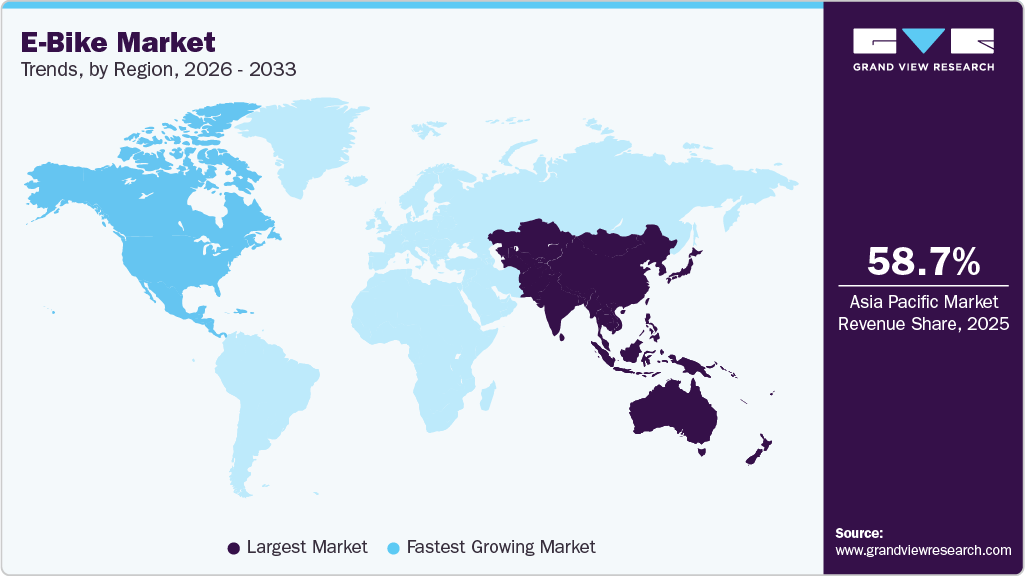
Asia Pacific e-bike market dominated the global industry in 2025 and accounted for 58.7% The region benefits from a strong manufacturing base, cost-effective production, and high population density. Governments in countries such as India and Japan are promoting e-bike adoption through subsidies and infrastructure development. Urban congestion and rising environmental concerns are further driving the market, with lightweight and foldable e-bikes gaining popularity in metropolitan areas.
 To learn more about this report, Download Free Sample Report
 The e-bike market in China dominates the APAC market, accounting for the largest global share in production and consumption. The government's push for electric vehicles to combat pollution, combined with a well-established supply chain, drives growth. Affordable pricing and extensive adoption in urban and semi-urban areas make e-bikes the preferred mode of transportation for daily commutes. The development of high-tech e-bikes with advanced battery systems and connectivity features is further strengthening China's market position.
North America E-Bike Market Trends
The e-bike market in North America is witnessing the fastest growth during the forecasted period, fueled by increasing environmental consciousness and government incentives to promote sustainable transportation. Urban commuting and recreational use are key drivers, with a strong emphasis on e-mountain bikes and city bikes. The market benefits from improving cycling infrastructure and the rising adoption of e-bikes among fitness enthusiasts. While the U.S. leads the region in terms of revenue, challenges like high upfront costs and limited awareness in certain demographics persist.
U.S. E-Bike Market Trends
E-bike market in the U.S.accounts for a significant share of North America, driven by growing interest in micro-mobility solutions and rising fuel costs. The demand is concentrated in urban areas, where e-bikes are increasingly seen as viable alternatives to traditional commuting methods. Premium e-bike brands dominate, although entry-level models are gaining traction among first-time buyers. State-level subsidies and tax credits are further accelerating adoption, particularly in states such as California and New York.
Europe E-Bike Market Trends
The e-bike market in Europe represents one of the fastest-growing global markets, supported by government policies promoting eco-friendly transportation and expanding cycling infrastructure. The adoption of e-bikes spans urban commuting, leisure, and cargo transportation, with Germany and the UK leading the charge. High disposable incomes, coupled with a strong focus on sustainable living, have fueled demand for premium and mid-range e-bikes. Robust distribution networks and a preference for high-performance models also support the market.
The UK e-bike market is growing rapidly, driven by increasing investments in cycling infrastructure and rising consumer awareness of eco-friendly mobility. The demand for e-bikes is particularly strong in urban areas, where they are used for commuting and delivery services. Government incentives, such as subsidies and cycling-to-work schemes, are further accelerating adoption. Premium e-bike brands dominate the market, with a growing emphasis on lightweight and foldable models to cater to urban riders.
The e-bike market in Germany stands as the largest in Europe, bolstered by strong consumer demand and a mature cycling culture. The country leads in innovation, with manufacturers focusing on high-performance e-bikes equipped with advanced motor systems and long-range batteries. Cargo e-bikes are gaining significant traction in the logistics sector, driven by rising urbanization and the need for efficient delivery solutions. Favorable government policies and a well-established cycling infrastructure further support market growth.
Key E-Bike Company Insights
Some of the key companies in the market include Yadea Technology Group Co., Ltd., Giant Manufacturing Co., Ltd, Accell Group N.V., Pedego Electric Bikes, Yamaha Motor Company, and others. Prominent players in the market adopt various growth strategies, such as geographic expansion and new product launches, to strengthen their market presence. Moreover, they focus on enhancing their existing product offerings and improving brand awareness to gain a competitive edge in the market. Leading players also take initiatives such as mergers and acquisitions, agreements and contracts, and partnerships with technology companies.
-
Yadea Technology Group Co., Ltd. manufactures electric two-wheelers, including electric motorcycles, mopeds, bicycles, and kick scooters. The company’s extensive product range is designed to cater to the growing demand for eco-friendly transportation solutions. The company has successfully expanded its market presence to over 100 countries. The company has a network of more than 4,000 distributors and 40,000 retailers.
-
Giant Manufacturing Co. Ltd. is a global manufacturer of bicycles, e-bikes, and related products. The company has expanded its portfolio to include e-bikes, with advanced designs and technologies that cater to urban commuters, fitness enthusiasts, and cyclists seeking high-performance models. The company has a strong global presence, with production facilities in Asia, Europe, and the U.S., and continues to lead the market through its commitment to sustainability, cutting-edge designs, and technological advancements in cycling.
Key E-Bike Companies:
The following key companies have been profiled for this study on the e-bike market.
- Giant Manufacturing Co. Ltd.
- Yadea Group Holdings Ltd.
- Pedego Electric Bikes
- Merida Industry Co. Ltd
- Trek Bicycle Corporation
- Accell Group N.V.
- Brompton Bicycle Ltd.
- Yamaha Motor Company
- Pon.Bike
- Aima Technology Group Co., Ltd.
Competitive Benchmarking
Operating Strategies
Competitive Edge
Weaknesses
Mature Players: Giant Manufacturing Co. Ltd.; Merida Industry Co. Ltd; Accell Group N.V.; Trek Bicycle Corporation; Yamaha Motor Company; Pon.Bike; Brompton Bicycle Ltd.
- Focus on expanding global presence through strong distribution networks and dealership expansion
- Invest in R&D for battery efficiency, lightweight frames, and smart e-bike technologies
- Strong brand recognition and established global supply chains
- Wide product portfolios across premium, commuter, and performance e-bikes
- High product portfolio complexity increases operational challenges
- Slower adaptation to rapidly changing consumer preferences in some regions
Emerging Players: Yadea Group Holdings Ltd.; Pedego Electric Bikes; Aima Technology Group Co., Ltd.
- Focus on mass-market penetration with cost-effective e-bike offerings
- Rapid expansion in urban mobility and shared mobility segments
- Fast innovation cycles in battery and motor technologies
- Strong presence in high-growth Asian markets
- Limited global brand recognition compared to mature players
- Dependence on regional markets and supply chain constraints
Recent Developments
-
In December 2024, Segway revealed two new e-bikes, the Xafari and Xyber, boasting futuristic designs and extensive tech features such as integrated smart technology, full suspension, and long-range capabilities. The Xafari is more cycling-focused, featuring a rear rack, while the Xyber leans into a mini-moto style. Segway's U.S. expansion includes building a dealer network to support these models. The bikes are scheduled to launch in Q1 2025.
-
In April 2024, Pedego introduced its new Fat Tire Trike e-bike, featuring a low-step frame design and three tires for enhanced stability and comfort. This model is equipped with advanced propulsion software, PEDALSENSE. The software offers riders multiple assistance options, including torque assist, throttle drive, and cruise assist. These features aim to provide a customizable and smooth riding experience for a variety of users, making it suitable for both leisure and practical commuting.
E-Bike Market Report Scope
Report Attribute
Details
Market size in 2025
USD 69.7 billion
Estimated Market size in 2026
USD 77.9 billion
Projected Market size by 2033
USD 144.3 billion
Growth rate
CAGR of 9.2% from 2026 to 2033
Base year of estimation
2025
Historical data
2021 - 2024
Forecast period
2026 - 2033
Quantitative units
Revenue in USD million/billion, Volume in units and CAGR from 2026 to 2033
Report coverage
Revenue forecast, company market share, competitive landscape, growth factors, and trends
Segments covered
Drive, battery, end use, region
Regional scope
North America; Europe; Asia Pacific; Latin America; MEA
Country scope
U.S.; Canada; Mexico; UK; Germany; France; China; India; Japan; South Korea; Australia; Brazil; Saudi Arabia; UAE; South Africa
Key companies profiled
Giant Manufacturing Co. Ltd.; Yadea Group Holdings Ltd.; Pedego Electric Bikes; Merida Industry Co. Ltd.; Trek Bicycle Corporation; Accell Group N.V.; Brompton Bicycle Ltd.; Yamaha Motor Company; Pon.Bike; Aima Technology Group Co., Ltd.
Customization scope
Free report customization (equivalent to up to 8 analysts working days) with purchase. Addition or alteration to country, regional & segment scope
Pricing and purchase options
Avail customized purchase options to meet your exact research needs. Explore purchase options
Global E-Bike Market Report Segmentation
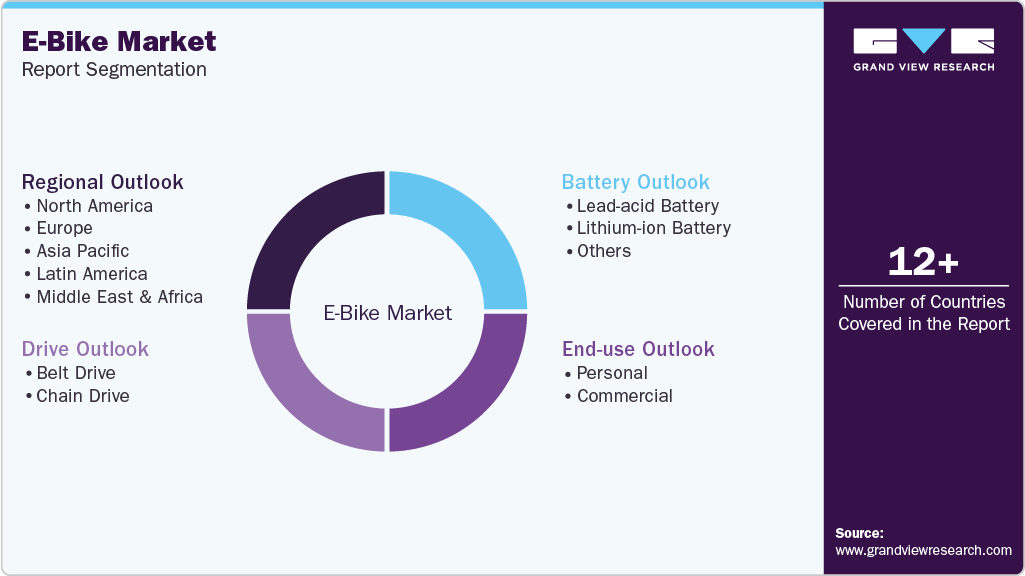
The report forecasts revenue growth at global, regional, and country levels and provides an analysis of the latest industry trends in each of the sub-segments from 2021 to 2033. For this study, Grand View Research has segmented the global e-bike market report based on drive, battery, end use, and region:
 To learn more about this report, Download Free Sample Report
 -
Drive Outlook (Volume, Units; Revenue, USD Million, 2021 - 2033)
-
Belt Drive
-
Chain Drive
-
-
Battery Outlook (Volume, Units; Revenue, USD Million, 2021 - 2033)
-
Lead-acid Battery
-
Lithium-ion Battery
-
Others
-
-
End Use Outlook (Volume, Units; Revenue, USD Million, 2021 - 2033)
-
Personal
-
Commercial
-
-
Regional Outlook (Volume, Units; Revenue, USD Million, 2021 - 2033)
-
North America
-
U.S.
-
Canada
-
Mexico
-
-
Europe
-
UK
-
Germany
-
France
-
-
Asia Pacific
-
China
-
India
-
Japan
-
South Korea
-
Australia
-
-
Latin America
-
Brazil
-
-
Middle East & Africa
-
Kingdom of Saudi Arabia (KSA)
-
UAE
-
South Africa
-
-
Delivered Customizations
This report has been delivered with the following In-depth customizations
Client Request
Customization Delivered
Value Adds
E-Bike Market Analysis
- Regional e-bike demand assessment
- Consumer preference and pricing analysis
- Battery, motor performance and charging infrastructure evaluation
- Identified high-growth urban mobility and micro-mobility segments
- Supported product development and expansion strategy
E-Bike Consumer Behavior Study
- Commuting and utility cycling trends analysis
- Consumer purchasing behavior assessment
- Premium vs commuter e-bike analysis
- Improved customer targeting strategy
- Supported pricing and positioning decisions
Competitive Landscape Assessment
- Benchmarking of leading bicycle manufacturers
- Product portfolio comparison
- Distribution channel analysis
- Supported competitive intelligence
- Identified differentiation opportunities in design, technology and branding
Frequently Asked Questions About This Report
The chain drive segment led with a 88.9% revenue share in 2025, while belt drive is the fastest-growing segment.
Lithium-ion battery held the largest revenue share in 2025.
Personal held the largest share in 2025, and commercial is the fastest-growing market.
The global e-bike market size was estimated at USD 69.7 billion in 2025 and is expected to reach USD 77.9 billion in 2026.
The global e-bike market is expected to grow at a compound annual growth rate of 9.2% from 2026 to 2033 to reach USD 144.3 billion by 2033.
The Asia Pacific dominated the e-bike market with a share of 58.7% in 2025.
Some key players operating in the e-bikes market include Accell Group N.V., Pedego Electric Bikes, Merida Industry Co. Ltd., Pon.Bike, Yadea Group Holdings Ltd., Giant Manufacturing Co., Ltd., and Yamaha Motor Company.
Key factors that are driving the e-bikes market growth include initiatives undertaken by various governments to mitigate their carbon footprints by encouraging the use of electric vehicles, electric bikes, and bicycles.
About the Author(s)
Automotive & Transportation Research Team
Technology · Automotive & TransportationThis report was authored by the automotive & transportation research team at Grand View Research - comprising two research analysts, one senior research analyst, and one industry expert - with specialized expertise in the automotive & transportation segment of the technology industry. All findings are based on proprietary technology databases, executive interviews, and regulatory analysis, subject to internal peer review prior to publication.
Last Updated:
Speak to Analyst

Customize this report to your needs - add regions, segments, or data points, with 20% free customization.
Or view our licence options:


ISO 9001:2015 & 27001:2022 Certified
We are GDPR and CCPA compliant! Your transaction & personal information is safe and secure. For more details, please read our privacy policy.


