
- Home
- »
- Plastics, Polymers & Resins
- »
-
E-commerce Mailers Market Size And Growth Report, 2026-2033GVR Report cover

E-commerce Mailers Market (2026 - 2033)
Size, Share & Trends Analysis Report By Material (Paper, Plastic), By Size (Small (Up to 10 × 13 inches), Medium (11 × 14 inches to 14 × 19 inches)) By Insulation, By Product, By Gusset, By Region, And Segment Forecasts
Market Size, 2025
$16.6BMarket Estimate, 2026
$18.0BMarket Forecast, 2033
$33.1BCAGR, 2026–2033
9.1%E-commerce Mailers Market Summary
The global e-commerce mailers market size was valued at USD 16.6 billion in 2025 and is projected to grow from USD 18.0 billion in 2026 to USD 33.1 billion by 2033, at a CAGR of 9.1% from 2026 to 2033. The Asia Pacific held the largest share of 39.9% of the global market in 2025. The demand for e-commerce mailers is growing steadily across the global market, primarily driven by the continued expansion of online retail.
 Source: Grand View Research, IR Documents, Primary Interviews, Paid DatabasesTo learn more about this report,
 Download Free Sample Report
 Key Market Trends & Insights
- By material: Plastic segment held the largest market share of 55.2% in 2025.
- By insulation: Non-insulated segment accounted for the largest market share of 79.1% in 2025.
- By product: Non-padded segment accounted for the largest market share of 64.3% in 2025.
- By size: Medium (11 × 14 inches to 14 × 19 inches) segment accounted for the largest market share of 37.1% in 2025.
- By gusset: Non-gusseted segment accounted for the major revenue share of 64.6% in 2025..
Regional Highlights
- Largest regional market: Asia Pacific (39.9% revenue share, 2025)
- Fastest-growing regional market: Asia Pacific
- By country: China is expected to grow at a CAGR of 9.5% from 2026 to 2033.
Market Size & Forecast
- Market size in 2025: USD 16.6 Billion
- Estimated market size in 2026: USD 18.0 Billion
- Projected market size by 2033: USD 33.1 Billion
- CAGR (2026-2033): 9.1%
Three ways to get this report
Buy it, customize it, or ask a question.Ask an Analyst
A direct answer, usually in 1 working day
- AccessReport author, directly
- Reply timeWithin 1 working day
- No sales callDirect answer only
- FormatEmail reply
- CostFree, no cost
Get the Full Report
What the study covers
- FormatsPDF · Excel · Dashboard
- Timeline2026–2033 annual, 2025 base
- Coverage20+ countries, 5 regions
- Companies10+ key players profiled
Customize the Report
20% free customization
- IncludeCountries, segments, points
- TailorTo your product definition
- ExtendDeeper competitor detail
- OrA fully bespoke study
- Turnaround5–10 working days
As consumers increasingly prefer the convenience of doorstep delivery, the number of parcels shipped worldwide has risen sharply. Every online transaction requires packaging that is optimized for shipping rather than shelf display, making mailers an essential component of the e-commerce supply chain. This structural shift in buying behavior has created a sustained, long-term demand for lightweight and efficient shipping formats.Another major factor supporting the growth of e-commerce mailers is the need to reduce logistics and shipping costs. Compared to rigid boxes, mailers are significantly lighter and more space-efficient, helping sellers minimize dimensional weight charges and transportation expenses. For high-volume e-commerce operators, even small savings per shipment translate into meaningful cost reductions at scale. As shipping costs remain a key pressure point for online retailers, the adoption of flexible and padded mailers continues to increase.
 To learn more about this report, Download Free Sample Report
 Sustainability considerations are also playing a critical role in shaping demand. Consumers are becoming more environmentally conscious and increasingly expect brands to use recyclable, reusable, or paper-based packaging. In response, e-commerce companies are shifting toward eco-friendly mailers made from recyclable plastics, paper, or compostable materials. Mailers offer an easier pathway to sustainability compared to traditional packaging, as they typically require less material overall and generate lower packaging waste per shipment.
In addition, the diversity of products sold online has fueled demand for specialized mailer solutions. From apparel and accessories to electronics, cosmetics, and pharmaceuticals, e-commerce shipments require packaging that provides adequate protection while remaining lightweight. Padded, bubble-lined, and protective mailers help reduce product damage and return rates, improving overall supply-chain efficiency. At the same time, customizable mailers allow brands to enhance the unboxing experience and reinforce brand identity, which is increasingly important in a competitive digital marketplace.
The rapid expansion of logistics infrastructure and cross-border e-commerce further supports market growth. As international shipping volumes increase, businesses favor standardized, durable mailer formats that can withstand long transit times and multiple handling points. Mailers are well suited to these complex logistics networks, contributing to their widespread adoption across both developed and emerging markets.
Market Concentration & Characteristics
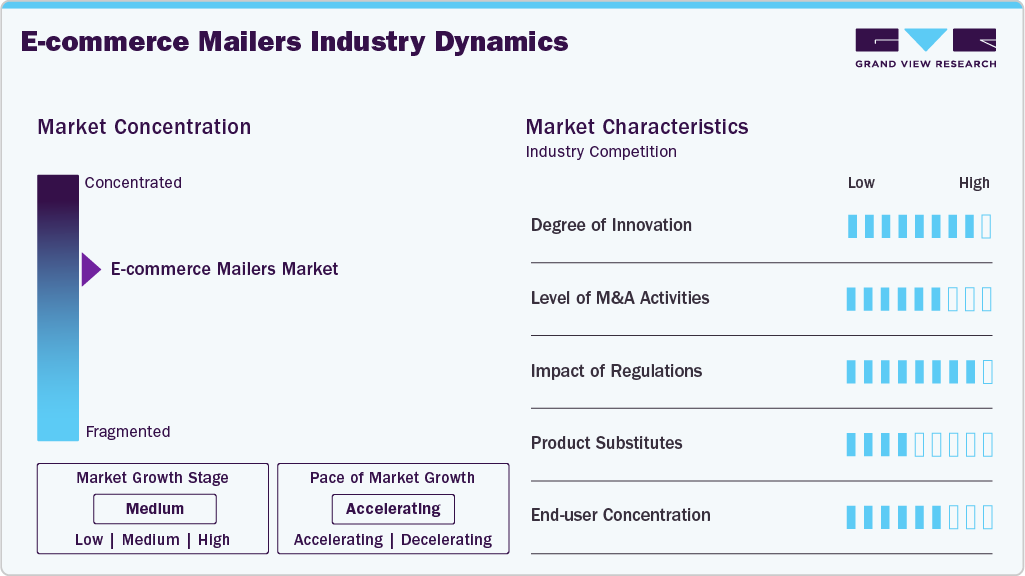
The e-commerce mailers industry is characterized by high volume, cost sensitivity, and rapid innovation cycles. Demand is directly linked to parcel shipment volumes, making the market scale-driven rather than value-driven. While entry barriers are moderate due to relatively standardized manufacturing processes, price competition remains intense, particularly for plastic and poly mailers. Large-scale converters benefit from economies of scale in raw material procurement, production efficiency, and logistics, allowing them to compete aggressively on pricing while maintaining acceptable margins.
Another defining characteristic of the industry is its material and regulatory exposure. Mailer manufacturers rely heavily on paper, polyethylene, and recycled plastics, making them vulnerable to raw material price volatility and supply chain disruptions. At the same time, increasing environmental regulations-such as plastic reduction mandates, recycled content requirements, and extended producer responsibility (EPR) frameworks-are reshaping product design and material choices. This has accelerated innovation in recyclable, mono-material, paper-based, and compostable mailers, while also raising compliance costs and complexity for manufacturers operating across multiple regions.
 To learn more about this report, Download Free Sample Report
 In addition, the industry is marked by strong buyer power and increasing customization requirements. Large e-commerce platforms, third-party logistics providers, and major retailers account for a significant share of demand and often negotiate long-term supply contracts, exerting pressure on pricing and margins. However, these buyers also drive innovation by demanding branded, tamper-evident, lightweight, and sustainability-compliant mailers tailored to specific product categories. As a result, competitive differentiation increasingly depends on product performance, sustainability credentials, and the ability to deliver consistent quality at scale rather than on price alone.
Material Insights
The plastic segment recorded the largest market revenue share of 55.2% in 2025. Plastic dominates the material segment in the e-commerce mailers market primarily due to its cost efficiency, performance advantages, and scalability. Polyethylene-based mailers are lightweight yet durable, offering excellent tear resistance, moisture protection, and flexibility across a wide range of product categories. These properties make plastic mailers especially suitable for high-volume e-commerce shipments such as apparel, soft goods, and non-fragile items. In addition, plastic mailers require less material than rigid or paper-based alternatives to achieve the same level of protection, helping sellers reduce both packaging and shipping costs, an important consideration in a price-sensitive e-commerce environment.
Another key reason for plastic’s dominance is the maturity of manufacturing infrastructure and ongoing material innovation. Plastic mailers can be produced at scale using well-established extrusion and converting technologies, ensuring consistent quality and reliable supply across global markets. At the same time, advancements in recyclable mono-material films, post-consumer recycled (PCR) content, and downgauged film structures have helped plastic maintain its relevance amid rising sustainability pressure. These innovations allow e-commerce companies to balance environmental commitments with functional performance, reinforcing plastic’s leading position in the material mix despite the growing adoption of paper-based alternatives.
The paper mailers segment is forecasted to grow at the fastest CAGR of 9.7% over the forecast years. Paper mailers are expected to grow rapidly over the coming years as sustainability moves from a preference to a requirement across global e-commerce value chains. Governments are tightening regulations on single-use plastics, while extended producer responsibility (EPR) rules and packaging waste directives are increasing the compliance burden for plastic-based solutions. In this environment, paper mailers benefit from strong regulatory alignment, high recyclability rates, and positive consumer perception. For many brands, especially in fashion, beauty, and direct-to-consumer segments, switching to paper mailers is a visible and credible way to demonstrate environmental responsibility and meet corporate sustainability targets.
In addition, advances in paper-based packaging technology are improving the functional performance of paper mailers, making them viable for a wider range of applications. Innovations such as reinforced kraft structures, barrier coatings, and hybrid paper solutions have enhanced tear resistance, moisture protection, and durability during transit. As production scales up and costs gradually narrow the gap with plastic alternatives, paper mailers are becoming increasingly competitive on both performance and economics. This combination of regulatory support, brand-driven demand, and material innovation positions paper as the fastest-growing material segment in the e-commerce mailers market over the medium to long term.
Size Insights
Based on size, Medium (11 × 14 inches to 14 × 19 inches) mailers dominated the market with the major revenue share of 37.1% in 2025. This is on account of the balance they offer between versatility and cost efficiency for online retailers. This size range is well suited for a wide variety of high-volume e-commerce products such as apparel, footwear, books, small electronics, accessories, and bundled orders. Retailers can use medium mailers across multiple product categories without maintaining excessive inventory of different packaging sizes, which simplifies operations and reduces warehousing and procurement complexity.
In addition, medium-sized mailers align closely with carrier pricing structures and logistics optimization. They help minimize unused space while avoiding dimensional weight penalties that are common with oversized packaging. By fitting efficiently into standard sorting, handling, and last-mile delivery systems, medium mailers reduce shipping costs and damage risk during transit. Their compatibility with automated fulfillment lines and high-speed packaging systems further reinforces their widespread adoption, making them the most commonly used and commercially attractive size segment in the global e-commerce mailers market.
Product Insights
Based on product, the non-padded mailer segment dominate the market with te major revenue share of 64.3% in 2025. Non-padded e-commerce mailers dominate the product segment mainly because they serve the largest share of items sold online while offering the lowest cost per shipment. A significant portion of e-commerce volume consists of soft, non-fragile products such as apparel, textiles, documents, accessories, and promotional items that do not require additional cushioning. For these applications, non-padded mailers provide sufficient protection while avoiding the added material, weight, and cost associated with padded alternatives, making them the preferred choice for high-volume retailers.
Furthermore, non-padded mailers offer greater material efficiency and sustainability advantages, which are increasingly important to both sellers and regulators. Their simpler construction allows for easier recyclability, especially in mono-material plastic or paper formats, and supports downgauging initiatives to reduce overall packaging usage. They are also more compatible with automated packing and sealing processes used in large fulfillment centers, enabling faster throughput and lower operational costs. These combined economic, operational, and sustainability benefits have reinforced the dominance of non-padded mailers in the global e-commerce packaging market.
Insulation Insights
The non-insulated mailers let the market with the major revenue share of 79.1% in 2025 and is forecast to grow significantly over the forecast period. Non-insulated e-commerce mailers dominate the insulation segment primarily because the majority of products shipped through e-commerce do not require temperature control. Core online retail categories such as apparel, footwear, books, accessories, home goods, and consumer electronics can be shipped safely under ambient conditions. For these high-volume product types, non-insulated mailers provide adequate protection at the lowest possible cost, making them the default packaging choice for most e-commerce shipments.
Moreover, non-insulated mailers offer clear advantages in terms of cost efficiency, weight reduction, and operational simplicity. Insulated solutions add material layers, bulk, and expense, which are difficult to justify for standard shipments. Non-insulated mailers are lightweight, easier to store and transport, and fully compatible with automated fulfillment and sorting systems used by large e-commerce players. As temperature-sensitive goods represent only a niche share of overall e-commerce volumes, demand remains heavily concentrated toward non-insulated mailers, reinforcing their dominant position in the market.
Gusset Insights
Based on gusset, the gusseted segment dominated the market with the major revenue share of 64.6% in 2025. Non-gusseted e-commerce mailers dominate the gusset segment because they align better with the flat, lightweight nature of most e-commerce shipments. A large share of online orders-such as apparel, documents, books, and small consumer goods-do not require expandable depth. Non-gusseted mailers provide a snug fit for these items, helping reduce excess material usage and unnecessary void space. Their simpler structure also makes them easier to handle, seal, and stack during fulfillment and transit.
 To learn more about this report, Download Free Sample Report
 From an operational standpoint, non-gusseted mailers offer cost and efficiency advantages over gusseted alternatives. They require less material and fewer manufacturing steps, resulting in lower unit costs and more consistent quality at scale. In high-volume fulfillment environments, non-gusseted formats are more compatible with automated packing and sealing systems, enabling faster processing and lower labor requirements. These economic and operational benefits have driven their widespread adoption, making non-gusseted mailers the dominant choice in the global e-commerce packaging market.
Region Insights
Asia Pacific dominated the market and accounted for the largest revenue share of over 39.9% in 2025. Asia Pacific dominates the global e-commerce mailers market due to the sheer scale of its e-commerce activity, population base, and manufacturing ecosystem. The region is home to some of the world’s largest and fastest-growing online retail markets, including China, India, Southeast Asia, and South Korea, where rising internet penetration, mobile commerce adoption, and a rapidly expanding middle class are driving exceptionally high parcel volumes. At the same time, Asia Pacific serves as a global hub for packaging manufacturing, supported by abundant raw material availability, cost-competitive labor, and well-established converting and printing infrastructure. This combination of massive domestic demand and localized, cost-efficient production enables high mailer consumption across both domestic and cross-border e-commerce, firmly positioning Asia Pacific as the dominant regional market.
 To learn more about this report, Download Free Sample Report
 The demand for e-commerce mailers in China is growing due to the continued evolution of its digital retail ecosystem and ultra-fast fulfillment models. Same-day and next-day delivery expectations have pushed platforms to rely on standardized, lightweight mailers that support rapid sorting and last-mile efficiency. In addition, the rise of social commerce, livestream shopping, and direct brand-to-consumer sales has increased shipment frequency and smaller order sizes, directly driving higher mailer consumption per transaction.
North America E-commerce Mailers Market Trends
In North America, rising demand is fueled by the continued shift toward direct-to-consumer (DTC) and omnichannel retail models. Brands are increasingly shipping directly from warehouses and stores to end customers, increasing parcel volumes and packaging intensity. This shift favors flexible mailers that reduce shipping costs, integrate branding, and support reverse logistics, particularly for returns-heavy categories such as apparel and lifestyle goods.
The demand for e-commerce mailers in the U.S. is growing due to high per-capita online spending and the dominance of subscription and repeat-purchase models. Frequent, recurring shipments in categories such as fashion, personal care, pet products, and health goods have increased demand for cost-effective, standardized mailers. In parallel, pressure to optimize last-mile delivery costs across a geographically large market has reinforced the adoption of lightweight mailers that improve shipping economics and operational efficiency.
Europe E-commerce Mailers Market Trends
In Europe, demand growth is largely driven by regulatory-led packaging transformation and cross-border e-commerce expansion. Stricter packaging waste directives and recycling mandates are encouraging retailers to adopt compliant mailer formats, particularly paper-based and mono-material solutions. At the same time, the growth of intra-EU online trade has increased parcel flows across borders, favoring durable, standardized mailers that can perform consistently across multiple logistics systems and regulatory environments.
Germany’s demand for e-commerce mailers is supported by its role as Europe’s logistics and fulfillment backbone. The country hosts major distribution centers serving both domestic and pan-European e-commerce, leading to disproportionately high packaging throughput. Strong consumer expectations around packaging quality, recyclability, and damage prevention are also pushing demand for premium, well-engineered mailers that meet Germany’s strict environmental and performance standards.
Key E-commerce Mailers Company Insights
The e-commerce mailers market is highly competitive and fragmented, with a mix of global packaging majors, regional converters, and low-cost local manufacturers competing primarily on price, scale, and reliability. Large players benefit from economies of scale, long-term contracts with major e-commerce platforms, and the ability to offer a broad portfolio spanning plastic, paper, and sustainable mailer formats. Smaller and regional players remain competitive through cost advantages, proximity to customers, and customization capabilities. Competitive differentiation is increasingly shifting beyond pricing toward sustainability credentials, material innovation, consistent quality at high volumes, and the ability to support fast-moving fulfillment and logistics requirements, making operational efficiency and regulatory compliance key determinants of market positioning.
-
In December 2024, Stora Enso launched a new bag and mailer paper that combines both fresh and recycled fibers, aiming to enhance the sustainability of packaging solutions. The blend of fibres enables the paper to maintain high performance standards and recyclability, supporting circular economic goals and helping brands move away from fossil-based materials.
-
In September 2023, Georgia-Pacific LLC broadened its EarthKraft range of curbside-recyclable mailers with the addition of larger formats and new side- and bottom-gusseted unpadded options intended for higher-volume shipments. The expanded range adds to the company’s existing EarthKraft mailer offerings, including padded versions introduced earlier. The update is supported by added manufacturing capability, beginning with a new production line at the McDonough, Georgia facility, with further capacity additions planned.
Key E-commerce Mailers Companies:
The following key companies have been profiled for this study on the e-commerce mailers market.
- Pregis LLC
- Sealed Air
- Intertape Polymer Group (IPG)
- Mondi
- Amcor plc
- Smurfit Westrock
- International Paper
- ProAmpac
- Stora Enso
- Georgia-Pacific
- SupremeX
- Zeal X International Limited
- RollsPack Pty Ltd
E-commerce Mailers Market Report Scope
Report Attribute
Details
Market size in 2025
USD 16.6 billion
Estimated market size in 2026
USD 18.0 billion
Projected market size by 2033
USD 33.1 billion
Growth rate
CAGR of 9.1% from 2025 to 2033
Historical data
2021 - 2024
Forecast period
2026 - 2033
Quantitative units
Revenue in USD million/billion, volume in million units, and CAGR from 2026 to 2033
Report coverage
Revenue & Volume forecast, competitive landscape, growth factors, and trends
Segments covered
Material, product, gusset, size, insulation, and region
Regional scope
North America, Europe, Asia Pacific, Latin America, the Middle East & Africa
Country scope
U.S.; Canada; Mexico; Germany; France; UK; Italy; Spain; China; India; Japan; Australia; South Korea; Brazil; Argentina; South Africa; Saudi Arabia; UAE
Key companies profiled
Pregis LLC; Sealed Air; Intertape Polymer Group (IPG); Mondi; Amcor plc; Smurfit Westrock; International Paper; ProAmpac; Stora Enso; Georgia-Pacific; SupremeX; Zeal X International Limited; RollsPack Pty Ltd
Customization scope
Free report customization (equivalent up to 8 analyst’s working days) with purchase. Addition or alteration to country, regional, and segment scope.
Pricing and purchase options
Avail customized purchase options to meet your exact research needs. Explore purchase options
Global E-commerce Mailers Market Report Segmentation
This report forecasts revenue growth at a global level and provides an analysis of the latest industry trends in each of the sub-segments from 2021 to 2033. For this study, Grand View Research has segmented the global E-commerce mailers market report based on product, material, application, and region:
-
Material Outlook (Volume, Million Units; Revenue, USD Million 2021 - 2033)
-
Plastic
-
Paper
-
Others
-
-
Insulation Outlook (Volume, Million Units; Revenue, USD Million 2021 - 2033)
-
Insulated
-
Non-Insulated
-
-
Product Outlook (Volume, Million Units; Revenue, USD Million 2021 - 2033)
-
Padded Mailers
-
Non-Padded Mailers
-
-
Size Outlook (Volume, Million Units; Revenue, USD Million 2021 - 2033)
-
Small (Up to 10 × 13 inches)
-
Medium (11 × 14 inches to 14 × 19 inches)
-
Large (15 × 20 inches to 19 × 24 inches)
-
Extra Large (Above 19 × 24 inches)
-
-
Gusset Outlook (Volume, Million Units; Revenue, USD Million 2021 - 2033)
-
Gusseted
-
Only Side Gusseted
-
Only Bottom Gusseted
-
Side & Bottom Gusseted
-
-
Non-Gusseted
-
-
Region Outlook (Volume, Million Units; Revenue, USD Million 2021 - 2033)
-
North America
-
U.S.
-
Canada
-
Mexico
-
-
Europe
-
Germany
-
France
-
UK
-
Italy
-
Spain
-
-
Asia Pacific
-
China
-
India
-
Japan
-
Australia
-
South Korea
-
-
Latin America
-
Brazil
-
Argentina
-
-
Middle East & Africa
-
South Africa
-
Saudi Arabia
-
UAE
-
-
Frequently Asked Questions About This Report
The global e-commerce mailers market size was valued at USD 16.6 billion in 2025 and is estimated at USD 18.0 billion in 2026.
The global e-commerce mailers market is expected to grow at a CAGR of 9.1% from 2026 to 2033, reaching USD 33.1 billion by 2033.
Asia Pacific is the fastest-growing regional market during the forecast period.
Some of the key players operating in the e-commerce mailers market include Pregis LLC, Sealed Air, Intertape Polymer Group (IPG), Mondi, Amcor plc, Smurfit Westrock, International Paper, ProAmpac, Stora Enso, Georgia-Pacific, SupremeX, Zeal X International Limited, and RollsPack Pty Ltd.
Key factors driving the e-commerce mailers market include the continued expansion of online retail, increasing parcel shipment volumes, growing demand for lightweight and cost-efficient packaging solutions, rising sustainability requirements for recyclable and eco-friendly packaging, increasing adoption of specialized protective mailers, and the rapid expansion of logistics infrastructure and cross-border e-commerce activities.
The plastic segment led the market with a 55.2% revenue share in 2025, while the paper mailers segment is expected to grow at the fastest CAGR of 9.7% during the forecast period.
The non-insulated segment held the largest revenue share of 79.1% in 2025 and is expected to grow significantly over the forecast period.
The non-padded segment held the largest revenue share of 64.3% in 2025 and is forecasted to grow at the fastest CAGR over the coming years.
Asia Pacific dominated the global e-commerce mailers market with a revenue share of 39.9% in 2025.
About the Author(s)
Plastics, Polymers & Resins Research Team
Bulk Chemicals · Plastics, Polymers & ResinsThis report was authored by the plastics, polymers & resins research team at Grand View Research - comprising two research analysts, one senior research analyst, and one industry expert - with specialized expertise in the plastics, polymers & resins segment of the bulk chemicals industry. All findings are based on proprietary bulk chemicals databases, executive interviews, and regulatory analysis, subject to internal peer review prior to publication.
Last Updated:
Speak to Analyst

Customize this report to your needs - add regions, segments, or data points, with 20% free customization.
Or view our licence options:


ISO 9001:2015 & 27001:2022 Certified
We are GDPR and CCPA compliant! Your transaction & personal information is safe and secure. For more details, please read our privacy policy.


