
- Home
- »
- Next Generation Technologies
- »
-
Edge AI Market Size, Share & Forecast Report, 2026-2033GVR Report cover

Edge AI Market (2026 - 2033)
Size, Share & Trends Analysis Report By Component (Hardware, Software, Edge Cloud Infrastructure, Services), By End Use (Consumer Electronics, Smart Cities, Manufacturing, Automotive), By Region, And Segment Forecasts
Market Size, 2025
$24.9BMarket Estimate, 2026
$30.0BMarket Forecast, 2033
$118.7BCAGR, 2026–2033
21.7%Edge AI Market Summary
The global edge AI market size was valued at USD 24.9 billion in 2025 and is projected to grow from USD 30.0 billion in 2026 to USD 118.7 billion by 2033, at a CAGR of 21.7% from 2026 to 2033. The market in North America dominated with a revenue share of 36.0% in 2025. The market is experiencing significant growth driven by the rapid expansion of IoT and connected devices, the increasing demand for real-time, low-latency data processing, the growing adoption of AI-enabled automation across industries, and a rising focus on data privacy through Edge AI and localized intelligence at the network edge.
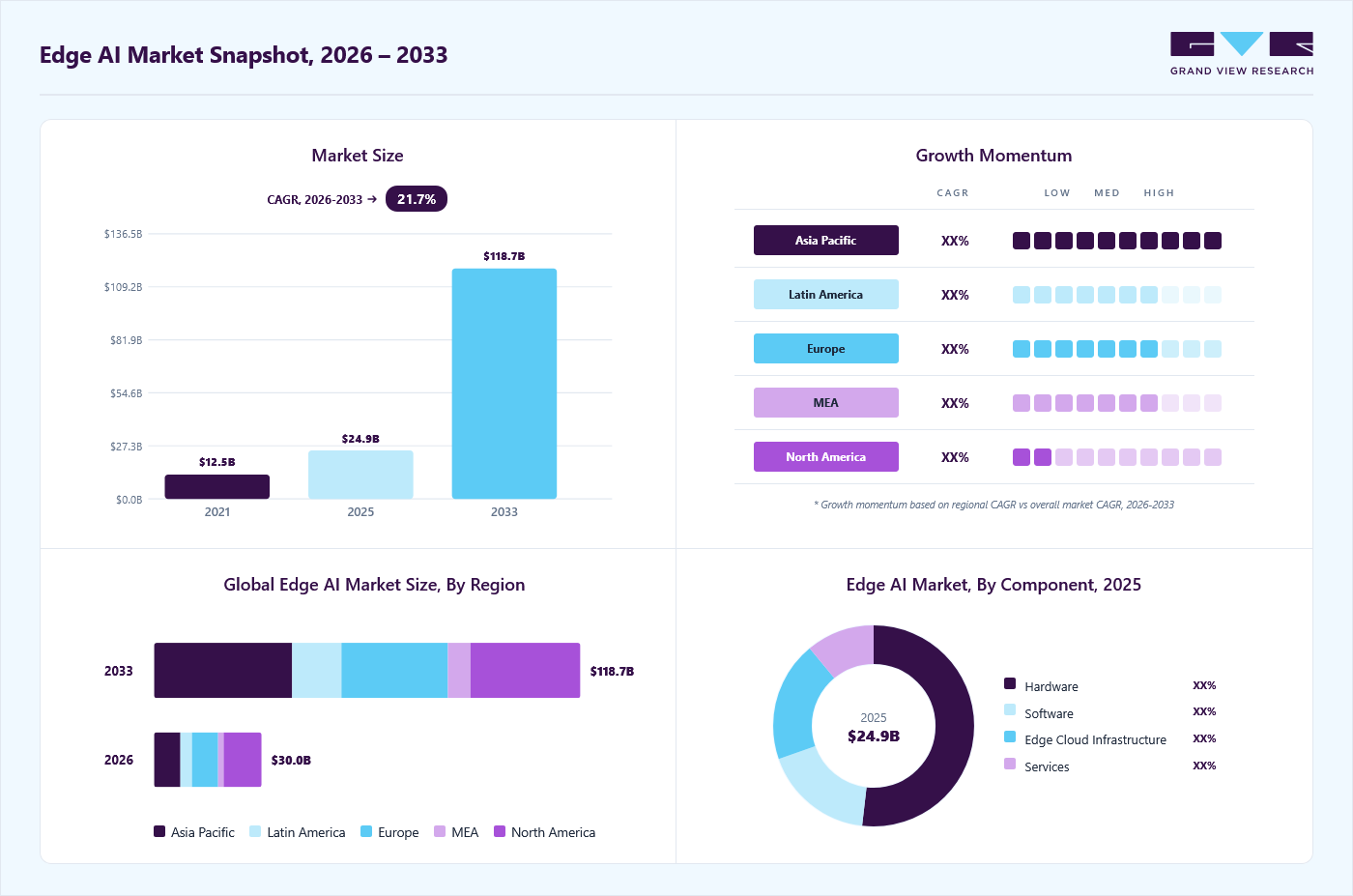 Source: Grand View Research, IR Documents, Primary Interviews, Paid DatabasesTo learn more about this report,
 Download Free Sample Report
 Key Market Trends & Insights
- By component: Hardware segment held the largest market share of 51.8% in 2025.
- By end use: Consumer electronics segment held the largest market share in 2025.
Regional Highlights
- Largest regional market: North America (36.0% revenue share, 2025)
- By country: The U.S. held the largest market share in 2025
Market Size & Forecast
- Market size in 2025: USD 24.9 Billion
- Estimated market size in 2026: USD 30.0 Billion
- Projected market size by 2033: USD 118.7 Billion
- CAGR (2026-2033): 21.7%
Three ways to get this report
Buy it, customize it, or ask a question.Ask an Analyst
Analyst response in 1 business day
- AccessReport author, directly
- Reply timeWithin 1 working day
- No sales callDirect answer only
- FormatEmail reply
- CostFree, no cost
Get the Full Report
What the study covers
- FormatsPDF · Excel · Dashboard
- Timeline2026–2033 annual, 2025 base
- Coverage20+ countries, 5 regions
- Companies10+ key players profiled
Customize the Report
20% free customization
- IncludeCountries, segments, points
- TailorTo your product definition
- ExtendDeeper competitor detail
- OrA fully bespoke study
- Turnaround5–10 working days
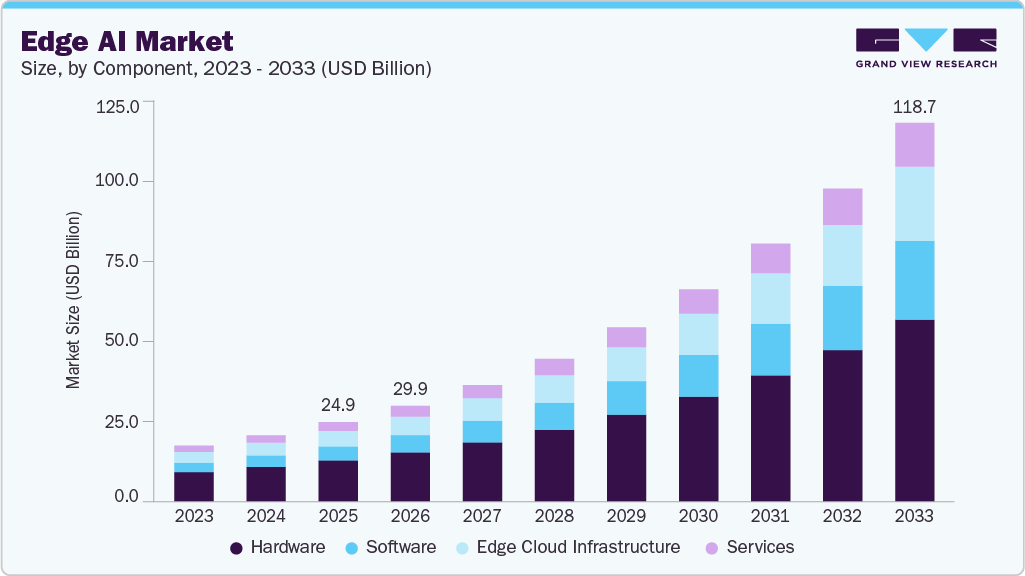
The market is witnessing strong growth driven by the rising demand for distributed computing resources that support real-time data processing and storage at the network edge. Enterprises are increasingly adopting edge cloud infrastructure to enable low-latency connectivity and improve operational efficiency across digital operations. The rapid expansion of smart cities and IoT ecosystems is further accelerating the need for scalable and resilient edge cloud solutions to manage large volumes of device-generated data. By processing data closer to the source, organizations can achieve faster response times while reducing bandwidth and centralized cloud costs. This shift positions edge cloud infrastructure as a critical enabler of enhanced performance, scalability, and improved user experiences across multiple applications within the AI edge computing sector.The growing adoption of AI technologies across enterprises is driving increased demand for consulting, training, and support services to enable effective digital transformation. Organizations are seeking expert guidance to define AI implementation strategies, manage complexity, and adopt best practices that align with their operational objectives. At the same time, training and continuous support services are becoming critical as companies invest in upskilling their workforce to fully leverage AI-driven solutions. As AI adoption expands across industries such as manufacturing, healthcare, and automation, the need for ongoing optimization and lifecycle support is expected to rise. By delivering industry-specific, tailored service offerings, providers play a crucial role in ensuring successful edge AI deployments and long-term value creation.
 To learn more about this report, Download Free Sample Report
 The edge AI market is characterized by the deployment of distributed artificial intelligence workloads at the network edge, enabling low-latency data processing, real-time inference, and localized decision-making without heavy reliance on centralized cloud infrastructure. This market is gaining strong momentum due to the increasing adoption of edge computing architectures, AI accelerators (such as GPUs, TPUs, and NPUs), and embedded machine learning models across industry verticals. Furthermore, the integration of IoT endpoints, smart sensors, and connected devices is accelerating the demand for edge analytics platforms capable of handling high-velocity data at the source. Edge AI facilitates predictive inventory optimization, demand sensing, and autonomous store operations by leveraging deep learning models, anomaly detection algorithms, and real-time telemetry data.
Market Dynamics
The increasing demand for real-time analytics, intelligent automation, and low-latency data processing is significantly driving the growth of the edge AI market across industries including manufacturing, healthcare, automotive, and telecommunications. Enterprises are increasingly deploying edge AI solutions to process and analyze data locally, enabling faster operational decision-making while reducing dependence on centralized cloud infrastructure. This capability is becoming critical for applications such as autonomous driving, predictive maintenance, industrial automation, and smart surveillance, where rapid response times directly impact operational efficiency and safety outcomes. Furthermore, the growing adoption of connected devices, industrial IoT ecosystems, and smart infrastructure is accelerating enterprise investments in edge AI technologies.
Edge AI is transforming industrial operations by enabling localized intelligence and real-time processing directly at the source of data generation. In manufacturing environments, edge AI supports predictive maintenance, equipment monitoring, production optimization, and quality management, helping organizations improve productivity while minimizing operational downtime. In the healthcare sector, edge AI is driving advancements in remote patient monitoring, medical imaging analysis, and real-time diagnostics to support faster and more accurate clinical decision-making. Similarly, the automotive industry is increasingly leveraging edge AI technologies for autonomous mobility, object detection, and advanced driver-assistance systems (ADAS), where immediate data processing capabilities are essential for safety and operational performance.
Limited computing resources across edge devices remain a major restraint affecting the large-scale deployment and performance efficiency of edge AI solutions. Unlike centralized cloud environments, edge devices such as IoT sensors, smart cameras, mobile devices, and embedded systems operate with constrained processing power, memory capacity, storage, and energy availability. These hardware limitations restrict the deployment of highly complex AI models and advanced analytics workloads directly at the edge, potentially impacting system accuracy, responsiveness, and overall operational efficiency. As enterprises increasingly demand sophisticated real-time AI capabilities, balancing performance requirements with hardware constraints continues to present a significant industry challenge.
The need to optimize AI models for resource-constrained edge environments further adds complexity to edge AI development and deployment processes. Organizations are required to implement techniques such as model compression, pruning, quantization, and lightweight neural network architectures to reduce computational requirements while maintaining acceptable performance levels. However, these optimization processes often require specialized expertise in AI engineering, semiconductor design, and edge computing architectures, increasing development complexity and implementation costs. In addition, continuous efforts to improve power efficiency, thermal management, and hardware utilization are creating additional technical challenges for solution providers and enterprises.
The growing demand for real-time decision-making and ultra-low-latency processing is creating substantial growth opportunities for the edge AI market in autonomous systems and industrial environments. Industries such as automotive, manufacturing, robotics, and smart infrastructure are adopting edge AI technologies to enable immediate data analysis and autonomous responses. Edge AI supports mission-critical applications including autonomous vehicles, intelligent robotics, predictive maintenance, and industrial automation, where rapid processing impacts operational safety and efficiency. As enterprises prioritize intelligent automation and real-time capabilities, demand for advanced edge AI solutions is expected to increase significantly.
Market Concentration & Characteristics
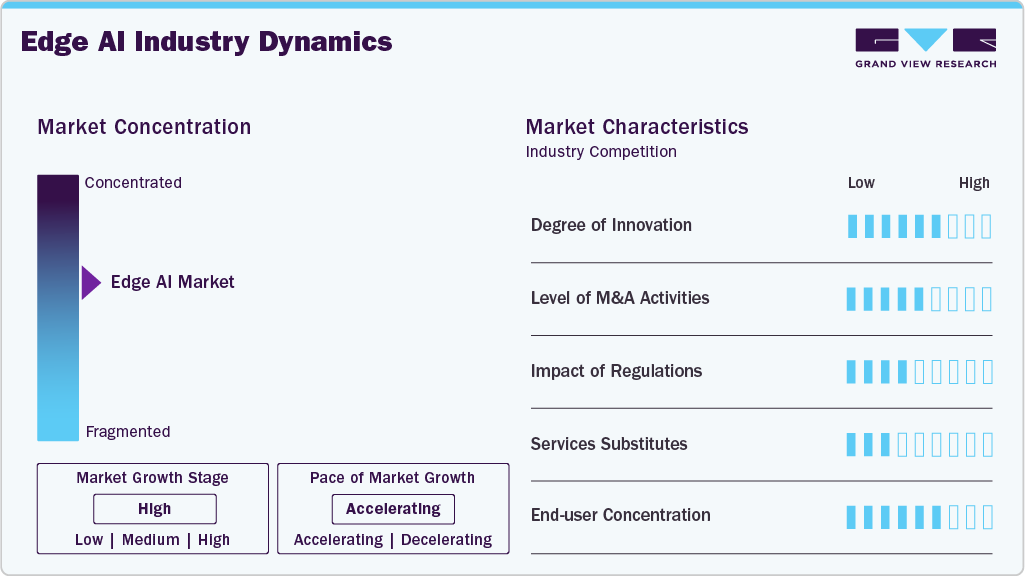
The Edge AI market demonstrates a high degree of innovation driven by continuous advancements in AI chips, edge computing platforms, real-time analytics, and low-latency processing technologies. Companies are actively investing in AI model optimization, energy-efficient hardware, and intelligent automation capabilities to improve performance across industrial, automotive, healthcare, and smart city applications. The growing adoption of generative AI, computer vision, and IoT-enabled edge devices is further accelerating technological development and product differentiation in the market.
 To learn more about this report, Download Free Sample Report
 The impact of regulations in the market is moderate, primarily influenced by data privacy, cybersecurity, AI governance, and cross-border data transfer policies. Governments and regulatory bodies are introducing frameworks focused on responsible AI usage, data protection, and secure edge infrastructure, especially in sectors handling sensitive information such as healthcare, finance, and public safety. Compliance requirements can increase operational complexity, but they also encourage the adoption of secure and transparent AI systems.
Component Insights
The hardware segment dominates the market, with a revenue share of over 51% in 2025, owing to the rising demand for real-time data processing across IoT devices, autonomous vehicles, and smart city applications. Enterprises are increasingly adopting advanced edge hardware to reduce latency, improve operational efficiency, and enable localized decision-making without heavy reliance on centralized cloud infrastructure. The rapid proliferation of IoT deployments across healthcare, manufacturing, and agriculture is further driving demand for specialized AI processors, GPUs, and edge-optimized systems capable of handling complex workloads. Additionally, the shift toward decentralized computing and the integration of AI capabilities into edge devices are making hardware solutions indispensable for time-sensitive and mission-critical applications.
The software segment is expected to witness significant growth over the forecast period, driven by the increasing demand for real-time analytics, edge-native AI models, and on-device machine learning capabilities. Enterprises are prioritizing edge-optimized software platforms, AI inference engines, and data orchestration tools to generate actionable insights at the source, reducing latency and reliance on centralized cloud systems. Advancements in agile development frameworks, DevOps pipelines, MLOps practices, and containerized deployments are accelerating the creation and scaling of edge-ready applications, supported by enterprise AI platforms such as IBM watsonx.ai. Additionally, rising investments in customized, use-case-specific software solutions aligned with Industry 4.0 and digital transformation strategies are further driving the adoption of software across the region.
End Use Insights
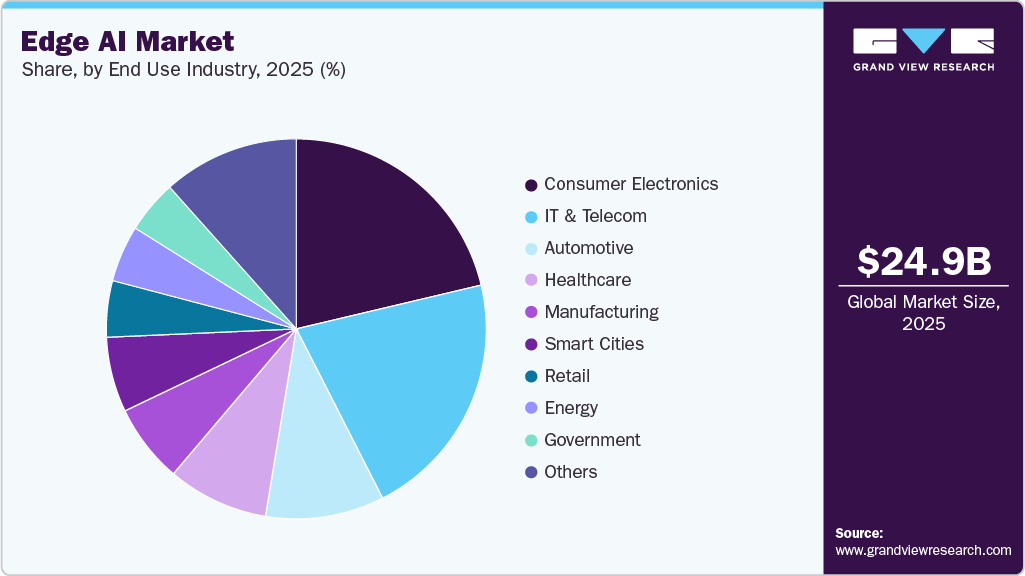
The consumer electronics segment accounted for the largest share of global edge AI market revenue in 2025, driven by the accelerating integration of on-device artificial intelligence, embedded ML models, and dedicated AI chipsets (NPUs, ASICs, and edge GPUs) into mass-market devices such as smartphones, smart speakers, wearables, and home automation systems. The growing adoption of smart home devices further accelerates segment growth, as consumers increasingly prefer intelligent products that offer faster response times, greater automation, and reduced reliance on constant cloud connectivity. The rapid proliferation of smart home ecosystems and IoT-enabled consumer devices is further accelerating segment growth, as manufacturers increasingly deploy edge inference engines, sensor fusion technologies, and real-time analytics pipelines to deliver seamless automation and interoperability.
 To learn more about this report, Download Free Sample Report
 The manufacturing segment is expected to register strong growth throughout the forecast period, driven by the accelerated adoption of Industry 4.0 frameworks focused on intelligent automation, connected operations, and data-centric production environments. Edge AI is increasingly deployed at the factory level to enable real-time data processing, edge analytics, and low-latency decision-making, significantly enhancing operational agility and minimizing downtime. By integrating edge AI with industrial IoT (IIoT) networks, smart sensors, and autonomous control systems, manufacturers can leverage capabilities such as predictive maintenance, anomaly detection, and in-line quality inspection using computer vision models. Additionally, the adoption of AI-driven robotics, digital twins, and edge-enabled systems supported by advanced edge platforms and AI accelerators is enhancing efficiency, reducing human intervention, and improving precision.
Regional Insights
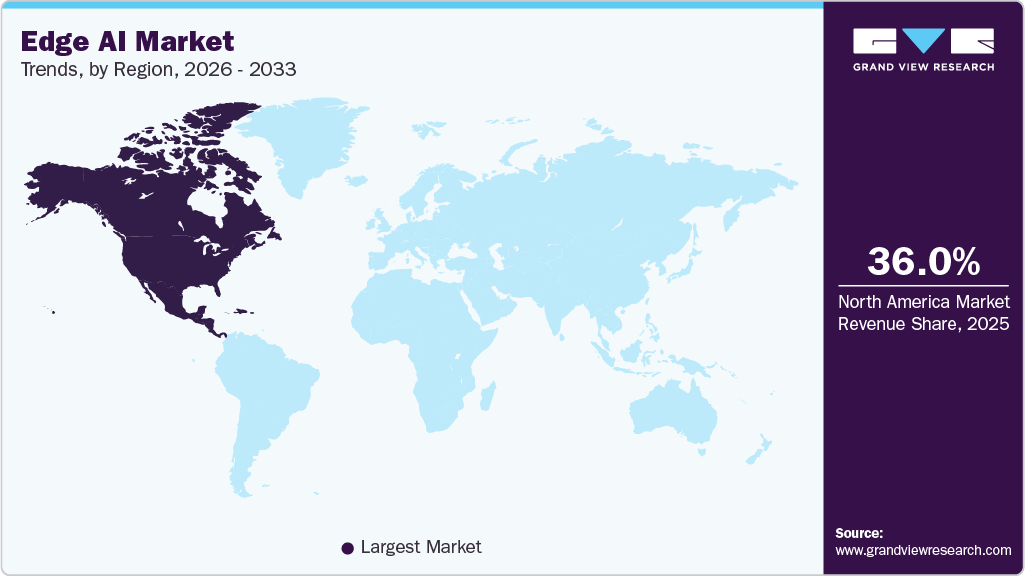
The North America edge AI industry dominates globally, with a revenue share of over 36% in 2025, driven by early technology adoption and strong digital infrastructure. The region benefits from widespread deployment of edge AI hardware across industries such as healthcare, retail, manufacturing, and autonomous systems. Robust investments in AI R&D, cloud-to-edge integration architectures, and advanced semiconductor innovations-including AI accelerators and edge chipsets are further reinforcing the region’s market leadership. Moreover, the strong presence of leading technology providers, along with a mature ecosystem of hyperscalers, edge platform vendors, and AI solution developers, is accelerating innovation, scalability, and commercialization of edge AI deployments across North America.
 To learn more about this report, Download Free Sample Report
 U.S. Edge AI Market Trends
The edge AI industry in the U.S. is experiencing robust growth driven by strong demand for real-time data processing across IoT, defense, healthcare, and smart infrastructure applications. Enterprises are increasingly adopting edge AI to enhance operational efficiency, reduce latency, and strengthen data security. Significant investments in AI startups, edge hardware, and software platforms are accelerating deployment at scale. Supportive government initiatives and strong collaboration between industry and research institutions further reinforce market expansion.
Europe Edge AI Market Trends
The edge AI industry in Europe is experiencing significant growth driven by increasing adoption of Industry 4.0 practices and smart manufacturing initiatives. The rising emphasis on data privacy, regulatory compliance, and localized data processing is driving the deployment of edge-based AI solutions. Key industries such as automotive, energy, and industrial automation are leveraging edge AI for predictive maintenance and process optimization. Additionally, growing investments in smart cities and sustainable digital infrastructure are supporting long-term market growth.
Asia Pacific Edge AI Market Trends
The edge AI industry in the Asia Pacific is anticipated to grow significantly throughout the forecast period, driven by rapid industrialization and large-scale adoption of IoT technologies. Leading countries such as China, Japan, and South Korea are making significant investments in smart manufacturing, industrial robotics, and connected infrastructure, accelerating the adoption of edge intelligence solutions. The region’s strong position as a global hub for consumer electronics manufacturing and the increasing demand for AI-integrated devices with on-device processing capabilities are further driving market expansion.
The India edge AI hardware industry is gaining strong momentum, supported by increasing investments in domestic electronics manufacturing, government-led digital initiatives, and rising demand for AI-enabled devices across industries.
Key Edge AI Company Insights
Some of the key players operating in the market include Amazon.com, Inc., and Intel Corporation, among others.
-
Amazon is a prominent player in the edge AI market, driven by AWS Greengrass and its integrated AI and cloud ecosystem that enables seamless edge-to-cloud deployment. The company’s strength lies in combining scalable cloud infrastructure with AI-enabled IoT and real-time edge processing capabilities. Amazon competes primarily with Microsoft Azure and Google Cloud, while also facing indirect competition from specialized AI hardware providers such as Intel and NVIDIA. However, data security concerns, regulatory scrutiny, and the need for continued investment in AI chips and edge security remain key challenges.
-
Intel holds a prominent position in the edge AI market through its AI accelerators, OpenVINO toolkit, and FPGA-based solutions supporting real-time edge inference. Its competitive advantage is rooted in the integration of AI processing with high-performance computing, serving industries such as healthcare, automotive, and industrial automation. Intel’s Xeon processors and AI-optimized chips enable low-latency, enterprise-grade edge computing deployments. Nonetheless, rising competition from NVIDIA’s GPU leadership and the shift of major players toward in-house silicon development continue to pressure Intel’s market position.
Key Edge AI Companies:
The following key companies have been profiled for this study on the edge AI market.
- ADLINK Technology Inc.
- Alphabet Inc.
- Amazon.com, Inc.
- Gorilla Technology Group
- Intel Corporation
- International Business Machines Corporation
- Microsoft Corporation
- Nutanix, Inc.
- Synaptics Incorporated
- Viso.ai
Competitive Benchmarking
Operating Strategies
Competitive Edge
Weaknesses
Mature Players: Alphabet Inc.; Amazon.com, Inc; Intel Corporation; Microsoft
- Focus on expanding integrated Edge AI ecosystems through cloud, hardware, and software partnerships.
- Invest heavily in R&D and infrastructure to deliver scalable, enterprise-grade AI solutions across industries.
- Strong global presence, established customer base, and advanced technological expertise support market leadership.
- Ability to provide secure, high-performance, and end-to-end Edge AI solutions for complex enterprise applications.
- Dependence on legacy infrastructure can slow adaptation to rapidly evolving Edge AI technologies.
- Large operational structures may reduce agility and delay innovation compared to smaller competitors.
Emerging Players: ADLINK Technology Inc.; Gorilla Technology Group; Nutanix, Inc
- Develop specialized and cost-effective Edge AI solutions made for niche and real-time applications.
- Focus on agility, customization, and rapid product innovation to address evolving customer demands.
- Faster speed-to-market enables quick adoption of new technologies and customer requirements.
- Strong focus on flexible and customer-centric solutions helps differentiate them in niche markets.
- Limited financial resources and smaller market presence can restrict large-scale expansion.
- Lower brand recognition and customer trust compared to established global technology companies.
Recent Developments
-
In March 2026, Nutanix, Inc. unveiled its Nutanix Agentic AI, a full-stack software solution designed to accelerate enterprise adoption of agentic AI. The solution enables organizations to build, scale, and operate AI factories using an integrated platform that combines infrastructure orchestration, Kubernetes-based environments, and AI platform services, while delivering enhanced performance, security, and cost optimization for large-scale AI workloads.
-
In January 2025, Qualcomm Technologies, Inc., a U.S.-based semiconductor company, and Amazon.com, Inc. collaborated to enhance in-car experiences using Qualcomm’s Snapdragon Cockpit Platform and Amazon’s AI and cloud capabilities, enabling more intuitive, personalized, and AI-powered solutions. The collaboration enables intuitive, personalized in-car experiences using optimized LLMs and edge AI, while offering an AWS-based virtual environment for faster development and testing of infotainment and ADAS systems.
-
In January 2025, ADLINK Technology Inc. launched the DLAP Supreme Series, an edge generative AI platform powered by Phison’s aiDAPTIV+ technology, which overcomes memory limitations and enhances performance on edge devices, making generative AI more accessible and cost-effective. This breakthrough enables enterprises to deploy large language models and accelerate AI adoption.
-
In January 2025, Synaptics Incorporated formed a strategic partnership with Broadcom, Inc., a U.S.-based semiconductor manufacturing company, to integrate advanced technologies such as UWB, Wi-Fi 8, Wi-Fi 7, Bluetooth, and next-gen GPS/GNSS into its wireless product portfolio. This collaboration strengthens Synaptics' Edge AI capabilities and broadens its market reach within the IoT and Android ecosystems.
Edge AI Market Report Scope
Report Attribute
Details
Market size in 2025
USD 24.9 billion
Estimated market size in 2026
USD 30.0 billion
Projected market size by 2033
USD 118.7 billion
Growth rate
CAGR of 21.7% from 2026 to 2033
Base year for estimation
2025
Historical data
2021 to 2024
Forecast period
2026–2033
Quantitative units
Market revenue in USD Million & CAGR from 2026 to 2033
Report coverage
Revenue forecast, company ranking, competitive landscape, growth factors, and trends
Segments covered
Component, end use, region
Regional scope
North America; Europe; Asia Pacific; Latin America; MEA
Country scope
U.S.; Canada; Mexico; UK; Germany; France; China; India; Japan; South Korea; Australia; Brazil; Kingdom of Saudi Arabia (KSA); UAE; South Africa
Key companies profiled
ADLINK Technology Inc.; Alphabet Inc.; Amazon.com, Inc ; Gorilla Technology Group; Intel Corporation; International Business Machines Corporation; Microsoft Corporation; Nutanix, Inc.; Synaptics Incorporated; Viso.ai
Customization scope
Free report customization (equivalent up to 8 analysts working days) with purchase. Addition or alteration to country, regional, and segment scope.
Global Edge AI Market Report Segmentation
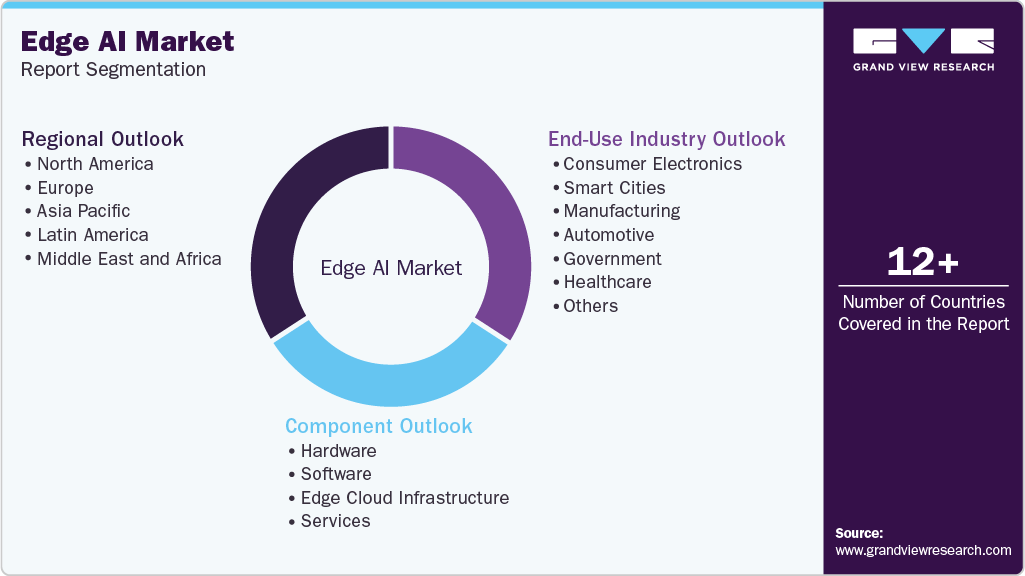
This report forecasts revenue growth on global, regional, and country levels and provides an analysis of the industry trends in each of the sub-segments from 2021 to 2033. For this study, Grand View Research has segmented the global edge AI market report on the basis of component, end use, and region:
 To learn more about this report, Download Free Sample Report
 -
Component Outlook (Revenue, USD Million, 2021 - 2033)
-
Hardware
-
Software
-
Edge Cloud Infrastructure
-
Services
-
-
End Use Outlook (Revenue, USD Million, 2021 - 2033)
-
Consumer Electronics
-
Smart Cities
-
Manufacturing
-
Automotive
-
Government
-
Healthcare
-
IT & Telecom
-
Energy
-
Retail
-
Others
-
-
Regional Outlook (Revenue, USD Million, 2021 - 2033)
-
North America
-
U.S.
-
Canada
-
Mexico
-
-
Europe
-
UK
-
Germany
-
France
-
-
Asia Pacific
-
China
-
Japan
-
India
-
South Korea
-
Australia
-
-
Latin America
-
Brazil
-
-
Middle East and Africa
-
Kingdom of Saudi Arabia (KSA)
-
UAE
-
South Africa
-
-
Delivered Customizations
This report has been delivered with the following In-depth customizations
Client Objective Custom Research Modules Delivered
Strategic Value / Business Impact
Market Entry & Expansion Assessment
Regional demand sizing and forecasting
Customer segmentation and buying behavior analysis
Competitive landscape benchmarking
Regulatory and distribution channel assessment
Identified high-growth market opportunities.
Supported go-to-market strategy development
Highlighted investment priorities and risks
Enabled data-driven expansion planning
Technology & Innovation Assessment
Emerging technology trend analysis
Innovation pipeline
Technology adoption readiness assessment
Ecosystem and partnership mapping
Identified future growth areas
Supported innovation roadmap planning
Evaluated commercialization potential
Strengthened strategic partnership decisions
Supply Chain & Procurement Intelligence
Supplier benchmarking and mapping
Raw material and cost structure analysis
Distribution and logistics assessment
Risk and dependency evaluation
Improved supply chain visibility
Identified cost optimization opportunities
Reduced procurement and sourcing risks
Supported operational efficiency initiatives
Investment Feasibility & Opportunity Analysis
Market attractiveness evaluation
Revenue and profitability modeling
SWOT and risk assessment
Industry trend and scenario analysis
Supported investment decision-making.
Identified high-potential segments
Reduced market uncertainty
Enabled strategic business planning
Frequently Asked Questions About This Report
The hardware segment led with a 51.8% revenue share in 2025.
The consumer electronics segment held the largest revenue share in 2025.
The global edge AI market size was valued at USD 24.9 billion in 2025 and is estimated at USD 30.0 billion for 2026.
The global edge AI market is expected to grow at a CAGR of 21.7% from 2026 to 2033, reaching USD 118.7 billion by 2033.
North America dominated the edge AI market, accounting for a share of over 36.0% in 2025, driven by early technology adoption and strong digital infrastructure. The region benefits from the widespread deployment of edge AI across various industries, including healthcare, retail, manufacturing, and autonomous systems.
Key players include ADLINK Technology Inc.; Alphabet Inc.; Amazon.com, Inc ; Gorilla Technology Group; Intel Corporation; International Business Machines Corporation; Microsoft Corporation; Nutanix, Inc.; Synaptics Incorporated; Viso.ai.
Key factors driving the edge AI market growth include the growing use of edge AI applications such as Smart AI Vision, Smart Energy, AI Healthcare, Smart Factory, and Intelligent transportation systems is attributed to the market growth
About the Author(s)
Next Generation Technologies Research Team
Technology · Next Generation TechnologiesThis report was authored by the next generation technologies research team at Grand View Research - comprising two research analysts, one senior research analyst, and one industry expert - with specialized expertise in the next generation technologies segment of the technology industry. All findings are based on proprietary technology databases, executive interviews, and regulatory analysis, subject to internal peer review prior to publication.
Last Updated:
Speak to Analyst

Customize this report to your needs - add regions, segments, or data points, with 20% free customization.
Or view our licence options:


ISO 9001:2015 & 27001:2022 Certified
We are GDPR and CCPA compliant! Your transaction & personal information is safe and secure. For more details, please read our privacy policy.


