
- Home
- »
- Next Generation Technologies
- »
-
Edge AI Software Market Size And Share Report, 2026-2033GVR Report cover

Edge AI Software Market (2026 - 2033)
Size, Share & Trends Analysis Report By Data Type (Audio Data, Mobile Data, Sensor Data, Biometric Data, Speech Recognition), By Offering (Solutions, Services), By Vertical (BFSI, Automotive), By Region, And Segment Forecasts
Market Size, 2025
$2.5BMarket Estimate, 2026
$3.1BMarket Forecast, 2033
$19.7BCAGR, 2026–2033
29.9%Edge AI Software Market Summary
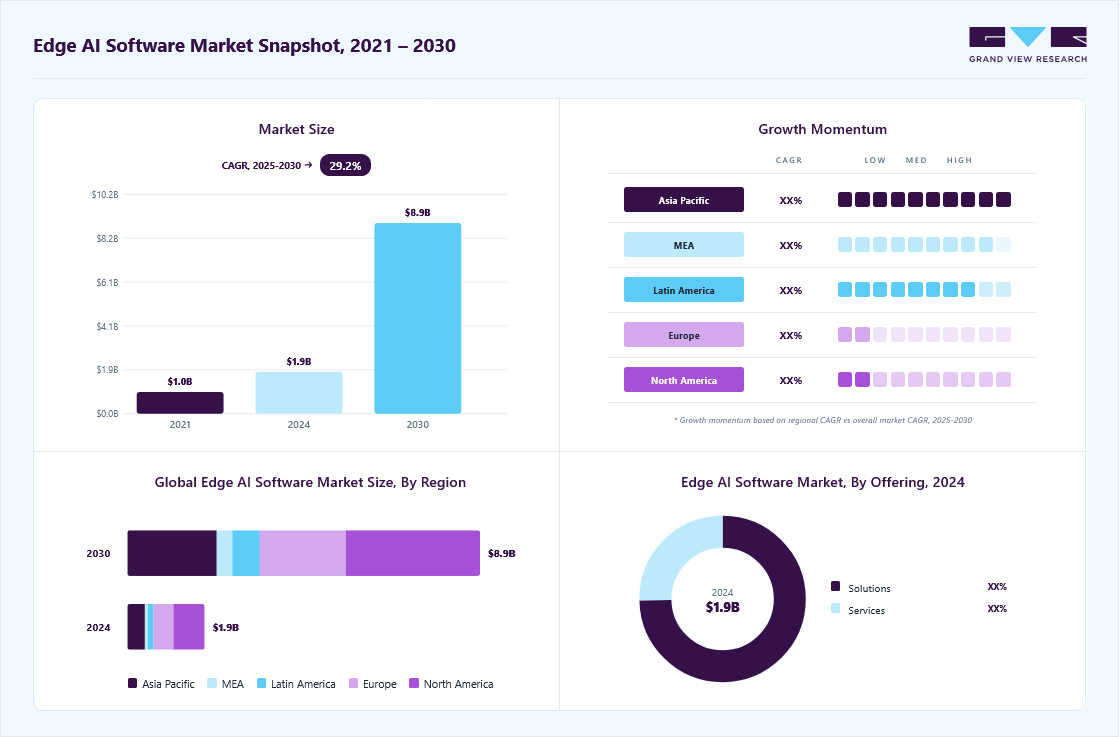
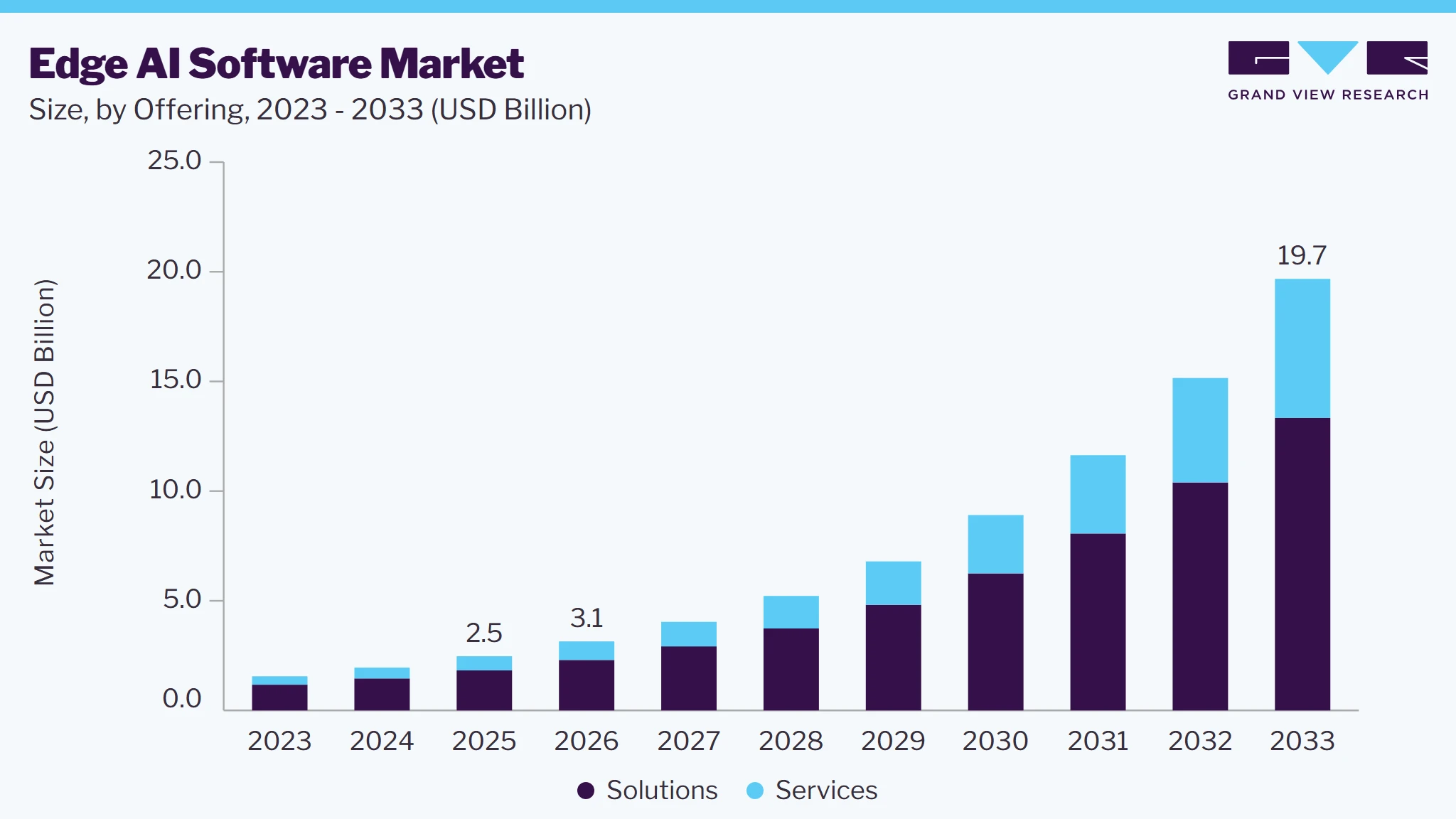
The global edge AI software market size was valued at USD 2.5 billion in 2025 and is projected to grow from USD 3.1 billion in 2026 to USD 19.7 billion by 2033, at a CAGR of 29.9% from 2026 to 2033. The market in North America dominated with a revenue share of 40.0% in 2025. The market is driven by the increasing adoption of edge computing, rising deployment of AI-powered edge devices, growing demand for real-time data processing, and expanding implementation of machine learning at the edge across manufacturing, automotive, healthcare, retail, and industrial automation.
 Source: Grand View Research, IR Documents, Primary Interviews, Paid DatabasesTo learn more about this report,
 Download Free Sample Report
 Key Market Trends & Insights
- By offering: Solutions segment held the largest market share of 73.9% in 2025.
- By data type: Video and image recognition segment held the largest market share of 19.7% in 2025.
- By vertical: IT & telecommunications segment held the largest market share in 2025.
Regional Highlights
- Largest regional market: North America (40.0% revenue share, 2025)
- Fastest-growing regional market: Asia Pacific (highest CAGR, 2026-2033)
- By country: The U.S. held the largest market share in 2025
Market Size & Forecast
- Market size in 2025: USD 2.5 Billion
- Estimated market size in 2026: USD 3.1 Billion
- Projected market size by 2033: USD 19.7 Billion
- CAGR (2026-2033): 29.9%
Three ways to get this report
Buy it, customize it, or ask a question.Ask an Analyst
Analyst response in 1 business day
- AccessReport author, directly
- Reply timeWithin 1 working day
- No sales callDirect answer only
- FormatEmail reply
- CostFree, no cost
Get the Full Report
What the study covers
- FormatsPDF · Excel · Dashboard
- Timeline2026–2033 annual, 2025 base
- Coverage20+ countries, 5 regions
- Companies10+ key players profiled
Customize the Report
20% free customization
- IncludeCountries, segments, points
- TailorTo your product definition
- ExtendDeeper competitor detail
- OrA fully bespoke study
- Turnaround5–10 working days
Furthermore, advancements in embedded AI, IoT-enabled intelligent systems, computer vision, and low-latency AI inference are accelerating enterprise investments in edge AI software platforms, supporting sustained market growth.Edge AI systems are designed to be energy-efficient, which is essential for various battery-powered devices such as drones, sensors, and wearables. This enables the scalable deployment of Edge AI solutions across various sectors. Moreover, by performing AI processing at the edge, companies can significantly reduce the costs associated with data transmission to the cloud. This also decreases latency, making Edge AI suitable for applications requiring quick response times, such as robotics and smart manufacturing. Furthermore, the rise of autonomous vehicles, drones, and robots requires real-time AI processing at the edge for various tasks such as object recognition, navigation, and decision-making without relying on cloud-based systems.
 To learn more about this report, Download Free Sample Report
 Industry 4.0 and smart manufacturing initiatives drive demand for Edge AI software to monitor and optimize production lines, predict equipment failures, and ensure quality control in real time. Ongoing developments in AI and machine learning algorithms allow complex models to be run efficiently on edge devices with limited computing resources. This improvement expands the scope of Edge AI applications across various industries. These drivers collectively contribute to the accelerated market adoption and growth across multiple industries and regions.
Market Dynamics
The edge AI software market is driven by the growing demand for real-time data processing and low-latency AI inference across connected devices and distributed computing environments. Increasing adoption of edge computing, AI-powered edge devices, and machine learning at the edge is enabling enterprises to process data locally, improve operational efficiency, and reduce cloud dependency. Rising investments in IoT, computer vision, predictive analytics, and embedded AI are accelerating the deployment of intelligent software platforms across manufacturing, automotive, healthcare, retail, and smart city applications. The expansion of 5G networks, coupled with advancements in AI model optimization and edge hardware acceleration, is strengthening the performance and scalability of edge AI software solutions. Furthermore, growing enterprise focus on data privacy, cybersecurity, bandwidth optimization, and autonomous decision-making is supporting sustained adoption and long-term growth of the edge AI software market.
The edge AI software market is driven by the increasing adoption of edge AI platforms that enable real-time data processing and low-latency decision-making across connected environments. Enterprises are deploying edge AI software to support AI inference directly on devices, reducing reliance on centralized cloud infrastructure and improving operational efficiency. Growing implementation of edge intelligence, computer vision, and machine learning inference across manufacturing, automotive, healthcare, and retail is accelerating software demand. The expansion of IoT edge devices and intelligent sensors is further increasing the need for scalable AI software capable of processing data locally. These factors continue to strengthen enterprise investment in advanced edge AI software solutions.
Increasing deployment of AI model optimization, edge AI frameworks, and embedded AI software is enhancing the performance of intelligent applications operating at the network edge. Advancements in TinyML, neural network optimization, and on-device AI are enabling efficient execution of AI workloads on resource-constrained devices. The rollout of 5G-enabled edge computing is supporting faster communication between edge devices while improving AI application responsiveness. Organizations are increasingly adopting edge AI development platforms to simplify model deployment and lifecycle management across distributed environments. This technological advancement is supporting sustained growth of the global edge AI software market.
The edge AI software market faces challenges due to the complexity of deploying AI applications across heterogeneous edge hardware and operating environments. Integrating edge AI frameworks with multiple chipsets, processors, and embedded systems often requires extensive software customization and optimization. Variations in hardware architecture create interoperability challenges for developers deploying AI inference software on a scale. Maintaining consistent model performance across distributed edge devices also increases software development and validation efforts. These implementation challenges continue to restrain widespread enterprise adoption.
Limited availability of standardized edge AI development tools, combined with increasing cybersecurity requirements, further constrains market expansion. Organizations must continuously update AI software platforms to address evolving security vulnerabilities while maintaining reliable edge performance. Resource limitations on edge devices can also restrict the deployment of complex deep learning models without significant optimization. High implementation costs associated with software integration, maintenance, and lifecycle management create additional barriers for small and medium-sized enterprises. These factors remain key constraints affecting the commercialization of advanced edge AI software solutions.
The edge AI software market is expected to benefit from the rapid expansion of autonomous systems, smart factories, and intelligent connected infrastructure. Increasing demand for edge AI applications in autonomous vehicles, industrial automation, robotics, healthcare devices, and smart cities is creating significant opportunities for software vendors. Enterprises are investing in AI orchestration, edge analytics, and real-time AI inference to improve operational intelligence while reducing cloud processing requirements. The growing adoption of multimodal AI, federated learning, and AI lifecycle management is enabling more scalable and efficient edge deployments. These trends are creating new revenue opportunities across multiple industry verticals.
Advancements in generative AI at the edge, AI accelerators, and edge-native AI software are expanding the capabilities of intelligent edge applications. Software providers are developing optimized platforms that support seamless deployment across heterogeneous edge computing environments. Rising investments in industrial IoT, private 5G networks, and software-defined edge infrastructure are accelerating demand for intelligent edge software solutions. Growing regulatory emphasis on data sovereignty and local data processing is further encouraging organizations to deploy AI models closer to data sources. These developments are expected to support long-term innovation and sustained growth in the global edge AI software market.
Market Concentration & Characteristics
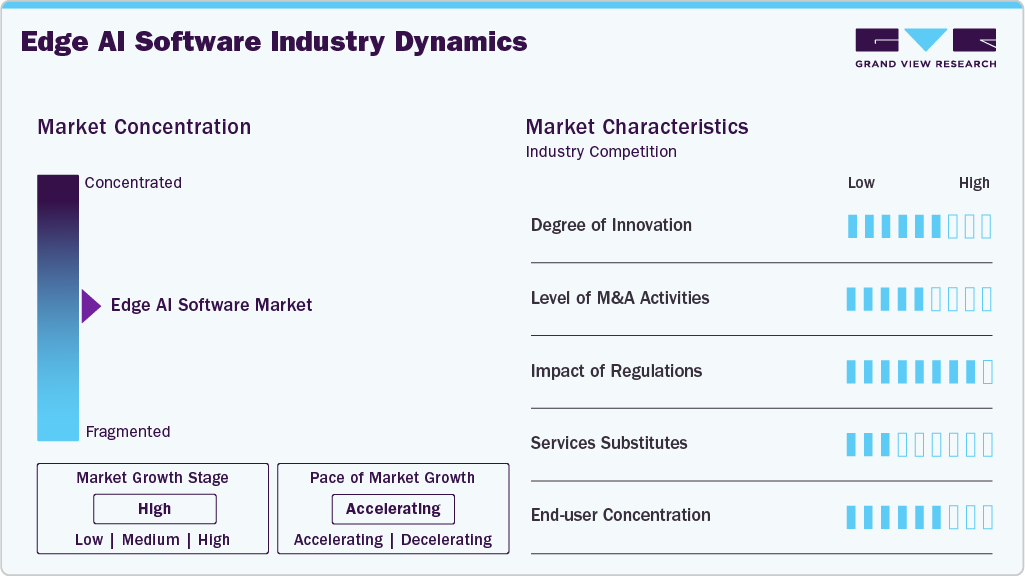
The edge AI software market exhibits a moderately concentrated competitive landscape, with leading technology providers strengthening their market positions through continuous innovation in edge AI software, strategic partnerships, and platform expansion. Market participants are investing in AI inference software, edge AI frameworks, and on-device AI capabilities to address growing enterprise demand for real-time intelligence and low-latency computing. The market is characterized by a high growth stage and an accelerating pace of expansion, supported by increasing adoption of edge computing, IoT, and intelligent edge applications across diverse industry verticals. Continuous advancements in AI model optimization and edge-native software architectures are intensifying competition while creating opportunities for both established vendors and emerging software developers.
 To learn more about this report, Download Free Sample Report
 The market demonstrates a high degree of innovation, as vendors focus on enhancing computer vision, machine learning inference, embedded AI, and edge analytics capabilities to improve software performance and deployment efficiency. Merger and acquisition activity remains moderate, with companies expanding their AI software portfolios and strengthening technological capabilities through strategic collaborations rather than large-scale consolidation. Regulatory requirements related to data privacy, AI governance, and cybersecurity have a high impact, encouraging organizations to adopt secure, compliant, and localized edge AI software deployments. Service substitution remains low due to the specialized nature of edge AI applications, while medium-to-high end-user concentration across manufacturing, automotive, healthcare, telecommunications, and retail continues to support stable demand and long-term market expansion.
Analyst Perspective
The edge AI software market is expected to witness sustained growth as enterprises increasingly prioritize real-time AI inference, edge computing, and localized data processing to improve operational efficiency and reduce cloud dependency. Rising adoption of embedded AI, computer vision, IoT, and 5G-enabled edge infrastructure is expanding the deployment of intelligent software across manufacturing, automotive, healthcare, telecommunications, and smart city applications. Continuous advancements in AI model optimization, edge AI frameworks, and on-device AI are enabling scalable, low-latency solutions capable of supporting mission-critical workloads. Technology providers are strengthening their competitive position through investments in edge-native AI platforms, strategic partnerships, and industry-specific software capabilities that address evolving enterprise requirements. As organizations accelerate digital transformation and demand secure, intelligent, and distributed computing environments, the global edge AI software market is well positioned for long-term innovation and sustainable revenue growth.
Offering Insights
Based on offering, the solutions segment led the market with the largest revenue share of 73.9% in 2025. Edge AI solutions enable real-time data analysis and decision-making at the source, reducing latency and enhancing real-time responses, which is crucial for various applications such as autonomous vehicles and industrial automation. Moreover, Edge AI solutions help keep sensitive data local, minimizing exposure to potential breaches and ensuring better compliance with data privacy regulations. Furthermore,Edge AI solutions are scalable and can be integrated into various devices and systems, such as IoT sensors and mobile devices, providing flexibility to adapt to different use cases and industries.These factors collectively drive the adoption and growth of Edge AI software solutions.
The services segment is anticipated to exhibit the highest CAGR over the forecast period. Customization and support, training and skill development, and security and compliance are primary drive the growth of the segment. Moreover, Edge AI services ensure that Edge AI solutions remain current with the latest advancements in technology and best practices, helping organizations stay competitive. Edge AI services ensure seamless operation and interoperability with existing systems. Thus, driving the segment’s growth.
Data Type Insights
Based on data type, the video and image recognition segment led the market with the largest revenue share of 19.7% in 2025. Growing concerns about security and surveillance drive the need for real-time video and image analysis for applications such as facial recognition, anomaly detection, and threat assessment. Moreover, improvements in AI algorithms and machine learning models enhance the accuracy and efficiency of video and image recognition, making these technologies more effective and widely adopted. Furthermore, the proliferation of smart cameras, smartphones, and other IoT devices equipped with image and video sensors fuels the demand for Edge AI solutions that can process and analyze visual data locally.
The audio data segment is anticipated to grow at a significant CAGR over the forecast period. The rising use of voice-activated assistants and smart speakers in consumer electronics drives demand for Edge AI solutions that process audio data locally for real-time voice recognition and command execution. Moreover, processing audio data locally on edge devices helps address privacy concerns by keeping sensitive voice interactions and recordings secure and compliant with data protection regulations. Furthermore, Edge AI enables low-latency processing of audio data, which is crucial for applications such as real-time transcription, voice-controlled applications, and interactive voice response systems.
Vertical Insights
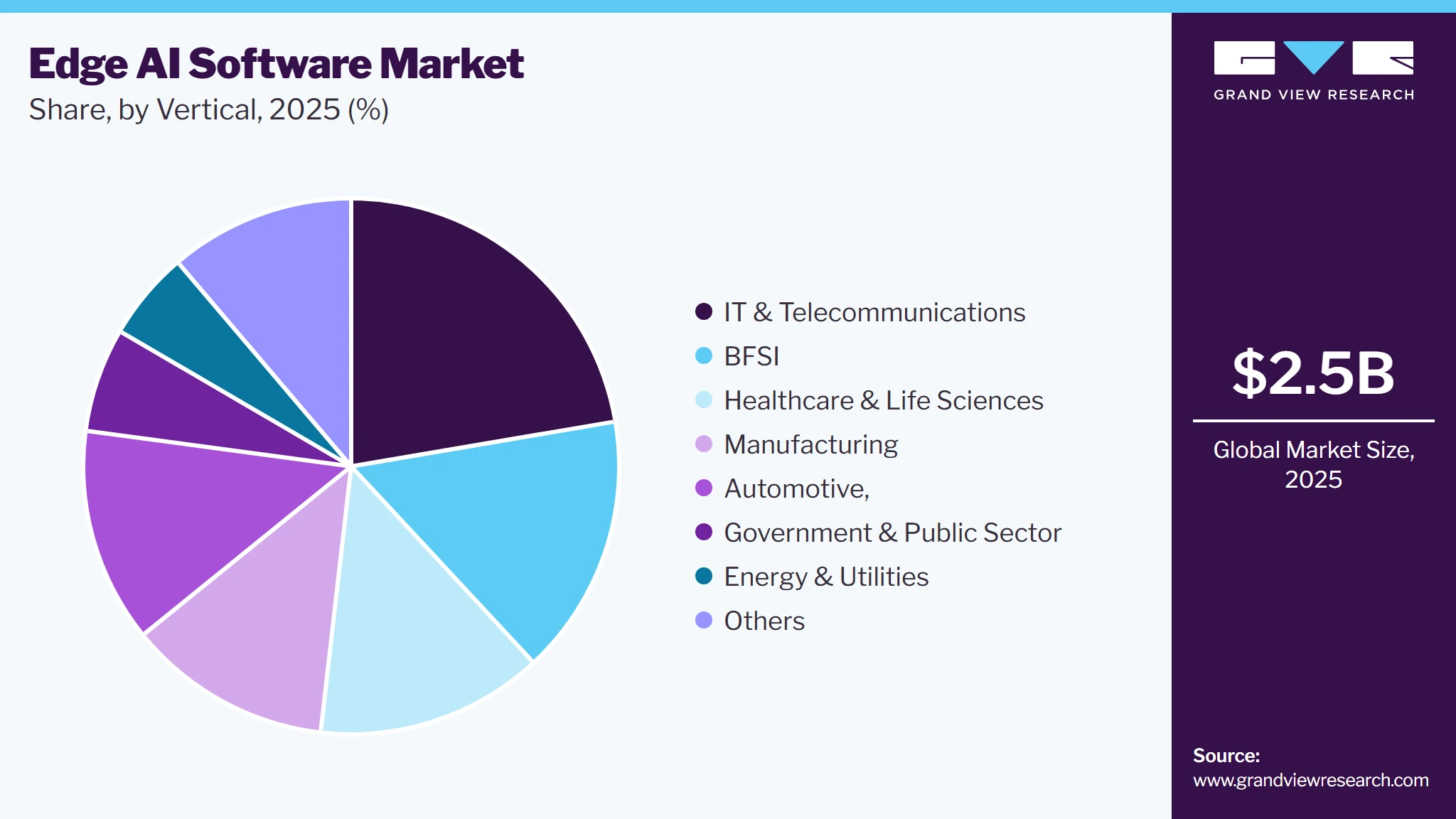
Based on vertical, the IT & telecommunications segment led the market with the largest revenue share of over 22.0% in 2025. Numerous factors, such as the expansion of 5G networks, the increasing need for real-time data processing, and enhanced network security, drive market demand in the IT and telecommunications segment. Moreover, Edge AI supports dynamic network management, traffic optimization, and predictive maintenance, helping telecommunications companies improve operational efficiency and reduce costs. Furthermore, ongoing advancements in AI algorithms and edge computing infrastructure boost the capabilities of edge AI solutions, enabling advanced and efficient network management and services.
 To learn more about this report, Download Free Sample Report
 The healthcare & life sciences segment is anticipated to exhibit the highest CAGR over the forecast period. Edge AI supports advanced imaging and diagnostic tools, providing real-time analysis of medical images and assisting in early disease detection and accurate diagnosis. Moreover, the rise of telemedicine and remote healthcare services drives demand for edge AI solutions that can process and analyze data locally, ensuring high-quality video consultations and accurate remote diagnostics. Edge AI solutions also help maintain patient data privacy and comply with regulatory requirements by processing sensitive health information locally, reducing the risk of data breaches.
Regional Insights
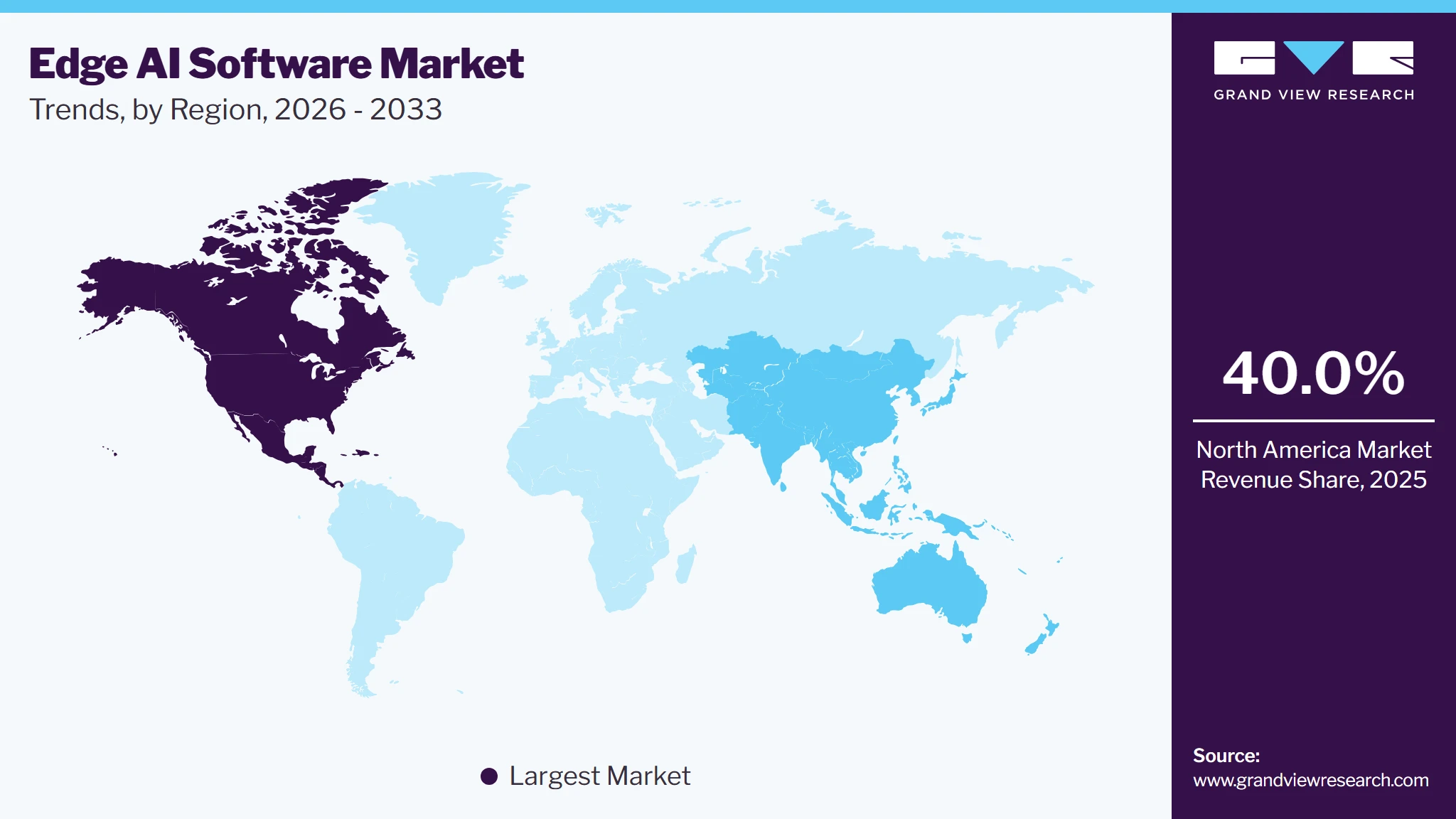
North America dominated the edge AI software market with the largest revenue share of 40.0% in 2025. The increasing adoption of IoT and smart devices is driving the region’s need for real-time, on-device processing. Edge AI software enables these devices to process data locally, reducing the need for constant cloud communication. Moreover, ongoing developments in AI and machine learning algorithms in the region allow complex models to be run efficiently on edge devices with limited computing resources. This improvement expands the scope of Edge AI applications across various industries.
 To learn more about this report, Download Free Sample Report
 U.S. Edge AI Software Market Trends
The edge AI software market in the U.S. held the largest share in the North America region in 2025. The rollout of 5G networks across the U.S. is a major enabler for Edge AI. The higher speeds, lower latency, and increased capacity of 5G enhance the ability of edge devices to handle real-time AI workloads, especially in various applications, such as smart cities and autonomous systems. The U.S. is a global hub for autonomous systems development, including self-driving cars, drones, and robotics. These systems rely heavily on Edge AI for local data processing to ensure safety and real-time operational efficiency.
Europe Edge AI Software Market Trends
The Edge AI software market in Europe is expected to witness significant growth over the forecast period. The European Union's emphasis on data privacy and security through regulations such as the General Data Protection Regulation (GDPR) is driving the adoption of Edge AI, which processes data locally and ensures better compliance with stringent data privacy laws. Moreover, Europe's commitment to green technology and sustainable development is encouraging the use of Edge AI in areas such as smart grids, energy management, and environmental monitoring, where real-time processing is essential.
Asia Pacific Edge AI Software Market Trends
The Edge AI software market in the Asia Pacific region is anticipated to register the highest CAGR over the forecast period. Various countries in the APAC region, such as India, China, and Singapore, are developing smart city projects. Edge AI is crucial for optimizing efficiency and sustainability and managing real-time data generated by city infrastructure, such as traffic systems, energy grids, and surveillance systems.
Key Edge AI Software Company Insights
Key Edge AI software companies include Amazon Web Services, Edge Impulse Inc., and Google. Companies active in the Edge AI software market are focusing aggressively on expanding their customer base and gaining a competitive edge over their rivals. Hence, they pursue various strategic initiatives, including partnerships, mergers & acquisitions, collaborations, and new product/ technology development. For instance, in June 2024, Advantech Co., Ltd., an IoT intelligent systems provider, launched the AIR-520 Edge AI server solution for generative AI applications, including Phison's patented aiDAPTIV+ technology. The solution facilitates fine-tuning large language models (LLMs) using 1-4 GPU cards and SQ ai100 AI SSDs. It allows businesses to train LLMs cost-effectively while ensuring the security of sensitive data at the edge.
-
Amazon Web Services (AWS) is a global leader in cloud computing, offering an extensive Free Tier that allows new users to explore over 100 services. Among its offerings, AWS provides Edge AI software capabilities through services like AWS IoT Greengrass, Amazon SageMaker Edge Manager, and AWS Panorama, enabling real-time machine learning inference directly on edge devices. These tools empower businesses to deploy intelligent applications outside the cloud, improving latency, bandwidth efficiency, and operational resilience.
-
Intel is a global technology provider specializing in semiconductor innovation and advanced computing solutions. In Edge AI, Intel offers a comprehensive suite of software and hardware designed to bring artificial intelligence capabilities closer to data sources, enabling real-time processing and decision-making. Key offerings include the Intel Edge Software Hub, which provides prevalidated software packages for optimizing edge solutions in computer vision and deep learning applications. Additionally, Intel®Smart Edge is a Kubernetes-based platform that simplifies the deployment of edge networks and multi-access edge computing (MEC) applications, enhancing performance and security. These solutions empower industries such as healthcare, manufacturing, and retail to implement intelligent, responsive systems at the edge, improving efficiency and outcomes.
Key Edge AI Software Companies
The following are the leading companies in the edge AI software market.
- Amazon Web Services
- Edge Impulse Inc.
- IBM Corporation
- Intel Corporation
- Kyndryl Inc.
- Microsoft
- NVIDIA Corporation
- Qualcomm Technologies, Inc.
- Siemens
Competitive benchmarking
Operating Strategies
Competitive Edge
Weaknesses
Mature Players: Microsoft, NVIDIA Corporation, Amazon Web Services, Google, IBM Corporation
- Mature players are expanding edge AI software platforms, AI inference engines, and edge-to-cloud deployment capabilities to strengthen their leadership in the global edge AI software market.
- Established vendors benefit from comprehensive AI software ecosystems, global cloud infrastructure, and extensive developer communities that accelerate enterprise adoption.
Continuous investment in AI research, software innovation, and platform modernization results in significant operational and development costs. Emerging Players: Edge Impulse Inc., Kyndryl Inc., Qualcomm Technologies, Inc., Intel Corporation, Siemens
- Emerging players are focusing on embedded AI software, lightweight AI frameworks, and industry-specific edge AI solutions to expand their presence across intelligent edge applications.
- These companies leverage specialized expertise in edge hardware integration, industrial automation, AI optimization, and embedded computing to deliver high-performance edge AI software.
- Emerging vendors generally have lower global software platform penetration and smaller enterprise customer bases than established cloud and AI software providers.
Recent Developments
-
In July 2024, NTT DATA Inc., a consulting and information technology service company, launched Edge AI, which delivers a comprehensive managed service platform designed to expedite Information Technology (IT)/Operational Technology (OT) convergence by migrating AI processing to the edge. This platform encompasses everything needed for Edge AI deployment, including systems, tools, and necessary capabilities. It effectively handles data identification, gathering, integration, computing capacity, smooth connectivity, and the management of AI models.
-
In June 2024, STMicroelectronics, a semiconductor manufacturer, launched ST Edge AI Suite, integrating tools, software, and expertise to streamline and expedite the development of edge-AI applications. The ST Edge AI Suite stands as a unified set of software tools aimed at simplifying the creation and launch of embedded AI applications. This complete package aids in the entire process from data collection to the actual implementation of machine learning algorithms on devices, making the development workflow more efficient for various user types.
-
In February 2024, Intel Corporation launched a new Edge Platform, a scalable, open-source software platform that allows companies to easily create, deploy, manage, secure, and operate edge and AI applications with the ease of cloud technology.
Edge AI Software Market Report Scope
Report Attribute
Details
Market size in 2025
USD 2.5 billion
Estimated market size in 2026
USD 3.1 billion
Projected market size by 2033
USD 19.7 billion
Growth rate
CAGR of 29.9% from 2026 to 2033
Base year for estimation
2025
Historical data
2021 - 2024
Forecast period
2026 - 2033
Quantitative units
Revenue in USD million/billion and CAGR from 2026 to 2033
Report coverage
Revenue forecast, company ranking, competitive landscape, growth factors, and trends
Segments covered
Offering, data type, vertical, region
Regional scope
North America; Europe; Asia Pacific; Latin America; MEA
Country scope
U.S.; Canada; Mexico; Germany; UK; France; China; Japan; India; South Korea; Australia; Brazil; Saudi Arabia; South Africa; UAE
Key companies profiled
Amazon Web Services; Edge Impulse Inc.; Google; IBM Corporation; Intel Corporation; Kyndryl Inc.; Microsoft; NVIDIA Corporation; Qualcomm Technologies, Inc.; Siemens
Customization scope
Free report customization (equivalent up to 8 analysts' working days) with purchase. Addition or alteration to country, regional & segment scope.
Pricing and purchase options
Avail customized purchase options to meet your exact research needs. Explore purchase options
Global Edge AI Software Market Report Segmentation
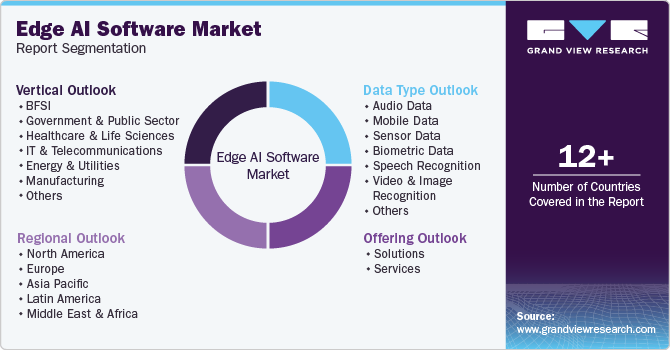
This report forecasts revenue growth at global, regional, and country levels and provides an analysis of the latest industry trends in each of the sub-segments from 2021 to 2033. For this study, Grand View Research has segmented the global Edge AI software market report based on the offering, data type, vertical, and region.
 To learn more about this report, Download Free Sample Report
 -
Offering Outlook (Revenue, USD Million, 2021 - 2033)
-
Solutions
-
Services
-
-
Data Type Outlook (Revenue, USD Million, 2021 - 2033)
-
Audio Data
-
Mobile Data
-
Sensor Data
-
Biometric Data
-
Speech Recognition
-
Video and Image Recognition
-
Others
-
-
Vertical Outlook (Revenue, USD Million, 2021 - 2033)
-
BFSI
-
Government & Public Sector
-
Healthcare & Life Sciences
-
IT & Telecommunications
-
Energy & Utilities
-
Manufacturing
-
Automotive
-
Others
-
-
Regional Outlook (Revenue, USD Million, 2021 - 2033)
-
North America
-
U.S.
-
Canada
-
Mexico
-
-
Europe
-
UK
-
Germany
-
France
-
-
Asia Pacific
-
China
-
India
-
Japan
-
Australia
-
South Korea
-
-
Latin America
-
Brazil
-
-
MEA
-
UAE
-
South Africa
-
KSA
-
-
Research Methodology
The Edge AI software market figures in this report are based on a proven research process that combines executive interviews with secondary research from proprietary databases, company filings, and recognized regulatory and institutional sources. Market size is built through value-chain sizing - reconciling supply-side and demand-side estimates - and triangulated with bottom-up and top-down approaches. Every estimate passes multiple levels of expert validation before publication, with each Edge AI software segment quantified using the revenue-capture definitions in the table below.
Segment Definition
Segment - Offering
Revenue capture definition
Solutions
This segment comprises software platforms, AI frameworks, development tools, and deployment applications designed to enable artificial intelligence processing directly on edge devices. It includes solutions that support real-time inference, model optimization, device management, and edge intelligence across distributed computing environments.
Services
This segment includes professional and managed services that assist organizations in implementing, integrating, optimizing, and maintaining edge AI software deployments. It covers consulting, customization, system integration, technical support, training, and lifecycle management services.
Segment - Data Type
Revenue capture definition
Audio Data
This segment covers edge AI software designed to process and analyze audio signals generated by microphones, communication systems, and connected devices. It enables applications such as sound classification, voice analytics, acoustic monitoring, and event detection.
Mobile Data
This segment consists of AI software that processes data generated from smartphones, tablets, wearable devices, and other mobile endpoints. It supports intelligent applications requiring localized analytics, contextual insights, and real-time decision-making on mobile devices.
Sensor Data
This segment includes software that interprets information collected from industrial, environmental, automotive, and IoT sensors at the network edge. It enables continuous monitoring, anomaly detection, predictive maintenance, and operational intelligence without relying on centralized processing.
Biometric Data
This segment comprises AI software that analyzes unique biological and behavioral characteristics for identity verification and authentication purposes. It supports the processing of fingerprints, facial attributes, iris patterns, and other biometric identifiers on edge devices.
Speech Recognition
This segment includes edge AI software capable of converting spoken language into structured digital information for automated interaction and command execution. It enables voice-controlled applications while processing speech locally to improve response speed and data privacy.
Video and Image Recognition
This segment covers software applications that perform visual data analysis using artificial intelligence directly on edge devices. It supports object detection, facial analysis, image classification, quality inspection, and surveillance across real-time environments.
Others
The other segment encompasses additional data formats processed by edge AI software that are not classified under the primary categories. It includes location data, environmental information, telemetry, text, and other specialized datasets used in industry-specific applications.
Segment - Vertical
Revenue capture definition
BFSI
This segment includes banks, financial institutions, and insurance companies deploying edge AI software to improve fraud detection, customer authentication, and branch intelligence. The software supports secure data processing, real-time analytics, and operational efficiency within financial environments.
Government & Public Sector
This segment comprises public agencies and government organizations utilizing edge AI software for security, public safety, transportation, and smart infrastructure applications. It enables localized data processing to enhance decision-making, service delivery, and regulatory compliance.
Healthcare & Life Sciences
This segment includes healthcare providers, medical device manufacturers, laboratories, and life sciences organizations implementing edge AI software for clinical and operational applications. The software enables real-time patient monitoring, medical imaging analysis, and intelligent healthcare workflows.
IT & Telecommunications
This segment consists of technology companies and telecom operators deploying edge AI software to optimize network operations, service delivery, and distributed computing infrastructure. It supports intelligent network management, edge analytics, and AI-enabled communication services.
Energy & Utilities
This segment includes organizations operating power generation, transmission, renewable energy, water, and utility infrastructure that leverage edge AI software for operational optimization. It enables predictive maintenance, asset monitoring, and real-time analysis of critical infrastructure.
Manufacturing
This segment comprises industrial manufacturers implementing edge AI software to improve production efficiency, automation, and quality control. It supports machine vision, equipment monitoring, predictive maintenance, and intelligent factory operations through localized AI processing.
Automotive
This segment includes automotive manufacturers, suppliers, and mobility solution providers utilizing edge AI software for connected, autonomous, and software-defined vehicles. The software enables advanced driver assistance, in-vehicle intelligence, predictive diagnostics, and real-time decision-making.
Others
This segment covers industries beyond the primary classifications that deploy edge AI software to support intelligent operations and localized analytics. It includes retail, logistics, aerospace, education, agriculture, media, and other sectors adopting edge-based artificial intelligence solutions.
Estimation Model
Layer Name
Key Questions
Description
Edge AI Device & Infrastructure Layer
Which devices and infrastructure require edge AI software?
Identify connected devices and edge computing infrastructure deploying edge AI software, including industrial gateways, IoT devices, smart cameras, autonomous vehicles, robotics, medical devices, smartphones, wearables, edge servers, and intelligent sensors. This layer establishes the total addressable deployment base for edge AI software across enterprise and consumer environments.
Edge AI Workload Adoption Layer
Where are edge AI workloads being deployed?
Apply adoption rates of computer vision, speech recognition, predictive analytics, anomaly detection, natural language processing, industrial automation, intelligent surveillance, and autonomous systems across major industries. This layer measures the expansion of AI workloads requiring localized processing and real-time inference at the network edge.
Edge AI Software Integration Layer
Which organizations implement advanced edge AI software capabilities?
Apply penetration levels of AI inference engines, edge AI frameworks, model optimization tools, AI orchestration platforms, embedded AI software, edge analytics, and lifecycle management solutions across manufacturing, automotive, healthcare, telecommunications, retail, energy, and smart city deployments. This layer captures the integration of advanced edge AI software into distributed computing environments.
Edge AI Software Revenue Realization Layer
How much revenue is generated from edge AI software deployment?
Estimate market revenue by combining active edge AI software deployments with enterprise spending on AI software platforms, development frameworks, software licensing, subscription services, deployment and integration services, maintenance, technical support, and software upgrades. This layer quantifies the total revenue generated across the global edge AI software value chain.
Delivered Customizations
This report has been delivered with the following In-depth customizations
Client Request
Customization Delivered
Value Adds
Edge AI Software Technology Adoption & Growth Assessment
Performed a comprehensive assessment of adoption trends related to edge computing, AI inference, machine learning, computer vision, embedded AI, IoT, 5G connectivity, and on-device AI across major industry verticals.
Enables stakeholders to identify high-growth technology segments, evaluate enterprise adoption trends, optimize investment priorities, and strengthen competitive positioning within the edge AI software market.
Industry-Specific Edge AI Software Deployment Analysis
Analyzed the deployment of edge AI software across manufacturing, automotive, healthcare, BFSI, telecommunications, government, energy & utilities, and retail, including intelligent automation, predictive analytics, autonomous systems, and real-time data processing applications.
Provides actionable insights into industry-specific deployment patterns, software adoption requirements, emerging application areas, and long-term market opportunities to support strategic business expansion and product development.
Edge AI Platforms, AI Inference & Intelligent Edge Computing Opportunity Assessment
Evaluated growth opportunities associated with edge AI platforms, AI model optimization, edge analytics, AI orchestration, TinyML, generative AI at the edge, and edge-native AI software across global markets.
Supports technology roadmap development, product innovation strategies, solution differentiation, and expansion into high-growth edge AI applications while enabling organizations to capitalize on evolving intelligent edge computing opportunities.
Frequently Asked Questions About This Report
Asia Pacific is the fastest-growing region over the forecast period.
The video and image recognition segment led with a 19.7% revenue share in 2025 and is the fastest-growing segment.
The IT & telecommunications segment led with a 22.3% revenue share in 2025, while healthcare & life sciences is the fastest-growing segment.
North America dominated the edge AI software market, with a 40.0% share in 2025. The increasing adoption of IoT and smart devices is driving the need for real-time, on-device processing in the region.
The solutions segment led with over 73.0% revenue share in 2025, while services is the fastest-growing segment.
The global edge AI software market size was valued at USD 2.5 billion in 2025 and is estimated at USD 3.1 billion for 2026.
The global edge AI software market is expected to grow at a CAGR of 29.9% from 2026 to 2033, reaching USD 19.7 billion by 2033.
Some key players operating in the edge AI software market include Amazon Web Services; Edge Impulse Inc.; Google; IBM Corporation; Intel Corporation; Kyndryl Inc.; Microsoft; NVIDIA Corporation; Qualcomm Technologies, Inc.; and Siemens.
Numerous factors such as proliferation of Internet of Things (IoT) devices, increasing demand for real-time decision-making, advancements in AI and Machine Learning, and 5G network expansion are primarily contributing to the growth of the Edge AI software market.
About the Author(s)
Next Generation Technologies Research Team
Technology · Next Generation TechnologiesThis report was authored by the next generation technologies research team at Grand View Research - comprising two research analysts, one senior research analyst, and one industry expert - with specialized expertise in the next generation technologies segment of the technology industry. All findings are based on proprietary technology databases, executive interviews, and regulatory analysis, subject to internal peer review prior to publication.
Last Updated:
Speak to Analyst

Customize this report to your needs - add regions, segments, or data points, with 20% free customization.
Or view our licence options:


ISO 9001:2015 & 27001:2022 Certified
We are GDPR and CCPA compliant! Your transaction & personal information is safe and secure. For more details, please read our privacy policy.


