Edible Films And Coating Market Summary
The global edible films and coating market size was estimated at USD 2.81 billion in 2024 and is projected to reach USD 4.25 billion by 2030, growing at a CAGR of 7.1% from 2025 to 2030. Consumers’ increased adaptability to eco-friendly packaging solutions will drive the edible films and coating market.
Key Market Trends & Insights
- North America accounted for the largest market share of around 35% in global revenue in 2021 and is expected to grow at a substantial growth rate from 2022 to 2028.
- Asia Pacific is estimated to be the second-largest contributor and fastest-growing market of edible films and coatings at a CAGR of 8.2% from 2022 to 2028.
- Based on material type, polysaccharides material accounted for the largest share of around 40% of global revenue in 2021.
- In terms of application, fruits and vegetables accounted for the highest revenue share of over 35% in the global edible films and coating revenue in 2021 and is expected to be the fastest-growing segment with a CAGR of 8.1% from 2022 to 2028.
Market Size & Forecast
- 2024 Market Size: USD 2.81 Billion
- 2030 Projected Market Size: USD 4.25 Billion
- CAGR (2025-2030): 7.1%
- North America: Largest market in 2021
This technology is useful for improving the food quality, shelf life, safety, and functionality of the product. Increased use of plastic in the food packaging and transportation industry raises concerns, as they are not easily disposable. Edible films and coating are one of the best potential alternatives for food packaging that can improve the storability of food, provide an alternative to existing packaging solutions, bio-degradable, eco-friendly, and for expanding the shelf life of products.

An edible coating is a thin layer applied around the food product to protect it from the surroundings and can be consumed along with food products. It works as a barricade to CO2, moisture, oxygen, lipids, and aromas between a food component and the surrounding environment, these films or coatings help to improve the food quality and increase shelf life. Polymer is used in edible material, protein, and polysaccharides are the most commonly used groups in biopolymers. Plants, animals, and microorganisms are the sources of polymers to be obtained. Soybean proteins, wheat gluten, corn zein, whey, sunflower proteins, and gelatin are the most popular proteins used in editable films and coatings.
The product has a number of benefits other than packaging alternatives to synthetic packaging. Edible material contains polymer and it benefits in multiple ways as it holds low unit weight and good shear characteristics. The use of natural biopolymers has several advantages in life sciences as it is available from agriculture, marine life, or animals and has biocompatibility, and is easily biodegradable. Thus, manufacturing companies are investing heavily in R&D. consumers are more inclined toward environmentally friendly solutions, and the growing interest of food manufacturing companies will drive the edible films and coating market.
The COVID-19 pandemic has affected a number of economies all across the globe. Pandemic influences many industries by slowing down their economic movement. Like other industries, the food packaging industry had an adverse effect on their economic movement. Reduced demand for food products, fruits, and vegetables from consumers due to country-wise lockdown, which negatively affected the edible films and coatings market during the period. Pandemic brought a lot of changes in consumers' shopping behavior and consumption patterns. Reduced production, decrease demand from consumers, break in the supply chain as restrictions on import and export. These entire factors hamper the growth of edible films and coating industry, however, as the thing gets normal post COVID era, it will open up new market opportunities and expected to have a growing demand for edible films and coating market.
By Material Type Insights
Polysaccharides material accounted for the largest share of around 40% of global revenue in 2021. Starch, cellulose, carrageenan, carboxymethylcellulose, gums, etc. are used for making edible films and coatings. Polysaccharides-based films and coating are characterized by poor moisture barrier properties but moderately less permeable to O2 and CO2. Polysaccharides are suitable for fruits and vegetables as it modifies the internal environment of the food product resulting in expanded shelf life.
The protein segment is estimated to be the fastest-growing segment at a growth rate of a CAGR of 8.1% from 2022 to 2028. The protein-based segment has increased interest from scientists as well as from manufacturing companies. Animal proteins like gelatin and plant-based protein like soybean protein, wheat gluten, sunflower protein, etc. are used in edible films and coatings.
By Application Insights
Fruits and vegetables accounted for the highest revenue share of over 35% in the global edible films and coating revenue in 2021 and is expected to be the fastest-growing segment with a CAGR of 8.1% from 2022 to 2028. The edible coating is highly used for fruits and vegetables as they help to sustain textural properties, mass transfer in vegetables and fruits, reduce oxidative reactions on fruits and vegetables and enhance glossiness and shine on fruits and vegetables.
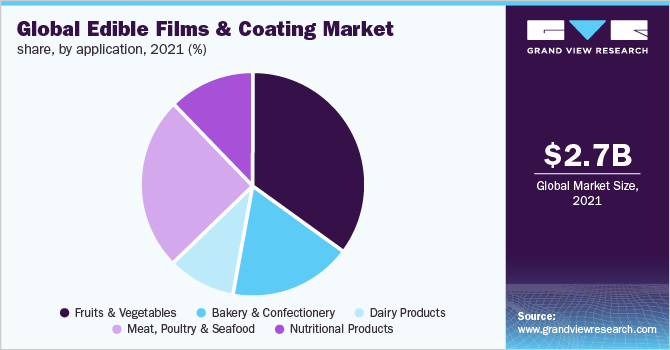
The meat, poultry, and seafood sector is the second largest segment where edible films and coating are used is expected to expand at a healthy growth rate from 2022 to 2028. Starch, carrageenan, chitosan, gelatin, etc. are used in meat, poultry, and seafood products. These products have growing demand from non-vegetarian people and consumers prefer to buy products with edible films rather than products packed in synthetic plastic.
Regional Insights
North America accounted for the largest market share of around 35% in global revenue in 2021 and is expected to grow at a substantial growth rate from 2022 to 2028. Increased awareness about eco-friendly products, the presence of global players and easy availability of edible films and coating products, and consumers’ willingness to pay for products will drive the segment’s market growth.
Asia Pacific is estimated to be the second-largest contributor and fastest-growing market of edible films and coatings at a CAGR of 8.2% from 2022 to 2028. China and Japan are the major contributors to the edible films and coating market in this region. The presence of global players, easy availability of products, and rising concerns for the environment will drive market growth.
Key Companies & Market Share Insights
The global market for edible films and coating is competitive, and a number of global players play a vital role in the market growth. Manufacturing companies investing heavily in research and developments to develop the alternative to plastic packaging and edible films and coatings is a potential one. Companies shifted their focus on producing edible films and coating, which are eco-friendly and biodegradable. Manufacturing companies adopted strategies like mergers & acquisitions, new product developments, and expansion of distribution channels to strengthen their presence in the trash bags market. Some of the key players operating in the global edible films and coating market include: -
-
Tate & Lyle PLC
-
DuPont de Nemours Inc.
-
Dohler Group
-
Koninklijke DSM NV
-
Cargill Incorporated
-
Ingredion Incorporated
-
Lactips
-
Nagase America LLC
-
Kerry Group plc
-
Pace International, LLC
-
Watson Inc.
Edible Films And Coating Market Report Scope
|
Report Attribute
|
Details
|
|
Market size value in 2025
|
USD 3.01 billion
|
|
Revenue forecast in 2030
|
USD 4.25 billion
|
|
Growth Rate
|
CAGR of 7.1% from 2025 to 2030
|
|
Base year for estimation
|
2024
|
|
Historical data
|
2018 - 2023
|
|
Forecast period
|
2025 - 2030
|
|
Quantitative units
|
Revenue in USD million/billion and CAGR from 2025 to 2030
|
|
Report coverage
|
Revenue forecast, company ranking, competitive landscape, growth factors, and trends
|
|
Segments covered
|
By material type, application, region
|
|
Regional scope
|
North America, Europe, Asia Pacific, Central & South America, Middle East & Africa
|
|
Country scope
|
U.S., Germany, U.K., France, China, Japan, Brazil, South Africa
|
|
Key companies profiled
|
Tate & Lyle PLC, DuPont de Nemours Inc., Dohler Group, Koninklijke DSM NV, Cargill Incorporated, Ingredion Incorporated, Lactips, Nagase America LLC, Kerry Group plc, Pace International, LLC, Watson Inc.
|
|
Customization scope
|
Free report customization (equivalent up to 8 analysts working days) with purchase. Addition or alteration to country, regional & segment scope.
|
|
Pricing and purchase options
|
Avail customized purchase options to meet your exact research needs. Explore purchase options
|
Segments Covered in the Report
This report forecasts revenue growth at global, regional & country levels and provides an analysis on the latest trends and opportunities in each of the sub-segment from 2017 to 2028. For this study, Grand View Research has segmented the global edible films and coating market report based on material type, application, and region.
-
Material Type Outlook (Revenue, USD Million, 2018 - 2030)
-
Protein
-
Polysaccharides
-
Lipids
-
Composites
-
Application (Revenue, USD Million, 2018 - 2030)
-
Regional Outlook (Revenue, USD Million, 2018 - 2030)
-
North America
-
Europe
-
Asia Pacific
-
Central & South America
-
Middle East & Africa
Frequently Asked Questions About This Report
b. The global edible films and coating market size was estimated at USD 2.70 billion in 2021 and is expected to reach USD 2.87 billion in 2022.
b. The global edible films and coating market is expected to grow at a compound annual growth rate of 7.7% from 2022 to 2028 to reach USD 4.54 billion by 2028.
b. North America dominated the edible films and coating market with a share of 34.71% in 2021. This is attributable to increased awareness about eco-friendly products, the presence of global players, and easy availability of edible films and coating products.
b. Some key players operating in the edible films and coating market include Tate & Lyle PLC; DuPont de Nemours Inc.; Dohler Group; Koninklijke DSM NV; Cargill Incorporated; Ingredion Incorporated; Lactips; Nagase America LLC; Kerry Group plc; Pace International, LLC; and Watson Inc.
b. Key factors that are driving the edible films and coating market growth include consumers’ increased adaptability to eco-friendly packaging solutions, increasing inclination of consumers towards environment-friendly solutions, and the growing interest of food manufacturing companies in edible films and coating.

 Download Sample Report
















