
- Home
- »
- Advanced Interior Materials
- »
-
Electric Kitchen Composter Market Size, Share Report, 2033GVR Report cover
![Electric Kitchen Composter Market (2026 - 2033)Report]()
Electric Kitchen Composter Market (2026 - 2033)
Size, Share & Trends Analysis Report By Capacity (Below 3 L, 3 - 5 L, Above 5 L), By Distribution Channel (Online, Offline), By End Use (Residential/Household, Hospitality, Institutions), By Region, And Segment Forecasts
Market Size, 2025
$317.6MMarket Estimate, 2026
$333.6MMarket Forecast, 2033
$497.1MCAGR, 2026–2033
5.9%Electric Kitchen Composter Market Summary
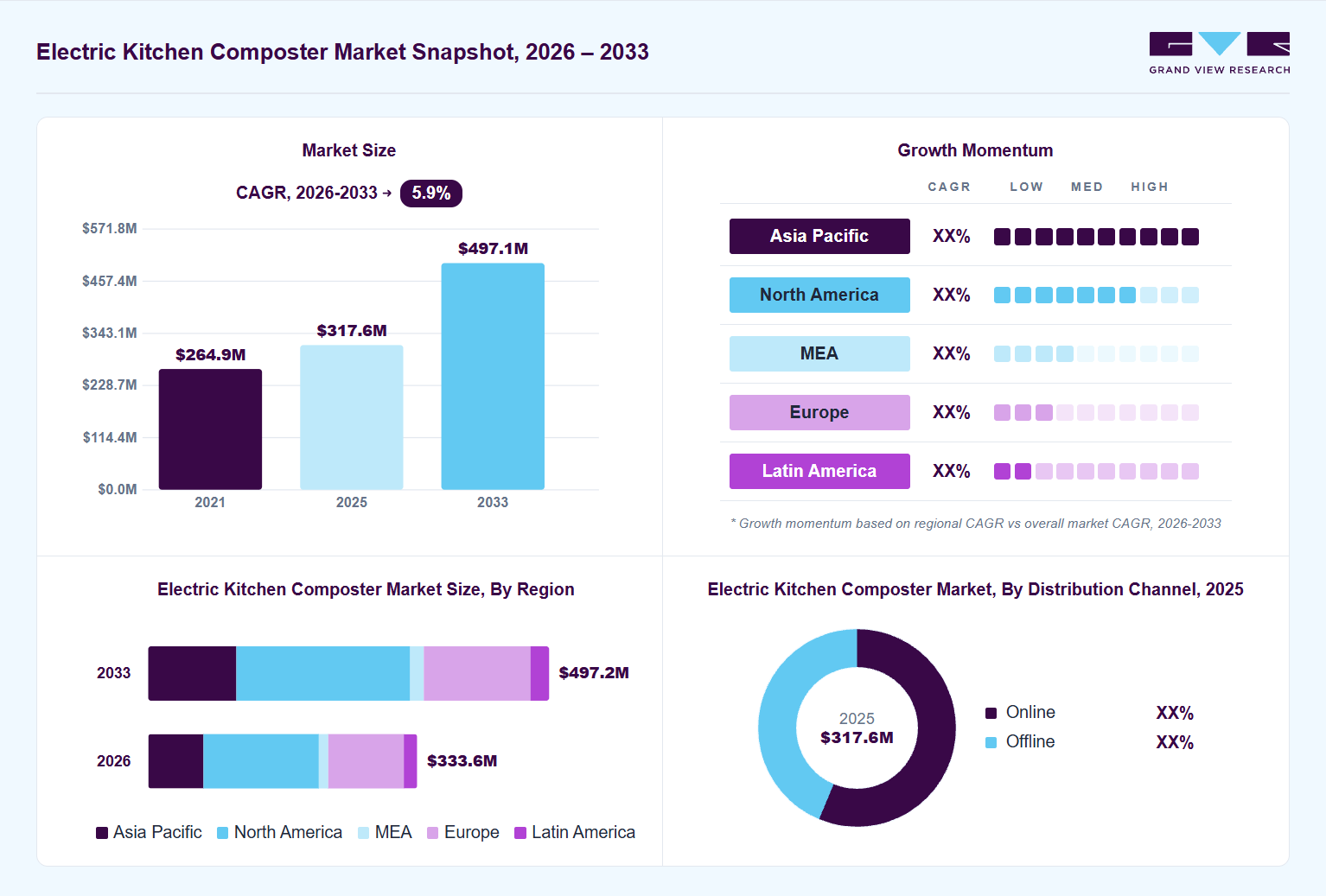
The global electric kitchen composter market size was valued at USD 317.6 million in 2025 and is projected to grow from USD 333.6 million in 2026 to USD 497.1 million by 2033, at a CAGR of 5.9% from 2026 to 2033. North America dominated the market, accounting for the largest revenue share of 42.8% in 2025. The global market is driven by rising household food waste generation, growing environmental awareness, urbanization, and increasing demand for convenient waste management solutions.
Key Market Trends & Insights
- By capacity: The 3 - 5 L segment led the market with the largest revenue share of 41.6% in 2025.
- By distribution channel: The online segment held the largest market share of 56.2% in 2025.
- By end use: The residential/hospitality segment held the largest market share of 78.3% in 2025.
Regional Highlights
- Largest regional market: North America (42.8% revenue share, 2025)
- Fastest-growing regional market: Asia Pacific (highest CAGR, 2026-2033)
- By country: The U.S. dominated North America with the largest revenue share in 2025
Market Size & Forecast
- Market size in 2025: USD 317.6 Million
- Estimated market size in 2026: USD 333.6 Million
- Projected market size by 2033: USD 497.1 Million
- CAGR (2026-2033): 5.9%
Limited space for traditional composting, stricter waste-diversion initiatives, and the growing adoption of smart and energy-efficient kitchen appliances are further supporting demand for compact electric composters that can reduce food-waste volume, odors, and handling time.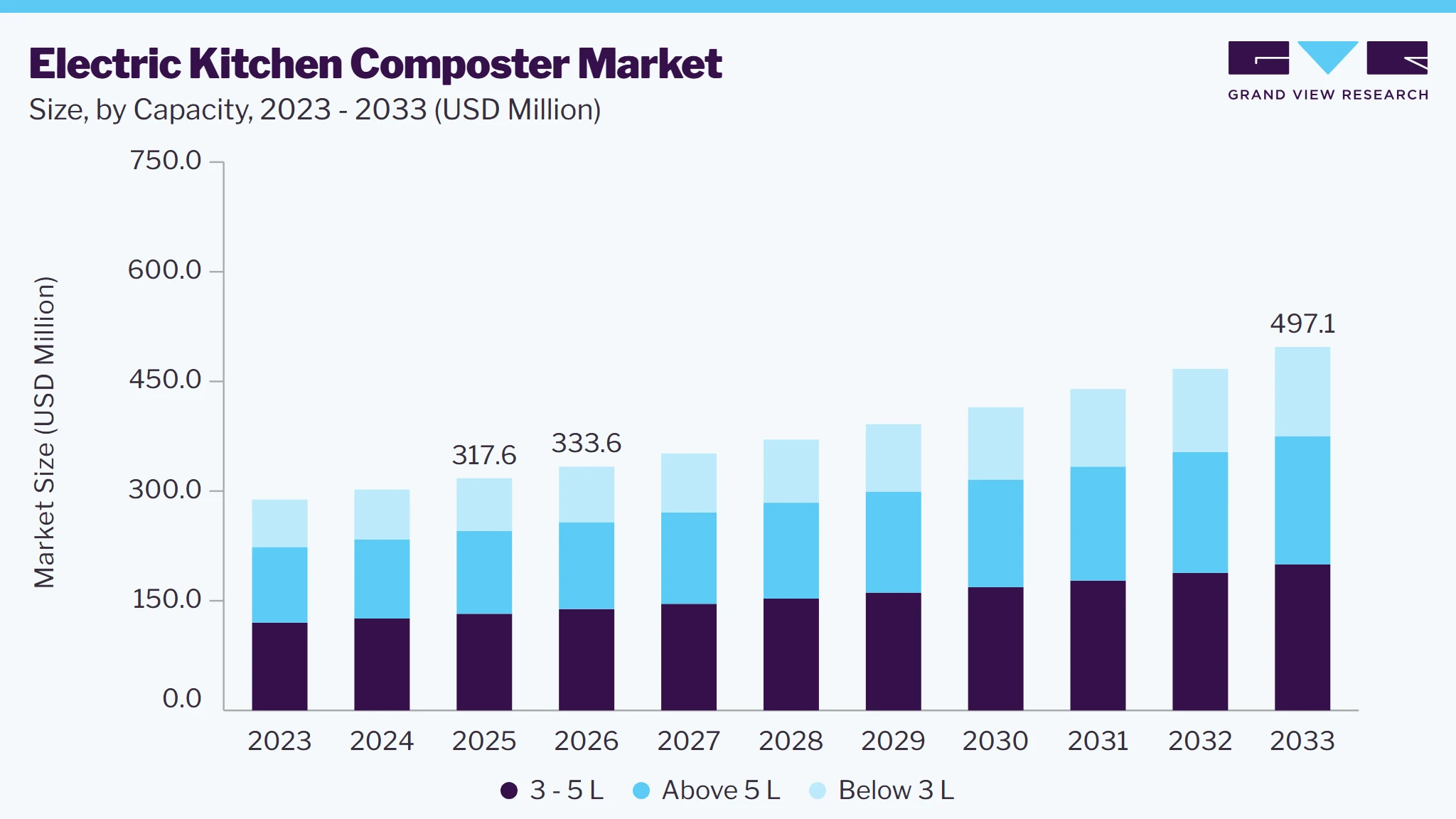
The global electric kitchen composter industry is transitioning from a niche sustainability product category toward a broader household food-waste management solution. Adoption is supported by growing consumer interest in reducing food waste at the source, particularly among urban households where traditional composting is less practical. Product offerings range from compact countertop units to higher-capacity systems, while manufacturers are increasingly focusing on faster processing, lower noise and energy consumption, improved odor control, and more user-friendly designs. Growth is also supported by expanding e-commerce availability and rising penetration of sustainable kitchen appliances.
Market Dynamics
The industry is shaped by capacity requirements, ease of use, processing speed, energy efficiency, odor and noise control, and the convenience of indoor food-waste processing, with residential households representing the core demand base. Smaller-capacity units are suited to compact urban kitchens, while larger-capacity models are more relevant to hospitality and institutional users with higher food-waste volumes. Technology remains a key differentiator, with manufacturers competing by leveraging heating and dehydration, grinding, microbial decomposition, automated temperature and moisture control, odor filtration, and smart monitoring to improve processing performance and the user experience.
Increasing household food-waste generation is creating a growing need for convenient, hygienic, and space-efficient solutions for managing organic waste at the point of disposal. As households generate substantial amounts of food scraps from meal preparation and consumption, electric kitchen composters offer an alternative to storing waste for collection or to relying on outdoor composting systems. These appliances can process food waste within a few hours, substantially reduce its volume, and help control odors associated with organic waste. Growing concerns regarding landfill use, methane emissions from decomposing organic waste, and the broader environmental impact of food waste are further encouraging consumers to adopt household-level processing solutions, supporting market demand.
Limited awareness of electric kitchen composters remains a significant restraint, particularly across developing economies where the category is still relatively new and household waste-management practices are largely centered on conventional collection and disposal systems. Many consumers have a limited understanding of how these appliances operate, the types of food waste they can process, their energy requirements, and how the resulting material can be used or disposed of. In addition, the relatively high purchase price compared with conventional waste bins or composting methods can make the value proposition less apparent to price-sensitive consumers. Limited retail presence, product demonstrations, and targeted consumer education further constrain adoption, particularly outside major urban markets.
Expansion into hospitality and institutional settings presents a significant opportunity for electric kitchen composters, as restaurants, hotels, cafeterias, hospitals, schools, and other facilities generate relatively large volumes of food waste daily. Compared with residential users, these establishments can benefit from larger-capacity systems that process food waste at the point of generation, reducing waste storage requirements, odor issues, and the frequency of waste collection. The growing emphasis on sustainable operations, waste segregation, landfill diversion, and environmental reporting is encouraging hospitality and institutional operators to adopt more efficient organic waste management solutions. Manufacturers can capitalize on this opportunity by developing higher-capacity, durable, and energy-efficient models tailored to continuous or high-frequency use.
Market Concentration & Characteristics
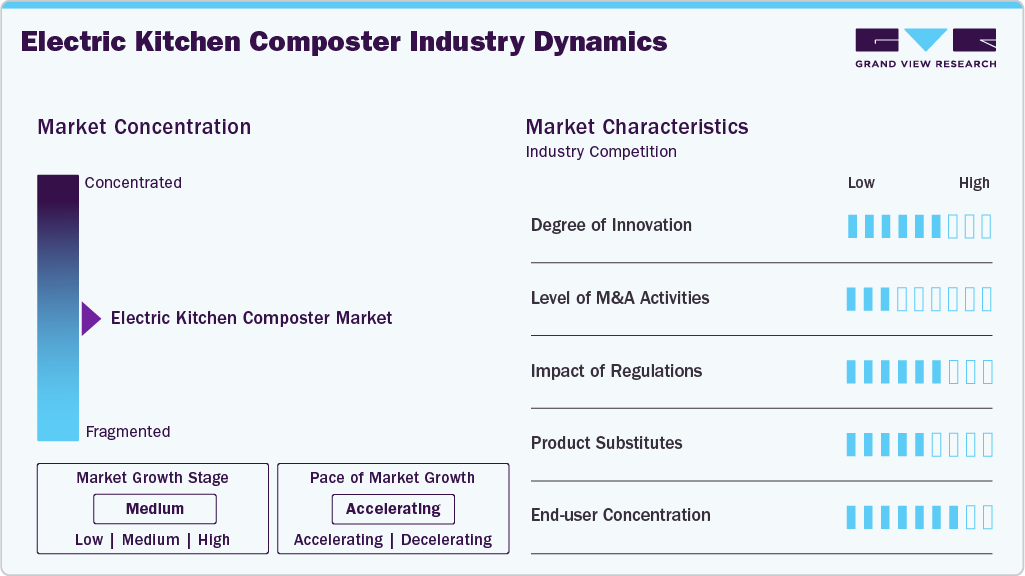
The global electric kitchen composter industry remains moderately fragmented, with Lomi, Mill, Reencle, and FoodCycler among the more prominent brands, while numerous smaller players compete on price, capacity, and functionality. The market also faces substitution by conventional composting, municipal organic waste collection, and garbage disposals, particularly where these alternatives are readily available and inexpensive. However, electric composters offer greater convenience and odor control for urban households with limited space.
Leading players are pursuing product innovation, premium positioning, direct-to-consumer sales, and recurring service models to strengthen customer retention. Lomi emphasizes compact countertop convenience and multiple processing modes; Reencle differentiates through continuous microbial composting; and Mill combines food-waste processing with collection and downstream reuse of its output. These strategies increasingly extend competition beyond the appliance itself toward consumables, subscriptions, waste-collection services, and integrated food-waste management ecosystems.
Analyst Perspective
The electric kitchen composter market is shaped by rising household food waste generation, sustainability awareness, urbanization, and demand for convenient in-home waste processing, while key challenges include high product costs, limited consumer awareness, electricity consumption, and established alternatives such as municipal organic waste collection and conventional composting. Technology remains central to product differentiation, with manufacturers focusing on heat-and-grind/dehydration and microbial processing, faster cycles, odor and noise reduction, energy efficiency, automated controls, and smart features. Regulatory initiatives focused on food-waste segregation, landfill diversion, composting, and circular waste management provide additional support, although their impact differs across countries.
Capacity Insights
The 3 - 5 L segment led the market with the largest revenue share of 41.6% in 2025. The segment’s leading position is supported by its balance among processing capacity, countertop footprint, and suitability for regular household food waste generation. These units are generally large enough to handle food waste from small- to medium-sized households while remaining compact enough for residential kitchens. Demand is further supported by the availability of models with automated processing, odor filtration, and relatively short processing cycles, making the capacity range suitable for consumers seeking a practical alternative to conventional food-waste disposal.
The below 3 L segment is projected to grow at the fastest CAGR of 7.0% during the forecast period, driven by demand for compact, affordable appliances designed for smaller households and kitchens with limited space. These models require less countertop or storage space and can appeal to consumers who generate relatively low volumes of food waste or prefer frequent processing cycles. The segment can also benefit from growing urbanization and smaller household sizes, although its growth may be constrained by lower processing capacity and the need for more frequent emptying compared with larger units.
End Use Insights
The residential/household segment led the market with the largest revenue share of 78.3% in 2025 and is projected to grow at the fastest CAGR during the forecast period, due to the increasing need for convenient food-waste management solutions at the household level. Urban consumers, particularly those living in apartments or homes without access to outdoor composting space, can benefit from compact appliances that process food waste indoors while reducing waste volume and odors. Rising environmental awareness, growing interest in sustainable living, and the increasing adoption of smart kitchen appliances are further supporting household demand.
The hospitality segment is expected to grow at a significant CAGR of 4.9% over the forecast period, representing a fairly lucrative growth opportunity due to the relatively high volumes of food waste generated by restaurants, hotels, cafés, and catering establishments. Electric kitchen composters can process food waste closer to the point of generation, reducing the space required for waste storage and potentially lowering collection frequency. Demand is likely to be strongest for higher-capacity, durable models capable of handling frequent processing, with sustainability initiatives and increasing emphasis on food-waste reduction providing additional support for adoption.
Distribution Channel Insights
The online segment led the market with the largest revenue share of 56.2% in 2025, representing a key distribution channel for electric kitchen composters. The online segment is expected to maintain a strong position as electric kitchen composters are relatively specialized products that benefit from digital product discovery and direct-to-consumer sales. Online channels enable manufacturers to reach consumers beyond traditional retail networks while providing detailed product specifications, demonstrations, customer reviews, and comparisons across capacity and functionality. The increasing adoption of e-commerce for household appliances, combined with the presence of digitally focused brands, is expected to further support online sales.
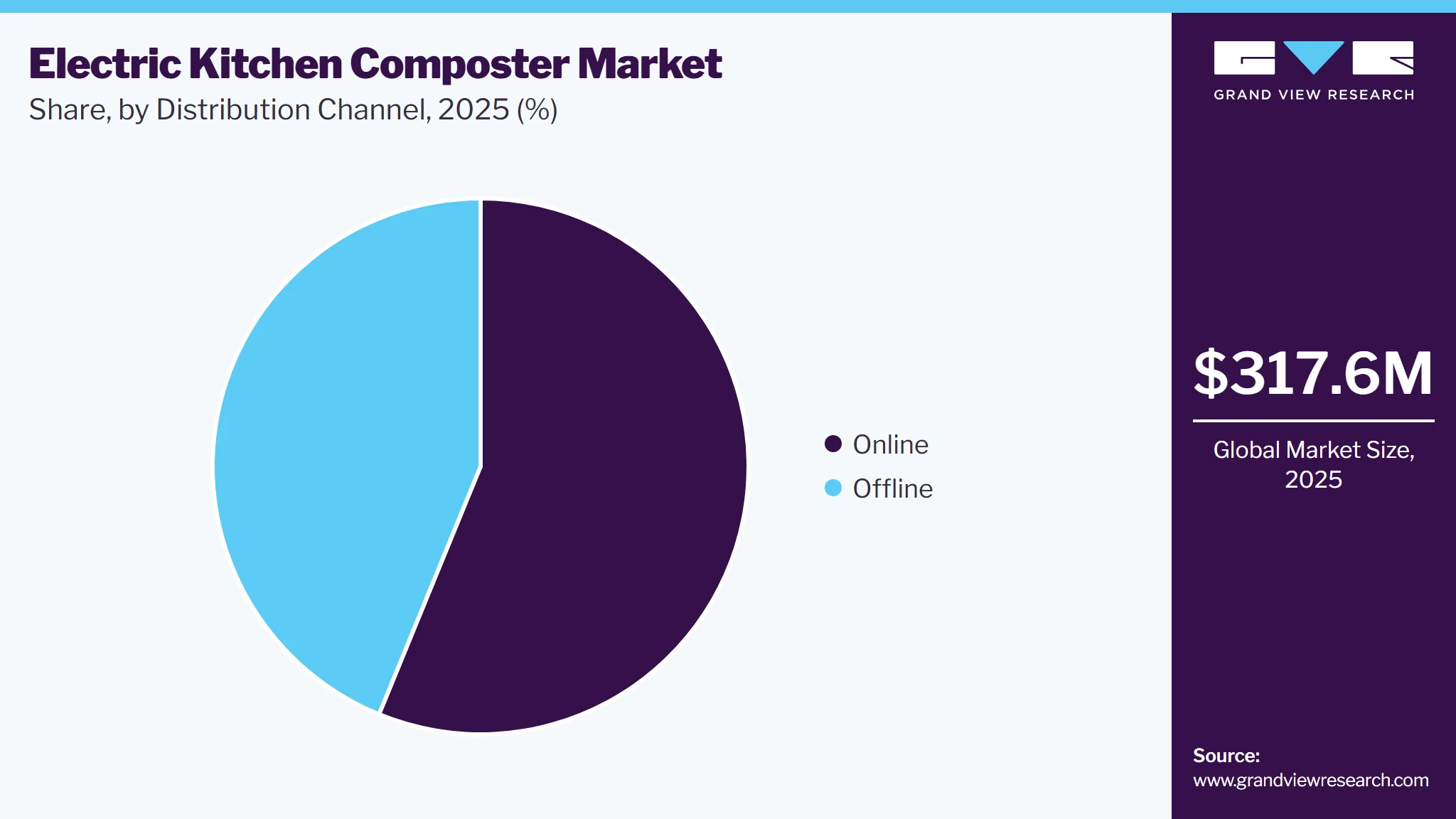
The offline segment is projected to grow at the fastest CAGR of 6.9% during the forecast period, as it continues to play an important role, particularly among consumers who prefer to evaluate appliances physically before purchase. Specialty appliance stores, large-format retailers, and other offline outlets allow consumers to assess product size, build quality, noise levels, and ease of operation, which can be important considerations for countertop appliances. Established retail networks also provide manufacturers with greater physical visibility and opportunities for in-store demonstrations, although offline channels face increasing competition from e-commerce and direct-to-consumer models.
Regional Insights
The North America electric kitchen composter market held the largest revenue share of 42.8% in 2025, driven by substantial household food waste generation, strong consumer awareness of sustainability, and demand for convenient waste management solutions in urban and space-constrained households. The U.S. and Canada also have relatively developed composting and organic-waste diversion infrastructure, which helps familiarize consumers with food-waste separation and creates a receptive market for household processing technologies. Moreover, state and local policies that restrict or discourage organic waste disposal in landfills serve as an additional driver of demand, while the established smart-home and premium kitchen-appliance ecosystem supports the adoption of technologically advanced countertop composters.

U.S. Electric Kitchen Composter Market Trends
The electric kitchen composter market in the U.S. accounted for the largest market revenue share in North America in 2025. The U.S. market benefits from high consumer awareness of food-waste reduction, established sustainability initiatives, and growing interest in convenient at-home waste processing, particularly among urban and environmentally conscious households. State and local policies encouraging organic waste diversion and composting are strengthening the broader ecosystem, while the country’s developed e-commerce and premium home appliance markets are driving the adoption of countertop electric composters. However, availability of municipal composting programs and other established disposal options can limit the need for dedicated household processing appliances in some areas.
Europe Electric Kitchen Composter Market Trends
The electric kitchen composter market in Europe is under strong regulatory pressure to reduce food waste and transition to circular waste management, making it one of the most favorable regional environments for electric kitchen composters. The EU's revised Waste Framework Directive introduced binding targets requiring member states to reduce food waste at the retail and consumption stages, including households, by 30% per capita by 2030. The associated requirement for national food-waste prevention programs to promote awareness, behavioral change, and technological solutions further strengthens the case for household food-waste processing appliances.
The Germany electric kitchen composter market represents a favorable market environment for stable growth due to its well-established waste-separation culture, strong environmental awareness, and mature bio-waste collection infrastructure. National efforts to reduce food waste span households, retail, food service, and other stages of the food chain, supporting consumer familiarity with organic waste diversion. At the same time, widespread access to municipal bio-waste collection can reduce the immediate need for electric kitchen composters, making convenience, space savings, and differentiated processing capabilities important for market penetration.
The electric kitchen composter market in Spain offers growth potential as food-waste prevention and bio-waste recovery become increasingly integrated into national waste-management policy. The country's regulatory framework promotes source separation and recycling of bio-waste, including household and community composting, while recent food-waste legislation places greater emphasis on prevention, reuse, and ultimately composting or other forms of recovery. These developments can improve consumer awareness of organic-waste management, although the availability of municipal collection and conventional composting options creates competition for household electric composters.
Asia Pacific Electric Kitchen Composter Market Trends
The electric kitchen composter market in the Asia Pacific is anticipated to grow at the fastest CAGR during the forecast period, driven by rapid urbanization, large household populations, substantial food-waste volumes, and increasingly active government and private-sector efforts to improve organic-waste management. The region's diverse markets range from mature food-waste recycling systems in countries such as Japan to emerging waste-management frameworks in Southeast and South Asia, creating multiple avenues for adoption. Rising awareness of sustainable lifestyles and the need for solutions suited to dense urban environments are particularly relevant, while the growing involvement of businesses and public-private initiatives in food-waste reduction is helping build consumer awareness and market acceptance.
The China electric kitchen composter market presents a large long-term opportunity due to rapid urbanization, dense residential environments, increasing emphasis on waste classification, and government efforts to improve food-waste resource recovery. Major cities such as Shanghai continue to strengthen source separation and food waste collection, while national legislation places responsibility on local governments to ensure that household food waste is treated through resource recovery or environmentally sound processing. Growing consumer awareness of sustainable waste management and the need for convenient solutions in space-constrained urban households can further support demand for electric kitchen composters. However, established municipal collection systems and varying levels of consumer familiarity with household composting technologies may limit adoption in some markets.
The electric kitchen composter market in India has a strong underlying demand opportunity, driven by rapid urbanization, rising household food waste generation, and a growing emphasis on source segregation and decentralized waste processing. The Solid Waste Management Rules, 2026, are expected to create a conducive environment for market growth by mandating the segregation of wet waste at the source and placing greater emphasis on its separate handling and processing. Rising environmental awareness, expanding e-commerce, and the growing availability of modern kitchen appliances create opportunities for market entry, improve product accessibility and visibility, and support adoption among urban consumers, particularly those seeking convenient solutions for managing food waste at home. However, price sensitivity, uneven waste-management infrastructure, limited awareness of electric composters, and the availability of traditional composting methods remain key challenges to broader penetration.
Latin America Electric Kitchen Composter Market Trends
The electric kitchen composter market in Latin America is anticipated to grow at a significant CAGR during the forecast period. Latin America's opportunity is underpinned by the high organic content of municipal waste, growing urban populations, and increasing efforts to reduce uncontrolled disposal and methane emissions from organic waste. According to the World Bank, approximately 48% of municipal solid waste generated in the region is organic, while recycling and recovery remain relatively limited, creating a substantial need for improved treatment solutions. Recent regional initiatives focused on reducing methane emissions and progressively preventing organic waste from reaching landfills and dumpsites are strengthening the broader market environment for decentralized food-waste processing technologies.
The Brazil electric kitchen composter market is supported by growing policy attention to food-waste reduction, circular economy practices, and organic-waste recovery, alongside a large urban consumer base. Brazil's recently established National Policy to Combat Food Loss and Waste supports the diversion of food unsuitable for human consumption toward composting, energy recovery, and other productive uses, strengthening the policy environment for food-waste reduction and resource recovery. Adoption of household electric composters is likely to remain concentrated initially among environmentally conscious, higher-income consumers, as affordability, consumer awareness, and the availability of conventional waste-management alternatives continue to influence purchasing decisions.
Middle East & Africa Electric Kitchen Composter Market Trends
The electric kitchen composter market in the Middle East & Africa is supported by high food waste generation, rapid urbanization, growing sustainability initiatives, and significant gaps in organic waste treatment infrastructure. In the Middle East, food waste is particularly pronounced at the household and hospitality levels, with cultural practices and periods of concentrated food consumption contributing to high volumes. Across MENA, waste generation exceeds the global average, while recycling and treatment remain limited, creating a need for decentralized solutions to reduce the volume of organic waste requiring collection and disposal. In Africa, expanding circular-economy initiatives and growing attention to food-waste reduction are gradually improving the environment for technologies enabling localized organic-waste recovery.
The Saudi Arabia electric kitchen composter market offers a promising market for food-waste processing technologies as Vision 2030 increasingly emphasizes resource efficiency, circular economy practices, and improved waste management. National efforts to reduce food loss and waste are raising awareness among households and businesses, while the country's substantial food-waste stream and reliance on landfill-based disposal are expected to create a need for alternative treatment solutions.
Key Electric Kitchen Composter Company Insights
Some of the key players operating in the electric kitchen composter industry include Lomi and Ecorich, among others
-
Lomi, a brand developed by Pela, is a food-waste technology company headquartered in British Columbia, Canada, focused on countertop electric food recyclers. Lomi sells primarily through its online channel and has expanded into select retail outlets across North America, with its current Lomi 3 specifications designed for the North American market. The company’s portfolio is centered on its Lomi 3 food recycler and supported by a range of complementary products, including odor-control filters, LomiPods, Lomi Blends, bucket lids, and extended-warranty services. The company also offers membership-based services that combine filter replenishment with warranty and support benefits, creating an ecosystem around its core food-waste processing appliance.
-
EcoRich is focused primarily on commercial and institutional food-waste processing solutions, rather than small residential countertop composters. Its portfolio broadly includes in-vessel aerobic composters and anaerobic digestion systems, covering applications in commercial kitchens, restaurants, hotels, educational institutions, and other organizations that generate significant food waste. Its aerobic range includes Elite II and Rapido composters, while its CIRC Kitchen Waste Series provides anaerobic digestion solutions that convert food waste into nutrient-rich liquid and biogas. EcoRich serves customers across the U.S., Canada, Mexico, the Caribbean, and Central and South America, positioning the company toward on-site, higher-capacity food-waste recycling and resource-recovery applications.
Key Electric Kitchen Composter Companies
The following key companies have been profiled for this study on the electric kitchen composter market.
-
Lomi
-
Mill Industries Inc.
-
Reencle
-
FoodCycler
-
ROKH SRL
-
Airthereal
-
Nagualep
-
Vego
-
Ecorich
-
NutriChef Kitchen
-
Espuente GmbH
-
Kismile
-
THINKWARE
-
Advwin
-
Lennon Electronics
Competitive Benchmarking
Category
Operating Strategies
Competitive Edge
Weakness
Established Players (e.g., Lomi, FoodCycler)
- Established players maintain broad online and offline distribution networks to maximize product accessibility and geographic coverage.
- Companies offer multiple product configurations and capacity options to address different household and commercial requirements.
- Players invest continuously in product upgrades, brand building, customer education, and after-sales support.
- Strong brand recognition and established consumer trust support purchasing decisions in an emerging product category.
- Extensive distribution and service networks provide greater market coverage and customer accessibility.
- Greater financial and operational resources support product development, marketing, and geographic expansion.
- Premium positioning and higher operating costs can limit penetration among price-sensitive consumers.
- Larger organizational structures can result in slower product development and response to changing consumer preferences.
- Dependence on established technologies can make differentiation more difficult as newer processing technologies emerge.
Emerging & Regional Players (e.g., Reencle, Vego)
- Emerging players focus on differentiated product technologies or specific consumer use cases to establish market niches.
- Companies primarily use direct-to-consumer websites, online marketplaces, and digital marketing to build market presence.
- Players prioritize rapid product development and feature enhancements based on consumer feedback.
- Focused product portfolios allow emerging players to respond quickly to changing consumer requirements.
- Specialized technologies provide opportunities to differentiate through processing performance, output quality, noise, energy efficiency, or capacity.
- Leaner operating structures support faster decision-making and product iteration.
- Limited brand recognition makes customer acquisition and trust-building more challenging.
- Smaller scale reduces bargaining power with component suppliers, distributors, and retailers.
- Limited after-sales and service networks can restrict expansion into new geographic markets.
Recent Developments
-
In December 2025, a partnership between Mill and Compost Crew introduces a joint food waste recycling service across Maryland, Northern Virginia, and Washington, D.C. Starting at USD 39 per month, subscribers receive an in-home Mill appliance that dehydrates and processes raw food scraps into dry grounds, which are then collected by Compost Crew on a monthly or bi-monthly schedule. These grounds are converted at local sites into high-grade soil amendment for nearby agriculture and gardens, helping residents reduce landfill waste and methane emissions while earning free annual compost returns.
-
In November, 2025, the One-Touch Lomi 3 launched nationwide in the U.S. at Costco, making the smart food recycling bin accessible in major retail locations. Featuring a simple single-button interface that transforms food waste into nutrient-rich fertilizer, Lomi plans to position its technology as a modern kitchen essential to support its market share expansion.
Global Electric Kitchen Composter Market Report Scope
Report Attribute
Details
Market size in 2025
USD 317.6 million
Estimated market size in 2026
USD 333.6 million
Projected market size by 2033
USD 497.1 million
Growth rate
CAGR of 5.9% from 2026 to 2033
Base year for estimation
2025
Historical data
2021 - 2024
Forecast period
2026 - 2033
Quantitative units
Revenue in USD million and CAGR from 2026 to 2033
Report coverage
Revenue forecast, company ranking, competitive landscape, growth factors, and trends
Segments covered
Capacity, distribution channel, end use, region
Regional scope
North America; Europe; Asia Pacific; Latin America; Middle East & Africa
Country scope
U.S.; Canada; Mexico; UK; Germany; France; Spain; Italy; China; Japan; India; Australia; South Korea; Brazil; Argentina; Saudi Arabia; UAE; South Africa
Key companies profiled
Lomi; Mill Industries Inc.; Reencle; FoodCycler; ROKH SRL; Airthereal; Nagualep; Vego; Ecorich; NutriChef Kitchen; Espuente GmbH; Kismile; THINKWARE; Advwin; Lennon Electronics
Customization scope
Free report customization (equivalent up to 8 analysts working days) with purchase. Addition or alteration to country, regional & segment scope.
Pricing and purchase options
Avail customized purchase options to meet your exact research needs. Explore purchase options
Global Electric Kitchen Composter Market Report Segmentation
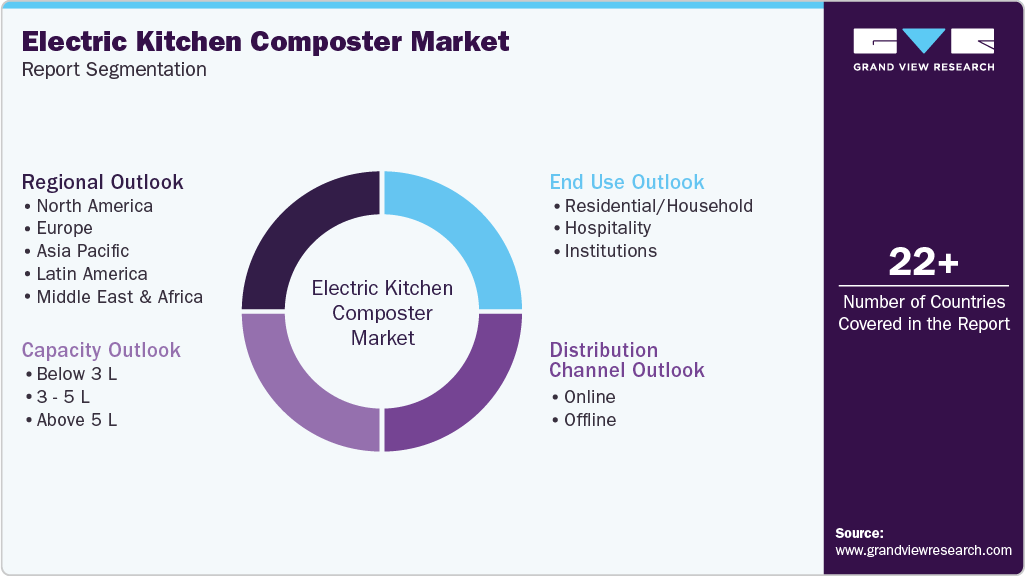
This report forecasts revenue growth at global, regional, and country levels and provides an analysis of the latest industry trends in each of the sub-segments from 2021 to 2033. For this study, Grand View Research has segmented the global electric kitchen composter market report based on capacity, distribution channel, end-use, and region
-
Capacity Outlook (Revenue, USD Million, 2021 - 2033)
-
Below 3 L
-
3 - 5 L
-
Above 5 L
-
-
Distribution Channel Outlook (Revenue, USD Million, 2021 - 2033)
-
Online
-
Offline
-
-
End Use Outlook (Revenue, USD Million, 2021 - 2033)
-
Residential/Household
-
Hospitality
-
Institutions
-
-
Regional Outlook (Revenue, USD Million, 2021 - 2033)
-
North America
-
U.S.
-
Canada
-
Mexico
-
-
Europe
-
Germany
-
France
-
Italy
-
Spain
-
UK
-
-
Asia Pacific
-
China
-
India
-
Japan
-
South Korea
-
Australia
-
-
Latin America
-
Brazil
-
Argentina
-
Middle East & Africa
-
Saudi Arabia
-
UAE
-
South Africa
-
-
Research Methodology
The electric kitchen composter marketfigures in this report are based on a proven research process that combines executive interviews with secondary research from proprietary databases, company filings, and recognized regulatory and institutional sources. Market size is built through value-chain sizing—reconciling supply-side and demand-side estimates—and triangulated with bottom-up and top-down approaches. Every estimate passes multiple levels of expert validation before publication, with electric kitchen composter segment quantified using the revenue-capture definitions in the table below.
Segment Definition
Capacity
Revenue Capture Definition
Below 3 L
The below 3 L segment comprises electric kitchen composters with a food-waste processing capacity of less than 3 liters. The segment represents the revenue captured from the sale of electric kitchen composters with capacities below.
3 - 5 L
The 3-5 L segment comprises electric kitchen composters designed to process between 3 and 5 liters of food waste per cycle. The segment represents the revenue captured from the sale of electric kitchen composters with capacities ranging from 3 to 5 L.
Above 5 L
The above 5 L segment comprises electric kitchen composters with a food-waste processing capacity of more than 5 liters. The segment represents the revenue captured from the sale of electric kitchen composters with capacities above 5 L.
Distribution Channel
Revenue Capture Definition
Online
The online segment represents revenue generated from the sale of electric kitchen composters through e-commerce platforms, company-owned websites, and other digital retail channels.
Offline
The offline segment represents revenue generated from the sale of electric kitchen composters through physical retail stores, specialty appliance outlets, distributors, and other non-digital sales channels.
End Use
Revenue Capture Definition
Residential/Household
The residential/household segment comprises electric kitchen composters used by individual consumers to process food waste generated in homes. The segment represents the revenue captured from the sale of electric kitchen composters for residential and household use.
Medical & Healthcare
The hospitality segment comprises electric kitchen composters used in hotels, restaurants, cafés, catering establishments, and other hospitality facilities to process food waste generated through their operations. The segment represents the revenue captured from the sale of electric kitchen composters for hospitality applications.
Institutional
The institutions segment comprises electric kitchen composters used in schools, universities, hospitals, and other institutional facilities to process food waste generated within their premises. The segment represents the revenue captured from the sale of electric kitchen composters for institutional applications.
Estimation Model
Layer Name
Key Question
Description
Industry & Demand Assessment
What is the underlying demand for electric kitchen composters?
Establish demand based on household and commercial food waste generation, urbanization, household formation, hospitality activity, institutional food service activity, and adoption of in-home food waste processing appliances. The top-down assessment uses food-waste volumes, household appliance expenditure, organic-waste diversion indicators, and relevant appliance penetration data, while the bottom-up assessment quantifies addressable households and establishments, appliance penetration, replacement demand, and average selling prices, with market-specific penetration and replacement assumptions developed from primary and secondary research.
Segment & Regional Assessment
How is demand distributed across the defined segments and geographies??
Allocate demand across segments, regions, and country markets. The bottom-up assessment applies segment-specific household and establishment counts, penetration rates, unit purchases, replacement demand, and pricing, while the top-down assessment incorporates household appliance spending, e-commerce penetration, food-waste generation, hospitality activity, institutional food-service expenditure, and regional waste-management practices to validate the resulting splits.
Supply & Distribution Assessment
What is the size and structure of the instrument supply base serving this demand?
Assess in-scope manufacturers and brands based on product portfolios, capacity offerings, production capabilities, geographic presence, distributor networks, OEM/direct sales, online and offline channels, and relevant aftermarket or consumable revenues. Company revenues, disclosed unit shipments, production and sales volumes, product pricing, distributor information, and import/export flows provide the basis for a bottom-up supply estimate and help identify differences between manufacturer sales, distributor revenues, and end-market sales.
Revenue Estimation & Triangulation
What market revenue is supported after reconciling demand and supply estimates?
Reconcile the top-down demand estimate, bottom-up demand estimate, and supply-side estimate to establish the base-year market value. Validate the result against company revenues, production and shipment volumes, import/export data, industry expenditure, product pricing and mix, distribution margins, replacement patterns, and relevant market benchmarks, followed by forecasting based on market-specific adoption, replacement demand, pricing, product mix, distribution expansion, and end-use penetration assumptions.
Delivered Customizations
This report has been delivered with the following In-depth customizations
Client Request
Customization Delivered
Value Adds
Regional Segmentation
Assessed market dynamics across North America, Europe, Asia Pacific, Latin America, and the Middle East & Africa, with region-specific evaluation of food-waste patterns, regulatory environments, urbanization, consumer adoption, and waste-management infrastructure.
Identified regional markets with stronger adoption potential and clarified the factors influencing geographic expansion and market-entry priorities.
Competitive Benchmarking
Benchmarked established and emerging players across product portfolios, capacity offerings, processing technologies, distribution approaches, geographic presence, strategic initiatives, and competitive positioning.
Highlighted competitive gaps, differentiated player strategies, and areas for product or positioning improvement to support competitive strategy.
Opportunity Assessment
Assessed opportunities across capacity, distribution channel, end use, and key country markets by evaluating adoption potential, demand characteristics, market maturity, regulatory support, and competitive conditions.
Enabled prioritization of attractive segments and markets while supporting investment allocation, product development, and expansion strategy decisions.
About the Author(s)
Advanced Interior Materials Research Team
Advanced Materials · Advanced Interior MaterialsThis report was authored by the advanced interior materials research team at Grand View Research - comprising two research analysts, one senior research analyst, and one industry expert - with specialized expertise in the advanced interior materials segment of the advanced materials industry. All findings are based on proprietary advanced materials databases, executive interviews, and regulatory analysis, subject to internal peer review prior to publication.
Last Updated:
Speak to Analyst


Customize this report to your needs — add regions, segments, or data points, with 20% free customization.
Or view our licence options:


ISO 9001:2015 & 27001:2022 Certified
We are GDPR and CCPA compliant! Your transaction & personal information is safe and secure. For more details, please read our privacy policy.


