
- Home
- »
- Advanced Interior Materials
- »
-
Electrochromic Glass Market Size And Share Report, 2033GVR Report cover
![Electrochromic Glass Market (2026 - 2033)Report]()
Electrochromic Glass Market (2026 - 2033)
Size, Share & Trends Analysis Report By End-use (Construction/Architectural, Automotive, Aerospace), By Application (Windows, Mirrors, Displays), By Region, And Segment Forecasts
Market Size, 2025
$2.3BMarket Estimate, 2026
$2.5BMarket Forecast, 2033
$4.6BCAGR, 2026–2033
9.2%Electrochromic Glass Market Summary
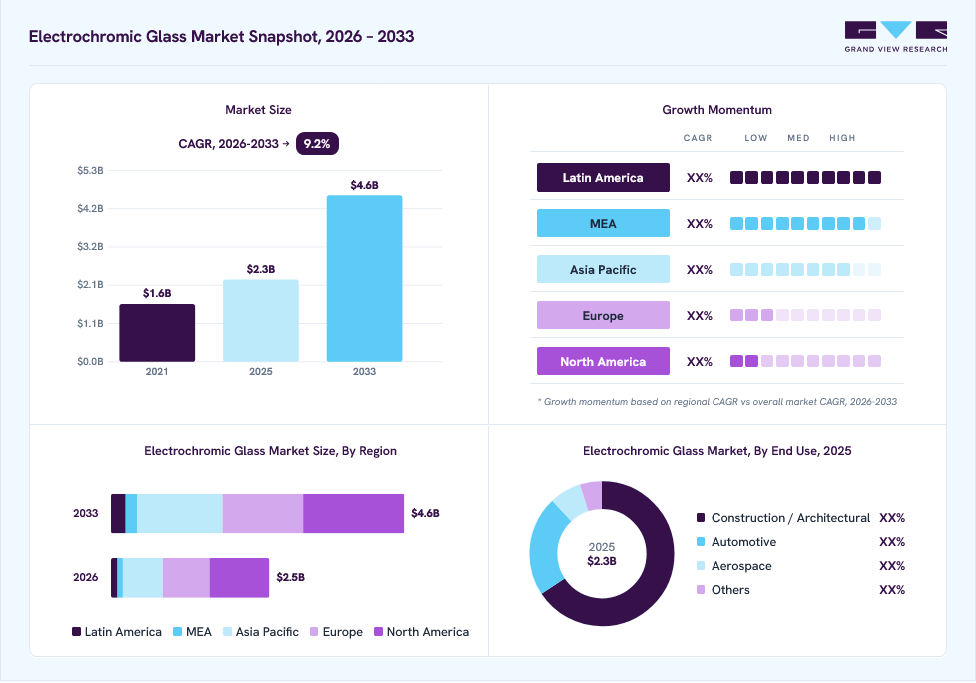
The global electrochromic glass market size was valued at USD 2.3 billion in 2025 and is projected to grow from USD 2.5 billion in 2026 to USD 4.6 billion by 2033, at a CAGR of 9.2% from 2026 to 2033. , accounting for Industry growth is driven by increasing demand for energy-efficient building solutions, growing adoption of smart and sustainable building technologies, and the need to improve solar heat and glare management in commercial and residential buildings.
Key Market Trends & Insights
- By end-use: Construction/architectural segment accounted for the largest market revenue share of 65.6% in 2025.
- By application: Windows segment is anticipated to register the fastest CAGR of 9.5% from 2026 to 2033.
Regional Highlights
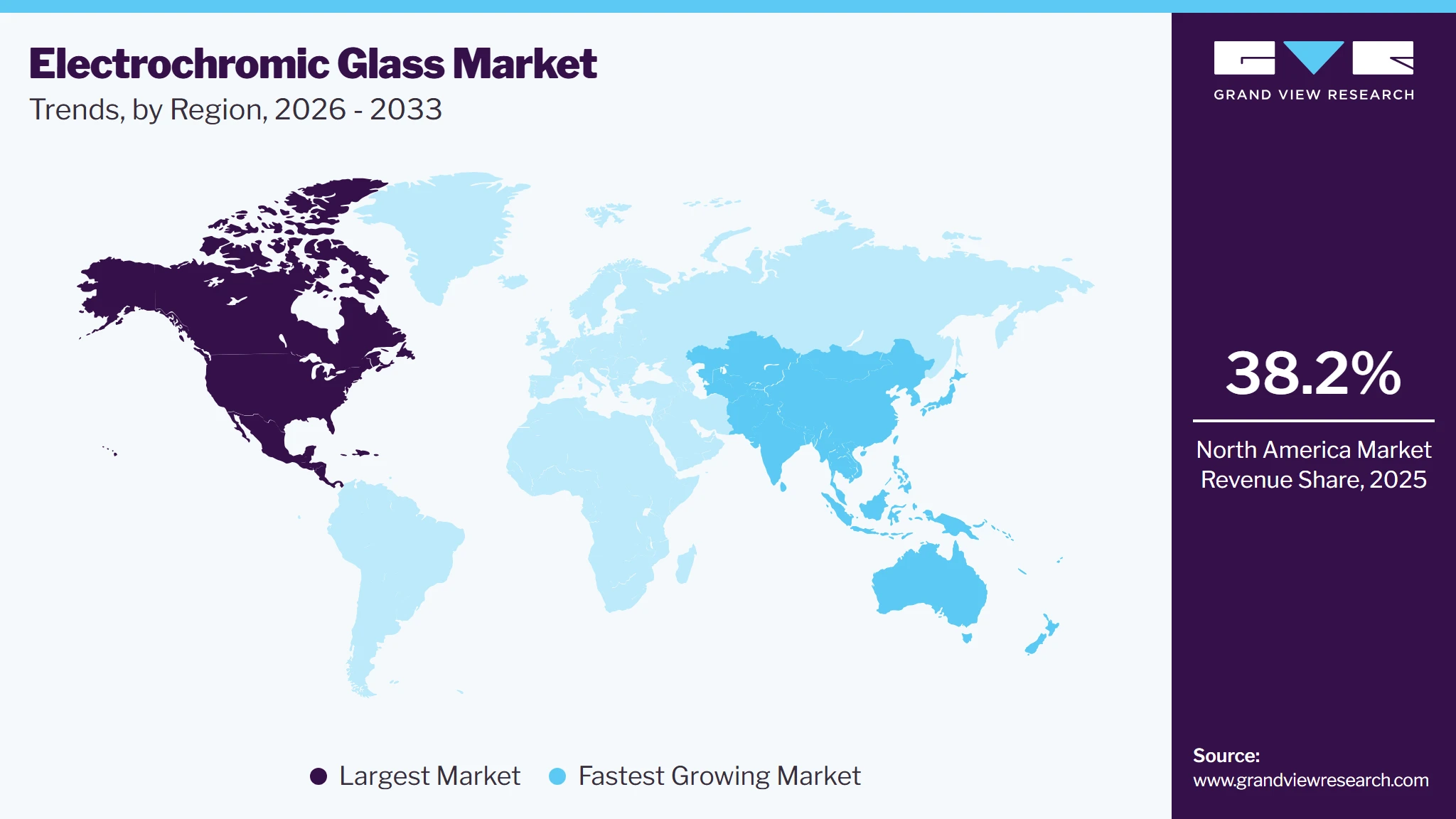
- Largest regional market: North America (38.2% revenue share, 2025)
- Fastest-growing regional market: Latin America (highest CAGR, 2026-2033)
- By country: The U.S. held the largest market share in 2025.
Market Size & Forecast
- Market Size in 2025: USD 2.3 billion
- Estimated market size in 2026: USD 2.5 billion
- Projected market size by 2033: USD 4.6 billion
- CAGR (2026-2033): 9.2%
Three ways to get this report
Buy it, customize it, or ask a question.Get the Full Report
What the study covers
- FormatsPDF · Excel · Dashboard
- Timeline2026–2033 annual, 2025 base
- Coverage20+ countries, 5 regions
- Companies10+ key players profiled
Customize the Report
20% free customization
- IncludeCountries, segments, points
- TailorTo your product definition
- ExtendDeeper competitor detail
- OrA fully bespoke study
- Turnaround5–10 working days
Ask Prism AI
A cited answer in seconds
- Corpus30K studies, 1.2M points
- ScopeAll markets, not just this
- CitationTraced to report & table
- HonestySays "not covered" if so
- SpeedSeconds, not days
The increasing focus on building sustainability and energy efficiency is supporting the adoption of dynamic glazing technologies that can reduce solar heat gain, glare, and dependence on artificial lighting and air conditioning. Electrochromic glazing can automatically adjust its tint level in response to electrical signals and changing environmental conditions, helping regulate the amount of sunlight and heat entering indoor spaces.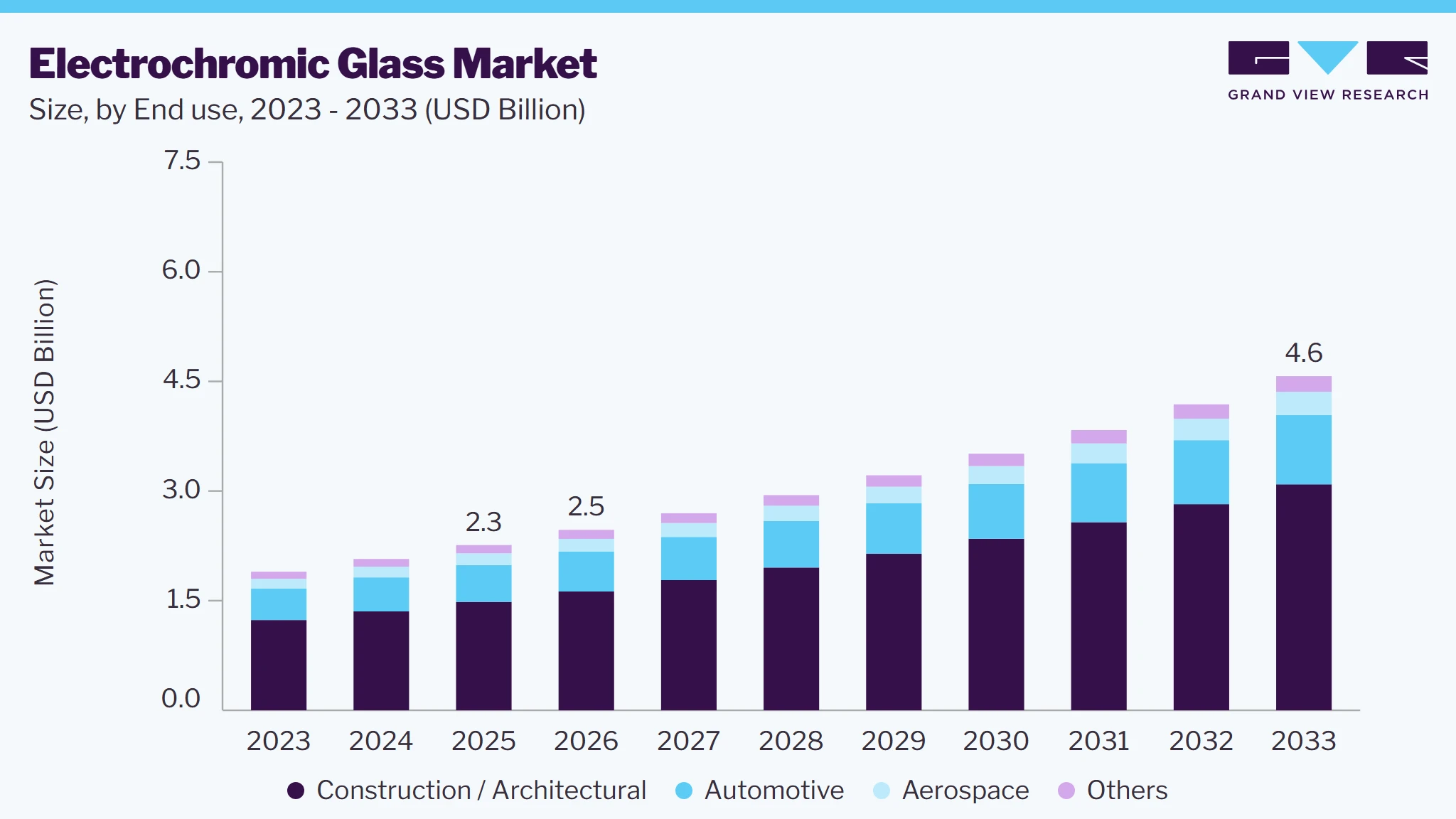
This capability can help reduce building energy consumption while maintaining natural daylight and improving indoor thermal and visual comfort.
Market Dynamics
Growing emphasis on low-carbon buildings, green construction, energy-efficient building envelopes, and resource conservation is encouraging architects, developers, and building owners to adopt technologies that improve the operational efficiency of buildings. Dynamic control of daylight and solar radiation can reduce cooling loads during periods of high solar exposure while supporting greater use of natural light. These benefits are particularly relevant for buildings with large, glazed façades, where conventional windows can contribute substantially to heat gain and glare.
The expansion of smart buildings and automated building-management systems is creating favorable conditions for electronically controlled glazing technologies. Electrochromic glazing can be integrated with sensors, lighting controls, HVAC systems, and building management platforms to automatically adjust tint levels based on sunlight intensity, indoor temperature, occupancy, and user preferences. This enables more precise control of daylight and solar heat compared with conventional fixed glazing or manually operated shading systems.
The increasing construction of commercial offices, corporate facilities, airports, hotels, hospitals, educational institutions, and other high-performance buildings is driving demand for advanced façade technologies. The growing adoption of green-building standards and energy-performance requirements is further encouraging developers to incorporate dynamic glazing into high-efficiency building-envelope solutions.
High upfront costs remain a major constraint, as electrochromic glazing incorporates specialized electrochromic materials, conductive layers, electrical connections, control systems, and associated components. Product costs can therefore be considerably higher than those of conventional architectural glass, while installation may require additional electrical infrastructure and integration with building-control systems.
Adoption can also be affected by project-specific factors such as building design, climate, energy prices, window-to-wall ratio, and expected energy savings. Integration with existing façades can be more complex in retrofit projects, while changes in performance, durability, and maintenance requirements, along with limited availability of specialized installation expertise, may further restrict adoption in cost-sensitive applications.
The growing development of high-performance commercial and institutional buildings presents significant opportunities, particularly for structures with extensive glazed façades and high solar exposure. Office buildings, airports, hotels, hospitals, educational facilities, and premium residential developments can benefit from dynamic control of glare, daylight, and solar heat gain. Retrofit opportunities are also emerging as building owners seek to improve the energy performance of existing properties without substantially altering their architectural appearance.
The expansion of net-zero-energy and low-carbon building initiatives is expected to create additional opportunities as developers increasingly evaluate technologies based on whole-building energy performance rather than upfront construction cost alone. Advances in switching speed, durability, control integration, manufacturing efficiency, and product design could further improve the commercial viability of electrochromic glazing and support penetration into new construction, renovation, automotive, and other specialized applications.
Analyst Perspective
Increasing adoption of energy-efficient building technologies is creating favorable conditions for electrochromic glazing. Its ability to adjust tint levels according to sunlight and indoor conditions supports solar heat management, glare reduction, and daylight optimization. Demand is being supported by commercial and institutional construction, renovation of existing buildings, smart-building integration, and sustainability-focused building standards. Continued development of electrochromic coatings, control systems, and glazing configurations is also expected to improve applicability across architectural and transportation uses.
End-use Insights
The construction / architectural segment accounted for the largest share of revenue in 2025 at 65.6%, and is also projected to register the highest CAGR during the forecast period. Demand is primarily driven by electrochromic glazing in commercial buildings, offices, hotels, healthcare facilities, institutional buildings, and premium residential projects. Increasing adoption of dynamic windows and façade glazing for solar control, glare reduction, daylight management, and energy efficiency is supporting the segment's growth.
Automotive represents another important end use segment, supported by the adoption of electrochromic glass in vehicle windows, sunroofs, and other glazing applications. Demand is driven by increasing integration of advanced glazing technologies in premium and high-end vehicles, particularly for enhanced glare control, thermal comfort, and cabin experience. Growing vehicle electrification and the increasing adoption of smart, electronically controlled features are also creating opportunities for electrochromic glazing in automotive applications.
Application Insights
The windows segment accounted for the largest share of revenue in 2025 and is projected to register the highest CAGR of 9.5% during the forecast period. The segment is supported by increasing adoption of dynamically tintable windows across commercial, institutional, hospitality, healthcare, and premium residential buildings. Growing demand for solar heat and glare control, improved occupant comfort, and integration with automated building-management systems is supporting the adoption of electrochromic windows.
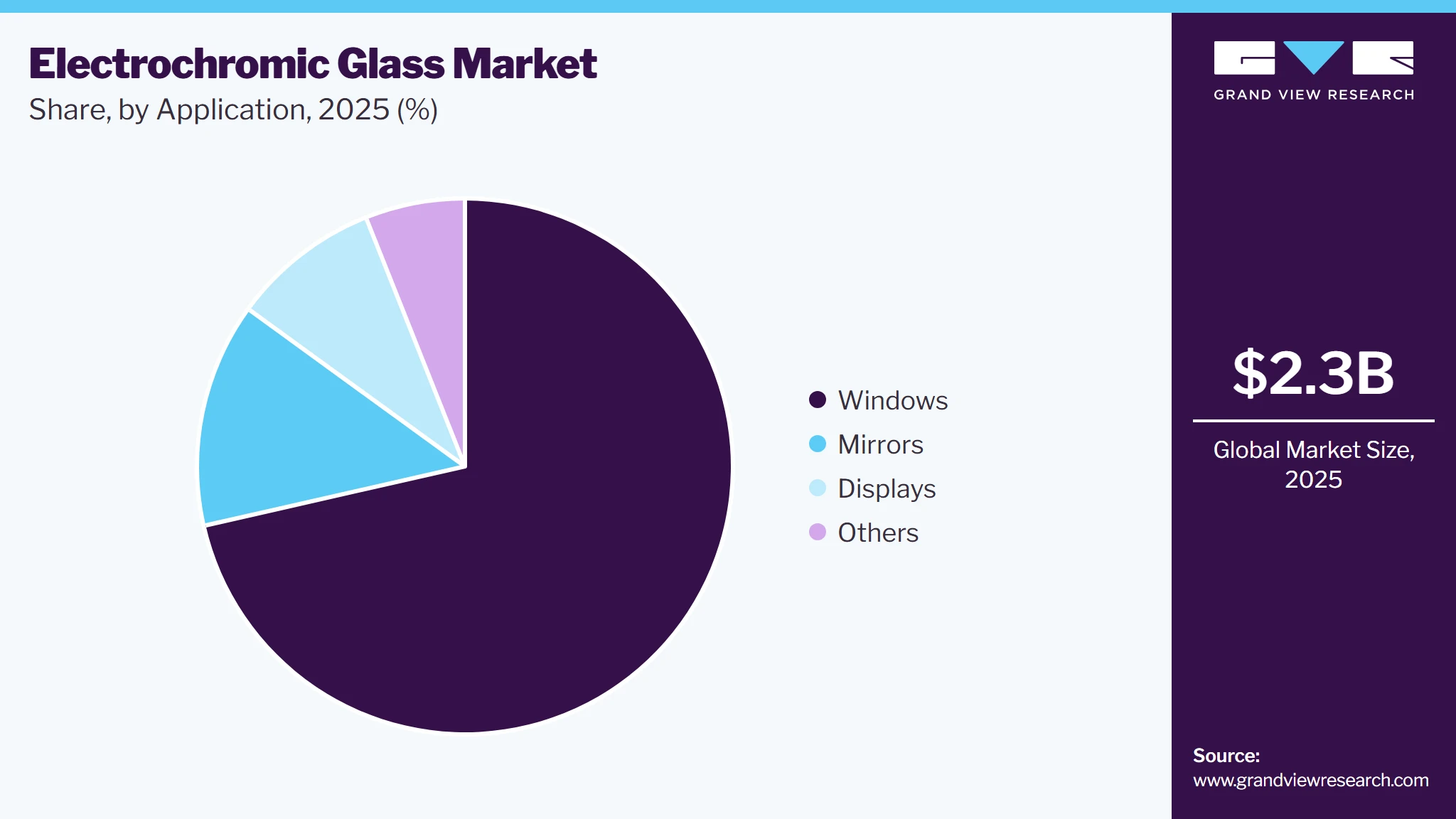
Mirrors represent an established application for electrochromic glass, particularly in automotive rear-view and side-view mirrors. The technology enables automatic adjustment of reflectance to reduce glare from headlights and improve driver visibility. Demand is supported by increasing adoption of electronically controlled mirror systems, particularly in premium and technologically advanced vehicles, while continued integration of smart features in modern automotive interiors provides further growth opportunities.
Regional Insights
The North America electrochromic glass market led the global industry, accounting for the largest revenue share of 38.2% in 2025. It represents a mature market, supported by established adoption of smart-building technologies and increasing integration of electrochromic glass into energy-efficient building designs. Demand is further supported by green-building standards, corporate sustainability initiatives, and investments in advanced building automation. The presence of established technology providers and increasing awareness among architects and developers is also facilitating adoption.
U.S. Electrochromic Glass Market Trends
The electrochromic glass market in the U.S. is a major hub in North America, with demand concentrated in commercial buildings, offices, hotels, healthcare facilities, and institutional projects. Electrochromic windows represent the principal application, while automotive and other specialized glazing applications provide additional demand. Adoption is supported by the increasing use of dynamic glazing in high-performance buildings and by its integration with automated building-control systems.
Europe Electrochromic Glass Market Trends
The electrochromic glass market in Europe is an established market, with growth supported by stringent building energy-performance regulations and decarbonization targets. Renovation of aging building stock is creating opportunities for advanced glazing technologies, particularly in energy-efficient retrofits. The region’s emphasis on sustainable architecture and low-energy buildings is also encouraging the integration of electrochromic glass into new construction projects.
Asia Pacific Electrochromic Glass Market Trends
The electrochromic glass market in the Asia Pacific is driven by increasing adoption of advanced glazing in commercial buildings, high-rise developments, hospitality properties, and premium residential projects. China, Japan, South Korea, and Australia represent important markets for electrochromic glazing. Windows and architectural glazing constitute major applications, while automotive and specialized applications provide additional market opportunities. Increasing deployment of smart-building technologies is supporting the integration of electrochromic glass into automated glazing systems.
Latin America Electrochromic Glass Market Trends
The electrochromic glass market in Latin America is expected to exhibit the fastest CAGR over the forecast period, with demand primarily concentrated in premium commercial, hospitality, institutional, and residential projects. Electrochromic windows and architectural glazing are highly sought after in the region. Adoption remains comparatively limited due to the higher upfront cost of electrochromic glass and lower market penetration compared with developed regions. However, selected high-end building projects provide opportunities for market expansion.
Middle East & Africa Electrochromic Glass Market Trends
The electrochromic glass market in the Middle East & Africa is an emerging industry, with adoption concentrated in high-end architectural developments, hospitality projects, airports, and premium commercial facilities. Large-scale urban development programs and investments in smart-city infrastructure are creating opportunities for advanced glazing technologies. However, higher upfront costs, limited local manufacturing capabilities, and relatively low market awareness continue to constrain penetration.
Key Electrochromic Glass Company Insights
Some of the key players operating in the market include Saint-Gobain’s SageGlass, ChromoGenics AB, and others.
-
Saint-Gobain’s SageGlass, developed by SAGE Electrochromics, is a U.S.-based smart-window business focused on electrochromic glazing for commercial and institutional buildings. SageGlass provides electronically tintable glass that dynamically regulates daylight, glare, and solar heat gain through electrochromic coatings and intelligent control systems. Its products include insulating glass units with electrochromic coatings and automated controls that can respond to light and weather conditions. The company’s solutions are used across offices, airports, educational facilities, cultural buildings, and other large architectural projects.
-
ChromoGenics AB, founded in 2003 and headquartered in Uppsala, Sweden, is a smart-glass manufacturer specializing in electrochromic materials and dynamic glazing solutions. Its primary product, ConverLight Dynamic, uses a patented electrochromic foil that can be laminated into glass to control heat and light transmission. The company operates production, testing, and development facilities in Uppsala and manufactures electrochromic foil for integration into architectural glass products. Its solutions are targeted primarily at commercial buildings and are designed to improve solar control, indoor comfort, and building energy performance.
-
View, Inc. is a U.S.-based smart-window technology company focused on electronically tintable architectural glass for commercial buildings. Its technology is designed to dynamically regulate daylight and solar heat entering buildings while maintaining outdoor views. The company has developed smart windows that integrate electrochromic technology with digital controls and building-management systems, targeting applications in offices, healthcare facilities, airports, and other commercial properties. Its approach combines dynamic glazing with automated controls to manage interior lighting, glare, and thermal conditions.
Key Electrochromic Glass Companies:
The following key companies have been profiled for this study on the electrochromic glass market:
-
AGC Inc.
-
ChromoGenics AB
-
EControl-Glas GmbH & Co. KG
-
Gentex Corporation
-
Guardian Glass / Guardian Industries
-
Magna International Inc.
-
PPG Industries, Inc.
-
RavenBrick LLC
-
Saint-Gobain S.A. (SageGlass)
-
View, Inc.
Competitive Benchmarking
Category
Operating Strategies
Competitive Edge
Weakness
Established Players (AGC Inc., Gentex Corporation, Guardian Glass, PPG Industries, Inc., Saint-Gobain (SageGlass))
- Develop electrochromic and advanced glazing products for architectural, automotive, and specialty applications.
- Use established manufacturing, distribution, R&D, and customer networks to support large-scale project execution.
- Integrate dynamic glazing with insulating glass units, façade systems, electronic controls, and other high-performance glass solutions.
- Strong manufacturing capabilities and established relationships with architects, façade contractors, automotive manufacturers, and building developers.
- Broad glass portfolios allow participation across conventional, high-performance, and dynamic glazing applications.
- Extensive geographic presence and technical resources support deployment across multiple regional markets.
- Electrochromic glass represents a specialized portion of their broader glass or automotive businesses.
- Large product portfolios can result in lower strategic focus on electrochromic glazing compared with specialized technology providers.
- Higher manufacturing and system-integration costs can limit adoption in price-sensitive projects.
Emerging & Regional Players (ChromoGenics AB, EControl-Glas GmbH & Co. KG, RavenBrick LLC, View, Inc.)
- Focus on electrochromic glazing, smart windows, dynamic façades, and related control technologies.
- Develop proprietary electrochromic materials, coatings, films, glass configurations, and automated control systems.
- Target commercial buildings, offices, institutional facilities, façades, skylights, and other applications requiring dynamic solar and daylight management.
- Specialized technical expertise enables greater focus on electrochromic materials and dynamic-glazing applications.
- Flexible product development can support customized solutions for specific façade designs and building requirements.
- Proprietary technologies and control systems can differentiate products based on switching performance, solar control, energy efficiency, and user comfort.
- Smaller production and distribution capabilities can restrict participation in large multinational projects.
- Adoption depends on project economics, building specifications, installation requirements, and customer awareness.
- Limited scale compared with diversified global glass manufacturers can create challenges in international market expansion.
Recent Developments
-
In January 2026, AGC showcased its latest glass and smart-material technologies at CES 2026 in Las Vegas. The company presented solutions across mobility, optoelectronics, semiconductors, and energy, including advanced in-vehicle glass, transparent displays, and glass-integrated technologies. The event demonstrated AGC's continued development of functional and electronically enabled glass technologies.
-
In October 2025, SageGlass introduced BirdWell, a solution combining electrochromic glass with a laser-etched bird-friendly pattern. The product is designed to provide dynamic daylight and solar-heat control while also reducing bird-collision risk. SageGlass stated that the pattern is applied to the surface of the glass to improve visibility to birds while maintaining the appearance of the façade.
Electrochromic Glass Market Report Scope
Report Attribute
Details
Market Definition
The market size represents the sales value of electrochromic glass across construction / architectural, automotive, aerospace, and other end uses, covering windows, mirrors, displays, and other applications during the specified year.
Market size in 2025
USD 2.3 billion
Estimated market size in 2026
USD 2.5 billion
Projected market size by 2033
USD 4.6 billion
Growth Rate
CAGR of 9.2% from 2026 to 2033
Base year for estimation
2025
Historical data
2021 – 2024
Forecast period
2026-2033
Quantitative Units
Revenue in USD billion and CAGR from 2026 to 2033
Report coverage
Revenue forecast, competitive landscape, growth factors, and trends
Segments covered
End-use, application, region
Regional scope
North America; Europe; Asia Pacific; Latin America; Middle East & Africa
Country scope
U.S.; Canada; Mexico; Germany; UK; France; Italy; China; Australia; India; South Korea; Brazil; Argentina; South Africa; Saudi Arabia; UAE
Key companies profiled
AGC Inc.; ChromoGenics AB; EControl-Glas GmbH & Co. KG; Gentex Corporation; Guardian Glass; Magna International Inc.; PPG Industries, Inc.; RavenBrick LLC; Saint-Gobain (SageGlass); View, Inc.
Customization scope
Free report customization (equivalent up to 8 analysts working days) with purchase. Addition or alteration to country, regional & segment scope.
Pricing and purchase options
Avail customized purchase options to meet your exact research needs. Explore purchase options
Global Electrochromic Glass Market Report Segmentation
This report forecasts revenue growth at global, regional, and country levels and provides an analysis of the latest industry trends in each of the sub-segments from 2021 to 2033. For this study, Grand View Research has segmented the global electrochromic glass market report on the basis of end-use, application, and region:
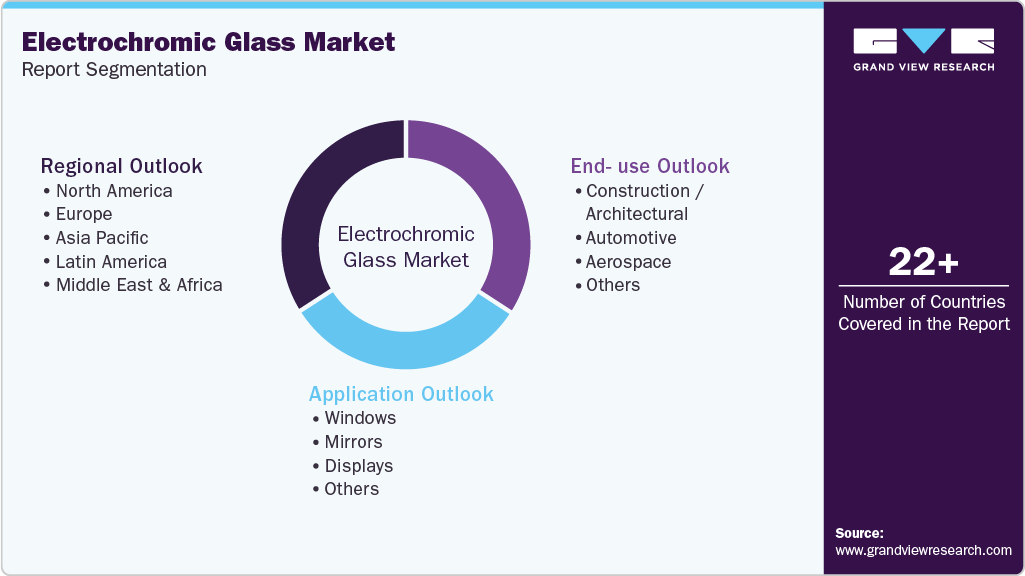
-
End-use Outlook (Revenue, USD Billion, 2021-2033)
-
Construction / Architectural
-
Automotive
-
Aerospace
-
Others
-
-
Application Outlook (Revenue, USD Billion, 2021-2033)
-
Windows
-
Mirrors
-
Displays
-
Others
-
-
Regional Outlook (Revenue, USD Billion, 2021-2033)
-
North America
-
U.S.
-
Canada
-
Mexico
-
-
Europe
-
Germany
-
UK
-
France
-
Italy
-
-
Asia Pacific
-
China
-
Australia
-
India
-
South Korea
-
-
Latin America
-
Brazil
-
Argentina
-
-
Middle East & Africa
-
South Africa
-
Saudi Arabia
-
UAE
-
-
Research Methodology
The electrochromic glass market figures in this report are based on a proven research process that combines executive interviews with secondary research from proprietary databases, company filings, and recognized regulatory and institutional sources. Market size is built through value-chain sizing—reconciling supply-side and demand-side estimates—and triangulated with bottom-up and top-down approaches. Every estimate passes multiple levels of expert validation before publication, with eachelectrochromic glasssegment quantified using the revenue-capture definitions in the table below.
Segment Definition
End Use
Revenue Capture Definition
Construction / Architectural
Revenue is captured from the sales of electrochromic glass used in building façades, windows, curtain walls, skylights, and other architectural glazing applications across commercial, residential, hospitality, healthcare, educational, and other buildings.
Automotive
Revenue is derived from the sales of electrochromic glass used in automotive applications, including dynamically tintable windows, sunroofs, and other vehicle glazing applications requiring variable light transmission and glare control.
Aerospace
Revenue is generated from the sales of electrochromic glass used in aerospace applications, including aircraft windows, cockpit glazing, and other specialized transparent surfaces requiring controllable light transmission and glare reduction.
Others
Includes revenue from the sales of electrochromic glass used in transportation, marine, specialty vehicles, infrastructure, and other applications requiring dynamic control of light transmission and solar radiation.
Application
Revenue Capture Definition
Windows
Revenue is generated from the sales of electrochromic glass used in dynamically tintable windows across commercial, residential, hospitality, healthcare, educational, and other building applications.
Mirrors
Revenue is derived from the sales of electrochromic glass used in automatically dimming mirrors, particularly automotive rear-view and side-view mirror applications.
Displays
Revenue is captured from the sales of electrochromic glass used in specialized display and transparent-display applications requiring controllable optical transmission, tinting, or light management.
Others
Includes revenue from the sales of electrochromic glass used in applications other than windows, mirrors, and displays, including skylights, façade elements, sunroofs, aircraft glazing, transportation glazing, partitions, and other specialty dynamic-glazing applications.
Estimation Model
Layer No.
Layer Name
Key Question
Description
01
Addressable Building Base Layer
What is the potential demand base for electrochromic glass?
Quantify the building and façade base that can accommodate dynamic glazing across commercial, residential, hospitality, healthcare, education, transportation, and other applications. Evaluate factors such as total building floor area, glazing area, window-to-wall ratio, solar exposure, building age, energy-performance requirements, and new construction and renovation activity.
02
Technology Adoption Layer
How widely is electrochromic glazing being adopted?
Determine the penetration of electrochromic glazing across applicable building and architectural applications. Assess adoption by building type, glazing application, project size, technology type, and region. Incorporate existing installations, new projects, retrofit activity, and announced projects to establish the current and potential adoption base.
03
Market Adoption & Installation Layer
What is the scale of electrochromic glass deployment?
Assess the scale of electrochromic glass deployment by applying adoption and penetration rates to the addressable building base. Incorporate new construction, renovation, replacement activity, project-level installations, and applicable building characteristics to determine the extent of electrochromic glazing deployment across targeted applications and regions.
04
Pricing & Revenue Layer
What is the monetary value of the installed glass demand?
Estimate market revenue based on the applicable electrochromic glass adoption base and average selling prices. Pricing is assessed based on product specifications, glass configuration, size, tinting performance, control requirements, and application. Where relevant, separate the value of the glass from installation, controls, and other ancillary services to maintain consistency with the defined market scope.
Delivered Customizations
This report has been delivered with the following In-depth customizations
Client Request
Customization Delivered
Value Adds
Project-Level ROI & Payback Analysis
Evaluation of project economics using product cost, installation expenditure, energy savings, maintenance costs, building operating hours, electricity prices, and expected product life.
Determines project-level payback periods, lifetime economic benefits, and conditions under which electrochromic glazing becomes financially attractive.
Electrochromic Glass Technology Cost & Economics Analysis
Assessment of product and installation costs across different electrochromic glass configurations, including glass type, glazing thickness, tinting range, control systems, electrical components, installation, maintenance, and replacement costs.
Identifies key cost drivers and compares the economics of electrochromic glazing with conventional and other dynamic-glazing solutions across different building applications.
Regional Adoption & Penetration Analysis
Assessment of electrochromic glass penetration by country and region using building construction activity, energy-efficiency regulations, green-building standards, climate conditions, and smart-building investments.
Highlights markets with favorable adoption conditions and supports regional expansion and market-entry decisions.
About the Author(s)
Advanced Interior Materials Research Team
Advanced Materials · Advanced Interior MaterialsThis report was authored by the advanced interior materials research team at Grand View Research - comprising two research analysts, one senior research analyst, and one industry expert - with specialized expertise in the advanced interior materials segment of the advanced materials industry. All findings are based on proprietary advanced materials databases, executive interviews, and regulatory analysis, subject to internal peer review prior to publication.
Last Updated:
Speak to Analyst


Customize this report to your needs - add regions, segments, or data points, with 20% free customization.
Or view our licence options:


ISO 9001:2015 & 27001:2022 Certified
We are GDPR and CCPA compliant! Your transaction & personal information is safe and secure. For more details, please read our privacy policy.


