
- Home
- »
- IT Services & Applications
- »
-
Embedded Analytics Market Size & Share Report, 2026-2033GVR Report cover

Embedded Analytics Market (2026 - 2033)
Size, Share & Trends Analysis Report By Component (Software, Services), By Analytics Type, By Deployment Mode (Cloud, On-premises, Hybrid), By Application, By End Use, By Region, and Segment Forecasts
Market Size, 2025
$77.7BMarket Estimate, 2026
$86.6BMarket Forecast, 2033
$210.6BCAGR, 2026–2033
13.5%Embedded Analytics Market Summary
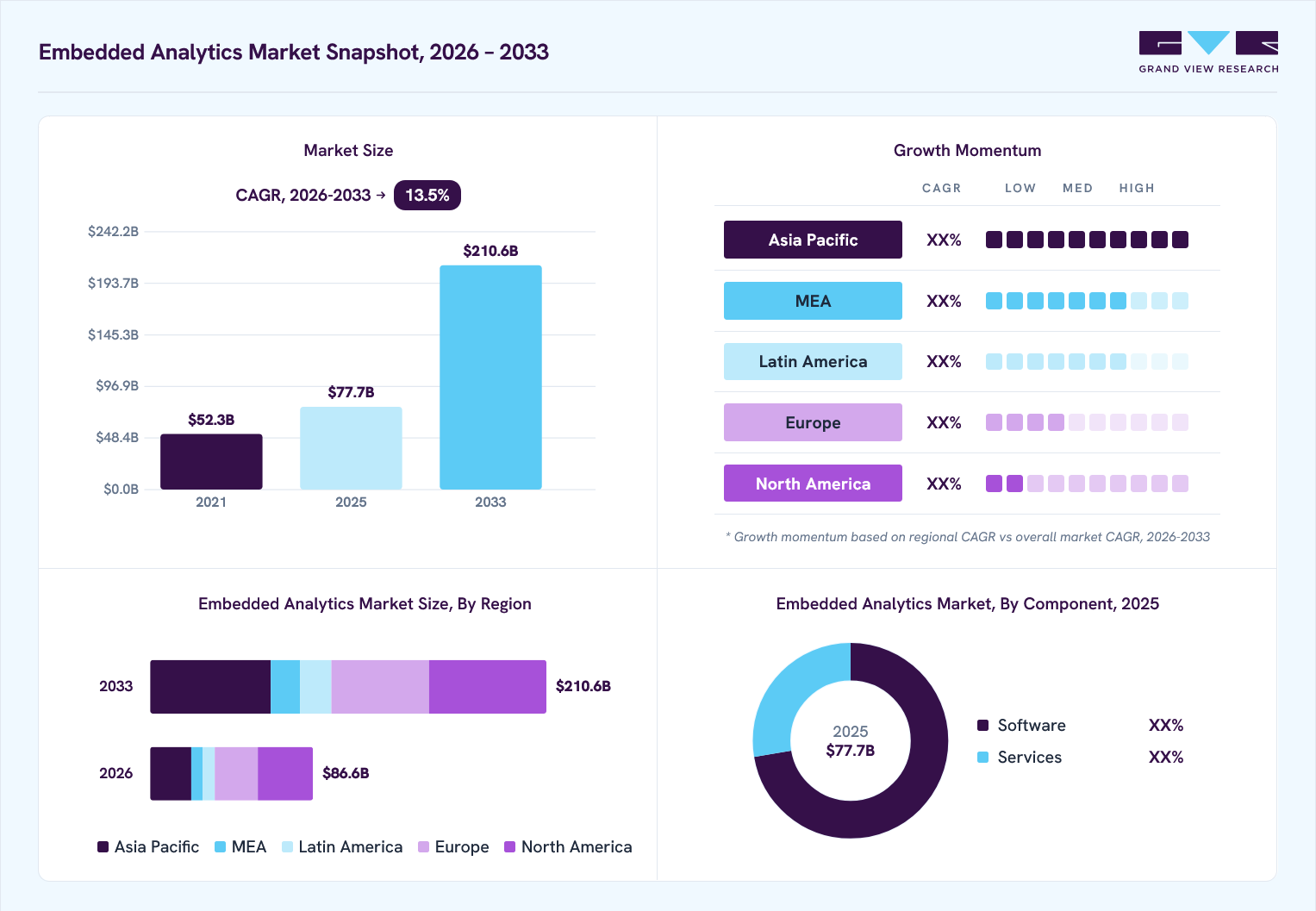
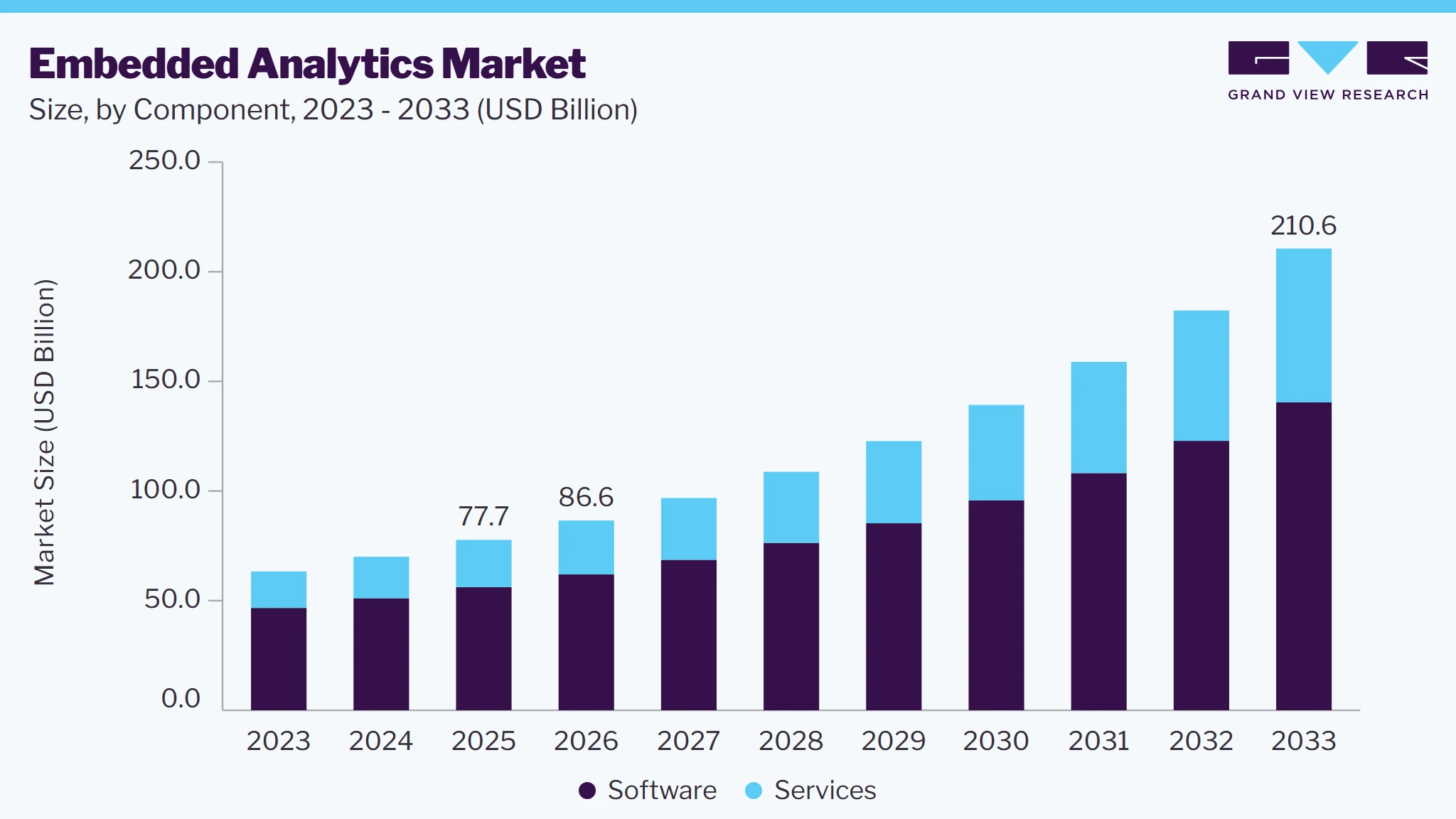
The global embedded analytics market size was valued at USD 77.7 billion in 2025 and is projected to grow from USD 86.6 billion in 2026 to USD 210.6 billion by 2033, at a CAGR of 13.5% from 2026 to 2033. The market in North America dominated with a revenue share of 34.5% in 2025. The market is driven by the growing adoption of cloud-based analytics, business intelligence (BI), and self-service reporting integrated into enterprise applications to enable real-time data access and faster decision-making.
 Source: Grand View Research, IR Documents, Primary Interviews, Paid DatabasesTo learn more about this report,
 Download Free Sample Report
Key Market Trends & Insights
- By component: Software segment held the largest market share of 72.3% in 2025.
- By analytics type: Descriptive analytics segment held the largest market share of over 46.0% in 2025.
- By deployment mode: Cloud segment held the largest market share of over 58.0% in 2025.
- By application: Business intelligence and reporting segment held the largest market share of over 23.0% in 2025.
- By end use: BFSI segment held the largest market share of 21.0% in 2025.
Regional Highlights
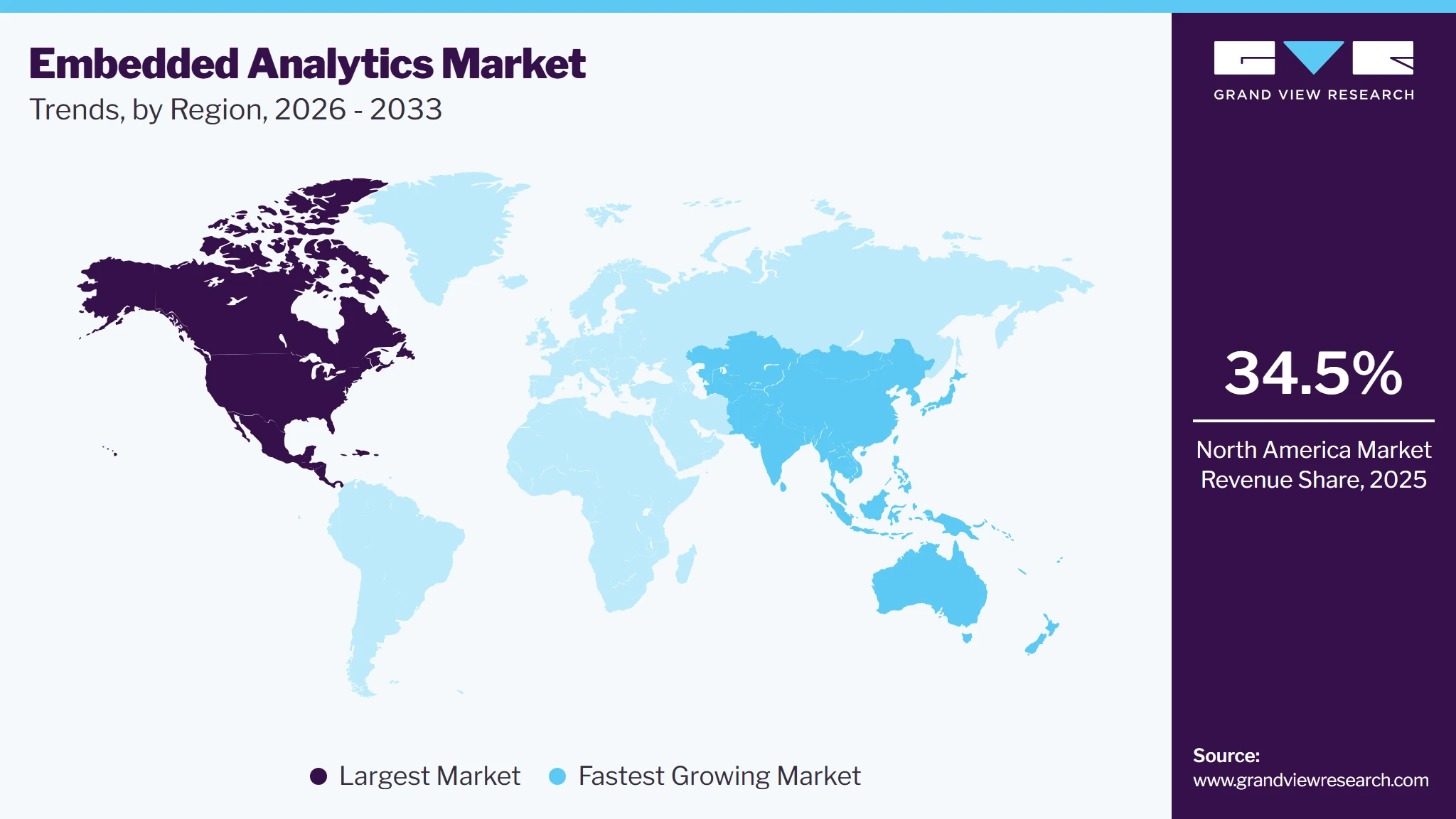
- Largest regional market: North America (34.5% revenue share, 2025)
- Fastest-growing regional market: Asia Pacific (highest CAGR, 2026-2033)
- By country: The U.S. held the largest market share in 2025
Market Size & Forecast
- Market size in 2025: USD 77.7 Billion
- Estimated market size in 2026: USD 86.6 Billion
- Projected market size by 2033: USD 210.6 Billion
- CAGR (2026-2033): 13.5%
Prism AI by Grand View Research Free to tryAsk a question about the embedded analytics marketTry asking✓Every figure cited from GVR research Prefer the report? Download free sample →Increasing investments in digital transformation, AI-powered analytics, predictive modeling, and data visualization, coupled with rising demand for personalized customer experiences and operational efficiency, are accelerating embedded analytics adoption across industries. The growing integration of conversational AI into business applications is driving demand for analytical interfaces that allow users to retrieve insights through natural language queries. Automated summaries, contextual explanations, and AI-generated responses are expanding access to business data among non-technical employees. Organizations are adopting these capabilities to reduce dependence on specialist teams for routine data analysis and reporting. Integration with existing enterprise workflows is further accelerating the use of conversational interfaces across sales, finance, customer service, and operations. This trend is strengthening demand for accessible, AI-enabled analytical capabilities within enterprise software.
The expansion of enterprise data access is driving demand for embedded analytical environments with stronger governance and permission controls, particularly across the Germany embedded analytics market. Organizations are increasing the implementation of role-based access, standardized metrics, and centralized oversight to maintain reporting consistency while enabling independent data exploration. Growing concerns over confidential business information are further driving investments in tenant-level data separation and administrative safeguards. The increasing use of enterprise applications across multiple customers and sensitive financial and operational functions is strengthening demand for secure, governed analytics solutions. These requirements are accelerating the adoption of embedded analytics platforms that combine broader data accessibility with enterprise security and compliance controls.
 To learn more about this report, Download Free Sample Report
The growing need for immediate operational visibility is accelerating the integration of continuously updated data into business applications, supporting demand across the South Korea embedded analytics market. Organizations are adopting real-time monitoring to identify performance deviations, respond to emerging risks, and adjust operational activities without relying on scheduled reports. Rising transaction volumes and interconnected business systems are driving investments in faster data processing and delivery capabilities. In the India embedded analytics market, increasing digitalization across retail, manufacturing, and financial services is driving adoption of real-time analytics to improve operational responsiveness and continuity. This demand is encouraging enterprises to integrate embedded analytics solutions that enable faster, data-driven operational decisions.
Market Dynamics
The embedded analytics market is driven by the increasing integration of analytical capabilities into enterprise applications to improve data accessibility, operational efficiency, and decision-making. Rising adoption of cloud-based software, growing enterprise data volumes, and demand for real-time business insights are accelerating the deployment of embedded analytics across industries. Advancements in artificial intelligence, automated reporting, and predictive modeling are encouraging organizations to incorporate advanced analytical functions into existing workflows. Furthermore, the expansion of SaaS platforms and demand for customized digital experiences are creating opportunities for software providers to strengthen their analytical offerings. However, data security concerns, integration complexity, implementation costs, and shortages of skilled professionals may restrict adoption among organizations with limited technical resources.
The increasing need for data-driven decision-making is driving the integration of analytical capabilities into enterprise applications, enabling businesses to access insights without switching between separate platforms. Rising adoption of cloud computing, enterprise resource planning (ERP), customer relationship management (CRM), and software-as-a-service (SaaS) solutions is expanding the deployment of embedded analytics. Growing business data volumes are further increasing demand for interactive dashboards, automated reporting, and real-time performance monitoring. Additionally, organizations are investing in predictive modeling and advanced data visualization to improve operational efficiency, customer engagement, and resource allocation. These factors are accelerating the adoption of embedded analytics across industries, including BFSI, retail, manufacturing, healthcare, and information technology.
Data security concerns and integration complexity are restraining the adoption of embedded analytics, particularly among organizations managing sensitive financial, customer, and operational information. Integrating analytical functions into legacy applications can require substantial customization, data mapping, and infrastructure modifications, increasing implementation costs and deployment timelines. Organizations must also maintain consistent data governance, access controls, and regulatory compliance across multiple systems and user environments. Limited availability of skilled professionals in data engineering, application development, and analytics integration can further complicate implementation and ongoing maintenance. These challenges may delay adoption among small and medium-sized enterprises and restrict investments in complex deployments.
The growing adoption of artificial intelligence and machine learning is creating opportunities for embedded analytics providers to introduce advanced forecasting, automated insights, and contextual recommendations within business applications. Increasing demand for industry-specific solutions is enabling vendors to develop tailored analytical capabilities for financial risk assessment, healthcare operations, retail demand forecasting, and manufacturing performance monitoring. The expansion of cloud-native applications and multi-tenant SaaS platforms is also creating opportunities to deliver scalable analytics functionality to a broader customer base. Furthermore, natural language interfaces and self-service reporting can simplify data interpretation for non-technical users and expand analytics adoption across business functions. These developments are creating opportunities for providers to differentiate their offerings through specialized capabilities, flexible integration, and application-specific analytical solutions.
Market Concentration & Characteristics
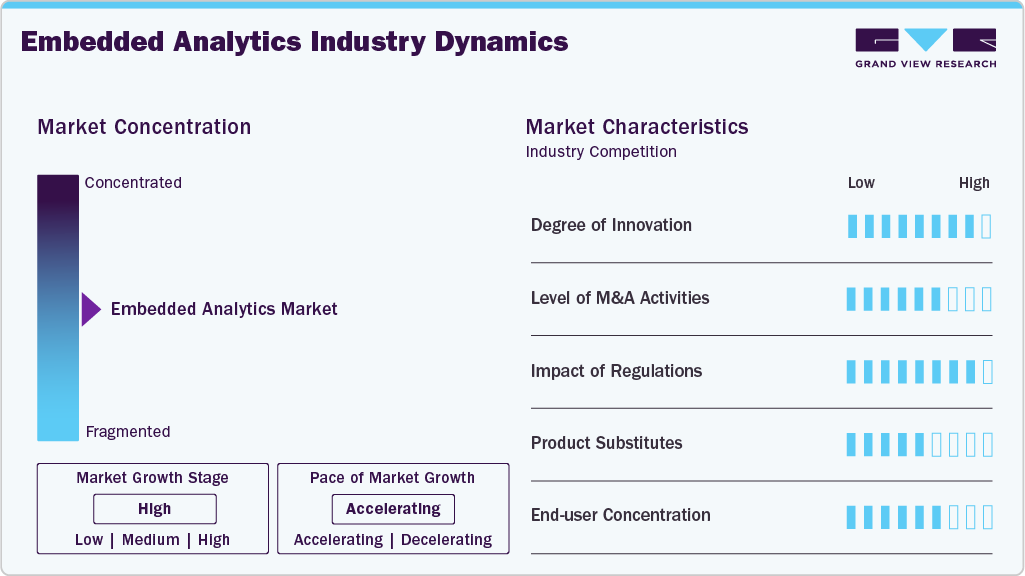
The embedded analytics market is highly fragmented, with competition distributed among established business intelligence providers, enterprise software vendors, and specialized analytics solution providers. Leading companies such as Microsoft, IBM, Oracle, Salesforce, and SAP compete through integrated software offerings, product innovation, cloud capabilities, and strategic partnerships. The market is experiencing a high growth stage, supported by increasing demand for real-time reporting, self-service analytics, and data-driven decision-making across industries. The pace of market growth is accelerating as organizations integrate analytical functionality into enterprise applications and adopt AI-enabled capabilities.
 To learn more about this report, Download Free Sample Report
The market is characterized by a high degree of innovation, as vendors continuously enhance their offerings through artificial intelligence, predictive analytics, natural language interfaces, and automated reporting. Merger and acquisition activity is moderate, with partnerships and technology integrations providing additional avenues for expanding product capabilities and customer reach. Regulatory requirements related to data privacy, security, and governance have a significant impact on solution development and deployment, particularly in regulated industries such as BFSI and healthcare. The availability of alternative analytics tools and varying levels of end-user concentration intensify competition, encouraging providers to differentiate through integration flexibility, scalability, security, and industry-specific functionality.
Analyst Perspective
The embedded analytics market is positioned for sustained growth as enterprises increasingly integrate analytical capabilities into business applications to improve operational efficiency and data-driven decision-making. Rising adoption of cloud-based software, expanding enterprise data volumes, and demand for real-time insights are driving investments in embedded reporting, interactive dashboards, and predictive analytics. Advancements in artificial intelligence, natural language interfaces, and automated data interpretation are further expanding the functionality of embedded analytics solutions across business operations. Market participants are strengthening their competitive positions through product innovation, strategic partnerships, and integration with enterprise resource planning (ERP) and customer relationship management (CRM) platforms. Going forward, demand for scalable, secure, and industry-specific analytical capabilities is expected to support market expansion across BFSI, IT and telecommunications, retail, healthcare, and manufacturing.
Component Insights
Based on the component, the software segment led the market in 2025, accounting for 72.3% of global revenue, driven by increasing demand for integrated dashboards, interactive reporting, and data visualization capabilities within enterprise applications. The growing need for real-time business intelligence is driving organizations to embed analytical tools directly into their existing software platforms. Rising adoption of self-service reporting is further driving software demand by enabling business users to access and interpret data without extensive technical support. The integration of predictive analytics and automated reporting is strengthening software capabilities and supporting faster, data-driven decision-making. Growing enterprise investments in digital transformation are further driving the deployment of embedded analytics software to improve workflow efficiency and business performance.
The services segment is expected to experience the fastest growth during the forecast period, driven by increasing demand for implementation, integration, customization, and technical support services. Organizations are investing in specialized expertise to integrate embedded analytics into existing enterprise applications and ensure compatibility with complex data infrastructures. The growing need for data migration, system configuration, and ongoing maintenance is further driving demand for professional and managed services. Increasing adoption of advanced analytical tools is also encouraging businesses to seek consulting services to optimize deployment and improve the utilization of analytical capabilities. These factors support services demand as enterprises expand embedded analytics across their business operations.
Analytics Type Insights
Based on analytics type, the descriptive analytics segment led the market in 2025, accounting for over 46.0% of global revenue, owing to increasing demand for historical data analysis, performance monitoring, and business reporting. Organizations are adopting descriptive analytics to track key performance indicators (KPIs), identify operational patterns, and evaluate business outcomes through interactive dashboards and visual reports. The growing need for consolidated data visibility is driving the integration of reporting capabilities into enterprise resource planning (ERP), customer relationship management (CRM), and other business applications. Rising emphasis on operational transparency and performance measurement is further strengthening demand for tools that convert complex datasets into accessible business insights. These factors support the widespread deployment of descriptive analytics across enterprise workflows and decision-making processes.
The prescriptive analytics segment is expected to experience the fastest growth during the forecast period, driven by increasing adoption of AI-powered recommendation engines, optimization algorithms, and automated decision-support systems. Organizations are integrating prescriptive capabilities into business applications to identify optimal actions, improve resource allocation, and address operational inefficiencies. Growing demand for scenario modeling and risk-based recommendations is further encouraging adoption across financial planning, inventory management, supply chain optimization, and customer engagement. Advancements in machine learning and real-time data processing are strengthening the ability of prescriptive analytics tools to generate actionable recommendations from complex datasets. These developments are driving demand for embedded solutions that support faster decisions and improve business performance.
Deployment Mode Insights
Based on deployment mode, the cloud segment led the market in 2025, accounting for over 58.0% of global revenue, supported by increasing adoption of cloud-based enterprise applications and software-as-a-service (SaaS) platforms. The demand for scalable infrastructure and centralized data access is driving organizations to deploy embedded analytics without significant investments in on-premises hardware. Growing requirements for remote accessibility and real-time data sharing are further encouraging cloud deployment across distributed business operations. Continuous improvements in cloud security, integration capabilities, and data processing infrastructure are strengthening enterprise confidence in cloud-hosted analytical solutions. These factors are driving cloud adoption by enabling faster implementation, flexible resource utilization, and simplified management of embedded analytics applications.
The hybrid segment is expected to experience the fastest growth during the forecast period, primarily driven by the rising development of enterprise environments that combine cloud infrastructure with on-premises systems. Organizations are adopting hybrid deployment to balance data accessibility, infrastructure flexibility, and control over sensitive business information. Increasing demand for seamless integration between legacy applications and cloud-based analytical platforms is further supporting hybrid adoption. Growing concerns regarding data privacy, regulatory compliance, and operational continuity are encouraging enterprises to retain critical workloads on-premises while leveraging cloud capabilities for scalable analytics. These factors are driving demand for hybrid deployment models that support diverse IT requirements and evolving business needs.
Application Insights
Based on application, the business intelligence and reporting segment led the market in 2025, accounting for over 23.0% of global revenue, driven by widespread deployment of on-die graphics capabilities and growing demand for mainstream visual computing solutions. Increasing use of high-resolution display processing, hardware-accelerated video playback, and graphical user interface rendering is strengthening adoption across consumer and commercial electronics. Advancements in silicon design efficiency, graphics execution units, and processor-level integration are enabling improved visual performance without increasing system complexity. These developments are supporting broader implementation of integrated graphics across personal computing devices and digital platforms.
The supply chain analytics segment is expected to experience significant growth during the forecast period, supported by increasing demand for end-to-end supply chain visibility, inventory optimization, and logistics performance monitoring. Organizations are integrating analytical capabilities into supply chain applications to improve demand forecasting, streamline procurement, and identify potential disruptions across distribution networks. Growing complexities in global trade and rising pressure to reduce operational costs are further driving the adoption of data-driven supply chain management solutions. Real-time shipment tracking, supplier performance analysis, and predictive inventory planning are strengthening the role of embedded analytics in supply chain operations. These factors are encouraging businesses to incorporate advanced analytical tools into existing platforms to improve responsiveness and operational efficiency.
End Use Insights
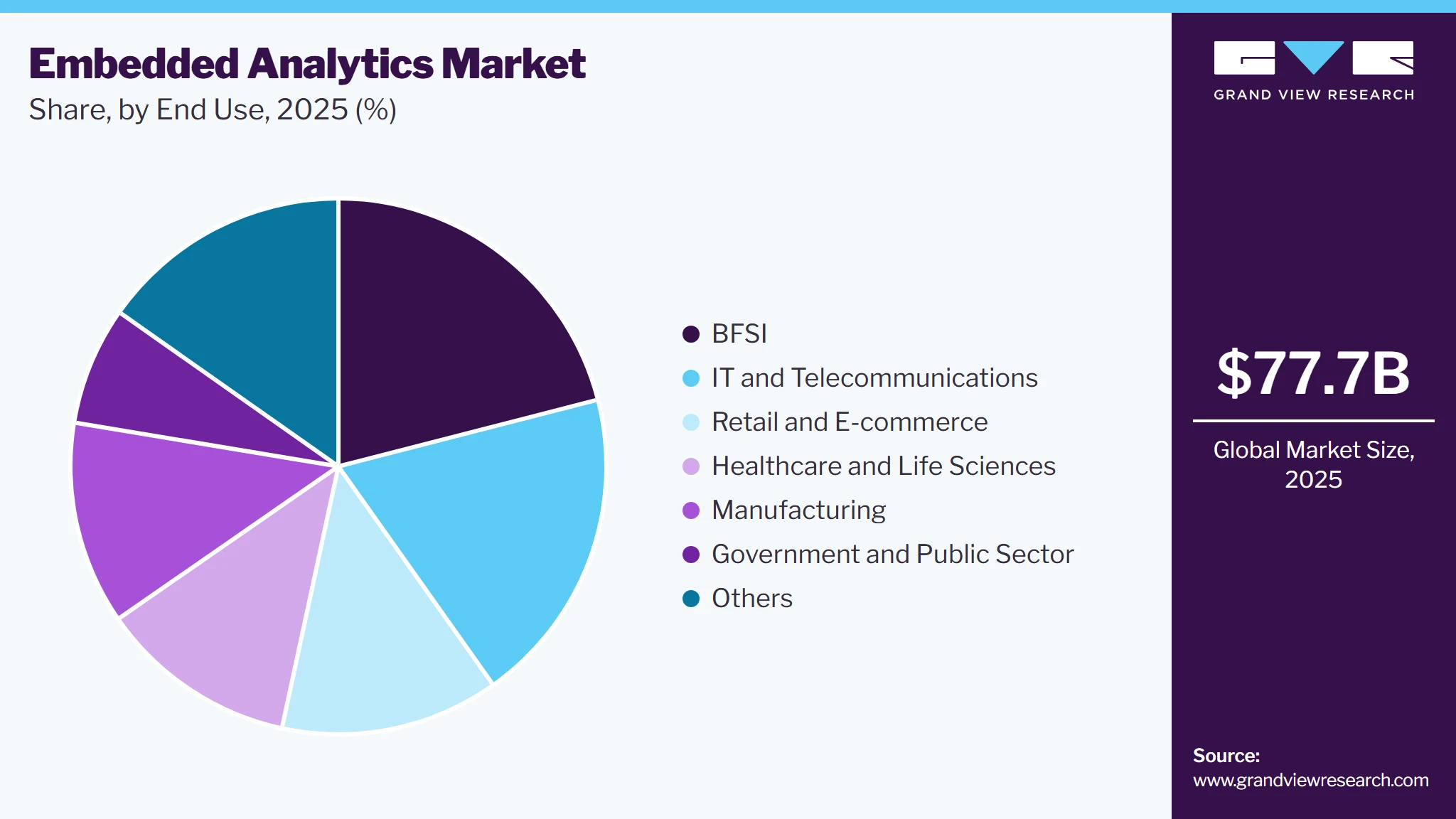
Based on end use, the BFSI segment led the market in 2025, accounting for 21.0% of global revenue, driven by widespread adoption of data analytics for fraud detection, risk assessment, and financial performance monitoring. Banks, insurance providers, and financial institutions are integrating analytical capabilities into their applications to improve transaction visibility, assess creditworthiness, and strengthen regulatory reporting. Increasing volumes of digital payments and online financial transactions are further driving demand for real-time monitoring and automated reporting solutions. The growing need to streamline customer analytics, portfolio management, and compliance processes is encouraging financial institutions to incorporate embedded analytics into their existing systems. These factors are strengthening the adoption of embedded analytics across banking, lending, insurance, and investment management operations.
 To learn more about this report, Download Free Sample Report
The healthcare and life sciences segment is expected to experience significant growth during the forecast period, owing to increasing adoption of data-driven clinical decision-making, patient monitoring, and healthcare administration systems. Healthcare providers are integrating analytical capabilities into electronic health records (EHRs), hospital management platforms, and clinical applications to improve access to patient information and operational insights. Rising demand for real-time analysis of clinical outcomes, resource utilization, and treatment effectiveness is further driving the deployment of embedded analytics. Growing investments in digital health infrastructure and the need to streamline regulatory reporting are encouraging healthcare organizations to incorporate advanced reporting and predictive capabilities into existing workflows. These factors support the adoption of embedded analytics to improve operational efficiency, resource allocation, and the delivery of patient care.
Regional Insights
The North America embedded analytics market accounted for the largest revenue share of 34.5% in 2025, driven by increasing investments in digital transformation, cloud computing, and enterprise business intelligence solutions. Widespread adoption of SaaS platforms, ERP systems, and CRM applications is accelerating the integration of embedded dashboards, real-time reporting, and predictive analytics into business workflows. The strong presence of established technology providers is driving product innovation and expanding the availability of AI-powered analytics, automated reporting, and data visualization tools. Growing demand for data-driven decision-making, operational efficiency, and customer insights is further encouraging enterprises to integrate analytical capabilities into existing software platforms. These factors are strengthening regional demand for embedded analytics across BFSI, IT and telecommunications, retail, healthcare, and manufacturing industries.
 To learn more about this report, Download Free Sample Report
U.S. Embedded Analytics Market Trends
The U.S. embedded analytics market is gaining momentum, driven by increasing investments in cloud-based enterprise software, business intelligence, and AI-powered data analytics. The widespread adoption of SaaS applications, ERP systems, and CRM platforms is accelerating the integration of interactive dashboards, automated reporting, and predictive modeling into business workflows. Growing demand for real-time insights, operational optimization, and data-driven decision-making is encouraging enterprises to incorporate analytical capabilities directly into their applications. Furthermore, advancements in generative AI, natural language querying, and automated data visualization are expanding analytical accessibility across business functions. These factors are driving market growth as U.S. enterprises prioritize software innovation, workflow automation, and improved business performance.
Europe Embedded Analytics Market Trends
The Europe embedded analytics market is witnessing robust growth, primarily driven by increasing investments in digital transformation, cloud computing, and enterprise data management solutions. The growing adoption of business intelligence platforms, SaaS applications, and integrated reporting tools is encouraging organizations to embed analytical capabilities into existing business software. Stringent data protection requirements and growing emphasis on data governance are driving demand for secure analytics solutions with controlled access and transparent reporting processes. Furthermore, rising adoption of predictive analytics, automated dashboards, and AI-enabled decision-support tools is strengthening demand across financial services, manufacturing, retail, and healthcare. These factors are accelerating the integration of embedded analytics into enterprise workflows as European businesses prioritize operational efficiency, regulatory compliance, and data-driven decision-making.
Asia Pacific Embedded Analytics Market Trends
The Asia Pacific embedded analytics market is growing rapidly, driven by digital transformation, expanding cloud infrastructure, and rising adoption of enterprise software. Increasing investments in SaaS platforms, business intelligence solutions, and data-driven applications are accelerating the integration of analytical capabilities into business workflows. The expansion of e-commerce, digital banking, and manufacturing automation is further driving demand for real-time reporting, predictive insights, and operational performance monitoring.
Key Embedded Analytics Company Insights
Key players operating in the Embedded Analytics market include Oracle Corporation, Microsoft Corporation, SAP SE, IBM Corporation, MicroStrategy, Inc., Salesforce, Inc. and among others
-
Microsoft Corporation offers embedded analytics through Power BI Embedded, enabling software developers and enterprises to integrate interactive dashboards, reports, and visualizations into their applications. Its Azure-based infrastructure, developer APIs, and customization features support scalable analytics deployment across customer-facing and internal business applications.
-
Salesforce, Inc. provides embedded analytics through Tableau, allowing organizations to integrate interactive dashboards, data visualizations, and analytical insights into business applications and digital workflows. Its embedding tools, APIs, and customization capabilities help software providers deliver analytics within their own products while supporting secure access and personalized user experiences.
Key Embedded Analytics Companies
The following key companies have been profiled for this study on the embedded analytics market.
-
Domo, Inc.
-
IBM Corporation
-
Microsoft Corporation
-
MicroStrategy, Inc.
-
Oracle Corporation
-
QlikTech International AB
-
Salesforce, Inc.
-
SAP SE
-
Sisense Inc.
-
ThoughtSpot, Inc.
Competitive Benchmarking
Operating Strategies
Competitive Edge
Weaknesses
Mature Players: Microsoft Corporation, IBM Corporation, Oracle Corporation, Salesforce, Inc., SAP SE
- Mature players focus on expanding embedded analytics capabilities within enterprise software ecosystems, strengthening cloud-based analytics offerings, integrating AI-powered reporting tools, and developing strategic partnerships. They prioritize product innovation, enterprise application integration, and expansion of customer-facing analytics solutions across business functions.
- Their competitive advantage lies in established enterprise relationships, extensive software portfolios, strong cloud infrastructure, global distribution networks, proprietary analytics technologies, and integration with ERP, CRM, and business intelligence platforms. Their ability to provide scalable solutions, advanced data visualization, and comprehensive enterprise support strengthen their market positioning.
- These companies face challenges related to complex implementation processes, high licensing and customization costs, integration difficulties with legacy systems, and dependence on broader software ecosystems. Maintaining compatibility across diverse applications, addressing data security requirements, and continuously upgrading analytical capabilities can increase development and operational costs.
Emerging Players: Domo, Inc., QlikTech International AB, Sisense Inc., ThoughtSpot, Inc., MicroStrategy, Inc.
- Emerging players focus on specialized embedded analytics offerings, including API-driven integration, interactive dashboards, self-service reporting, AI-powered data discovery, and customizable analytical applications. They prioritize flexible deployment models, developer-friendly tools, and simplified integration to address specific enterprise requirements and expand their customer base.
- Their strengths include specialized product capabilities, flexible integration frameworks, intuitive user interfaces, customizable dashboards, and differentiated data exploration features. Their focus on developer experience, application-level analytics, and simplified deployment supports differentiation across specific customer segments and software environments.
- Limited scale compared with diversified enterprise technology providers, comparatively smaller distribution networks, and dependence on strategic partnerships may constrain market expansion. High customer acquisition costs, competition from established software vendors, ongoing technology investment requirements, and challenges in securing large enterprise contracts may affect their growth and profitability.
Recent Developments
-
In June 2026, ThoughtSpot announced an expanded integration with Snowflake, incorporating Snowflake Cortex AI and Snowflake Semantic Views into its Spotter agentic analytics platform. Integration enables enterprises to access AI-powered insights, interactive visualizations, and governed business metrics while maintaining data security within the Snowflake environment. The development strengthens embedded analytics capabilities by enabling developers to integrate AI-powered analytical experiences into custom applications and business workflows through ThoughtSpot Embedded
-
In March 2026, Domo, Inc. introduced enhancements to its analytics platform, including Worksheets, Report Builder for PDF, and improvements to its semantic layer and data modeling capabilities. These enhancements enable enterprises to explore governed datasets, generate structured reports, and maintain consistent business metrics across analytical environments. The additions drive demand for more flexible embedded analytics solutions by improving self-service reporting, streamlining data exploration, and enabling faster access to actionable business insights.
-
In January 2026, Sisense introduced enhancements to its AI-first analytics platform, including the Sisense Intelligence assistant, Model Context Protocol (MCP) server support, and Sisense Managed LLM capabilities. These enhancements enable developers and enterprises to integrate conversational analytics, automated dashboard creation, and AI-generated insights into existing applications while maintaining data governance and access controls. The development strengthens Sisense's embedded analytics offering by enabling self-service data exploration and AI-powered analytical experiences directly within customer-facing applications and enterprise workflows
Embedded Analytics Market Report Scope
Report Attribute
Details
Market size in 2025
USD 77.7 billion
Estimated market size in 2026
USD 86.6 billion
Projected market size by 2033
USD 210.6 billion
Growth rate
CAGR of 13.5% from 2026 to 2033
Base year for estimation
2025
Historical data
2021 - 2024
Forecast period
2026 - 2033
Quantitative units
Revenue in USD Billion and CAGR from 2026 to 2033
Report coverage
Revenue forecast, company share, competitive landscape, growth factors, and trends
Segments covered
Component, analytics type, deployment mode, application, end use, and region
Regional scope
North America; Europe; Asia Pacific; Latin America; Middle East and Africa
Country scope
U.S.; Canada; Mexico; U.K.; Germany; France; China; Japan; India; South Korea; Australia; Brazil; UAE; KSA; South Africa
Key companies profiled
Domo, Inc.; IBM Corporation; Microsoft Corporation; MicroStrategy, Inc.; Oracle Corporation; QlikTech International AB; Salesforce, Inc.; SAP SE; Sisense Inc.; ThoughtSpot, Inc.
Customization scope
Free report customization (equivalent to up to 8 analyst working days) with purchase. Addition or alteration to country, regional & segment scope.
Pricing and purchase options
Avail customized purchase options to meet your exact research needs. Explore purchase options
Global Embedded Analytics Market Report Segmentation
This report forecasts revenue growth at global, regional, and country levels and provides an analysis of the latest industry trends in each of the sub-segments from 2021 to 2033. For this study, Grand View Research has segmented the global embedded analytics market report based on component, analytics type, deployment mode, application, end use, and region.
-
Component Outlook (Revenue, USD Billion, 2021 - 2033)
-
Software
-
Services
-
-
Analytics Type Outlook (Revenue, USD Billion, 2021 - 2033)
-
Descriptive Analytics
-
Diagnostic Analytics
-
Predictive Analytics
-
Prescriptive Analytics
-
Others
-
-
Deployment Mode Outlook (Revenue, USD Billion, 2021 - 2033)
-
Cloud
-
On-premises
-
Hybrid
-
-
Application Outlook (Revenue, USD Billion, 2021 - 2033)
-
Business Intelligence and Reporting
-
Sales and Marketing Analytics
-
Financial Analytics
-
Operational Analytics
-
Customer Analytics
-
Supply Chain Analytics
-
Others
-
-
End Use Outlook (Revenue, USD Billion, 2021 - 2033)
-
BFSI
-
IT and Telecommunications
-
Retail and E-commerce
-
Healthcare and Life Sciences
-
Manufacturing
-
Government and Public Sector
-
Others
-
-
Regional Outlook (Revenue, USD Billion, 2021 - 2033)
-
North America
-
U.S.
-
Canada
-
Mexico
-
-
Europe
-
U.K.
-
Germany
-
France
-
-
Asia Pacific
-
China
-
Japan
-
India
-
South Korea
-
Australia
-
-
Latin America
-
Brazil
-
-
Middle East and Africa
-
UAE
-
KSA
-
South Africa
-
-
Research Methodology
The global embedded analytics market figures in this report are based on a proven research process that combines executive interviews with secondary research from proprietary databases, company filings, and recognized regulatory and institutional sources. Market size is built through value-chain sizing-reconciling supply-side and demand-side estimates-and triangulated with bottom-up and top-down approaches. Every estimate passes multiple levels of expert validation before publication, with each embedded analytics segment quantified using the revenue-capture definitions in the table below.
Segment Definition
Component
Revenue Capture Definition
Software
This segment includes software platforms and tools that integrate analytical capabilities into existing business applications. It covers embedded dashboards, reporting, data visualization, and interactive analytical functionalities.
Services
This segment includes professional and managed services supporting the implementation and operation of embedded analytics solutions. It covers consulting, integration, customization, maintenance, and technical support.
Analytics Type
Revenue Capture Definition
Descriptive Analytics
This segment includes tools that analyze historical and current data to provide insights into business performance. It covers dashboards, summary reports, KPI monitoring, and data visualization.
Diagnostic Analytics
This segment includes analytical tools that examine data to identify the causes of business outcomes and performance variations. It covers drill-down analysis, correlation analysis, root-cause identification, and anomaly investigation.
Predictive Analytics
This segment includes solutions that use historical data, statistical models, and machine learning to forecast future outcomes. It covers demand forecasting, trend prediction, risk assessment, and probability modeling.
Prescriptive Analytics
This segment includes tools that recommend suitable actions based on analytical results, forecasts, and business constraints. It covers optimization models, automated recommendations, scenario analysis, and decision-support capabilities.
Others
This segment includes analytical capabilities that do not fall under the four primary categories. It covers specialized analytical techniques and emerging data interpretation functionalities integrated into business applications.
Deployment Mode
Revenue Capture Definition
Cloud
This segment includes embedded analytics solutions hosted on cloud infrastructure and accessed through internet-based platforms. It covers cloud-native applications, SaaS-based analytics, and remotely managed analytical environments.
On-premises
This segment includes embedded analytics solutions deployed within an organization's internal IT infrastructure. It covers locally hosted software, internally managed databases, and analytics applications operated within private data centers.
Hybrid
This segment includes embedded analytics solutions that combine cloud-based and on-premises infrastructure. It covers deployments that distribute data processing, storage, and analytical workloads across both environments.
Application
Revenue Capture Definition
Business Intelligence and Reporting
This segment includes analytical functionalities integrated into business applications to monitor performance and generate reports. It covers interactive dashboards, KPI tracking, data visualization, and automated business reporting.
Sales and Marketing Analytics
This segment includes analytical tools integrated into sales and marketing applications to evaluate commercial performance and customer acquisition activities. It covers lead analysis, campaign measurement, sales forecasting, and conversion tracking.
Financial Analytics
This segment includes analytical capabilities integrated into financial applications to monitor financial performance and support planning activities. It covers budgeting, financial forecasting, expense analysis, profitability monitoring, and risk assessment.
Operational Analytics
This segment includes analytical functionalities integrated into operational applications to monitor business processes and improve productivity. It covers workflow monitoring, resource utilization, process performance, and operational efficiency analysis.
Customer Analytics
This segment includes analytical tools integrated into customer-facing applications to evaluate customer behavior and engagement patterns. It covers customer segmentation, retention analysis, satisfaction measurement, and purchasing behavior analysis.
Supply Chain Analytics
This segment includes analytical capabilities integrated into supply chain and logistics applications to monitor procurement, inventory, and distribution activities. It covers demand forecasting, supplier performance, inventory optimization, and shipment tracking.
Others
This segment includes embedded analytical applications that support specialized business functions beyond the primary categories. It covers areas such as workforce analytics, compliance monitoring, project performance, and specialized industry reporting.
End Use
Revenue Capture Definition
BFSI
This segment includes banks, financial institutions, insurance providers, and other financial service organizations using embedded analytics in their business applications. It covers transaction monitoring, fraud detection, credit assessment, financial reporting, and risk management.
IT and Telecommunications
This segment includes IT service providers, software companies, and telecommunications operators integrating analytics into enterprise and customer-facing applications. It covers network performance monitoring, service usage analysis, customer management, and operational reporting.
Retail and E-commerce
This segment includes retail businesses and online commerce platforms using embedded analytics to evaluate sales performance and customer purchasing behavior. It covers inventory monitoring, product performance, demand forecasting, and customer engagement analysis.
Healthcare and Life Sciences
This segment includes hospitals, healthcare providers, pharmaceutical companies, and life sciences organizations using analytical capabilities within healthcare applications. It covers patient data analysis, clinical performance monitoring, resource utilization, and healthcare administration.
Manufacturing
This segment includes manufacturing companies integrating analytical tools into production, quality management, and enterprise applications. It covers production monitoring, equipment performance, quality control, inventory management, and process optimization.
Government and Public Sector
This segment includes government departments, public agencies, and public service organizations using embedded analytics to monitor administrative and service delivery activities. It covers public finance reporting, resource allocation, program monitoring, and performance measurement.
Others
This segment includes end-use industries not covered under the primary categories that integrate analytical capabilities into their business applications. It covers education, transportation, logistics, energy, utilities, media and entertainment.
Estimation Model
Layer Name
Key Questions
Description
Embedded Analytics Demand Layer
Who drives demand for embedded analytics solutions?
Identify demand across enterprises, software providers, and application developers for integrated dashboards, reporting tools, data visualization, and analytical capabilities within business applications.
Embedded Analytics Spending Layer
How much do organizations spend on embedded analytics solutions?
Assess spending on embedded analytics software, licensing, subscriptions, implementation, integration, customization, and maintenance services across industries and regions.
Embedded Analytics Adoption & Segmentation Layer
Which embedded analytics solutions and deployment models are adopted?
Evaluate adoption across component, analytics type, deployment mode, application, and end-use industry to determine market distribution and technology preferences.
Embedded Analytics Revenue Realization Layer
How much revenue is generated by the embedded analytics market?
Estimate revenue from embedded analytics software licenses, subscriptions, cloud-based deployments, and directly attributable professional and managed services across regions to establish the total market size.
Delivered Customizations
This report has been delivered with the following in-depth customizations
Client Request
Customization Delivered
Value Adds
Embedded Analytics Component & Software Assessment
Analyzed Software and Services components, covering embedded dashboards, reporting, data visualization, analytics platforms, implementation, integration, customization, and technical support services.
Identifies key revenue-generating components, software adoption patterns, service requirements, and opportunities for product and service expansion.
Analytics Type & Capability Assessment
Evaluated Descriptive, Diagnostic, Predictive, Prescriptive, and other analytics capabilities across embedded analytics solutions.
Highlights the adoption of advanced analytical capabilities, evolving enterprise requirements, technology differentiation, and opportunities for AI-enabled analytics development.
Deployment Mode & Adoption Analysis
Assessed adoption across Cloud, On-premises, and Hybrid deployment models, considering enterprise infrastructure requirements and data management preferences.
Provides insights into deployment preferences, cloud adoption, integration requirements, data security considerations, and opportunities to expand scalable analytics offerings.
Application-Specific Demand Assessment
Analyzed demand across Business Intelligence & Reporting, Sales & Marketing Analytics, Financial Analytics, Operational Analytics, Customer Analytics, Supply Chain Analytics, and other applications.
Identifies high-potential application areas, enterprise use cases, functional requirements, and opportunities to integrate analytics into business workflows.
End-Use Industry & Competitive Landscape Assessment
Evaluated adoption across BFSI, IT & Telecommunications, Retail & E-commerce, Healthcare & Life Sciences, Manufacturing, Government & Public Sector, and other industries, alongside key market participants and their strategies.
Supports identification of high-growth industries, sector-specific analytics requirements, competitive positioning, and potential areas for industry-focused market expansion.
About the Author(s)
IT Services & Applications Research Team
Technology · IT Services & ApplicationsThis report was authored by the it services & applications research team at Grand View Research - comprising two research analysts, one senior research analyst, and one industry expert - with specialized expertise in the it services & applications segment of the technology industry. All findings are based on proprietary technology databases, executive interviews, and regulatory analysis, subject to internal peer review prior to publication.
Last Updated:
Speak to Analyst

Customize this report to your needs - add regions, segments, or data points, with 20% free customization.
Or view our licence options:


ISO 9001:2015 & 27001:2022 Certified
We are GDPR and CCPA compliant! Your transaction & personal information is safe and secure. For more details, please read our privacy policy.


