
- Home
- »
- Electronic Devices
- »
-
Inkjet Printers Market Size And Share Report, 2026-2033GVR Report cover

Inkjet Printers Market (2026 - 2033)
Size, Share & Trends Analysis Report By Type (Multifunctional Printers, Desktop Printers, Large Format Printers), By Technology (Continuous Inkjet, Drop on Demand, UV Inkjet), By End Use, By Region, And Segment Forecasts
Market Size, 2025
$45.2BMarket Estimate, 2026
$48.0BMarket Forecast, 2033
$69.7BCAGR, 2026–2033
5.5%Inkjet Printers Market Summary
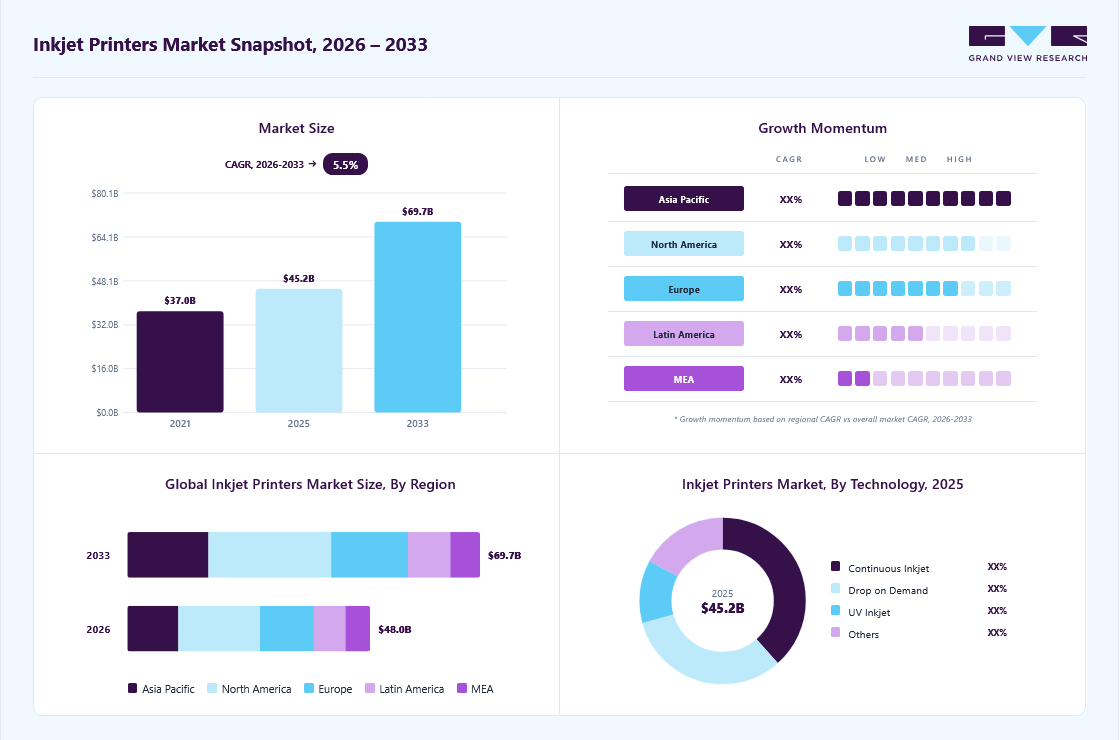
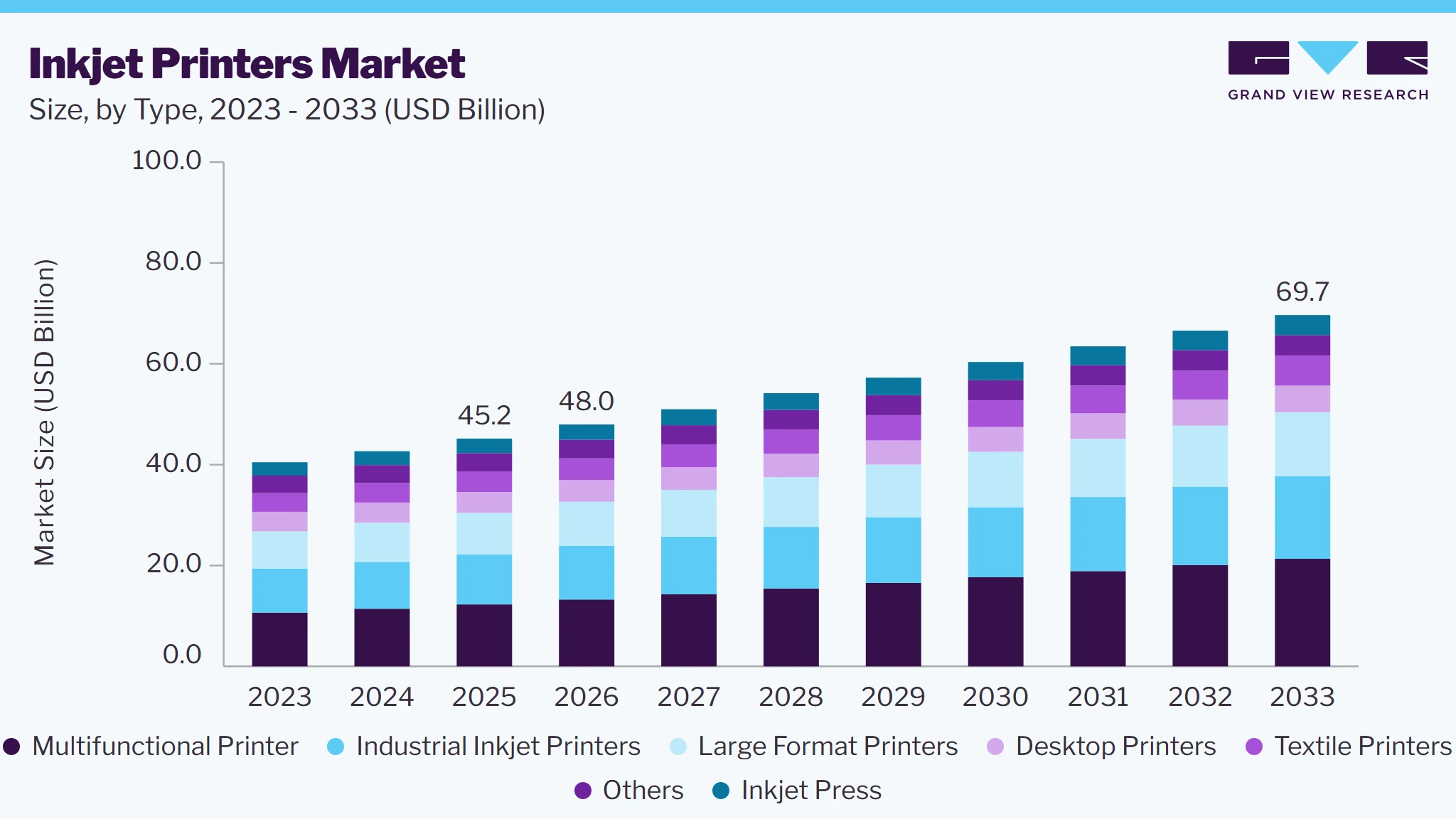
The global inkjet printers market size was estimated at USD 45.2 billion in 2025 and is projected to grow from USD 48.0 billion in 2026 to USD 69.7 billion by 2033, growing at a CAGR of 5.5% from 2026 to 2033. North America dominated the global market with the largest revenue share of 33.4% in 2025. Inkjet printers are well-regarded for their affordability and multifunctionality, making them highly useful in both personal applications as well as in businesses and educational institutions.
 Source: Grand View Research, IR Documents, Primary Interviews, Paid DatabasesTo learn more about this report,
 Download Free Sample Report
Key Market Trends & Insights
- By type: Multifunctional Printers segment dominated the market, with a revenue share of 27.2% in 2025.
- By technology: Continuous Inkjet segment held the largest market share of 38.4% in 2025.
- By end use: Consumer segment accounted for the largest revenue share in 2025.
Regional Highlights
- Largest regional market: North America (33.4% revenue share, 2025)
- Fastest-growing regional market: Asia Pacific (highest CAGR, 2026-2033)
- By country: The U.S. held the largest market share in 2025.
Market Size & Forecast
- Market size in 2025: USD 45.2 Billion
- Estimated market size in 2026: USD 48.0 Billion
- Projected market size by 2033: USD 69.7 Billion
- CAGR (2026-2033): 5.5%
Three ways to get this report
Buy it, customize it, or ask a question.Ask an Analyst
Analyst response in 1 business day
- AccessReport author, directly
- Reply timeWithin 1 working day
- No sales callDirect answer only
- FormatEmail reply
- CostFree, no cost
Get the Full Report
What the study covers
- FormatsPDF · Excel · Dashboard
- Timeline2026–2033 annual, 2025 base
- Coverage20+ countries, 5 regions
- Companies10+ key players profiled
Customize the Report
20% free customization
- IncludeCountries, segments, points
- TailorTo your product definition
- ExtendDeeper competitor detail
- OrA fully bespoke study
- Turnaround5–10 working days
They offer user-friendly controls that make it extremely easy to print high-quality photos and documents, driving their deployment in homes and offices. Furthermore, inkjet printing is a widely used tool in the packaging industry, where factors concerning efficiency, customization, traceability, and sustainability in processes have highlighted its importance. As a result, a wide range of applications for this technology has enabled strong growth prospects for the inkjet printers industry.Inkjet printers typically have a lower upfront cost compared to laser printers, making them an attractive option for consumers and businesses with limited budgets. Newer inkjet models, such as those with refillable ink tanks (Epson EcoTank, Canon MegaTank), are further driving product sales due to the reduced cost per page they offer. These models lower the frequency of ink cartridge replacements, reducing long-term operational costs and making them attractive for both consumers and small businesses with higher printing volumes.
 To learn more about this report, Download Free Sample Report
Moreover, the emergence of multifunction inkjet printers, which combine printing, scanning, copying, and occasionally faxing, has been another market driver. These all-in-one devices are very popular in home offices, small businesses, and educational institutions, as they offer a wide range of features while being economical and space-efficient. The increasing use of Internet of Things (IoT) devices and smart home systems has driven demand for printers seamlessly integrating with other smart technologies. Printers that can communicate with other devices have become significantly appealing to customers as they ensure a more efficient workflow.
Over the past few years, major brands such as Epson, Xerox, and Canon have shifted towards the launch of solutions that can address consumers' environmental and sustainability concerns. For example, printers with refillable ink tanks or eco-friendly inks and energy-efficient designs attract environmentally conscious buyers. Printer manufacturers have also made significant strides in offering recycling programs for ink cartridges, which is popular among consumers who wish to reduce their environmental footprint. This has helped promote eco-friendly models and support customer loyalty. Soy-based, water-based, and vegetable-based inks are becoming highly popular for printing purposes due to their lower VOC emissions, biodegradability, and the lower level of harm they pose to both human health and the environment.
For instance, in May 2023, KYOCERA announced the launch of the FOREARTH sustainable inkjet printer for the textile sector. The product aims to eliminate or minimize water usage in the fabric printing category, ultimately lowering the fashion business's environmental impact. This multifunctional printing solution utilizes a proprietary pigment ink, a finishing agent, and pre-treatment liquid, which are continuously discharged from the inkjet head in the same order. The innovative system thus eliminates the need for pre-and post-processing in traditional dye printing and lowers water consumption in the textile printing space by 99%. Similar innovations by other companies in terms of product build or print technologies are expected to ensure healthy growth of the inkjet printers market in the coming years.
Market Dynamics
The inkjet printers’ market is shaped by the convergence of digital transformation across printing workflows, increasing demand for short-run and customized output, and ongoing advancements in printhead and ink technologies. The market spans consumer, commercial, and industrial applications, with demand shifting toward high-resolution, faster, and more material-compatible inkjet systems. Technology innovation, sustainability considerations, and automation integration continue to redefine adoption patterns, while cost sensitivity and operational constraints influence purchasing decisions across regions and end-use segments.
The growing preference for digital and on-demand printing stems from structural changes in publishing, packaging, textiles, and commercial printing. Businesses increasingly require shorter print runs, faster turnaround times, and variable data printing to support customization, brand differentiation, and localized production. Traditional analog printing technologies are less suited to these requirements due to higher setup costs and longer production cycles, creating a strong market pull toward inkjet-based solutions.
Inkjet printers address this driver by enabling direct-to-media printing without plates, reducing setup time and material waste. Advanced drop control, higher nozzle density, and improved ink formulations allow inkjet systems to deliver consistent quality at industrial speeds. As a result, inkjet printers are increasingly adopted across packaging, textile, and commercial printing workflows, accelerating overall market growth and expanding use beyond traditional office environments.
Despite technological progress, the inkjet printer market is constrained by the high total cost of ownership associated with professional and industrial-grade systems. Costs related to printheads, proprietary inks, maintenance cycles, and system calibration can significantly increase long-term operational expenses. These expenses are particularly impactful for small and mid-sized enterprises with limited capital expenditure flexibility.
Downstream, this restraint disproportionately affects adoption in price-sensitive regions and among small commercial printers, educational institutions, and emerging-market industrial users. The large format, industrial, and inkjet press segments are more exposed due to higher upfront costs for equipment and consumables. As a result, replacement cycles are extended, and some buyers continue to rely on legacy technologies, slowing overall market penetration.
The expansion of inkjet technology into industrial and packaging applications presents a significant opportunity for the market. Growth in e-commerce, regulatory labeling requirements, and brand-driven packaging differentiation has increased demand for high-speed, high-resolution, and variable data printing directly on production lines. Continuous improvements in ink adhesion, durability, and substrate compatibility are enabling inkjet systems to meet industrial performance standards.
This opportunity offers strong growth potential for industrial inkjet printers, inkjet presses, and UV inkjet technologies. Vendors with expertise in industrial automation integration, durable printhead design, and application-specific inks are best positioned to capture this demand. Packaging, pharmaceutical, and logistics-related printing segments are expected to be the primary beneficiaries as inkjet solutions become embedded within smart manufacturing environments.
Analyst Perspective
The inkjet printers market remains in a steady transition from office-centric printing toward industrial, packaging, and textile-driven demand. Technology advancements in printhead precision, ink chemistry, and UV curing are reshaping performance benchmarks and expanding addressable applications. Investment activity is increasingly focused on industrial inkjet platforms and production-grade systems rather than entry-level consumer devices. Competitive dynamics reflect a shift toward solution-oriented portfolios that combine hardware, consumables, and workflow integration. Over the medium term, vendors emphasizing automation compatibility and application-specific innovation are expected to strengthen their market positioning.
Type Insights
Based on type, the multifunctional printers segment led the market with the largest revenue share of 27.2% in 2025. These printers, also known as all-in-one printers, combine a range of functions, including printing, scanning, and copying, into a single device. This leads to several advantages, such as space efficiency, cost savings, productivity gains, and streamlined workflows. Multifunctional printers (MFPs) also generally use fewer consumables than separate devices, resulting in the utilization of fewer consumables, easier management, and lower operational costs.
The growing adoption of digital workflows by companies further boosts the demand for MFPs due to their ability to integrate with cloud services and enterprise document management systems. For instance, in October 2024, FUJIFILM Business Innovation Asia Pacific announced the launch of three new A3 digital color multifunction printers to support digital transformation for businesses. The three products, part of the company’s Apeos series, connect the collected information through scanning or printing with different cloud services, which include accounting and document management systems.
The industrial inkjet printers segment is expected to advance at a substantial CAGR from 2025 to 2030. The continued global expansion of the e-commerce, packaging, and textile industries has resulted in significant sales of these printing solutions. Packaging is vital for printing barcodes, lot numbers, expiration dates, product details, and other important information directly on primary packaging, such as bottles, cans, cartons, and flexible pouches. Meanwhile, they are also used to print labels for different products, particularly cosmetics, healthcare, and food items. These labels often contain regulatory information, product descriptions, safety instructions, and barcodes. The flexibility of industrial inkjet printers makes it easy to print high-quality labels on different materials, such as paper, plastic, or metal. Inkjet printers are additionally ideal for printing high-resolution barcodes and QR codes for product tracking, inventory management, and consumer engagement.
Technology Insights
Based on technology, the continuous inkjet segment led the market with the largest revenue share of 38.4% in 2025. This is one of the most widely used forms of industrial inkjet printing, particularly in high-speed and high-volume environments. The continued demand for high precision and speed during printing processes on a variety of substrates, including packaging, products, and materials, enables segment growth. Continuous inkjet printers are designed for fast-paced production environments, offering speeds ranging from 100 to over 1,000 meters per minute, depending on the application and substrate. Moreover, they are well-suited for the real-time printing of variable data, including batch numbers, dates, barcodes, and logos, directly onto products or packaging as they move through production lines. The lack of physical contact with the printing surface, a notable feature of this technology, further helps eliminate wear and tear on the printhead and reduces the risk of damage to delicate or irregular surfaces.
The Drop on Demand (DOD) inkjet technology is expected to witness the fastest growth in the market during the forecast period. Unlike Continuous Inkjet (CIJ), where ink flows continuously through the printhead, DOD systems generate ink droplets only when needed, meaning that ink is ejected from the printhead in discrete bursts. This results in the creation of droplets that are precise and well-controlled for each print job. Moreover, as the ink is only ejected when needed, this printing technique is more ink-efficient than continuous systems, making it a cost-effective solution for applications involving smaller print runs or variable data. In December 2023, FUJIFILM Integrated Inkjet Solutions introduced the FUJIFILM 46kUV Inkjet Printbar System, an integrated solution for industrial production operations to print on a range of packaging materials and labels. The new product features a DOD design that offers fast printing speeds of up to 500 feet per minute and ensures streamlined workflow for customers.
End Use Insights
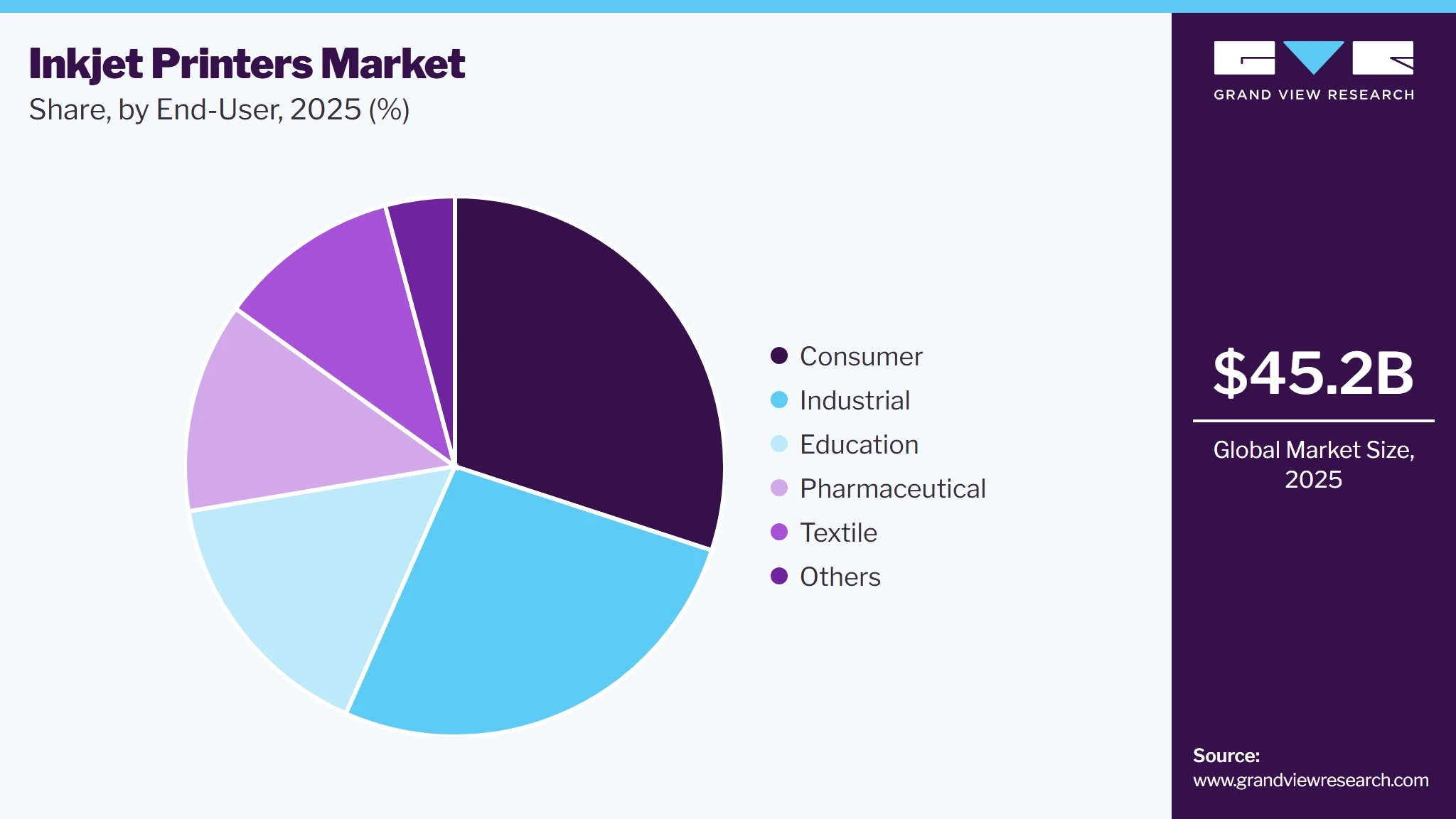
Based on end use, the consumer segment led the market with the largest revenue share of 30.0% in 2025. These accessories are widely popular among students, creatives, home offices, and general consumers, as they can produce high-quality prints for a wide range of personal applications, including documents, photos, and creative projects. Inkjet printers often use a combination of cyan, magenta, yellow, and key (black) ink (CMYK) to produce a wide color gamut, ensuring accurate color reproduction for photographs, presentations, and art prints. The affordability and wide availability of printers, enabled by rising consumer demand and increasing competition among leading brands, have led to several positive advancements in the market.
 To learn more about this report, Download Free Sample Report
The industrial segment in the inkjet printers industry is expected to advance at the highest CAGR from 2025 to 2030. This segment includes several major applications, such as packaging, publishing, and photography, where inkjet printing technologies are extensively used. These printers allow businesses to print custom designs, QR codes, or personalized branding directly onto packaging. This is particularly useful for brands that want to personalize products or respond to the growing demand for short-run packaging for limited-edition products. Meanwhile, the need for food & beverage and pharmaceutical manufacturers to adhere to various regulatory standards and provide clear product and ingredient descriptions to ensure transparency is another major avenue for market expansion. Inkjet printing is used to print security features such as holograms, microtexts, and watermarks that are difficult to reproduce, preventing product counterfeiting, especially in high-value goods such as electronics or pharmaceuticals.
Regional Insights
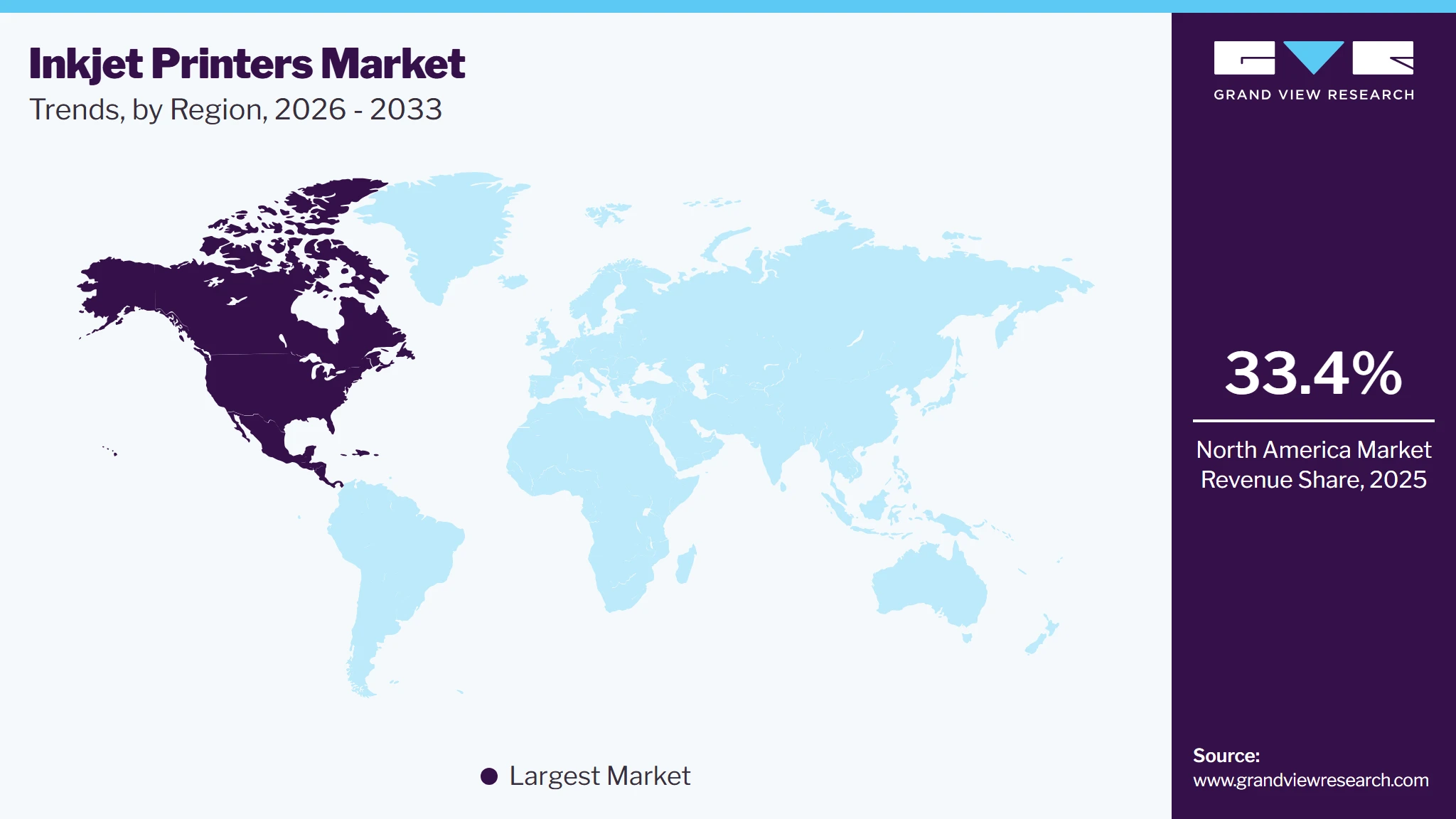
North America dominated the global inkjet printers’ market with the largest revenue share of 33.4% in 2025, on account of the widespread presence of business establishments that utilize printing solutions and technological advancements in this industry. Furthermore, these printers are popular stationery for home use, particularly among families, students, and remote workers. They are being increasingly favored for their relatively low initial cost and the ability to print high-quality color images and documents. The rapid expansion of the e-commerce industry in the region has highlighted the need for high-resolution printing, which can be achieved using these printers.
 To learn more about this report, Download Free Sample Report
U.S. Inkjet Printers Market Trends
The inkjet printers market in the U.S. held the largest share in the North America region in 2025. The continued strengthening of the supply chain infrastructure in the economy and the need for industries to comply with various regulations has resulted in a healthy growth of this market, as inkjet printers prove to be essential for product serialization and packaging purposes. Moreover, the continued adoption of hybrid working models and online learning for students has led to strong sales of inkjet printers for personal uses. The education sector in the country continues to be a significant end-user of this product. For instance, schools, colleges, and universities leverage inkjet printers for a wide range of applications, from printing assignments and educational materials to producing colorful posters and projects.
Europe Inkjet Printers Market Trends
Europe inkjet printers market accounted for a substantial revenue share in the global market in 2024 due to the growing adoption of inkjet printers by small businesses and educational institutions across regional economies. Moreover, European consumers and commercial firms are becoming increasingly environmentally conscious, which significantly impacts printer preferences. Many consumers prefer eco-friendly inkjet printers that use refillable ink tanks, energy-efficient designs, and recyclable or reusable ink cartridges. As a result, notable manufacturers such as Epson, Canon, and HP are responding to these demands by promoting sustainability in their products and services. The regional market is also witnessing substantial expansion through the industrial segment, as these solutions are extensively utilized in manufacturing, packaging, and labeling, along with the electronics and automotive industries.
Asia Pacific Inkjet Printers Market Trends
The Asia Pacific region is anticipated to advance at the highest CAGR from 2025 to 2030. The region includes a number of fast-growing economies such as India, China, and other Southeast Asian countries where rising disposable incomes, industrialization, and increasing presence of small businesses have driven a substantial demand for personal and business printers. The exponential growth of the e-commerce sector and rapidly improving supply chain infrastructure have also created growth avenues for inkjet printer manufacturers and distributors. Product sales have further increased through the educational and commercial end-use areas. Regional economies are increasingly investing in improving their educational infrastructure and offering access to quality education. This has resulted in schools, universities, and tutoring centers purchasing cost-effective printing solutions for educational materials, projects, and assignments.
China accounted for a leading revenue share in the regional market in 2024, aided by the rapid economic growth in the country, government initiatives for educational establishments, and the rising rate of technological adoption among businesses and individual end-users. The economy’s rapidly expanding middle-class demographic is a major factor enabling market expansion. As disposable incomes rise, more consumers and small businesses are purchasing personal printers for home offices, educational purposes, and general use. Moreover, the widespread penetration of mobile and internet services across the country has led to the increasing popularity and adoption of wireless printing solutions, providing opportunities for market players to launch innovative offerings.
Key Inkjet Printers Company Insights
Some of the leading companies involved in the global inkjet printers industry include Videojet Technologies, Canon, and Xerox, among others.
-
Videojet Technologies specializes in developing coding and marking solutions, with notable products including continuous inkjet printers, laser marking solutions, thermal inkjet, thermal transfer, case coders, and label applicators. These products cater to several major industries, including automotive & aerospace, baked goods and cereals, beverages, dairy, cosmetics and home care, and pharmaceuticals and medical.
-
Canon is a Japanese multinational corporation specializing in printing, imaging, medical, and industrial solutions such as printers, scanners, cameras, lenses, medical equipment, and semiconductor manufacturing equipment. Under the printing division, the company offers products such as laser printers, inkjet printers, laser multifunction printers, and image scanners. Other notable offerings include digital continuous feed presses, digital sheet-fed presses, large format printers, document solutions, and calculators, and others.
Key Inkjet Printers Companies
The following key companies have been profiled for this study on the inkjet printers market.
-
Videojet Technologies Inc.
-
Pannier Corporation
-
Canon Inc.
-
HP Development Company, L.P.
-
Xerox Corporation
-
Brother Industries, Ltd.
-
KEYENCE CORPORATION
-
Konica Minolta, Inc.
-
Seiko Epson Corporation
-
Mimaki
-
InkJet, Inc.
-
CONTROL PRINT LTD.
Competitive Benchmarking
Category
Operating Strategies
Competitive Edge
Weakness
Established Players (Canon Inc., HP Development Company, L.P., Seiko Epson Corporation, Xerox Corporation)
- These players are focused on broad portfolio coverage across consumer, commercial, and industrial inkjet; strong global distribution and R&D investment.
- These players have strong brand recognition, proprietary printhead and ink technologies, and a large installed base
- Higher exposure to mature markets and slower replacement cycles
Emerging Players (Videojet Technologies Inc., Mimaki, Konica Minolta, Inc.)
- These players are focused on expansion in industrial, textile, and specialty inkjet applications.
- These players have application-specific expertise and strong industrial integration capabilities
- Narrower product portfolios and lower consumer market penetration
Recent Developments
-
In September 2024, Mimaki USA unveiled the TS330-3200DS dual-capability digital textile printer at the PRINTING United Expo event held in Las Vegas. The product has been designed for high-value textile use cases, where it can function as a sublimation unit for printing to transfer paper, as well as a direct-to-textile unit to print on polyester fabrics. The printer can be used to create various digital textile solutions, including SEG frame printing, backlit fabric displays, theatrical backdrops, flags, POP displays, and interior décor, among others.
-
In April 2024, Videojet Technologies, which develops marking, coding, and printing solutions, launched a new ink formulated with advanced properties aimed at the pharmaceutical sector. The innovative V4234 ink has been developed to be used in the current line of Videojet SIMPLICiTY continuous inkjet printers, which includes the Videojet 1880 Series range, to apply dates, codes, and other vital information on products during the packaging stage. The ink is ideal for printing codes on medical and pharmaceutical packaging, such as flexible film, blister packs, plastic bottles, aluminum vial closures, plastic caps, glass vials, and steel and paper cartons.
-
In April 2024, Epson announced the launch of the AM-C400 and AM-C550 multifunction printers, part of the company’s A4 inkjet range, which leverage the company’s Heat-Free Line Inkjet technology. The products have been indicated for customers with higher print volumes, offering high scan and print speeds of up to 100ipm and 55ppm, respectively. Furthermore, these printers feature high paper capacities as well as high-yield ink cartridges (maximum 31,500 pages), which help improve productivity. The use of Epson Heat-Free inkjet technology ensures substantial waste reduction and lower energy consumption, supporting the company’s sustainability initiatives.
Inkjet Printers Market Report Scope
Report Attribute
Details
Market size in 2025
USD 45.2 billion
Estimated market size in 2026
USD 48.0 billion
Projected market size by 2033
USD 69.7 billion
Growth rate
CAGR of 5.5% from 2026 to 2033
Base year for estimation
2025
Historical data
2021 - 2024
Forecast period
2026 - 2033
Quantitative units
Revenue in USD billion and CAGR from 2026 to 2033
Report coverage
Revenue forecast, company market share, competitive landscape, growth factors, and trends
Segments covered
Type, technology, end use, region
Regional scope
North America; Europe; Asia Pacific; Latin America; MEA
Country scope
U.S.; Canada; Mexico; Germany; U.K.; France; China; Japan; India; South Korea; Australia; Brazil; Saudi Arabia; UAE; and South Africa
Key companies profiled
Videojet Technologies Inc.; Pannier Corporation; Canon Inc.; HP Development Company, L.P.; Xerox Corporation; Brother Industries, Ltd.; KEYENCE CORPORATION; Konica Minolta, Inc.; Seiko Epson Corporation; Mimaki; InkJet, Inc.; CONTROL PRINT LTD.
Customization scope
Free report customization (equivalent up to 8 analysts' working days) with purchase. Addition or alteration to country, regional & segment scope.
Pricing and purchase options
Avail customized purchase options to meet your exact research needs. Explore purchase options
Global Inkjet Printers Market Report Segmentation
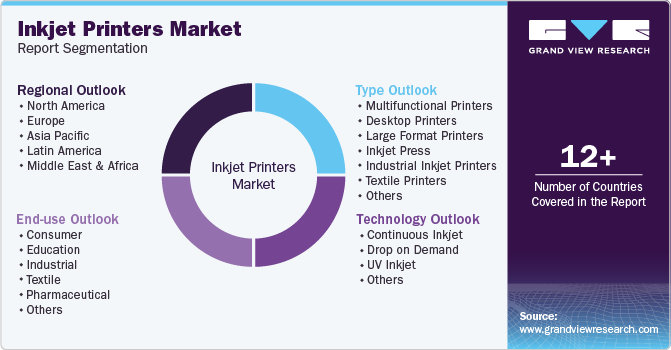
This report forecasts revenue growth at the global, regional, and country levels and provides an analysis of the latest industry trends in each of the sub-segments from 2021 to 2033. For this study, Grand View Research has segmented the global inkjet printers market report based on type, technology, end use, and region:
 To learn more about this report, Download Free Sample Report
-
Type Outlook (Revenue, USD Million, 2021 - 2033)
-
Multifunctional Printers
-
Desktop Printers
-
Large Format Printers
-
Inkjet Press
-
Industrial Inkjet Printers
-
Textile Printers
-
Others
-
-
Technology Outlook (Revenue, USD Million, 2021 - 2033)
-
Continuous Inkjet
-
Drop on Demand
-
UV Inkjet
-
Others
-
-
End Use Outlook (Revenue, USD Million, 2021 - 2033)
-
Consumer
-
Education
-
Industrial
-
Packaging
-
Publishing
-
Photography
-
-
Textile
-
Pharmaceutical
-
Others
-
-
Regional Outlook (Revenue, USD Million, 2021 - 2033)
-
North America
-
U.S.
-
Canada
-
Mexico
-
-
Europe
-
Germany
-
U.K.
-
France
-
-
Asia Pacific
-
China
-
Japan
-
India
-
South Korea
-
Australia
-
-
Latin America
-
Brazil
-
-
Middle East & Africa
-
Saudi Arabia
-
South Africa
-
UAE
-
-
Research Methodology
The inkjet printers market figures in this report are based on a proven research process that combines executive interviews with secondary research from proprietary databases, company filings, and recognized regulatory and institutional sources. Market size is built through value-chain sizing - reconciling supply-side and demand-side estimates - and triangulated with bottom-up and top-down approaches. Every estimate passes multiple levels of expert validation before publication, with each inkjet printers segment quantified using the revenue-capture definitions in the table below.
Segment Definition
Segment - Type
Revenue capture definition
Multifunctional Printer
Revenue generated from sales of inkjet-based all-in-one devices that combine printing, scanning, copying, and faxing, along with recurring revenue from branded ink cartridges, printheads, replacement parts, bundled software licenses, warranties, and after-sales service contracts.
Desktop Printers
Revenue derived from compact inkjet printer hardware sold for home and small office use, supplemented by continuous income from ink cartridges, refill systems, maintenance kits, and basic support services.
Large Format Printers
Revenue captured from wide-format inkjet printer systems used for signage, graphics, CAD, and advertising applications, including printer hardware sales, specialty inks (latex, pigment, solvent), printhead replacements, and extended maintenance agreements.
Inkjet Press
Revenue generated from high-speed production inkjet press installations for commercial and publishing applications, including capital equipment sales, long-term service and maintenance contracts, workflow software, consumables, and periodic system upgrades.
Industrial Inkjet Printers
Revenue captured from continuous and drop-on-demand inkjet systems integrated into manufacturing and packaging lines, including equipment sales, industrial inks, spare parts, printhead replacements, software integration, and lifecycle support services.
Textile Printers
Revenue derived from digital textile inkjet printer sales used for fabric and garment printing, along with recurring income from textile-specific inks (reactive, disperse, pigment), pretreatment systems, printheads, and technical service contracts.
Others
Revenue generated from niche inkjet printer categories such as photo printers, label printers, and application-specific devices, including associated consumables, accessories, and limited service offerings.
Segment - Technology
Revenue capture definition
Continuous Inkjet
Revenue generated from sales of continuous inkjet printing systems used in industrial coding and marking, along with recurring revenue from industrial inks, solvents, printhead components, system controllers, spare parts, software modules, and preventive maintenance and service contracts.
Drop on Demand
Revenue captured from drop-on-demand inkjet printer hardware across consumer, commercial, large-format, and textile applications, supported by ongoing income from ink cartridges or bulk ink systems, printhead replacements, firmware/software upgrades, and after-sales support services.
UV Inkjet
Revenue generated from UV inkjet printer systems, UV-curable inks, curing lamps or LED units, printheads, maintenance consumables, workflow software, and long-term service and technical support agreements.
Others
Revenue derived from alternative inkjet technologies such as latex and solvent-based systems, including printer sales, specialty inks, substrate-specific consumables, accessories, and limited application-focused service offerings.
Segment - End Use
Revenue capture definition
Consumer
Revenue is generated from sales of home-use inkjet printers and multifunctional devices, as well as recurring income from ink cartridges, refill bottles, photo paper, replacement parts, and basic warranty or support services.
Education
Revenue captured from inkjet printers deployed in schools, colleges, and universities, including hardware procurement, bulk ink and consumables supply contracts, maintenance agreements, and periodic device replacement programs.
Industrial
Revenue generated from inkjet systems integrated into industrial workflows, including capital equipment sales, industrial inks, printhead replacements, software integration, and long-term service contracts. The segment includes industrial such as packaging, publishing, and photography
- Packaging: Revenue derived from inkjet printers used for carton, label, and flexible packaging printing, including printer systems, UV and solvent inks, coding consumables, and maintenance services.
- Publishing: Revenue generated from inkjet presses and large-format printers used in book, journal, and commercial print production, including equipment sales, workflow software, consumables, and service agreements.
- Photography: Revenue captured from high-resolution inkjet photo printers, specialty photo inks, premium media, printheads, and professional support services.
Textile
Revenue generated from digital textile inkjet printer sales, along with recurring income from textile-specific inks (reactive, disperse, pigment), pretreatment chemicals, printheads, and technical service contracts.
Pharmaceutical
Revenue captured from inkjet printers used for pharmaceutical packaging and labeling, including compliant inks, coding and marking systems, validation software, and maintenance services.
Others
Revenue derived from inkjet printers used in logistics, advertising, signage, and other specialty applications, including device sales, consumables, accessories, and limited service offerings.
Estimation Model
Layer Name
Key Question
Description
Addressable Printing Demand
Where is inkjet printing used across industries?
This layer identifies end-use industries adopting inkjet printers, including consumer, commercial, textile, packaging, and industrial manufacturing. It evaluates print volume requirements, material types, and application-specific needs driving inkjet adoption. The layer establishes the broad demand base supporting market sizing.
Technology Adoption Layer
Which inkjet technologies are being deployed?
This layer assesses penetration of continuous inkjet, drop-on-demand, and UV inkjet technologies across applications. It evaluates suitability based on speed, resolution, substrate compatibility, and durability. Technology directly influences average selling prices and consumables revenue.
Product Configuration Layer
What types of inkjet systems are purchased?
This layer analyzes demand distribution across desktop, multifunctional, large format, industrial, and press-based inkjet systems. It reflects purchasing behavior across different user segments and operational scales. Product configuration impacts hardware-to-consumables revenue ratios.
Revenue Realization Layer
How is revenue monetized across the value chain?
This layer captures revenue from hardware sales, ink and consumables, printhead replacements, software, and services. Recurring consumables and service contracts are critical contributors. The layer consolidates market value realization mechanisms.
Delivered Customizations
This report has been delivered with the following In-depth customizations
Client Request
Customization Delivered
Value Adds
Regional Inkjet Printers Market Opportunity Assessment
Country/region-wise market sizing and forecasts
Analysis of demand, adoption trends, and regulatory landscape
Identification of high-growth regions and investment hotspots
Identified region-specific growth opportunities
Supported expansion and go-to-market strategy
Enabled informed regional investment decisions
Cross-Segmentation Analysis for the Inkjet Printers Market
Criss-cross market analysis by type, technology, and end use
Demand and adoption assessment across key segments
Segment attractiveness and growth potential benchmarking
Identified high-potential market segments
Supported targeted product positioning and marketing strategy
Improved customer and segment prioritization
Competitive Benchmarking and Strategic Positioning in the Inkjet Printers Market
Benchmarking of key competitors across products, pricing, partnerships, and innovation
Comparative assessment of market share, capabilities, and strategies
Analysis of competitive strengths, gaps, and differentiation areas
Identified competitive white spaces and growth gaps
Supported strategic positioning and differentiation
Enabled data-driven competitive strategy development
Frequently Asked Questions About This Report
North America dominated the global market, with the largest revenue share of 33.4% in 2025, due to the widespread presence of businesses that use printing solutions and technological advancements in the industry. Furthermore, these printers are popular stationery for home use, particularly among families, students, and remote workers.
Asia Pacific is the fastest-growing region over the forecast period.
Continuous Inkjet segment held the largest market share of 38.4% in 2025, while drop on demand is the fastest-growing segment over the forecast period.
The global Inkjet Printing market size was estimated at USD 45.2 billion in 2025 and is expected to reach USD 48.0 billion in 2026.
The global Inkjet Printing market is expected to grow at a compound annual growth rate of 5.5% from 2026 to 2033, reaching USD 69.7 billion by 2033.
Multifunctional Printers segment dominated the market, with a revenue share of 27.2% in 2025. These printers, also known as all-in-one printers, combine a range of functions, including printing, scanning, and copying, into a single device.
Some key players operating in the Inkjet Printing market include Videojet Technologies Inc.; Pannier Corporation; Canon Inc.; HP Development Company, L.P.; Xerox Corporation; Brother Industries, Ltd.; KEYENCE CORPORATION; Konica Minolta, Inc.; Seiko Epson Corporation; Mimaki; InkJet, Inc.; CONTROL PRINT LTD.
Inkjet printers are well-regarded for their affordability and multifunctionality, making them highly useful in both personal applications as well as in businesses and educational institutions.
Consumer segment accounted for the largest revenue share of 30.0% in 2025, while industrial is the fastest-growing segment over the forecast period.
About the Author(s)
Electronic Devices Research Team
Semiconductors & Electronics · Electronic DevicesThis report was authored by the electronic devices research team at Grand View Research - comprising two research analysts, one senior research analyst, and one industry expert - with specialized expertise in the electronic devices segment of the semiconductors & electronics industry. All findings are based on proprietary semiconductors & electronics databases, executive interviews, and regulatory analysis, subject to internal peer review prior to publication.
Last Updated:
Speak to Analyst

Customize this report to your needs - add regions, segments, or data points, with 20% free customization.
Or view our licence options:


ISO 9001:2015 & 27001:2022 Certified
We are GDPR and CCPA compliant! Your transaction & personal information is safe and secure. For more details, please read our privacy policy.


