
- Home
- »
- Advanced Interior Materials
- »
-
Escape Respirators Market Size & Share Report, 2026-2033GVR Report cover

Escape Respirators Market (2026 - 2033)
Size, Share & Trends Analysis Report By Product (Air-Purifying Escape Respirators, Self-Contained Escape Respirators), By Technology (Filtration-based, Compressed-air Supply), By End Use, By Region, And Segment Forecasts
Market Size, 2025
$1.2BMarket Estimate, 2026
$1.3BMarket Forecast, 2033
$2.0BCAGR, 2026–2033
6.4%Escape Respirators Market Summary
The global escape respirators market size was valued at USD 1.2 billion in 2025 and is projected to grow from USD 1.3 billion in 2026 to USD 2.0 billion by 2033, at a CAGR of 6.4% from 2026 to 2033. The market in Europe dominated with a revenue share of 35.6% in 2025. The global escape respirator market is driven by stringent workplace safety regulations and the need to mitigate respiratory hazards across high-risk industrial environments.
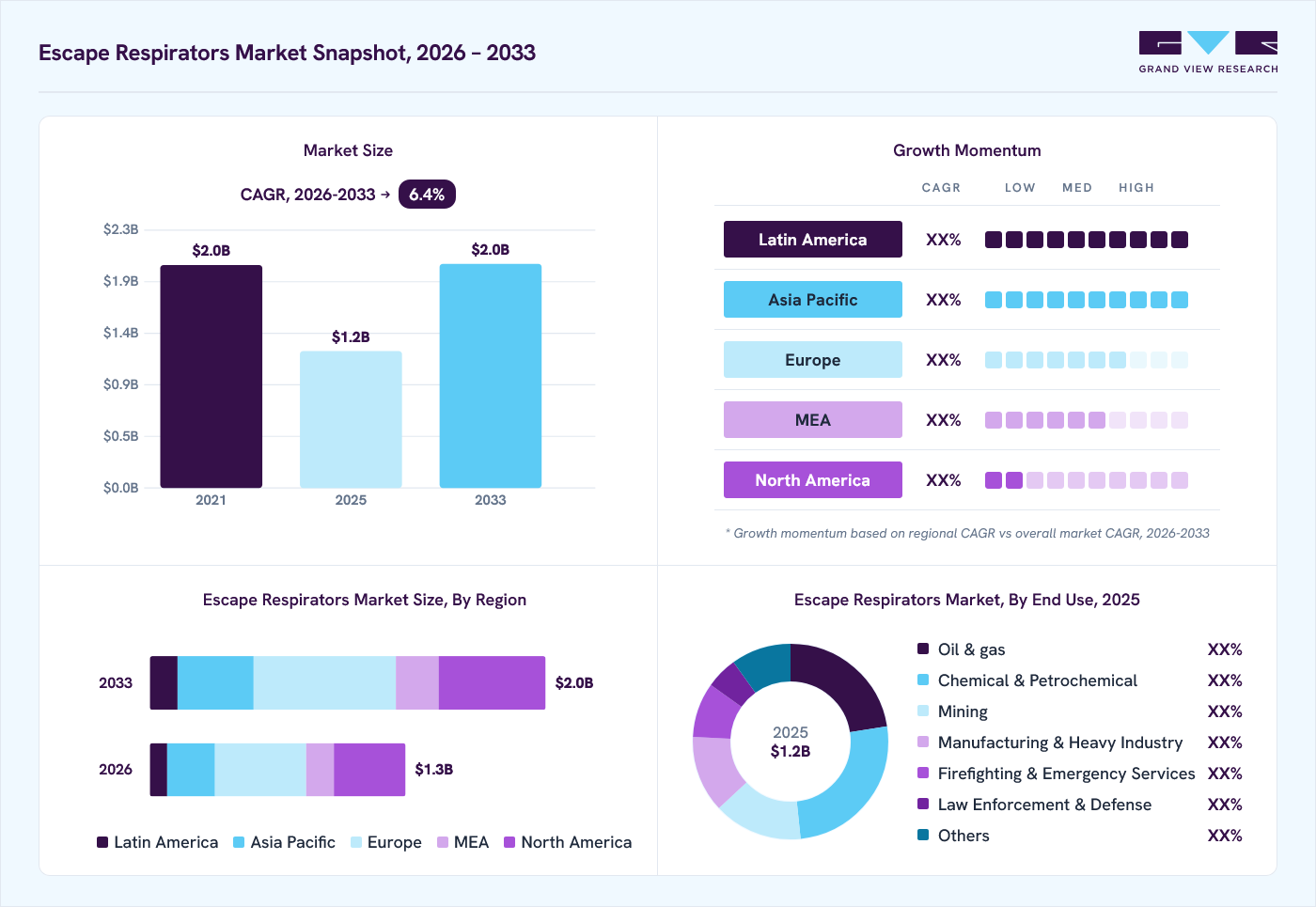 Source: Grand View Research, IR Documents, Primary Interviews, Paid DatabasesTo learn more about this report,
 Download Free Sample Report
Key Market Trends & Insights
- By product: Air-purifying escape respirators (APERs) segment held the largest market share of 48.3% in 2025.
- By technology: Compressed-air supply segment is projected to grow at the fastest CAGR of 6.8% during the forecast period.
- By end use: Chemical and petrochemical segment held the largest market share of 25.8% in 2025.
Regional Highlights
- Largest regional market: Europe (35.6% revenue share, 2025)
- By country: Germany held the largest market share in 2025.
Market Size & Forecast
- Market size in 2025: USD 1.2 Billion
- Estimated market size in 2026: USD 1.3 Billion
- Projected market size by 2033: USD 2.0 Billion
- CAGR (2026-2033): 6.4%
Three ways to get this report
Buy it, customize it, or ask a question.Ask an Analyst
Analyst response in 1 business day
- AccessReport author, directly
- Reply timeWithin 1 working day
- No sales callDirect answer only
- FormatEmail reply
- CostFree, no cost
Get the Full Report
What the study covers
- FormatsPDF · Excel · Dashboard
- Timeline2026–2033 annual, 2025 base
- Coverage20+ countries, 5 regions
- Companies10+ key players profiled
Customize the Report
20% free customization
- IncludeCountries, segments, points
- TailorTo your product definition
- ExtendDeeper competitor detail
- OrA fully bespoke study
- Turnaround5–10 working days
Potential exposure to toxic gases, smoke, chemical vapors, and oxygen-deficient atmospheres across oil and gas facilities, chemical plants, mining sites, and maritime operations sustains demand for emergency evacuation equipment.Additionally, demand is being reinforced by expanding maritime operations, offshore energy projects, mining activities, and chemical processing facilities, where personnel require readily accessible respiratory protection for emergency evacuation. Greater emphasis on safety drills, equipment inspections, and emergency response planning is encouraging organizations to incorporate escape respirators into established workplace protection programs.
 To learn more about this report, Download Free Sample Report
Market Dynamics
The global escape respirators market is shaped by industrial hazard profiles, occupational safety requirements, and the need for dependable respiratory protection during emergency egress. Demand varies according to exposure risks, evacuation protocols, and the type of equipment required to protect personnel from specified airborne contaminants or unsafe atmospheric conditions. Differences in operating environments and regulatory obligations influence product specifications and procurement priorities across industrial, maritime, mining, and energy applications.
The implementation of formal safety procedures across hazardous workplaces is reinforcing demand for emergency escape respiratory equipment. Operators handling toxic chemicals, combustible gases, and other dangerous substances must evaluate potential exposure scenarios and establish appropriate evacuation measures. Escape respirators form part of these arrangements by providing a means of respiratory protection when personnel need to leave affected areas.
The financial obligations associated with escape respirator ownership can limit procurement, particularly for organizations managing extensive equipment inventories. Beyond initial acquisition, expenditure may include scheduled inspections, specialized servicing where required, storage management, training, and replacement of expired units. Self-contained escape breathing apparatus may involve additional maintenance and handling requirements compared with certain filtering models.
Advances in hood materials, compact packaging, activation systems, and breathing-gas delivery mechanisms create scope for differentiated escape respirator offerings. Manufacturers can address specific operational requirements through configurations emphasizing rapid donning, portability, defined protection durations, and reliable storage characteristics. Opportunities also arise from tailoring equipment to maritime escape arrangements, confined industrial spaces, and installations with specialized atmospheric hazards.
Market Concentration & Characteristics
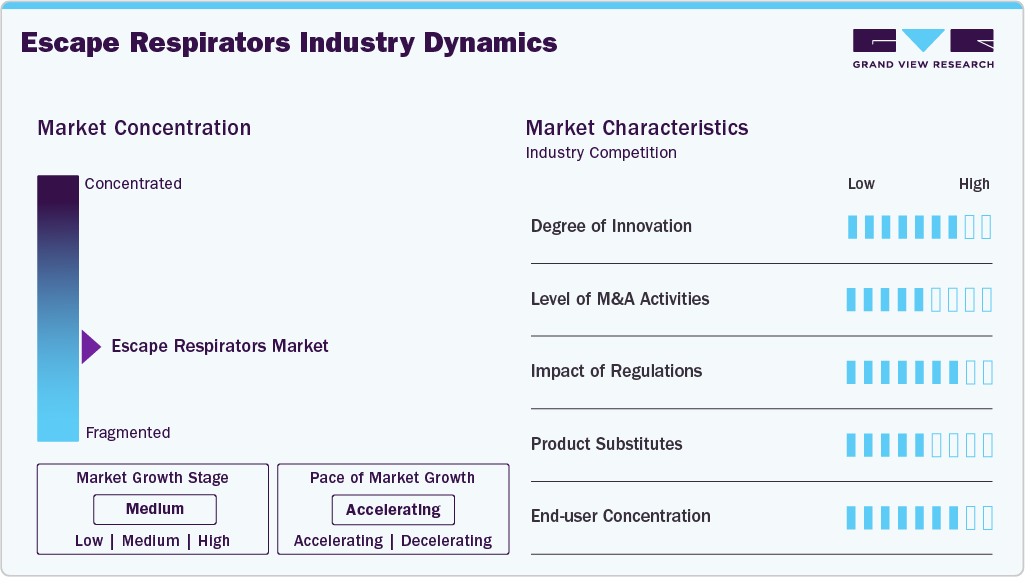
The global escape respirators market comprises established respiratory protection manufacturers and specialized safety equipment suppliers serving industrial, maritime, mining, and other hazardous operating environments. Competitive positioning reflects technical expertise, breadth of product offerings, distribution capabilities, and compliance with applicable certification requirements. Established customer relationships and the ability to meet sector-specific safety standards influence supplier selection, particularly among industrial operators and maritime organizations with stringent equipment qualification procedures.
Product differentiation centers on protection mechanisms, rated escape duration, equipment configuration, and suitability for defined atmospheric hazards. Filtering escape respirators protect against specified contaminants under appropriate atmospheric conditions, whereas self-contained escape breathing apparatus supplies an independent breathing gas source when ambient air cannot be relied upon. Hood construction, activation mechanisms, portability, storage stability, and donning procedures further distinguish available configurations and determine their applicability across operating conditions.
 To learn more about this report, Download Free Sample Report
Demand originates from oil and gas exploration, chemical processing facilities, mining operations, manufacturing plants, and commercial vessels. Procurement strategies reflect workplace safety obligations, site-specific risk profiles, workforce requirements, and the costs associated with inspection and equipment replacement. Industrial infrastructure development and maritime fleet expansion contribute to new equipment demand, while expiry dates and prescribed replacement schedules sustain recurring purchases.
Analyst Perspective
The global escape respirator market is influenced by occupational safety regulations, industrial risk exposure, and the implementation of emergency evacuation protocols across hazardous workplaces. Demand across oil and gas, chemical and petrochemical processing, mining, manufacturing, and maritime operations reflects the need for respiratory protection against specified airborne contaminants and unsafe atmospheric conditions. Competitive positioning depends on certified product performance, rated escape duration, equipment configuration, and the ability to meet application-specific safety requirements. Procurement priorities encompass hazard compatibility, storage stability, replacement intervals, and lifecycle expenditure. Continued emphasis on workforce protection and emergency preparedness is expected to shape purchasing patterns, while technological specialization and distribution capabilities will influence supplier competitiveness throughout the forecast period.
Product Insights
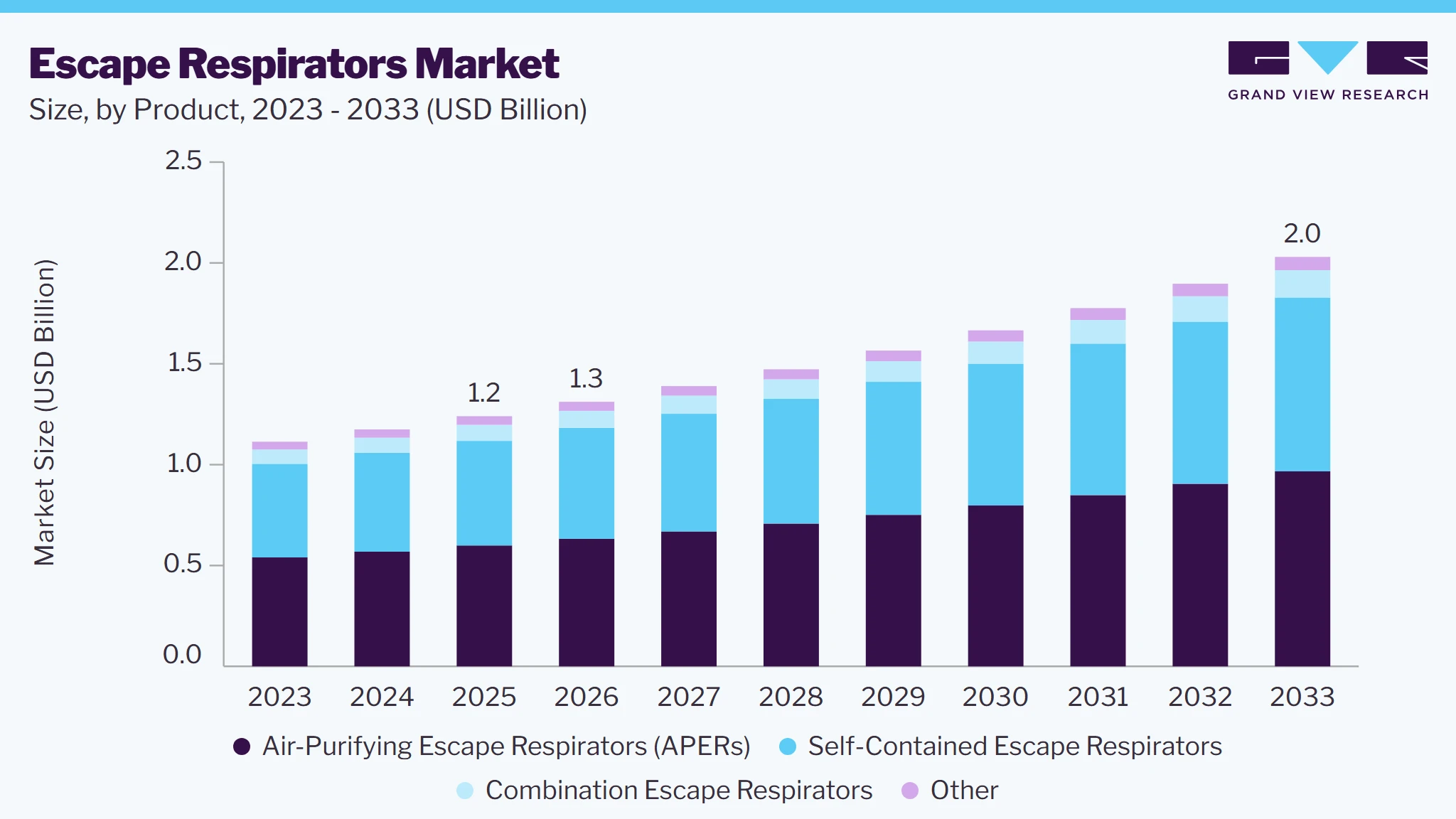
The air-purifying escape respirators (APERs) segment held the largest share of the global escape respirator market in 2025. Their established application in environments containing specified airborne contaminants, where oxygen levels remain adequate, supports adoption across industrial facilities. Compact construction, portability, and the absence of an independent breathing-air supply contribute to their suitability for designated emergency evacuation scenarios. Demand is influenced by workplace hazard assessments and the need to maintain accessible respiratory protection in accordance with applicable safety requirements.
The combination escape respirators segment is projected to expand at a CAGR of 7.0% during the forecast period. Growth prospects reflect demand for equipment that integrates multiple respiratory protection capabilities into a single configuration. Such systems can address specific evacuation requirements involving different anticipated hazards, subject to their certified performance limits. Product development focused on deployment simplicity, protection duration, and configuration flexibility is expected to influence adoption among industrial and other high-risk end users.
Technology Insights
The filtration-based segment accounted for 58.3% of the global escape respirator market in 2025. Its leading position reflects the established use of filter-based equipment to protect against designated contaminants in oxygen-sufficient atmospheres. Relatively simple equipment configurations and portability support deployment across industrial settings where the identified hazards fall within the respirator's certified capabilities.
The compressed-air supply segment is anticipated to register the fastest CAGR during the forecast period. These systems provide an independent breathing-air source, making them relevant to evacuation scenarios in which ambient air cannot be relied upon. Demand prospects are linked to safety requirements in hazardous industrial facilities and applications involving potentially oxygen-deficient atmospheres. Rated operating duration, air-supply integrity, equipment readiness, and maintenance obligations remain important considerations in purchasing decisions.
End Use Insights
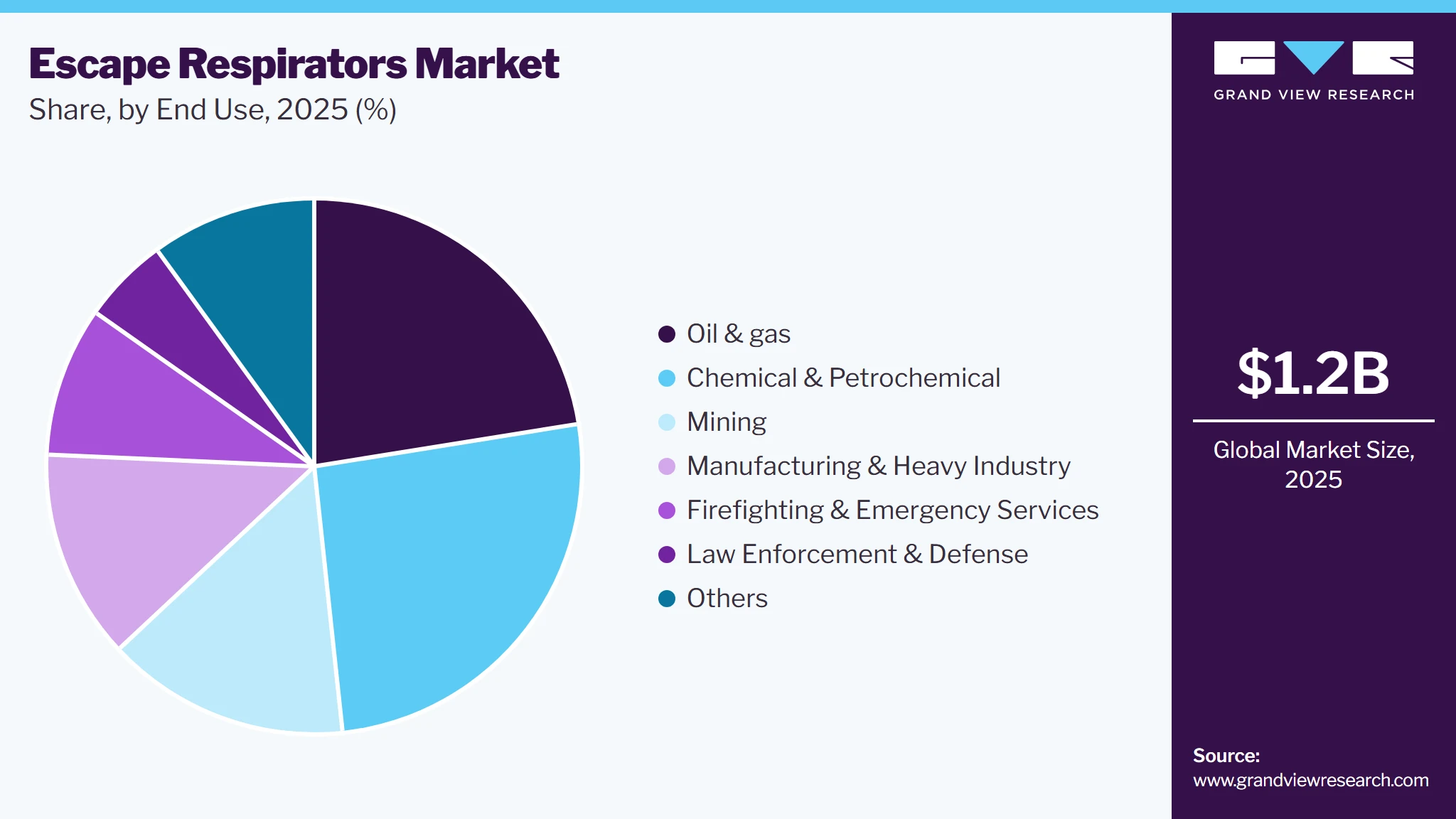
The chemical and petrochemical segment accounted for 25.8% of the global escape respirator market in 2025, making it the largest end-use category. Refining, chemical production, and petrochemical processing can involve the release of toxic substances and hazardous vapors, necessitating rapid personnel evacuation. The concentration of process equipment, storage infrastructure, and material-handling operations reinforces the need for suitable emergency respiratory protection. Demand is shaped by facility-specific risk assessments, regulatory obligations, and established industrial safety procedures.
 To learn more about this report, Download Free Sample Report
The mining segment is projected to record the fastest CAGR from 2026 to 2033. Underground operations present distinct evacuation challenges associated with restricted escape routes, potential gas accumulation, fires, and smoke infiltration. These conditions strengthen the requirement for appropriately selected escape respirators and clearly defined emergency response protocols. Investment in mine safety infrastructure and workforce protection is expected to contribute to segment growth, with equipment selection governed by anticipated atmospheric hazards, required escape duration, and the limitations of individual respiratory protection technologies.
Regional Insights
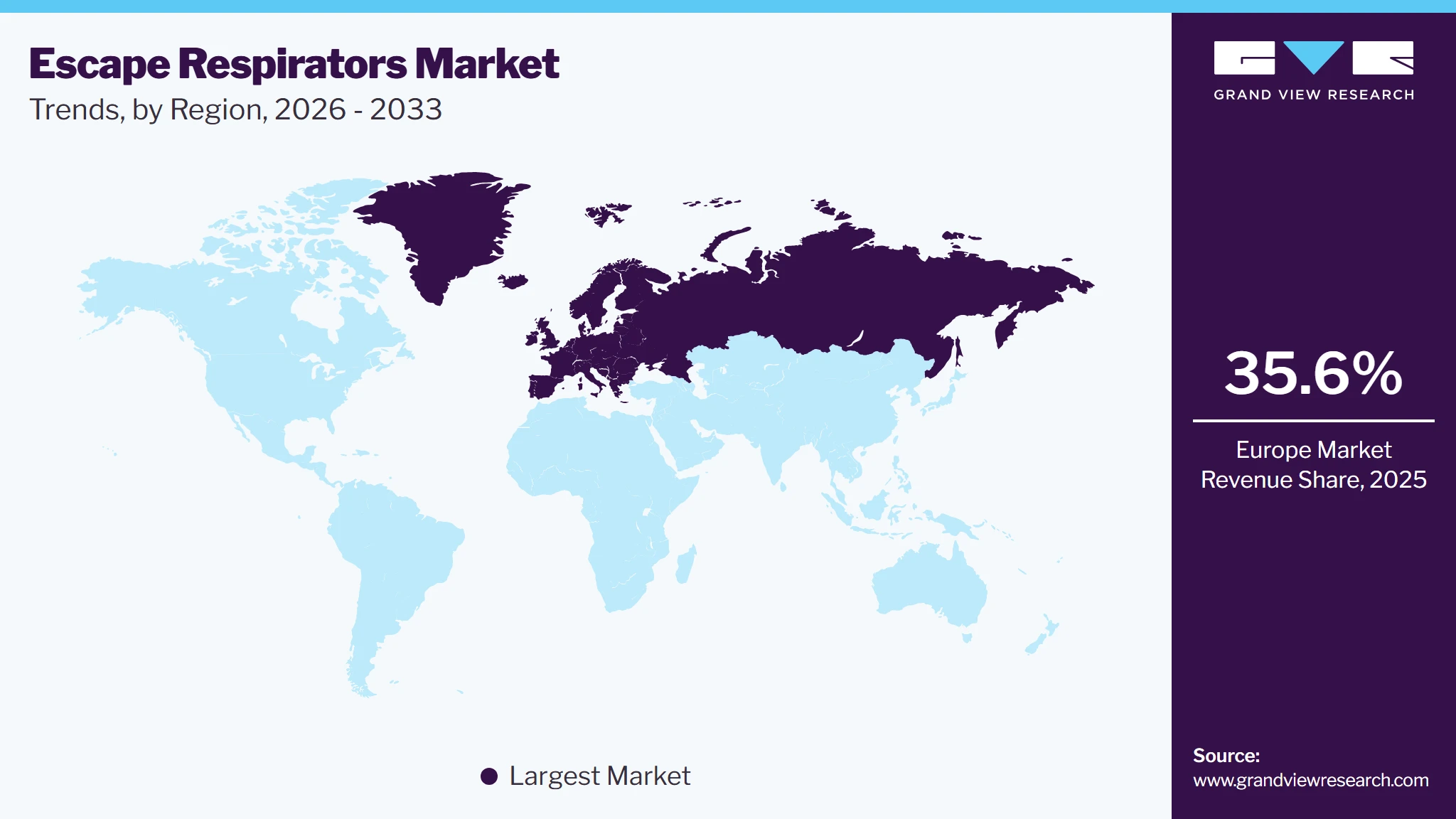
Europe dominated the market, accounting for the largest revenue share of 35.6% in 2025. The market is shaped by established occupational safety frameworks, extensive chemical and petrochemical production, energy infrastructure, and maritime operations. The region's emphasis on industrial risk assessment and regulatory compliance influences the adoption of emergency respiratory equipment across facilities handling hazardous materials. Demand is further determined by workplace exposure profiles, equipment certification requirements, and the integration of evacuation provisions into industrial safety management systems.
 To learn more about this report, Download Free Sample Report
Germany Escape Respirators Market Trends
Germany represents a prominent national market, supported by its chemical industry, manufacturing infrastructure, and extensive industrial processing activities. Facilities handling hazardous substances require appropriate emergency arrangements to address potential atmospheric contamination and protect personnel during evacuation. Established industrial safety practices and the concentration of process-intensive operations contribute to demand for escape respirators across relevant applications.
The France escape respirators market reflects its chemical and petrochemical industries, energy infrastructure, manufacturing activities, and maritime sector. Industrial processing facilities require emergency provisions for incidents involving hazardous releases, while port and vessel operations create additional requirements for respiratory protection during evacuation. Procurement is influenced by operational risk assessments, applicable safety standards, and the suitability of equipment for anticipated emergency conditions.
Asia Pacific Escape Respirators Market Trends
Asia Pacific is an important market for escape respirators, owing to its extensive chemical manufacturing base, mining operations, energy infrastructure, and maritime activities. The concentration of hazardous industrial processes across the region creates a need for emergency respiratory protection against toxic releases, smoke, and other hazardous atmospheric conditions. Market development is influenced by occupational safety regulations, industrial capacity expansion, and the integration of respiratory protection into formal emergency management protocols.
The China escape respirators market prominent country-level market within the region, supported by its large-scale chemical processing industry, petroleum refining capacity, manufacturing infrastructure, and mining sector. The breadth of these activities drives demand for evacuation equipment across facilities that handle hazardous substances and operate under potentially unsafe atmospheric conditions. Industrial safety initiatives, compliance requirements, and the scale of the country's production infrastructure shape procurement patterns across relevant end-use sectors.
The India escape respirators market is influenced by the expansion of chemical production, petroleum refining, mining, and industrial infrastructure. Increasing attention to occupational risk management and emergency response preparedness is creating opportunities for escape respirator suppliers across hazardous workplaces. Procurement requirements are shaped by facility-specific exposure risks, applicable safety obligations, and the need to equip personnel for emergency evacuation under defined operating conditions.
North America Escape Respirators Market Trends
North America benefits from a diversified industrial base encompassing oil and gas extraction, petrochemical processing, mining, manufacturing, and maritime operations. Demand for escape respirators reflects the need to establish appropriate evacuation provisions in facilities where hazardous atmospheric conditions may arise unexpectedly. Occupational safety requirements, corporate risk-management policies, and the technical suitability of respiratory protection equipment influence purchasing decisions across the region.
The U.S. dominated the North America escape respirators market in 2025, supported by its extensive energy infrastructure, chemical manufacturing capacity, and established industrial safety framework. Potential exposure to toxic substances, hazardous gases, and smoke across processing facilities and industrial installations reinforces demand for emergency respiratory protection. Regulatory oversight and structured workplace safety programs contribute to equipment procurement across high-risk operating environments.
The Canada escape respirators market is projected to register the fastest CAGR of 6.4% during the forecast period. Expansion prospects are associated with mining, oil and gas extraction, chemical processing, and other resource-intensive activities that require appropriate provisions for respiratory emergencies. Investments in industrial operations and heightened attention to personnel safety are expected to strengthen demand, particularly at facilities where remote locations and operating conditions necessitate carefully planned evacuation arrangements.
Middle East & Africa Escape Respirators Market Trends
The Middle East and Africa market is influenced by petroleum production, refining, petrochemical processing, mining, and the development of industrial infrastructure. These activities involve potential exposure to hazardous gases, chemical releases, and smoke, creating requirements for suitable emergency respiratory protection. Regional demand varies according to industrial concentration, occupational safety enforcement, infrastructure investment, and the maturity of emergency preparedness programs.
The Saudi Arabia escape respirators market represents a principal country-level market, underpinned by its extensive petroleum industry, refining infrastructure, petrochemical production, and industrial diversification initiatives. Processing facilities and energy installations require emergency response provisions for incidents that may compromise atmospheric safety. Continued industrial development and the emphasis on workplace risk management create opportunities for escape respirator suppliers serving high-hazard applications.
Latin America Escape Respirators Market Trends
Latin America's escape respirators market is supported by mining, petroleum production, chemical processing, and industrial manufacturing. These sectors encompass operations in which toxic substances, hazardous gases, and combustion-related incidents may necessitate immediate personnel evacuation. Market development depends on industrial investment, occupational safety practices, access to certified equipment, and the incorporation of respiratory protection into site-specific emergency response procedures.
The Brazil escape respirators market contribution to the Latin American escape respirators industry is shaped by its industrial workforce, offshore energy infrastructure, and regulatory framework for occupational risk management. Adoption is linked to safety equipment standards across industrial employers, contractor requirements, and the integration of emergency escape devices into workplace safety programs. The availability of locally distributed products and the ability of suppliers to meet industry-specific certification and procurement requirements also influence market penetration.
Key Escape Respirators Company Insights
Some of the key players operating in the market include Dragerwerk AG & Co. KGaA, MSA Safety Incorporated, among others.
-
Dragerwerk AG & Co. KGaA is a German medical and safety technology manufacturer with an established presence across industrial safety, mining, emergency services, and healthcare. The company's safety technology portfolio encompasses respiratory protection equipment, gas detection systems, breathing apparatus, and emergency escape devices for hazardous operating environments. Its escape respiratory solutions address industrial evacuation and underground mining applications, with product configurations tailored to specific atmospheric hazards and protection requirements.
-
MSA Safety Incorporated is a global manufacturer of safety equipment and technologies serving the oil and gas, chemical, mining, construction, and industrial manufacturing sectors. Its product portfolio includes self-contained breathing apparatus, respiratory protection systems, gas detection instruments, and fire and rescue equipment. The company's relevance to the escape respirators market stems from its self-rescue and emergency breathing solutions, which address personnel evacuation requirements in hazardous industrial and underground mining environments.
Key Escape Respirators Companies
The following key companies have been profiled for this study on the escape respirators market.
-
Dragerwerk AG & Co. KGaA
-
MSA Safety Incorporated
-
PIP Global Safety
-
3M Company / Scott Safety
-
Avon Technologies plc (Avon Protection)
-
Ocenco, Incorporated
-
CSE Corporation
-
Survitec Group Limited
-
Interspiro AB
-
RSG Safety B.V.
-
Matisec
-
KOKEN LTD.
-
Shigematsu Works Co., Ltd.
-
VENUS Safety & Health Pvt. Ltd.
-
Sundstrom Safety AB
Competitive Benchmarking
Category
Operating Strategies
Competitive Edge
Weakness
Established Players (e.g., Dragerwerk AG & Co. KGaA; MSA Safety Incorporated; PIP Global Safety; 3M Company / Scott Safety; Avon Technologies plc (Avon Protection); Ocenco, Incorporated; CSE Corporation; Survitec Group Limited)
- Maintain escape respirator portfolios tailored to industrial, mining, energy, and maritime evacuation requirements, with emphasis on certified performance and equipment readiness.
- Strengthen distribution and customer relationships across industrial safety and maritime procurement channels.
- Established technical capabilities and recognized safety brands support qualification for demanding industrial and institutional requirements.
- Broad respiratory protection expertise and distribution reach facilitate access to multiple end-use sectors.
- Extensive product portfolios and international operations increase supply-chain and product-management complexity.
- Certification, quality assurance, and equipment replacement requirements contribute to lifecycle costs.
Emerging & Regional Players (e.g., Interspiro AB; RSG Safety B.V.; Matisec; KOKEN LTD.; Shigematsu Works Co., Ltd.; VENUS Safety & Health Pvt. Ltd.; Sundström Safety AB.)
- Focus on selected respiratory protection technologies, customer groups, or geographic markets.
- Develop targeted distribution relationships and product configurations aligned with specific customer requirements, where applicable to their verified escape respirator offerings.
- Focused technical expertise can support specialization in selected respiratory protection applications.
- Regional customer knowledge and targeted sales channels can facilitate service within defined markets.
- Narrower product coverage or geographic reach may limit participation in multinational procurement programs.
- Certification requirements and customer qualification processes can increase the cost and time required to expand into new applications.
Recent Developments
-
In May 2025, Protective Industrial Products (PIP) completed the acquisition of Honeywell’s Personal Protective Equipment business. The transaction expanded PIP’s portfolio across respiratory protection, head and hearing protection, fall protection, and first-responder equipment, while strengthening its global product offering and distribution network.
-
In March 2025, Dräger introduced ProAir, a NIOSH-certified closed-circuit breathing apparatus providing up to four hours of breathable oxygen for rescue and hazardous-materials operations. Its features include carbon dioxide removal, RFID-enabled canister monitoring, and optional cooling configurations. The product serves extended-duration respiratory protection rather than emergency escape.
Escape Respirators Market Report Scope
Report Attribute
Details
Market size in 2025
USD 1.2 billion
Estimated market size in 2026
USD 1.3 billion
Projected market size by 2033
USD 2.0 billion
Growth rate
CAGR of 6.4% from 2026 to 2033
Base year for estimation
2025
Historical data
2021 - 2024
Forecast period
2026 - 2033
Quantitative units
Revenue in USD billion and CAGR from 2026 to 2033
Report coverage
Revenue forecast, company market position analysis, competitive landscape, growth factors, and trends
Segments covered
Product, technology, end use, region
Regional scope
North America; Europe; Asia Pacific; Latin America; Middle East & Africa
Country Scope
U.S.; Canada; Mexico; Germany; UK; Italy; Spain; France; China; Japan; India; Australia; South Korea; Brazil; Argentina; Saudi Arabia; UAE; South Africa
Key companies profiled
Dragerwerk AG & Co. KGaA; MSA Safety Incorporated; PIP Global Safety; 3M Company/Scott Safety; Avon Technologies plc (Avon Protection); Ocenco; Incorporated; CSE Corporation; Survitec Group Limited; Interspiro AB; RSG Safety B.V.; Matisec; KOKEN LTD.; Shigematsu Works Co., Ltd.; VENUS Safety & Health Pvt. Ltd.; Sundstrom Safety AB.
Customization scope
Free report customization (equivalent up to 8 analysts working days) with purchase. Addition or alteration to country, regional & segment scope.
Pricing and purchase options
Avail customized purchase options to meet your exact research needs. Explore purchase options
Global Escape Respirators Market Report Segmentation
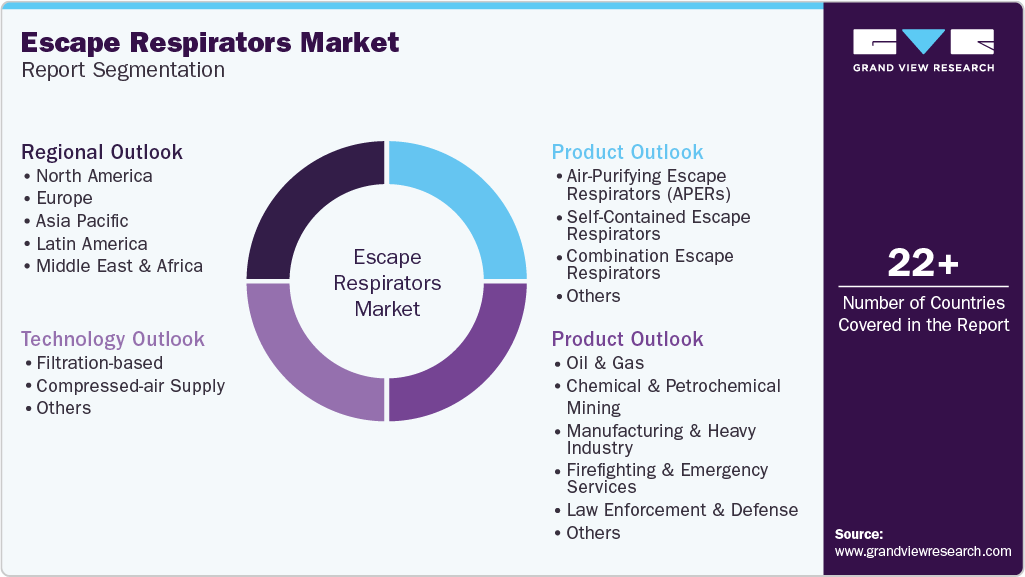
This report forecasts revenue growth at global, regional & country levels and provides an analysis on the industry trends in each of the sub-segments from 2021 to 2033. For the purpose of this study, Grand View Research has segmented the global escape respirators market on the basis of product, technology, end use, and region:
 To learn more about this report, Download Free Sample Report
-
Product Outlook (Revenue, USD Billion, 2021 - 2033)
-
Air-Purifying Escape Respirators (APERs)
-
Self-Contained Escape Respirators
-
Combination Escape Respirators
-
Others
-
-
Technology Outlook (Revenue, USD Billion, 2021 - 2033)
-
Filtration-based
-
Compressed-air Supply
-
Others
-
-
End Use Outlook (Revenue, USD Billion, 2021 - 2033)
-
Oil & Gas
-
Chemical & Petrochemical
-
Mining
-
Manufacturing & Heavy Industry
-
Firefighting & Emergency Services
-
Law Enforcement & Defense
-
Others
-
-
Regional Outlook (Revenue, USD Billion, 2021 - 2033)
-
North America
-
U.S.
-
Canada
-
Mexico
-
-
Europe
-
Germany
-
France
-
UK
-
Spain
-
Italy
-
-
Asia Pacific
-
China
-
India
-
Japan
-
South Korea
-
Australia
-
-
Latin America
-
Brazil
-
Argentina
-
-
Middle East & Africa
-
Saudi Arabia
-
UAE
-
South Africa
-
-
Research Methodology
The escape respirators market figures in this report are based on a proven research process that combines executive interviews with secondary research from proprietary databases, company filings, and recognized regulatory and institutional sources. Market size is built through value-chain sizing-reconciling supply-side and demand-side estimates-and triangulated with bottom-up and top-down approaches. Every estimate passes multiple levels of expert validation before publication, with each escape respirators segment quantified using the revenue-capture definitions in the table below.
Segment Definition
Product
Revenue Capture Definition
Air-Purifying Escape Respirators (APERs)
Revenue generated from the sale of air-purifying escape respirators incorporating filters or cartridges to protect users against specified airborne contaminants during emergency evacuation.
Self-Contained Escape Respirators
Revenue generated from the sale of self-contained escape respirators that provide an independent breathing-gas supply for evacuation from hazardous or oxygen-deficient atmospheres.
Combination Escape Respirators
Revenue generated from the sale of combination escape respirators integrating multiple respiratory protection mechanisms within a single device to address specified emergency evacuation hazards.
Others
Revenue generated from the sale of other escape respirator types not classified under air-purifying, self-contained, or combination escape respirators.
Technology
Revenue Capture Definition
Filtration-based
Revenue generated from the sale of filtration-based escape respirators that remove specified airborne contaminants through filters or cartridges, subject to the equipment's certified operating conditions.
Compressed-air Supply
Revenue generated from the sale of escape respirators that provide breathing air from a compressed-air source for emergency evacuation.
Others
Revenue generated from the sale of escape respirators employing technologies other than filtration-based or compressed-air supply systems.
End Use
Revenue Capture Definition
Oil & Gas
Revenue generated from the sale of escape respirators to oil and gas operators for emergency evacuation at exploration, production, processing, refining, storage, and transportation facilities.
Chemical & Petrochemical
Revenue generated from the sale of escape respirators to chemical and petrochemical facilities for personnel protection during emergency evacuation involving potential exposure to hazardous gases, vapors, or other airborne contaminants.
Mining
Revenue generated from the sale of escape respirators to mining operators for emergency evacuation in underground and surface mining environments where respiratory hazards may arise.
Manufacturing & Heavy Industry
Revenue generated from the sale of escape respirators to manufacturing plants and heavy industrial facilities for emergency egress from areas with potential airborne contaminants or unsafe atmospheric conditions.
Firefighting & Emergency Services
Revenue generated from the sale of escape respirators to firefighting organizations and emergency response agencies for respiratory protection during designated evacuation scenarios.
Law Enforcement & Defense
Revenue generated from the sale of escape respirators to law enforcement agencies and defense organizations for emergency egress from environments involving specified chemical, biological, or other respiratory hazards.
Others
Revenue generated from the sale of escape respirators to end users outside the specified oil and gas, chemical and petrochemical, mining, manufacturing and heavy industry, firefighting and emergency services, and law enforcement and defense categories.
Estimation Model
Layer Name
Key Question
Description
Market Demand Assessment Layer
Where does demand for escape respirators originate?
Evaluate demand across oil and gas, chemical and petrochemical, mining, manufacturing and heavy industry, firefighting and emergency services, law enforcement and defense, and other end-use sectors. Assess purchasing requirements arising from occupational hazard exposure, emergency evacuation protocols, regulatory compliance, industrial facility development, and periodic equipment replacement.
Procurement & Product Specification Layer
Which factors influence escape respirator procurement decisions?
Examine purchasing criteria encompassing respiratory protection technology, anticipated atmospheric hazards, rated escape duration, filtration capability, independent breathing-gas supply, hood or mask configuration, activation mechanism, portability, shelf life, certification requirements, and equipment maintenance. Assess procurement channels, including direct manufacturer sales, industrial safety distributors, and specialized safety equipment suppliers.
Product & Technology Adoption Layer
How do product configurations and protection technologies align with end-user requirements?
Analyze adoption across air-purifying escape respirators (APERs), self-contained escape respirators, combination escape respirators, and other product categories. Evaluate filtration-based, compressed-air supply, and other technologies according to contaminant exposure, oxygen availability, evacuation duration, operating conditions, and application-specific protection requirements.
Revenue Generation Layer
What revenue is attributable to escape respirator sales?
Quantify annual revenue from qualifying escape respirator sales by product type, technology, end use, and geography. Include the invoiced value of finished escape respirators sold by manufacturers and distribution channels, while excluding general-purpose respiratory protection equipment outside the market definition, unrelated breathing apparatus, standalone replacement components, maintenance services, training, and other non-product revenue.
Delivered Customizations
This report has been delivered with the following In-depth customizations
Client Request
Customization Delivered
Value Adds
Competitive Benchmarking
Leading escape respirator manufacturers were evaluated based on product portfolios, respiratory protection mechanisms, rated escape duration, breathing-gas supply configurations, certification requirements, application coverage, and distribution capabilities. Competitive positioning and areas of product differentiation were also assessed.
Establishes a comparative view of supplier capabilities, portfolio coverage, and technical differentiation. The assessment highlights competitive strengths, product coverage gaps, and areas of specialization.
Regional Segmentation
Market conditions were assessed across North America, Europe, Asia Pacific, Latin America, and the Middle East & Africa, with selected country-level analysis. The review considered industrial hazard exposure, occupational safety requirements, oil and gas activity, chemical processing, mining operations, maritime demand, and procurement structures.
Identifies geographic variations in market development and purchasing requirements. The findings inform regional prioritization, distribution planning, and evaluation of market-entry potential.
Opportunity Assessment
Commercial opportunities were evaluated across air-purifying escape respirators, self-contained escape respirators, combination escape respirators, and other product categories. The analysis also covered filtration-based and compressed-air supply technologies across oil and gas, chemical and petrochemical, mining, manufacturing and heavy industry, firefighting and emergency services, law enforcement and defense, and other end-use sectors.
Highlights growth potential across product, technology, and end-use segments. The findings guide portfolio development, application-specific targeting, and resource allocation toward relevant market opportunities.
About the Author(s)
Advanced Interior Materials Research Team
Advanced Materials · Advanced Interior MaterialsThis report was authored by the advanced interior materials research team at Grand View Research - comprising two research analysts, one senior research analyst, and one industry expert - with specialized expertise in the advanced interior materials segment of the advanced materials industry. All findings are based on proprietary advanced materials databases, executive interviews, and regulatory analysis, subject to internal peer review prior to publication.
Last Updated:
Speak to Analyst

Customize this report to your needs - add regions, segments, or data points, with 20% free customization.
Or view our licence options:


ISO 9001:2015 & 27001:2022 Certified
We are GDPR and CCPA compliant! Your transaction & personal information is safe and secure. For more details, please read our privacy policy.


