
- Home
- »
- Organic Chemicals
- »
-
Ethylene Dichloride Market Size And Share Report, 2033GVR Report cover

Ethylene Dichloride Market (2026 - 2033)
Size, Share & Trends Analysis Report By Grade (Industrial Grade, Pharmaceutical Grade), By Application (Vinyl Chloride Monomer, Ethyleneamines, Chlorinated Solvents), By Region (North America, Europe), And Segment Forecasts
Market Size, 2025
$15.6BMarket Estimate, 2026
$16.1BMarket Forecast, 2033
$21.4BCAGR, 2026–2033
4.1%Ethylene Dichloride Market Summary
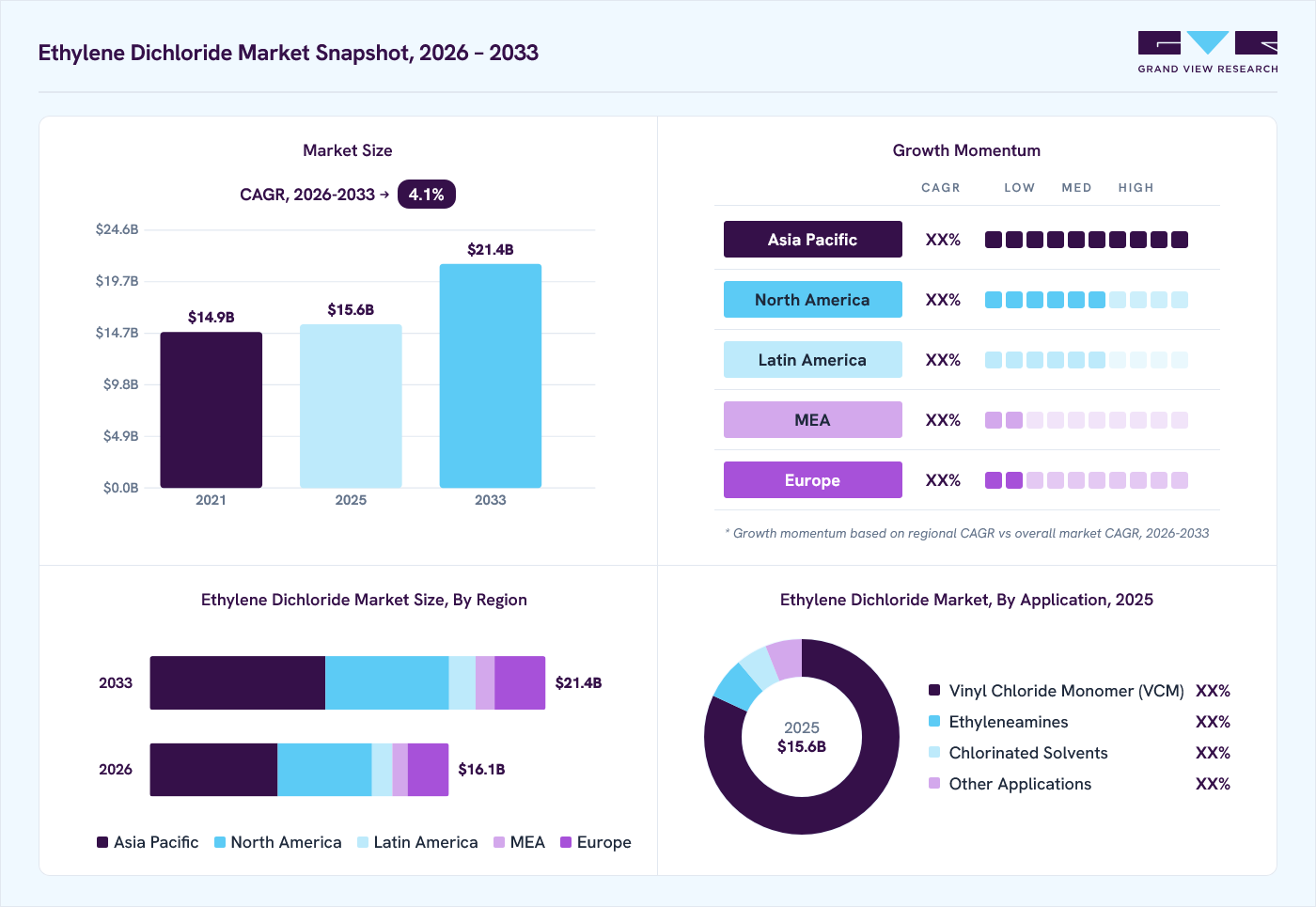
The global ethylene dichloride market size was valued at USD 15.6 billion in 2025 and is projected to grow from USD 16.1 billion in 2026 to USD 21.4 billion in 2033, at a CAGR of 4.1% from 2026 to 2033. Asia Pacific dominated the market, accounting for the largest revenue share of 42.8% in 2025. Market growth is driven by rising demand for ethylene dichloride as a key feedstock for vinyl chloride monomer (VCM) production, along with increasing consumption across chlorinated solvents and ethyleneamine applications.
 Source: Grand View Research, IR Documents, Primary Interviews, Paid DatabasesTo learn more about this report,
 Download Free Sample Report
 Key Market Trends & Insights
- By grade: The industrial grade dominated the market, capturing a 91.3% revenue share in 2025.
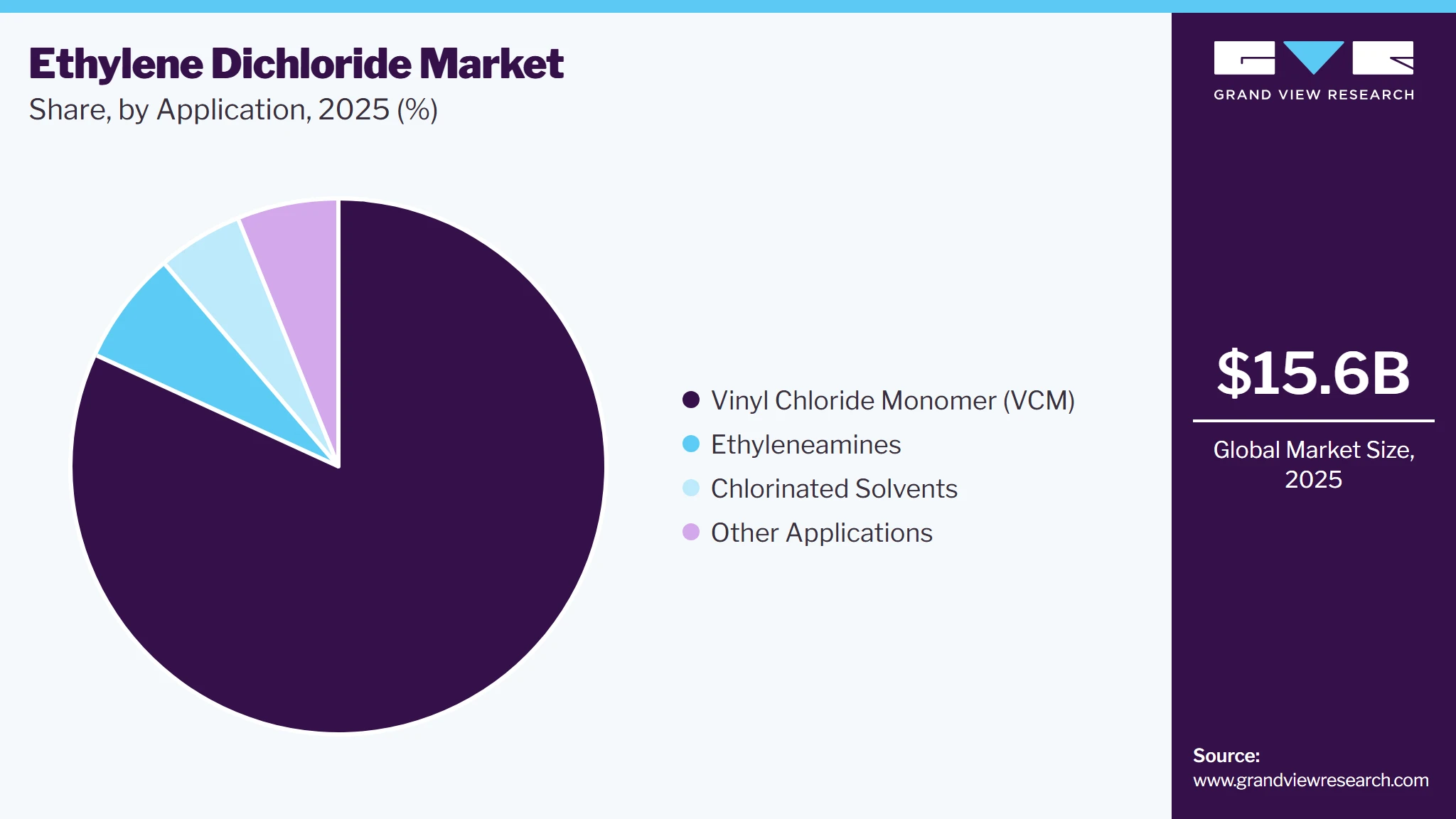
- By application: The vinyl chloride monomer (VCM) accounted for the largest share, representing 81.8% of market revenue in 2025.
Regional Highlights
- Largest region: Asia Pacific (42.8% revenue share, 2025)
- By country: India held the largest market share in 2025.
Market Size & Forecast
- Market size in 2025: USD 15.6 Billion
- Estimated market size in 2026: USD 16.1 Billion
- Projected market size by 2033: USD 21.4 Billion
- CAGR (2026-2033): 4.1%
Three ways to get this report
Buy it, customize it, or ask a question.Ask an Analyst
Analyst response in 1 business day
- AccessReport author, directly
- Reply timeWithin 1 working day
- No sales callDirect answer only
- FormatEmail reply
- CostFree, no cost
Get the Full Report
What the study covers
- FormatsPDF · Excel · Dashboard
- Timeline2026–2033 annual, 2025 base
- Coverage20+ countries, 5 regions
- Companies10+ key players profiled
Customize the Report
20% free customization
- IncludeCountries, segments, points
- TailorTo your product definition
- ExtendDeeper competitor detail
- OrA fully bespoke study
- Turnaround5–10 working days
The expansion is supported by continued PVC demand in construction and infrastructure, growing industrial chemical production, ongoing capacity development, and downstream integration across major markets. Rising investments in PVC production capacity and growing demand for chlorine-based intermediates are supporting the use of ethylene dichloride across downstream chemical industries. Applications in vinyl chloride monomer, ethyleneamines, chlorinated solvents, and other chemical processes are gaining traction as producers seek reliable feedstock availability, efficient integrated manufacturing, and consistent supply for expanding downstream operations.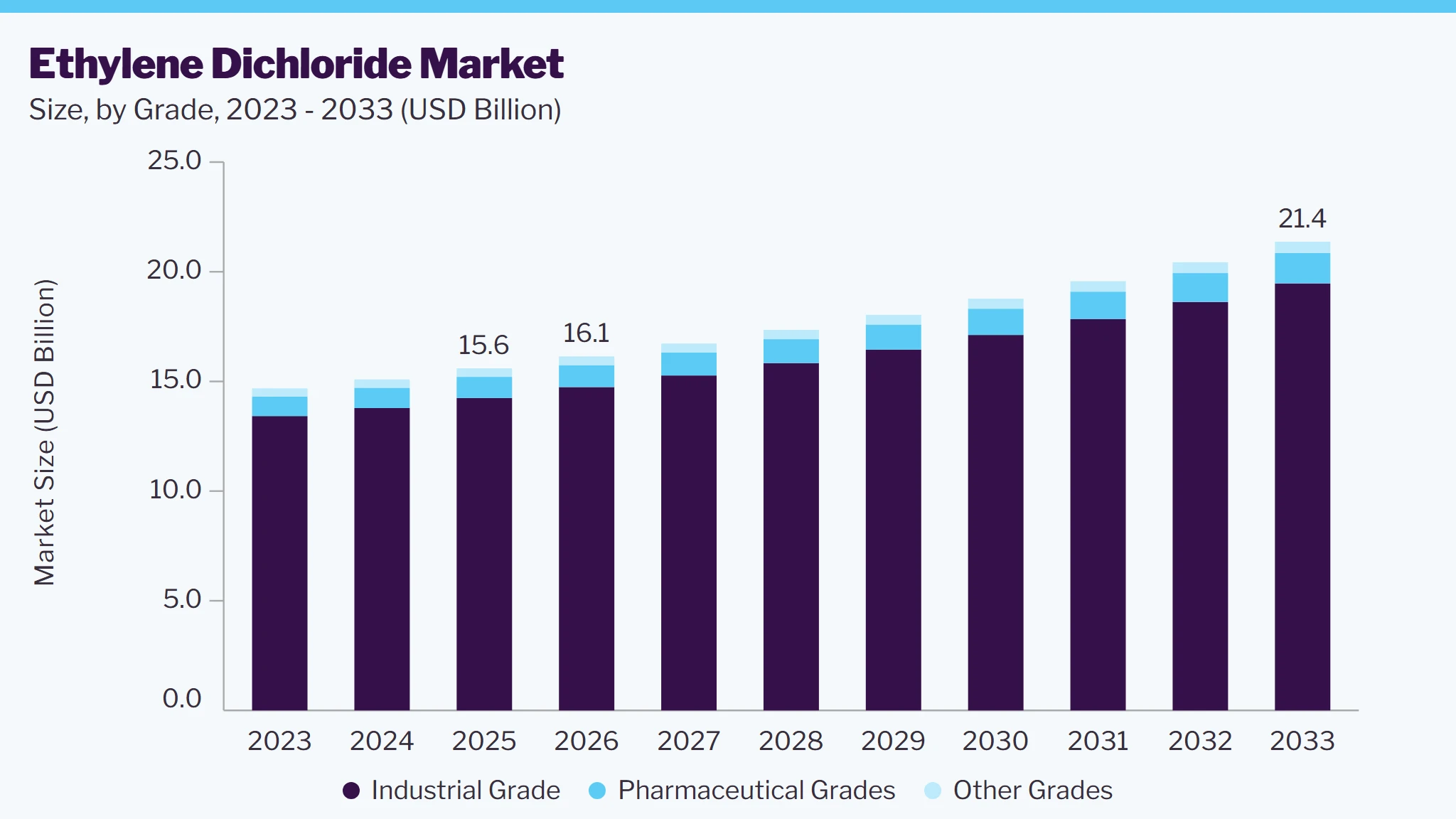 To learn more about this report, Download Free Sample Report
 Market Dynamics
The market is supported by sustained demand for vinyl chloride monomer (VCM), PVC production, and other chlorine-based chemical intermediates across industrial applications. Growing PVC consumption in construction and infrastructure, continued requirements for ethyleneamines and chlorinated solvents, and investments in integrated chlor-alkali and petrochemical facilities are supporting EDC consumption. Improvements in production efficiency, feedstock integration, process optimization, and capacity utilization are strengthening supply capabilities and enabling producers to serve diverse downstream requirements.
The increasing consumption of PVC across construction, infrastructure, electrical, packaging, automotive, and industrial applications is a primary factor supporting the market. EDC is predominantly converted into VCM, making the performance of downstream PVC production an important factor influencing market demand. Rising requirements for pipes, profiles, cables, flooring, membranes, and other PVC products are supporting VCM production and, consequently, EDC consumption across major manufacturing regions. In addition, investments in housing, urban infrastructure, water management systems, and industrial facilities are expanding the application base for PVC and strengthening demand for EDC-derived products.
In response to rising downstream requirements, producers are increasing investments in integrated EDC and VCM manufacturing facilities, production capacity, feedstock management, and process efficiency. Companies are strengthening integration between ethylene, chlorine, EDC, VCM, and PVC operations to improve raw material availability, optimize production economics, and maintain consistent downstream supply.
The capital-intensive nature of EDC production represents a significant market restraint. Manufacturing EDC at commercial scale requires substantial investment in chlorination or oxychlorination facilities, feedstock infrastructure, VCM integration, process equipment, environmental controls, and safety systems. Producers must maintain efficient handling of chlorine, ethylene, and other process streams while ensuring reliable plant operation, product quality, and compliance with stringent industrial and environmental requirements, increasing the complexity of facility development and ongoing production management.
The technical requirements associated with EDC manufacturing also vary according to production routes, feedstock availability, plant configuration, and downstream integration. Manufacturers must invest in process optimization, equipment maintenance, emissions management, energy efficiency, safety systems, and technical expertise to achieve consistent production performance. These capital and operating requirements can create challenges for smaller or less-integrated producers, potentially limiting new capacity additions and slowing market expansion in regions where feedstock infrastructure and downstream VCM or PVC facilities are less developed.
The increasing investment in PVC manufacturing, chemical infrastructure, and integrated petrochemical facilities presents a significant opportunity for companies operating in the market. Producers are increasingly developing integrated facilities that connect ethylene, chlorine, EDC, VCM, and PVC production to improve feedstock security, production efficiency, and downstream supply reliability. Capacity additions across construction-related PVC applications, chemical intermediates, and other downstream markets are creating opportunities for EDC producers to expand their customer base and strengthen their presence across major regions.
At the same time, advancements in EDC production processes, oxychlorination technology, energy management, process automation, and integrated manufacturing are enabling producers to improve operating efficiency and resource utilization. The development of strategically integrated production networks supports greater flexibility in feedstock sourcing and downstream product manufacturing while improving supply coordination across regional markets.
Market Concentration & Characteristics
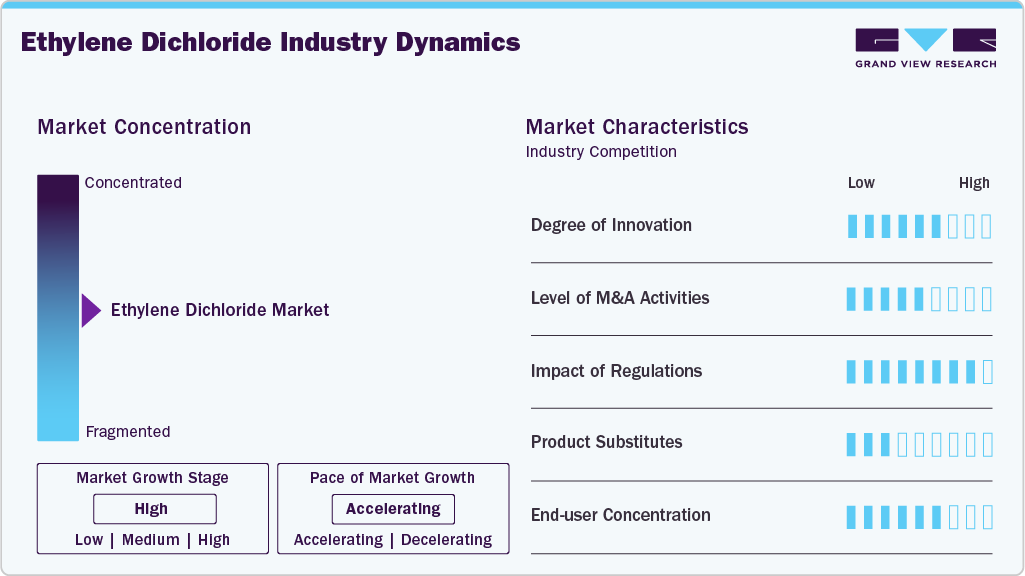
The global ethylene dichloride industry is moderately consolidated, with competition centered on production capacity, feedstock integration, manufacturing efficiency, product quality, supply reliability, downstream VCM integration, and long-term relationships with industrial customers. Leading companies are expanding and optimizing EDC production capabilities to address requirements across VCM, PVC, ethyleneamines, chlorinated solvents, and other downstream applications. Investments in integrated manufacturing, process optimization, capacity expansion, energy efficiency, supply chain management, and technical capabilities have become key competitive differentiators.
 To learn more about this report, Download Free Sample Report
 Participants are also strengthening their position through strategic acquisitions, capacity expansions, integrated production investments, and development of regional manufacturing and distribution capabilities. Companies are increasingly working with downstream customers to align EDC supply with VCM, PVC, ethyleneamines, chlorinated solvents, and other chemical production requirements. In addition, investments in process optimization, plant automation, energy efficiency, production capacity, supply chain management, and technical capabilities are enabling EDC producers to differentiate their operations while maintaining a reliable supply and meeting evolving downstream demand.
Analyst Perspective
The market is closely linked to the performance of downstream VCM and PVC industries, with continued investments in construction, infrastructure, and chemical manufacturing supporting consumption. Growing demand for PVC products, integrated production capabilities, reliable feedstock supply, and improved manufacturing efficiency are encouraging producers to strengthen EDC capacity and process integration. Advances in production technologies, plant automation, energy management, and integrated chlor-alkali and petrochemical operations are improving operational efficiency and supporting broader market development.
Grade Insights
Industrial grade held the largest revenue share of 91.3% in 2025. Its extensive use in VCM production and other large-scale chemical processes supports the segment's market position, while strong integration with chlor-alkali, petrochemical, and PVC manufacturing networks continues to sustain demand. Established production infrastructure, high-volume consumption, and its role as a key intermediate for downstream chemical manufacturing further reinforce the prominence of industrial-grade EDC.
Pharmaceutical grade remained the fastest growing segment, projected to grow at a CAGR of 4.8% from 2026 to 2033. Growth is supported by increasing requirements for high-purity chemical intermediates and stringent quality specifications across pharmaceutical and specialty chemical manufacturing. Greater emphasis on purity, process consistency, quality control, and specialized production standards is encouraging suppliers to strengthen pharmaceutical-grade capabilities, while expanding pharmaceutical manufacturing activity is further supporting segment development.
Application Insights
Vinyl chloride monomer (VCM) accounted for the dominant revenue share of 81.8% of the total market in 2025, supported by EDC's central role as the primary feedstock for VCM and downstream PVC production. Strong PVC consumption across construction, infrastructure, electrical, packaging, and industrial applications continues to sustain EDC requirements for VCM manufacturing. Expanding PVC production capacity, integrated ethylene and chlorine supply chains, and investments in downstream chemical facilities are further reinforcing the importance of VCM within the EDC market.
 To learn more about this report, Download Free Sample Report
 Chlorinated solvents are projected to grow at a CAGR of 4.2% from 2026 to 2033. Growth is supported by their use across industrial cleaning, chemical processing, metal treatment, and other specialized applications requiring chlorine-based solvents. Continued demand for solvent-based processing and investments in industrial manufacturing are supporting consumption, while evolving formulation requirements and greater emphasis on process efficiency are creating opportunities for suppliers serving chlorinated solvent production.
Regional Insights
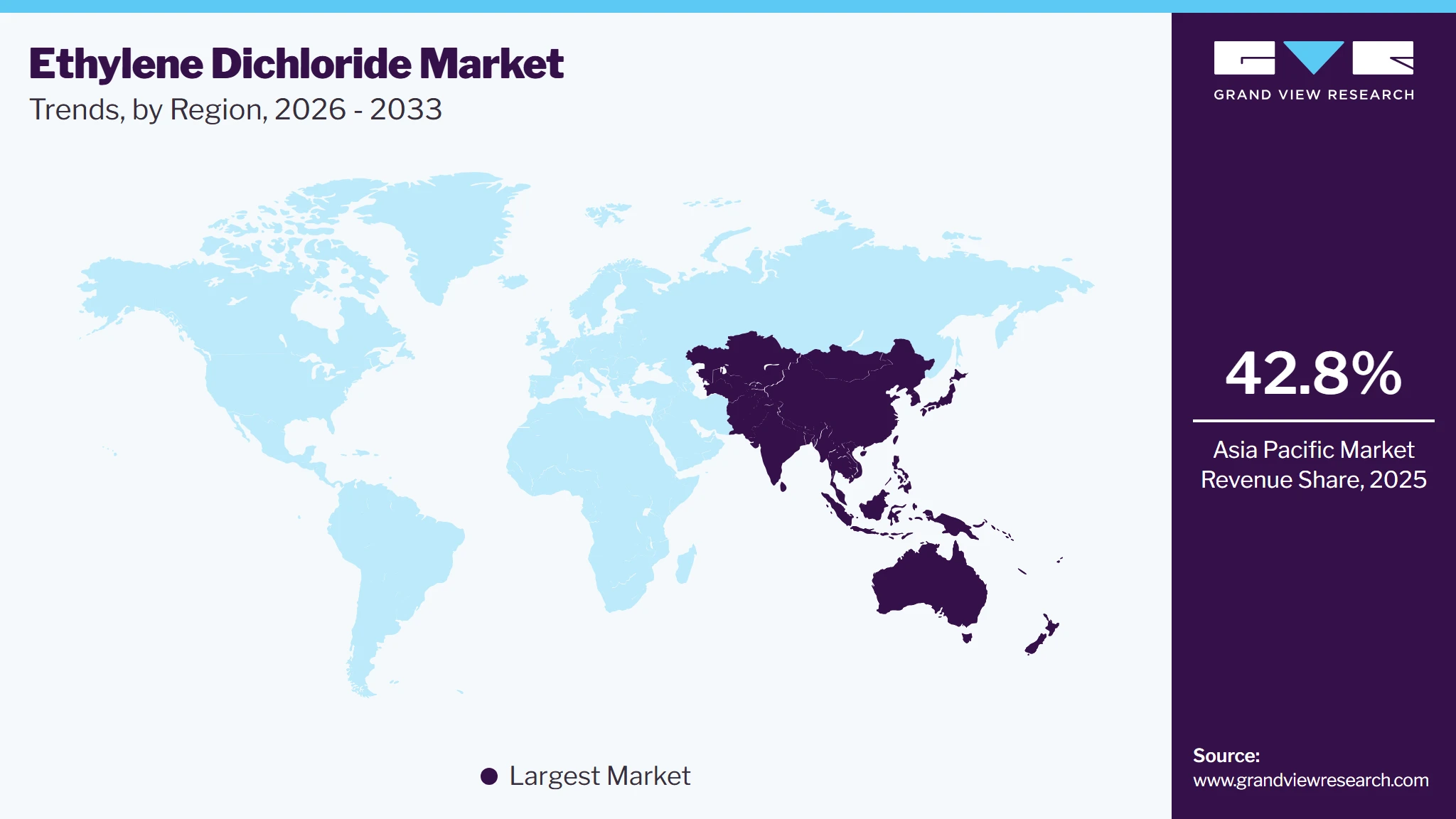
The Asia Pacific ethylene dichloride market accounted for the largest revenue share of 42.8% in 2025, supported by expanding PVC production, petrochemical capacity, industrial manufacturing, and infrastructure development across the region. The region represents a significant market due to its large chemical manufacturing base, growing construction activity, increasing downstream PVC consumption, and investments in integrated ethylene, chlorine, EDC, and VCM facilities. Rising requirements for EDC in VCM production, ethyleneamines, and chlorinated solvents are supporting regional consumption. China dominates the Asia Pacific market, supported by its extensive chemical manufacturing infrastructure, substantial PVC production capacity, and integrated petrochemical industry.
 To learn more about this report, Download Free Sample Report
 China Ethylene Dichloride Market Trends
The ethylene dichloride market in China represents the leading market within the Asia Pacific landscape, supported by its extensive chemical manufacturing base, substantial PVC production capacity, and continued investments in petrochemical infrastructure. Growing requirements for PVC across construction, infrastructure, electrical, and industrial applications are sustaining demand for VCM and, consequently, EDC. Increasing investments in integrated ethylene, chlorine, EDC, and VCM production, together with capacity expansion across downstream chemical industries, are further supporting market development in China.
North America Ethylene Dichloride Market Trends
The ethylene dichloride market in North America accounted for a revenue share of 31.5% in 2025, supported by established petrochemical infrastructure, integrated chlor-alkali operations, and significant PVC and VCM production capacity. The region represents a mature market with strong integration across ethylene, chlorine, EDC, VCM, and downstream PVC manufacturing. Continued investments in production efficiency, plant modernization, capacity optimization, and downstream chemical facilities are supporting EDC consumption across major industrial applications.
The U.S. ethylene dichloride market represents a leading market within North America, supported by extensive petrochemical infrastructure, integrated production networks, and established VCM and PVC manufacturing capabilities. Strong demand for PVC across construction, infrastructure, electrical, packaging, and industrial applications continues to support EDC consumption. Investments in production capacity, process efficiency, feedstock integration, and modernization of chemical manufacturing facilities are further contributing to market development in the U.S.
Europe Ethylene Dichloride Market Trends
The ethylene dichloride market in Europe accounted for a revenue share of 13.8% in 2025 and is supported by established chemical manufacturing infrastructure, downstream PVC production, and integrated petrochemical operations. The region represents a mature market characterized by stringent environmental requirements, process efficiency initiatives, and investments in modernizing chemical production facilities. Demand for EDC across VCM manufacturing and other downstream chemical applications, together with efforts to improve energy efficiency and optimize production processes, is supporting regional market development.
Latin America Ethylene Dichloride Market Trends
The ethylene dichloride market in Latin America accounted for a revenue share of 6.8% in 2025, supported by expanding chemical manufacturing, construction activity, infrastructure development, and downstream PVC consumption. Growing requirements for PVC products across pipes, cables, construction materials, and industrial applications are supporting VCM production and EDC consumption. Investments in petrochemical infrastructure, production capacity, and downstream chemical facilities are creating additional opportunities for EDC suppliers across the region.
Middle East & Africa Ethylene Dichloride Market Trends
The ethylene dichloride market in MEA accounted for a revenue share of 5.1% in 2025 and is projected to grow at a CAGR of 3.2% from 2026 to 2033. Market development is supported by investments in petrochemical facilities, industrial infrastructure, construction, and downstream chemical manufacturing. Increasing integration of ethylene and chlorine feedstocks, expansion of PVC-related production, and development of new chemical manufacturing capacity are supporting EDC consumption. Investments in petrochemical integration and downstream processing are expected to strengthen regional market opportunities.
Key Ethylene Dichloride Company Insights
Companies operating in the market are adopting strategies centered on capacity expansion, production integration, process optimization, strategic partnerships, and regional business expansion to strengthen their competitive position. Leading chemical producers are enhancing EDC, VCM, and PVC manufacturing capabilities while investing in integrated ethylene and chlorine feedstock networks to address requirements across construction, infrastructure, chemical manufacturing, and other downstream applications.
-
Dow Inc. is a major global chemical producer with integrated capabilities across ethylene, chlorine, EDC, VCM, and downstream materials. The company focuses on optimizing production efficiency, strengthening feedstock integration, and maintaining a reliable supply across its downstream value chain. Its extensive manufacturing footprint, integrated operations, and broad customer base support its position in the market.
-
Westlake Corporation is a major chemical and materials producer with integrated chlor-alkali, EDC, VCM, and PVC manufacturing capabilities. The company focuses on expanding production efficiency, strengthening vertical integration, and supporting reliable supply across downstream applications. Its established manufacturing infrastructure, integrated feedstock network, and PVC-related operations enable Westlake to serve diverse customer requirements and maintain a strong position in the market.
Key Ethylene Dichloride Companies
The following key companies have been profiled for the study on the ethylene dichloride market.
-
Dow Inc.
-
Westlake Corporation
-
Formosa Plastics Corporation
-
Olin Corporation
-
Occidental Chemical Corporation (OxyChem)
-
Shin-Etsu Chemical Co., Ltd.
-
INEOS
-
Reliance Industries Limited
-
SABIC
-
LG Chem Ltd.
Competitive Benchmarking
Operating Strategies
Competitive Edge
Weaknesses
Mature Players: Dow Inc.; Westlake Corporation; Formosa Plastics Corporation; Olin Corporation; Occidental Chemical Corporation (OxyChem); Shin-Etsu Chemical Co., Ltd.
- Invest in EDC, VCM, and PVC capacity expansion, plant modernization, process optimization, and integrated feedstock infrastructure.
- Strengthen vertical integration across ethylene, chlorine, EDC, VCM, and downstream PVC operations to improve production efficiency and supply reliability.
- Expand strategic partnerships and regional manufacturing capabilities while optimizing production networks to serve diverse downstream chemical requirements.
- Extensive EDC and VCM production capabilities supported by integrated petrochemical and chlor-alkali operations.
- Established manufacturing infrastructure, large-scale production capacity, and strong downstream integration provide reliable supply and operational efficiency.
- Broad geographic presence, established customer relationships, and technical expertise reinforce their competitive position across major EDC-consuming markets.
- Large integrated production networks require significant capital expenditure for maintenance, modernization, and capacity expansion.
- Exposure to fluctuations in ethylene, chlorine, energy, and other feedstock costs can affect production economics.
- Mature operations in developed markets can face stringent environmental requirements and higher compliance and operating costs.
Emerging Players: INEOS; Reliance Industries Limited; SABIC; LG Chem Ltd.
- Expand regional petrochemical and chlor-alkali capabilities while increasing integration across EDC, VCM, PVC, and related chemical value chains.
- Invest in new production capacity, process efficiency, downstream integration, and strategic partnerships to strengthen regional market presence.
- Develop integrated manufacturing networks and diversify downstream applications to improve feedstock utilization and capture growth in developing markets.
- Growing petrochemical infrastructure and expanding production capabilities provide opportunities to strengthen EDC and downstream chemical operations.
- Strong access to regional feedstocks and integrated chemical manufacturing supports cost efficiency and supply-chain flexibility.
- Investments in capacity expansion, technology upgrades, and downstream integration provide potential to increase market penetration across high-growth regions.
- Comparatively smaller or less established EDC market presence in some regions than leading mature producers.
- Expansion into new markets and large-scale integrated facilities requires substantial capital investment and technical capabilities.
- Dependence on successful capacity ramp-ups, downstream integration, and regional demand growth can create execution and market penetration challenges.
Recent Developments
- In August 2026, INEOS Inovyn agreed to acquire the UK's only ethylene dichloride asset from administration, including the remaining 50% stake in Runcorn MCP Limited. The acquisition is expected to strengthen local EDC production and secure continuity of strategically important chlor-alkali operations. By reinforcing regional supply capabilities and downstream chemical integration, the transaction is expected to support market stability and long-term EDC demand in the UK.
Ethylene Dichloride Market Report Scope
Report Attribute
Details
Market size in 2025
USD 15.6 billion
Estimated market size in 2026
USD 16.1 billion
Projected market size by 2033
USD 21.4 billion
Growth rate
CAGR of 4.1% from 2026 to 2033
Historical data
2021 - 2025
Forecast period
2026 - 2033
Quantitative units
Volume in kilotons, revenue in USD billion and CAGR from 2026 to 2033
Report coverage
Revenue forecast, volume forecast, company ranking, competitive landscape, growth factors, and trends
Segments covered
Grade, application, region
Regional scope
North America; Europe; Asia Pacific; Latin America; MEA
Country scope
U.S.; Canada; Mexico; Germany; UK; France; Italy; Spain; China; India; Japan; South Korea; Brazil; Argentina; Saudi Arabia; South Africa
Key companies profiled
Dow Inc.; Westlake Corporation; Formosa Plastics Corporation; Olin Corporation; Occidental Chemical Corporation (OxyChem); Shin-Etsu Chemical Co., Ltd.; INEOS; Reliance Industries Limited; SABIC; LG Chem Ltd.
Customization scope
Free report customization (equivalent up to 8 analysts’ working days) with purchase. Addition or alteration to country, regional & segment scope.
Pricing and purchase options
Avail customized purchase options to meet your exact research needs. Explore purchase options
Global Ethylene Dichloride Market Report Segmentation
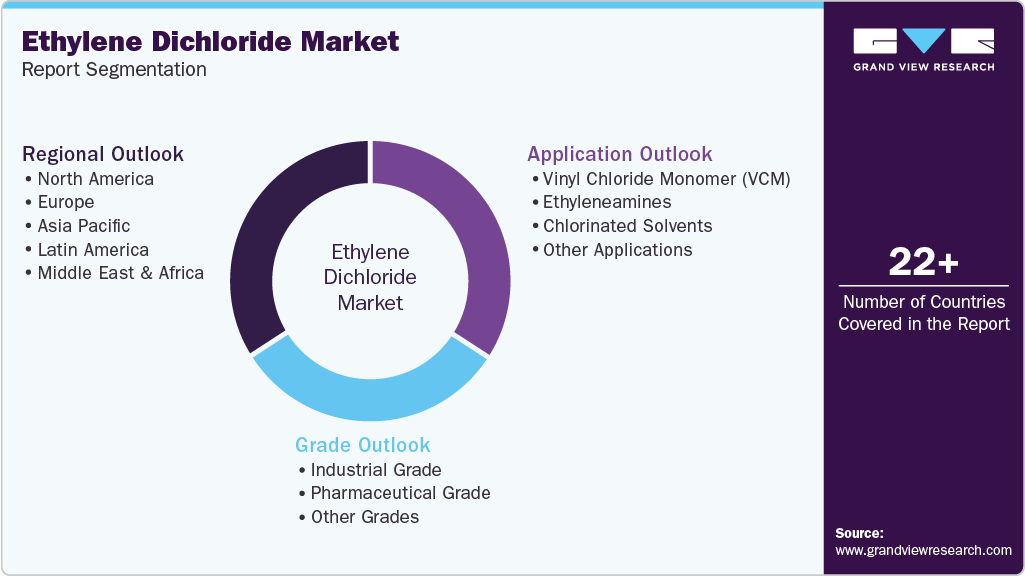
This report forecasts volume & revenue growth at regional, and country levels and provides an analysis of the latest industry trends in each of the sub-segments from 2021 to 2033. For this study, Grand View Research has segmented the global ethylene dichloride market report based on grade, application and region:
 To learn more about this report, Download Free Sample Report
 -
Grade Outlook (Revenue, USD Billion; Volume, Kilotons, 2021 - 2033)
-
Industrial Grade
-
Pharmaceutical Grade
-
Other Grades
-
-
Application Outlook (Revenue, USD Billion; Volume, Kilotons, 2021 - 2033)
-
Vinyl Chloride Monomer (VCM)
-
Ethyleneamines
-
Chlorinated Solvents
-
Other Applications
-
-
Region Outlook (Revenue, USD Billion; Volume, Kilotons, 2021 - 2033)
-
North America
-
U.S.
-
Canada
-
Mexico
-
-
Europe
-
Germany
-
UK
-
France
-
Italy
-
Spain
-
-
Asia Pacific
-
China
-
India
-
Japan
-
South Korea
-
-
Latin America
-
Brazil
-
Argentina
-
-
Middle East & Africa
-
Saudi Arabia
-
South Africa
-
-
Research Methodology
The ethylene dichloride market figures in this report are based on a proven research process that combines executive interviews with secondary research from proprietary databases, company filings, and recognized regulatory and institutional sources. Market size is built through value-chain sizing-reconciling supply-side and demand-side estimates-and triangulated with bottom-up and top-down approaches. Every estimate passes multiple levels of expert validation before publication, with each ethylene dichloride segment quantified using the revenue-capture definitions in the table below.
Segment Definition
Segment - Grade
Revenue capture definition
Industrial Grade
Market value is generated through industrial-grade ethylene dichloride used primarily as a feedstock for vinyl chloride monomer (VCM) production and other large-scale chemical processes. Its extensive use across integrated petrochemical and PVC manufacturing operations supports the majority of market revenue.
Pharmaceutical Grade
Revenue is generated through high-purity ethylene dichloride grades meeting stringent quality and specification requirements for pharmaceutical and specialty chemical applications. Demand is supported by requirements for consistent purity, controlled production processes, and reliable chemical intermediates across specialized manufacturing operations.
Other Grades
Market value is generated through ethylene dichloride grades used in applications outside industrial and pharmaceutical grades. These products serve specialized chemical processing requirements where specific purity, quality, or performance characteristics are required across niche downstream applications.
Segment - Application
Revenue capture definition
Vinyl Chloride Monomer (VCM)
Market value is generated through the use of ethylene dichloride as the primary feedstock for VCM production, which is subsequently used to manufacture PVC. Extensive PVC consumption across construction, infrastructure, electrical, packaging, and industrial applications supports EDC demand within this application.
Ethyleneamines
Revenue is generated through the utilization of ethylene dichloride as a chemical intermediate in ethyleneamine production. Demand is supported by applications for ethyleneamines across agrochemicals, surfactants, pharmaceuticals, water treatment, and other industrial chemical processes.
Chlorinated Solvents
Market value is created through the utilization of ethylene dichloride in the production of chlorinated solvents used across industrial cleaning, chemical processing, metal treatment, and other specialized applications. Continued requirements for chlorine-based solvents and chemical intermediates support demand within this application.
Other Applications
Revenue is generated through the utilization of ethylene dichloride across downstream applications outside VCM, ethyleneamines, and chlorinated solvents. Specialized chemical processing and the use of EDC as an intermediate across diversified industrial applications contribute to market value within this category.
Estimation Model
Layer Name
Key Question
Description
Grade Layer
What grades of ethylene dichloride are supplied?
Identify the production, commercial availability, and consumption of industrial-grade, pharmaceutical-grade, and other grades of ethylene dichloride across global markets. The assessment considers grade specifications, purity requirements, production capabilities, quality standards, supplier capacity, and downstream application requirements to determine grade-wise market value.
Application Layer
Where is ethylene dichloride utilized?
Assess the utilization of ethylene dichloride across vinyl chloride monomer (VCM), ethyleneamines, chlorinated solvents, and other applications. The assessment considers downstream production volumes, EDC consumption intensity, feedstock requirements, plant capacity, operating rates, production integration, and application-specific demand to estimate annual consumption across global markets.
Downstream Demand Layer
What factors influence EDC consumption?
Analyze downstream demand across PVC, construction, infrastructure, chemical manufacturing, pharmaceutical, industrial, and other relevant industries. The assessment considers PVC production, VCM capacity, chemical manufacturing activity, plant expansions, capacity utilization, infrastructure investments, downstream production trends, and regional industrial development to determine EDC consumption requirements.
Revenue Layer
How is market revenue generated?
Market revenue is generated through the production, distribution, and commercial sale of ethylene dichloride across global markets. Revenue estimation considers annual EDC consumption, prevailing market prices, grade and application mix, regional pricing variations, production capacity, supply-demand conditions, and downstream market requirements to determine total market value.
Delivered Customizations
This report has been delivered with the following In-depth customizations
Client Request
Customization Delivered
Value Adds
Regional segmentation
The assessment includes country-level market size and forecasts; demand patterns by grade and application; consumption trends across industrial grade, pharmaceutical grades, and other grades; VCM, ethyleneamines, chlorinated solvents, and other applications; downstream PVC demand; EDC and VCM production capacity; plant utilization; feedstock availability; capacity expansions; production integration; regulatory developments; and investment opportunities shaping the ethylene dichloride industry across each country.
Supports market entry planning, competitor evaluation, and expansion strategy development by providing visibility into EDC consumption patterns, downstream demand, production capabilities, and regional market dynamics. Helps identify high-growth markets while improving resource allocation, capacity planning, partnership decisions, supply strategies, and long-term investment planning.
Opportunity Assessment
Detailed evaluation of emerging growth opportunities across industrial grade, pharmaceutical grades, and other EDC grades, along with VCM, ethyleneamines, chlorinated solvents, and other applications. The assessment covers increasing PVC consumption, new VCM and EDC capacity, integrated petrochemical investments, downstream chemical production, process optimization, and expanding applications across construction, infrastructure, chemical manufacturing, pharmaceutical, and other industrial sectors.
Enables prioritization of high-growth grade, application, and downstream segments while identifying investment opportunities across the global ethylene dichloride value chain. Supports capacity expansion, production optimization, strategic partnerships, market development, and commercialization initiatives through insights into evolving downstream requirements, production trends, and long-term market demand.
Competitive Benchmarking
Comparative assessment of leading global ethylene dichloride producers based on EDC and VCM production capacity, product portfolio, geographic presence, downstream integration, feedstock access, manufacturing footprint, customer base, strategic partnerships, research and development capabilities, capacity expansion initiatives, and operating strategies. The benchmarking also evaluates capabilities across industrial and pharmaceutical grades, VCM, ethyleneamines, chlorinated solvents, and other applications.
Supports benchmarking against key competitors while identifying gaps in production capacity, downstream integration, geographic coverage, manufacturing capabilities, application exposure, and market reach. Enables informed decision-making related to capacity investments, strategic partnerships, supply agreements, production expansion, market entry, customer targeting, and long-term competitive positioning within the global ethylene dichloride industry.
About the Author(s)
Organic Chemicals Research Team
Bulk Chemicals · Organic ChemicalsThis report was authored by the organic chemicals research team at Grand View Research - comprising two research analysts, one senior research analyst, and one industry expert - with specialized expertise in the organic chemicals segment of the bulk chemicals industry. All findings are based on proprietary bulk chemicals databases, executive interviews, and regulatory analysis, subject to internal peer review prior to publication.
Last Updated:
Speak to Analyst

Customize this report to your needs - add regions, segments, or data points, with 20% free customization.
Or view our licence options:


ISO 9001:2015 & 27001:2022 Certified
We are GDPR and CCPA compliant! Your transaction & personal information is safe and secure. For more details, please read our privacy policy.


