
- Home
- »
- Advanced Interior Materials
- »
-
Europe Agricultural Tying Equipment Market Report, 2033GVR Report cover

Europe Agricultural Tying Equipment Market (2026 - 2033)
Size, Share & Trends Analysis Report, By Type (Tying Tools/ Tapeners, Clipping Tools), By Operation (Manual, Battery Operated), By Crop (Tomato, Bell Pepper), By Country, And Segment Forecasts
Market Size, 2025
$7.1MMarket Estimate, 2026
$7.5MMarket Forecast, 2033
$11.6MCAGR, 2026–2033
6.3%Europe Agricultural Tying Equipment Market Summary
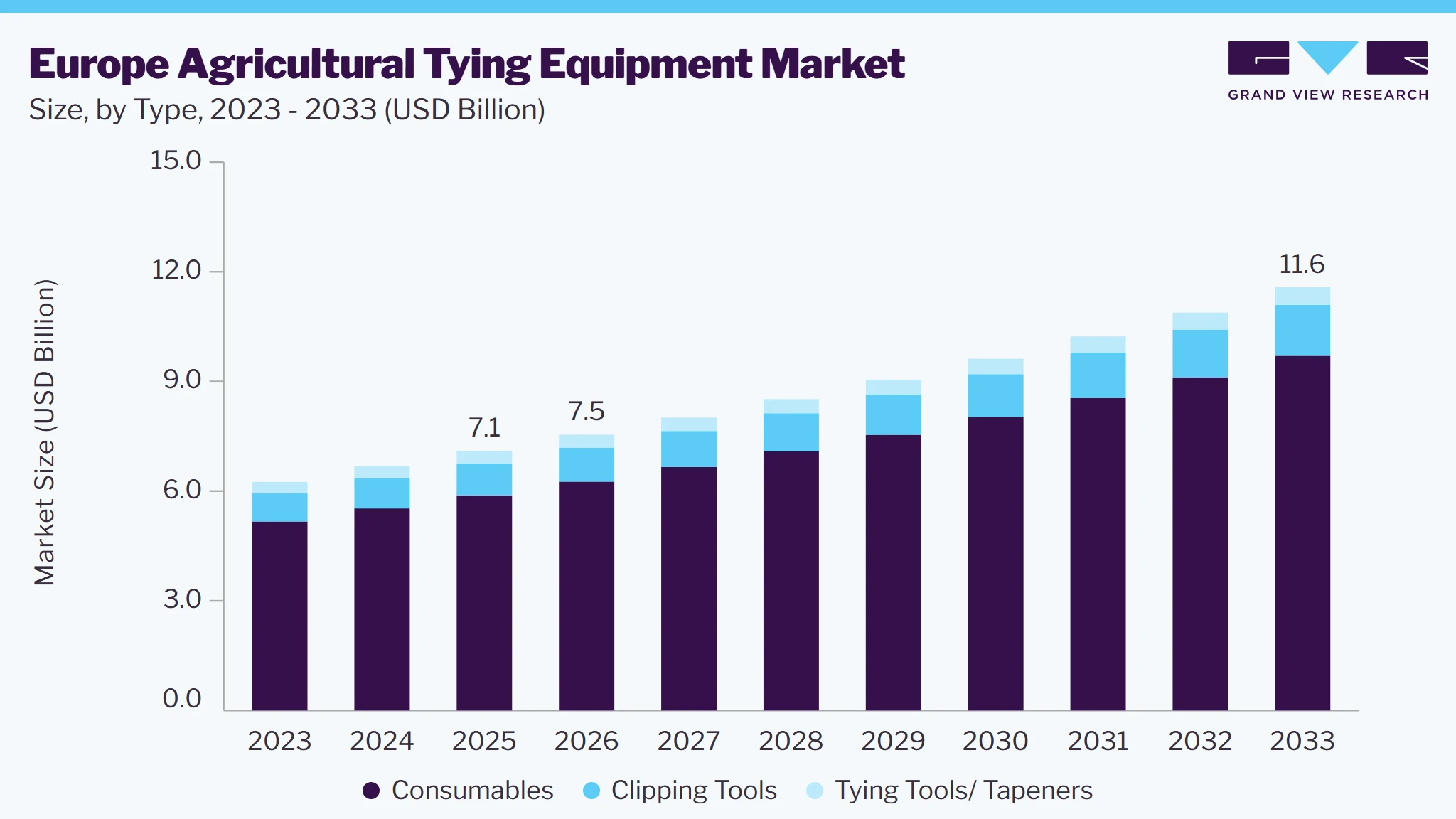
The Europe agricultural tying equipment market size was valued at USD 7.1 million in 2025 and is projected to grow from USD 7.5 million in 2026 to USD 11.6 million by 2033, at a CAGR of 6.3% from 2026 to 2033. Netherland dominated the market with the largest revenue share of 18.3% in 2025. Growth is driven by increasing mechanization in greenhouse and high-value crop cultivation, labor shortages, and rising adoption of battery-powered tying tools that improve productivity and reduce dependence on manual labor. Expanding protected cultivation and the need for faster, more consistent crop-support operations are also expected to support market growth.
Key Market Trends & Insights
- Based on type: Clipping tools segment is projected to grow at a CAGR of 5.9% over the forecast period.
- On the basis of crop: Tomato segment accounted for the largest revenue share in 2025, representing 58.4% of total market revenue.
- By operation: Manual segment is expected to register a CAGR of 3.9% over the forecast period.
Market Size & Forecast
- Market Size in 2025: USD 7.1 Million
- Estimated Market Size in 2026: USD 7.5 Million
- Projected Market Size by 2033: USD 11.6 Million
- CAGR (2026-2033): 6.3%
Three ways to get this report
Buy it, customize it, or ask a question.Ask an Analyst
A direct answer, usually in 1 working day
- AccessReport author, directly
- Reply timeWithin 1 working day
- No sales callDirect answer only
- FormatEmail reply
- CostFree, no cost
Get the Full Report
What the study covers
- FormatsPDF · Excel · Dashboard
- Timeline2026–2033 annual, 2025 base
- Coverage20+ countries, 5 regions
- Companies10+ key players profiled
Customize the Report
20% free customization
- IncludeCountries, segments, points
- TailorTo your product definition
- ExtendDeeper competitor detail
- OrA fully bespoke study
- Turnaround5–10 working days
 Source: Grand View Research, IR Documents, Primary Interviews, Paid DatabasesTo learn more about this report,
 Download Free Sample Report
 The market is benefiting from the increasing use of agricultural tying equipment in vineyards, nurseries, orchards, and vegetable cultivation, where timely and consistent plant support is important for crop management. Growing emphasis on reducing crop damage during tying, improving worker ergonomics, and maintaining uniform tying practices is encouraging growers to adopt specialized equipment.
Market Dynamics
The Europe agricultural tying equipment market is shaped by the shift toward mechanized and battery-operated tying solutions, as growers seek to reduce manual labor requirements and improve consistency in repetitive crop-support activities. Product development is increasingly focused on lightweight equipment, ergonomic handling, longer battery operating times, and compatibility with different tying materials. Market conditions are also influenced by machinery safety, worker protection, battery management, and environmental regulations, while fluctuations in the prices of metals, plastics, electronic components, and batteries affect manufacturing costs and supply conditions. Manufacturers are responding through compact equipment designs, crop-specific solutions, expanded spare-parts and maintenance offerings, and the use of durable materials suited to repeated agricultural operations.
Growing demand for faster, labor-efficient tying equipment is supporting the Europe agricultural tying equipment market as growers seek to reduce the time and manual effort required for crop-support and plant-training activities. Vegetable cultivation, greenhouse production, and nursery operations involve repeated tying tasks that require substantial labor when performed manually. Battery-operated tying tools and tapeners can complete individual tying operations more quickly, allowing workers to cover larger cultivated areas within available working periods. This is particularly relevant where farms face difficulties in maintaining sufficient seasonal agricultural labor.
Small and fragmented farm structures can restrain agricultural tying equipment adoption across parts of Europe, as limited cultivated areas and lower tying volumes may not justify the upfront cost of battery-operated tools, batteries, chargers, and consumables. Rising labor and farm input costs can further constrain investment in productivity-enhancing equipment, particularly among smaller growers. Consequently, mechanized tying solutions are likely to see stronger adoption among commercial greenhouse and intensive horticultural operations with higher tying frequency, while smaller farms may continue using manual or conventional tying methods.
Tying is a repetitive agricultural activity that can cause hand, wrist, shoulder, and back fatigue during prolonged manual operations, particularly when large numbers of plants require tying within short periods. This creates an opportunity for manufacturers to develop lightweight, ergonomically designed, and easy-to-operate equipment that reduces physical strain while maintaining tying consistency. Improvements in balanced tool design, comfortable grips, accessible controls, efficient tying mechanisms, and cordless battery operation can enhance handling and mobility, making mechanized tying more practical across field and protected cultivation. Such developments can also encourage adoption among smaller growers seeking compact equipment that is easy to transport, operate, and store, supporting the gradual shift from manual to mechanized tying practices.
Market Concentration & Characteristics
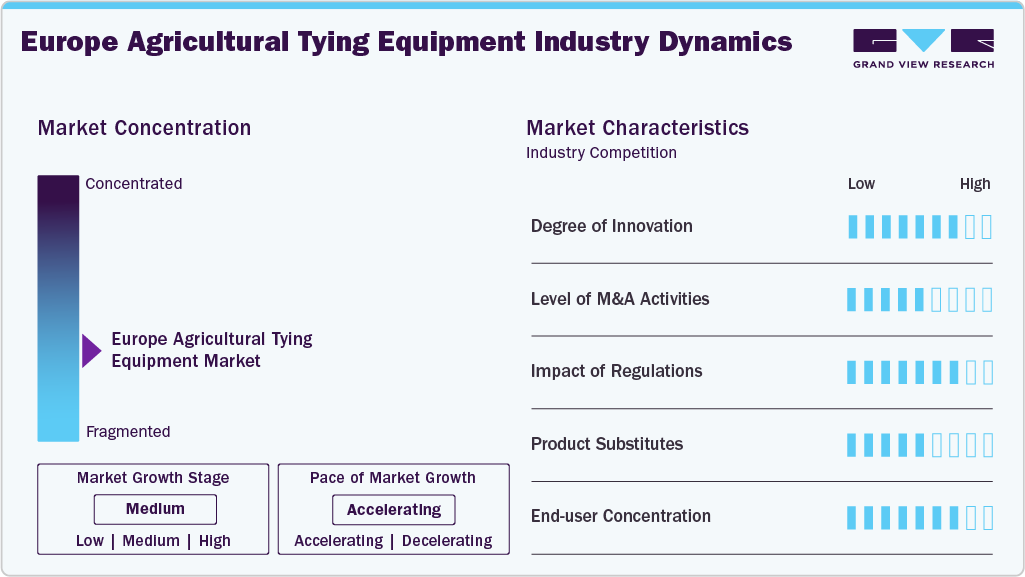
The Europe agricultural tying equipment market comprises a mix of established manufacturers, specialized agricultural tool companies, and regional suppliers. Competition varies across tying machines, fastening tools, tapes, staples, and related accessories, with manufacturers serving both professional growers and specialized horticultural operations. Established distribution networks and relationships with agricultural dealers contribute to market reach, while specialized suppliers compete through application-specific equipment and consumable offerings.
Product portfolios differ in terms of tying mechanism, power source, tool configuration, fastening material compatibility, and operating capacity. Battery-powered equipment represents an important area of product development, particularly for portable applications requiring repeated tying across cultivation areas. Manufacturers also differentiate through compatibility between tying tools and consumables, replacement component availability, and equipment suited to specific crop-support requirements.
 To learn more about this report, Download Free Sample Report
 Market characteristics are influenced by the structure of European horticulture, including commercial vineyards, orchards, nurseries, and protected cultivation operations. Purchasing decisions are shaped by equipment durability, handling requirements, maintenance needs, and the availability of technical and distribution support. The presence of both specialized local suppliers and broader agricultural equipment companies creates a competitive environment in which product specialization and established customer relationships remain important factors.
Analyst Perspective
The Europe agricultural tying equipment market is being shaped by the need for greater labor efficiency in commercial vegetable cultivation, where tying and clipping remain repetitive activities requiring considerable manual effort. The adoption of tying tools/tapeners and clipping tools provides growers with practical means of streamlining crop-support operations, while battery-operated equipment is expanding the scope for mechanized handling and reducing operator fatigue. Demand also remains closely linked to the cultivation of high-value vegetables and the increasing use of greenhouse and protected cultivation systems, where structured plant training is integral to crop management. Within this environment, manufacturers offering lightweight equipment, ergonomic designs, and compatible consumables are positioned to address operational requirements across different cultivation settings.
Type Insights
The consumables segment accounted for 82.9% of total revenue in the Europe agricultural tying equipment market in 2025. This position is primarily attributed to recurring demand for tying tapes, wires, twines, clips, and other fastening materials used in crop training and support activities. Unlike equipment, these materials require regular replacement or replenishment during cultivation cycles, creating a recurring revenue stream for suppliers. Their broad use across vineyards, orchards, nurseries, and protected cultivation systems is expected to sustain demand over the forecast period.
The clipping tools segment is expected to grow over the forecast period, supported by increasing adoption of reusable and purpose-built clipping devices for crop support applications. These tools enable growers to secure plant stems and shoots with greater consistency while reducing reliance on manual fastening practices. Demand is particularly relevant in greenhouse and high-value crop production, where frequent plant training and support activities require practical and repeatable fastening solutions.
Crop Insights
On the basis of crop, the tomato segment accounted for the largest revenue share of the Europe agricultural tying equipment market in 2025. The segment’s dominance is supported by Europe’s large tomato cultivation base and the widespread use of tying, clipping, and vertical training systems, particularly in greenhouse production. The high frequency of plant-support activities throughout the tomato growing cycle further strengthens demand for tying equipment and consumables.
The cucumber segment is projected to register the fastest growth over the forecast period, at a CAGR of 7.8%. Growth is supported by the increasing use of vertical cultivation and trellising systems, particularly in protected production, where cucumber plants require regular fastening as they develop along support structures. The expansion of intensive vegetable cultivation and greater adoption of structured crop-training practices are expected to further increase demand for specialized tying and clipping solutions.
Operation Insights
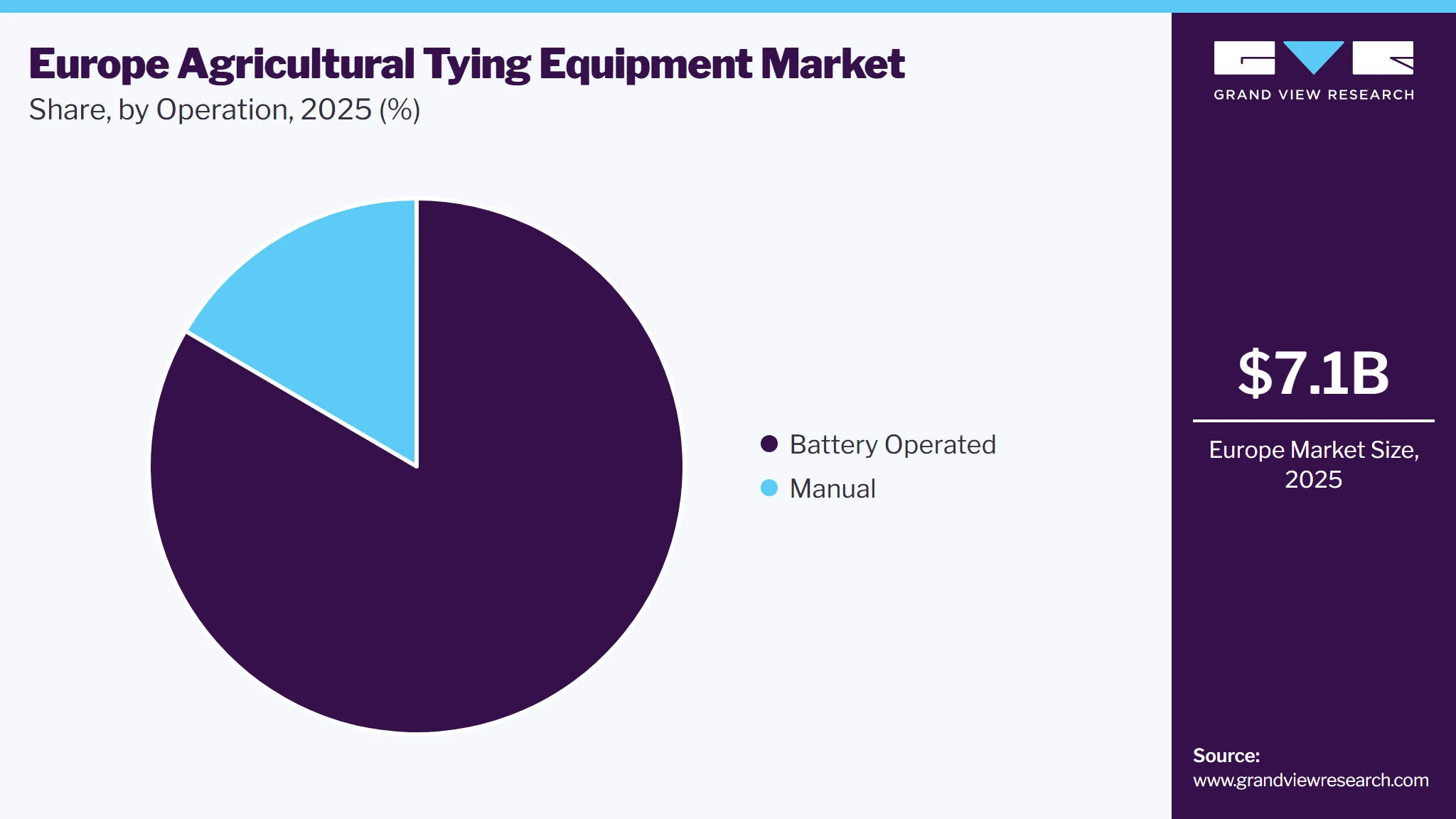
The battery-operated segment accounted for the largest revenue share of the equipment market in 2025, holding 83.4% of the total share. The segment benefits from higher operating efficiency, consistent tying performance, and reduced physical effort during repetitive crop-support activities. Its suitability for intensive greenhouse cultivation and large-scale horticultural operations, where frequent tying is required throughout the crop cycle, continues to support strong adoption.
 To learn more about this report, Download Free Sample Report
 The manual segment is expected to grow over the forecast period, supported by its affordability, ease of use, and suitability for farms with relatively low or intermittent tying requirements. Manual tying tools remain relevant among small and medium-sized growers, as they require limited maintenance and no battery or charging infrastructure. Their flexibility across different crop layouts and tying materials also makes them suitable for seasonal cultivation and applications where the investment in powered equipment may not be economically justified.
Country Insights
The Netherlands' highly developed horticulture and greenhouse ecosystem provides a favorable environment for agricultural tying equipment. The country has a strong specialization in greenhouse-grown vegetables, including tomatoes, cucumbers, peppers, and eggplant that require regular plant training and support which helps create a conducive environment for stable market growth. The Dutch government identifies horticulture and propagation materials as one of the country's key innovative sectors and continues to support innovation across agriculture and horticulture. Moreover, labor pressure is a significant driver for agricultural tying equipment adoption in the Netherlands, particularly within labor-intensive greenhouse horticulture. Repetitive crop-training activities such as tying and clipping require considerable manual effort, encouraging growers to adopt battery-operated tying tools and efficient clipping equipment to improve worker productivity and reduce physical workload. The country's increasing focus on greenhouse automation and mechanization further supports the replacement of slower manual processes with specialized crop-management equipment.
Switzerland's high labor costs and increasing emphasis on farm mechanization create a favorable environment for labor-saving agricultural tying equipment. Agroscope identifies mechanization and digitalization as important factors influencing agricultural work processes and provides tools specifically designed to assess how mechanization can affect farm labor requirements. This is particularly relevant to intensive horticultural production, where recurring tying, training, and clipping activities can be time-consuming. The opportunity therefore lies in greater adoption of battery-operated tying tools, tapeners, and clipping equipment that can accelerate repetitive crop-support operations and reduce operator workload. Moreover, Switzerland's expanding greenhouse vegetable base provides a direct application environment for agricultural tying equipment. Greenhouse cultivation has become increasingly established within Swiss vegetable production, with tomatoes and cucumbers, among the key crops grown under protected conditions. Tomatoes and cucumbers, in particular, are commonly produced using support and training systems, generating recurring requirements for tying tools/tapeners, clipping tools, and fastening consumables.
Key Europe Agricultural Tying Equipment Company Insights
Some of the key players operating in the market include MAGE Agri, INFACO, LLC, AGRIFAST (Desa Group), and Cavi Group.
-
MAGE Agri is an agricultural equipment manufacturer specializing in portable electric tools for professional agricultural applications. The company offers equipment for repetitive cultivation tasks across viticulture, arboriculture, and fruit cultivation. Its tying portfolio includes the LEA 30.s electric tying tool and dedicated tie spools, including biodegradable, photo-degradable, and PVC variants, which support plant-training and fastening applications. The company’s solutions are used for crops such as vines, kiwis, raspberries, olives, cherries, and apples, positioning MAGE Agri as a relevant supplier of agricultural tying and plant-support equipment.
-
MAX Co., Ltd. is a Japan-based manufacturer with its European operations headquartered through MAX Europe B.V. in Almere, Netherlands. The company operates across industrial equipment, office products, agriculture and food equipment, home-environment solutions, and healthcare-related equipment. Its agricultural business covers plant-binding, vegetable-binding, and related fastening solutions for professional cultivation applications. MAX maintains R&D, manufacturing, and sales operations across Japan and international markets, with products developed in Japan and manufactured at ISO 9001- and ISO 14001-certified facilities. MAX Europe serves customers across European countries and maintains a German office in Düsseldorf to support its regional operations and distribution network.
Key Europe Agricultural Tying Equipment Company
-
MAGE Agri
-
MAX Co., Ltd. (MAX EUROPE B.V.)
-
AGRIFAST (Desa Group)
-
INFACO
-
Cavi Group
-
SWANSOFT
-
ZHEJIANG GUYUEHU INDUSTRY & TRADE CO., LTD
-
PELLENC
-
ZANON S.r.l.
-
CAMPAGNOLA Srl
Competitive Benchmarking
Category
Operating Strategies
Competitive Edge
Weakness
Established Players (e.g., MAGE Agri; MAX Co., Ltd. (MAX EUROPE B.V.); INFACO; PELLENC; ZANON S.r.l.; CAMPAGNOLA Srl)
- Broaden portfolios across battery-powered and manual tying tools, fastening systems, tapes, staples, and related accessories for diverse horticultural applications.
- Strengthen dealer networks, technical support, product development, and crop-specific solutions to maintain reach across vineyards, orchards, nurseries, and protected cultivation.
- Established brand recognition, diversified product portfolios, and well-developed distribution channels provide broad market access.
Experience in cordless agricultural tools, fastening systems, and professional horticultural applications enables solutions suited to different crop-training requirements.
- Higher manufacturing, product development, distribution, and service costs can place pressure on operating margins.
- Managing diversified product ranges requires greater resources for inventory, technical support, spare parts, and aftermarket services.
Emerging & Regional Players (e.g., AGRIFAST (Desa Group); Cavi Group; SWANSOFT; ZHEJIANG GUYUEHU INDUSTRY & TRADE CO., LTD)
- Concentrate on selected tying tools, clips, tapes, fastening products, and accessories designed for specific cultivation requirements.
- Expand through regional distributors, targeted grower segments, application-focused product development, and competitive pricing strategies.
- Focused portfolios allow greater specialization in particular tying and fastening applications.
Regional market knowledge, flexible product offerings, and closer customer relationships can help address localized requirements and niche cultivation practices.
- Smaller manufacturing scale, geographic coverage, and brand visibility can limit access to large commercial growers and multinational distribution channels.
- Reliance on regional distributors may constrain broader market penetration and the availability of technical and aftermarket support.
Recent Developments
-
In December 2025, Zanon showcased the ZL 700 PRO, a new professional tying machine presented at SITEVI 2025 for applications across vineyards, floriculture, and olive cultivation. The equipment is engineered to simplify plant and branch tying operations, offering four operating settings and compatibility with six different wire types to support varied agricultural requirements.
-
In July 2025, Pellenc introduced the F3X, a fourth-generation battery-powered tying tool designed to improve tying speed, precision, and operator comfort. Powered by the Alpha Lite battery, the tool can deliver up to 13,000 ties per charge and offers eight adjustable tension settings. It is available in two configurations, the H25 with a 25 mm opening and the H35 with a wider horizontal opening for larger tying diameters and support materials. The F3X also integrates NFC connectivity with the Pellenc Connect app, enabling users to monitor operating statistics, tool performance, and settings through a smartphone.
Europe Agricultural Tying Equipment Market Report Scope
Report Attribute
Details
Market size in 2025
USD 7.1 million
Estimated market size in 2026
USD 7.5 million
Projected market size by 2033
USD 11.6 million
Growth rate
CAGR of 6.3% from 2026 to 2033
Base year for estimation
2025
Historical data
2021-2024
Forecast period
2026 - 2033
Quantitative units
Revenue in USD million and CAGR from 2026 to 2033
Report coverage
Revenue forecast, company market position analysis, competitive landscape, growth factors, and trends
Segments covered
Type, operation, crop, country
Country scope
Germany; Belgium; Netherlands; Finland; Norway; UK; Iceland; Denmark; Ireland; Sweden; Austria; Czech Republic; Switzerland
Key companies profiled
MAGE Agri; MAX Co., Ltd. (MAX EUROPE B.V.); AGRIFAST (Desa Group); INFACO; Cavi Group; SWANSOFT; ZHEJIANG GUYUEHU INDUSTRY & TRADE CO., LTD; PELLENC; ZANON S.r.l.; CAMPAGNOLA Srl
Customization scope
Free report customization (equivalent up to 8 analysts working days) with purchase. Addition or alteration to country, regional & segment scope.
Pricing and purchase options
Avail customized purchase options to meet your exact research needs. Explore purchase options
Europe Agricultural Tying Consumables Market Report Segmentation
This report forecasts revenue growth at country levels and provides an analysis of the latest industry trends in each of the sub-segments from 2021 to 2033. For this study, Grand View Research has segmented the Europe agricultural tying equipment market report based on type, crop, operation, and country.
-
Type Outlook (Revenue, USD Million, 2021 - 2030)
-
Tying Tools/ Tapeners
-
Clipping Tools
-
Consumables
-
Tying Tape
-
Tying Wire & Twine
-
Tying Clips
-
Galvanized Clips
-
Non-galvanized Clips
-
-
Others
-
-
-
Operation Outlook (Revenue, USD Million, 2021 - 2030)
-
Manual
-
Battery Operated
-
-
Crop Outlook (Revenue, USD Million, 2021 - 2030)
-
Tomato
-
Bell Pepper
-
Eggplant
-
Cucumber
-
-
Country Outlook (Revenue, USD Million, 2021 - 2033)
-
Germany
-
Belgium
-
Netherlands
-
Finland
-
Norway
-
UK
-
Iceland
-
Denmark
-
Ireland
-
Sweden
-
Austria
-
Czech Republic
-
Switzerland
-
Research Methodology
The Europe agricultural tying consumables market figures in this report are based on a proven research process that combines executive interviews with secondary research from proprietary databases, company filings, and recognized regulatory and institutional sources. Market size is built through value-chain sizing—reconciling supply-side and demand-side estimates—and triangulated with bottom-up and top-down approaches. Every estimate passes multiple levels of expert validation before publication, with each Europe agricultural tying consumables segment quantified using the revenue-capture definitions in the table below.
Segment Definition
Type
Revenue Capture Definition
Tying Tools/Tapeners
Revenue generated from the sale of agricultural tying tools and tapeners, including manually operated and battery-operated equipment. Revenue covers the supply of complete tying devices and associated equipment designed for commercial agricultural tying operations.
Clipping Tools
Revenue generated from the sale of agricultural clipping tools and related clip-handling equipment. The segment includes tools supplied as complete equipment for commercial crop fastening and plant-support activities.
Consumables
Revenue generated from the sale of recurring agricultural tying and fastening consumables. The segment includes tying tape, tying wire & twine, tying clips (galvanized and non-galvanized), and other consumables such as staples, rubber/elastic ties, twist ties, and biodegradable ties.
Operation
Revenue Capture Definition
Tying Tools/Tapeners
Revenue generated from the sale of agricultural tying tools and tapeners, including manually operated and battery-operated equipment. Revenue covers the supply of complete tying devices and associated equipment designed for commercial agricultural tying operations.
Clipping Tools
Revenue is generated from the sale of agricultural clipping tools and related clip-handling equipment. The segment includes tools supplied as complete equipment for commercial crop fastening and plant-support activities.
Crop
Revenue Capture Definition
Tomato
Revenue generated from the sale of agricultural tying equipment, clipping tools, and associated consumables classified within the tomato crop segment. Revenue includes product sales and supply attributable to tomato-specific agricultural tying and fastening requirements.
Bell Pepper
Revenue generated from the sale of agricultural tying equipment, clipping tools, and associated consumables classified within the bell pepper crop segment. Revenue includes product sales and supply attributable to bell pepper-specific agricultural tying and fastening requirements.
Eggplant
Revenue generated from the sale of agricultural tying equipment, clipping tools, and associated consumables classified within the eggplant crop segment. Revenue includes product sales and supply attributable to eggplant-specific agricultural tying and fastening requirements.
Cucumber
Revenue generated from the sale of agricultural tying equipment, clipping tools, and associated consumables classified within the cucumber crop segment. Revenue includes product sales and supply attributable to cucumber-specific agricultural tying and fastening requirements.
Estimation Model
Layer No.
Layer Name
Key Question
Description
01
Crop Cultivation & Demand Layer
Where is demand for agricultural tying equipment generated?
Assesses demand from commercial crop tying, training, and plant-support activities across open-surface and greenhouse/protected cultivation. The analysis considers target crops, cultivation area, plant population, and crop-support practices involving stakes, trellis wires, strings, and other support structures.
02
Crop-Support Activity & Equipment Requirement Layer
What level of crop-support activity creates demand for tying equipment and consumables?
Evaluates tying and clipping requirements based on crop characteristics, plant-training practices, frequency of support activities, and manual labor requirements. The assessment covers the operational need for tying tools/tapeners, clipping tools, and fastening materials throughout crop cycles.
03
Product Adoption & Replacement Layer
What agricultural tying solutions are being adopted and replenished?
Analyzes adoption of tying tools/tapeners, clipping tools, and consumables across manual and battery-operated equipment. It considers equipment penetration, crop suitability, operating requirements, and recurring replacement or replenishment of tying tape, wire and twine, clips, staples, rubber/elastic ties, twist ties, and biodegradable ties.
04
Revenue & Market Estimation Layer
How much revenue is generated from agricultural tying equipment and consumables?
Estimates revenue and unit demand by type, operation, crop, and geography using harvested area, plants per hectare, tying adoption, equipment and consumable penetration, replacement rates, and manufacturer/FOB-level selling prices. The report applies a hybrid top-down and bottom-up approach, with correlation, regression, and time-series analysis and validation through primary interviews.
Delivered Customizations
This report has been delivered with the following In-depth customizations
CLIENT REQUEST
CUSTOMIZATION DELIVERED
VALUE ADDS
Competitive Benchmarking
A comprehensive competitive benchmarking assessment was conducted covering agricultural tying equipment manufacturers and suppliers operating across Europe. The assessment covered tying tools/tapeners, clipping tools, and related consumables, including product portfolios, operating modes, crop suitability, consumable compatibility, product specifications, distribution presence, and strategic developments.
Enabled stakeholders to assess competitive positioning, compare product portfolios and capabilities, identify areas of product differentiation, and formulate competitive and product-positioning strategies.
Regional Segmentation
A detailed regional assessment was conducted across selected European markets, evaluating market demand in relation to crop production, greenhouse and protected cultivation, agricultural practices, mechanization levels, labor requirements, and adoption of agricultural tying equipment and consumables.
Provided a structured assessment of regional market potential and demand patterns, enabling stakeholders to evaluate geographic opportunities and support market expansion and resource-allocation decisions.
Opportunity Assessment
A comprehensive opportunity assessment was conducted across equipment, crop, and consumable segments by evaluating high-value vegetable production, labor requirements, agricultural mechanization, adoption of battery-operated equipment, and demand for efficient and ergonomic crop-training solutions. Opportunities were assessed across tying tools/tapeners, clipping tools, tying tape, tying wire & twine, tying clips, and other consumables for key vegetable crops.
Enabled stakeholders to identify revenue opportunities across equipment and consumable segments, evaluate demand arising from labor and mechanization trends, prioritize product development areas, and support market-entry, expansion, and investment decisions.
Frequently Asked Questions About This Report
Key companies include MAGE Agri, MAX Co., Ltd. (MAX EUROPE B.V.), AGRIFAST (Desa Group), INFACO, Cavi Group, SWANSOFT, ZHEJIANG GUYUEHU INDUSTRY & TRADE CO., LTD, PELLENC, ZANON S.r.l., CAMPAGNOLA Srl
The Europe agricultural tying equipment market was valued at USD 7.1 million in 2025 and is projected to grow at a CAGR of 6.3% from 2026 to 2033.
The Europe agricultural tying equipment market is projected to grow at a CAGR of 6.3% from 2026 to 2033, driven by increasing mechanization, labor shortages, protected cultivation, and adoption of battery-operated tying tools.
Clipping tools segment is projected to grow at a CAGR of 5.9% over the forecast period.
Manual segment is expected to register a CAGR of 3.9% over the forecast period.
Tomato segment accounted for the largest revenue share in 2025, representing 58.4% of total market revenue.
Increasing mechanization in greenhouse and high-value crop cultivation, labor shortages, adoption of battery-powered tying tools, expanding protected cultivation, and demand for faster and more consistent crop-support operations are driving market growth.
About the Author(s)
Advanced Interior Materials Research Team
Advanced Materials · Advanced Interior MaterialsThis report was authored by the advanced interior materials research team at Grand View Research - comprising two research analysts, one senior research analyst, and one industry expert - with specialized expertise in the advanced interior materials segment of the advanced materials industry. All findings are based on proprietary advanced materials databases, executive interviews, and regulatory analysis, subject to internal peer review prior to publication.
Last Updated:
Speak to Analyst

Customize this report to your needs - add regions, segments, or data points, with 20% free customization.
Or view our licence options:


ISO 9001:2015 & 27001:2022 Certified
We are GDPR and CCPA compliant! Your transaction & personal information is safe and secure. For more details, please read our privacy policy.


