
- Home
- »
- Clothing, Footwear & Accessories
- »
-
Europe Outdoor Apparel Market Size, Industry Report, 2033GVR Report cover

Europe Outdoor Apparel Market (2026 - 2033) Size, Share & Trends Analysis Report by Apparel Type (Casual Wear, Fashion Wear, Rainy Wear, Promotional Apparel, Recreational Wear, Sports & Activity Wear), By Product Type, By Fabric Type, By End User, By Distribution Channel, By Region, And Segment Forecasts
Market Size, 2023
$19.9BMarket Estimate, 2026
$20.9BMarket Forecast, 2033
$28.1BCAGR, 2024–2033
4.3%Europe Outdoor Apparel Market Summary
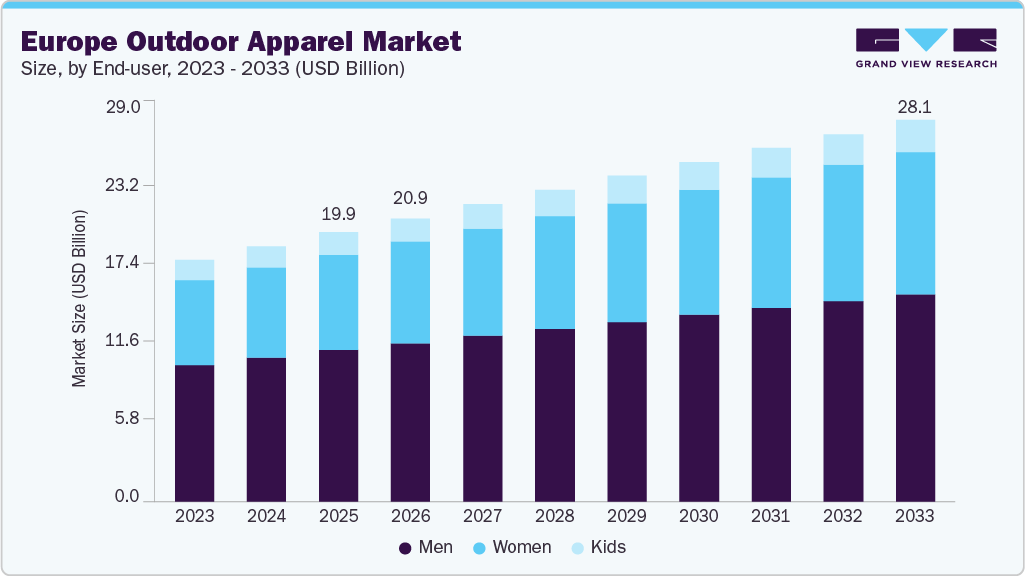
The Europe outdoor apparel market size was estimated at USD 19.87 billion in 2025 and is projected to reach USD 28.14 billion by 2033, growing at a CAGR of 4.3% from 2026 to 2033. This growth reflects a steady transformation in consumer preferences, with outdoor activities increasingly becoming an integral part of everyday life rather than occasional pursuits.
Key Market Trends & Insights
- By apparel type, sports & activity wear accounted for a revenue share of 26.1% in 2025.
- By product type, top wear accounted for a revenue share of 79.5% in 2025.
- By fabric type, polyester accounted for a revenue share of 38.4% in 2025.
- By end user, the men segment accounted for a revenue share of 56.1% in 2025.
- By distribution channel, sales through the offline channel accounted for a revenue share of 62.45% in 2025.
Market Size & Forecast
- 2025 Market Size: USD 19.87 Billion
- 2033 Projected Market Size: USD 28.14 Billion
- CAGR (2026-2033): 4.3%
Prism AI by Grand View Research Free to tryAsk a question about the europe outdoor apparel marketTry asking✓Every figure cited from GVR research Prefer the report? Download free sample →
A key factor driving this expansion of the Europe outdoor apparel industry is the growing participation in outdoor and adventure activities such as hiking, camping, and rock climbing. Consumers across Europe are increasingly seeking nature-based experiences for both recreation and wellness, which is directly influencing demand for apparel that offers protection, durability, and comfort in diverse environmental conditions. This has led to a noticeable shift toward investing in high-quality outdoor clothing that can perform reliably in unpredictable weather.Consumers are prioritizing features such as waterproofing, thermal insulation, breathability, and lightweight construction. This trend supports the premiumization of outdoor apparel, as buyers are more willing to pay for products that deliver long-term performance and multi-purpose use across both outdoor and urban settings.
 Source: Grand View Research, IR Documents, Primary Interviews, Paid DatabasesTo learn more about this report,
 Download Free Sample Report
In addition, sustainability considerations are playing a critical role in shaping the competitive landscape. European consumers are increasingly attentive to environmental impact, encouraging brands to adopt recycled materials, responsible sourcing, and circular business models. This shift is not only influencing product innovation but also strengthening brand differentiation. Companies are aligning with these evolving expectations. Patagonia continues to expand its repair, reuse, and resale initiatives across Europe, reinforcing its commitment to sustainability.
Sustainability in the European outdoor apparel market is increasingly being driven by regulation-led design discipline rather than voluntary branding alone. Policy frameworks such as the EU Ecodesign Directive and the forthcoming digital product passport are pushing outdoor apparel manufacturers to redesign garments for traceability, repairability, and extended product lifecycles. As a result, performance outerwear sold across Europe is being engineered with mono-material constructions, detachable components, and standardized trims to simplify recycling at scale, particularly in categories such as insulated jackets, hiking trousers, and technical mid-layers.
At the same time, the market’s end-user structure is gradually evolving, which is influencing product demand and positioning. Men continue to represent the largest consumer base, while the women’s segment is steadily expanding over the same period, reflecting rising participation by women in outdoor activities such as hiking, trekking, and adventure travel. This gradual diversification is encouraging brands to design more inclusive and versatile product ranges.
European outdoor brands are also shifting emphasis from volume-driven seasonal launches toward longevity-based value propositions. Companies such as Patagonia and Vaude have expanded repair services, spare-part availability, and resale initiatives across Europe, reinforcing durability as a sustainability metric. This approach aligns strongly with European consumer behavior, where outdoor enthusiasts increasingly prioritize long-term use, warranty coverage, and brand accountability over frequent product replacement.
Furthermore, Europe is emerging as a hub for scaling bio-based, low-impact textiles rather than experimental pilots. Outdoor apparel manufacturers are increasingly integrating fibers such as hemp blends, responsibly sourced merino wool, and mechanically recycled polyamide into core product lines rather than limited-edition capsules. Brands including Mammut and Haglöfs have transitioned large portions of their collections toward bluesign-approved fabrics and PFC-free water-repellent treatments, addressing environmental impact without compromising weather resistance or alpine performance standards.
In addition, European retail dynamics are driving the adoption of sustainable design. Major outdoor specialty retailers and cooperative buying groups are increasingly setting environmental compliance criteria for supplier onboarding, including lifecycle disclosures and chemical management standards. This retailer-led pressure is accelerating adoption of circular production models across the supply chain, particularly for high-volume categories such as hiking shells, base layers, and softshell apparel. As a result, sustainability in Europe’s outdoor apparel market is becoming less of a marketing differentiator and more of a baseline requirement for commercial participation, fundamentally reshaping how products are designed, sourced, and brought to market.
 To learn more about this report, Download Free Sample Report
Brand Market Share Insights
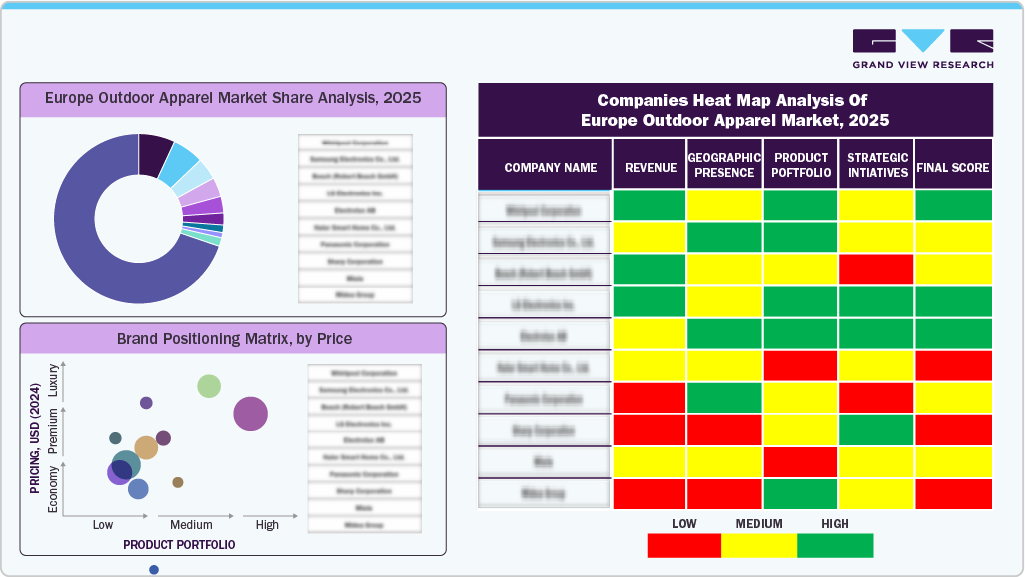
The Europe outdoor apparel market is highly competitive, with brands competing based on product performance, innovation, sustainability, and brand positioning. The market includes both mainstream sportswear leaders and specialist outdoor brands, creating a balanced mix of scale-driven and niche-focused competition.
Key players such as Nike, Inc.; Adidas AG; PUMA SE; Under Armour Inc.; ASICS Corporation; and Mizuno Corporation are strengthening their presence in the outdoor segment by integrating performance-led technologies into their apparel ranges.
Competition in the Europe outdoor apparel industry is increasingly shaped by the ability to deliver functionally advanced apparel that performs across changing environments. Consumers expect outdoor clothing to offer a combination of waterproofing, breathability, thermal regulation, and durability. As a result, brands are investing heavily in fabric innovation and product engineering to improve comfort, performance, and versatility across both outdoor and urban use cases.
Sustainability has also become a key competitive expectation rather than a niche positioning strategy. Leading brands are focusing on the use of recycled materials, reduced environmental impact processes, and circular product initiatives. Columbia Sportswear and Arc’teryx are increasingly integrating sustainable materials into their technical product lines without compromising performance standards.
Digital transformation is further intensifying competition. The growth of e-commerce, direct-to-consumer platforms, and social media-driven marketing is enabling brands to launch products faster, engage consumers more directly, and respond quickly to changing trends. This is particularly important in categories such as jackets, hiking apparel, and performance layers, where seasonal demand and trends play a significant role.
 To learn more about this report, Download Free Sample Report
Consumer Insights
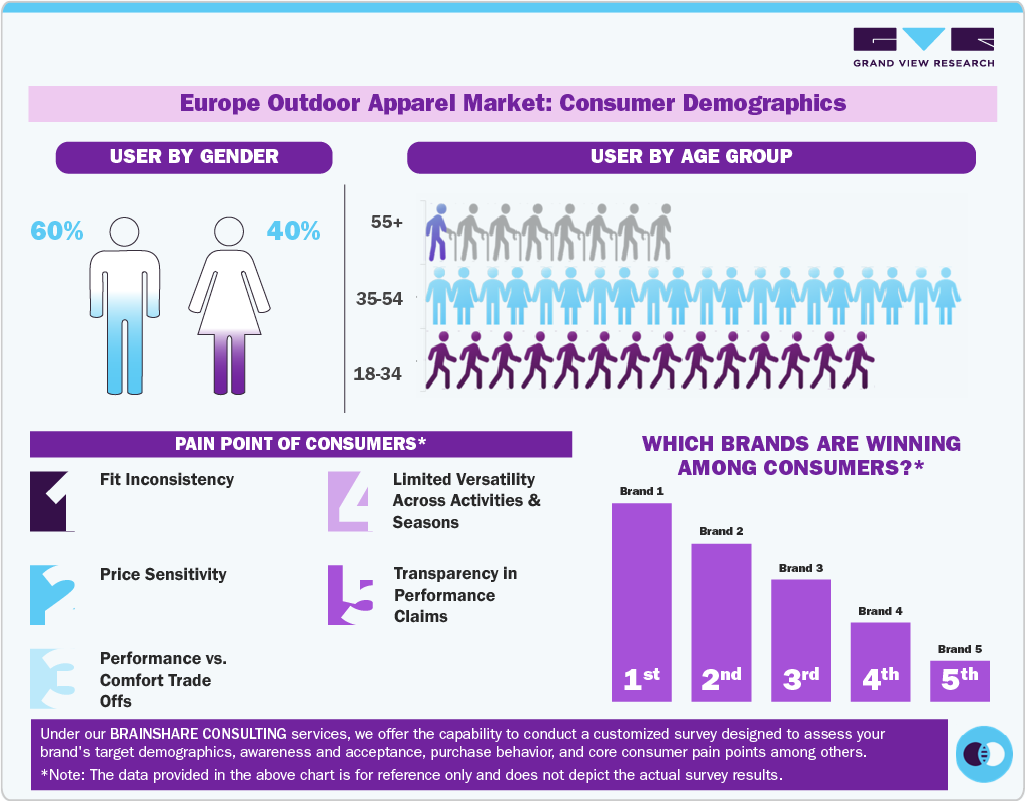
Across Western and Northern Europe, demand is being shaped by a broad consumer base that includes millennials and Gen Z consumers (typically aged 18-40), urban professionals with active lifestyles, and an aging yet highly engaged population of outdoor enthusiasts aged 45+. Younger consumers are driving frequent purchases and style-led demand, while older demographics prioritize comfort, weather protection, and long-term durability for activities such as hiking, trekking, walking, and cycling. This multigenerational consumer base has widened the addressable market for outdoor apparel, pushing brands to design products suitable for both performance use and daily wear.
Consumer trends in Europe increasingly reflect a preference for versatility and climate adaptability. Rather than single-purpose garments, buyers favor lightweight layers, softshell jackets, insulated vests, and stretch trousers that perform across changing weather conditions and varied intensity levels. Apparel that supports mobility, moisture regulation, and thermal balance is especially valued in regions with unpredictable climates, including Northern and Central Europe. European consumers also show strong sensitivity to fit and ergonomics, driving demand for articulated patterning, gender-specific cuts, and inclusive sizing that supports comfort during prolonged wear rather than short-duration activity.
Shoppers frequently rely on brand-owned websites, specialty outdoor retailers, and social platforms to understand fabric performance, weather resistance, and layering systems. Product transparency, such as explanations of breathability ratings, waterproof membranes, and insulation performance, has become central to purchase decisions. Peer reviews, outdoor community forums, and influencer-led content focused on real-use conditions are particularly influential among younger buyers, reinforcing credibility over purely aspirational marketing.
Apparel Type Insights
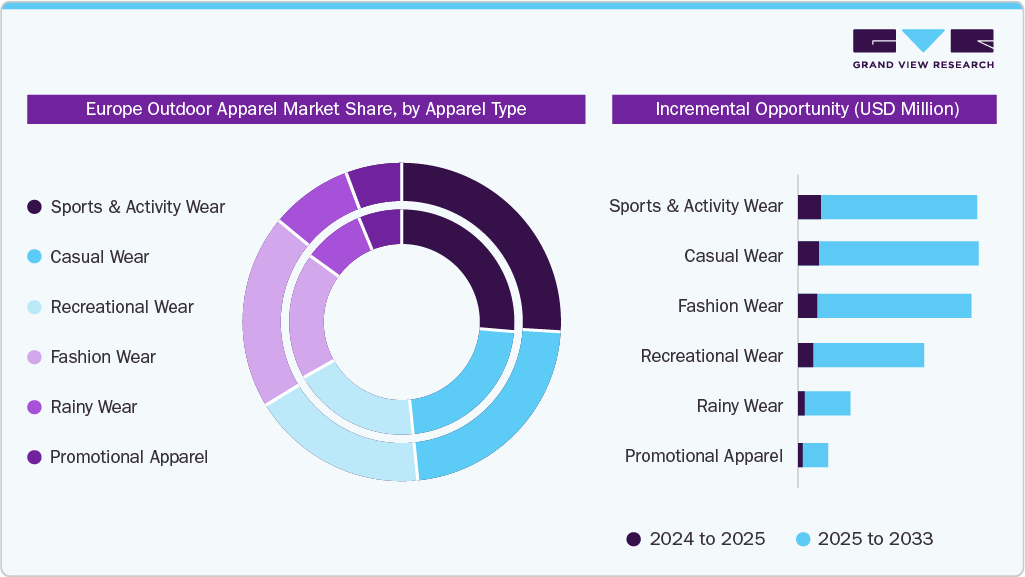
Sports & activity wear apparel led the Europe outdoor apparel industry, accounting for a revenue share of 26.1% in 2025. Demand is increasingly shaped by the needs of women consumers, who are seeking apparel that enhances performance while delivering sustained comfort, fit, stability, and freedom of movement. Across Europe, sports and activity wear is being worn not only during workouts but also in daily routines, raising expectations for garments that remain comfortable over extended periods rather than just during short training sessions.
 To learn more about this report, Download Free Sample Report
The fashion outdoor apparel segment is projected to grow at the fastest CAGR of 5.5% from 2026 to 2033, driven by rapid shifts in adoption trends and the increasing influence of digital culture on consumer purchasing behavior. The segment is expanding as consumers seek frequent wardrobe refreshments inspired by social media, influencers, and celebrity-led fashion narratives. Rising demand for trend-forward yet affordable apparel has reinforced the fast fashion model, in which brands rapidly translate high-fashion concepts into mass-market collections.
Product Type Insights
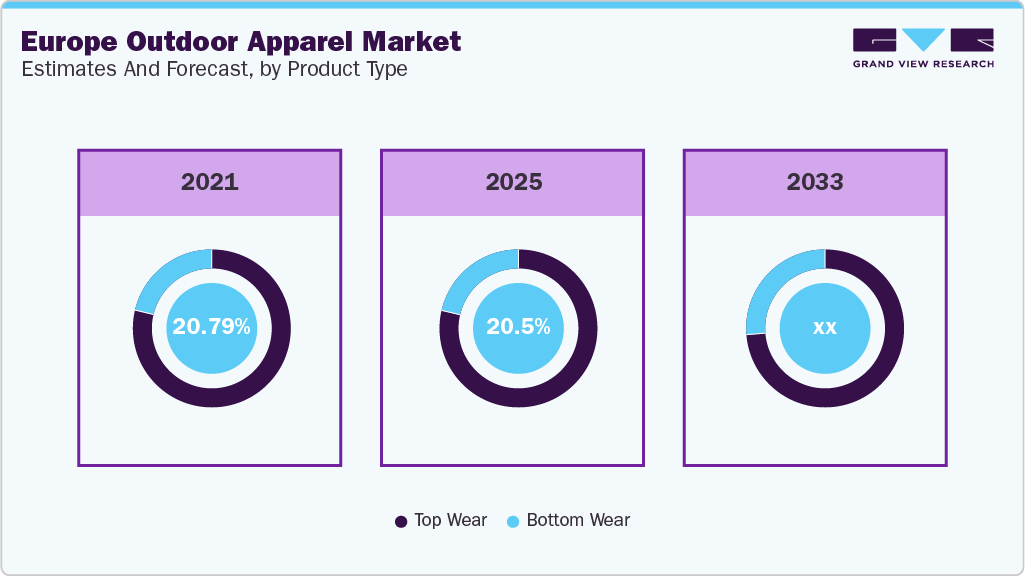
Top wear accounted for a 79.5% revenue share of the Europe outdoor apparel market in 2025. This segment includes outer layers and upper-body garments such as jackets, fleeces, sweatshirts, technical tops, and lightweight shells, which are essential for layering in Europe’s variable climatic conditions. Demand remains resilient as consumers frequently update top wear to adapt to changing weather, evolving outdoor activities, and shifting style preferences. The growing influence of digital retail platforms has further accelerated purchases, enabling brands to showcase new collections, fabric innovations, and styling versatility through e-commerce and social channels. Continuous design refreshes, ranging from updated color palettes and silhouettes to improved comfort, insulation, and weather resistance, encourage repeat purchases.
 To learn more about this report, Download Free Sample Report
The bottom wear apparel segment is expected to grow at a CAGR of 3.9% from 2026 to 2033, as consumers increasingly prioritize comfort, mobility, and functional design in lower-body garments. This category includes outdoor trousers, performance pants, leggings, shorts, skirts, and hybrid bottoms designed to support a wide range of activities, from hiking and walking to travel and everyday wear. Growth is being driven by the expanding variety of styles and constructions available, allowing consumers to choose garments suited to different climates, terrain conditions, and intensity levels.
Product diversification within bottom wear has become a key growth enabler. Brands are offering multiple fits and silhouettes, including tapered, straight-leg, relaxed, cargo-inspired, and stretch-based designs, along with features such as articulated knees, flexible waistbands, reinforced panels, and lightweight, quick-drying materials. These design enhancements improve freedom of movement and durability, making bottom wear suitable for prolonged use across varied outdoor settings.
Fabric Type Insights
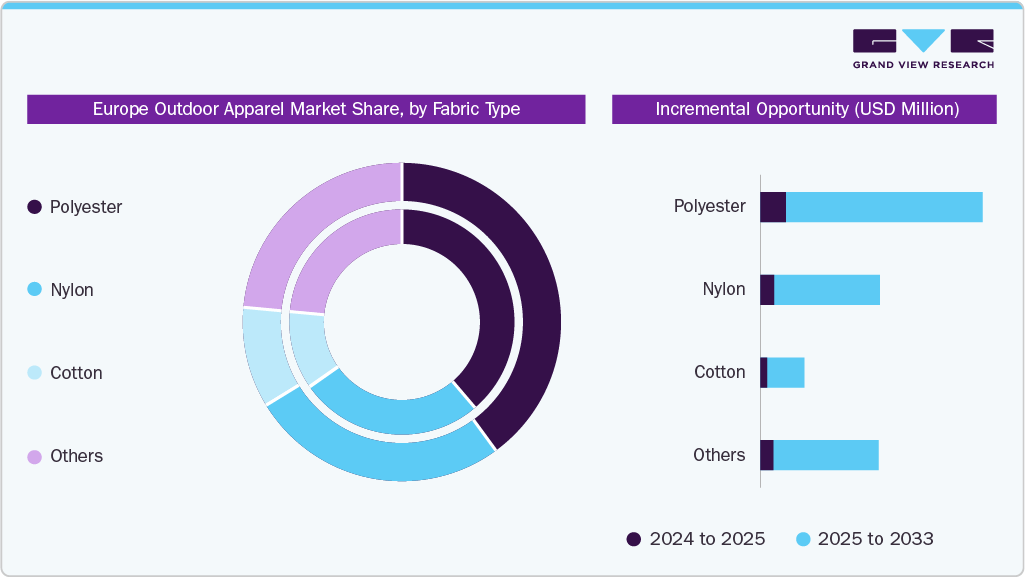
Polyester outdoor apparel led the Europe outdoor apparel market, accounting for a revenue share of 38.4% in 2025. Demand is increasingly influenced by consumers seeking garments that balance durability with lightweight comfort, particularly as outdoor apparel is worn across extended periods rather than limited to short-duration activities. Polyester’s inherent moisture-wicking capability, quick-drying performance, and shape retention make it well-suited for activities such as hiking, walking, fitness, and travel, which are widely practiced across European lifestyles.
Consumer expectations around comfort and mobility are further reinforcing polyester’s adoption in outdoor apparel. Garments made from polyester blends are engineered to offer stretch, breathability, and fit stability, enabling freedom of movement during both physical activity and daily routines. As outdoor clothing continues to overlap with casual and lifestyle wear in Europe, polyester-based apparel is increasingly designed to remain comfortable throughout the day while maintaining performance functionality.
 To learn more about this report, Download Free Sample Report
The nylon outdoor apparel industry segment is projected to grow at a CAGR of 3.9% from 2026 to 2033. Nylon is increasingly favored for its high tensile strength, abrasion resistance, and lightweight properties, making it well-suited for jackets, shells, trousers, and technical outer layers designed for frequent use. As outdoor apparel continues to overlap with lifestyle and fashion wear, nylon fabrics are being adopted in designs that balance durability with a sleek, modern appearance. Growth in this segment is further reinforced by changing consumer behavior, particularly among digitally engaged shoppers who follow trend-led product launches and visually driven styling cues.
End user Insights
The men's outdoor apparel segment dominated the market, accounting for a share of 56.1% in 2025. Men are actively seeking outdoor apparel that offers ergonomic construction, stable fits, and unrestricted mobility, particularly in core categories such as outerwear, base layers, and bottoms. Features such as flexible fabrics, adaptive insulation, and breathable structures are becoming standard requirements, reflecting a shift toward comfort-led performance. This evolution is reinforcing men’s outdoor apparel as a long-term, high-usage wardrobe category in Europe, driven by practical needs, lifestyle integration, and sustained participation in outdoor and wellness-oriented activities.
The women’s outdoor apparel industry is projected to grow at the highest CAGR of 4.9% from 2026 to 2033. Female consumers are actively seeking outdoor apparel that aligns with both functional needs and personal style, particularly as outdoor and activewear become embedded in everyday dressing. Inspiration drawn from social platforms, fitness creators, and lifestyle influencers is accelerating demand for updated silhouettes and seasonal refreshes, encouraging higher purchase frequency across core categories such as tops, leggings, outer layers, and lightweight jackets.
Distribution Channel Insights
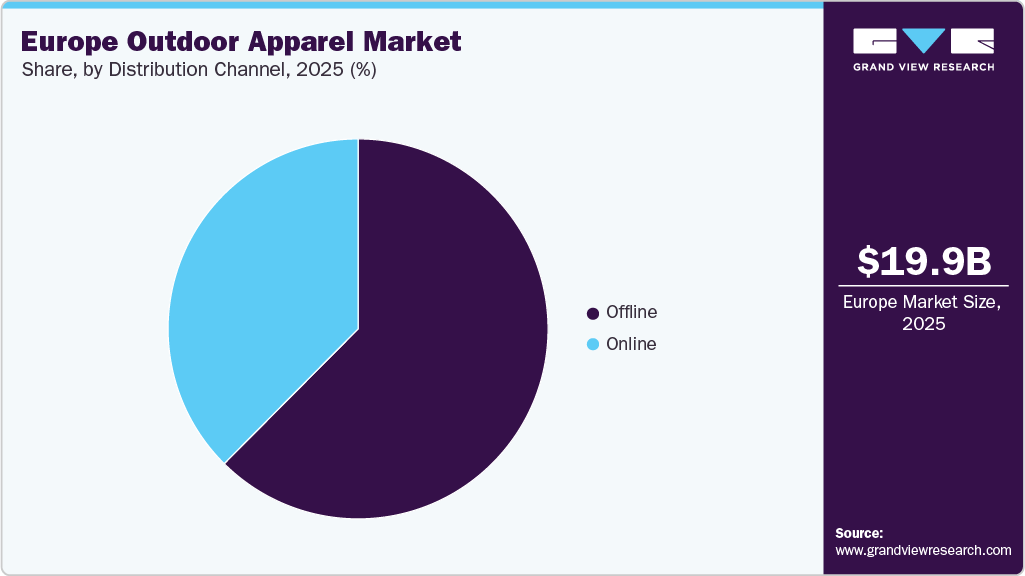
Sale of outdoor apparel through offline channels dominated, accounting for a 62.45% share of the Europe outdoor apparel industry in 2025. Physical stores allow shoppers to assess fabric quality, comfort, insulation, and mobility in real time, which is especially important for categories such as jackets, base layers, and bottoms. In-store expertise and product guidance further enhance confidence in purchase decisions, particularly as consumers increasingly prioritize ergonomic construction, breathable materials, and flexible designs for extended wear.
 To learn more about this report, Download Free Sample Report
Sale of outdoor apparel through online channels is projected to grow at the fastest CAGR of 5.5% from 2026 to 2033. Online platforms enable shoppers to explore a wide assortment of styles, compare product features, and access detailed visuals and fit guidance, which is particularly appealing to female consumers seeking apparel that balances performance with personal style. Social media influence, fitness creators, and lifestyle-led content are playing a central role in shaping discovery and purchase decisions, accelerating demand for refreshed silhouettes and seasonally updated collections.
Regional Insights
UK Outdoor Apparel Market Trends
The UK outdoor apparel market accounted for 15.37% share of the Europe outdoor apparel industry in 2025. Market growth is primarily driven by rising health and wellness awareness, changing lifestyle patterns, and increased adoption of outdoor apparel for daily wear beyond recreational use. The widespread acceptance of comfort-oriented clothing following the pandemic has reinforced demand for functional outerwear, mid-layers, and performance tops suitable for both indoor and outdoor environments. In addition, the strong penetration of e-commerce platforms and the continued expansion of physical retail networks by established brands have enhanced product accessibility across the country.
Germany Outdoor Apparel Market Trends
The Germany outdoor apparel industry is projected to grow at a CAGR of 4.2% from 2026 to 2033, supported by strong consumer participation in hiking, trekking, skiing, and cycling activities across the country. Demand for high-performance outdoor clothing is increasing as consumers prioritize durability, weather resistance, and sustainable materials in apparel purchases. Germany’s strong environmental awareness is also encouraging the adoption of eco-friendly outdoor apparel made from recycled fabrics and responsibly sourced materials. In addition, the presence of established outdoor brands, expanding e-commerce penetration, and rising interest in year-round outdoor recreation are contributing to steady market growth. Regulatory initiatives promoting sustainable textile manufacturing and stricter environmental compliance standards are further influencing product innovation within the market.
France Outdoor Apparel Market Trends
The France outdoor apparel industry is anticipated to grow at a CAGR of 3.5% between 2026 and 2033, driven by growing consumer interest in outdoor leisure activities, mountain tourism, and adventure sports. Demand is particularly strong for lightweight, multifunctional apparel suitable for hiking, alpine activities, and urban outdoor lifestyles. French consumers increasingly prefer premium outdoor clothing that combines technical performance with fashion-oriented designs, supporting the rise of lifestyle outdoor apparel categories. Sustainability is also becoming a key purchasing factor, with brands focusing on recyclable materials, low-impact manufacturing, and transparent sourcing practices. Furthermore, government regulations on textile sustainability and circular-economy initiatives are encouraging outdoor apparel manufacturers to adopt environmentally responsible production strategies.
Italy Outdoor Apparel Market Trends
The Italy outdoor apparel industry is expected to grow at a CAGR of 3.3% from 2026 to 2033, supported by rising participation in trekking, trail running, skiing, and mountaineering activities across alpine and nature tourism destinations. Italian consumers are increasingly seeking premium outdoor apparel that balances functionality, comfort, and contemporary design aesthetics, driving demand for technical jackets, insulated wear, and performance sportswear. The market is also benefiting from growing domestic tourism and increasing consumer preference for versatile apparel suitable for both outdoor activities and casual urban use. In addition, Italian manufacturers are emphasizing innovation in lightweight fabrics, thermal insulation technologies, and ergonomic product designs to strengthen competitiveness. Sustainability regulations and growing focus on responsible textile production are further encouraging the adoption of eco-conscious materials and ethical manufacturing practices.
Spain Outdoor Apparel Market Trends
The Spain outdoor apparel industry is expected to grow at a strong CAGR of 4.9% from 2026 to 2033, driven by increasing participation in outdoor fitness activities, hiking, camping, and water sports. Rising health awareness and active lifestyle trends among younger consumers are significantly contributing to demand for outdoor performance apparel across the country. Spain’s favorable climate and expanding adventure tourism industry are also supporting year-round consumption of outdoor clothing and accessories. Consumers are increasingly adopting lightweight, breathable, and UV-protective apparel designed for multifunctional outdoor use, while e-commerce platforms and sports retail chains continue to improve product accessibility. Additionally, evolving European sustainability regulations and rising consumer demand for recycled and ethically produced outdoor apparel are encouraging brands to invest in sustainable collections.
Key Europe Outdoor Apparel Companies:
The following key companies have been profiled for this study on the Europe outdoor apparel market.
- Adidas AG
- Columbia Sportswear Company
- VF Corporation
- Mizuno Corporation
- Nike, Inc.
- PUMA SE
- Under Armour Inc.
- Patagonia, Inc.
- Arc'teryx
- ASICS Corporation
Recent Developments
-
In October 2025, PUMA further strengthened its strategic positioning in the functional training and outdoor performance space by extending its partnership with HYROX through 2030. The agreement includes the continued development of performance-driven apparel and footwear featuring NITRO cushioning technology, as well as expanded athlete-focused collections. The collaboration reflects PUMA’s broader strategy to enhance brand visibility in the fast-growing fitness and outdoor endurance category through innovation-led product development and athlete engagement.
-
In October 2025, Merrell partnered with Gramicci to launch a collaborative outdoor collection that reinterprets classic hiking footwear with a modern lifestyle approach. The partnership focuses on combining Merrell’s technical hiking expertise with Gramicci’s movement-oriented design philosophy, resulting in products that emphasize comfort, flexibility, and rugged performance. This collaboration reflects a broader industry trend of merging technical outdoor gear with everyday lifestyle wear, expanding the addressable consumer base beyond traditional outdoor users.
Europe Outdoor Apparel Market Report Scope
Report Attribute
Details
Market size value in 2026
USD 20.90 billion
Revenue forecast in 2033
USD 28.14 billion
Growth rate
CAGR of 4.3% from 2026 to 2033
Actuals
2021 - 2025
Forecast period
2026 - 2033
Quantitative units
Revenue in USD million/billion and CAGR from 2026 to 2033
Report coverage
Revenue forecast, company ranking, competitive landscape, growth factors, and trends
Segments covered
Apparel type, product type, fabric type, end user, distribution channel, and country
Regional scope
Europe
Country scope
UK; Germany; France; Italy; Spain
Key companies profiled
Adidas AG; Columbia Sportswear Company; VF Corporation; Mizuno Corporation, Nike; Inc.; PUMA S.E; Under Armour Inc.; Patagonia, Inc.; Arc'teryx; ASICS Corporation
Customization scope
Free report customization (equivalent up to 8 analysts working days) with purchase. Addition or alteration to country, regional & segment scope.
Pricing and purchase options
Avail customized purchase options to meet your exact research needs. Explore purchase options
Europe Outdoor Apparel Market Report Segmentation
This report forecasts revenue growth at the regional and country levels and provides an analysis of the latest industry trends and opportunities in each of the sub-segments from 2021 to 203. For this study, Grand View Research has segmented the Europe outdoor apparel market report based on apparel type, product type, fabric type, end user, distribution channel, and country:
-
Apparel Type Outlook (Revenue, USD Million, 2021 - 2033)
-
Casual Wear
-
Fashion Wear
-
Rainy Wear
-
Promotional Apparel
-
Recreational Wear
-
Sports & Activity Wear
-
-
Product Type Outlook (Revenue, USD Million, 2021 - 2033)
-
Top Wear
-
Bottom Wear
-
-
Fabric Type Outlook (Revenue, USD Million, 2021 - 2033)
-
Polyester
-
Nylon
-
Cotton
-
Others
-
-
End User Outlook (Revenue, USD Million, 2021 - 2033)
-
Men
-
Women
-
Kids
-
-
Distribution Channel Outlook (Revenue, USD Million, 2021 - 2033)
-
Online
-
Offline
-
-
Regional Outlook (Revenue, USD Million, 2021 - 2033)
-
UK
-
Germany
-
France
-
Italy
-
Spain
-
Frequently Asked Questions About This Report
Sports & Activity Wear apparel dominated the market in 2025, with a 26.1% revenue share.
The Europe outdoor apparel size was estimated at USD 19.9 billion in 2025 and is expected to reach USD 20.9 billion in 2026.
he Europe outdoor apparel is expected to grow at a CAGR of 4.3% from 2026 to 2033 to reach USD 28.2 billion by 2030.
Some key players operating in Europe outdoor apparel market are Adidas AG, Columbia Sportswear Company, VF Corporation, Mizuno Corporation, Nike, Inc., PUMA S.E, Under Armour Inc., Patagonia, Inc., Arc'teryx, and Newell Brands
The growing emphasis on health and well-being has become a prominent factor driving the flourishing outdoor apparel market in Europe. In recent years, there has been a noticeable shift in people's lifestyles and priorities, with a strong focus on staying fit, maintaining good health, and seeking ways to enjoy the great outdoors. This shift has had a major impact on the outdoor apparel market.
About the Author(s)
Clothing, Footwear & Accessories Research Team
Consumer Goods · Clothing, Footwear & AccessoriesThis report was authored by the clothing, footwear & accessories research team at Grand View Research - comprising two research analysts, one senior research analyst, and one industry expert - with specialized expertise in the clothing, footwear & accessories segment of the consumer goods industry. All findings are based on proprietary consumer goods databases, executive interviews, and regulatory analysis, subject to internal peer review prior to publication.
Last Updated:
Speak to Analyst

Customize this report to your needs - add regions, segments, or data points, with 20% free customization.
Or view our licence options:


ISO 9001:2015 & 27001:2022 Certified
We are GDPR and CCPA compliant! Your transaction & personal information is safe and secure. For more details, please read our privacy policy.


