
- Home
- »
- Animal Health
- »
-
Europe Pet Daycare Market Size & Share Report, 2026-2033GVR Report cover

Europe Pet Daycare Market (2026 - 2033)
Size, Share & Trends Analysis Report By Pet (Dogs, Cats), By Service (Day Boarding, Pet Grooming & Spa Services, Pet Walking Services), By Type (Hourly-based Pet Daycare), By Delivery Channel, By Country, and Segment Forecasts
Market Size, 2025
$1.4BMarket Estimate, 2026
$1.5BMarket Forecast, 2033
$2.6BCAGR, 2026–2033
8.8%Europe Pet Daycare Market Summary
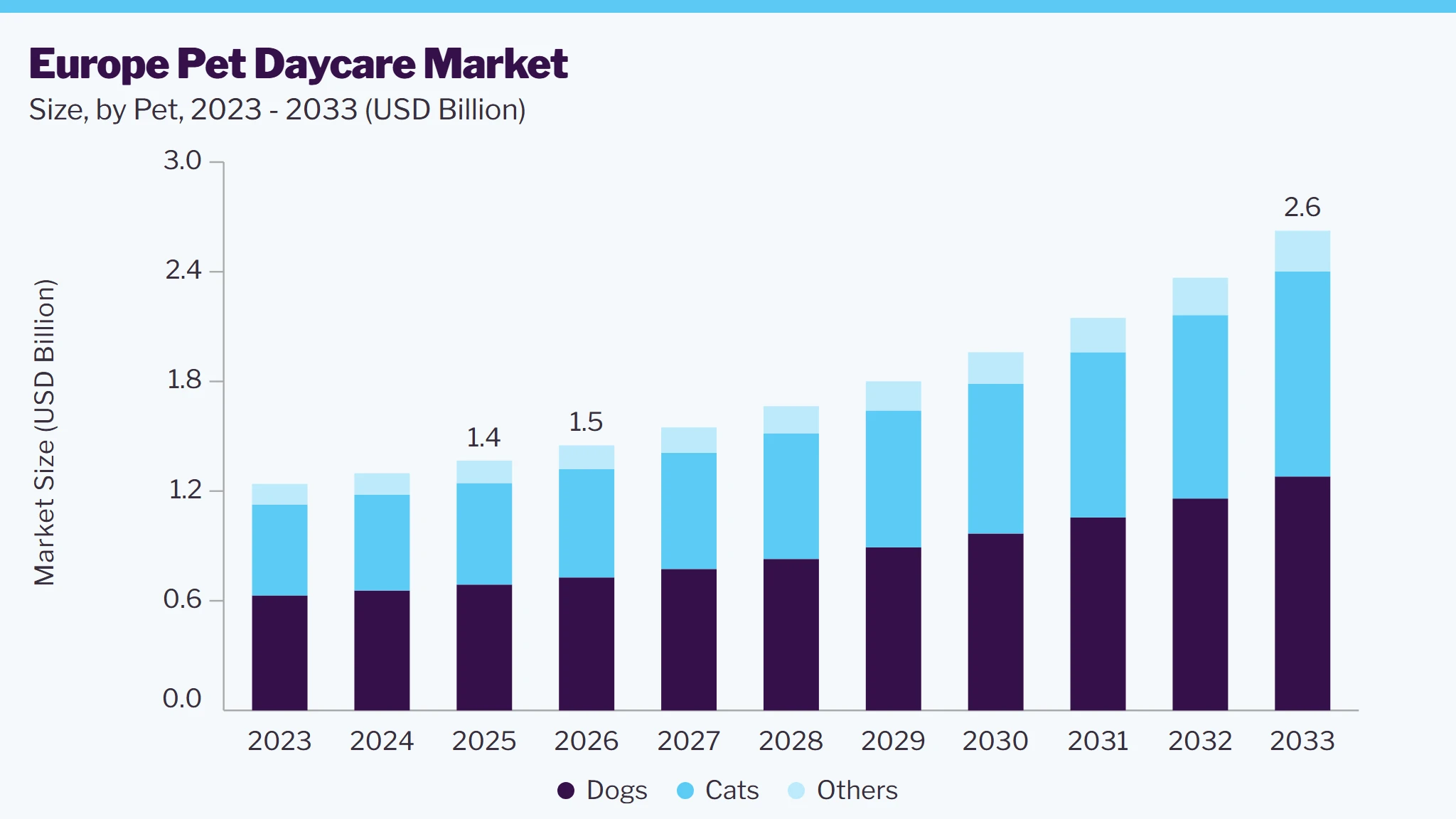
The Europe pet daycare market size was valued at USD 1.4 billion in 2025 and is projected to grow from USD 1.5 billion in 2026 to USD 2.6 billion by 2033, at a CAGR of 8.8% from 2026 to 2033. The UK dominated the market, accounting for a revenue share of 23.9% of the market in 2025. The market is driven by rising pet humanization, busy working schedules, urbanization, and increasing demand for professional animal care. Owners increasingly seek reliable daytime supervision, exercise, socialization, and enrichment activities to support their pets’ physical and emotional well-being.
Key Market Trends & Insights
- By pet: Dogs segment led the market with the largest revenue share of 50.4% in 2025.
- Based on service: Day boarding segment led the market with the largest revenue share of 51.1% in 2025.
- Based on type: Full-day pet daycare segment led the market with the largest revenue share of 59.4% in 2025.
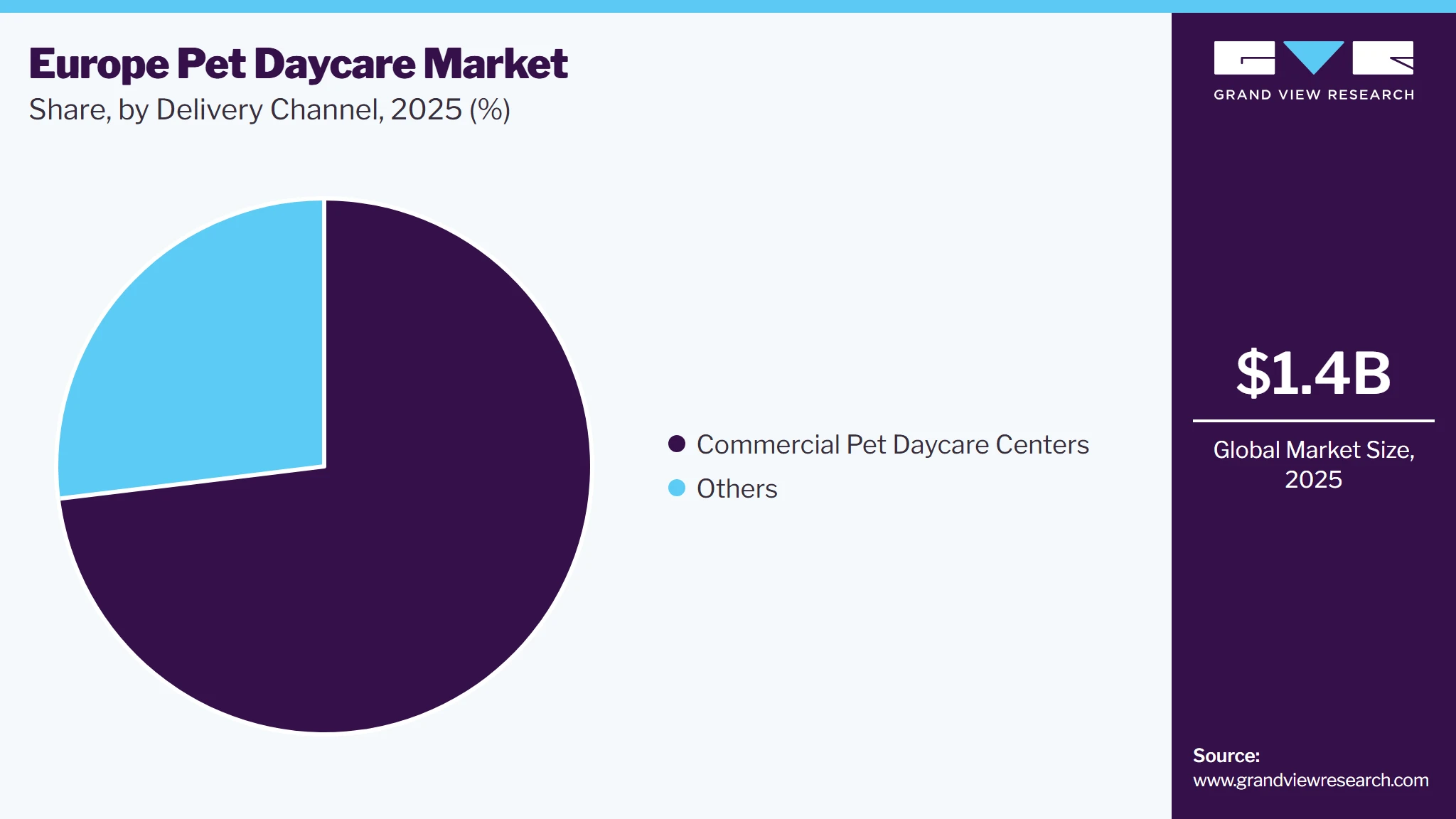
- By delivery channel: Commercial pet daycare centers segment dominated with a share of 73.1% in 2025.
Market Size & Forecast
- Market Size in 2025: USD 1.4 Billion
- Estimated market size in 2026: USD 1.5 Billion
- Projected Market Size by 2033: USD 2.6 Billion
- CAGR (2026-2033): 8.8%
Three ways to get this report
Buy it, customize it, or ask a question.Ask an Analyst
Analyst response in 1 business day
- AccessReport author, directly
- Reply timeWithin 1 working day
- No sales callDirect answer only
- FormatEmail reply
- CostFree, no cost
Get the Full Report
What the study covers
- FormatsPDF · Excel · Dashboard
- Timeline2026–2033 annual, 2025 base
- Coverage20+ countries, 5 regions
- Companies10+ key players profiled
Customize the Report
20% free customization
- IncludeCountries, segments, points
- TailorTo your product definition
- ExtendDeeper competitor detail
- OrA fully bespoke study
- Turnaround5–10 working days
 Source: Grand View Research, IR Documents, Primary Interviews, Paid DatabasesTo learn more about this report,
 Download Free Sample Report
Market Dynamics
The Europe pet daycare market is evolving toward flexible, specialized, and technology-enabled care, as owners seek convenient alternatives to leaving pets unattended during working hours or travel. Providers are diversifying their offerings through hourly bookings, supervised enrichment, behavioral activities, and integrated grooming or transportation services. For instance, digital platforms such as Pawshake help owners connect with local pet sitters, while dedicated daycare centers differentiate themselves through structured play, trained staff, and purpose-built facilities.
However, market development is constrained by rising wages, rental costs, insurance, facility maintenance, and country-specific animal-welfare and licensing requirements. Noise complaints and planning restrictions can also limit facility locations, particularly in residential and environmentally protected areas. Consequently, providers that balance operational efficiency, regulatory compliance, flexible pricing, and consistent care quality are better positioned to compete and expand across European markets.
Rising pet humanization and premiumization are driving demand in the Europe pet daycare market as owners increasingly consider pet’s family members and prioritize their welfare, socialization, and emotional well-being. According to FEDIAF’s 2026 European Facts & Figures, based on 2024 data, 140 million European households, representing 49% of households, own at least one pet, while Europe has approximately 91 million dogs and 111 million cats. This large pet-owning population creates opportunities for professional daycare providers offering supervised play, enrichment activities, individualized attention, and structured rest.
Premiumization is further reflected in specialized facilities that combine daycare with grooming, behavioral training, and wellness services. For instance, London-based WagWorks offers membership-based daycare packages alongside grooming, training workshops, and routine healthcare. Such offerings illustrate how owners’ willingness to invest in comprehensive pet care can support premium pricing, recurring bookings, and market growth, although pet ownership statistics alone do not quantify daycare spending directly.
High operating costs and substantial upfront investment pose significant restraints on the Europe pet daycare market, particularly for independent operators and new entrants. Establishing a facility requires expenditure on suitable premises, secure indoor and outdoor play areas, durable flooring, ventilation, sanitation equipment, insurance, and licensing, while recurring costs include staff wages, utilities, cleaning supplies, and animal welfare compliance. For instance, in England, commercial dog daycare operators must obtain a local authority license and meet prescribed staffing, space, hygiene, and safety standards, adding to operational expenses. These fixed costs can pressure profit margins, especially during the initial period when customer numbers and facility occupancy are still growing, and may limit expansion into high-rent urban locations.
Additionally, high operating costs and initial investment can constrain pet daycare operators due to planning restrictions, licensing requirements, noise-control measures, and the need for suitable facilities. For instance, in September 2026, a dog daycare business at Wragby Grange in Wakefield, England, lost an appeal against restrictions on animal exercising following council concerns about barking and breaches of planning conditions. This case highlights how regulatory disputes and site-compliance requirements can create additional costs and operational uncertainty for daycare businesses.
The pet daycare market in Europe presents opportunities through flexible hourly bookings, customized daycare packages, and premium services tailored to pets’ individual needs. Demand for enrichment activities, supervised socialization, behavioral support, and specialized cat care can enable providers to differentiate their offerings and increase revenue per customer. Digital booking systems, real-time care updates, and online payment facilities can further improve accessibility and customer convenience. For instance, Pawshake connects pet owners with local pet sitters through its online platform, demonstrating how digital channels can simplify the discovery and booking of pet care services. Providers that combine flexible pricing, reliable animal welfare standards, and convenient digital access can attract a broader customer base and strengthen repeat bookings across European markets.
Pricing Analysis by Service Type
Country
Pet daycare / day
Day boarding / night
Dog walking
Pet grooming / session
UK
USD 34-USD 40
USD 20-USD 67
USD 17-USD 38
USD 40-USD 90
France
USD 30-USD 52
USD 30-USD 65
USD 20-USD 33
USD 44-USD 82
Germany
USD 25-USD 46
USD 22-USD 49
USD 16-USD 27
USD 46-USD 87
Netherlands
USD 25-USD 46
USD 30-USD 65
USD 21-USD 27
USD 46-USD 82
Spain
USD 25-USD 46*
USD 22-USD 49
USD 16-USD 27*
USD 27-USD 52
• Premium pricing in Western Europe: The UK, France, Germany, and the Netherlands offer opportunities for premium daycare services, particularly in large cities where labor and property costs can be higher. Published UK and French daycare rates demonstrate that service positioning and included activities can materially affect prices.
• Major European cities can command higher prices due to rent, staffing, and demand for convenient pet care. The UK, for instance, has published full-day daycare guides of Euro 20 to Euro 40, equivalent to approximately USD 27-USD 54 at the assumed exchange rate.
• Daycare and boarding have different pricing structures: Daycare typically covers daytime supervision, while boarding includes overnight accommodation. Providers should avoid comparing their prices without accounting for hours of care, accommodation, and meals.
• Grooming provides an additional revenue opportunity: Grooming prices vary with dog size, coat condition, and service complexity. Bundling grooming with daycare may help operators increase spending per customer, where demand and operational capacity support it.
Service type
Typical price in Europe (USD)
Pricing unit
Market positioning
Pet daycare
USD 26-USD 46
Per day
Core recurring service
Day boarding / overnight boarding
USD 32-USD 64
Per night
Higher price due to overnight accommodation
Dog walking
USD 16-USD 29
Per 1-hour walk
Flexible, on-demand service
Pet sitting at home
USD 12-USD 21
Per hour
Personalized care at the pet owner's home
• Boarding can generate higher revenue per booking. Overnight boarding typically costs more than daytime daycare because it involves extended supervision and accommodation. Operators can offer both services to serve customers' daily-care and travel-related needs.
• Bundled services can increase customer spending. Combining daycare with walking, grooming, or training can differentiate providers and create opportunities to increase average revenue per customer.
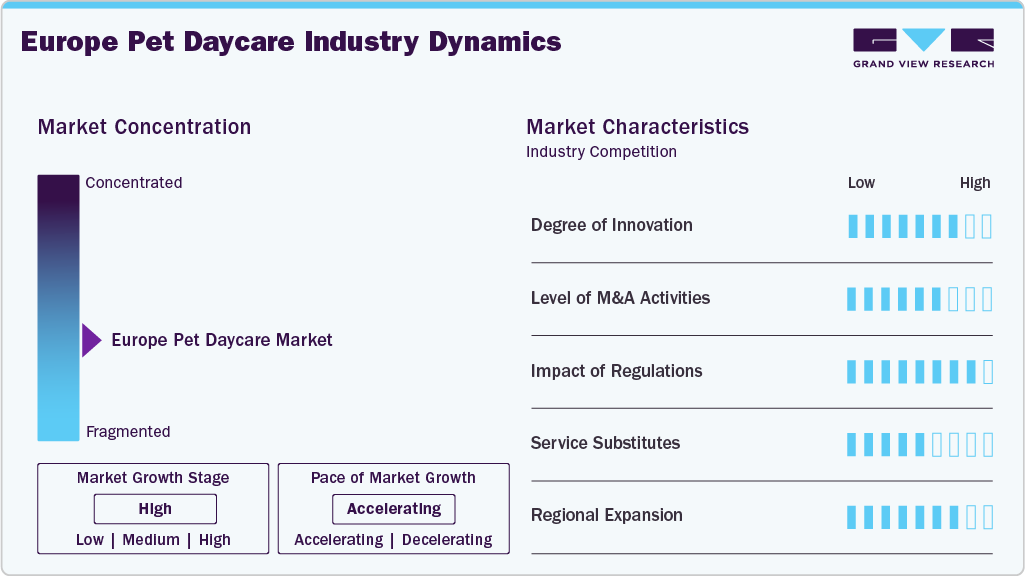
Market Concentration & Characteristics
The Europe pet daycare industry is highly fragmented, comprising independent daycare centers, regional operators, pet care chains, and digital booking platforms, with no single player dominating the entire market. Key players, including Rover, Pets at Home, and Dogtopia, compete through service diversification, digital booking, partnerships, and geographic expansion. Their strategies increasingly emphasize personalized care, trained staff, transparent service quality, and convenient booking experiences to improve customer retention. Digital platforms and demand for specialized services are creating additional opportunities for expansion, although high operating costs and competition from informal and home-based providers remain challenges.
The pet daycare industry in Europe demonstrates a moderate and evolving degree of innovation, driven primarily by digitalization, service diversification, and improvements in pet care quality. Service innovation includes enrichment-based play, behavioral activities, personalized care plans, and integrated offerings such as grooming, transportation, and boarding. Additionally, investments in staff training, pet safety protocols, and technology-enabled facility management are helping providers differentiate their services and strengthen customer retention.
 To learn more about this report, Download Free Sample Report
The market is characterized by selective consolidation and strategic expansion, rather than a clearly established wave of large-scale mergers and acquisitions (M&A). Larger pet care groups and service platforms can expand their geographic reach, customer base, and service portfolios by acquiring regional operators or integrating complementary services such as boarding, grooming, and pet sitting. M&A activity is particularly relevant in a fragmented market where independent providers offer opportunities for regional consolidation. However, the level of activity specifically targeting European pet daycare remains difficult to quantify separately from the broader pet care sector.
Regulations have a significant impact on the industry by establishing standards for animal welfare, hygiene, staffing, safety, and disease prevention. In England, the Animal Welfare (Licensing of Activities Involving Animals) (England) Regulations 2018 require commercial dog daycare businesses to obtain a local authority license and meet prescribed welfare standards. For instance, licensed facilities must provide suitable rest areas, competent staff, appropriate supervision, enrichment, and documented health and emergency procedures. These requirements increase compliance, staffing, and facility costs, but can also strengthen consumer trust and professionalize service delivery. Regulatory requirements vary across European countries; the English framework is a national instance, not a uniform Europe-wide licensing rule.
Product substitutes in the industry include in-home pet sitting, dog walking, pet boarding, informal care by family or friends, and pet-sitting platforms that provide alternatives to center-based daytime care. For instance, platforms such as Rover connect owners with local sitters offering home visits and pet care, while professional dog walkers provide exercise and supervision without full-day daycare attendance. In-home care is particularly attractive for cats and pets that experience stress in unfamiliar group environments. The threat of substitutes is moderate to high, as these alternatives offer flexibility and convenience; however, dedicated daycare centers retain an advantage through structured socialization, supervised group activities, and purpose-built facilities.
Regional expansion is driven by rising pet ownership, urban lifestyles, and demand for professional daytime pet care, particularly in major cities and densely populated urban areas. Providers typically expand through new facility openings, franchising, partnerships, and digital platforms that connect pet owners with local daycare providers. Expansion opportunities are strongest where busy working households and limited daytime supervision create demand for convenient, reliable services.
Analyst Perspective
The Europe pet daycare market is a promising growth market, supported by increasing pet humanization, demand for professional pet care, and busy urban lifestyles. Dedicated commercial daycare centers and full-day boarding services are expected to remain important revenue contributors, while hourly daycare and ancillary services offer opportunities for faster growth through flexible, personalized care. Digital booking platforms, service diversification, and regional expansion can help providers strengthen market reach and customer retention. However, rising labor and facility costs, regulatory compliance, and competition from home-based pet sitters may pressure profitability. Overall, providers that combine reliable animal welfare standards, convenience, and differentiated services are well positioned to capitalize on evolving demand.
Pet Insights
The dogs segment held the largest share of 50.4% in 2025 in the Europe pet daycare market. The growth is due to its higher demand for supervised daytime care, exercise, and socialization compared with other companion animals. Dogs generally require regular physical activity and interaction, making daycare particularly attractive to working owners who cannot provide continuous supervision during the day. Additionally, rising dog ownership, growing pet humanization, and increasing willingness to spend on professional canine care services support the segment’s dominant market position. Among dog types, small-breed dogs are a key contributor to demand because they are well suited to urban living, where limited living space and busy lifestyles can increase reliance on external daycare services. Their portability and ease of accommodation in urban households also support widespread ownership, while owners’ close emotional attachment to companion dogs encourages spending on professional care, safety, and enrichment services.
The cats segment is the fastest growing with a CAGR of 9.6% over the forecast period, driven by increasing cat ownership, urbanization, and rising expenditure on companion animal care. Growing demand for professional cat-sitting, supervised care, and specialized boarding options is expected to support adoption among owners who travel or work long hours. Additionally, increasing pet humanization and the expansion of cat-friendly care facilities offering stress-minimizing environments and individualized attention are likely to accelerate demand for cat daycare services across Europe.
Service Insights
The day boarding segment held the largest share of 51.1% in 2025 in the Europe pet daycare market, driven by demand from working professionals and busy households requiring reliable, full-day supervision for their pets. The service combines supervised play, exercise, socialization, feeding, and rest within a single booking, offering a convenient alternative to leaving pets unattended for extended periods. Growing pet humanization and the preference for professional, structured daytime care further support demand for day boarding services.
The other services segment is anticipated to grow at the fastest CAGR of 13.9% over the forecast period. The projection is supported by increasing demand for personalized, flexible, and value-added pet care services. Growing pet humanization and owners’ focus on pets’ physical activity, mental stimulation, and well-being are expected to boost demand for enrichment activities, supervised play sessions, and behavioral support. Additionally, convenient add-on services such as feeding and pet transportation enable providers to meet diverse owner needs, diversify revenue streams, and strengthen customer retention.
Type Insights
The full-day pet daycare segment dominated the market with share of 59.4% in 2025, as it caters to owners requiring continuous pet supervision during full working days and extended periods away from home. It offers comprehensive care, including supervised play, exercise, socialization, feeding, and rest, making it a practical option for working professionals and busy households. Compared with half-day services, full-day daycare also generates higher revenue per booking and supports recurring weekday attendance, contributing to its larger market share.
Moreover, the hourly-based pet daycare segment in the Europe pet daycare market is expected to grow at the fastest CAGR, as pet owners increasingly seek flexible, pay-as-you-go care that fits irregular work schedules, short errands, social commitments, and brief periods away from home. Compared with full-day packages, hourly bookings allow customers to pay only for the care they need, making daycare more accessible for occasional users and first-time customers. The expansion of digital booking options and demand for convenient, short-duration pet supervision may further support segment growth.
Delivery Channel Insights
The commercial pet daycare centers segment dominated with a share of 73.1% in 2025, due to their professional supervision, structured play, socialization, and reliable daytime care for pets while owners are at work or otherwise occupied. Dedicated facilities can accommodate multiple pets and offer standardized routines, trained staff, and purpose-built play areas, strengthening customer trust and repeat bookings. Additionally, Europe’s substantial pet-owning population-with 49% of households owning at least one pet in 2024, as per the FEDIAF report published in June 2026- provides a broad customer base for organized pet care services.
 To learn more about this report, Download Free Sample Report
The others segment is expected to grow with the highest CAGR of 9.6% over the forecast period due to the increasing availability of multi-service pet care options, including veterinary clinics, pet hotels, pet retailers, and home-based providers. These providers can leverage existing facilities, customer relationships, and complementary pet care services to attract owners seeking convenient, flexible daytime care. Growing demand for personalized care and convenient drop-off options may further support adoption beyond dedicated daycare centers. This channel also benefits from the expansion of flexible, locally accessible care models and the bundling of daycare with boarding, veterinary, or other pet services, which can help providers capture additional spending.
Country Insights
UK Pet Daycare Market Trends
The UK dominated the Europe pet daycare market, accounting for a revenue share of 23.9% in 2025. The growth is driven by a substantial dog-owning population and increasing demand for professional care, although adoption remains relatively limited: the UK government reports approximately 11.1 million pet dogs in 2025, while the Dogs Trust National Dog Survey 2025 found that fewer than one in ten dog owners had ever used daycare. This suggests potential to convert owners who currently rely on informal care into paying customers. For instance, daycare operators can target working professionals with full-day packages, flexible weekly memberships, and add-on grooming or training services. The market also presents a premium-service opportunity, but operators must manage staffing, premises, and compliance costs. In England, commercial dog daycare businesses require the relevant license, with statutory guidance specifying a maximum of 10 dogs per staff member and 6 square meters of space per dog. Overall, growth opportunities depend on converting unmet demand into repeat paid usage while maintaining affordable prices, high welfare standards, and efficient facility utilization.
Spain Pet Daycare Market Trends
Spain is expected to grow at the fastest CAGR over the forecast period in the Europe pet daycare market. The growth is largely due to rising pet ownership, increasing expenditure on pet care, and opportunities to expand formal daycare and boarding services. Spain’s government reported approximately 7.56 million registered dogs in 2025, while the total number of registered companion animals increased by 14% between 2021 and 2025, expanding the potential customer base for professional care. In addition, EAE Business School’s 2026 report estimated that pets generate €5.77 billion annually in Spain’s broader pet economy, highlighting the sector’s growing economic importance. These trends could support greater adoption of weekday daycare among working owners, flexible pet-sitting services, and boarding packages in urban and tourism-oriented locations such as Madrid, Barcelona, and coastal destinations.
Key Europe Pet Daycare Company Insights
The Europe pet daycare market is highly fragmented, comprising digital platforms such as PetBacker and Pawshake, UK-focused operators such as Bruce’s Doggy Day Care and We Love Pets, and international daycare brands such as Dogtopia Enterprises. Digital marketplaces compete through booking convenience and access to local caregivers, while physical daycare centers differentiate themselves through supervised activities, facility quality, and personalized services. These businesses represent different competitive models: PetBacker and Pawshake operate digital pet-care marketplaces; Bruce’s Doggy Day Care and other specialist centers focus on facility-based care; We Love Pets uses a broader pet-care franchise model; and Dogtopia and Pet Paradise are primarily North American competitors. Rover Group is also an important competitor: it acquired European platform Gudog in April 2025 and announced expansion into Denmark and Ireland, strengthening its European marketplace presence.
Key Europe Pet Daycare Companies
-
PetBacker
-
Brucesdoggydaycare
-
The Doggy Day Care Center Ltd
-
Oscar's Daycare Centre
-
Hunters Lodge
-
Merrist Wood’s Dog Day Care Centre
-
We Love Pets Ltd
-
Pawshake Inc.
-
Pet Paradise
-
Dogtopia Enterprises
Competitive Benchmarking
Category
Operating Strategies
Competitive Edge
Weakness
Established Global Leaders - Daycare Operators - Bruce’s Doggy Daycare, The Doggy Day Care Centre Ltd, Oscar’s Daycare Centre
- Focus on dedicated dog daycare facilities, supervised group activities, socialization, structured routines and recurring customer relationships. Some operators supplement daycare with grooming, training, transport or other services.
- Specialized daycare expertise, established local reputations, direct relationships with pet owners and greater control over the customer experience. Bruce’s differentiates itself through structured enrichment, recurring packages and dog transport at selected locations.
- High facility, staffing, insurance and maintenance costs. Geographic concentration can limit market reach, while capacity constraints, local competition and dependence on regular attendance can affect profitability.
Emerging Players - Hunters Lodge, Merrist Wood’s Dog Day Care Centre
- Emphasize supervised dog care, outdoor space, exercise, socialization and activity-led experiences. Service offerings and operating formats vary by facility.
- Access to outdoor environments and opportunities for exercise and enrichment can differentiate these providers from smaller urban facilities. Local expertise and personalized care can support customer loyalty.
- Land availability, weather conditions, operating capacity and transport accessibility may constrain expansion. Maintaining suitable facilities and meeting animal welfare and safety requirements can increase operating costs.
Recent Developments
-
In August 2026, Guernsey’s GSPCA updated its pet boarding rates, reduced booking deposits to 25%, and introduced full payment requirements before or at drop-off. The changes address rising licensing and operating costs, alongside kennel and cattery improvements under its #GSPCABiggestBuildAppeal, while the pet taxi service is now priced at £25 per journey.
-
In June 2026, Dogtopia launched its Canine Behavior Expert Council to improve dog daycare safety, enrichment, and behavior-based care across its U.S. locations. Since January 2026, the council has developed over 36 behavior-modification plans, along with training resources to support franchisees, staff, and pet parents.
-
In April 2025, Rover expanded into Denmark and Ireland and acquired European pet-care platform Gudog, whose network spans eight European countries with 20,000 sitters and walkers. The expansion strengthens Rover’s European presence, with the company planning a further USD 15 million investment over five years to support growth across the region.
Europe Pet Daycare Market Report Scope
Report Attribute
Details
Market size in 2025
USD 1.4 billion
Estimated market size in 2026
USD 1.5 billion
Projected market size by 2033
USD 2.6 billion
Growth Rate
CAGR of 8.8% from 2026 to 2033
Actual Data
2021 - 2025
Forecast period
2026 - 2033
Quantitative units
Revenue in USD billion and CAGR from 2026 to 2033
Report coverage
Revenue forecast, company ranking, competitive landscape, growth factors, and trends
Segments covered
Pet, service, type, delivery channel, country
Country scope
UK; Germany; France; Italy; Spain ;Denmark; Sweden; Norway
Key companies profiled
PetBacker; Brucesdoggydaycare;The Doggy Day Care Center Ltd; Oscar's Daycare Centre; Hunters Lodge; Merrist Wood’s Dog Day Care Centre; We Love Pets Ltd; Pawshake Inc.; Pet Paradise; Dogtopia Enterprises
Customization scope
Free report customization (equivalent up to 8 analysts working days) with purchase. Addition or alteration to country, & segment scope.
Pricing and purchase options
Avail customized purchase options to meet your exact research needs. Explore purchase options
Europe Pet Daycare Market Report Segmentation
This report forecasts revenue growth at country levels and provides an analysis of the latest industry trends in each of the sub-segments from 2021 to 2033. For this study, Grand View Research has segmented the Europe pet daycare market report based on pet, service, type, delivery channel, and country.
-
Pet Outlook (Revenue, USD Billion, 2021 - 2033)
-
Dogs
-
Small Breeds
-
Medium Breeds
-
Large Breeds
-
-
Cats
-
Others
-
-
Service Outlook (Revenue, USD Billion, 2021 - 2033)
-
Day Boarding
-
Pet Grooming & Spa Services
-
Pet Walking Services
-
Other Services
-
-
Type Outlook (Revenue, USD Billion, 2021 - 2033)
-
Hourly-based Pet Daycare
-
Full-Day Pet Daycare
-
-
Delivery Channel Outlook (Revenue, USD Billion, 2021 - 2033)
-
Commercial Pet Daycare Centers
-
Others
-
-
Country Outlook (Revenue, USD Billion, 2021 - 2033)
-
Europe
-
UK
-
Germany
-
France
-
Italy
-
Spain
-
Denmark
-
Sweden
-
Norway
-
-
Research Methodology
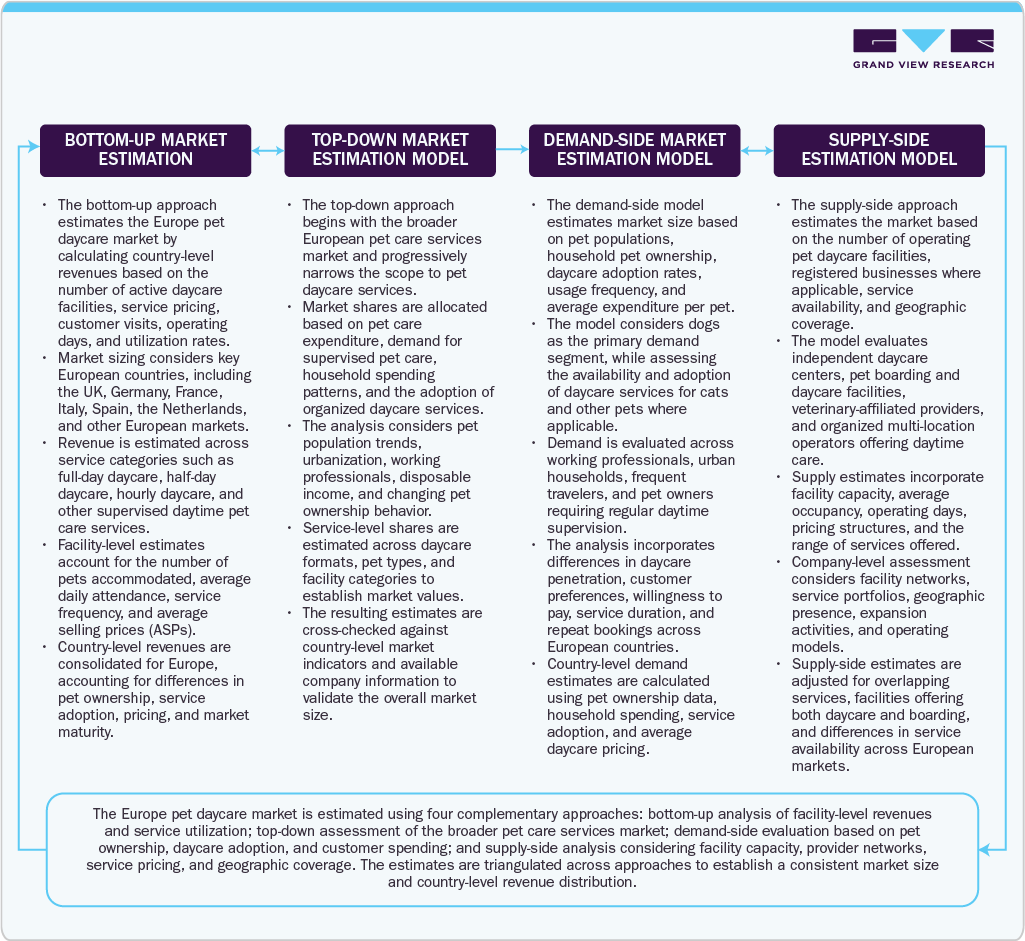
The Europe pet daycare market figures in this report are based on a proven research process that combines executive interviews with secondary research from proprietary databases, company filings, and recognized regulatory and institutional sources. Market size is built through value-chain sizing-reconciling supply-side and demand-side estimates-and triangulated with bottom-up and top-down approaches. Every estimate passes multiple levels of expert validation before publication, with eachEuropepet daycaresegment quantified using the revenue-capture definitions in the table below.
Segment Definition
Pet
Definition
Dogs
Revenue generated from pet daycare services provided for dogs, including supervised daytime care, playtime, rest, feeding, walking, and related daycare activities offered without overnight accommodation.
Cats
Revenue generated from pet daycare services provided for cats, including supervised daytime care, feeding, play, rest, enrichment, and related daytime care activities.
Others
Revenue generated from daycare services provided for pets other than dogs and cats, including small mammals, birds, and other companion animals accommodated by pet daycare providers.
Service
Definition
Day Boarding
Revenue generated from daytime boarding services in which pets are cared for and supervised for a defined period during the day, generally including feeding, exercise, rest, and supervised activities, without overnight stays.
Pet Grooming & Spa Services
Revenue generated from grooming and spa services offered to pets at daycare facilities, including bathing, brushing, nail trimming, hair trimming, coat care, and other non-medical hygiene and wellness services.
Pet Walking Services
Revenue generated from supervised pet walking and outdoor exercise services provided as part of or alongside daycare services.
Other Services
Revenue generated from additional pet daycare-related services not classified under day boarding, grooming & spa, or pet walking, including feeding services, play sessions, behavioral activities, transportation, enrichment activities, and other ancillary services.
Type
Definition
Hourly-Based Pet Daycare
Revenue generated from pet daycare services charged based on the number of hours or partial-day periods for which a pet is accommodated and supervised.
Full-Day Pet Daycare
Revenue generated from pet daycare services charged at a full-day or daily rate, generally covering extended daytime care and associated activities during the provider's operating hours.
Delivery Channel
Definition
Commercial Pet Daycare Centers
Revenue generated through dedicated commercial facilities that provide structured daytime care for pets on a paid basis, including independent daycare centers, pet-care chains, and specialized pet-care establishments.
Others
Revenue generated through non-dedicated or alternative delivery channels providing pet daycare services, including veterinary clinics, pet hotels with daytime daycare offerings, pet retailers, residential or home-based providers, and other service providers.
Estimation Model
 To learn more about this report, Download Free Sample Report
Delivered Customizations
This report has been delivered with the following In-depth customizations
Client Request
Customization Delivered
Value Adds
Market Sizing, Pricing & Volume Assessment
The study was customized to quantify the Europe pet daycare market by country, service type, pet type, and facility type. Historical analysis and forecasts were developed using pet ownership trends, daycare participation, average daily service pricing, facility capacity, utilization rates, and revenue generated from daycare services.
Enabled stakeholders to assess market size, pricing variations, demand patterns, and growth potential across European countries, supporting market entry decisions and revenue planning.
Service Type & Facility Assessment
The report was customized to distinguish between full-day daycare, half-day daycare, hourly daycare, and other daycare-related services. Facilities were assessed across independent pet daycare centers, veterinary-affiliated facilities, pet boarding and daycare centers, and other organized service providers, based on service offerings, operating models, and customer reach.
Supported the identification of high-potential service categories, facility models, and differentiation opportunities, enabling stakeholders to evaluate service expansion and business model strategies.
Country-Level Opportunity & Competitive Assessment
The study was customized to assess key European markets based on pet ownership, household spending on pets, urbanization, demand for supervised pet care, competitive intensity, and the presence of organized daycare providers. Key companies were mapped based on geographic presence, service portfolio, pricing, facility network, and business expansion activities.
Enabled targeted country prioritization, competitor benchmarking, identification of underserved markets, and assessment of opportunities for geographic expansion and service differentiation.
About the Author(s)
Animal Health Research Team
Healthcare · Animal HealthThis report was authored by the animal health research team at Grand View Research - comprising two research analysts, one senior research analyst, and one industry expert - with specialized expertise in the animal health segment of the healthcare industry. All findings are based on proprietary healthcare databases, executive interviews, and regulatory analysis, subject to internal peer review prior to publication.
Last Updated:
Speak to Analyst

Customize this report to your needs - add regions, segments, or data points, with 20% free customization.
Or view our licence options:


ISO 9001:2015 & 27001:2022 Certified
We are GDPR and CCPA compliant! Your transaction & personal information is safe and secure. For more details, please read our privacy policy.


