
- Home
- »
- Next Generation Technologies
- »
-
Event Management Software Market Size, Share Report 2033GVR Report cover

Event Management Software Market (2026 - 2033)
Size, Share & Trends Analysis Report By Component (Software, Services), By Deployment (Cloud-based, On-premise), By Enterprise Size, By Application (Event Organizers & Planners, Corporate), By Region, And Segment Forecasts
Market Size, 2025
$16.0BMarket Estimate, 2026
$18.4BMarket Forecast, 2033
$39.6BCAGR, 2026–2033
11.5%Event Management Software Market Summary
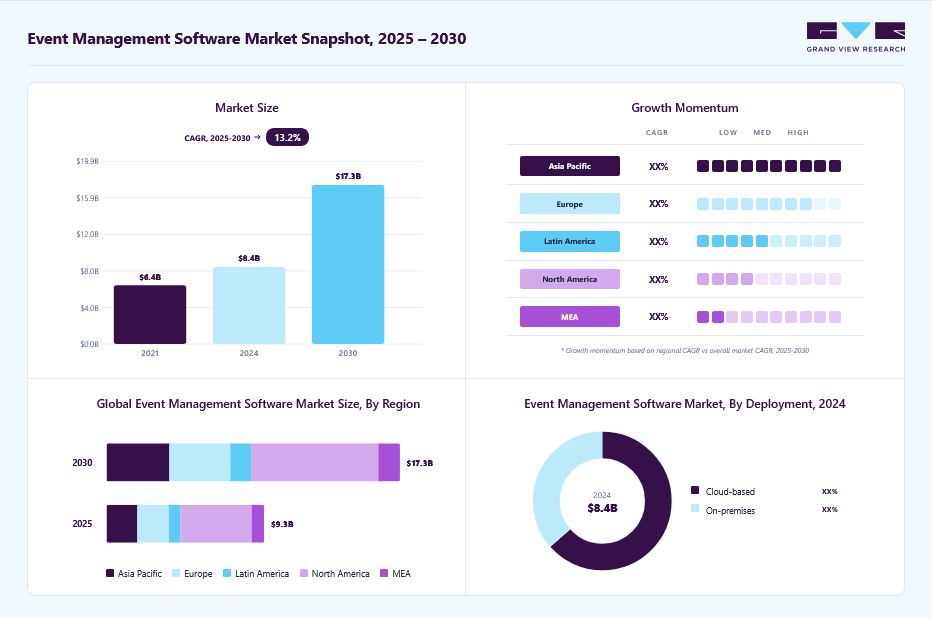
The global event management software market size was valued at USD 16.0 billion in 2025 and is projected to grow from USD 18.4 billion in 2026 to USD 39.6 billion by 2033, at a CAGR of 11.5% from 2026 to 2033. The North America dominated the global market, accounting for the largest revenue share of 45.0% in 2025. With the proliferation of technology, event management software has strong data-handling attributes.
 Source: Grand View Research, IR Documents, Primary Interviews, Paid DatabasesTo learn more about this report,
 Download Free Sample Report
 Key Market Trends & Insights
- By component: Software segment accounted for the largest market share of over 64.6% in 2025
- By deployment: Cloud-based segment held the largest market share of over 64.1% in 2025.
- By enterprise size: Large enterprise segment dominated the market share of over 53.2% in 2025.
Regional Highlights
- Largest regional market: North America (45.0% revenue share, 2025)
- Fastest-growing regional market: Asia Pacific (highest CAGR, 2026-2033)
- By country: The U.S. held the largest market share in 2025.
Market Size & Forecast
- Market size in 2025: USD 16.0 Billion
- Estimated market size in 2026: USD 18.4 Billion
- Projected market size by 2033: USD 39.6 Billion
- CAGR (2026-2033): 11.5%
Three ways to get this report
Buy it, customize it, or ask a question.Ask an Analyst
Analyst response in 1 business day
- AccessReport author, directly
- Reply timeWithin 1 working day
- No sales callDirect answer only
- FormatEmail reply
- CostFree, no cost
Get the Full Report
What the study covers
- FormatsPDF · Excel · Dashboard
- Timeline2026–2033 annual, 2025 base
- Coverage20+ countries, 5 regions
- Companies10+ key players profiled
Customize the Report
20% free customization
- IncludeCountries, segments, points
- TailorTo your product definition
- ExtendDeeper competitor detail
- OrA fully bespoke study
- Turnaround5–10 working days
It enables event managers to gather and evaluate data on participant population demographics, opinions, and behavior. The data gathered can assist event organizers in making informed choices, enhancing future events, and customizing the overall experience to the needs of participants is driving the event management software industry’s growth. Event management has grown in importance globally as the range of worldwide conferences, exhibits, and cultural events has increased. Cultural variations, communication hurdles, and foreign logistics are all managed by event organizers. They play an important role in planning events that cater to varied audiences and ensure cross-border activities run effectively.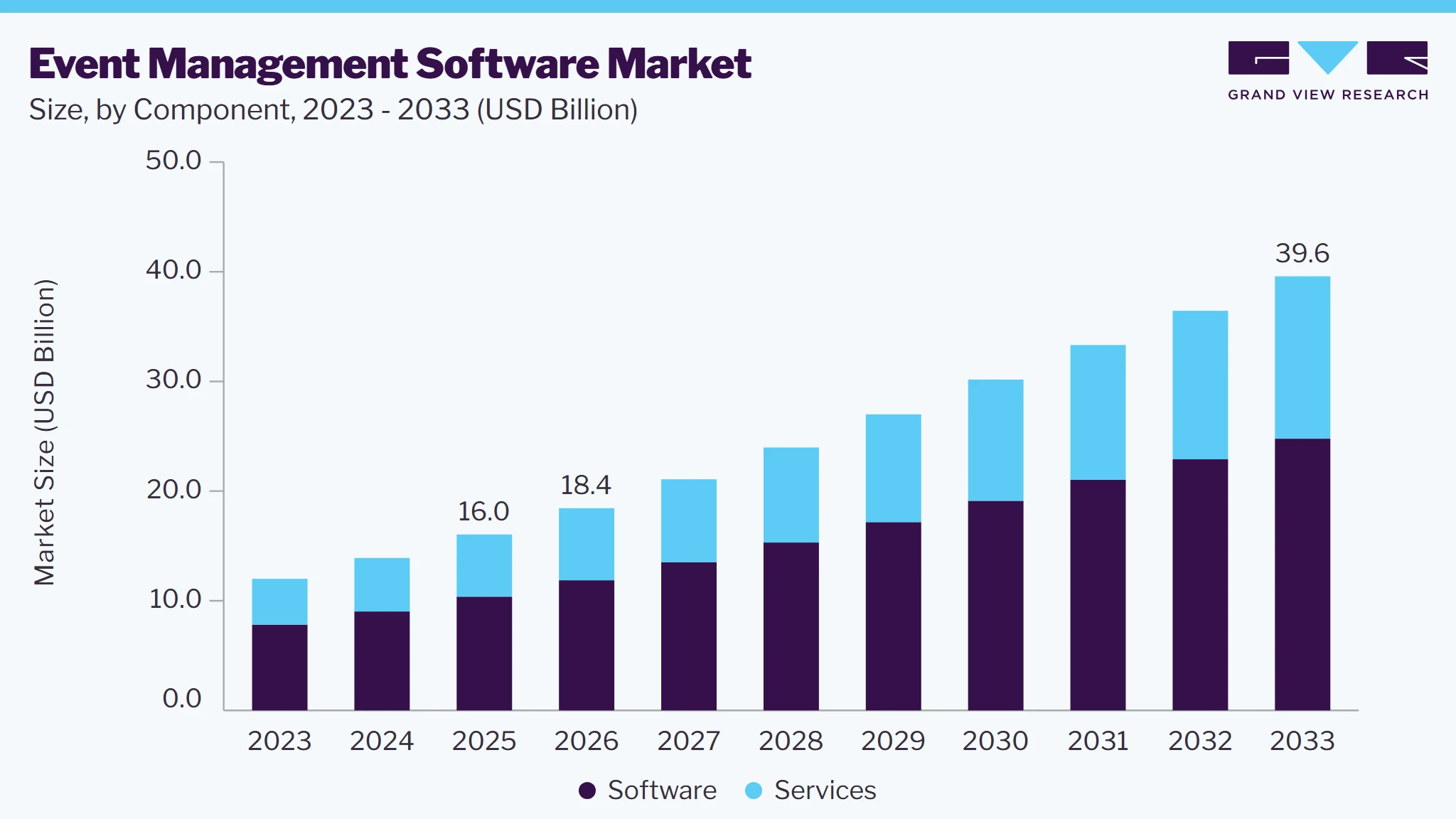 To learn more about this report, Download Free Sample Report
 The strong emphasis various event planners put on implementing automation and making data-driven decisions for business growth is poised to drive market growth over the forecast period. Event management software facilitates various tasks, including event planning, event marketing, analytics & reporting, and venue & ticket management. As such, market players are offering event management software tailored to the specific requirements of end users as part of their efforts to augment revenues and strengthen brand positioning. For instance, in June 2023, capital market access platform Q4, Inc. introduced the Event Management App to its Q4 Platform. The Event Management App enables streamlined event preparation, reporting, and management for various events, such as investor days and earning days, on the clients’ IR calendars.
Artificial intelligence (AI) and machine learning (ML) are revolutionizing many elements of event management. AI-powered chatbots and digital assistants can answer guest inquiries, offer event details, and provide customized suggestions. Automation technologies can help companies reduce time by automating email marketing, social media time management, and statistical entry tasks. Interactive event engagements are gradually being created using AR and VR technologies. AR can provide fun and interactive elements by adding digital content to the physical event venue. Attendees can utilize VR to discover virtual settings while participating in virtual presentations, outings, or games. These technologies provide events with a new dimension by allowing visitors to examine items, venues, or ideas in a more collaborative and realistic method.
The initial costs of using event management software usually include licensing expenses, customization, and coaching. These costs can be expensive for small firms with limited resources. Furthermore, ongoing upkeep and subscription charges may put an additional burden on the budget, particularly for ongoing activities or firms with an increased activity frequency.To facilitate online registration and ticket sales, event management software frequently interacts with payment gateways. Visitors are able to navigate to the event website or registration platform and choose their desired tickets or registration options.
The increased emphasis on sustainability and eco-friendly methods will impact the event management software industry. Green event management software will include features that reduce paper waste via digital applications, purchasing tickets, and interaction. Sustainability measurement and reporting capabilities will be embedded in event management software to assess and track environmental effects, which is expected to propel the market in the forecasted period.
Market Dynamics
Event management software is gaining traction as organizations increasingly rely on digital platforms for event planning, attendee registration, ticketing, venue management, marketing automation, networking, and post-event analytics. These solutions enable event organizers to streamline operations, enhance attendee engagement, and improve event outcomes through real-time data visibility and workflow automation. The growing adoption of hybrid and virtual events, coupled with increasing demand for personalized attendee experiences and data-driven event management, is expected to continue driving growth in the event management software market.
The increasing adoption of digital event planning and management solutions is driving growth in the event management software market, as organizations seek more efficient ways to plan, coordinate, and execute events of varying sizes and formats. Traditional event management processes often involve manual scheduling, registration handling, communication, and resource allocation, which can be time-consuming and prone to errors. Event management software automates these functions through centralized digital platforms, improving operational efficiency and event execution. These solutions enable organizers to manage attendee registration, ticketing, venue logistics, vendor coordination, and event analytics from a single interface. As organizations increasingly digitize event operations, demand for event management software continues to grow significantly.
The recurring subscription expenses associated with cloud-based event management solutions contribute to this restraint. Many software providers operate on subscription-based pricing models that charge fees based on the number of users, events, attendees, or feature packages. While these models provide flexibility and scalability, the cumulative cost can become substantial for organizations that host multiple events annually. Additional charges for premium functionalities, virtual event modules, advanced analytics, and third-party integrations further increase total expenditure. For smaller organizations, these recurring costs can create long-term financial challenges. Consequently, budget constraints often delay or prevent software adoption.
The integration of Internet of Things and smart venue technologies is expanding opportunities for event management software providers. IoT-enabled devices, such as smart badges, attendance-tracking systems, occupancy sensors, and interactive kiosks, generate real-time event data that can be integrated with virtual event platforms. This allows organizers to monitor attendee engagement, manage venue capacity, and personalize event experiences across both physical and digital environments. The combination of smart venue infrastructure and hybrid event technology enhances operational efficiency and attendee satisfaction. As connected event ecosystems become more common, demand for integrated event management solutions is expected to rise.
Analyst Perspective
The event management software market sits at a favorable intersection of digital transformation, rising demand for scalable event experiences, and the growing need for measurable return on event investments. The central competitive moat, however, will belong to the provider that integrates event planning, attendee engagement, marketing automation, networking capabilities, and analytics into a unified platform, transforming event management from a logistical function into a strategic business tool that delivers actionable insights, stronger audience engagement, and sustained value across physical, virtual, and hybrid event formats.
Component Insights
Based on component, the software segment led the market with the largest revenue share of 64.6% in 2025. The segment growth is attributed to a wide range of tools and capabilities to manage numerous components of event planning. It consists of event selection, financial management, conference scheduling, logistical management, vendor management, and task monitoring. The rise of hybrid and virtual events has resulted in the creation of software solutions designed solely for handling these types of events. For instance, virtual exhibitor booths, chat functionality, live broadcasting, and content distribution are all accessible via virtual event platforms. Event organizers can utilize these platforms to create influencing and engaging digital journeys for visitors.
The services segment is expected to register the highest CAGR over the forecast period.Event management software services provide detailed knowledge and a specialized understanding of event planning, organization, and performance. Professional event planners have expertise in event logistics, current trends, standard procedures, and innovative methods. Their expertise and skills help to guarantee that events are well-planned, efficiently performed, and connected with the client's aims and objectives. Event management software services include promotional and marketing techniques to increase event participation and attract the target audience.
Deployment Insights
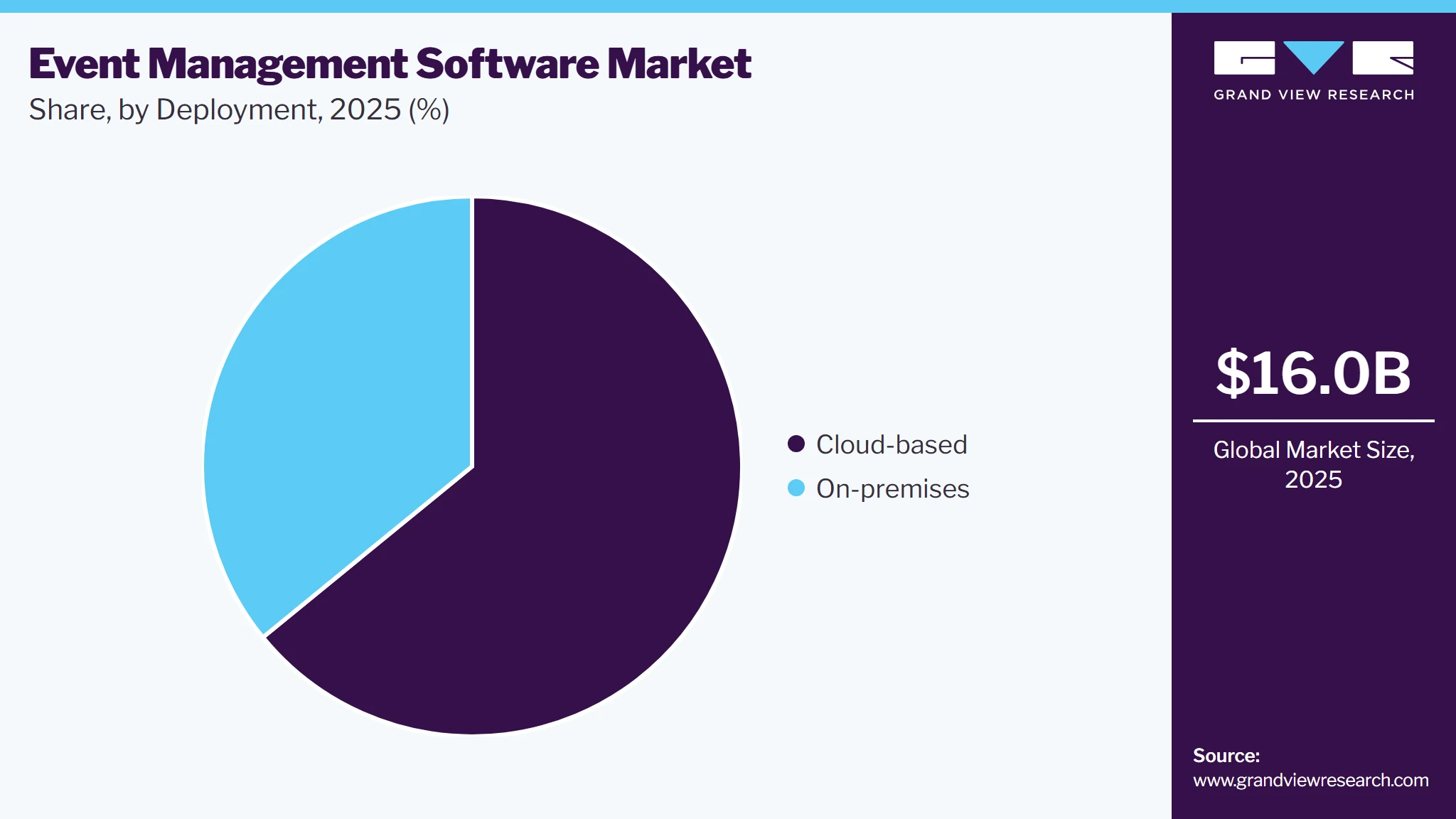
Based on deployment, the cloud segment led the market with the largest revenue share of 64.1% in 2025. Cloud-based event management software permits customers to use the platform with a broadband connection from any location. Event planners, administrators, and participants can use the program on various devices, including PCs, tablets, and smartphones. This flexibility facilitates real-time communication, notifications, and event management on an ongoing basis. Cloud-based event management software is built to provide high availability and consistent performance, reducing the chance of interruption during key event operations.
 To learn more about this report, Download Free Sample Report
 The on-premises segment is expected to grow at a CAGR of 10.9% over the forecast period. Organizations gain full control over their event data using on-premises software as it is stored within their private infrastructure. Since the data does not reside in an outside cloud environment, it has better personal information security and compliance control. Organizations with on-premises software have greater flexibility over modification and configuration possibilities. They can customize the platform to match its unique event management requirements, procedures, and integration needs with other internal applications.
Enterprise Size Insights
Based on enterprise size, the large enterprises segment led the market with the largest revenue share of 53.2% in 2025. Large enterprises aim to provide superior service to their guests, including clients, staff members, or industry experts. Corporate event management software aids resource allocation, planning, supplier contracts, logistical coordination, and real-time updates. Large enterprises often organize various events, ranging from meetings and conferences to trade exhibitions and product launches. Event management software facilitates identification, ticketing, attendance management, logistical coordination, and reporting.
The SMEs segment is expected to register the highest CAGR over the forecast period. The segment's expansion can be ascribed to the increasing number of small & medium enterprises (SMEs) in countries such as India, the U.S., and China. During events, SMEs often aim to portray an expert image and provide a pleasant brand experience. Event management software provides forms for registration, email designs, configurable event sites, and branding options to assist small businesses in presenting a professional and logical image to customers. This professional image boosts their credibility and can positively affect client perception.
Application Insights
Based on application, the event organizers & planners segment led the market with the largest revenue share of 40.1% in 2025. Depending on its features, event organizers and planners frequently use event management software to organize, prepare, and execute events. They use the platform to manage the registration process, participant engagement, advertising, logistics collaboration, and analytics. Event organizers' and planners' desire for effective, user-friendly, and feature-rich software solutions drives development and creativity in the market.
The corporate segment is expected to grow at the highest CAGR from 2025 to 2030. Corporate events often demand high reliability, accuracy, and focus on small details. It enables organizations to simplify operations, automate jobs, and provide an ongoing and expert approach to handling events. Corporate enterprises prioritize data security and compliance with privacy legislation. Many corporate organizations are present at worldwide events across multiple locations. Highly confidential data, such as customer data, financial details, and intellectual property, is often displayed during corporate events. Data security is prioritized by event management software, ensuring conformity with privacy laws and business standards.
Regional Insights
North America dominated the event management software market with the largest revenue share of 45.0% in 2025. North America is known worldwide for technological developments and early adopters of new solutions. Event management software vendors in the region supply innovative and feature-rich software solutions by integrating cutting-edge technologies such as cloud hosting, Machine Learning (ML), Artificial Intelligence (AI), data analytics, and mobile applications. In North America, event management software is employed across various sectors, such as corporate, government, healthcare, education, non-profit, and entertainment. These sectors depend on event management software to boost event experiences, improve procedures, enhance consumer engagement, and meet event targets.
 To learn more about this report, Download Free Sample Report
 U.S. Event Management Software Market Trends
The event management software market in the U.S. held the largest share in the North America region in 2025. The U.S. market growth can be attributed to the rising initiatives taken by the government to improve the digitalization ecosystem. Adopting sophisticated event management solutions for applications such as real-time data reporting, collecting online payments, and organizing housing and travel preferences is expected to boost market growth. Industry players operating in the country are focused on improving their product portfolio by raising funds.
Europe Event Management Software Market Trends
The event management software market in Europe is expected to register a CAGR of 11.6% from 2025 to 2030. The growing number of events, such as stand-up comedy shows, tradeshows, musical concerts, and product launches, is a major factor driving market growth in Europe. Event management software is widely used in many international music festivals, such as the Sziget Festival, Tomorrowland, and Glastonbury Festival, bringing traction in the European market.
The UK event management software industry is expected to grow rapidly in the coming years. The market is booming owing to the rising use of event management tools in conferences, festivals, exhibitions & fairs, fundraising & social events, and promotion & product launches. Furthermore, private education centers and universities offer event management courses to help students pursue careers in this sector, creating robust market opportunities. Industry players emphasize improving their brand identity by launching event management platforms for nonprofit organizations and charitable trusts.
The event management software market in Germany held a substantial market share in 2024. The country’s market growth can be attributed to the increasing digital transformation of society and the thriving entertainment sector. The countries’ consumer demographics are shifting rapidly with evolving lifestyles and digital preferences.
Asia Pacific Event Management Software Market Trends
The event management software market in the Asia Pacific is growing significantly at a CAGR of over 15.3% from 2025 to 2030. The region's enormous population, developing economy, and rising technological adoption contribute to the market's expansion. The market is expanding as regional firms discover the advantageous features of event management software. The region's thriving tourism industry and increased corporate events drive demand for event management software services that help accelerate event planning, execution, and guest management.
China event management software industry held a substantial market share in 2024. Significant digitization and the availability of a larger audience are driving market growth in China. Supportive initiatives taken by the government to improve the digital ecosystem are also expected to create lucrative opportunities for the market.
The event management software industry in Japan held a considerable market share in 2024. Market growth can be attributed to the shifting focus of various end-user companies on organizing events to improve their connection with customers. Moreover, the market is driven by rising research and development (R&D) investments in technological advancements in event management software and the increasing popularity of virtual events.
India event management software industry is growing rapidly due to the significant presence of market players and the rising number of international conventions in the country. Companies operating in the Indian event management market emphasize strengthening their product portfolio and increasing their market share. For instance, in February 2023, Country Holidays Travel India launched event management and banquets & destination wedding services. The new services will be available for Diwali events, birthday parties, dandiya night celebrations, New Year events, and summer & winter vacations, among others.
Key Event Management Software Company Insights
The key market players in the global market include Cvent, Inc., EventBrite, Whova, Certain, Inc., and Zoho Corporation Pvt Ltd, among others. Companies in the market are investing resources in research & development activities to support growth and enhance their internal business operations. Moreover, companies can engage in mergers & acquisitions and partnerships to further upgrade their products and gain a competitive advantage in the market. They are effectively developing new products and enhancing existing products to acquire new customers and capture more market share.
Key Event Management Software Companies:
The following key companies have been profiled for this study on the event management software market.
-
Active Network LLC
-
Arlo
-
Stova
-
Bitrix24
-
Eventdex.com
-
Hopin
-
webMOBI
-
Whova
-
Certain, Inc.
-
Cvent, Inc.
-
EMS Software LLC
-
EventBrite
-
Rainfocus
-
Ungerboeck
-
Zoho Corporation Pvt Ltd
Competitive Benchmarking
Category
Operating Strategies
Competitive Edge
Weakness
Established Players (Cvent; Eventbrite; Bizzabo; Hubilo; Certain)
- Mature players in the event management software market focus on end-to-end event planning and execution platforms. They integrate registration, ticketing, attendee engagement, and analytics tools. Their solutions support in-person, virtual, and hybrid events. They also expand through enterprise contracts and global event partnerships.
- Mature players benefit from strong brand recognition and large customer bases. Their platforms offer comprehensive event management capabilities in a single system. Advanced analytics and engagement tools improve event outcomes. Extensive partner ecosystems strengthen customer retention.
- These platforms often involve higher subscription and implementation costs. Complex feature sets can increase learning and onboarding time. Customization may require additional technical support and resources. Large platform structures can slow feature deployment and updates.
Emerging Players (Airmeet; Hopin; Whova; vFairs; EventMobi)
- Emerging players focus on cloud-based and engagement-driven event platforms. They emphasize networking, audience interaction, and hybrid event experiences. Many integrate AI-powered matchmaking and event analytics features. Their strategy targets flexibility and rapid deployment for organizers.
- Emerging players offer user-friendly platforms that can be implemented faster. Their solutions are highly adaptable for virtual and hybrid event formats. A strong focus on attendee engagement increases event participation. They also innovate quickly with new digital event features.
- Emerging players have limited enterprise penetration compared to established vendors. Their platforms may lack extensive integrations with large corporate systems. Global brand visibility remains lower in highly competitive markets. Resource constraints can limit large-scale expansion and product development.
Recent Developments
-
In February 2025, Eventdex.com, a provider of event management software, launched an integrated event suite to enhance event experience, operational efficiency, and event planning. The suite combines three tools: Gala Event Seating Software, Custom Event Badge Printing Software, and Event Floor Plan Software.
-
In September 2024, Stova, an event management technology provider, launched an exhibitor management solution named Exhibitor Resource Center (ERC) for event professionals, sponsors, and exhibitors. ERC features include task management, sponsorship management, actionable insights, and seamless integration with other systems and tools.
-
In April 2023, Eventdex.com announced a strategic partnership with One World Rental, an event technology rental company offering laptops, iPads, and VR event equipment. This collaboration will strengthen Eventdex.com’s event management solution offerings, including software and hardware.
Event Management Software Market Report Scope
Report Attribute
Details
Market size in 2025
USD 16.0 billion
Estimated market size in 2026
USD 18.4 billion
Projected market size by 2033
USD 39.6 billion
Growth rate
CAGR of 11.5% from 2026 to 2033
Base year for estimation
2025
Historical data
2021 - 2024
Forecast period
2026 - 2033
Quantitative units
Revenue in USD million/billion and CAGR from 2026 to 2033
Report coverage
Revenue forecast, company ranking, competitive landscape, growth factors, and trends
Segments covered
Component, deployment, enterprise size, application, region
Regional scope
North America; Europe; Asia Pacific; Latin America; MEA
Country scope
U.S.; Canada; Mexico; Germany; UK; France; China; Japan; India; South Korea; Australia; Brazil; Saudi Arabia; South Africa; UAE
Key companies profiled
Active Network LLC; Arlo; Stova; Bitrix24; Eventdex.com; Hopin; webMOBI; Whova; Certain, Inc.; Cvent, Inc.; EMS Software LLC; EventBrite; Rainfocus; Ungerboeck; Zoho Corporation Pvt Ltd
Customization scope
Free report customization (equivalent up to 8 analysts' working days) with purchase. Addition or alteration to country, regional & segment scope.
Pricing and purchase options
Avail customized purchase options to meet your exact research needs. Explore purchase options
Global Event Management Software Market Report Segmentation
This report forecasts revenue growth at global, regional, and country levels and provides an analysis of the latest industry trends in each of the sub-segments from 2021 to 2033. For this study, Grand View Research has segmented the global event management software market report based on component, deployment, enterprise size, application, and region:
-
Component Outlook (Revenue, USD Million, 2021 - 2033)
-
Software
-
Event Planning
-
Event Marketing
-
Venue & Ticket Management
-
Analytics and Reporting
-
Others
-
-
Services
-
Professional Services
-
Consulting
-
Deployment & Integration
-
Support & Maintenance
-
-
Managed Services
-
-
-
Deployment Outlook (Revenue, USD Million, 2021 - 2033)
-
Cloud-based
-
On-premises
-
-
Enterprise Size Outlook (Revenue, USD Million, 2021 - 2033)
-
Small & Medium Enterprise
-
Large Enterprise
-
-
Application Outlook (Revenue, USD Million, 2021 - 2033)
-
Event Organizers & Planners
-
Corporate
-
Government
-
Education
-
Others
-
-
Regional Outlook (Revenue, USD Million, 2021 - 2033)
-
North America
-
U.S.
-
Canada
-
Mexico
-
-
Europe
-
UK
-
Germany
-
France
-
Italy
-
Spain
-
-
Asia Pacific
-
China
-
India
-
Japan
-
Australia
-
South Korea
-
-
Latin America
-
Brazil
-
Argentina
-
-
Middle East & Africa
-
UAE
-
Saudi Arabia
-
South Africa
-
-
Research Methodology
Segment Definition
Segment - Component
Revenue capture definition
Software
The primary revenue-generating segment, capturing income through subscription-based licensing of event planning, registration, ticketing, attendee engagement, venue management, analytics, and marketing automation platforms. Vendors increasingly monetize through tiered SaaS pricing models based on event volume, attendee count, feature access, and integration capabilities.
Services
Revenue is earned through implementation, customization, system integration, technical support, training, managed event operations, and consulting services. Organizations frequently engage service providers to optimize platform deployment, enhance user adoption, and manage complex large-scale events requiring specialized expertise.
Segment - Deployment
Revenue capture definition
Cloud
The dominant deployment model captures revenue through recurring subscription fees, usage-based pricing, and multi-tenant SaaS offerings delivered via the cloud. Growth is driven by scalability, remote accessibility, real-time collaboration, and reduced infrastructure costs, making cloud solutions particularly attractive for hybrid and virtual event management.
On-Premise
Revenue is generated through perpetual software licenses, annual maintenance contracts, upgrades, and professional services. This deployment model remains relevant among organizations with stringent data security, regulatory compliance, or internal IT governance requirements that necessitate direct control over event data and infrastructure.
Segment - Farming Environment
Revenue capture definition
Small & Medium Enterprises
Revenue is primarily captured through affordable subscription plans, modular feature packages, and self-service event management tools. SMEs typically seek cost-effective solutions for marketing events, customer engagement programs, webinars, and local conferences, creating demand for scalable platforms with low implementation complexity.
Large Enterprises
Revenue is earned through enterprise-wide licensing agreements, premium feature subscriptions, custom integrations, and dedicated support services. Large organizations often manage extensive portfolios of conferences, product launches, trade shows, and internal events, resulting in higher contract values and long-term platform commitments.
Segment - Application
Revenue capture definition
Event Organizers & Planners
Revenue is generated through platform subscriptions and transaction-based fees supporting event registration, attendee management, ticketing, exhibitor coordination, sponsorship management, and event analytics. Professional organizers frequently require advanced automation and multi-event management capabilities, driving premium software adoption.
Corporate
Revenue is captured through enterprise subscriptions used for conferences, product launches, employee engagement initiatives, training programs, and customer events. Vendors benefit from recurring contracts as corporations increasingly prioritize data-driven event experiences and ROI measurement.
Government
Revenue is earned through software licensing and service agreements supporting public conferences, citizen engagement programs, trade missions, policy forums, and official ceremonies. Demand is strengthened by requirements for secure attendee management, compliance reporting, and large-scale stakeholder coordination.
Education
Revenue is generated through subscriptions and institutional contracts for managing academic conferences, alumni events, workshops, seminars, admissions events, and virtual learning engagements. Educational institutions increasingly adopt digital event platforms to enhance participation, communication, and event administration efficiency.
Others
This segment includes non-profit organizations, associations, healthcare institutions, religious organizations, sports bodies, and entertainment groups. Revenue is captured through a mix of subscription fees, event-based pricing, virtual event hosting charges, and specialized engagement tools tailored to unique event requirements.
Estimation Model
Event Organizer Layer
Event Organizer Layer
Adoption & Utilization Layer
Monetisation Layer
Who has a need for event management software?
Who can be reached digitally?
Who actively uses event management software?
How much revenue is generated?
Identify organizations conducting conferences, exhibitions, trade shows, corporate meetings, educational events, and virtual events to define the potential user base.
Apply cloud software adoption, internet accessibility, and digital infrastructure readiness to determine the reachable market for event management solutions.
Analyze platform adoption across enterprises, event agencies, institutions, and organizers to convert reachable organizations into active software users.
Assess revenue generation potential by analyzing spending on software subscriptions, event technology solutions, and related professional services, while incorporating recurring licensing and support revenues.
Delivered Customizations
This report has been delivered with the following In-depth customizations
Client Request Customization Delivered
Value Adds
Event Planning, Registration & Attendee Engagement Trends
Conducted a focused analysis of event management software covering event registration, ticketing, attendee engagement, event marketing, networking tools, mobile event apps, and hybrid event management trends across corporate, educational, and public events.
Helps stakeholders identify high-growth application areas, evaluate customer adoption trends, and assess commercialization opportunities in digital event management platforms.
Virtual, Hybrid & Corporate Event Technology Adoption Trends
Evaluated adoption trends for virtual event platforms, hybrid event solutions, webinar management, live streaming, audience interaction tools, and AI-powered event personalization features, including subscription and SaaS deployment models.
Provides insights into evolving event formats, customer requirements, and commercially attractive software segments to support product development and market expansion strategies.
Event Technology Ecosystem & Digital Transformation Opportunity Assessment
Assessed demand for cloud-based event management platforms, AI-driven analytics, automated event planning tools, CRM integration, and real-time event performance monitoring solutions, along with data security, interoperability, and implementation challenges.
Supports investment and growth strategies by identifying underserved customer segments, evaluating technology readiness, and strengthening long-term opportunities in enterprise and large-scale event management solutions.
Frequently Asked Questions About This Report
The global event management software market size was valued at USD 16.0 billion in 2025 and is estimated to reach USD 18.4 billion in 2026.
The global event management software market is expected to grow at a CAGR of 11.5% from 2026 to 2033, reaching USD 39.6 billion by 2033.
Key factors that are driving the event management software market growth include the increasing adoption of digital event planning and management solutions and growing adoption of hybrid and virtual event platforms
North America dominated with a 45.0% revenue share in 2025.
Asia Pacific is the fastest-growing region over the forecast period.
The software segment accounted for the largest market share of over 64.6% in 2025. The segment growth is attributed to a wide range of tools and capabilities to manage numerous components of event planning. It consists of event selection, financial management, conference scheduling, logistical management, vendor management, and task monitoring.
The outdoor farming segment held the largest revenue share in 2025 and the fastest-growing segment.
The large enterprises segment led the market with a (53.2%) revenue share in 2025, while the small and medium-sized enterprises segment is expected to register the fastest growth.
Major companies operating in the event management software market include Active Network LLC; Arlo; Stova; Bitrix24; Eventdex.com; Hopin; webMOBI; Whova; Certain, Inc.; Cvent, Inc.; EMS Software LLC; EventBrite; Rainfocus; Ungerboeck; Zoho Corporation Pvt Ltd.
About the Author(s)
Next Generation Technologies Research Team
Technology · Next Generation TechnologiesThis report was authored by the next generation technologies research team at Grand View Research - comprising two research analysts, one senior research analyst, and one industry expert - with specialized expertise in the next generation technologies segment of the technology industry. All findings are based on proprietary technology databases, executive interviews, and regulatory analysis, subject to internal peer review prior to publication.
Last Updated:
Speak to Analyst

Customize this report to your needs - add regions, segments, or data points, with 20% free customization.
Or view our licence options:


ISO 9001:2015 & 27001:2022 Certified
We are GDPR and CCPA compliant! Your transaction & personal information is safe and secure. For more details, please read our privacy policy.


