
- Home
- »
- Plastics, Polymers & Resins
- »
-
Feed Packaging Market Size, Share & Trends Report, 2033GVR Report cover

Feed Packaging Market (2026 - 2033)
Size, Share & Trends Analysis Report By Material (Plastic, Paper & Paperboard), By Packaging Type, By End Use, By Packaging Format, By Feed Type, By Region, And Segment Forecasts
Market Size, 2025
$18.1BMarket Estimate, 2026
$19.1BMarket Forecast, 2033
$28.7BCAGR, 2026–2033
6.0%Feed Packaging Market Summary
The global feed packaging market size was valued at USD 18.1 billion in 2025 and is projected to grow from USD 19.1 billion in 2026 to USD 28.7 billion by 2033, at a CAGR of 6.0% from 2026 to 2033. Asia Pacific dominated the market, accounting for a revenue share of 42.2% in 2025. Rising employee health and safety awareness, combined with high industrial deaths in emerging economies due to shortage of protective equipment, is likely to fuel market expansion over the forecast period.
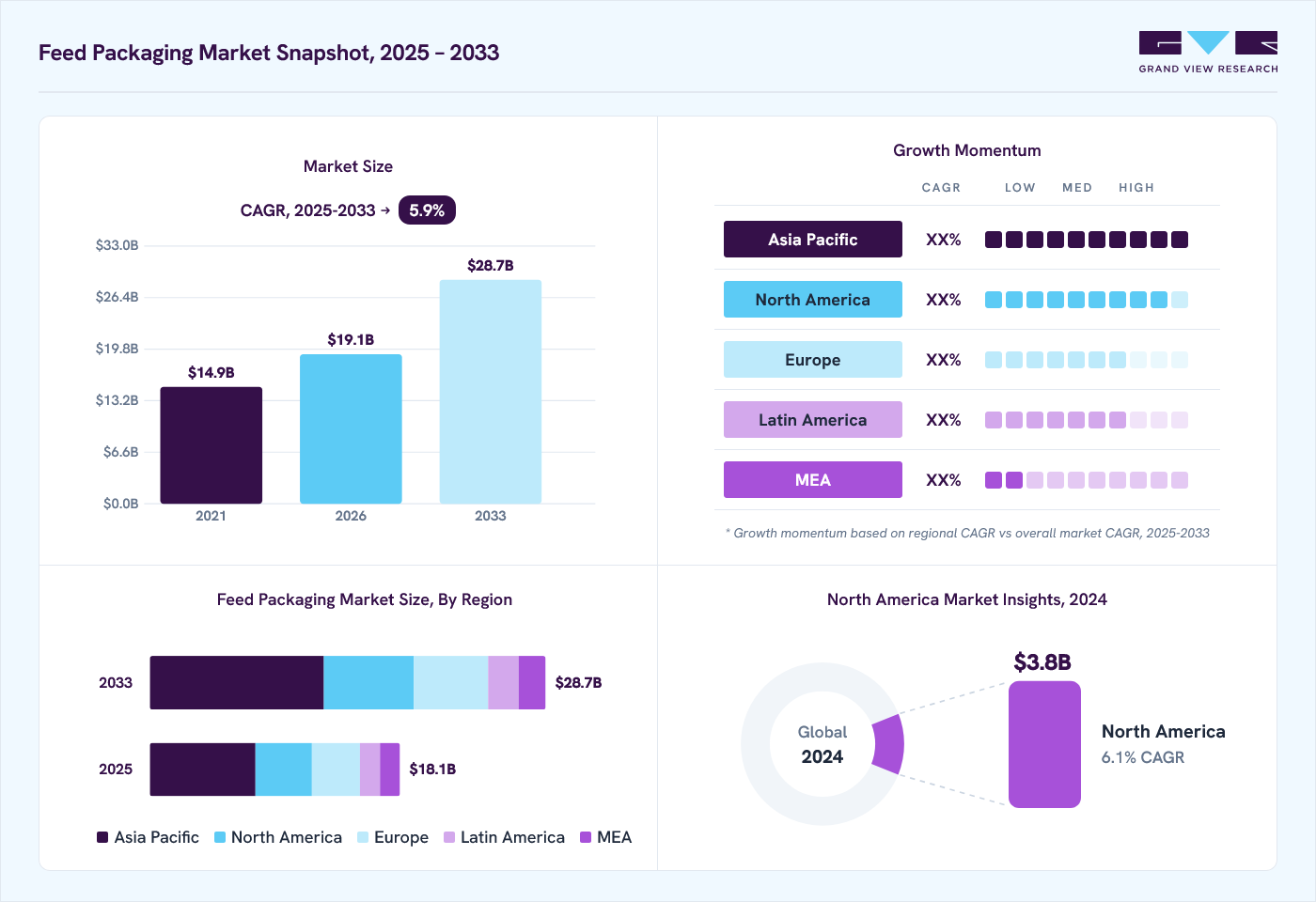 Source: Grand View Research, IR Documents, Primary Interviews, Paid DatabasesTo learn more about this report,
 Download Free Sample Report
 Key Market Trends & Insights
- By material: Plastic segment dominated the market, with a revenue share of 52.4% in 2025.
- By packaging type: Flexible segment held the largest market share of 72.6% in 2025.
- By packaging format: Bags segment held the largest revenue share of 45.7% in 2025.
- By feed type: Dry feed segment dominated the market, with a revenue share of 53.2% in 2025.
- By end use: Livestock feed segment accounted for the largest revenue share of 44.32% in 2025.
Regional Highlights
- Largest regional market: Asia Pacific (42.2% revenue share, 2025)
- By country: China held the largest market share in 2025.
Market Size & Forecast
- Market size in 2025: USD 18.1 Billion
- Estimated market size in 2026: USD 19.1 Billion
- Projected market size by 2033: USD 28.7 Billion
- CAGR (2026-2033): 6.0%
Three ways to get this report
Buy it, customize it, or ask a question.Ask an Analyst
A direct answer, usually in 1 working day
- AccessReport author, directly
- Reply timeWithin 1 working day
- No sales callDirect answer only
- FormatEmail reply
- CostFree, no cost
Get the Full Report
What the study covers
- FormatsPDF · Excel · Dashboard
- Timeline2026–2033 annual, 2025 base
- Coverage20+ countries, 5 regions
- Companies10+ key players profiled
Customize the Report
20% free customization
- IncludeCountries, segments, points
- TailorTo your product definition
- ExtendDeeper competitor detail
- OrA fully bespoke study
- Turnaround5–10 working days
Additionally, expanding livestock farming and pet food sectors are boosting market growth. As livestock farming intensifies to meet the demand for meat, dairy, and eggs, the need for safe, efficient, and long-lasting packaging solutions becomes critical. For example, in Asia-Pacific countries such as China and India, rising meat consumption is prompting large-scale feed production and thus increasing demand for high-barrier packaging to preserve the quality of feed. Efficient packaging ensures longer shelf life and protection from contamination, reducing feed wastage and improving overall supply chain efficiency.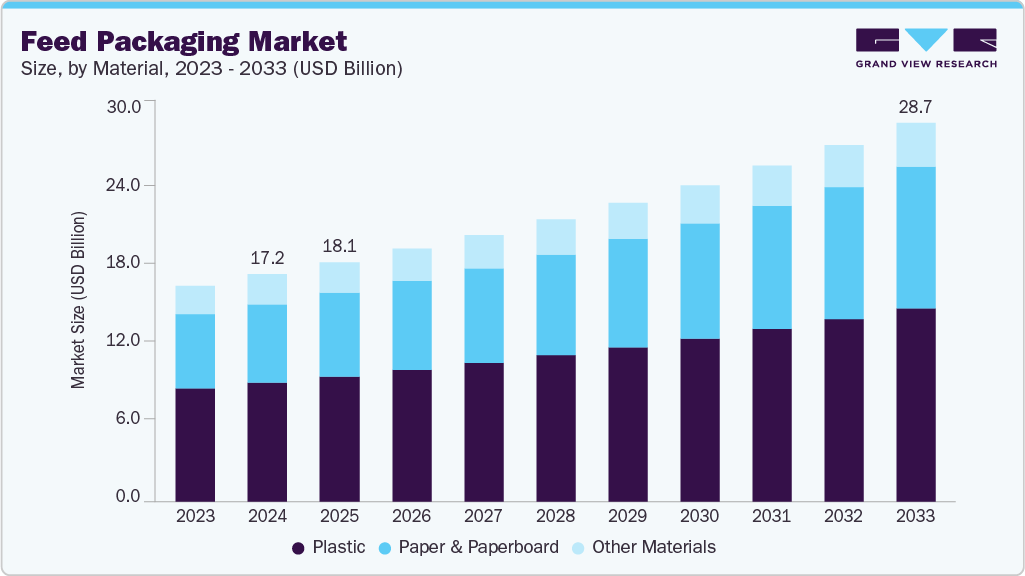 To learn more about this report, Download Free Sample Report
 Governments and international organizations are enforcing stricter regulations related to feed quality and safety, driving demand for advanced packaging. Packaging must now comply with standards that prevent microbial contamination, moisture ingress, and degradation of nutritional content. This is particularly important in the poultry and aquaculture sectors, where improper feed handling can directly affect animal health and human food safety. For instance, the European Union’s Feed Hygiene Regulation (EC No 183/2005) mandates that feed packaging materials must not adversely affect feed safety, pushing manufacturers toward high-barrier laminates and multi-layer plastic bags with resealable closures.
Innovations in feed packaging technologies, including vacuum packaging, UV-resistant films, and biodegradable materials, are reshaping the market landscape. These technologies enhance product integrity during transportation and storage. The adoption of multi-layer laminated bags and woven polypropylene sacks with barrier films is growing, as this helps preserve nutritional content while being tear-resistant and lightweight. Leading companies such as Mondi and LC Packaging are introducing sustainable and cost-effective solutions like recyclable paper-based feed bags and compostable film layers, which are especially popular in markets with strong environmental regulation and consumer awareness.
The rapid expansion of the pet food industry and increasing consumer willingness to invest in premium pet nutrition are driving innovations in smaller, branded, and consumer-oriented feed packaging. Flexible pouches with zip-locks, printed designs, and portion-controlled packaging are gaining traction in developed markets like North America and Europe. Simultaneously, specialty feeds, such as those for horses, rabbits, and aquaculture, require differentiated packaging formats that support brand identity and functional use. This trend is pushing packaging companies to invest in customized and niche solutions, spurring market growth across a variety of feed types.
Market Dynamics
The feed packaging market is witnessing steady growth, driven by rising demand for livestock, poultry, aquaculture, and pet feed, along with increasing focus on feed safety, quality preservation, and extended shelf life. Growing commercial feed production, stricter regulations on feed storage and transportation, and the adoption of advanced packaging solutions are supporting market expansion. The shift toward sustainable and recyclable packaging materials is further creating new opportunities, although raw material price volatility and packaging waste concerns remain key challenges.
The primary driver of the feed packaging market is the increasing global demand for animal feed, supported by the growth of the livestock, poultry, aquaculture, and pet food industries. Rising consumption of meat, dairy products, eggs, and seafood, coupled with expanding commercial farming activities, has led to higher feed production volumes worldwide. This growth is creating a strong need for reliable packaging solutions that can efficiently store, transport, and protect feed products throughout the supply chain.
As feed manufacturers focus on maintaining product quality and nutritional value, demand for durable and high-performance packaging is increasing. Feed packaging plays a critical role in preventing moisture ingress, contamination, pest infestation, and product spoilage, ensuring feed remains safe and effective until consumption. Consequently, the expansion of industrial feed production and distribution networks continues to drive investments in advanced feed packaging materials and formats, supporting sustained market growth.
A significant restraint for the feed packaging market is the volatility in raw material prices, particularly for plastic resins, paper, and other packaging substrates. Changes in crude oil prices, supply chain disruptions, and fluctuations in commodity markets can increase packaging production costs, putting pressure on manufacturers' profit margins. Since feed producers often operate in a highly price-sensitive environment, rising packaging costs can limit the adoption of advanced packaging solutions and create challenges for maintaining cost competitiveness across the value chain.
The increasing focus on environmental sustainability presents a significant opportunity for the feed packaging market. Feed manufacturers and packaging suppliers are increasingly adopting recyclable, reusable, and bio-based packaging materials to reduce environmental impact and comply with evolving regulations. Growing awareness among stakeholders regarding plastic waste reduction, coupled with corporate sustainability initiatives, is driving demand for eco-friendly packaging alternatives. This trend is encouraging innovation in lightweight, recyclable, and resource-efficient packaging formats, creating new growth avenues for market participants and strengthening their competitive positioning.
Market Concentration & Characteristics
The feed packaging market is moderately consolidated, featuring a mix of global packaging giants and specialized regional players. Large firms dominate the high-volume animal feed and bulk packaging segments, while smaller players often serve niche markets like pet food or aquaculture feed packaging. This structure allows for a balance between innovation-driven premium solutions and cost-effective mass production.
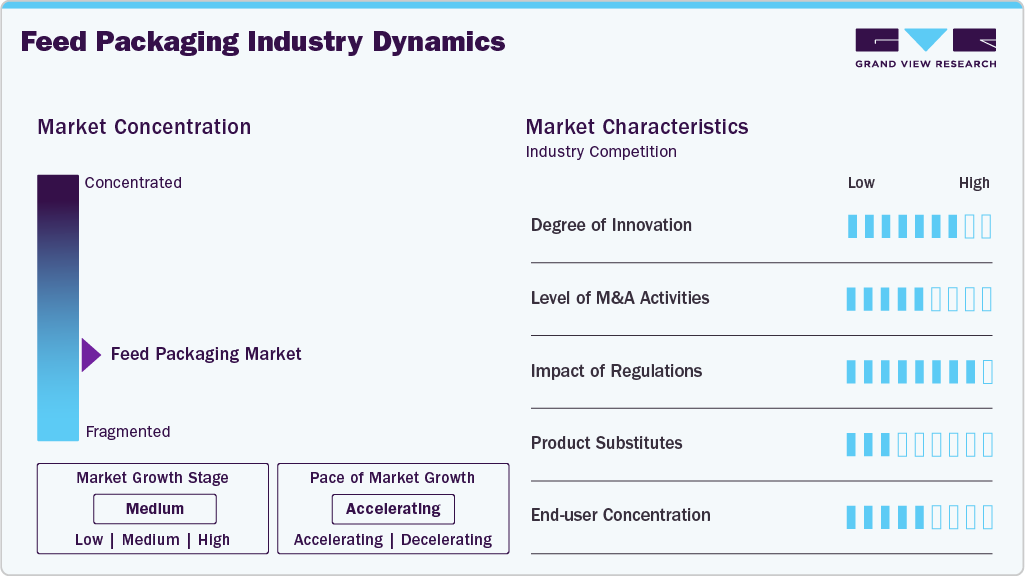 To learn more about this report, Download Free Sample Report
 The feed packaging industry is highly dependent on the health and growth of the livestock, poultry, aquaculture, and pet food industries. Any fluctuations in these sectors, caused by disease outbreaks, feed ingredient shortages, or shifts in consumer dietary preferences, can directly impact feed packaging demand. Additionally, the market is tied to agricultural cycles and commodity prices, making it somewhat seasonal and sensitive to raw material costs.
Analyst Perspective
The feed packaging market is expected to experience steady growth, driven by rising demand for livestock feed, pet food, and aquatic feed, along with increasing focus on feed safety, product protection, and shelf-life extension. Growing feed production volumes and expanding distribution networks are boosting the adoption of packaging solutions that prevent contamination, moisture exposure, and nutrient loss. The market is also witnessing increased demand for sustainable and recyclable packaging materials, supported by environmental regulations and sustainability goals. Companies offering durable, cost-effective, and eco-friendly packaging solutions are expected to gain a competitive advantage in the coming years.
Material Insights
Based on material, the plastic segment led the market with the largest revenue share of 52.4% in 2025. Plastic is the most widely used material in feed packaging due to its durability, flexibility, lightweight nature, and excellent barrier properties. It is predominantly used in the form of polyethylene (PE), polypropylene (PP), and polyethylene terephthalate (PET) in flexible and rigid formats, including bags, pouches, and containers. Plastic packaging ensures longer shelf life by providing protection against moisture, contaminants, and UV rays, making it highly suitable for animal feed stored over long periods or transported across long distances.
The paper & paperboard segment is expected to grow at the fastest CAGR of 6.9% during the forecast period. Paper and paperboard are gaining popularity in feed packaging due to their renewable and biodegradable nature. They are commonly used for small pet feed packs and bulk sacks for livestock feed, often with inner linings to improve moisture resistance. The growing consumer and regulatory push toward sustainable packaging is the primary driver for paper & paperboard feed packaging.
Packaging Type Insights
Based on packaging type, the flexible segment led the market with the largest revenue share of 72.6% in 2025. Flexible feed packaging includes materials such as plastic films, paper, and multi-layer laminates that can be easily shaped. Common formats include bags, pouches, and wraps. This type of packaging is widely used for dry feed, pet food, and specialty animal nutrition products due to its lightweight nature, ease of handling, and lower material usage. It offers excellent printability for branding and labeling, resealability, and is cost-effective for transportation and storage.
Rigid feed packaging includes containers such as plastic tubs, metal cans, and paperboard boxes. This packaging type offers enhanced protection and structural integrity, making it ideal for bulk feed storage, premium pet food, or liquid feed applications. It provides better barrier properties against moisture, pests, and contamination. Rigid packaging is often used in industrial-scale livestock operations and specialized animal nutrition products. Rigid packaging demand is driven by the need for product integrity and protection during transport and storage, particularly in longer supply chains and industrial-scale livestock operations.
End Use Insights
Based on end use, the livestock feed segment led the market with the largest revenue share of 44.3% in 2025. Livestock feed packaging caters to the nutritional feed requirements of farm animals such as cattle, poultry, swine, and goats. Packaging in this segment is designed for bulk transport and storage, focusing on moisture resistance, durability, and cost-efficiency. Common packaging formats include multi-wall paper bags, woven polypropylene sacks, and large flexible intermediate bulk containers (FIBCs), often tailored for large-scale farms and commercial feed producers. The growth of the livestock feed packaging segment is primarily driven by the increasing demand for animal-based products such as meat, milk, and eggs due to the rising global population and changing dietary preferences.
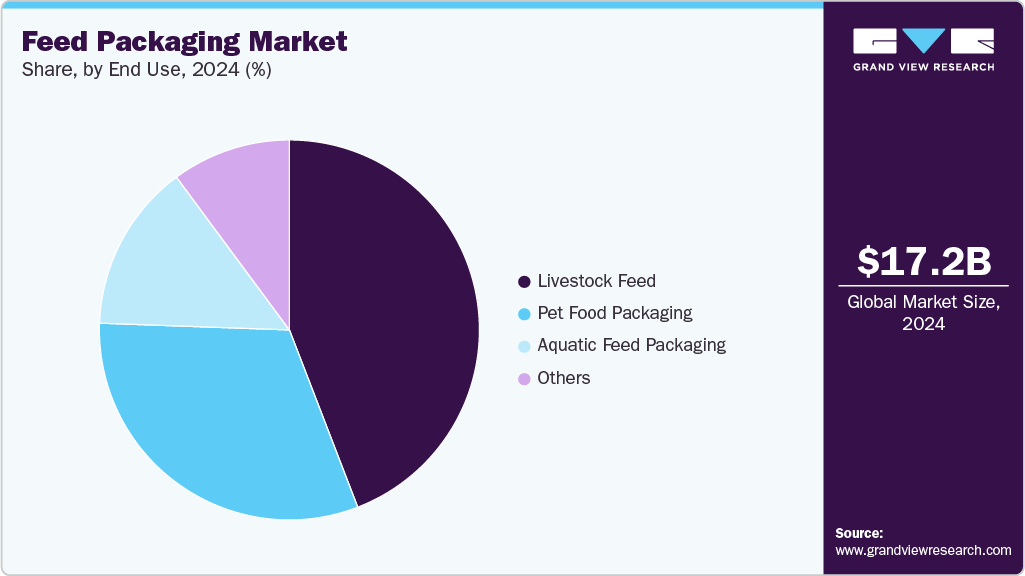 To learn more about this report, Download Free Sample Report
 The aquatic feed packaging segment is projected to grow at the fastest CAGR of 6.5% during the forecast period. Aquatic feed packaging serves the aquaculture industry, which includes feeding fish, shrimp, and other marine life. The packaging for this segment is specialized to preserve the nutritional integrity of high-protein feeds, protect against humidity, and offer strength for marine environments. Common formats include moisture-barrier bags and HDPE woven sacks with liners. The growth of aquaculture as a sustainable source of protein is the major driver for aquatic feed packaging.
Packaging Format Insights
Based on packaging format, the bags segment led the market with the largest revenue share of 45.7% in 2025. Bags are the most widely used packaging format for animal feed, especially bulk and dry feed products such as grains, pellets, and mash. They are typically made from materials such as polypropylene (PP), paper, or multi-layer laminates to ensure durability and moisture resistance. Bags are popular in both commercial livestock and pet feed sectors due to their cost-effectiveness and scalability. The demand for bags is driven by their affordability, high-volume capacity, and ease of transportation and storage.
The pouches/pockets segment is expected to grow at the fastest CAGR of 6.3% during the forecast period. Pouches or pockets are flexible, resealable packaging formats commonly used for premium pet food and specialty animal nutrition products. These are often designed with zippers or spouts and made from multi-layer films offering high barrier protection against oxygen, moisture, and contaminants. The growth of pouches is primarily driven by increased urban pet ownership and the demand for premium, portion-controlled packaging.
Feed Type Insights
Based on feed type, the dry feed segment led the market with the largest revenue share of 53.2% in 2025. Dry feed is the most common type of animal and pet feed and includes kibbles, pellets, flakes, and crumbles. It is widely used due to its longer shelf life, lower production costs, and ease of storage and transportation. Packaging for dry feed typically involves multilayer paper bags, plastic pouches, or woven polypropylene sacks to ensure protection from moisture and contamination.
The chilled & frozen segment is expected to grow at the fastest CAGR of 6.8% during the forecast period. Chilled and frozen feed includes perishable formulations such as raw meat-based diets or frozen meal packs, commonly used for high-end pet food or special livestock feeding regimens. Packaging solutions here focus on insulation, vacuum sealing, and temperature control, often using laminated films or plastic trays. The growing popularity of raw and fresh pet diets, especially among affluent urban consumers, is a key driver.
Regional Insights
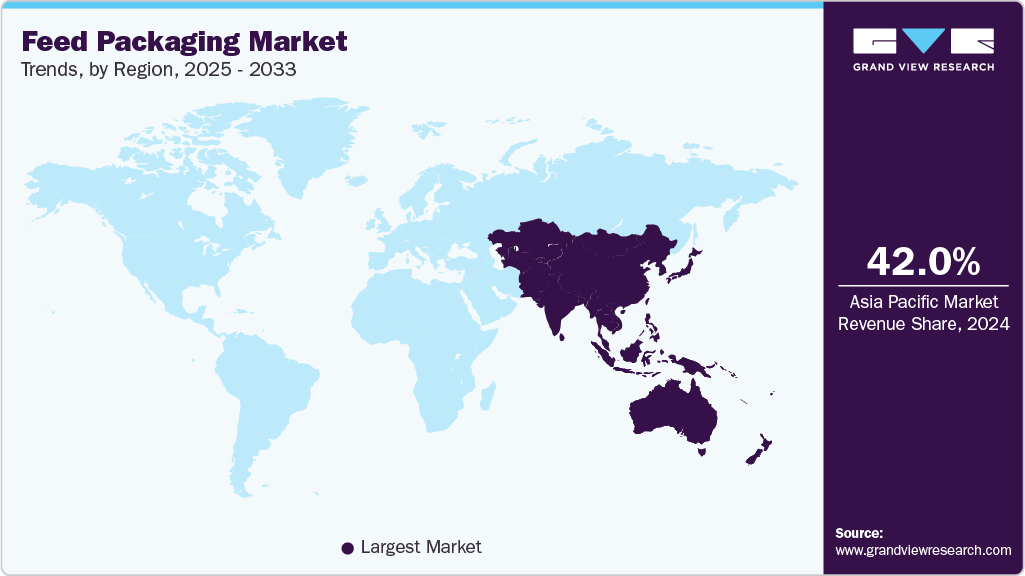
Asia Pacific dominated the feed packaging market with the largest revenue share of 42.2% in 2025. This positive outlook is due to rapid industrialization in agriculture, increasing meat consumption, and expanding livestock production. Countries such as China, India, andVietnam are witnessing a surge in demand for high-quality feed packaging to support their growing poultry, aquaculture, and dairy industries. The rise of organized livestock farming and government initiatives promoting animal nutrition further boosts the need for durable and sustainable packaging solutions.
 To learn more about this report, Download Free Sample Report
 The feed packaging market in China held the largest share in the North America region in 2025. The China feed packaging market dominates due to its massive livestock and aquaculture industries, which demand high volumes of packaged feed. The country’s shift toward intensive farming has increased the need for moisture-proof and UV-resistant packaging, particularly for poultry and swine feed. Companies such as New Hope Group and COFCO use multi-layer plastic bags and woven polypropylene sacks to ensure durability during storage and transport. Government policies promoting feed safety and quality further accelerate packaging innovations, such as anti-counterfeit seals and vacuum packaging.
Europe Feed Packaging Market Trends
Europe’s feed packaging industry is shaped by strict EU regulations on food safety, sustainability, and animal welfare, driving demand for high-barrier and eco-friendly materials. Countries like Germany, France, and the Netherlands are at the forefront of adopting bio-based plastics and recyclable packaging to comply with the European Green Deal. The region’s strong dairy and poultry industries rely on airtight and pest-resistant packaging to maintain feed quality. For example, German feed manufacturers use silo bags and FIBCs (Flexible Intermediate Bulk Containers) for large-scale storage and transportation.
North America Feed Packaging Market Trends
Advanced farming practices, stringent food safety regulations, and high meat consumption in the U.S. and Canada drive the growth of the North America’s feed packaging industry. The region emphasizes sustainable and efficient packaging solutions, such as recyclable plastics and paper-based materials, to align with environmental policies. For instance, major feed producers such as Cargill and ADM use bulk packaging and intermediate bulk containers (IBCs) to optimize storage and transportation. The growing demand for organic and non-GMO animal feed has also led to innovations in barrier films and vacuum-sealed packaging to preserve nutritional integrity.
U.S. Feed Packaging Market Trends
The U.S. feed packaging industry’s growth is driven by large-scale livestock farming, pet food demand, and technological advancements in packaging. The country’s beef, poultry, and dairy industries rely on bulk packaging solutions like FIBCs and paper bags for cost-effective distribution. Major players like Land O’Lakes and Tyson Foods use automated packaging lines to enhance efficiency and reduce contamination risks. The increasing popularity of premium pet food has also spurred demand for resealable and branded pouches, with companies like Blue Buffalo using high-barrier films to extend shelf life.
Key Feed Packaging Company Insights
The competitive environment of the feed packaging market is moderately fragmented, with a mix of global packaging giants and regional players competing based on innovation, sustainability, cost-efficiency, and customization. Companies such as Amcor plc, Mondi, Sonoco Products Company, Sealed Air, and ProAmpac dominate the market through strong R&D capabilities, diversified product portfolios, and strategic partnerships with feed manufacturers. Additionally, market players are increasingly investing in digital printing and smart packaging technologies to enhance brand differentiation and traceability, further intensifying competition.
-
In June 2025, Mondi partnered with French pet food manufacturer Saga Nutrition to launch a recyclable, mono-material packaging, replacing traditional non-recyclable multi-material plastics, for Saga’s dry pet food range. Dubbed the re/cycle FlexiBag, this innovative solution ensures product freshness with high-barrier protection against moisture, fat, and odour, while supporting a circular economy and complying with CEFLEX recycling guidelines.
-
In April 2025, UFlex Limited opened a USD 50 million manufacturing plant in Mexico to produce woven polypropylene bags for dry pet food packaging, targeting North and South American markets. The facility, set to operate by 2025-26, will boost regional supply with durable, moisture-resistant, and recyclable packaging, supporting the growing USD 135 billion pet food market in the Americas.
-
In December 2024, Berry Global Inc. and VOID Technologies teamed up to launch a high-performance, sustainable polyethylene film for pet food packaging. The new film offers enhanced strength and recyclability, using VOID’s VO+ technology to reduce plastic use and improve opacity. This collaboration supports eco-friendly packaging solutions that meet food safety standards and help reduce environmental impact.
Key Feed Packaging Companies:
The following key companies have been profiled for this study on the feed packaging market.
-
Amcor plc
-
Mondi
-
WINPAK LTD.
-
Huhtamaki
-
Berry Global Inc.
-
UFlex Limited
-
ProAmpac
-
Sealed Air
-
Tetra Pak
-
Graphic Packaging International, LLC
-
SHU Packaging Co., Ltd
-
Duropack Limited
-
Sonoco Products Company
-
LC Packaging
Competitive Benchmarking
Category
Operating Strategies
Competitive Edge
Weakness
Established Players (Amcor plc, Mondi, WINPAK LTD., Huhtamaki, Berry Global Inc., UFlex Limited, ProAmpac, Sealed Air, Tetra Pak, Graphic Packaging International, LLC, Sonoco Products Company, LC Packaging)
- Focus on expanding global manufacturing and distribution networks to serve multinational feed producers while ensuring supply chain reliability and cost efficiency.
- Invest heavily in sustainable packaging solutions, advanced barrier technologies, and product innovation to meet evolving regulatory and customer requirements.
- Strong brand recognition, extensive customer relationships, and diversified product portfolios enable them to secure large-volume contracts across multiple end-use industries.
- Robust financial resources and advanced R&D capabilities support continuous innovation, operational scalability, and faster commercialization of new packaging solutions.
- Large operational structures and global footprints often result in higher overhead costs and reduced organizational agility compared to smaller competitors.
- Dependence on mature markets and complex supply chains can limit responsiveness to rapidly changing regional demand patterns and niche customer requirements.
Emerging Players (SHU Packaging Co., Ltd., Duropack Limited)
- Concentrate on regional market expansion and customized feed packaging solutions tailored to specific customer requirements and local industry needs.
- Emphasize cost-competitive manufacturing, flexible production capabilities, and strategic partnerships to strengthen market presence and customer acquisition.
- Greater operational flexibility allows quicker adaptation to changing customer preferences, packaging specifications, and market trends.
- Lean organizational structures enable faster decision-making and competitive pricing strategies in targeted regional markets.
- Limited financial resources and smaller production capacities may restrict large-scale expansion, technology investments, and global market penetration.
- Lower brand visibility and narrower distribution networks can make it challenging to compete with established multinational packaging companies for major contracts.
Feed Packaging Market Report Scope
Report Attribute
Details
Market size in 2025
USD 18.1 billion
Estimated market size in 2026
USD 19.1 billion
Projected market size by 2033
USD 28.7 billion
Growth rate
CAGR of 6.0% from 2026 to 2033
Base year for estimation
2025
Historical data
2021 - 2024
Forecast period
2026 - 2033
Quantitative units
Revenue in USD million/billion and CAGR from 2026 to 2033
Report coverage
Revenue forecast, company ranking, competitive landscape, growth factors, and trends
Segments covered
Material, packaging type, packaging format, feed type, end use, region
Regional scope
North America; Europe; Asia Pacific; Latin America; MEA
Country scope
U.S.; Canada; Mexico; Germany; UK; France; Italy; Spain; China; Japan; India; South Korea; Australia; Brazil; Argentina; Saudi Arabia; South Africa; UAE
Key companies profiled
Amcor plc; Mondi; WINPAK LTD.; Huhtamaki; Berry Global Inc.; UFlex Limited; ProAmpac; Sealed Air; Tetra Pak; Graphic Packaging International, LLC; SHU Packaging Co., Ltd; Duropack Limited; Sonoco Products Company; LC Packaging
Customization scope
Free report customization (equivalent up to 8 analysts' working days) with purchase. Addition or alteration to country, regional & segment scope.
Pricing and purchase options
Avail customized purchase options to meet your exact research needs. Explore purchase options
Global Feed Packaging Market Report Segmentation
This report forecasts revenue growth at the global, regional, and country levels and provides an analysis of the latest industry trends in each of the sub-segments from 2021 to 2033. For this study, Grand View Research has segmented the global feed packaging market report based on material, packaging type, end use, packaging format, feed type, and region:
-
Material Outlook (Revenue, USD Million, 2021 - 2033)
-
Plastic
-
Paper & Paperboard
-
Others
-
-
Packaging Type Outlook (Revenue, USD Million, 2021 - 2033)
-
Flexible
-
Rigid
-
-
End Use Outlook (Revenue, USD Million, 2021 - 2033)
-
Livestock Feed
-
Pet Food Packaging
-
Aquatic Feed Packaging
-
Others
-
-
Packaging Format Outlook (Revenue, USD Million, 2021 - 2033)
-
Bags
-
Pouches/Pockets
-
Boxes/Cartons
-
Jars/Containers
-
Others
-
-
Feed Type Outlook (Revenue, USD Million, 2021 - 2033)
-
Dry Feed
-
Pet Treats
-
Chilled & Frozen
-
Wet Feed
-
Others
-
-
Regional Outlook (Revenue, USD Million, 2021 - 2033)
-
North America
-
U.S.
-
Canada
-
Mexico
-
-
Europe
-
Germany
-
France
-
UK
-
Italy
-
Spain
-
-
Asia Pacific
-
China
-
India
-
Japan
-
Australia
-
South Korea
-
-
Latin America
-
Brazil
-
Argentina
-
-
Middle East & Africa
-
South Africa
-
Saudi Arabia
-
UAE
-
-
Research Methodology
The feed packaging market figures in this report are based on a proven research process that combines executive interviews with secondary research from proprietary databases, company filings, and recognized regulatory and institutional sources. Market size is built through value-chain sizing - reconciling supply-side and demand-side estimates - and triangulated with bottom-up and top-down approaches. Every estimate passes multiple levels of expert validation before publication, with each feed packaging segment quantified using the revenue-capture definitions in the table below.
Segment Definition
Segment - Material
Revenue capture definition
Plastic
Revenue generated from the sale of feed packaging products manufactured using plastic materials such as polyethylene (PE), polypropylene (PP), and polyethylene terephthalate (PET). This segment includes bags, pouches, containers, and other packaging formats used for livestock feed, pet food, and aquatic feed applications.
Paper & Paperboard
Revenue generated from the sale of feed packaging products made from paper and paperboard materials designed to provide sustainable and cost-effective packaging solutions. This segment includes multi-wall paper bags, cartons, and other paper-based packaging used for dry feed and pet food products.
Other Materials
Revenue generated from the sale of feed packaging products manufactured using alternative materials such as metal, jute, woven fabrics, biodegradable materials, and composites. This segment includes specialized packaging solutions used for niche feed applications requiring enhanced durability or sustainability.
Segment - Packaging Type
Revenue capture definition
Flexible
Revenue generated from the sale of flexible feed packaging solutions designed for efficient storage, transportation, and product protection. This segment includes bags, pouches, sacks, and other lightweight packaging formats used across livestock, pet, and aquatic feed applications.
Rigid
Revenue generated from the sale of rigid feed packaging solutions that provide enhanced structural strength and protection. This segment includes containers, jars, bins, and other rigid packaging formats used for premium, specialty, and wet feed products.
Segment - Packaging Format
Revenue capture definition
Bags
Revenue generated from the sale of feed packaging bags used for bulk and retail distribution of livestock feed, pet food, and aquatic feed products. This segment includes woven, laminated, paper, and plastic bags.
Pouches/Pockets
Revenue generated from the sale of pouch and pocket packaging formats designed to offer convenience, portability, resealability, and product freshness. This segment includes stand-up pouches and specialty pouches primarily used for pet food and feed supplements.
Boxes/Cartons
Revenue generated from the sale of box and carton packaging solutions used for retail feed products and pet food packaging. This segment includes paperboard cartons and corrugated boxes designed for product protection and branding.
Jars/Containers
Revenue generated from the sale of jar and container packaging solutions used for wet feed, feed additives, supplements, and specialty pet food products. This segment includes plastic and composite containers with secure closure systems.
Others
Revenue generated from the sale of other feed packaging formats, including drums, tubs, cans, and customized packaging solutions designed for specific feed storage, handling, and transportation requirements.
Segment - Feed Type
Revenue capture definition
Dry Feed
Revenue generated from the sale of packaging solutions used for dry feed products, including pellets, mash, grains, and feed mixtures. This segment includes packaging designed to protect feed from moisture, contamination, and nutrient loss.
Pet Treats
Revenue generated from the sale of packaging solutions specifically designed for pet treats and snack products. This segment includes resealable pouches, bags, cartons, and premium packaging formats that enhance convenience and shelf appeal.
Chilled & Frozen
Revenue generated from the sale of packaging solutions used for chilled and frozen feed products requiring temperature resistance and product integrity during storage and distribution.
Wet Feed
Revenue generated from the sale of packaging solutions designed for wet feed products, including canned, pouch-packed, and containerized feed formulations. This segment includes packaging that supports freshness, leakage prevention, and extended shelf life.
Others
Revenue generated from the sale of packaging solutions used for specialty feed products, feed supplements, medicated feed, and other niche feed categories not covered under the primary feed type segments.
Segment - End Use
Revenue capture definition
Livestock Feed
Revenue generated from the sale of packaging solutions used for cattle, poultry, swine, and other livestock feed products. This segment includes bulk and retail packaging formats designed for feed protection, storage, and transportation.
Pet Food Packaging
Revenue generated from the sale of packaging solutions used for dog, cat, bird, and other companion animal food products. This segment includes premium, resealable, and convenience-focused packaging formats designed to maintain product quality and enhance consumer appeal.
Aquatic Feed Packaging
Revenue generated from the sale of packaging solutions used for aquaculture feed products, including fish, shrimp, and other aquatic species feed. This segment includes moisture-resistant and durable packaging formats designed to preserve feed quality in diverse storage and transportation conditions.
Estimation Model
Layer Name
Key Question
Description
Feed Production Demand Layer
What forms the demand base?
Identify global production and consumption volumes of livestock feed, pet food, and aquatic feed across major regions. Assess feed demand generated by poultry, cattle, swine, aquaculture, and companion animal industries. This layer establishes the total addressable feed volume that creates demand for packaging solutions.
Packaging Adoption Layer
Where is feed packaging utilized?
Estimate the penetration of packaged feed across different feed categories, including dry feed, wet feed, chilled & frozen feed, and pet treats. Evaluate the adoption of packaging materials such as plastic, paper & paperboard, and other materials, along with packaging formats used across commercial and retail feed distribution channels.
Packaging Consumption Intensity Layer
How much packaging is consumed?
Analyze average packaging usage per ton of feed, packaging format preferences, replacement cycles, storage requirements, transportation needs, and shelf-life considerations. Packaging intensity is influenced by feed type, distribution distance, regulatory requirements, product value, and end-use applications including livestock, pet food, and aquatic feed.
Revenue Layer
How is market revenue generated?
Market revenue is quantified through the sale of feed packaging products, including bags, pouches, boxes/cartons, jars/containers, and other packaging formats. Revenue is generated from demand across livestock feed packaging, pet food packaging, and aquatic feed packaging applications, supported by value-added features such as barrier protection, resealability, sustainability, branding, and supply chain efficiency.
Delivered Customizations
This report has been delivered with the following In-depth customizations
Client Request
Customization Delivered
Value Adds
Regional Segmentation Analysis
Detailed market sizing, growth forecasts, consumption trends, regulatory assessment, and feed packaging demand analysis across North America, Europe, Asia Pacific, Central & South America, and Middle East & Africa. Country-level evaluation was incorporated for major livestock, pet food, and aquaculture feed markets.
Enables identification of high-growth regions, regional demand variations, investment priorities, and market expansion opportunities.
Cross-Segmentation Analysis
Comprehensive analysis of the feed packaging market through intersections such as Material, Packaging Type, Packaging Format, Feed Type, End Use, and Region. Key combinations including plastic bags for dry feed, paper-based pet food packaging, and rigid containers for wet feed were assessed.
Provides deeper visibility into high-potential segment combinations, emerging demand pockets, and revenue-generating opportunities across the value chain.
Competitive Benchmarking
Comparative evaluation of leading feed packaging companies based on product portfolio coverage across plastic, paper & paperboard, flexible and rigid packaging solutions, manufacturing capabilities, geographic presence, sustainability initiatives, innovation activities, and strategic partnerships serving livestock, pet food, and aquatic feed applications.
Helps stakeholders benchmark competitors, identify market leaders, assess competitive positioning, and develop differentiation strategies.
Frequently Asked Questions About This Report
The livestock feed segment led the feed packaging market with a 44.3% revenue share in 2025.
The flexible segment led the feed packaging market with a 72.6% revenue share in 2025.
The plastic segment led the feed packaging market with a 52.4% revenue share in 2025.
The global feed packaging market size was valued at USD 18.1 billion in 2025 and is estimated at USD 19.1 billion for 2026.
Key factors driving the feed packaging market include rising demand for animal feed and pet food, increasing focus on feed safety and shelf-life extension, growth in commercial feed production, stricter storage and transportation standards, and growing adoption of sustainable packaging solutions.
The global feed packaging market is expected to grow at a CAGR of 6.0% from 2026 to 2033, reaching USD 28.7 billion by 2033.
Asia Pacific dominated the feed packaging market with a 42.2% revenue share in 2025.
Key players in the feed packaging market include Amcor plc; Mondi; WINPAK LTD.; Huhtamaki; Berry Global Inc.; UFlex Limited; ProAmpac; Sealed Air; Tetra Pak; Graphic Packaging International, LLC; SHU Packaging Co., Ltd; Duropack Limited; Sonoco Products Company; and LC Packaging.
About the Author(s)
Plastics, Polymers & Resins Research Team
Bulk Chemicals · Plastics, Polymers & ResinsThis report was authored by the plastics, polymers & resins research team at Grand View Research - comprising two research analysts, one senior research analyst, and one industry expert - with specialized expertise in the plastics, polymers & resins segment of the bulk chemicals industry. All findings are based on proprietary bulk chemicals databases, executive interviews, and regulatory analysis, subject to internal peer review prior to publication.
Last Updated:
Speak to Analyst

Customize this report to your needs - add regions, segments, or data points, with 20% free customization.
Or view our licence options:


ISO 9001:2015 & 27001:2022 Certified
We are GDPR and CCPA compliant! Your transaction & personal information is safe and secure. For more details, please read our privacy policy.


