
- Home
- »
- Communications Infrastructure
- »
-
Fiber Optic Connectors Market Size Report, 2026-2033GVR Report cover
![Fiber Optic Connectors Market (2026 - 2033)Report]()
Fiber Optic Connectors Market (2026 - 2033)
Size, Share & Trends Analysis Report By Product, By Application (Telecom, Oil & Gas, Military & Aerospace, BFSI, Medical, Railway), By Region (North America, Europe, Asia Pacific, Latin America, MEA), And Segment Forecasts
Market Size, 2025
$6.0BMarket Estimate, 2026
$6.4BMarket Forecast, 2033
$9.9BCAGR, 2026–2033
6.6%Fiber Optic Connectors Market Summary
The global fiber optic connectors market size was valued at USD 6.0 billion in 2025 and is projected to grow from USD 6.4 billion in 2026 to USD 9.9 billion by 2033, growing at a CAGR of 6.6% from 2026 to 2033. North America dominated the market, accounting for a revenue share of 30.6% in 2025. The market is witnessing a shift toward high-density and compact fiber optic connector designs that maximize port utilization while supporting higher data transmission speeds in space-constrained environments.

Key Market Trends & Insights
- By product: LC connector segment dominated the market, with a revenue share of 35.0% in 2025.
- By application: Telecom segment held the largest market share of 40.7% in 2025.
Regional Highlights
- Largest regional market: North America (30.6% revenue share, 2025)
- Fastest-growing regional market: Asia Pacific (highest CAGR, 2026-2033)
- By country: The U.S. held the largest market share in 2025
Market Size & Forecast
- Market size in 2025: USD 6.0 Billion
- Estimated market size in 2026: USD 6.4 Billion
- Projected market size by 2033: USD 9.9 Billion
- CAGR (2026-2033): 6.6%
The market is primarily driven by the rapid growth of cloud computing and Artificial Intelligence (AI), telecommunications industry developments, and the surge in deployment of IoT-based and smart tech solutions. The rapid growth of cloud computing and AI is transforming into how data is processed and shared. These technologies require faster data transmission and highly reliable connectivity. To address this growing demand, data centers and subsea cable projects are expanding globally. These systems must efficiently manage large volumes of data with minimal signal degradation. This creates a need for efficient and durable fiber optic connections.
As a result, high-performance, low-loss connectors such as MTP/MPO and LC are increasingly used in dense network environments. For instance, in February 2024, Cisco Systems, Inc., a U.S.-based technology company, and Microsoft completed an 800Gbps transmission trial on the Amitie transatlantic cable to meet the rising demand for cloud and AI services. This initiative shows how subsea networks are improving, allowing faster speeds and more data to support growing global digital needs.
The telecommunications industry's transition to fiber optic networks is a significant factor driving the growth of Fiber Optic Connectors. As telecom providers move away from legacy copper infrastructure, they are opting for fiber optics to offer faster, more reliable communication services. Fiber optic networks enable the transfer of data at much higher speeds than traditional copper-based networks, with reduced signal loss and greater bandwidth capacity. This is particularly important as consumer demand for high-speed internet and data-intensive services such as video streaming and cloud computing continues to increase. Moreover, fiber optics provide lower latency, ensuring quicker and more efficient communication for real-time applications. The upgrade to fiber optic technology by telecom providers is, therefore, directly fueling the demand for fiber optic connectors to link network products.
The increasing adoption of Internet Things (IoT) devices and smart technologies is significantly driving the demand for fiber optic connectors. IoT devices, such as smart home gadgets, industrial sensors, and wearable technology, are becoming more prevalent, generating vast amounts of data. This data must be transmitted quickly and reliably to centralized processing hubs, often located in the cloud, for analysis and real-time decision-making. Fiber optics provide the high-speed, low-latency communication needed to support this data transfer. As more devices connect to networks, the demand for fast and efficient data transmission grows. Fiber optic connectors are critical in ensuring that this data is transferred seamlessly and with minimal delay across complex IoT networks.
Market Dynamics
The fiber optic connectors market is gaining momentum as the growing deployment of high-speed broadband networks, hyperscale data centers, and 5G infrastructure is accelerating demand for fiber optic connectors capable of supporting low-latency, high-bandwidth communication. Enterprises and telecom operators are expanding fiber-based connectivity to accommodate rising data traffic generated by cloud computing, video streaming, artificial intelligence workloads, and connected devices. Increasing investments in fiber-to-the-home (FTTH) and next-generation network modernization projects are further driving connector adoption across telecommunications and enterprise environments. The need for reliable signal transmission, scalability, and network efficiency continues to reinforce the market’s growth trajectory.
High-speed broadband, large data centers, and 5G networks are driving strong demand for fiber optic connectors around the world. As people use more data for cloud computing, video streaming, AI, and connected devices, network operators are turning to fiber-based systems to handle higher bandwidth and lower latency. Fiber optic connectors are essential for reliable and efficient signal transmission in these modern networks. Governments and telecom companies are speeding up fiber-to-the-home projects and upgrading networks to boost connectivity and digital access. As the need for scalable, high-performance communication grows, more telecom and business networks are using advanced fiber optic connectors. These connectors help deliver faster data, reliable networks, and future-ready connections, making them a key part of next-generation communication systems.
High installation and deployment costs for fiber infrastructure continue to hold back the fiber optic connectors market. Setting up a fiber network needs a large investment in special cables, connectors, equipment, trenching, and skilled workers, which makes the initial costs higher than those for copper networks. These expenses are especially tough for small and medium businesses, rural broadband projects, and organizations with tight budgets. The complicated process of installing, testing, and maintaining fiber networks often raises project costs and extends timelines. Network operators need to spend on precise connector work, upgrades, and regular maintenance to keep the network running well. Because of these costs, some expansion plans are delayed, and the adoption of fiber optic connectors is slower in certain areas and among some users.
Governments and telecom companies are investing more in fiber networks to make the internet more accessible, close the digital gap, and meet higher bandwidth needs for homes and businesses. As these networks reach more underserved and remote areas, the need for reliable, high-quality fiber optic connectors keeps rising during network installations. Ongoing digital changes, more people working from home, online learning, telemedicine, and smart community projects all require strong broadband connections. Fiber optic connectors are essential for installing, maintaining, and transmitting signals in these growing networks. As FTTH and broadband programs expand, connector manufacturers have more chances to offer products that help networks stay reliable, scalable, and high-performing.
Market Concentration & Characteristics
Regulations have a moderate influence on the fiber optic connectors market, particularly in areas related to telecommunications standards, product quality, environmental compliance, and network safety. Manufacturers must hold to international performance specifications and certification requirements to ensure interoperability and reliability across communication networks. Environmental regulations governing materials usage, waste management, and sustainability practices also shape product development and manufacturing processes. Compliance with these standards is essential for maintaining market access and customer confidence.
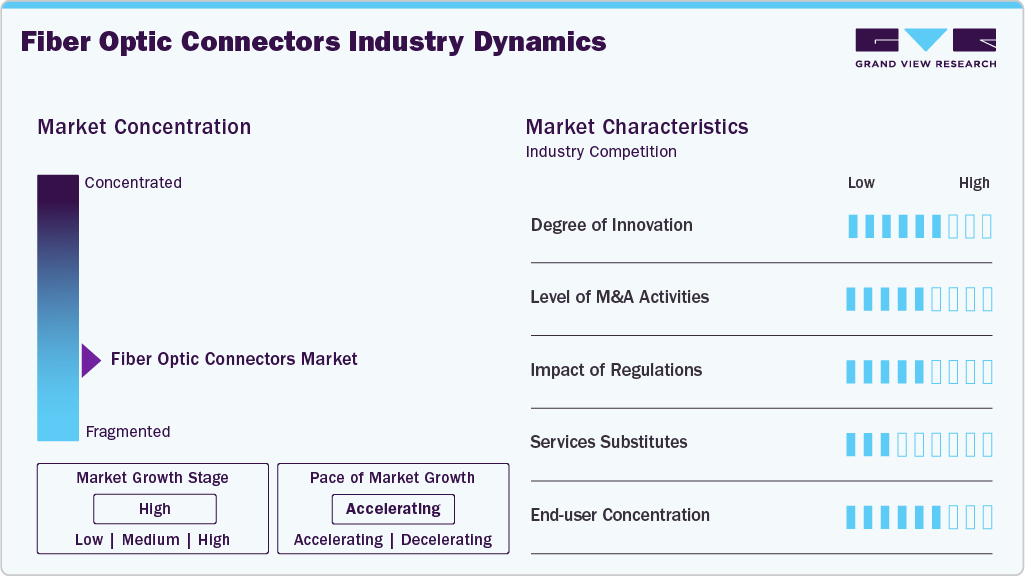
End-user concentration in the fiber optic connectors market is moderately high, with demand largely driven by telecommunications operators, data center providers, enterprise network operators, and broadband infrastructure developers. Large-scale network deployment projects account for a substantial portion of connector consumption, particularly in high-growth digital infrastructure segments. However, expanding adoption across industrial automation, healthcare, transportation, and smart city applications is gradually diversifying the customer base. This broadening range of end users supports market resilience while reducing dependence on a single application segment.
Analyst Perspective
The fiber optic connectors market is evolving within the broader digital infrastructure ecosystem, supported by sustained investments in hyperscale data centers, 5G network rollouts, fiber-to-the-home deployments, and enterprise network modernization. Unlike many connectivity components that face commoditization pressure, fiber optic connectors remain performance-critical elements where reliability, insertion loss, density, and interoperability directly influence network efficiency and total cost of ownership. As data traffic growth accelerates and network architectures migrate toward higher-density optical connectivity, value creation is shifting from basic connectivity products to precision-engineered solutions optimized for next-generation broadband, cloud, and AI-driven infrastructure environments.
Product Insights
Based on product, the LC connector segment led the market with the largest revenue share of 35.0% in 2025 and is expected to grow at the significant CAGR over the forecast period. LC connectors are known for their compact form factor, which is particularly advantageous in high-density data center environments where space optimization is crucial. Their small size allows for greater port density on patch panels and network equipment, accommodating the rapid scaling of cloud and enterprise networks. Moreover, the surge in demand for LC connectors is driven by proliferation of virtualization, cloud computing, and hyper scale data centers. As organizations migrate to cloud-based architectures and adopt software-defined networking, the need for flexible, high-capacity cabling solutions intensifies. LC connectors, with their low insertion loss and high performance, are well-suited to these applications, supporting faster data rates and reliable signal transmission over longer distances.
FC connector segment is expected to register the fastest CAGR over the forecast period. FC connectors are renowned for their threaded mechanism, which provides superior vibration resistance and ensures a secure, stable connection. This makes them suitable for applications in environments with high mechanical stress, such as industrial automation and long-haul telecommunications. Moreover, the increasing adoption of FC connectors is driven by the expansion of 5G networks and the growing need for reliable data transmission in mission-critical applications. Their design minimizes signal loss and maintains high performance over extended distances, supporting the stringent requirements of modern telecommunication infrastructure.
Application Insights
Based on application, the telecom segment led the market with the largest revenue share of 40.7% in 2025 and is expected to grow at the significant CAGR over the forecast period. This growth is driven by the rapid rollout of 5G networks, rising internet penetration, and surging data consumption, all of which are accelerating investments in fiber optic networks, where connectors are essential for ensuring seamless and reliable connectivity. The telecom industry’s emphasis on minimizing latency and maximizing bandwidth is driving the adoption of advanced fiber optic connector solutions, which are critical for linking network equipment such as base stations, switches, and routers. For instance, in April 2024, an estimated 22 million Americans were reported to lack home broadband access. However, this figure may be understated, as the Federal Communications Commission (FCC) recently updated its definition of broadband to require minimum speeds of 100 Mbps download and 20 Mbps upload, a significant increase from the previous benchmark of 25 Mbps download and 3 Mbps upload. These connectors help the telecom sector scale efficiently and meet the demands of modern digital communication.

Railway segment is expected to register the fastest CAGR over the forecast period. Fiber optic connectors play a crucial role in enabling high-speed, reliable data transmission across railway operations, supporting real-time monitoring, control, and safety systems. The shift toward digital signaling and automated train control systems is a major factor driving the adoption of these connectors. Their ability to perform in harsh and demanding conditions makes them ideal for both trackside infrastructure and onboard use. Railway operators are increasingly investing in robust communication networks to improve operational efficiency, passenger safety, and overall service quality. Fiber optic connectors support the seamless integration of surveillance systems, passenger information displays, and ticketing solutions, facilitating the transition to smart transportation ecosystems.
Regional Insights
North America dominated the fiber optic connectors market with the largest revenue share of 30.6% in 2025. As enterprises and consumers seek reliable connectivity for services such as video streaming, cloud computing, and telecommuting. Fiber optic connectors play a key role in scaling these networks by minimizing signal loss and supporting the rapid expansion of broadband infrastructure. Technological advancements in high-density cables, connector designs, and transmission speeds are driving adoption. The region also benefits from a strong ecosystem of manufacturers and technology innovators, which helps accelerate the rollout of next-generation fiber optic solutions.

U.S. Fiber Optic Connectors Market Trends
The fiber optic connectors market in the U.S. held the largest share in the North America region in 2025 driven by large-scale investments in 5G infrastructure, broadband expansion, and data center proliferation. The demand for high-speed internet and advanced communication technologies is particularly acute, with both public and private sectors prioritizing digital transformation. The U.S. government’s push for universal broadband access has accelerated fiber deployment in both metropolitan and rural areas, ensuring broader connectivity. For instance, in January 2025, the National Telecommunications and Information Administration (NTIA) of the Department of Commerce granted nearly USD 18 million to seven tribal organizations to enhance high-speed Internet access and adoption in various regions. Most of this funding is to support prepaid broadband services for thousands of tribal homes and public buildings, while a portion is dedicated to digital training initiatives aimed at promoting digital equity within these communities.
Europe Fiber Optic Connectors Market Trends
The fiber optic connectors market in Europe is expected to grow significantly over the forecast period. This growth is driven by the deployment of fiber networks and strong government support for digital infrastructure. The region is experiencing increased bandwidth demand due to the expansion of 5G, smart city initiatives, and industrial automation. European Union policies promoting digital connectivity are supporting the rollout of high-speed broadband services across member states. Technological innovation plays a crucial role in the European market, with advancements in connector design and manufacturing facilitating the transition to next-generation networks. The expansion of data centers and the growing adoption of cloud computing services further support the demand for high-quality fiber optic connectors, as enterprises and consumers increasingly require faster, more reliable internet connections.
Asia Pacific Fiber Optic Connectors Market Trends
The fiber optic connectors industry in the Asia Pacific region is anticipated to be at the fastest CAGR over the forecast period driven by large-scale investments in telecommunications infrastructure, rapid urbanization, and the widespread adoption of high-speed broadband and 5G networks. Countries across the region are prioritizing digital transformation, making fiber optic connectors essential for supporting the surge in data traffic and connectivity needs. Asia Pacific’s diverse economies, ranging from advanced markets such as Japan and South Korea to rapidly developing nations such as India and Indonesia, are all investing heavily in fiber optic networks. The region’s booming data center market, proliferation of IoT devices, and growth in cloud computing services further amplify the demand for reliable, high-performance fiber optic connectors.
Key Fiber Optic Connectors Company Insights
Some key companies in the fiber optic connectors industry areTE Connectivity and Optical Cable Corporation
-
TE Connectivity is a global provider of connectivity and sensor solutions, serving a wide range of industries. The company designs and manufactures a broad portfolio of products, including connectors, terminals and products, sensors, relays, heat shrink tubing, interventional medical products, wires and cables, and antennas. The company's products are used across a wide range of industries, including automotive, aerospace, defense, marine, industrial, medical, data and devices, appliances, and energy. The company markets its products through a direct sale-force and third-party distributors, with manufacturing facilities and distribution centers across the globe.
-
Optical Cable Corporation manufactures fiber optics cables for telecommunications applications. The company produces high-quality fiber optics cables and offers data solutions for communication and connectivity purposes. The company’s fiber optics cables are mainly designed for harsh environments. The company is also engaged in the development of tight-buffered and tight-bound cable technologies for military and defense applications, especially in tactical field operations.
Key Fiber Optic Connectors Companies:
The following key companies have been profiled for this study on the fiber optic connectors market.
-
3M
-
Broadcom
-
Corning Incorporated
-
ALE International, ALE USA Inc.
-
Arris Group (CommScope)
-
STL Tech
-
OFS Fitel, LLC
-
TE Connectivity
-
Optical Cable Corporation
-
FURUKAWA ELECTRIC CO., LTD.
Competitive Benchmarking
Category
Operating Strategies
Competitive Edge
Weakness
Established Players (3M; Broadcom; Corning Incorporated; TE Connectivity; Furukawa Electric Co., Ltd.; OFS Fitel, LLC)
- Focus on vertically integrated manufacturing, encompassing optical fiber, cable, and connector production.
- Prioritize long-term telecom, hyperscale data center, and enterprise contracts supported by global distribution networks.
- Extensive product portfolios covering multiple connector standards, applications, and performance requirements.
- Strong brand recognition, large-scale production capabilities, and established customer relationships across key regions.
- Large organizational structures can slow product customization and response to niche market requirements.
- High dependence on telecom and data center investment cycles can affect short-term revenue growth.
Emerging Players (ALE International; STL Tech; Optical Cable Corporation)
- Concentrate on targeted application segments and region-specific opportunities with flexible deployment models.
- Emphasize partnerships, network expansion projects, and specialized connectivity solutions to gain market share.
- Greater agility in addressing evolving customer requirements and emerging network architectures.
- Ability to compete through customized offerings, competitive pricing, and focused innovation initiatives.
- Limited global footprint and lower manufacturing scale compared with established market leaders.
- Relatively lower brand visibility and customer penetration in large telecom and hyperscale infrastructure projects.
Recent Developments
-
In March 2025, SENKO Advanced Products collaborated with 3M and Molex to launch the MPO EBO EZ-WAY connector, a fiber connectivity solution, integrating 3M expanded beam optical (EBO) Ferrule technology. This partnership aims to bring together the SENKO and MOLEX expertise in high-density connectivity and 3M’s new beam optical technology so that, to deliver reliability in market and improved optical performance, reliability in harsh environments, reduces operational costs and simple installation.
-
In March 2025, 3M partnered with Sumitomo Electric through an assembly agreement, allowing Sumitomo to offer optical fiber connectivity products that include 3M’s Expanded Beam Optical (EBO) interconnect technology. Designed for large data centers and edge computing, this technology offers scalable, high-performance connections with lower maintenance due to its reduced sensitivity to contamination.
-
In March 2025, Nubis Communications and Samtec partnered to create a new co-packaged platform that enables a 6.4T universal connector for both optical and copper connections. This collaboration combines Nubis’s 200G-per-lane Silicon Photonics IC, known as Puma, with Samtec’s Si-Fly HD interconnect technology. The platform introduces a flexible CPX design, allowing users to select either optics or copper on a per-link basis a feature aimed at lowering the barriers to co-packaged optics adoption.
Fiber Optic Connectors Market Report Scope
Report Attribute
Details
Market size in 2025
USD 6.0 billion
Estimated market size in 2026
USD 6.4 billion
Projected market size by 2033
USD 9.9 billion
Growth rate
CAGR of 6.6% from 2026 to 2033
Base year for estimation
2025
Historical data
2021 - 2024
Forecast period
2026 - 2033
Quantitative units
Revenue in USD million/billion and CAGR from 2026 to 2033
Report coverage
Revenue forecast, company ranking, competitive landscape, growth factors, and trends
Segments covered
Product, application, region
Regional scope
Asia Pacific; Europe; MEA; Latin America; North America
Country scope
U.S.; Canada; Mexico; Germany; UK; France; China; Japan; India; South Korea; Australia; Brazil; Saudi Arabia; South Africa; UAE
Key companies profiled
3M; Broadcom; Corning Incorporated; ALE International, ALE USA Inc.; Arris Group (CommScope); STL Tech; OFS Fitel, LLC; TE Connectivity; Optical Cable Corporation; FURUKAWA ELECTRIC CO., LTD.
Customization scope
Free report customization (equivalent up to 8 analysts' working days) with purchase. Addition or alteration to country, regional & segment scope.
Pricing and purchase options
Avail customized purchase options to meet your exact research needs. Explore purchase options
Global Fiber Optic Connectors Market Report Segmentation
This report forecasts revenue growth at global, regional, and country levels and provides an analysis of the latest industry trends in each of the sub-segments from 2021 to 2033. For this study, Grand View Research has segmented global fiber optic connectors market report based on product, application, and region.

-
Product Outlook (Revenue, USD Billion, 2021 - 2033)
-
SC Connector
-
LC Connector
-
FC Connector
-
ST Connector
-
MTP/MPO Connector
-
Others
-
-
Application Outlook (Revenue, USD Billion, 2021 - 2033)
-
Telecom
-
Oil & Gas
-
Military & Aerospace
-
BFSI
-
Medical
-
Railway
-
Others
-
-
Regional Outlook (Revenue, USD Billion, 2021 - 2033)
-
North America
-
U.S.
-
Canada
-
Mexico
-
-
Europe
-
Germany
-
UK
-
France
-
-
Asia Pacific
-
China
-
Japan
-
India
-
South Korea
-
Australia
-
-
Latin America
-
Brazil
-
-
Middle East and Africa (MEA)
-
UAE
-
KSA
-
South Africa
-
-
Research Methodology
The fiber optic connectors market figures in this report are based on a proven research process that combines executive interviews with secondary research from proprietary databases, company filings, and recognized regulatory and institutional sources. Market size is built through value-chain sizing - reconciling supply-side and demand-side estimates - and triangulated with bottom-up and top-down approaches. Every estimate passes multiple levels of expert validation before publication, with each fiber optic connectors segment quantified using the revenue-capture definitions in the table below.
Segment Definition
Segment - Product
Revenue capture definition
SC Connector
SC connectors generate revenue from deployments requiring reliable, easy-to-install fiber terminations across telecommunications networks, enterprise infrastructure, and broadband access systems. Their push-pull coupling mechanism and widespread compatibility support continued adoption in legacy and modern fiber networks.
LC Connector
LC connectors contribute significantly to market revenue through their extensive use in high-density data centers, cloud computing facilities, and enterprise communication networks. Their compact form factor enables efficient space utilization while supporting high-speed optical transmission requirements.
FC Connector
FC connectors account for revenue generated from applications demanding precise alignment and stable optical performance, particularly in testing equipment, industrial systems, and long-distance communication networks. Their threaded coupling design supports secure connections in environments exposed to vibration and movement.
ST Connector
ST connectors capture revenue from established fiber optic installations in campus networks, industrial facilities, and institutional communication systems. Their bayonet-style locking mechanism provides simple installation and dependable connectivity for a wide range of network environments.
MTP/MPO Connector
MTP/MPO connectors generate revenue through adoption in hyperscale data centers, high-performance computing environments, and next-generation telecommunications infrastructure. Their multi-fiber design supports high-bandwidth transmission and enables efficient deployment of parallel optical networking architectures.
Others
The "others" segment includes specialized fiber optic connectors designed for niche applications across military, aerospace, healthcare, industrial automation, and customized communication systems. Revenue within this category is supported by application-specific performance requirements, environmental durability standards, and specialized connectivity needs.
Segment - Application
Revenue capture definition
Telecom
Revenue in the telecom segment is generated from the deployment of fiber optic connectors across backbone networks, metropolitan networks, 5G infrastructure, fiber-to-the-home (FTTH) projects, and broadband expansion initiatives. Demand is driven by the need for high-speed, low-latency data transmission and network capacity enhancement.
Oil & Gas
Revenue is derived from the use of fiber optic connectors in exploration sites, offshore platforms, refineries, and pipeline monitoring systems. These connectors support reliable communication, sensing, and control operations in harsh and remote operating environments.
Military & Aerospace
Revenue in this segment comes from applications in defense communication systems, avionics, surveillance platforms, radar systems, and mission-critical networks. Adoption is supported by requirements for secure, high-performance, and interference-resistant data transmission.
BFSI
Revenue in the BFSI segment is generated through the deployment of fiber optic connectors in banking data centers, financial trading networks, disaster recovery facilities, and secure communication infrastructure. Increasing digital banking activities and data processing requirements support demand within this segment.
Medical
Revenue is attributed to the integration of fiber optic connectors in diagnostic equipment, medical imaging systems, surgical devices, and healthcare communication networks. The segment benefits from the need for accurate data transmission, equipment reliability, and advanced healthcare infrastructure.
Railway
Revenue in this segment is derived from the use of fiber optic connectors in signaling systems, train communication networks, traffic management systems, and station connectivity infrastructure. Growing investments in rail modernization and intelligent transportation systems contribute to segment demand.
Others
Revenue in the others segment includes applications across industrial automation, data centers, energy utilities, education, government facilities, and smart city infrastructure. Demand is supported by the increasing adoption of fiber-based connectivity solutions across diverse end-use industries requiring reliable and high-capacity communication networks.
Estimation Model
Layer Name
Key Questions
Description
Network Infrastructure Layer
Who deploys fiber networks?
Identify the installed and planned fiber infrastructure base across telecommunications networks, data centers, enterprises, industrial facilities, utilities, transportation systems, and government projects. This establishes the addressable pool of fiber-enabled locations and network assets requiring optical connectivity components.
Connectivity Deployment Layer
How many fiber connections are installed?
Apply fiber deployment and network expansion rates to estimate the number of active fiber links, cable terminations, equipment ports, and optical network nodes installed annually. This converts the infrastructure base into measurable fiber connectivity demand across end-use sectors.
Connector Adoption Layer
Where are fiber optic connectors used?
Measure the penetration of fiber optic connectors across telecommunications, data centers, enterprise networks, industrial automation systems, military & aerospace platforms, healthcare facilities, and railway infrastructure. This reflects the utilization of connector technologies across various network architectures and applications.
Monetization Layer
How much revenue is generated?
Apply the average selling price of fiber optic connectors based on connector type, performance specification, and application requirements, then aggregate revenues generated from connector sales, replacement demand, network upgrades, maintenance activities, and associated connectivity solutions. This provides the total addressable market revenue for fiber optic connectors.
Delivered Customizations
This report has been delivered with the following In-depth customizations
CLIENT REQUEST
CUSTOMIZATION DELIVERED
VALUE ADDS
Market Entry & Expansion Assessment
Regional demand sizing and forecasting
Customer segmentation and buying behavior analysis
Competitive landscape benchmarking
Regulatory and distribution channel assessment
Identified high-growth market opportunities
Supported go-to-market strategy development
Highlighted investment priorities and risks
Enabled data-driven expansion planning
Technology & Innovation Assessment
Emerging technology trend analysis
Innovation pipeline
Technology adoption readiness assessment
Ecosystem and partnership mapping
Identified future growth areas
Supported innovation roadmap planning
Evaluated commercialization potential
Strengthened strategic partnership decisions
Customer & End-User Insights Study
Consumer awareness and adoption analysis
Purchase decision journey mapping
Satisfaction and loyalty assessment
Usage pattern and pain-point evaluation
Revealed key adoption drivers and barriers
Supported customer-centric product development
Improved targeting and engagement strategy
Identified opportunities for retention and upselling
Frequently Asked Questions About This Report
Asia Pacific is the fastest-growing region over the forecast period.
The LC Connector segment led with a 35.0% revenue share in 2025, while FC Connector is the fastest growing segment.
Telecom held the largest revenue share of 40.7% in 2025, while railway is the fastest growing segment.
The global fiber optic connector market size was estimated at USD 6.0 billion in 2025 and is expected to reach USD 6.4 billion in 2026.
The global fiber optic connector market is expected to grow at a compound annual growth rate of 6.6% from 2026 to 2033 to reach USD 9.9 billion by 2033.
North America dominated the fiber optic connector market with a share of 30.6% in 2025.
Some key players operating in the fiber optic connector market include 3M; Broadcom; Corning Incorporated; ALE International, ALE USA Inc.; Arris Group (CommScope); STL Tech; OFS Fitel, LLC; TE Connectivity; Optical Cable Corporation; FURUKAWA ELECTRIC CO., LTD.
The market is witnessing a shift toward high-density and compact fiber optic connector designs that maximize port utilization while supporting higher data transmission speeds in space-constrained environments.
About the Author(s)
Communications Infrastructure Research Team
Technology · Communications InfrastructureThis report was authored by the communications infrastructure research team at Grand View Research - comprising two research analysts, one senior research analyst, and one industry expert - with specialized expertise in the communications infrastructure segment of the technology industry. All findings are based on proprietary technology databases, executive interviews, and regulatory analysis, subject to internal peer review prior to publication.
Last Updated:
Speak to Analyst

Customize this report to your needs — add regions, segments, or data points, with 20% free customization.
Or view our licence options:


ISO 9001:2015 & 27001:2022 Certified
We are GDPR and CCPA compliant! Your transaction & personal information is safe and secure. For more details, please read our privacy policy.












