
- Home
- »
- Specialty Glass, Ceramic & Fiber
- »
-
Fiberglass Fabric Market Size & Share Report, 2026-2033GVR Report cover

Fiberglass Fabric Market (2026 - 2033)
Size, Share & Trends Analysis Report By Application (Construction, Wind Energy, Electrical & Electronics, Marine), By Product (E-Glass, S-Glass), By Fabric Type (Woven, Nonwoven), By Region, And Segment Forecasts
Market Size, 2025
$14.9BMarket Estimate, 2026
$15.9BMarket Forecast, 2033
$25.6BCAGR, 2026–2033
7.1%Fiberglass Fabric Market Summary
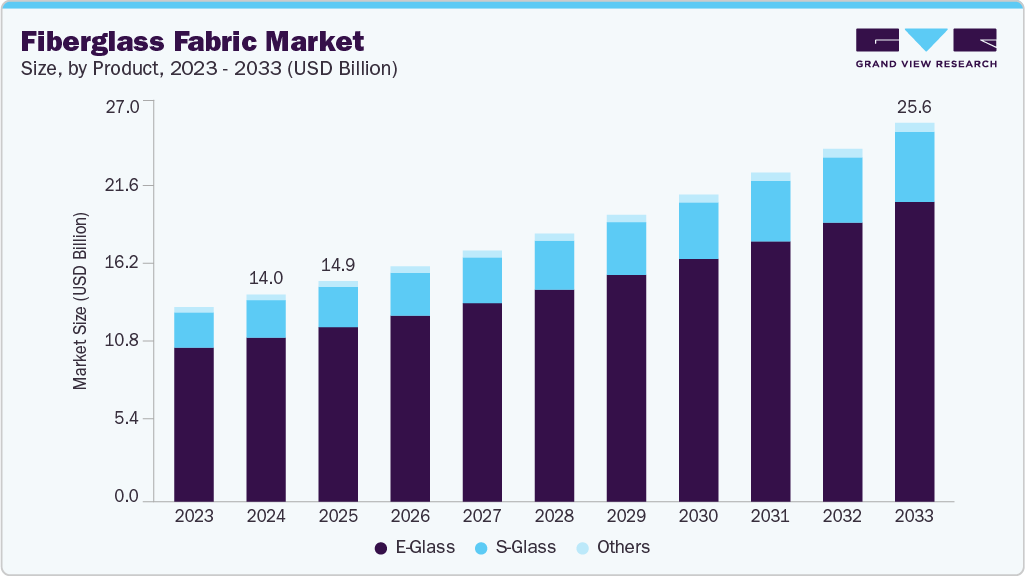
The global fiberglass fabric market size was valued at USD 14.9 billion in 2025 and is projected to grow from USD 15.9 billion in 2026 to USD 25.6 billion by 2033, at a CAGR of 7.1% from 2026 to 2033. The market in Asia Pacific dominated with a revenue share of 42.3% in 2025. The growing demand for lightweight, high-strength materials across various end-use industries is a primary driver of the fiberglass fabric market.
 Source: Grand View Research, IR Documents, Primary Interviews, Paid DatabasesTo learn more about this report,
 Download Free Sample Report
 Key Market Trends & Insights
- By product: E-glass segment held the largest market share of 79.1% in 2025.
- By fabric type: Woven segment held the largest market share of 59.2% in 2025.
- By application: Construction segment held the largest market share of 25.4% in 2025.
Regional Highlights
- Largest regional market: Asia Pacific (42.3% revenue share, 2025)
- By country: China held the largest market share in 2025.
Market Size & Forecast
- Market size in 2025: USD 14.9 Billion
- Estimated market size in 2026: USD 15.9 Billion
- Projected market size by 2033: USD 25.6 Billion
- CAGR (2026-2033): 7.1%
Three ways to get this report
Buy it, customize it, or ask a question.Ask an Analyst
Analyst response in 1 business day
- AccessReport author, directly
- Reply timeWithin 1 working day
- No sales callDirect answer only
- FormatEmail reply
- CostFree, no cost
Get the Full Report
What the study covers
- FormatsPDF · Excel · Dashboard
- Timeline2026–2033 annual, 2025 base
- Coverage20+ countries, 5 regions
- Companies10+ key players profiled
Customize the Report
20% free customization
- IncludeCountries, segments, points
- TailorTo your product definition
- ExtendDeeper competitor detail
- OrA fully bespoke study
- Turnaround5–10 working days
Industries such as aerospace, automotive, and construction are increasingly incorporating fiberglass fabrics due to their superior mechanical properties, corrosion resistance, and thermal insulation capabilities. In the automotive sector, for instance, manufacturers are leveraging fiberglass fabrics to reduce vehicle weight and improve fuel efficiency, aligning with stringent environmental regulations and carbon emission targets. Similarly, in the aerospace industry, the material offers significant advantages in terms of weight reduction and structural performance, which are critical for improving fuel economy and payload efficiency.
 To learn more about this report, Download Free Sample Report
 The construction industry's emphasis on high-performance materials for insulation, roofing, and reinforcement is contributing to the market's expansion. Fiberglass fabrics are widely used in architectural applications, including wall coverings, ceiling tiles, and fireproofing systems, due to their flame resistance and sound insulation properties. As infrastructure development accelerates in emerging economies, the need for reliable, long-lasting, and energy-efficient materials is expected to rise, creating lucrative opportunities for fiberglass fabric manufacturers. Additionally, advancements in weaving technology and product custmization are enabling broader use in specialized applications, further supporting market growth.
Another key factor fueling market growth is the expanding application of fiberglass fabric in the wind energy sector. As the global focus on renewable energy intensifies, wind turbine manufacturers are increasingly utilizing fiberglass fabric for manufacturing turbine blades due to its strength-to-weight ratio and resistance to environmental degradation. Additionally, government incentives and investments in wind power infrastructure, particularly in regions like Europe, North America, and Asia-Pacific, are further propelling the adoption of fiberglass composites in this sector. The durability and cost-effectiveness of fiberglass fabrics make them an attractive alternative to traditional materials used in energy infrastructure.
Market Dynamics
The fiberglass fabric market is experiencing steady growth driven by increasing adoption of lightweight, corrosion-resistant, and high-strength reinforcement materials across construction, transportation, wind energy, marine, electrical & electronics, and aerospace industries. Fiberglass fabrics offer an optimal combination of mechanical strength, thermal stability, electrical insulation, and cost-effectiveness, making them a preferred reinforcement material for composite structures. Growing investments in renewable energy infrastructure, expanding construction activities, and rising demand for durable composite components continue to strengthen market demand, while continuous advancements in weaving technologies and resin compatibility further enhance product performance and application scope.
The increasing preference for lightweight composite materials across transportation, construction, aerospace, and industrial sectors is a primary driver of the fiberglass fabric market. Manufacturers are replacing conventional materials such as steel and aluminum with fiberglass-reinforced composites to reduce component weight while maintaining high mechanical strength, corrosion resistance, and long service life. This transition improves fuel efficiency in transportation, lowers maintenance costs, and enhances structural durability, thereby accelerating fiberglass fabric consumption across multiple industries.
Another significant growth factor is the rapid expansion of renewable energy installations, particularly wind power. Fiberglass fabric is extensively used in wind turbine blades because of its excellent fatigue resistance, dimensional stability, and high strength-to-weight ratio. Simultaneously, increasing infrastructure development, marine applications, electrical insulation systems, and industrial equipment manufacturing are creating sustained demand for woven and nonwoven fiberglass fabrics. Technological improvements in fabric architecture and automated manufacturing processes are also enabling manufacturers to produce higher-performance composite materials for demanding applications.
The fiberglass fabric market faces challenges from fluctuating raw material prices and high energy consumption during glass fiber manufacturing. Production relies on minerals such as silica sand, limestone, and other additives, while melting and fiber-forming processes require substantial energy inputs. Variations in energy prices, transportation costs, and global supply chain disruptions increase manufacturing expenses and reduce profit margins for producers. Additionally, environmental regulations concerning emissions and the limited recyclability of certain fiberglass composite products add further operational and compliance challenges for manufacturers.
The growing focus on sustainable manufacturing and next-generation composite technologies presents significant opportunities for the fiberglass fabric market. Manufacturers are investing in energy-efficient production processes, recyclable composite systems, low-emission manufacturing techniques, and advanced weaving technologies to improve product performance while meeting environmental objectives. Increasing adoption of fiberglass fabrics in electric vehicles, smart infrastructure, renewable energy systems, and high-performance industrial applications is expected to create new growth avenues. Furthermore, innovations in specialty glass fibers, hybrid composite materials, and automated fabrication technologies are expanding the range of high-value applications for fiberglass fabrics across global industries.
Market Concentration & Characteristics
The fiberglass fabric market is moderately concentrated, with a mix of global and regional players actively competing through innovation, product customization, and strategic expansions. The degree of innovation in the market is relatively high, driven by the growing demand for high-performance composites in sectors such as aerospace, wind energy, and automotive. Companies are investing in R&D to develop advanced fabrics with enhanced tensile strength, heat resistance, and lightweight properties, catering to industry-specific needs. Strategic partnerships and collaborations with end users and raw material suppliers further strengthen the competitive landscape, while large players leverage technological advancements to gain a competitive edge.
 To learn more about this report, Download Free Sample Report
 Mergers and acquisitions are moderately active in the market, often aimed at expanding geographical presence or integrating vertically to ensure a consistent supply of raw materials. Regulatory frameworks also play a crucial role, especially in applications involving fire resistance, environmental impact, and worker safety, influencing both product standards and production processes. Although substitutes such as carbon fiber or aramid fabric exist, their higher cost and limited applicability in certain sectors restrict widespread replacement of fiberglass fabric. End-user concentration varies across applications; while the automotive and wind energy sectors are characterized by a few major manufacturers driving bulk demand, the construction and industrial sectors present a more fragmented end-user base, offering opportunities for niche suppliers.
Analyst Perspective
The fiberglass fabric market is steadily evolving into a technology-driven composites industry, supported by rising demand for lightweight, high-strength, and corrosion-resistant materials across multiple end-use sectors. Increasing adoption in wind energy, transportation, construction, aerospace, marine, and electrical & electronics applications is encouraging manufacturers to develop advanced fiberglass fabrics with improved mechanical performance and processing efficiency. Investments in automated manufacturing, sustainable production methods, and high-performance glass fiber technologies are further strengthening the market outlook. While fluctuations in raw material and energy costs remain key challenges, expanding use of fiberglass composites in renewable energy systems, electric vehicles, and modern infrastructure is expected to create significant long-term growth opportunities.
Application Insights
Based on application, the construction segment led the market with the largest revenue share of 25.4% in 2025 and is expected to grow at a CAGR of 6.6% over the forecast period, driven by the increasing demand for lightweight, durable, and corrosion-resistant materials in infrastructure development. Fiberglass fabrics are widely used in concrete reinforcement, insulation, and roofing systems, offering superior strength and longevity. The surge in urbanization and large-scale public infrastructure projects, especially in emerging economies, further fuels this demand. Strict regulations promoting energy efficiency and sustainable construction practices also encourage the use of fiberglass fabrics. Moreover, their resistance to moisture and fire makes them ideal for modern building materials. These attributes significantly contribute to their growing adoption in both residential and commercial construction.
Wind energy segment is expected to grow at the fastest CAGR of 8.6% over the forecast period, driven by its extensive application in wind energy and oil & gas industries. Wind turbine blades require lightweight yet high-strength composite materials, and fiberglass fabric meets these criteria effectively. Increasing global investments in renewable energy, particularly wind power, are accelerating the need for such materials. Additionally, fiberglass is used in pipelines, insulation, and protective equipment in the oil & gas industry due to its thermal and chemical resistance. The push for sustainable energy sources and infrastructure resilience further supports the growth of this segment. This aligns with global energy transition goals and infrastructure modernization efforts.
Product Insights
Based on product, the e-glass segment led the market with the largest revenue share of 79.1% in 2025 and is expected to grow at a CAGR of 7.0% over the forecast period, driven by its excellent electrical insulation, high strength-to-weight ratio, and cost-efficiency. E-glass fibers are extensively used in automotive, aerospace, electronics, and construction sectors where these properties are crucial. The affordability and availability of E-glass, along with its compatibility with various resins, make it a versatile material choice. Continuous product innovations and the development of advanced composites further drive its consumption. Its thermal stability and dimensional accuracy under diverse conditions are highly valued in end-use applications. These factors collectively underpin the strong demand for E-glass fabrics globally.
S-glass segment is anticipated to experience the fastest CAGR of 7.3% during the forecast period, driven by demand from high-performance applications that require superior mechanical strength and thermal stability. S-glass fabrics are widely utilized in aerospace, defense, and high-end sports equipment industries due to their enhanced tensile strength and modulus. Although more expensive than E-glass, S-glass offers exceptional performance in extreme environments, making it ideal for mission-critical components. The growth in military spending and advanced aerospace manufacturing contributes significantly to the rising adoption of S-glass. In addition, its usage in ballistic protection and structural reinforcement in automotive and marine sectors is expanding. These niche but essential uses maintain steady demand for this premium fiberglass type.
Fabric Type Insights
Based on fabric type, the woven segment led the market with the largest revenue share of 59.2% in 2025 and is expected to grow at a CAGR of 7.0% over the forecast period, driven by its balanced structural integrity, high dimensional stability, and design flexibility. These fabrics are commonly used in applications requiring uniform strength in multiple directions, such as boat hulls, industrial panels, and sports gear. The consistent performance and predictable behavior of woven fiberglass in stress conditions make it a preferred material in precision engineering. Growth in composite manufacturing and increasing demand for customized structural components are enhancing the uptake of woven variants. Moreover, their ease of handling and compatibility with various manufacturing processes support their use across industries. These characteristics keep woven fiberglass in high demand across both traditional and advanced applications.
 To learn more about this report, Download Free Sample Report
 The nonwoven segment is anticipated to experience the fastest CAGR of 7.2% during the forecast period, driven by its lightweight properties, cost-effectiveness, and suitability for insulation and filtration applications. These fabrics are often used in roofing materials, acoustic panels, and thermal insulation solutions, where uniform distribution and low density are beneficial. Rising environmental regulations and emphasis on energy efficiency in buildings further support the use of nonwoven fiberglass. Advancements in nonwoven processing technologies have improved their mechanical properties, expanding their applicability. Additionally, their recyclability and ease of installation are attractive for green construction and industrial settings. These market dynamics are steadily boosting the nonwoven segment's growth trajectory.
Regional Insights
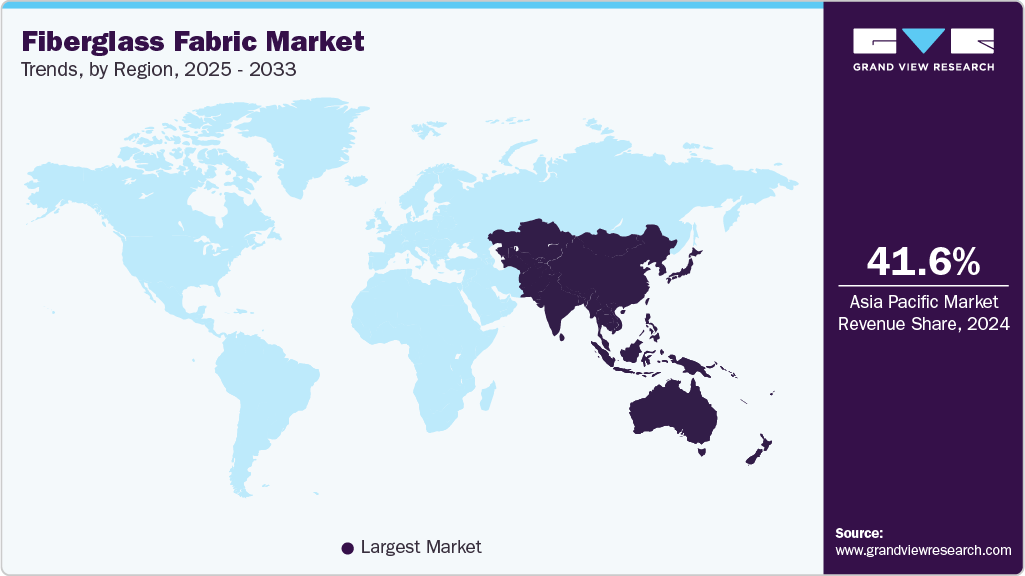
Asia Pacific dominated the fiberglass fabric market with the largest revenue share of 42.3% in 2025, fueled by rapid industrialization, urban development, and infrastructure expansion. Countries like China, India, South Korea, and Japan are witnessing increased use of fiberglass in construction, automotive, and electronics industries. The push for energy-efficient and sustainable building materials is accelerating demand in residential and commercial projects. Additionally, expanding wind energy capacity and automotive production in the region are key growth contributors. Competitive manufacturing costs and the availability of raw materials also encourage large-scale production and export activities.
 To learn more about this report, Download Free Sample Report
 The fiberglass fabric market in China held the largest share in the Asia Pacific region in 2025. China fiberglass fabric market dominates the Asia Pacific market owing to its massive industrial base and government-driven infrastructure projects. The country is a leading producer and exporter of fiberglass products, benefiting from cost-effective labor and raw material access. Rapid expansion in the construction, transportation, and electronics sectors is fueling domestic consumption. The government's emphasis on renewable energy sources, especially wind power, has significantly driven the use of fiberglass composites. Additionally, the growing demand for electric vehicles and lightweight automotive components continues to spur innovation in fiberglass fabric applications.
North America Fiberglass Fabric Market Trends
The fiberglass fabric market in North America is driven by robust demand from the aerospace, defense, and wind energy sectors. The U.S. government’s increasing investments in renewable energy projects and military modernization have significantly boosted the need for lightweight and durable materials like fiberglass fabrics. Moreover, stringent regulations regarding emissions and fuel efficiency are pushing automotive manufacturers to adopt composite materials to reduce vehicle weight. Growth in infrastructure and industrial applications, especially in thermal insulation and corrosion resistance, further contributes to market expansion. Strong R&D capabilities and the presence of key manufacturers support ongoing innovation in the region.
U.S. Fiberglass Fabric Market Trends
The U.S. fiberglass fabric market benefits from advancements in composite manufacturing and a well-established base of end-use industries. Demand from high-performance sectors such as aerospace, electronics, and marine drives the adoption of engineered fiberglass solutions. The rapid growth in wind energy installations and electric vehicles also fuels the consumption of lightweight and high-strength materials. Favorable policies supporting domestic manufacturing and sustainability initiatives further support the market. The presence of leading players and a strong distribution network enhances product accessibility and application-specific innovation.
Europe Fiberglass Fabric Market Trends
Europe’s fiberglass fabric market is driven by sustainability goals and stringent regulatory standards across multiple sectors, particularly automotive, aerospace, and construction. The European Union’s Green Deal and carbon neutrality targets are encouraging the use of lightweight composite materials to improve energy efficiency. The automotive sector is undergoing a major shift toward electric mobility, which enhances demand for fiberglass for weight reduction. Furthermore, refurbishment of aging infrastructure and growing renewable energy initiatives, especially offshore wind energy, provide long-term opportunities for the fiberglass fabric industry.
Germany fiberglass fabric market holds a prominent share of European market, supported by its strong automotive and industrial base. German manufacturers are heavily investing in advanced composites to enhance vehicle performance, reduce emissions, and meet environmental standards. The country is also a hub for wind energy projects, particularly in offshore installations, which require durable and corrosion-resistant materials like fiberglass. Innovation in high-temperature and electrically insulating fabrics for electronics and machinery applications further supports market growth. Supportive regulations and government funding for green technologies play a pivotal role in fostering demand.
Central & South America Fiberglass Fabric Market Trends
The fiberglass fabric market in Central & South America is propelled by increasing demand for regional and low-cost air travel. Brazil, home to Embraer, is a significant contributor, particularly in the regional jet segment. The need to modernize older aircraft fleets in the region encourages retrofitting, boosting demand for insulation upgrades. Although budget constraints remain, international partnerships and investments in airport infrastructure help stimulate market activity. Growing environmental awareness is also encouraging interest in sustainable insulation fabric types.
Middle East & Africa Fiberglass Fabric Market Trends
The fiberglass fabric market in the Middle East & Africa is driven by large-scale construction projects and the growing oil & gas sector. High-temperature resistant and corrosion-proof fiberglass fabrics are widely used in pipelines, insulation, and protective applications. Countries like the UAE and Saudi Arabia are investing heavily in renewable energy projects, including solar and wind power, which require composite materials for components and infrastructure. Additionally, the region’s push toward economic diversification and sustainable building practices enhances opportunities for fiberglass fabric manufacturers. However, the market still faces challenges related to limited local manufacturing and supply chain constraints.
Key Fiberglass Fabric Company Insights
Some key players operating in the market include Owens Corning, and Jushi Group Co. Ltd.
-
Owens Corning is a global player in building and industrial materials, headquartered in the United States. The company is widely recognized for its innovations in composite materials, particularly in fiberglass technology. Owens Corning's product portfolio includes fiberglass fabrics, reinforcements, insulation materials, and roofing components, serving industries such as construction, automotive, wind energy, and industrial applications. Its fiberglass fabric offerings are known for their durability, lightweight nature, and resistance to heat and corrosion.
-
Jushi Group Co., Ltd, based in China, is one of the world’s largest manufacturers of fiberglass and fiberglass reinforced products. The company offers a broad range of fiberglass products including direct roving, chopped strands, woven roving, fiberglass mats, and fabrics. Its fiberglass fabric solutions are engineered to meet high-performance standards, catering to diverse industrial and structural reinforcement needs worldwide.
Gurit, Hexcel Corporation are some emerging participants in the market.
-
Gurit is a Swiss-based company that specializes in advanced composite materials, engineering, and tooling solutions. The company serves a range of sectors, including aerospace, marine, automotive, and wind energy. Gurit’s product portfolio comprises prepregs, structural core materials, adhesives, and engineered fiberglass fabrics. The company is particularly noted for its tailored composite solutions that enable lightweight, high-strength applications.
-
Hexcel Corporation, headquartered in the United States, is a leading producer of advanced composites and engineered materials. The company manufactures high-performance reinforcement fabrics, including fiberglass, carbon fiber, and hybrid textiles. Hexcel’s fiberglass fabrics are primarily used in aerospace, defense, automotive, and industrial sectors, offering strength, stiffness, and durability while reducing overall weight.
Key Fiberglass Fabric Companies
The following key companies have been profiled for this study on the fiberglass fabric market.
-
Owens Corning
-
Jushi Group Co. Ltd
-
Gurit
-
Hexcel Corporation
-
BGF Industries, Inc.
Competitive Benchmarking
Category
Operating Strategies
Competitive Edge
Weakness
Established Players (Owens Corning; Jushi Group Co. Ltd; Gurit; Hexcel Corporation)
Expansion of high-performance and specialty fiberglass fabric product portfolios.
Long-term supply agreements with automotive, wind energy, and construction manufacturers.
Investments in advanced weaving technologies and global production facilities.
Strong global distribution and manufacturing capabilities.
Broad application expertise across construction, transportation, and industrial sectors.
Established relationships with major composite manufacturers and OEMs.
High dependence on energy-intensive manufacturing processes.
Exposure to raw material and transportation cost fluctuations.
Challenges associated with environmental compliance and recycling.
Emerging Players ( BGF Industries, Inc.; Chomarat Group)
Focus on customized and application-specific fiberglass fabric solutions
Expansion into niche industrial and renewable energy applications.
Adoption of cost-efficient manufacturing and regional supply strategies.
Greater flexibility in meeting customer-specific requirements.
Competitive pricing in regional markets.
Faster adoption of innovative fabric structures and specialty coatings.
Limited production capacity and global market presence.
Lower bargaining power compared to established manufacturers.
Dependence on regional demand and distributor networks.
Recent Developments
-
In October 2023, Owens Corning launched an advanced E-glass fabric engineered for superior strength and improved fire resistance, specifically tailored for use in wind turbine blade applications.
Fiberglass Fabric Market Report Scope
Report Attribute
Details
Market size in 2025
USD 14.9 billion
Estimated market size in 2026
USD 15.9 billion
Projected market size by 2033
USD 25.6 billion
Growth rate
CAGR of 7.1% from 2026 to 2033
Base year for estimation
2025
Historical data
2021 - 2024
Forecast period
2026 - 2033
Quantitative units
Volume in Million Square Meters, Revenue in USD million/billion, and CAGR from 2026 to 2033
Report coverage
Revenue forecast, company ranking, competitive landscape, growth factors, and trends
Segments covered
Application, product, fabric type, region
Regional scope
North America; Europe; Asia Pacific; Central & South America; Middle East & Africa
Country scope
U.S.; Canada; Mexico; Germany; UK; France; India; China; Japan; Australia, South Korea; Brazil; Argentina; South Africa
Key companies profiled
Owens Corning, Jushi Group Co. Ltd, Gurit, Hexcel Corporation, BGF Industries, Inc.
Customization scope
Free report customization (equivalent up to 8 analysts' working days) with purchase. Addition or alteration to country, regional & segment scope.
Pricing and purchase options
Avail customized purchase options to meet your exact research needs. Explore purchase options
Global Fiberglass Fabric Market Report Segmentation
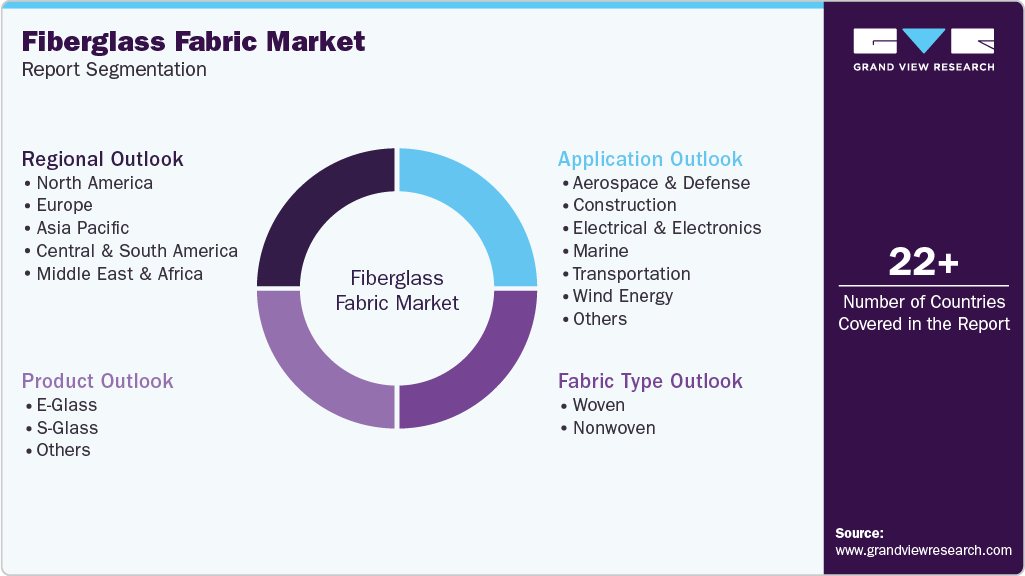
This report forecasts revenue growth at the global, regional, and country levels and provides an analysis of the latest industry trends in each of the sub-segments from 2021 to 2033. For this study, Grand View Research has segmented the global fiberglass fabric market report based on application, product, fabric type and region.
 To learn more about this report, Download Free Sample Report
 -
Application Outlook (Volume, Million Square Meters; Revenue, USD Million, 2021 - 2033)
-
Aerospace & Defense
-
Construction
-
Electrical & Electronics
-
Marine
-
Transportation
-
Wind Energy
-
Others
-
-
Product Outlook (Volume, Million Square Meters; Revenue, USD Million, 2021 - 2033)
-
E-Glass
-
S-Glass
-
Others
-
-
Fabric Type Outlook (Volume, Million Square Meters; Revenue, USD Million, 2021 - 2033)
-
Woven
-
Nonwoven
-
-
Regional Outlook (Volume, Million Square Meters; Revenue, USD Million, 2021 - 2033)
-
North America
-
U.S.
-
Canada
-
Mexico
-
-
Europe
-
Germany
-
UK
-
France
-
Russia
-
-
Asia Pacific
-
China
-
India
-
Japan
-
Australia
-
South Korea
-
-
Central & South America
-
Brazil
-
Argentina
-
-
Middle East & Africa
-
South Africa
-
-
Research Methodology
The fiberglass fabric market figures in this report are based on a proven research process that combines executive interviews with secondary research from proprietary databases, company filings, and recognized regulatory and institutional sources. Market size is built through value-chain sizing - reconciling supply-side and demand-side estimates - and triangulated with bottom-up and top-down approaches. Every estimate passes multiple levels of expert validation before publication, with each fiberglass fabric segment quantified using the revenue-capture definitions in the table below.
Segment Definition
Segment - Product
Revenue capture definition
E-Glass
Revenue generated from the sale of E-Glass fiberglass fabrics used in electrical insulation and general-purpose composite applications. They offer excellent strength, corrosion resistance, and cost-effectiveness. E-Glass is the most widely used fiberglass type across industries.
S-Glass
Revenue generated from the sale of S-Glass fiberglass fabrics designed for high-performance aerospace, defense, and sporting applications. These fabrics provide superior tensile strength, stiffness, and fatigue resistance. They are preferred where high mechanical performance is required.
Others
Revenue generated from the sale of specialty fiberglass fabrics such as C-Glass, R-Glass, and AR-Glass for niche applications. These materials offer enhanced chemical resistance, alkali resistance, or specialized mechanical properties. They are selected for application-specific performance needs.
Segment - Fabric Type
Revenue capture definition
Woven
Revenue generated from the sale of woven fiberglass fabrics manufactured using interlaced yarns. These fabrics provide high tensile strength, dimensional stability, and excellent reinforcement for composite structures. They are widely used in aerospace, marine, and construction applications.
Nonwoven
Revenue generated from the sale of nonwoven fiberglass fabrics produced through bonded or randomly oriented fibers. These fabrics offer superior conformability, resin absorption, and insulation properties. They are commonly used in filtration, thermal insulation, and molded composite products.
Segment - Application
Revenue capture definition
Aerospace & Defense
Revenue generated from the sale of fiberglass fabrics used in aircraft interiors, radomes, insulation systems, and defense equipment. These fabrics provide lightweight reinforcement, flame resistance, and high mechanical strength. They improve fuel efficiency and structural performance.
Construction
Revenue generated from the sale of fiberglass fabrics used in roofing, wall reinforcement, waterproofing membranes, insulation, and concrete strengthening. They enhance durability, crack resistance, and corrosion protection. Their long service life makes them suitable for modern infrastructure projects.
Electrical & Electronics
Revenue generated from the sale of fiberglass fabrics used in printed circuit boards (PCBs), electrical insulation, cable wraps, and electronic components. These fabrics offer excellent dielectric strength, thermal stability, and dimensional stability. They are essential for reliable electrical performance.
Marine
Revenue generated from the sale of fiberglass fabrics used in boats, yachts, ship hulls, decks, and marine structures. They provide corrosion resistance, lightweight construction, and high durability in harsh marine environments. Their use reduces maintenance and extends vessel lifespan.
Transportation
Revenue generated from the sale of fiberglass fabrics used in automotive, railway, and commercial vehicle components. These fabrics reduce vehicle weight while maintaining structural strength and impact resistance. They contribute to improved fuel efficiency and lower emissions.
Wind Energy
Revenue generated from the sale of fiberglass fabrics used in manufacturing wind turbine blades and nacelle components. They provide high fatigue resistance, stiffness, and lightweight reinforcement. Their use supports efficient renewable energy generation and longer turbine service life.
Others
Revenue generated from the sale of fiberglass fabrics used in industrial equipment, sports & leisure products, pipes & tanks, and consumer goods. These fabrics offer versatile reinforcement and thermal resistance. They support a wide range of specialized composite applications.
Estimation Model
Layer Name
Key Question
Description
Raw Material & Glass Fiber Production Analysis
What is the production capacity and availability of glass fibers used for fiberglass fabric manufacturing?
Evaluates the supply of key raw materials such as silica sand, limestone, alumina, and boron compounds, along with glass fiber production capacities, pricing trends, regional manufacturing hubs, and supply chain dynamics influencing fiberglass fabric production.
Fiberglass Fabric Manufacturing & Product Segmentation Analysis
How much fiberglass fabric is produced and consumed across different fabric types and products?
Assesses production volumes, manufacturing technologies, fabric types (E-Glass, S-Glass, Others), product categories (Woven and Nonwoven), capacity utilization, and technological advancements across major manufacturers.
Application Demand & Industry Consumption Analysis
Which industries generate the highest demand for fiberglass fabrics?
Estimates demand across aerospace & defense, construction, electrical & electronics, marine, transportation, wind energy, and other applications by evaluating composite manufacturing trends, production volumes, replacement rates, and end-use consumption patterns..
Regional Revenue Validation & Competitive Benchmarking
How is market revenue distributed across regions and leading manufacturers?
Validates market estimates using regional production and consumption data, import-export analysis, pricing trends, company revenues, capacity expansions, and competitive benchmarking to determine the overall fiberglass fabric market size and forecast.
Delivered Customizations
This report has been delivered with the following In-depth customizations
Client Request
Customization Delivered
Value Adds
Pricing Analysis
Comparative pricing analysis across fiberglass fabric products, including E-glass, S-glass, woven, and nonwoven fabrics, with pricing assessment by key applications such as aerospace & defense, construction, electrical & electronics, marine, transportation, and wind energy across major regions.
Supports procurement planning, supplier benchmarking, and cost optimization by identifying pricing variations across product types, fabric structures, and end-use applications.
Regulatory Environment
Analysis of environmental regulations, emission standards, occupational safety requirements, and compliance frameworks related to fiberglass manufacturing, composite processing, and industrial applications across major regions.
Help companies understand regulatory risks, maintain compliance, and align operations with sustainability and environmental standards.
Opportunity Assessment
Mapping growth opportunities across aerospace & defense, wind energy, transportation, construction, marine, and electrical & electronics applications, along with analysis of trends such as lightweight composites, renewable energy expansion, and infrastructure modernization.
Enables identification of high-growth applications and emerging market opportunities, supporting investment planning and long-term business strategy development.
Frequently Asked Questions About This Report
Key factors driving the fiberglass fabric market include rising demand for lightweight, durable, and heat-resistant materials across construction, energy, aerospace, and automotive industries.
Asia Pacific held the highest revenue market share of 42.3% in 2025, driven by strong composite manufacturing capabilities, rapid infrastructure development, expanding wind energy installations, and growing demand from the construction, transportation, and electrical & electronics industries, particularly in China and India.
The s-glass segment is the fastest-growing product in the fiberglass fabric market.
The wind energy segment is the fastest-growing application segment in the fiberglass fabric market.
The construction segment accounted for the largest revenue share of 25.4% in 2025, driven by increasing use of fiberglass fabrics in concrete reinforcement, roofing, insulation, waterproofing systems, and infrastructure projects due to their high strength, corrosion resistance, and long service life.
Some of the key players operating in the fiberglass fabric market include Owens Corning, Jushi Group Co., Ltd., Gurit, Hexcel Corporation, and BGF Industries, Inc.
The woven segment led with a 59.2% revenue share in 2025, while the nonwoven segment is the fastest-growing.
The global fiberglass fabric market size was valued at USD 14.9 billion in 2025 and is estimated at USD 15.9 billion for 2026.
The global fiberglass fabric market is expected to grow at a CAGR of 7.1% from 2026 to 2033, reaching USD 25.6 billion by 2033.
The e-glass segment held the highest revenue market share of 79.1% in 2025, driven by its excellent electrical insulation, mechanical strength, corrosion resistance, and cost-effectiveness, making it the preferred material for construction, transportation, electrical & electronics, and wind energy applications.
About the Author(s)
Specialty Glass, Ceramic & Fiber Research Team
Advanced Materials · Specialty Glass, Ceramic & FiberThis report was authored by the specialty glass, ceramic & fiber research team at Grand View Research - comprising two research analysts, one senior research analyst, and one industry expert - with specialized expertise in the specialty glass, ceramic & fiber segment of the advanced materials industry. All findings are based on proprietary advanced materials databases, executive interviews, and regulatory analysis, subject to internal peer review prior to publication.
Last Updated:
Speak to Analyst

Customize this report to your needs - add regions, segments, or data points, with 20% free customization.
Or view our licence options:


ISO 9001:2015 & 27001:2022 Certified
We are GDPR and CCPA compliant! Your transaction & personal information is safe and secure. For more details, please read our privacy policy.


