
- Home
- »
- Next Generation Technologies
- »
-
Field Force Automation Market Size, Growth Report, 2026-2033GVR Report cover

Field Force Automation Market (2026 - 2033)
Size, Share & Trends Analysis Report By Component (Solution, Services), By Deployment, By Organization Size, By End-use, By Region, And Segment Forecasts
Market Size, 2025
$3.8BMarket Estimate, 2026
$4.6BMarket Forecast, 2033
$17.8BCAGR, 2026–2033
21.4%Field Force Automation Market Summary
The global field force automation market size was estimated at USD 3.8 billion in 2025 and is projected to grow from USD 4.6 billion in 2026 to USD 17.8 billion by 2033, growing at a CAGR of 21.4% from 2026 to 2033. North America dominated the market, accounting for a revenue share of 30.0% in 2025. The market expansion across sectors is fueled by rising demand for efficient, automated solutions that enhance operational efficiency and optimize workforce productivity.
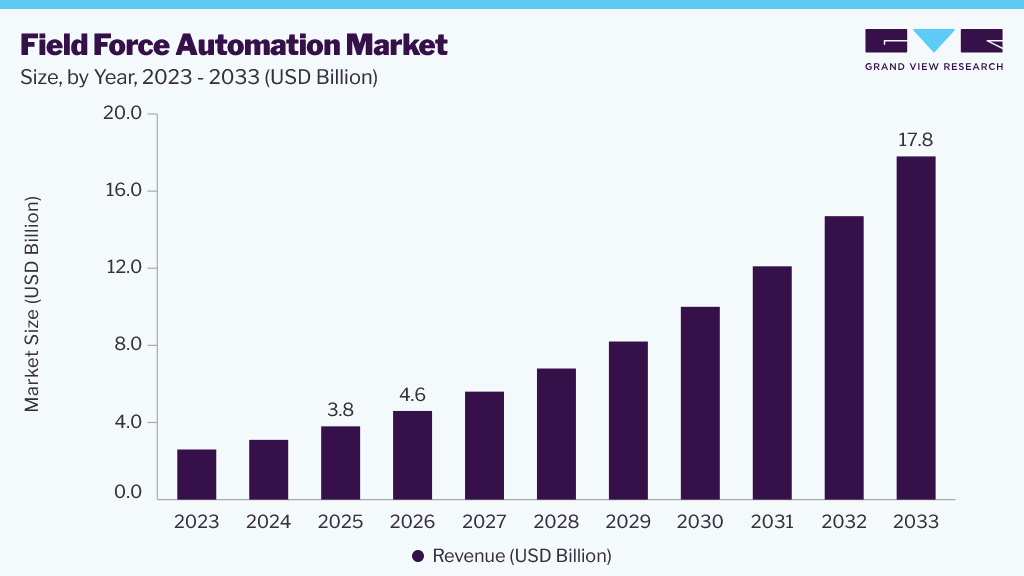 Source: Grand View Research, IR Documents, Primary Interviews, Paid DatabasesTo learn more about this report,
 Download Free Sample Report
Key Market Trends & Insights
- By component: The solution devices segment dominated the market, with a revenue share of about 81.0% in 2025.
- By deployment: The cloud segment held the largest revenue share in 2025.
- By organization size: The large-size enterprises segment held the largest revenue share in 2025.
- By end use: The IT & Telecom sector segment held the largest revenue share in 2025.
Regional Highlights
- Largest regional market: North America (30.0% revenue share, 2025)
- Fastest-growing regional market: Asia Pacific (Highest CAGR, 2026-2033)
Market Size & Forecast
- Market size in 2025: USD 3.8 Billion
- Estimated market size in 2026: USD 4.6 Billion
- Projected market size by 2033: USD 17.8 Billion
- CAGR (2026-2033): 21.4%
Three ways to get this report
Buy it, customize it, or ask a question.Ask an Analyst
Analyst response in 1 business day
- AccessReport author, directly
- Reply timeWithin 1 working day
- No sales callDirect answer only
- FormatEmail reply
- CostFree, no cost
Get the Full Report
What the study covers
- FormatsPDF · Excel · Dashboard
- Timeline2026–2033 annual, 2025 base
- Coverage20+ countries, 5 regions
- Companies10+ key players profiled
Customize the Report
20% free customization
- IncludeCountries, segments, points
- TailorTo your product definition
- ExtendDeeper competitor detail
- OrA fully bespoke study
- Turnaround5–10 working days
The widespread use of field force automation to schedule, manage attendance, oversee staff, and serve geographically diverse clients is a crucial driver of market growth. Furthermore, advancements in the IT industry and the increasing adoption of internet-connected devices with cloud capabilities contribute significantly to the market's upward trajectory.
The growing need to enhance the efficiency of field forces and the increasing adoption of cost-effective cloud-based solutions are expected to be key drivers of the field force automation market's expansion. Moreover, affordable solutions from various providers enable small and medium-sized enterprises with constrained budgets to implement these tools for effectively managing their field operations. Field force automation solutions enable scaling and adaptation to evolving business requirements and expanding workforces. They enable organizations to grow their field operations, incorporate new features, and integrate with current systems seamlessly, avoiding significant disruptions.
Analyst Perspective
The field force automation market is poised for sustained growth, driven by the increasing adoption of digital workforce management solutions, the growing need for real-time field operations, and the rising demand for enhanced workforce productivity across industries. Organizations are increasingly deploying cloud-based and mobile-enabled field force automation platforms to streamline scheduling, dispatching, route optimization, and customer service operations. Technological advancements in artificial intelligence, machine learning, Internet of Things (IoT), predictive analytics, and location-based services are improving operational efficiency, decision-making, and workforce visibility. The growing emphasis on digital transformation, remote workforce management, and customer-centric service delivery is further accelerating market expansion. As enterprises continue to optimize field operations, reduce operational costs, and improve service quality, the field force automation market is expected to grow steadily throughout the forecast period.
Deployment Insights
Based on deployment, the cloud segment accounted for the largest market revenue share in 2025 and is anticipated to register the fastest CAGR over the forecast period. Cloud-based solutions provide scalability and adaptability, allowing businesses to adjust their resources flexibly according to demand. It is especially advantageous for field force automation, enabling companies to oversee their mobile workforce and respond effectively to evolving needs. Platforms offer immediate access to essential information and analytics from any location at any time. Cloud-based field force automation solutions enable organizations to improve scheduling, route optimization, remote collaboration, and analytics while reducing infrastructure costs and enhancing scalability. For instance, in April 2025, Salesforce launched Agent Force for Field Service, an AI-powered cloud solution that automates scheduling, reporting, troubleshooting, and administrative tasks for field technicians, further accelerating the adoption of cloud-based field service management platforms.
The on-premises segment is anticipated to rise significantly over the forecast period. The on-premises segment involves implementing solutions within a company's internal infrastructure rather than using cloud-based hosting services. Organizations, especially in sectors such as healthcare, finance, and government, often choose on-premises solutions due to the need for enhanced data security and regulatory compliance. Enterprises with complex IT environments continue to invest in on-premises deployments to ensure data sovereignty while integrating field force automation with existing enterprise systems. For instance, in October 2024, Microsoft introduced new capabilities in Dynamics 365 Field Service Release Wave 2, including enhanced offline mobile functionality, Copilot-powered assistance, and improved scheduling features, enabling organizations with secure and hybrid deployment environments to optimize field operations while maintaining greater control over critical business data. The continued emphasis on data governance, cybersecurity, and regulatory compliance is expected to support sustained demand for on-premises field force automation solutions, particularly among large enterprises and regulated industries over the forecast period.
Organization Size Insights
By organization, the large enterprise segment accounted for the largest market revenue share in 2025. Field force automation solutions provide immediate insights into field operations, enabling businesses to enhance customer service quality. Through automated processes, field workers can promptly address customer needs, solve problems, and deliver tailored experiences. Large organizations are increasingly investing in intelligent automation solutions to optimize technician scheduling, improve asset performance, and enhance customer experience across large-scale field operations. For instance, in May 2024, IFS launched new Industrial AI capabilities for IFS Cloud, including enhanced Field Service Management features that enable large enterprises to automate scheduling, improve predictive maintenance, and optimize service delivery across asset-intensive industries such as manufacturing, utilities, telecommunications, and energy. The launch reinforces the growing demand for enterprise-grade field force automation platforms among large organizations.
The small and medium-sized enterprises (SMEs) segment is anticipated to register the fastest CAGR over the forecast period. Field force automation solutions present affordable resources that aid SMEs in optimizing their field activities, cutting down on manual work, and enhancing overall effectiveness. Through adopting these solutions, SMEs can realize cost reductions over time. These tools grant SMEs immediate insight into their field operations, enabling them to monitor their field staff's performance, allocate tasks more efficiently, and enhance route planning for increased productivity. Cloud deployment, mobile accessibility, and simplified implementation are enabling SMEs to enhance service delivery while reducing operational costs. For instance, in July 2025, Zoho introduced enhanced AI capabilities across its enterprise applications through Zia, including intelligent workflow automation, predictive analytics, and mobile productivity features that support field service operations. These enhancements enable SMEs to improve technician productivity, automate routine tasks, and deliver faster customer service using affordable cloud-based solutions. The increasing adoption of affordable cloud-based business applications and AI-powered automation tools is expected to accelerate the adoption of field force automation solutions among SMEs over the forecast period.
End-use Insights
The IT & Telecom sector accounted for the largest share of revenue in 2025. Customer experience is a top priority for IT & Telecom companies seeking to differentiate themselves in a crowded marketplace. Field force automation tools help organizations deliver superior customer service by enabling faster response times, personalized interactions, and efficient issue resolution. Service providers are leveraging AI-powered workforce management platforms to improve technician productivity, optimize dispatch operations, and deliver faster customer support. For instance, in March 2025, ServiceNow introduced AI agents specifically built for the telecommunications industry to automate labor-intensive workflows across customer service and network operations. Built in collaboration with NVIDIA, the AI agents support autonomous service testing, network incident analysis, billing resolution, and field engineer scheduling, enabling communications service providers to improve operational efficiency and enhance customer experiences.
The retail sector is anticipated to register the fastest CAGR over the forecast period. In an intensely competitive retail landscape, businesses seek methods to distinguish themselves from competitors. Embracing field force automation solutions enhances operational effectiveness and provides a competitive advantage, enabling retailers to deliver faster, provide enhanced service excellence, and ensure precise order completion. Retailers are increasingly investing in intelligent mobile technologies and AI-powered automation to improve frontline productivity, inventory management, and customer engagement.
Component Insights
The market is bifurcated into solution and service segments based on component type. The solution segment accounted for the largest market revenue share of approximately 81.0% in 2025. Integration capabilities are vital in field force automation solutions to effectively connect with various business systems, such as CRM software, ERP systems, and IoT devices. This connectivity ensures consistent data across diverse platforms and enhances operational effectiveness. Real-time monitoring and analytics are crucial in the field force automation solution sector. Organizations are investing in intelligent automation solutions that integrate field operations with business-critical applications to improve technician productivity, asset utilization, and customer engagement. Therefore, the increasing integration of artificial intelligence, cloud computing, IoT, and enterprise applications is expected to sustain the solution segment's dominance throughout the forecast period.
The services segment is anticipated to grow at the fastest CAGR over the forecast period. The increasing need for effective field service management solutions across the telecommunications, healthcare, utilities, and manufacturing sectors is a key driver of market growth. Companies are increasingly adopting field force automation solutions to boost efficiency, reduce operational expenses, and enhance customer satisfaction. Service providers are helping enterprises streamline deployment, optimize workforce management, and ensure continuous system performance across diverse industries. The increasing need for specialized consulting, implementation, and managed services to support enterprise digital transformation initiatives is expected to drive robust growth of the services segment during the forecast period.
Regional Insights
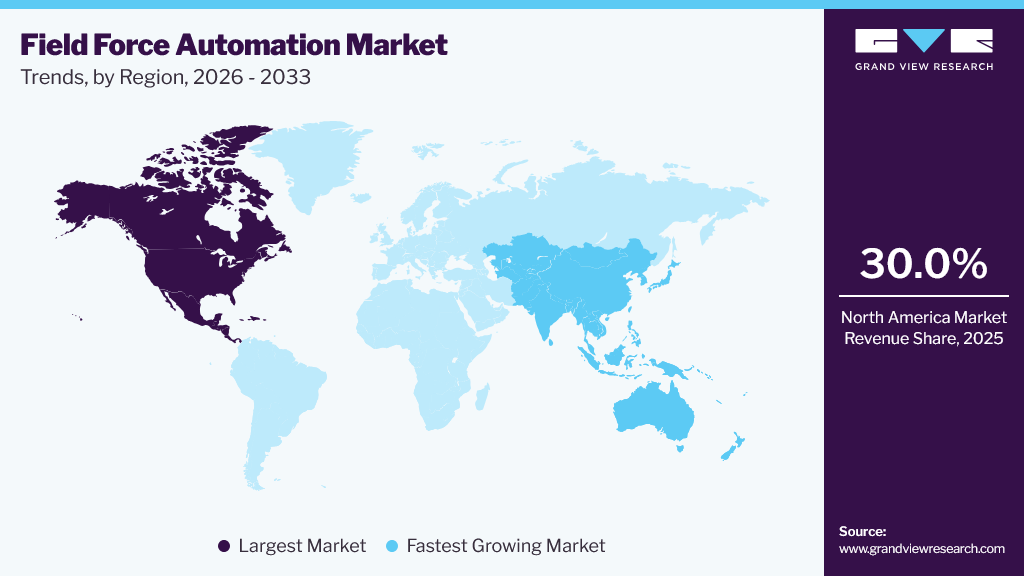
The North America dominated the market, accounting for a revenue share of 30.0%, in 2025. The increasing need for operational efficiency and real-time data access across industries such as telecommunications, healthcare, and others drives regional demand for field force automation. Organizations are increasingly integrating artificial intelligence with field service management to automate service workflows, improve technician productivity, and enhance customer experiences. For instance, in October 2024, Oracle introduced new AI-driven workflows for Oracle Fusion Cloud Service and Oracle Fusion Cloud Field Service. The new capabilities include AI-powered automated service agents, call and chat summarization, and knowledge search augmentation for field technicians, enabling organizations to improve first-time fix rates, reduce service resolution times, and enhance workforce productivity. These advancements highlight the growing adoption of intelligent field force automation solutions across North American enterprises.
 To learn more about this report, Download Free Sample Report
U.S. Field Force Automation Market Trends
The field force automation market of the U.S. accounted for above 20.0% of the global market in 2025 and is expected to grow significantly over the forecast period. The market growth is driven by the expanding mobile workforce and increasing demand for real-time data access to meet evolving customer expectations. In January 2024, Acumatica, Inc. launched Professional Services Edition, a new field force automation portfolio offering that will leverage Acumatica's project accounting, billing, and scheduling features. This edition aims to empower businesses to enhance client service, efficiently manage the entire customer engagement process, and monitor operations seamlessly within the Acumatica platform in the country.
Asia Pacific Field Force Automation Market Trends
The Asia Pacific field force automation market is anticipated to register the fastest CAGR over the forecast period. Rapid economic development, increasing smartphone penetration, and rising adoption of cloud-based enterprise solutions are driving market growth in the region. Growing adoption of IoT (Internet of Things) and AI technologies is further transforming field operations by enabling real-time monitoring, predictive maintenance, and intelligent workforce management. Organizations are increasingly leveraging intelligent field service platforms to improve technician productivity, automate workflows, and enhance customer experiences. For instance, in July 2025, Cyient and Zinier announced a strategic partnership to accelerate field service transformation for asset-intensive industries. The collaboration combines Cyient's implementation expertise with Zinier's AI-powered Field Service Management platform, enabling organizations across the Asia-Pacific region to modernize field operations through intelligent scheduling, mobile workforce management, predictive maintenance, and no-code workflow automation.
The field force automation market of China dominated the region in 2025. China, a global manufacturing hub with a significant footprint in sectors such as e-commerce, logistics, utilities, and services, sees high demand for field force automation solutions. Furthermore, government initiatives promoting digitalization across industries and the development of 5G infrastructure are expected to boost the market further.
The India field force automation market is anticipated to register the fastest CAGR over the forecast period. The growth in the Indian market can be attributed to several industries adopting these solutions, including telecommunications, healthcare, FMCG (Fast-Moving Consumer Goods), and others.
Latin America Field Force Automation Market Trends
The Latin America market is anticipated to grow significantly over the forecast period. Companies in the region are undergoing digital transformation, and growth in the adoption of field force automation is anticipated. Intense competition across sectors is driving the adoption of these solutions as companies seek a competitive edge through improved efficiency and service quality.
Key Field Force Automation Market Company Insights
Some of the key players operating in the market include Microsoft and Oracle.
- Microsoft has established a strong presence in the field force automation market through its cloud computing platform, Azure, and business applications such as Dynamics 365. Its field service solutions enable organizations to optimize scheduling, automate work orders, improve resource allocation, and enhance technician productivity through AI-powered insights, predictive maintenance, and remote assistance capabilities.
- Oracle offers robust field force automation capabilities through Oracle Field Service, a part of Oracle Cloud CX. Its platform helps organizations streamline field operations with intelligent scheduling, route optimization, real-time customer communication, and workforce management tools. Oracle continues to enhance its platform with AI-driven automation and analytics to improve operational efficiency and service delivery.
Key Field Force Automation CompaniesThe following key companies have been profiled for this study on the field force automation market:
-
Salesforce, Inc.
-
Microsoft
-
Oracle
-
SAP SE
-
IFS
-
PTC
-
Trimble Inc.
-
Acumatica, Inc.
-
LeadSquared
-
FieldEZ
Recent Developments
-
In January 2025, Zebra Technologies introduced the Zebra Mobile Computing AI Suite and Zebra Companion at NRF 2025 Retail's Big Show. The new AI-powered solutions enable frontline retail employees to automate data capture, improve inventory accuracy, streamline merchandising tasks, and optimize store operations, helping retailers enhance workforce productivity and deliver superior customer experiences.
-
In March 2024, Oracle introduced enhanced generative AI features in the Oracle Fusion Cloud Applications Suite to boost decision-making processes and improve the experiences of employees and customers. These new AI capabilities are integrated into various business workflows within finance, supply chain, HR, sales, marketing, and service.
-
In November 2023, Amazon Web Services, Inc. (AWS) (Amazon.com, Inc.) and Salesforce, Inc. expanded their longstanding partnership, enhancing product integrations in data and artificial intelligence (AI). This expansion allows customers to manage their data easily and securely across both platforms and incorporate the latest generative AI technologies into their applications and workflows safely and responsibly.
Field Force Automation Market Report Scope
Report Attribute
Details
Market size in 2025
USD 3.8 billion
Estimated market size in 2026
USD 4.6 billion
Projected market size by 2033
USD 17.8 billion
Growth rate
CAGR of 21.4% from 2026 to 2033
Base year for estimation
2025
Historical data
2021 – 2024
Forecast period
2026 – 2033
Quantitative units
Revenue in USD billion/million, and CAGR from 2026 to 2033
Report coverage
Revenue forecast, company ranking, competitive landscape, growth factors, trends
Segments covered
Component, deployment, organization size, end use, and region
Regional scope
North America; Europe; Asia Pacific; Latin America; MEA
Country scope
U.S.; Canada; UK; Germany; France; India; China; Japan; South Korea; Australia; Brazil; Mexico; Kingdom of Saudi Arabia (KSA); UAE; South Africa
Key companies profiled
Salesforce, Inc.; Microsoft; Oracle; SAP SE; IFS; PTC; Trimble Inc.; Acumatica, Inc.; LeadSquared; FieldEZ
Customization scope
Free report customization (equivalent to up to 8 analysts working days) with purchase. Addition or alteration to country, regional & segment scope.
Pricing and purchase options
Avail of customized purchase options to meet your exact research needs. Explore purchase options
Global Field Force Automation Market Segmentation
This report forecasts revenue growth at regional and country levels and provides an analysis of the latest industry trends in each of the sub-segments from 2021 to 2033. For this study, Grand View Research has segmented the global field force automation market based on component, deployment, organization size, end use, and region.
-
Component Outlook (Revenue, USD Million, 2021 - 2033)
-
Solution
-
Services
-
-
Deployment Outlook (Revenue, USD Million, 2021 - 2033)
-
Cloud
-
On-premises
-
-
Organization Size Outlook (Revenue, USD Million, 2021 - 2033)
-
Small and Medium-Sized Enterprises (SMEs)
-
Large Size Enterprises
-
-
End-use Outlook (Revenue, USD Million, 2021 - 2033)
-
Healthcare
-
IT & Telecom
-
Manufacturing
-
Energy & Utilities
-
Transportation & Logistics
-
Retail
-
Construction & Real Estate
-
Others
-
-
Regional Outlook (Revenue, USD Billion, 2021 - 2033)
-
North America
-
U.S.
-
Canada
-
-
Europe
-
UK
-
Germany
-
France
-
-
Asia Pacific
-
China
-
Japan
-
India
-
Australia
-
South Korea
-
-
Latin America
-
Brazil
-
Mexico
-
-
Middle East & Africa (MEA)
-
UAE
-
Kingdom of Saudi Arabia (KSA)
-
South Africa
-
-
Frequently Asked Questions About This Report
The global field force automation market size was valued at USD 3.8 billion in 2025 and is estimated at USD 4.6 billion for 2026
The global field force automation market is expected to grow at a CAGR of 21.4% from 2026 to 2033, reaching USD 17.8 billion
North America dominated with an approximately 30.0% revenue share in 2025
The solution segment accounted for the largest revenue share of approximately 81.0% in 2025.
Key players in the market include Salesforce, Inc.; Microsoft; Oracle; SAP SE; IFS; PTC; Trimble Inc.; Acumatica, Inc.; LeadSquared; FieldEZ, and others.
About the Author(s)
Next Generation Technologies Research Team
Technology · Next Generation TechnologiesThis report was authored by the next generation technologies research team at Grand View Research - comprising two research analysts, one senior research analyst, and one industry expert - with specialized expertise in the next generation technologies segment of the technology industry. All findings are based on proprietary technology databases, executive interviews, and regulatory analysis, subject to internal peer review prior to publication.
Last Updated:
Speak to Analyst

Customize this report to your needs - add regions, segments, or data points, with 20% free customization.
Or view our licence options:


ISO 9001:2015 & 27001:2022 Certified
We are GDPR and CCPA compliant! Your transaction & personal information is safe and secure. For more details, please read our privacy policy.


