
- Home
- »
- Advanced Interior Materials
- »
-
Fire Shutters Market Size, Share & Forecast Report, 2033GVR Report cover

Fire Shutters Market (2026 - 2033)
Size, Share & Trends Analysis Report By Product (Rolling / Coiling Fire Shutters, Counter Fire Shutters, Specialized Fire Shutters), By Operation Mode (Manual, Gravity / Automatic Closing, Motorized), By End Use, By Region, And Segment Forecasts
Market Size, 2025
$2.4BMarket Estimate, 2026
$2.5BMarket Forecast, 2033
$3.8BCAGR, 2026–2033
6.2%Fire Shutters Market Summary
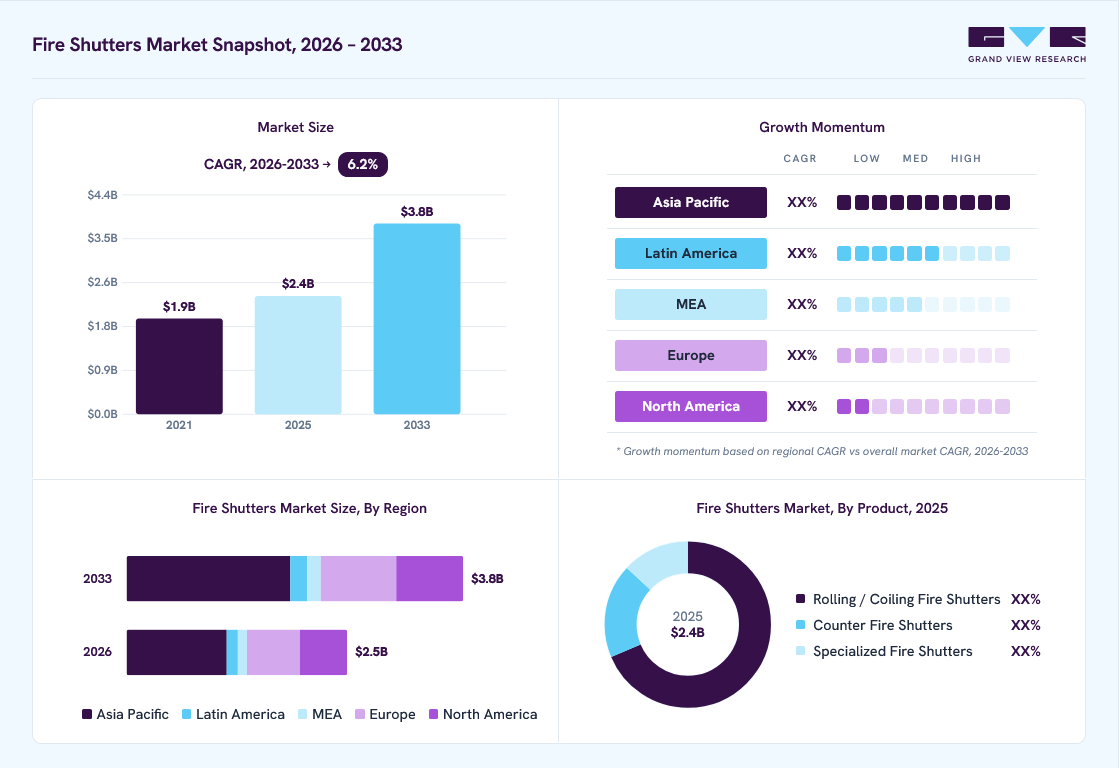
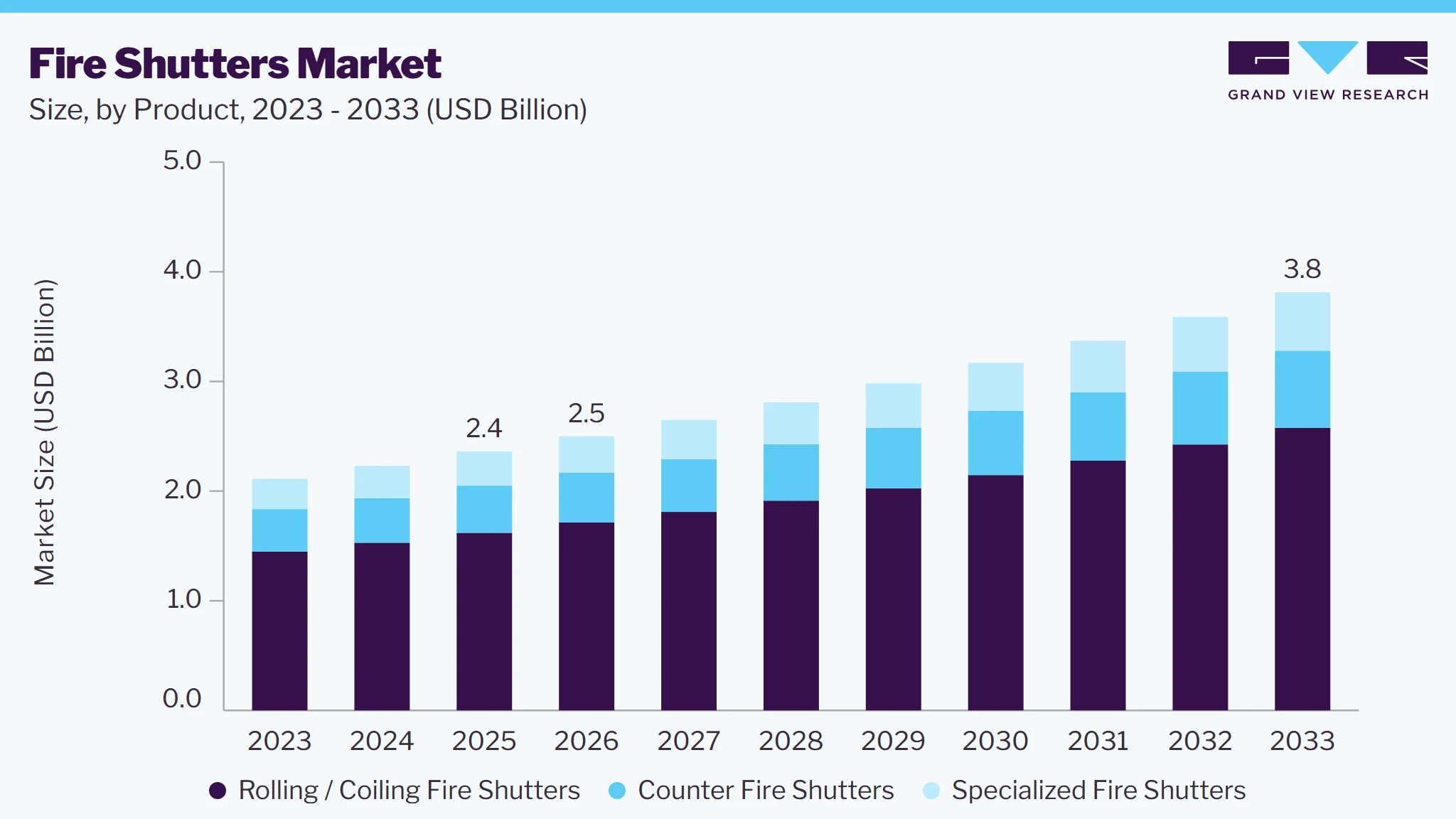
The global fire shutters market size was valued at USD 2.4 billion in 2025 and is projected to grow from USD 2.5 billion in 2026 to USD 3.8 billion by 2033, at a CAGR of 6.2% from 2026 to 2033. The market in Asia Pacific dominated with a revenue share of 44.9% in 2025. The industry is expected to grow due to stricter fire safety requirements in commercial and industrial buildings.
 Source: Grand View Research, IR Documents, Primary Interviews, Paid DatabasesTo learn more about this report,
 Download Free Sample Report
 Key Market Trends & Insights
- Based on product: Rolling / coiling fire shutters segment led the market with the largest revenue share of 68.5% in 2025.
- By operation mode: Motorized segment led the market with the largest revenue share of 65.9% in 2025.
- Based on end use: Warehouses & distribution centers segment is expected to grow at 6.9% CAGR during the forecast period.
Regional Highlights
- Largest Regional Market: Asia Pacific (44.9% revenue share, 2025)
- By Country: China held the largest market share in 2025
Market Size & Forecast
- Market size in 2025: USD 2.4 Billion
- Estimated market size in 2026: USD 2.5 Billion
- Projected market size by 2033: USD 3.8 Billion
- CAGR (2026-2033): 6.2%
Three ways to get this report
Buy it, customize it, or ask a question.Ask an Analyst
A direct answer, usually in 1 working day
- AccessReport author, directly
- Reply timeWithin 1 working day
- No sales callDirect answer only
- FormatEmail reply
- CostFree, no cost
Get the Full Report
What the study covers
- FormatsPDF · Excel · Dashboard
- Timeline2026–2033 annual, 2025 base
- Coverage20+ countries, 5 regions
- Companies10+ key players profiled
Customize the Report
20% free customization
- IncludeCountries, segments, points
- TailorTo your product definition
- ExtendDeeper competitor detail
- OrA fully bespoke study
- Turnaround5–10 working days
 To learn more about this report, Download Free Sample Report
Building codes and safety regulations increasingly require fire-rated barriers to compartmentalize buildings and limit the spread of flames and smoke, supporting demand for compliant fire shutters in warehouses, manufacturing facilities, commercial complexes, and public buildings. Expansion of industrial and logistics infrastructure is also fueling the demand for fire shutters. The development of warehouses, distribution centers, manufacturing plants, and large storage facilities increases the need for passive fire-protection systems at doors, openings, and access points. Fire shutters provide controlled separation between building areas while allowing operational movement when required.Market Dynamics
The fire shutters market is influenced by construction activity, fire-safety requirements, product certification, technological development, and installation considerations. Demand varies across commercial, industrial, institutional, and infrastructure buildings depending on fire-compartmentation needs and building layouts. Manufacturers are developing shutters with improved operating mechanisms, materials, and control systems while responding to certification requirements. Competition among specialized and diversified fire-protection suppliers also affects product availability, pricing, customization, and service capabilities across regional markets.
The increasing construction of high-rise residential and commercial buildings is driving demand for fire shutters by creating more openings and compartment boundaries that require passive fire protection. High-rise structures contain multiple floors, service areas, parking facilities, and utility spaces, where fire-rated closures can help restrict the spread of fire between designated zones. As urban construction shifts toward vertically integrated buildings, developers increasingly incorporate fire shutters into building safety designs, supporting installation opportunities across new construction projects.
High installation costs can restrain the fire shutters market growth, particularly for smaller construction projects and facilities operating under limited budgets. Expenses extend beyond the shutter itself to include structural preparation, electrical connections, fire-alarm integration, professional installation, testing, and commissioning. Complex building layouts may require customized dimensions or specialized installation procedures, further increasing project costs. These financial requirements can encourage some customers to postpone replacement or select alternative fire-protection arrangements.
Retrofitting aging commercial, industrial, and institutional buildings presents an opportunity for fire shutter manufacturers. Older facilities may require upgrades to improve compartmentation, replace outdated closures, or accommodate changes in building layouts and occupancy. Renovation projects can create demand for compact, customized, and remotely controlled fire shutters that fit existing openings without extensive structural modification. Growing investment in building refurbishment, therefore, provides manufacturers with opportunities beyond new construction and supports replacement-driven market revenue.
Complex site conditions remain challenging because fire shutters must operate reliably across diverse building configurations and installation environments. Limited wall space, irregular openings, restricted access, existing mechanical systems, and coordination with electrical and fire-safety infrastructure can complicate installation. Manufacturers and contractors may need customized designs and detailed site assessments to ensure proper operation. These requirements can lengthen project timelines, increase engineering needs, and create difficulties in maintaining consistent installation quality across different facilities.
Market Concentration & Characteristics
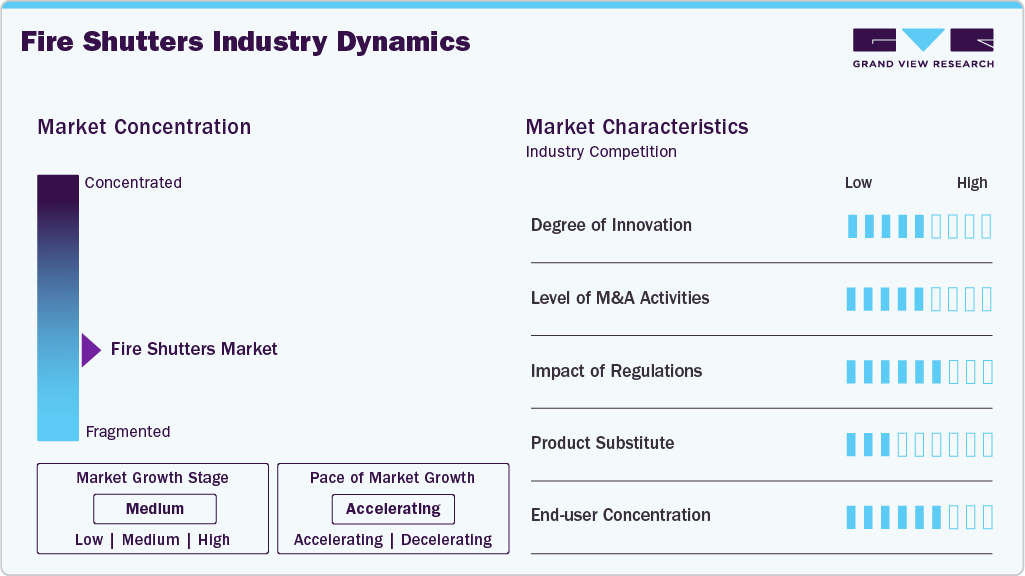
The fire shutters market is fragmented, with international manufacturers, regional suppliers, and specialized fire-protection companies competing across different applications and geographic markets. Competition varies based on product certifications, fire-resistance ratings, customization capabilities, installation services, and pricing. Local manufacturers often serve specific construction markets, while established companies offer broader product portfolios and distribution networks. This structure creates competition across commercial, industrial, institutional, and infrastructure projects.
 To learn more about this report, Download Free Sample Report
 The fire shutters industry is experiencing high innovation, with manufacturers focusing on improved fire resistance, smoke containment, automated operation, and durability. Developments include faster-response closing mechanisms, enhanced control systems, lightweight construction, and improved sealing materials. Integration with building fire-alarm and safety systems is also increasing, enabling coordinated shutter deployment during fire events and supporting more efficient building protection.
Fire safety regulations significantly shape the fire shutters industry by establishing requirements for fire resistance, smoke control, testing, installation, and building performance. Compliance with applicable building codes and certification standards influences product design and material selection. Manufacturers must demonstrate specified performance through standardized testing and certification processes.
Analyst Perspective
The fire shutters market is influenced by increasing requirements for passive fire protection, building compartmentation, and reliable closure systems across commercial, industrial, institutional, and infrastructure facilities. Fire shutters are used to protect openings, separate building zones, and restrict the movement of fire and smoke during emergencies. Demand is also supported by the renovation of existing buildings, the expansion of warehouses and distribution centers, and the development of specialized industrial facilities. North America and Europe remain important markets due to established fire-safety frameworks, while the Asia Pacific is expanding with industrial, logistics, and commercial construction activity.
Product Insights
The rolling / coiling fire shutters segment led the market in 2025 due to its compact design, efficient space utilization, and suitability for diverse building openings. Their vertical operation allows installation where conventional hinged barriers may require additional clearance. These shutters are widely used in warehouses, commercial buildings, industrial facilities, and service areas, where automated closing and reliable compartmentation support building fire-protection requirements.
The specialized fire shutters segment is expected to grow at a 7.0% CAGR during the forecast period as building designs increasingly require customized fire-protection solutions for non-standard openings and application-specific environments. These shutters can address requirements involving unusual dimensions, higher fire-resistance ratings, or integration with specialized building systems. Demand from industrial facilities, infrastructure projects, and complex commercial buildings is expected to support adoption, where conventional fire shutter configurations may not adequately meet installation requirements.
Operation Mode Insights
The motorized segment dominated the market in 2025 due to its ability to provide controlled opening and closing with minimal manual intervention. They can be integrated with fire alarm systems and building controls, enabling coordinated operation during emergencies. Their suitability for frequently accessed openings in commercial, industrial, and institutional facilities supports adoption where operational convenience and automated fire-protection response are important.
The gravity / automatic closing segment is expected to grow at a 5.9% CAGR during the forecast period, as it can provide a fail-safe closure during fire events without depending entirely on powered operation. Their simpler operating mechanism supports applications that require reliable emergency closure and reduced system complexity. Demand from warehouses, industrial facilities, utility areas, and other buildings requiring dependable passive fire-protection measures is expected to support segment expansion.
End Use Insights
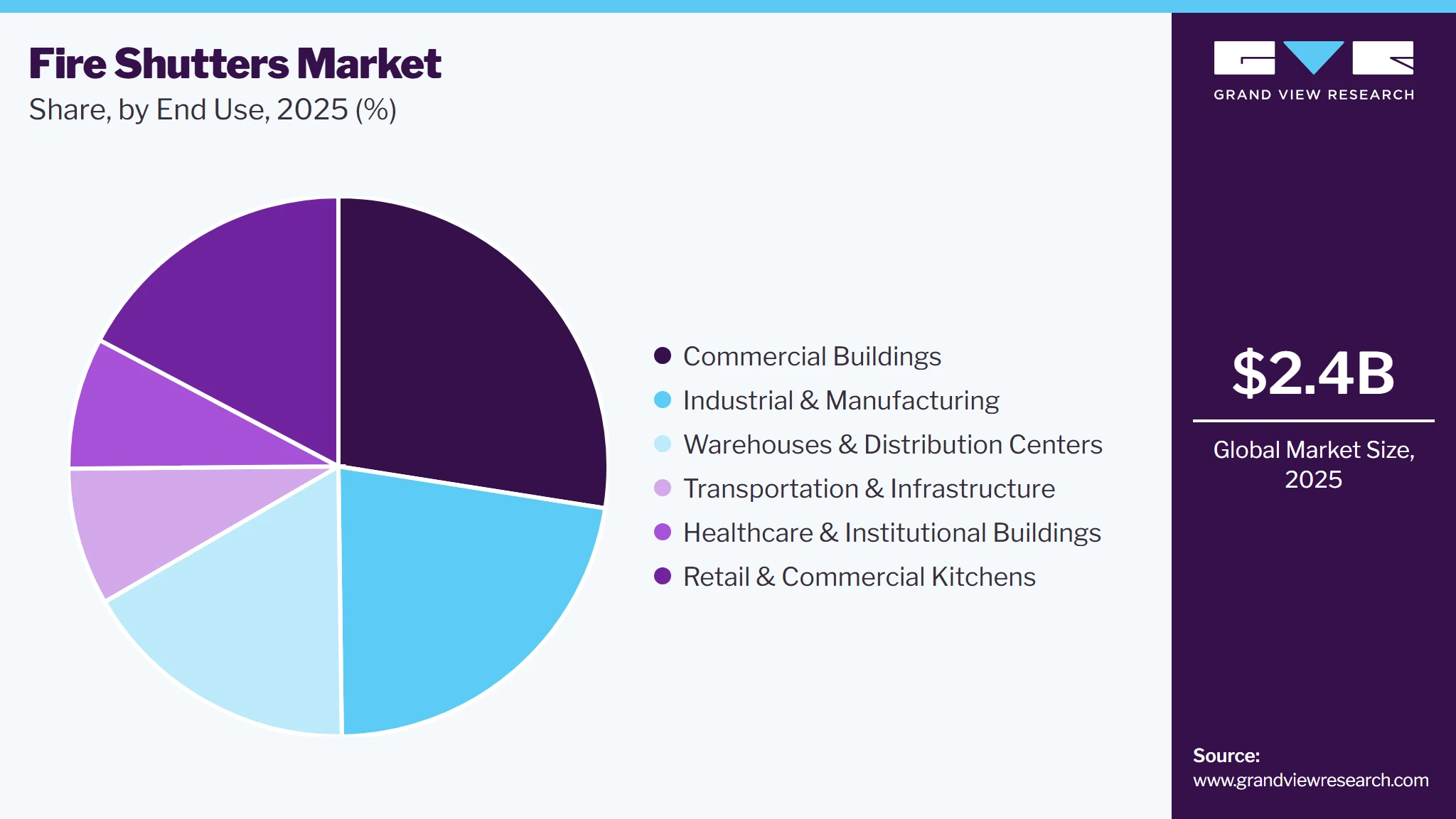
The commercial buildings segment led the market in 2025, holding a 27.5% market revenue share due to widespread installations in offices, retail centers, hotels, shopping complexes, and public facilities. These buildings contain numerous entrances, service areas, and internal openings requiring fire-rated closures. Increasing emphasis on occupant safety and compartmentation, combined with frequent building renovations and upgrades, supports the adoption of fire shutters across commercial properties.
 To learn more about this report, Download Free Sample Report
 The warehouses & distribution centers segment is expected to grow as logistics facilities increasingly incorporate automated storage systems, loading areas, and large access openings. These layouts create requirements for fire-rated closures that can separate storage zones and operational areas. Expansion of distribution infrastructure and development of larger fulfillment facilities are expected to increase installation opportunities for fire shutters.
Regional Insights
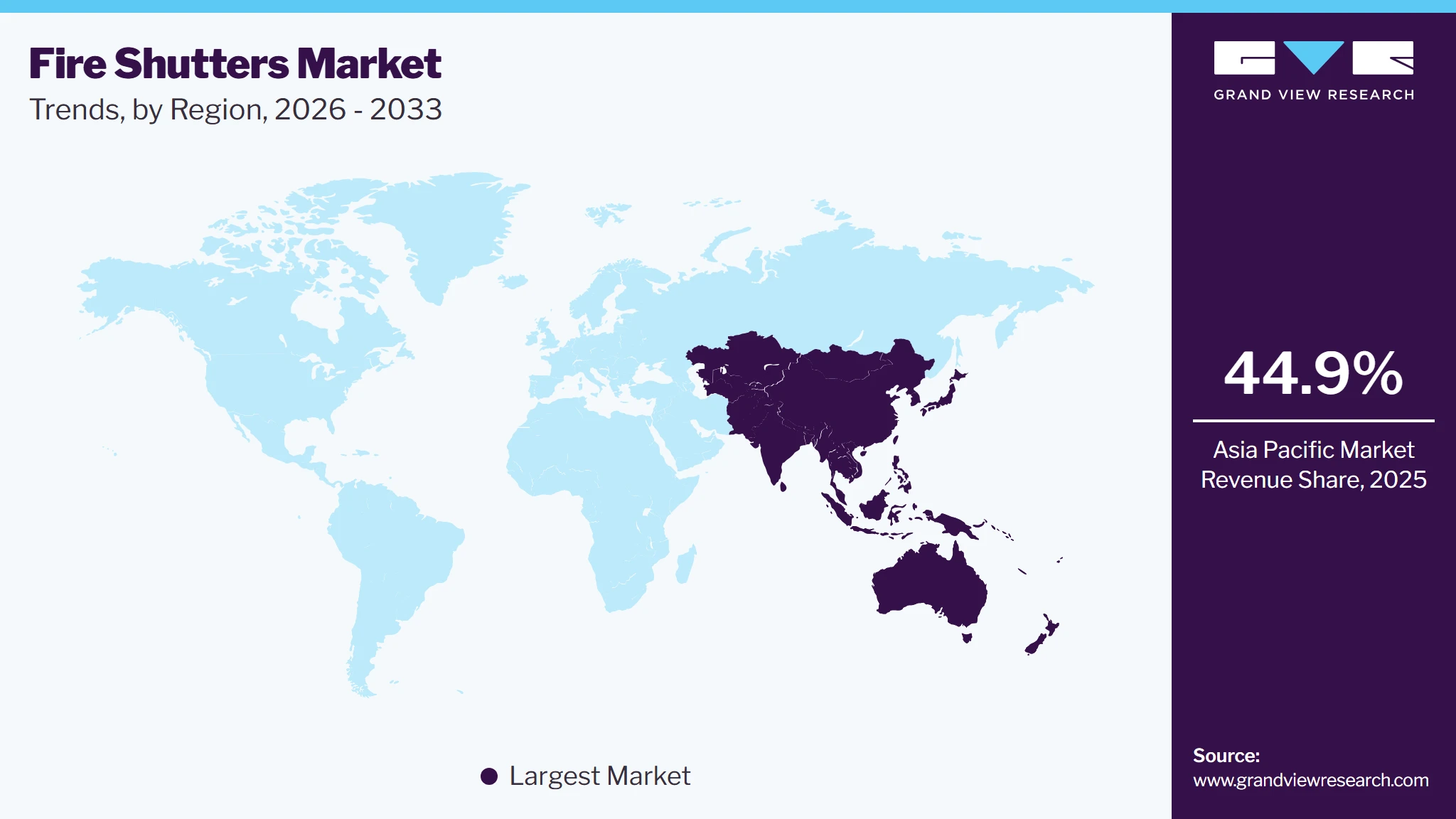
The Asia Pacific fire shutters market dominated the global industry, accounting for 44.9% revenue share in 2025. The growth is driven primarily by the expansion of electronics manufacturing facilities. Semiconductor, display, and electronic-component plants contain specialized production areas, utility spaces, clean environments, warehouses, and technical rooms requiring controlled separation. The construction of new manufacturing facilities and the expansion of existing plants create a need for fire-rated closures around designated openings.
 To learn more about this report, Download Free Sample Report
 The fire shutters market in China is expected to gain traction through large-scale logistics infrastructure development. Expansion of e-commerce and domestic distribution networks has increased investment in warehouses, fulfillment centers, and regional distribution facilities. These buildings typically contain large storage areas, loading zones, automated handling systems, and internal access points where fire-rated separation can be incorporated.
The India fire shutters market is expected to grow due to the expansion of data center infrastructure. The increasing development of facilities supporting cloud computing, digital services, financial technology, and enterprise applications is creating new demand for specialized building infrastructure. Data centers contain server halls, electrical rooms, battery areas, and utility spaces that require controlled separation.
North America Fire Shutters Market Trends
The fire shutters market in North America is supported by the expansion of data centers across the region. Increasing investment in digital infrastructure and cloud computing facilities is therefore creating additional installation opportunities for fire-rated shutter systems in newly constructed and expanded data center facilities as fire shutters can provide compartmentation around designated openings while maintaining operational access.
U.S. Fire Shutters Market Trends
The fire shutters market in the U.S. has received an impetus due to a rise in hospital construction and modernization. Healthcare facilities contain operating areas, laboratories, storage spaces, utility rooms, and service corridors where fire-rated closures are required to maintain compartmentation. Ongoing development and renovation of hospitals create opportunities for fire shutters at doors, service openings, and other building interfaces. Modern healthcare projects also require coordination between fire-protection systems and building infrastructure, supporting demand for compliant shutter solutions across new and renovated medical facilities.
Europe Fire Shutters Market Trends
The fire shutters market in Europe is expected to grow on the back of building renovation programs across aging commercial and public properties. Many existing buildings require modernization of fire-protection infrastructure as part of broader refurbishment projects. Fire shutters can be installed or replaced at openings to improve compartmentation without requiring complete rebuilding. Renovation of offices, public facilities, retail properties, and institutional buildings creates replacement and retrofit opportunities for manufacturers, particularly where older fire-protection components no longer meet current building requirements or operational expectations.
The Germany fire shutters market is well-positioned due to automotive manufacturing facility modernization. The country has a substantial base of vehicle and automotive-component production facilities undergoing modernization to accommodate updated manufacturing processes and layouts. These facilities contain production halls, storage areas, technical rooms, and internal access points requiring controlled separation.
The fire shutters market in the UK is witnessing demand on the heels of school and educational building refurbishment. Public and educational facilities undergoing renovation often require improvements to existing fire-safety infrastructure, including compartmentation and fire-rated closures. Fire shutters can be incorporated around service areas, corridors, kitchens, and other openings where separation is required.
Middle East & Africa Fire Shutters Market Trends
The fire shutters market in the Middle East and Africa is expected to grow through airport infrastructure development. Expansion and modernization of airports involve terminals, baggage-handling facilities, maintenance areas, retail spaces, service corridors, and technical rooms with diverse fire-safety requirements. Fire shutters can be installed at selected openings to provide compartmentation between operational areas while allowing regular movement when required.
The Saudi Arabia fire shutters market has gained prominence with the expansion of manufacturing and industrial facilities under its economic diversification initiatives. New factories, processing plants, and industrial zones require fire-rated separation across production areas, storage spaces, utility rooms, and service openings. Fire shutters can help compartmentalize these facilities while maintaining operational access.
Latin America Fire Shutters Market Trends
The fire shutters market in Latin America is expected to grow at 6.3% CAGR during the forecast period due to the expansion of manufacturing zones and industrial parks creates new facilities containing production areas, warehouses, utility rooms, and service spaces requiring fire compartmentation. Fire shutters can provide rated separation at access points and internal openings while accommodating movement between operational areas. The development of new industrial facilities and the expansion of existing manufacturing clusters create installation opportunities for fire-rated shutter systems across regional industrial construction projects.
The Brazil fire shutters market is expected to gain ground due to pharmaceutical manufacturing expansion. The development and modernization of pharmaceutical production facilities require controlled environments that include manufacturing rooms, laboratories, storage areas, and utility spaces. These facilities incorporate fire-safety measures to separate operational zones and protect critical areas. Fire shutters can be applied at designated openings where fire-rated compartmentation is required.
Key Fire Shutters Company Insights
Some of the key players operating in the market include Hörmann Group, ASSA ABLOY, Sanwa Holdings Corporation, and CornellCookson, among others.
-
Hörmann Group is a German manufacturer of doors, gates, shutters, frames, and related building-access systems. Its portfolio includes fire and smoke protection products designed for commercial, industrial, and institutional buildings. The company provides fire-rated doors and closures in different configurations to support compartmentation and building safety requirements. Its manufacturing and distribution network serves construction, logistics, industrial, and infrastructure applications across international markets.
-
ASSA ABLOY is a Swedish security and access-solutions company offering doors, entrance systems, and fire-protection products through its brands and business units. Its portfolio includes fire-rated doors, shutters, and related opening solutions for commercial, industrial, and institutional facilities. The company serves applications requiring controlled access and fire protection, with products designed around building regulations, operational requirements, and integration with broader door and access systems.
Key Fire Shutters Companies
The following key companies have been profiled for this study on the fire shutters market:
-
Hörmann Group
-
ASSA ABLOY
-
Sanwa Holdings Corporation
-
CornellCookson
-
Raynor Garage Doors
-
Alulux
-
BMP Group
-
Teckentrup
-
Albany Door Systems
-
CHI Overhead Doors
-
Wayne Dalton
-
Coopers Fire
-
Guardian Doors
-
Bolton Gate Company
-
Gliderol
Competitive Benchmarking
Operating Strategies
Competitive Edge
Weaknesses
Mature Players: Hörmann Group, ASSA ABLOY, Sanwa Holdings Corporation, CornellCookson, Raynor Garage Doors, Alulux, Teckentrup, Albany Door Systems, CHI Overhead Doors, Wayne Dalton, Coopers Fire
Mature players focus on expanding global distribution networks, developing fire-rated shutter systems, strengthening relationships with construction and fire-protection contractors, and improving automated operating mechanisms to address diverse commercial, industrial, and infrastructure requirements.
Their competitive advantage comes from established brand recognition, broad product portfolios, international distribution and service networks, engineering expertise, manufacturing capabilities, certifications, and the ability to provide customized fire shutter solutions for different building applications.
Established players often face higher manufacturing and operating costs, complex organizational structures, and longer product-development cycles. Their broad portfolios may also reduce flexibility when responding rapidly to highly specialized fire shutter requirements from smaller construction projects.
Emerging Players: BMP Group, Guardian Doors, Bolton Gate Company, Gliderol
Emerging players primarily target specialized fire shutter applications through customized products, competitive pricing, shorter delivery times, regional distribution, and application-specific engineering. They increasingly focus on fire-rated shutters designed for particular building openings, operating conditions, and installation requirements.
Emerging companies benefit from greater operational flexibility, faster customization, specialized product offerings, competitive pricing, and closer relationships with regional construction companies, contractors, and fire-protection specialists. Their focused portfolios can enable quicker responses to specific fire shutter requirements and changing customer preferences.
Emerging players generally have smaller geographic footprints, limited financial resources, narrower distribution networks, and lower brand recognition. Limited production scale, certification capabilities, and service infrastructure can also restrict their ability to compete for large multinational construction projects and geographically dispersed installations.
Recent Developments
-
In September 2026, ASSA ABLOY acquired Pacific Lock Company (PACLOCK), a U.S.-based manufacturer of padlocks and security hardware. The acquisition supports ASSA ABLOY’s strategy of strengthening its presence in established markets through complementary products and solutions.
-
In June 2026, ASSA ABLOY acquired Santos in Portugal, expanding its European manufacturing base and strengthening its regional production capabilities. The transaction supports broader product and manufacturing capacity within Europe, potentially improving supply capabilities and customer coverage.
Fire Shutters Market Report Scope
Report Attribute
Details
Market size in 2025
USD 2.4 billion
Estimated market size in 2026
USD 2.5 billion
Projected market size by 2033
USD 3.8 billion
Growth rate
CAGR of 6.2% from 2026 to 2033
Base year for estimation
2025
Historical data
2021 - 2024
Forecast period
2026 - 2033
Quantitative units
Revenue in USD billion and CAGR from 2026 to 2033
Report coverage
Revenue forecast, company market position analysis, competitive landscape, growth factors, and trends
Segments covered
Product, operation mode, end use, region
Regional scope
North America; Europe; Asia Pacific; Latin America; Middle East & Africa
Country Scope
U.S.; Canada; Mexico; Germany; UK; Italy; Spain; France; China; Japan; India; Australia; South Korea; Brazil; Argentina; Saudi Arabia; UAE; South Africa
Key companies profiled
Hörmann Group; ASSA ABLOY; Sanwa Holdings Corporation; CornellCookson; Raynor Garage Doors; Alulux; BMP Group; Teckentrup; Albany Door Systems; CHI Overhead Doors; Wayne Dalton; Coopers Fire; Guardian Doors; Bolton Gate Company; Gliderol
Customization scope
Free report customization (equivalent up to 8 analysts working days) with purchase. Addition or alteration to country, regional & segment scope.
Pricing and purchase options
Avail customized purchase options to meet your exact research needs. Explore purchase options
Global Fire Shutters Market Report Segmentation
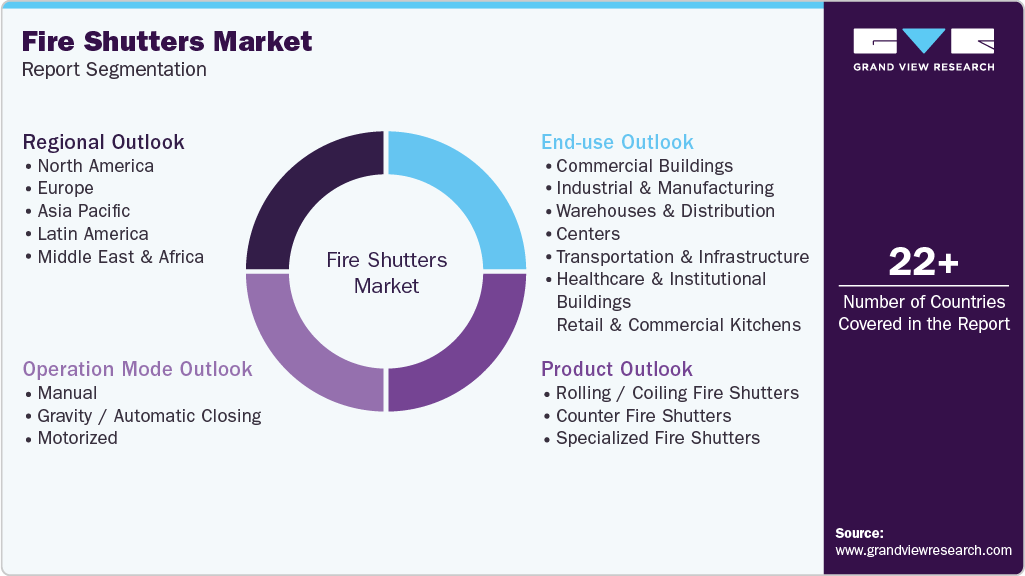
This report forecasts revenue growth at global, regional & country levels and provides an analysis on the industry trends in each of the sub-segments from 2021 to 2033. For this study, Grand View Research has segmented the global fire shutters market report on the basis of product, operation mode, end use, and region:
 To learn more about this report, Download Free Sample Report
 -
Product Outlook (Revenue, USD Billion, 2021 - 2033)
-
Rolling / Coiling Fire Shutters
-
Counter Fire Shutters
-
Specialized Fire Shutters
-
-
Operation Mode Outlook (Revenue, USD Billion, 2021 - 2033)
-
Manual
-
Gravity / Automatic Closing
-
Motorized
-
-
End Use Outlook (Revenue, USD Billion, 2021 - 2033)
-
Commercial Buildings
-
Industrial & Manufacturing
-
Warehouses & Distribution Centers
-
Transportation & Infrastructure
-
Healthcare & Institutional Buildings
-
Retail & Commercial Kitchens
-
-
Regional Outlook (Revenue, USD Billion, 2021 - 2033)
-
North America
-
U.S.
-
Canada
-
Mexico
-
-
Europe
-
Germany
-
France
-
UK
-
Spain
-
Italy
-
-
Asia Pacific
-
China
-
India
-
Japan
-
South Korea
-
Australia
-
-
Latin America
-
Brazil
-
Argentina
-
-
Middle East & Africa
-
Saudi Arabia
-
UAE
-
South Africa
-
-
Research Methodology
The fire shutters market figures in this report are based on a proven research process that combines executive interviews with secondary research from proprietary databases, company filings, and recognized regulatory and institutional sources. Market size is built through value-chain sizing-reconciling supply-side and demand-side estimates-and triangulated with bottom-up and top-down approaches. Every estimate passes multiple levels of expert validation before publication, with each fire shutters segment quantified using the revenue-capture definitions in the table below.
Segment Definition
Product
Revenue Capture Definition
Rolling / Coiling Fire Shutters
Revenue is generated from rolling and coiling fire shutters installed at building openings to provide fire-rated separation and protection.
Counter Fire Shutters
Revenue is captured from counter fire shutters designed for compact openings, service counters, and specialized building applications requiring fire protection.
Specialized Fire Shutters
Revenue is derived from customized fire shutters designed for non-standard openings, specialized environments, and application-specific fire-protection requirements.
Operation Mode
Revenue Capture Definition
Manual
Revenue is obtained from manually operated fire shutters requiring direct user operation for opening and closing.
Gravity / Automatic Closing
Revenue is generated from fire shutters designed to close automatically or through gravity-based mechanisms during fire emergencies.
Motorized
Revenue is captured from electrically powered fire shutters providing automated opening and closing through motors and control systems.
End Use
Revenue Capture Definition
Commercial Buildings
Revenue is generated from fire shutters installed in offices, hotels, commercial complexes, and other commercial properties.
Industrial & Manufacturing
Revenue is derived from fire shutters deployed across manufacturing plants, factories, production areas, and industrial facilities.
Warehouses & Distribution Centers
Revenue is captured from fire shutters installed in warehouses, fulfillment centers, distribution facilities, and logistics buildings.
Healthcare & Institutional Buildings
Revenue is generated from fire shutters used in hospitals, schools, government facilities, and other institutional buildings.
Transportation & Infrastructure
Revenue is obtained from fire shutters installed across airports, railway facilities, terminals, stations, tunnels, and infrastructure facilities.
Retail & Commercial Kitchens
Revenue is derived from fire shutters installed in retail outlets, restaurants, commercial kitchens, food-service facilities, and associated service areas.
Estimation Model
Layer Name
Key Question
Description
Building & Fire-Safety Demand Layer
Which building types and fire-protection requirements generate demand for fire shutters?
The estimation begins by evaluating commercial buildings, industrial and manufacturing facilities, warehouses and distribution centers, healthcare and institutional buildings, transportation and infrastructure facilities, and retail and commercial kitchens. Building size, occupancy, fire-compartmentation requirements, number of protected openings, construction activity, renovation projects, and applicable fire-safety requirements determine the underlying demand for fire shutters.
Product & Operation Mode Layer
Which fire shutter products and operating mechanisms determine market demand?
This layer refines demand by assessing rolling/coiling fire shutters, counter fire shutters, and specialized fire shutters across manual, gravity/automatic closing, and motorized operation modes. Fire-resistance requirements, opening dimensions, installation conditions, operating frequency, automation requirements, and building configuration influence product and operation-mode selection.
End-Use & Deployment Layer
What determines fire shutter utilization and deployment?
Market demand is estimated through deployment across commercial buildings, industrial and manufacturing facilities, warehouses and distribution centers, healthcare and institutional buildings, transportation and infrastructure, and retail and commercial kitchens. Building layouts, protected openings, renovation activity, new construction, fire-compartmentation requirements, accessibility, operating conditions, and replacement cycles influence new installations and replacement demand.
Revenue Layer
How is total market revenue calculated?
Revenue is estimated by aggregating spending on fire shutters across products, operation modes, end-use sectors, and regional markets. New installations and replacement demand are assessed using unit volumes, average selling prices, fire-resistance specifications, shutter dimensions, operating mechanisms, customization requirements, installation conditions, and purchasing activity to validate the overall market size.
Delivered Customizations
We have successfully delivered the following deep-dive customizations:
Client Request
Customization Delivered
Value Adds
Regional Segmentation
Detailed regional analysis was conducted across North America, Europe, Asia Pacific, Latin America, and the Middle East & Africa, including country-level assessment for key markets such as the U.S., Germany, China, India, Brazil, and Saudi Arabia. The study evaluated commercial construction, industrial facilities, warehouses and distribution centers, building renovation, manufacturing infrastructure, logistics development, and fire-safety requirements influencing fire shutter demand.
Helped identify regional differences in fire shutter adoption, country-specific demand patterns, construction activity, industrial development, renovation opportunities, and markets with increasing requirements for fire-rated closures. The analysis also supported assessment of new installations, retrofit demand, warehouse development, and fire-protection requirements across major markets.
Competitive benchmarking
Comprehensive benchmarking was carried out for major fire shutters market participants based on product portfolios, fire-resistance ratings, shutter configurations, operation modes, automation capabilities, customization, certification, application coverage, manufacturing capabilities, geographic presence, distribution networks, and installation and aftermarket services.
Assisted clients in understanding competitor positioning, product differentiation, operation mode capabilities, application coverage, geographic presence, distribution strategies, certification capabilities, product development activities, and technological developments within the fire shutters market.
Opportunity assessment
In-depth opportunity assessment was conducted by analyzing commercial buildings, industrial facilities, warehouses and distribution centers, institutional buildings, infrastructure projects, and renovation applications. The study evaluated opportunities related to rolling/coiling fire shutters, specialized fire shutters, motorized systems, gravity/automatic closing systems, customized configurations, and replacement of aging fire-protection closures.
Enabled clients to identify markets with increasing fire shutter requirements and evaluate opportunities across product types, operation modes, end-use sectors, retrofit applications, and geographic markets.
Frequently Asked Questions About This Report
Key factors driving the fire shutters market include stricter fire-safety requirements, expansion of commercial and industrial buildings, warehouse and logistics infrastructure development, increasing building renovation activity, demand for automated fire-protection systems, and growing adoption of fire-rated closures for compartmentation and protection of critical building areas.
The Asia Pacific region led the market and accounted for 44.9% of the global market revenue share in 2025.
The warehouses & distribution centers segment is expected to grow at 6.9% CAGR during forecast period in fire shutters market.
The global fire shutters market is expected to grow at a CAGR of 6.2% from 2026 to 2033, reaching USD 3.8 billion by 2033.
The rolling / coiling fire shutters segment led the market and accounted for 68.5% market revenue share in 2025.
The motorized segment led the market and accounted for 65.9% market share in 2025.
The commercial buildings segment led the market and accounted for 27.5% market revenue share in 2025.
Some of the key players operating in the fire shutters include Hörmann Group, ASSA ABLOY, Sanwa Holdings Corporation, CornellCookson, Raynor Garage Doors, Alulux, BMP Group, Teckentrup, Albany Door Systems, CHI Overhead Doors, Wayne Dalton, Coopers Fire, Guardian Doors, Bolton Gate Company, Gliderol
The global fire shutters market size was valued at USD 2.4 billion in 2025 and is estimated at USD 2.5 billion for 2026.
About the Author(s)
Advanced Interior Materials Research Team
Advanced Materials · Advanced Interior MaterialsThis report was authored by the advanced interior materials research team at Grand View Research - comprising two research analysts, one senior research analyst, and one industry expert - with specialized expertise in the advanced interior materials segment of the advanced materials industry. All findings are based on proprietary advanced materials databases, executive interviews, and regulatory analysis, subject to internal peer review prior to publication.
Last Updated:
Speak to Analyst

Customize this report to your needs - add regions, segments, or data points, with 20% free customization.
Or view our licence options:


ISO 9001:2015 & 27001:2022 Certified
We are GDPR and CCPA compliant! Your transaction & personal information is safe and secure. For more details, please read our privacy policy.


