
- Home
- »
- Advanced Interior Materials
- »
-
Fire Suppression System Market Size Report, 2026-2033GVR Report cover

Fire Suppression System Market (2026 - 2033)
Size, Share & Trends Analysis Report By Product (Fire Extinguishers, Sprinklers), By Application (Commercial, Industrial, Residential), By Region (North America, Asia Pacific), And Segment Forecasts
Market Size, 2025
$23.0BMarket Estimate, 2026
$24.1BMarket Forecast, 2033
$35.0BCAGR, 2026–2033
5.4%Fire Suppression System Market Summary
The global fire suppression system market size was valued at USD 23.0 billion in 2025 and is projected to grow from USD 24.1 billion in 2026 to USD 35.0 billion by 2033, at a CAGR of 5.4% from 2026 to 2033. North America dominated the global market with the largest revenue share of 35.9% in 2025. The market continues to expand steadily, fueled by rising demand from industries such as commercial construction, manufacturing, oil & gas, transportation, and data centers.
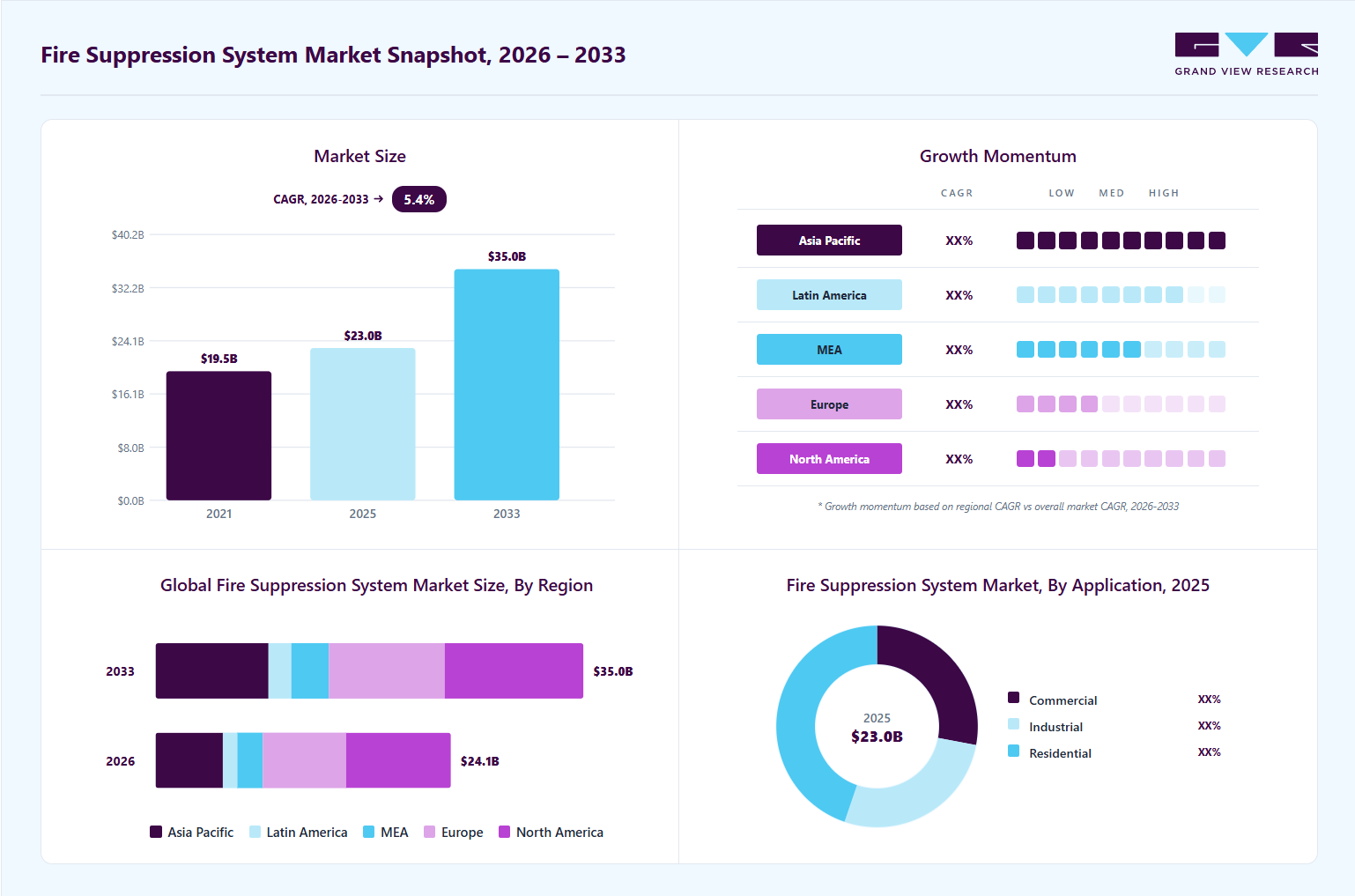 Source: Grand View Research, IR Documents, Primary Interviews, Paid DatabasesTo learn more about this report,
 Download Free Sample Report
 Key Market Trends & Insights
- By product: Fire extinguishers segment led the market with the largest revenue share of 56.6% in 2025.
- By application: Industrial segment led the market with the largest revenue share of 48.9% in 2025.
Regional Highlights
- Largest regional market: North America (35.9% revenue share, 2025)
- By country: The U.S. held the largest market share in 2025.
Market Size & Forecast
- Market size in 2025: USD 23.0 Billion
- Estimated market size in 2026: USD 24.1 Billion
- Projected market size by 2033: USD 35.0 Billion
- CAGR (2026-2033): 5.4%
Three ways to get this report
Buy it, customize it, or ask a question.Ask an Analyst
Analyst response in 1 business day
- AccessReport author, directly
- Reply timeWithin 1 working day
- No sales callDirect answer only
- FormatEmail reply
- CostFree, no cost
Get the Full Report
What the study covers
- FormatsPDF · Excel · Dashboard
- Timeline2026–2033 annual, 2025 base
- Coverage20+ countries, 5 regions
- Companies10+ key players profiled
Customize the Report
20% free customization
- IncludeCountries, segments, points
- TailorTo your product definition
- ExtendDeeper competitor detail
- OrA fully bespoke study
- Turnaround5–10 working days
 To learn more about this report, Download Free Sample Report
 The increasing focus on occupant safety, asset protection, and compliance with strict fire safety codes is driving adoption. Businesses and property owners are opting for reliable, advanced suppression systems to minimize downtime and fulfill regulatory requirements. The integration of connected sensors, predictive analytics, and cloud-based monitoring with fire suppression systems enables real-time performance tracking, remote diagnostics, and automated maintenance scheduling-opening new revenue streams for system manufacturers and service providers. Moreover, heightened environmental consciousness and stricter global regulations on greenhouse gases are driving demand for clean-agent suppression systems, such as inert gas and water mist, which ensure effective fire protection while minimizing environmental impact.
 To learn more about this report, Download Free Sample Report
 Market Dynamics
The fire suppression system market is experiencing steady growth due to increasing enforcement of fire safety regulations, rising investments in commercial and industrial infrastructure, and growing awareness regarding asset and occupant protection. Rapid urbanization, expansion of manufacturing facilities, and the development of high-value assets such as data centers, healthcare facilities, and logistics hubs are encouraging the adoption of advanced fire suppression solutions.
Governments and regulatory authorities worldwide continue to strengthen fire safety standards for commercial, industrial, and residential buildings. Compliance with fire protection codes often requires the installation of fire extinguishers, sprinkler systems, and other suppression equipment, making regulatory adherence a key factor influencing market demand. New construction projects are increasingly integrating fire suppression systems during the design phase to meet safety requirements and obtain operational approvals.
Additionally, industries handling hazardous materials, flammable liquids, and critical infrastructure face stricter inspection and safety obligations. Failure to comply with fire safety regulations can result in financial penalties, operational disruptions, and reputational risks. Consequently, businesses are investing in modern fire suppression technologies to ensure compliance while improving workplace safety and protecting valuable assets.
The implementation of fire suppression systems, particularly large-scale sprinkler networks and specialized suppression solutions, often involves significant upfront investment. Costs associated with system design, equipment procurement, installation, testing, and periodic maintenance can be substantial, especially for small and medium-sized enterprises. These financial considerations may delay adoption decisions or limit system upgrades, particularly in cost-sensitive markets where budget constraints remain a major concern.
The rapid expansion of data centers, telecommunications facilities, healthcare institutions, and other mission-critical infrastructure presents a significant growth opportunity for the fire suppression system market. These facilities require highly reliable fire protection solutions capable of preventing equipment damage and minimizing operational downtime. Traditional firefighting methods may not be suitable for sensitive electronic environments, increasing demand for advanced suppression technologies.
As digital transformation initiatives continue worldwide, investments in cloud computing, artificial intelligence infrastructure, and large-scale data storage facilities are rising substantially. This trend is creating opportunities for manufacturers and service providers to offer specialized fire suppression systems designed to protect high-value assets while ensuring uninterrupted operations and regulatory compliance.
Market Concentration & Characteristics
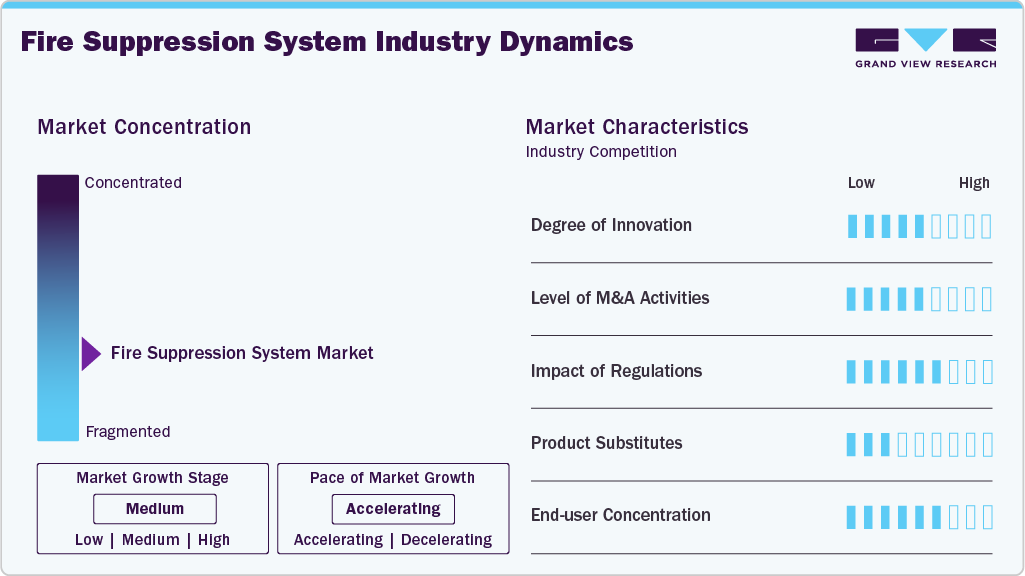
The industry is moderately fragmented, featuring a mix of well-established multinational players and numerous regional or specialized providers. Leading companies such as Johnson Controls, Honeywell International, and Siemens hold significant influence with extensive portfolios spanning commercial, industrial, and residential fire safety solutions. These firms benefit from advanced R&D, a broad geographic footprint, and robust maintenance networks. At the same time, a large presence of local and niche firms-particularly in emerging economies-ensures competitive pricing, customization, and responsiveness to local codes. This diversity prevents complete market consolidation and supports innovation, service specialization, and tailored offerings across regions. Ongoing public and private investments in modern infrastructure and occupational safety continue to shape the sector's competitiveness and value proposition.
Mergers and acquisitions activity is on the rise as leading players seek to broaden regional coverage, expand technology portfolios, and add specialized service capabilities. Large firms actively acquire niche technology providers and local installers to bolster competitive positions and capture growth in emerging and technically demanding markets. These transactions support accelerated product rollouts and access to new customer segments.
 To learn more about this report, Download Free Sample Report
 Regulation remains a defining force in the market. National and international building codes, insurance requirements, and safety standards such as NFPA, EN, and ISO are key drivers of system upgrades, product innovation, and market entry strategies. Compliance pressures push companies to adopt advanced detection technologies, cleaner suppression agents, and improved reporting and performance auditing tools. Supportive public policies and incentives for life safety investments, coupled with stricter enforcement and inspection practices, are accelerating the shift toward more reliable, automated, and sustainable fire suppression solutions worldwide.
Analyst Perspective
The fire suppression system market is positioned for sustained growth, driven by increasingly stringent fire safety regulations, expanding commercial and industrial infrastructure, and rising awareness of asset and occupant protection. As organizations place greater emphasis on operational continuity and risk management, demand is shifting toward more reliable and automated fire suppression solutions. Industrial facilities, data centers, healthcare institutions, and high-value commercial buildings are expected to remain key demand generators due to their critical need for uninterrupted operations and enhanced safety compliance.
Drivers, Opportunities & Restraints
Stringent fire safety norms and building codes across commercial, industrial, and residential sectors are a primary market driver. The rise in mega-projects, urban infrastructure upgrades, and ever-tightening insurance and regulatory requirements is accelerating the installation of modern fire suppression solutions. Demand is further underpinned by heightened awareness of the social and financial risks associated with fire incidents, as well as the trend toward comprehensive risk management and business continuity planning.
The ongoing modernization of existing infrastructure, especially in Asia and the Middle East, is providing significant opportunities for fire suppression system upgrades and retrofits. Advances in clean-agent and environmentally friendly systems are aligning with global sustainability goals and opening new market segments. The integration of IoT, smart detection, and remote monitoring technologies is enabling predictive maintenance, real-time performance management, and value-added service models for both new installations and existing systems.
High initial installation and periodic maintenance costs can pose challenges for smaller enterprises and in cost-sensitive markets. Technical complexity and variation in local fire safety regulations may limit standardized adoption and complicate compliance. Moreover, the limited availability of certified service providers in some regions can hinder timely inspection, maintenance, and system reliability, especially for advanced and digitally enabled solutions.
Product Insights
Based on product, fire extinguishers segment led the market with the largest revenue share of 56.6% in 2025. Fire extinguishers remain indispensable for first-response firefighting across virtually all environments-commercial, industrial, and residential. The demand is fueled by their relatively low cost, mandatory inclusion under safety regulations, easy maintenance, and broad awareness programs driving compliance locally and globally. Increasing emphasis on eco-friendly extinguishing agents and digital tagging for auditability is shaping product evolution.
Sprinkler systems are a critical component in modern fire safety strategies due to their proven effectiveness in rapidly detecting and extinguishing fires, especially in commercial and industrial applications. Continued enforcement of stringent building codes and insurance mandates globally is driving widespread adoption of advanced sprinkler solutions with faster detection, improved water efficiency, and integration with digital monitoring systems.
Application Insights
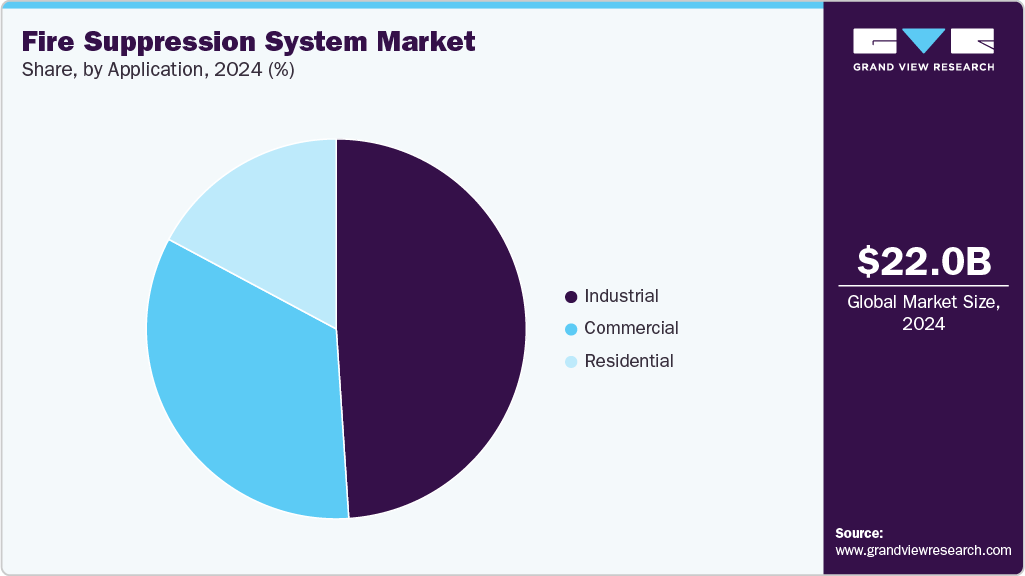
Based on application, industrial segment led the market with the largest revenue share of 48.9% in 2025. Industrial facilities, including manufacturing plants, energy producers, warehouses, and logistics hubs, face high fire hazards due to flammable materials and critical operational equipment. This segment’s expansion is driven by the need for robust, code-compliant fire suppression to ensure workplace safety, protect assets, and maintain regulatory certifications. The increasing scale of industrial operations worldwide and a focus on downtime minimization have resulted in rising investment in high-performance systems, such as gas-based and foam suppression, tailored for specialized industrial risks.
 To learn more about this report, Download Free Sample Report
 Growth in the residential segment is mainly attributed to stricter enforcement of fire safety codes for multi-family dwellings and new housing developments. Rising public awareness, government-led safety campaigns, and the spread of urban high-rises are supporting adoption. The segment is evolving with more user-friendly, space-efficient systems and a focus on affordable, easy-to-install sprinkler solutions for homes. Ongoing efforts in emerging markets to introduce or raise minimum fire safety requirements underpin long-term growth for residential fire suppression installations.
Regional Insights
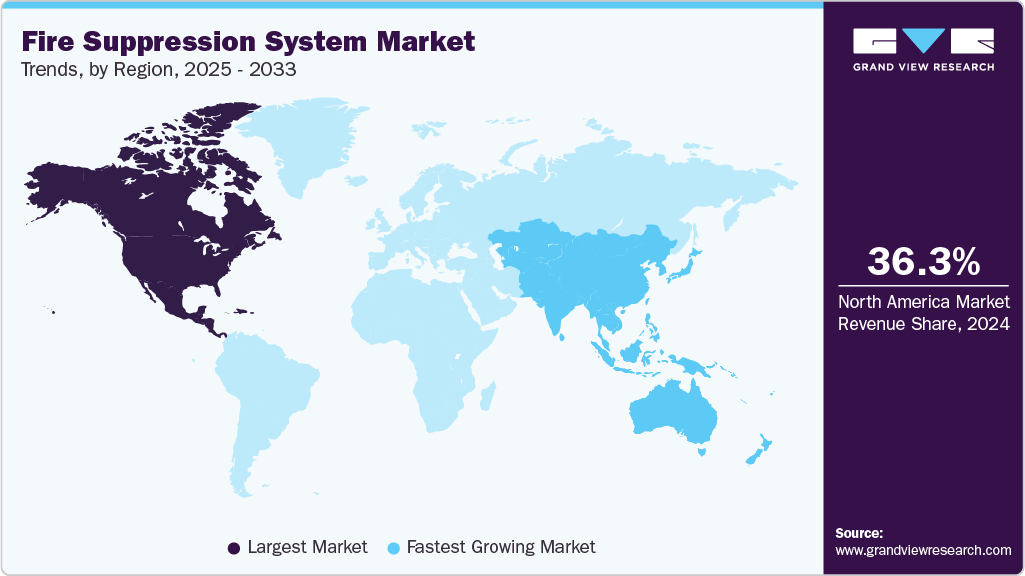
North America dominated the fire suppression system market with the largest revenue share of 35.9% in 2025. Growth is driven by well-established fire safety regulations, a large base of commercial and industrial facilities, and ongoing investments in infrastructure modernization. Adoption of advanced, smart suppression systems is rising across new and retrofit projects. The presence of major international players and a robust service network supports widespread system availability and compliance. Upgrades prompted by insurance and code requirements continue to fuel long-term market momentum.
 To learn more about this report, Download Free Sample Report
 The fire suppression system market in the U.S. held the largest share in the North America region in 2025. Well-established, stringent fire safety codes, high adoption of advanced suppression technologies, and an extensive base of commercial, industrial, and institutional buildings drive demand. The ongoing modernization of older infrastructure, frequent upgrades prompted by insurance requirements, robust growth in data centers, logistics, and high-rise construction support steady market expansion.
Europe Fire Suppression System Market Trends
The fire suppression system market in Europe is supported by strict fire safety standards, comprehensive insurance mandates, and a mature enforcement landscape. Efforts to renovate and retrofit aging building stock-including historic and cultural sites-boost demand for both traditional and clean-agent solutions. Eco-friendly and digitally integrated systems are gaining traction as sustainability and performance become key priorities.
The UK fire suppression system market is projected to grow at a significant CAGR of 6.7% over the forecast period. Growth is propelled by rigorous fire safety standards, a mature regulatory framework, and widespread insurance-driven compliance in the commercial and institutional sectors. Trends include rapid adoption of clean-agent and environmentally friendly suppression systems in data centers, offices, and public buildings.
The fire suppression system market in France is projected to grow at a CAGR of 5.1% over the forecast period. France’s fire suppression system market represented a considerable portion of Europe’s regional revenue. The country’s strict fire codes and insurance mandates drive consistent adoption, especially in commercial, cultural, and residential buildings.
Asia Pacific Fire Suppression System Market Trends
The fire suppression system market in Asia Pacific is expected to grow at the fastest CAGR, underpinned by rapid urbanization and major commercial construction projects. Growth is especially prominent in countries like China and India, where stricter enforcement of fire codes and significant infrastructure investment are ongoing. Widespread development of high-density residential, commercial, and industrial zones accelerates system installation rates.
India fire suppression system market is projected to grow at a rapid CAGR of 8.7% over the forecast period. India’s fire suppression system market is in a phase of rapid expansion, capturing an increasing share of Asia Pacific revenue in 2024. The surge is led by urbanization, new high-rise and commercial developments, and greater enforcement of fire safety regulations.
The fire suppression system market in China is projected to grow at a fast-paced CAGR of 8.1% over the forecast period. Massive urbanization, large-scale real estate developments, ongoing industrialization, and government-backed infrastructure projects underpin high demand. National fire safety standards have become more stringent, accelerating adoption across residential, commercial, and industrial sectors.
Middle East & Africa Fire Suppression System Market Trends
The fire suppression system market in the Middle East & Africa region captured a notable market share due to large-scale construction, urban development, and ambitious nation-building initiatives, particularly in Gulf countries such as Saudi Arabia. Expansion of commercial, hospitality, and industrial zones is supporting robust adoption of advanced fire suppression systems. Ongoing government focus on safety standards, combined with widespread infrastructure projects, shapes a dynamic market landscape.
Saudi Arabia fire suppression system market is estimated to expand at a considerable CAGR of 6.6% over the forecast period. The Kingdom’s Vision 2030 and rapid expansion of urban, commercial, and industrial facilities have fueled sustained demand for high-quality fire suppression solutions. Large-scale projects in hospitality, transport, oil and gas, and industry require integrated suppression technologies meeting global standards. Increasing adoption of automated and smart fire safety systems is seen in new building complexes and government infrastructure.
Latin America Fire Suppression System Market Trends
The fire suppression system market in Latin America is supported by infrastructure upgrades and urban housing expansion in key economies such as Brazil. Market growth is spurred by tightening regulatory oversight and greater awareness of fire safety, particularly in the commercial sector. Rapid urbanization and increasing industrial investment are creating new opportunities for system deployment.
Brazil fire suppression system market is projected to grow at a significant CAGR of 6.9% over the forecast period. Market momentum in Brazil is primarily driven by infrastructure development, expansion of urban housing, and tightening fire safety regulations and enforcement.
Key Fire Suppression System Companies Insights
Key players operating in the fire suppression system market are undertaking various initiatives to strengthen their presence and increase the reach of their products and services. Strategies such as expansion activities and partnerships are key in propelling the market growth.
Key Fire Suppression System Companies:
The following key companies have been profiled for this study on the fire suppression system market.
-
Fike Corporation
-
Minimax USA LLC
-
GENTEX Corporation
-
Halma Plc
-
HOCHIKI America Corporation
-
Honeywell International Inc.
-
Johnson Controls
-
Robert Bosch GmbH
-
Siemens AG
-
Carrier
-
NAFFCO
-
Amerex Corporation
-
ORR Protection
-
Desautel
-
Feuerschutz JOCKEL GmbH & Co. KG
Competitive Benchmarking
Category
Operating Strategies
Competitive Edge
Weakness
Established Players (e.g., Honeywell International Inc., Johnson Controls, Siemens AG, Robert Bosch GmbH, Carrier, Halma Plc)
- Focus on delivering integrated fire protection ecosystems combining detection, suppression, monitoring, and building automation systems.
- Expand market presence through acquisitions, technology upgrades, and large-scale commercial and industrial project partnerships.
- Strong global footprint with extensive distribution, service, and support networks.
- Ability to provide comprehensive, code-compliant fire safety solutions backed by significant R&D investments.
- Higher pricing structures compared to regional competitors can limit penetration in cost-sensitive markets.
- Complex organizational structures may reduce agility in addressing niche customer requirements and local market shifts.
Emerging & Regional Players (e.g., Fike Corporation, Minimax USA LLC, GENTEX Corporation, HOCHIKI America Corporation, NAFFCO, Amerex Corporation)
- Concentrate on specialized suppression technologies and application-specific fire protection solutions.
- Leverage regional partnerships and customized offerings to address local regulatory and industry requirements.
- Greater flexibility in product customization and faster response to customer-specific needs.
- Strong expertise in niche segments such as industrial fire hazards, extinguishers, clean-agent systems, and special hazard protection.
- Limited international reach and lower brand recognition compared with multinational market leaders.
- Smaller financial and R&D resources can constrain large-scale expansion and technology development initiatives.
Recent Developments
-
In January 2026, Halma plc acquired Safetec, an Italy-based provider of integrated fire and gas safety systems for industrial markets. Safetec designs customized fire and gas safety solutions for large-scale and high-risk industrial projects, strengthening Halma's capabilities in integrated fire protection and safety systems.
-
In November 2025, Amerex Corporation announced that its vehicle fire suppression systems achieved FM 5970 compliance following more than 200 fire-flow and component-level evaluations. The company also enhanced its dry chemical systems with expanded nozzle options and network configurations to provide tailored protection across heavy-duty vehicle applications, including mining, forestry, waste management, and transit.
-
In October 2024, Siemens Smart Infrastructure announced its acquisition of Danfoss Fire Safety, a Denmark-based subsidiary specializing in sustainable fire suppression technologies, particularly high-pressure water mist systems. This acquisition aims to strengthen Siemens's fire safety portfolio by integrating environmentally friendly and rapidly growing fire suppression solutions, enabling Siemens to better serve industries with rising fire safety demands such as data centers, industrial processes, and tunnels.
Fire Suppression System Market Report Scope
Report Attribute
Details
Market size in 2025
USD 23.0 billion
Estimated market size in 2026
USD 24.1 billion
Projected market size by 2033
USD 35.0 billion
Growth rate
CAGR of 5.4% from 2026 to 2033
Base year for estimation
2025
Historical data
2021 - 2024
Forecast period
2026 - 2033
Quantitative units
Revenue in USD billion and CAGR from 2026 to 2033
Report coverage
Revenue forecast, company ranking, competitive landscape, growth factors, and trends
Segments covered
Product, application, region.
Regional scope
North America; Europe; Asia Pacific; Latin America; Middle East & Africa
Country scope
U.S.; Canada; Mexico; UK; Germany; France; Spain; Italy; China; Japan; India; Australia; South Korea; Brazil; Argentina; Saudi Arabia; South Africa
Key companies profiled
Fike Corporation; Minimax USA LLC; GENTEX Corporation; Halma Plc; HOCHIKI America Corporation; Honeywell International Inc.; Johnson Controls; Robert Bosch GmbH; Siemens AG; Carrier; NAFFCO; Amerex Corporation; ORR Protection; Desautel; Feuerschutz JOCKEL GmbH & Co. KG
Customization scope
Free report customization (equivalent up to 8 analysts' working days) with purchase. Addition or alteration to country, regional & segment scope.
Pricing and purchase options
Avail customized purchase options to meet your exact research needs. Explore purchase options
Fire Suppression System Market Report Segmentation
This report forecasts revenue growth at the global, regional, and country levels and provides an analysis of the latest industry trends in each of the sub-segments from 2021 to 2033. For this study, Grand View Research has segmented the global fire suppression system market report based on product, application, and region.
 To learn more about this report, Download Free Sample Report
 -
Product Outlook (Revenue, USD Million, 2021 - 2033)
-
Fire Extinguishers
-
Gas
-
Water
-
Dry Chemical Powder
-
Others
-
Sprinklers
-
-
Application Outlook (Revenue, USD Million, 2021 - 2033)
-
Commercial
-
Industrial
-
Residential
-
-
Regional Outlook (Revenue, USD Million, 2021 - 2033)
-
North America
-
U.S.
-
Canada
-
Mexico
-
-
Europe
-
Germany
-
France
-
Italy
-
Spain
-
UK
-
-
Asia Pacific
-
China
-
India
-
Japan
-
South Korea
-
Australia
-
-
Latin America
-
Brazil
-
Argentina
-
-
Middle East and Africa
-
Saudi Arabia
-
South Africa
-
-
Research Methodology
The fire suppression system market figures in this report are based on a proven research process that combines executive interviews with secondary research from proprietary databases, company filings, and recognized regulatory and institutional sources. Market size is built through value-chain sizing - reconciling supply-side and demand-side estimates - and triangulated with bottom-up and top-down approaches. Every estimate passes multiple levels of expert validation before publication, with each fire suppression system segment quantified using the revenue-capture definitions in the table below.
Segment Definition
Product
Revenue Capture Definition
Fire Extinguishers
Revenue is generated from the sale of portable and fixed fire extinguishing units designed to suppress fires using different extinguishing agents. This segment includes gas-based, water-based, dry chemical powder, and other specialized extinguishers used across commercial, industrial, and residential settings.
Sprinklers
Revenue includes the supply of automatic fire sprinkler systems and related components installed in buildings and facilities. These systems provide continuous fire protection by detecting heat and releasing water to control or extinguish fires.
Application
Revenue Capture Definition
Commercial
Revenue is captured from fire suppression systems deployed in offices, retail spaces, hospitals, hotels, educational institutions, and other commercial facilities. Demand is driven by stringent fire safety regulations and building protection requirements.
Industrial
Revenue comprises fire suppression solutions installed in manufacturing plants, energy facilities, warehouses, chemical processing units, and other industrial environments. These systems are designed to address high-risk fire hazards and protect critical assets.
Residential
Revenue includes fire suppression equipment and sprinkler systems installed in homes, apartments, and residential complexes. Growth is supported by increasing awareness of fire safety, building code compliance, and adoption of residential fire protection systems.
Estimation Model
Layer Name
Key Question
Description
End-Use Industry Demand Layer
Which industries generate demand for fire suppression systems?
Evaluates demand from commercial, industrial, and residential sectors based on infrastructure development, safety requirements, and fire risk exposure. It also assesses construction activity and facility expansion trends that influence the need for fire protection solutions.
Technology Adoption Layer
What fire suppression technologies are being adopted across applications?
Assesses adoption of fire extinguishers (gas, water, dry chemical powder, others) and sprinkler systems across different end-use environments. The analysis further examines technology preferences based on regulatory compliance, fire hazards, and operational requirements.
Installation & Protection Layer
How extensively are fire suppression systems deployed within facilities?
Measures installation rates, regulatory compliance requirements, building protection standards, and coverage levels across various facilities and structures. It also evaluates the degree of fire safety integration within new and existing buildings to determine market penetration.
Revenue Layer
What revenue is generated from fire suppression system sales and deployment?
Calculates market revenue generated from fire extinguishers, sprinkler systems, and related fire suppression solutions across commercial, industrial, and residential applications. Revenue estimates are validated through end-user spending patterns, replacement demand, and ongoing investments in fire safety infrastructure.
Delivered Customizations
This report has been delivered with the following In-depth customizations
Client Request
Customization Delivered
Value Adds
Comprehensive Market Assessment and Strategic Analysis
Delivered a detailed assessment covering market size, forecasts, growth trends, demand drivers, restraints, opportunities, technology developments, regulatory landscape, and end-user adoption patterns across the fire suppression system market. The study also included qualitative and quantitative insights to support strategic planning and investment decisions.
Enabled stakeholders to gain a holistic understanding of market dynamics, growth potential, and future industry direction, facilitating informed business and investment strategies.
Segment-Level Analysis and Competitive Intelligence
Provided extensive segmentation analysis across products, applications, and key end-use industries, along with a thorough evaluation of the competitive landscape, company positioning, market share trends, strategic initiatives, and competitive benchmarking.
Helped identify high-growth segments, competitive gaps, and market positioning opportunities, supporting expansion planning and competitive strategy development.
Market Forecasting and Opportunity Identification
Developed a robust market estimation and forecasting framework supported by primary and secondary research, industry validations, demand analysis, and regional assessments. The report also identified emerging opportunities, investment hotspots, and evolving customer requirements across key markets.
Enhanced confidence in market projections and enabled clients to prioritize resources, evaluate growth opportunities, and align long-term business objectives with market developments.
Frequently Asked Questions About This Report
Stringent fire safety regulations, ongoing urbanization, and increased investments in commercial and industrial infrastructure are key drivers of the global fire suppression system market. Rising awareness of life-safety standards and rapid adoption of advanced, smart fire suppression technologies further support strong market growth.
Key players in the market include Fike Corporation; Minimax USA LLC; GENTEX Corporation; Halma Plc; HOCHIKI America Corporation; Honeywell International Inc.; Johnson Controls; Robert Bosch GmbH; Siemens AG; Carrier; NAFFCO; Amerex Corporation; ORR Protection; Desautel; and Feuerschutz JOCKEL GmbH & Co. KG.
North America dominated the fire suppression system market with the largest revenue share of 35.9% in 2025.
The fire extinguishers segment led the market with the largest revenue share of 56.6% in 2025.
The industrial segment accounted for the largest revenue share of 48.9% in 2025.
Key trends include the integration of smart fire safety technologies, increasing adoption of clean agent suppression systems, growing demand for environmentally friendly fire suppression solutions, and rising investments in industrial and commercial fire protection infrastructure.
The global fire suppression system market size was estimated at USD 23.0 billion in 2025 and is expected to be USD 24.1 billion in 2026.
The global fire suppression system market, in terms of revenue, is expected to grow at a compound annual growth rate of 5.4% from 2026 to 2033 to reach USD 35.0 billion by 2033.
About the Author(s)
Advanced Interior Materials Research Team
Advanced Materials · Advanced Interior MaterialsThis report was authored by the advanced interior materials research team at Grand View Research - comprising two research analysts, one senior research analyst, and one industry expert - with specialized expertise in the advanced interior materials segment of the advanced materials industry. All findings are based on proprietary advanced materials databases, executive interviews, and regulatory analysis, subject to internal peer review prior to publication.
Last Updated:
Speak to Analyst

Customize this report to your needs - add regions, segments, or data points, with 20% free customization.
Or view our licence options:


ISO 9001:2015 & 27001:2022 Certified
We are GDPR and CCPA compliant! Your transaction & personal information is safe and secure. For more details, please read our privacy policy.


