
- Home
- »
- Next Generation Technologies
- »
-
Firefighting Aircraft Market Size, Share, Industry Report 2033GVR Report cover
![Firefighting Aircraft Market Size, Share & Trends Report]()
Firefighting Aircraft Market (2025 - 2033) Size, Share & Trends Analysis Report By Aircraft Type (Rotorcraft, Fixed-wing), By Range (Less Than 1,000 km, 1,000 To 3,000 km), By Maximum Take-off Weight, By Region, And Segment Forecasts
Market Size, 2024
$7,475.4MMarket Estimate, 2026
$7,881.7MMarket Forecast, 2033
$13,299.9MCAGR, 2025–2033
6.8%Firefighting Aircraft Market Summary
The global firefighting aircraft market size was valued at USD 7,475.4 million in 2024 and is projected to reach USD 13,299.9 million by 2033, growing at a CAGR of 6.8% from 2025 to 2033. The market growth is primarily driven by the increasing frequency and severity of wildfires, rising investments in aerial firefighting capabilities, growing adoption of advanced water and retardant-dropping technologies, and the ongoing technological advancements in aircraft design and fire suppression systems.

Key Market Trends & Insights
- North America dominated the global firefighting aircraft market with the largest revenue share of over 47% in 2024.
- The firefighting aircraft market in the U.S. led the North America market and held the largest revenue share in 2024.
- By aircraft type, the fixed-wing segment led the market and held the largest revenue share of over 62% in 2024.
- By range, the less than 1,000 km segment led the market and held the largest revenue share of over 44% in 2024.
- By maximum take-off weight, the 8,000 to 30,000 kg (medium weight aircraft) segment led the market and held the largest revenue share of over 53% in 2024.
Market Size & Forecast
- 2024 Market Size: USD 7,475.4 Million
- 2033 Projected Market Size: USD 13,299.9 Million
- CAGR (2025-2033): 6.8%
- North America: Largest market in 2024
- Asia Pacific: Fastest growing market
Three ways to get this report
Buy it, customize it, or ask a question.Get the Full Report
What the study covers
- FormatsPDF · Excel · Dashboard
- Timeline2025–2033 annual, 2024 base
- Coverage20+ countries, 5 regions
- Companies10+ key players profiled
Customize the Report
20% free customization
- IncludeCountries, segments, points
- TailorTo your product definition
- ExtendDeeper competitor detail
- OrA fully bespoke study
- Turnaround5–10 working days
Ask Prism AI
A cited answer in seconds
- Corpus30K studies, 1.2M points
- ScopeAll markets, not just this
- CitationTraced to report & table
- HonestySays "not covered" if so
- SpeedSeconds, not days
The market growth is primarily driven by the rising frequency and severity of wildfires globally, which is creating sustained demand for specialized aerial firefighting fleets. The increasing need for rapid response capabilities in remote and rugged terrains is fueling the adoption of advanced firefighting aircraft. The integration of next-generation avionics, infrared imaging, and real-time fire mapping technologies significantly improves operational accuracy and reduces collateral damage. The increasing focus on multi-role aircraft with rescue capabilities is fueling fleet modernization efforts, which is anticipated to significantly propel the growth of the firefighting aircraft industry.The rising frequency and severity of wildfires, driven by climate change, prolonged droughts, and extreme heatwaves, are significantly fueling the growth of the firefighting aircraft market. Aircraft equipped with advanced retardant delivery systems and large water tanks enable rapid suppression of fast-spreading fires, particularly in remote or rugged terrains inaccessible to ground crews. This increasing need for high-speed, large-scale fire suppression is accelerating investments in the firefighting aircraft industry.

Additionally, the growing emphasis on multi-mission capabilities is becoming a major growth driver for the firefighting aircraft industry. Modern designs are incorporating modular systems that allow aircraft to switch between firefighting, search and rescue, and disaster relief operations. This versatility improves cost efficiency for operators and ensures year-round asset utilization. This demand for multifunctional platforms is spurring innovation and expanding adoption in defense sectors.
Furthermore, advancements in aerial firefighting technologies are revolutionizing operational efficiency. The integration of GPS-guided drop systems, thermal imaging sensors, and AI-assisted fire mapping enables more precise targeting of fire lines and hotspots. These technological upgrades reduce water wastage, improve mission accuracy, and enhance crew safety. Increasingly data-driven aerial firefighting is driving greater reliance on next-generation aircraft equipped with advanced avionics systems.
Moreover, increasing collaboration between aircraft manufacturers and fire management agencies enhances the development of specialized firefighting solutions. Strategic partnerships are leading to the design of aircraft tailored for specific regional needs. Joint R&D initiatives are also focusing on eco-friendly retardant materials and reduced emission propulsion systems to meet environmental compliance. This collaborative approach is fostering innovation, improving deployment readiness, and accelerating the global adoption of the advanced firefighting aircraft industry.
Aircraft Type Insights
The fixed wing segment dominated the market with a market share of over 62% in 2024, owing to its superior operational efficiency, large payload capacity, and ability to cover vast fire-affected areas in a single mission. Fixed-wing firefighting aircraft, such as airtankers and amphibious scoopers, play a crucial role in large-scale wildfire suppression, especially in forested and mountainous terrains. Governments increasing investments in modernizing aerial firefighting fleets are fueling the segment’s growth. Advancements in drop accuracy systems, digital fire mapping, and next-generation tank technologies are reinforcing the dominance of fixed-wing aircraft in the firefighting aircraft industry.
The rotorcraft segment is expected to witness a significant CAGR of over 6% from 2025 to 2033. This growth is attributed to the exceptional versatility, maneuverability, and ability to perform low-altitude precision firefighting. The increasing frequency of wildfires near populated areas and critical infrastructure has accelerated the demand for rotorcraft due to their capacity to operate from confined spaces and refill quickly from nearby water sources. Integrating advanced avionics, thermal imaging, and autonomous flight systems enhances safety and precision. Growing government investments in multi-role helicopters and fleet modernization programs are expected to boost the segment’s rapid expansion in the firefighting aircraft market.
Range Insights
The Less than 1,000 km segment accounted for the largest market share in 2024, driven by its efficiency in localized firefighting missions and cost-effectiveness for smaller regions or urban-wildland interface areas. The segment benefits from the increasing use of decentralized firefighting strategies and the growing popularity of agile, easy-to-maintain platforms. Continuous advancements in avionics, lightweight composite materials, and modular firefighting equipment are further enhancing performance and operational flexibility, supporting the segment’s sustained growth.
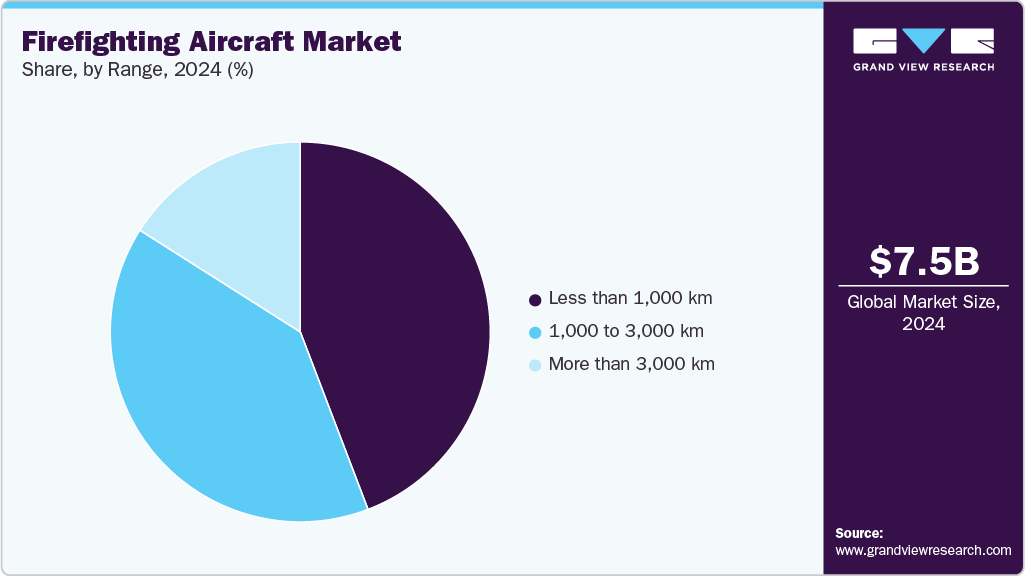
The 1,000 to 3,000 km segment is expected to witness the highest CAGR from 2025 to 2033. This growth is driven by its ideal balance between operational endurance and payload capacity. Aircraft in this category can efficiently perform multiple sorties with shorter turnaround times, ensuring rapid wildfire response. Growing demand for multi-mission versatility and the ability to operate from shorter runways further enhances adoption. Government agencies increasingly favor mid-range aircraft due to their lower operational costs, reinforcing the segment’s growth in the firefighting aircraft industry.
Maximum Take-Off Weight Insights
The 8,000 to 30,000 kg (Medium Weight Aircraft) segment accounted for the largest market share in 2024, driven by its optimal balance between payload capacity, maneuverability, and operational cost. The rising adoption of multi-role configurations that allow firefighting and surveillance operations further enhances their appeal. Increased procurement programs by governments focusing on aircraft capable of accessing rugged terrains and shorter airstrips have reinforced this segment’s leadership in the global firefighting aircraft market.
The more than 30,000 kg (Heavy Weight Aircraft) segment is expected to witness a significant CAGR from 2025 to 2033. This growth is driven by the escalating scale and intensity of wildfires worldwide and the growing demand for long-range, high-capacity aerial firefighting assets. The increasing integration of advanced avionics, high-efficiency dispersal systems, and next-generation mission management technologies further elevates their performance. Global collaborations and leasing initiatives for cross-border wildfire response are boosting the adoption of heavy-lift firefighting aircraft, propelling this segment’s strong growth trajectory.
Regional Insights
The North America firefighting aircraft market accounted for the largest market share of over 47% in 2024, primarily driven by the region’s rising incidence of large-scale wildfires. Robust government funding, including federal grants and state-level wildfire mitigation programs, is supporting the procurement and modernization of aerial firefighting fleets. The adoption of cutting-edge technologies such as infrared mapping, GPS-guided retard, and real-time aerial surveillance is enhancing operational efficiency and safety, solidifying North America’s position as a key hub for the firefighting aircraft industry.

U.S. Firefighting Aircraft Market Trends
The U.S. firefighting aircraft market is expected to grow at a CAGR of over 5% from 2025 to 2033, driven by the increasing federal and state funding for aerial firefighting fleets, alongside initiatives by the U.S. Forest Service and National Interagency Fire Center to modernize and expand aircraft capabilities. Supportive government policies, disaster relief budgets, and the growing emphasis on rapid response capabilities in remote and rugged terrains are further propelling the adoption of firefighting aircraft in the U.S.
Europe Firefighting Aircraft Market Trends
The Europe firefighting aircraft market is expected to grow at a CAGR of over 5% from 2025 to 2033. In Europe, market growth is driven by the increasing frequency of large-scale wildfires, prolonged heatwaves, and drought conditions linked to climate change. The European Union’s enhanced disaster response mechanisms are prompting significant investments in modern aerial firefighting assets. Strong participation from European aerospace manufacturers and service providers, coupled with stringent safety and operational standards, is fostering innovation and improving the efficiency of firefighting aircraft operations across the region.
The UK firefighting aircraft market is poised for significant expansion in the coming years. This is fueled by increasing government emphasis on strengthening disaster preparedness in response to the rise in forest fires. The integration of aerial firefighting capabilities into the UK Fire and Rescue Services’ modernization plans is driving demand for faster. The UK’s push to enhance inter-agency cooperation with the Royal Air Force and Coastguard for joint emergency operations is promoting the adoption of multi-role firefighting aircraft, ensuring greater operational efficiency and national coverage.
The Germany firefighting aircraft market is driven by the country’s increasing focus on wildfire prevention and rapid emergency response in the face of rising climate-related fire risks, particularly in forest-rich regions. Germany’s commitment to the EU Civil Protection Mechanism is further boosting demand for interoperable aircraft that can be deployed quickly in both domestic missions. Stringent aviation safety regulations, coupled with the integration of advanced navigation, encourage the procurement of technologically advanced firefighting aircraft in the country.
Asia Pacific Firefighting Aircraft Market Trends
The Asia Pacific firefighting aircraft market is expected to grow at the highest CAGR of over 9% from 2025 to 2033. Rapid urban expansion into fire-prone areas and the need to protect critical infrastructure and natural reserves are prompting governments to acquire firefighting aircraft. Increasing cross-border collaboration for disaster management is accelerating the procurement of firefighting aircraft. The adoption of advanced technologies such as GPS-guided retardant drops and night-vision operations is further enhancing operational efficiency and driving market growth across the Asia Pacific region.
The Japan firefighting aircraft market is gaining traction, fueled by the country’s heightened focus on disaster preparedness and rapid-response capabilities in the wake of increasingly frequent wildfires. Japan’s challenging terrain and densely forested areas require highly maneuverable rotary-wing aircraft and amphibious fixed-wing planes capable of operating in difficult-to-access zones. Strong domestic aerospace manufacturing capabilities and collaborations are fostering innovation and accelerating the deployment of specialized firefighting aircraft across the nation.
The China firefighting aircraft market is witnessing robust growth, driven by the country’s increasing frequency of large-scale wildfires in forested and grassland regions. The government’s heightened focus on disaster preparedness and emergency response modernization leads to substantial investments in advanced aerial firefighting fleets. Strong policy initiatives under China’s national forest protection encourage the adoption of aircraft equipped with precision water-drop systems and real-time fire mapping technologies. This strategic push supports China’s growing need and strengthens the firefighting aircraft industry.
Key Firefighting Aircraft Company Insights
Some of the key players operating in the market include Lockheed Martin Corporation and AIRBUS among others.
-
Lockheed Martin Corporation is a global leader in defense and aerospace, and a dominant force in the firefighting aircraft market. With its LM-100J FireHerc, a civilian-certified version of the C-130J Super Hercules, Lockheed brings rugged, proven aerial tanker performance to low-level, low-speed fire suppression missions with advanced avionics for situational awareness and potential night-fighting capabilities. Its Sikorsky FIREHAWK helicopter delivers multi-mission versatility, swift water drops, search and rescue, hoist, and medical evacuation all within a resilient airframe designed for intense firefighting operations.
-
AIRBUS stands out as a major player in aerial firefighting, offering a broad helicopter range and modular innovations. Their H125 and H215 helicopters are equipped for water bombing with buckets or belly tanks, capable of rapid, precise water drops. They are also pioneering modular solutions for fixed-wing platforms: Airbus is testing a removable kit to convert the A400M military airlifter into an air-to-ground fighting aircraft.
Viking Air Ltd. and Neptune Aviation Services are some of the emerging market participants in the firefighting aircraft market.
-
Viking Air Ltd. Is an emerging player in the amphibious aircraft lineage is transitioning from legacy platforms to leading-edge models, thus positioning itself as an emerging key player in firefighting aviation. Viking now manufactures and supports the DHC-515, the modern successor to the Canadair CL-415, updated with improved performance and avionics. This revitalizes amphibious aerial firefighting capabilities worldwide.
-
Neptune Aviation Services is an emerging player in the global firefighting aircraft market, recognized for its specialized fleet of BAe 146 Airtankers designed for precision aerial fire suppression. The company focuses on retrofitting and modernizing aircraft with advanced retardant delivery systems, enabling efficient coverage of wildfire hotspots while minimizing environmental impact. Neptune Aviation’s dedication to fleet modernization, operational reliability, and mission-ready availability is cementing its role as a rising force in the firefighting aircraft industry.
Key Firefighting Aircraft Companies:
The following are the leading companies in the firefighting aircraft market. These companies collectively hold the largest market share and dictate industry trends.
- Lockheed Martin Corporation
- AIRBUS
- Leonardo S.p.A.
- Textron Inc.
- Air Tractor, Inc.
- Bombardier
- Viking Air Ltd.
- Neptune Aviation Services
- Conair.
- Kaman Corporation
Recent Developments
-
In August 2025, Neptune Aviation Services announced that it is advancing its development plan for a next-generation air tanker based on the Airbus A319 aircraft. The modification aims to enhance firefighting capabilities with increased capacity and efficiency. This strategic upgrade positions Neptune to improve aerial firefighting effectiveness significantly and meet evolving wildfire challenges.
-
In June 2025, AIRBUS and Space completed a series of test drops and demonstrations of its A400M firefighting demonstrator kit. The tests showcased the aircraft's capability to carry and deploy large volumes of water, enhancing its potential for wildfire suppression operations. This highlights flexibility, rapid deployment capability, and operational efficiency, positioning it as a game changing asset in the firefighting aircraft industry.
-
In April 2025, Conair announced that its Dash 8 Q400AT and Q400MR aircraft have been highly effective in wildfire suppression and other firefighting operations. The aircraft's versatility and performance continue to make them staples in the Type-II aerial firefighting category. This ongoing success highlights Conair’s leadership in delivering reliable and advanced firefighting aircraft, meeting the growing global demand for effective wildfire response.
Firefighting Aircraft Market Report Scope
Report Attribute
Details
Market size value in 2025
USD 7,881.7 million
Revenue forecast in 2033
USD 13,299.9 million
Growth rate
CAGR of 6.8% from 2025 to 2033
Base year for estimation
2024
Historical data
2021 - 2023
Forecast period
2025 - 2033
Quantitative units
Revenue in USD Million and CAGR from 2025 to 2033
Report Product
Revenue forecast, company ranking, competitive landscape, growth factors, and trends
Segments covered
Aircraft type, range, maximum take-off weight, region
Region scope
North America; Europe; Asia Pacific; Latin America; Middle East & Africa
Country scope
U.S.; Canada; Mexico; UK; Germany; France; China; Japan; India; South Korea; Australia; Brazil; Saudi Arabia; UAE; South Africa
Key companies profiled
Lockheed Martin Corporation.; AIRBUS; Leonardo S.p.A.; Textron Inc.; Air Tractor, Inc.; Bombardier; Viking Air Ltd.; Neptune Aviation Services; Conair.; Kaman Corporation
Customization scope
Free report customization (equivalent to up to 8 analyst’s working days) with purchase. Addition or alteration to country, regional & segment scope.
Pricing and purchase options
Avail customized purchase options to meet you exact research needs. Explore purchase options
Global Firefighting Aircraft Market Report Segmentation
This report forecasts revenue growth at global, regional, and country levels and provides an analysis of the latest technological trends in each of the sub-segments from 2021 to 2033. For this study, Grand View Research has segmented the firefighting aircraft market report based on aircraft type, range, maximum take-off weight, and region:

-
Aircraft Type Outlook (Revenue, USD Million, 2021 - 2033)
-
Rotorcraft
-
Fixed-Wing
-
-
Range Outlook (Revenue, USD Million, 2021 - 2033)
-
Less than 1,000 km
-
1,000 to 3,000 km
-
More than 3,000 km
-
-
Maximum Take-Off Weight Outlook (Revenue, USD Million, 2021 - 2033)
-
Less than 8,000 kg (Light Weight Aircraft)
-
8,000 to 30,000 kg (Medium Weight Aircraft)
-
More than 30,000 kg (Heavy Weight Aircraft)
-
-
Regional Outlook (Revenue, USD Million, 2021 - 2033)
-
North America
-
U.S.
-
Canada
-
Mexico
-
-
Europe
-
UK
-
Germany
-
France
-
-
Asia Pacific
-
China
-
Japan
-
India
-
South Korea
-
Australia
-
-
Latin America
-
Brazil
-
-
Middle East & Africa
-
Saudi Arabia
-
UAE
-
South Africa
-
-
Frequently Asked Questions About This Report
The global firefighting aircraft market was estimated at USD 7,475.4 million in 2024 and is expected to reach USD 7,881.7 million in 2025.
The global firefighting aircraft market is expected to grow at a compound annual growth rate of 6.8% from 2025 to 2033 and to reach USD 13,299.9 million by 2033.
The North America firefighting aircraft market accounted for the largest market share of over 47% in 2024, primarily driven by the region’s rising incidence of large-scale wildfires. Robust government funding, including federal grants and state-level wildfire mitigation programs, is supporting the procurement and modernization of aerial firefighting fleets. The adoption of cutting-edge technologies such as infrared mapping, GPS-guided retard, and real-time aerial surveillance is enhancing operational efficiency and safety, solidifying North America’s position as a key hub for the firefighting aircraft industry.
The key players in the firefighting aircraft market are Lockheed Martin Corporation., AIRBUS, Leonardo S.p.A., Textron Inc., Air Tractor, Inc., Bombardier, Viking Air Ltd., Neptune Aviation Services, Conair., Kaman Corporation.
Key drivers of the firefighting aircraft include the increasing frequency and severity of wildfires, rising investments in aerial firefighting capabilities, growing adoption of advanced water and retardant-dropping technologies, and the ongoing technological advancements in aircraft design and fire suppression systems.
About the Author(s)
Next Generation Technologies Research Team
Technology · Next Generation TechnologiesThis report was authored by the next generation technologies research team at Grand View Research - comprising two research analysts, one senior research analyst, and one industry expert - with specialized expertise in the next generation technologies segment of the technology industry. All findings are based on proprietary technology databases, executive interviews, and regulatory analysis, subject to internal peer review prior to publication.
Last Updated:
Speak to Analyst


Customize this report to your needs - add regions, segments, or data points, with 20% free customization.
Or view our licence options:


ISO 9001:2015 & 27001:2022 Certified
We are GDPR and CCPA compliant! Your transaction & personal information is safe and secure. For more details, please read our privacy policy.


