
- Home
- »
- Beauty & Personal Care
- »
-
Fitness & Recreational Sports Centers Market Report, 2035GVR Report cover

Fitness & Recreational Sports Centers Market (2026 - 2035)
Size, Share & Trends Analysis Report By Facility (Gymnasiums/Health Club, Indoor Sports Centers, Swimming & Aquatic Centers), By End Use (Adults, Kids/Children), By Service, By Region, And Segment Forecasts
Market Size, 2025
$135.6BMarket Estimate, 2026
$145.9BMarket Forecast, 2035
$242.1BCAGR, 2026–2035
7.5%Fitness & Recreational Sports Centers Market Summary
The global fitness & recreational sports centers market size was valued at USD 135.6 billion in 2025 and is projected to grow from USD 145.9 billion in 2026 to USD 242.1 billion by 2035, at a CAGR of 7.5% from 2026 to 2035. North America dominated the market, accounting for a revenue share of 38.0% in 2025. The industry is experiencing steady growth as consumers are increasingly prioritizing preventive healthcare, active lifestyles, and overall well-being. Rising awareness of the health benefits associated with regular physical activity, including reduced risks of obesity, cardiovascular diseases, diabetes, and mental health disorders, continues to encourage participation in organized fitness programs, thereby supporting the market demand.
Key Market Trends & Insights
- By facility: The gymnasiums/health clubs accounted for the largest share of around 41.0% in 2025.
- By end use: The adults segment held the largest market share of over 80.0% in 2025.
- By service: The membership fees segment held the largest market share of around 85.0% in 2025.
Regional Highlights
- Largest regional market: North America (38.0% revenue share, 2025)
- Fastest-growing regional market: Asia Pacific (highest CAGR, 2026-2035)
Market Size & Forecast
- Market size in 2025: USD 135.6 Billion
- Estimated market size in 2026: USD 145.9 Billion
- Projected market size by 2035: USD 242.1 Billion
- CAGR (2026-2035): 7.5%
Prism AI by Grand View Research Free to tryAsk a question about the fitness & recreational sports centers marketTry asking✓Every figure cited from GVR research Prefer the report? Download free sample →
The industry is transformed by rapid digitalization and evolving consumer preferences. Fitness operators are increasingly adopting wearable technologies, AI-powered workout recommendations, mobile applications, virtual coaching, and contactless member-management solutions to enhance engagement, personalize services, and improve member retention. Hybrid fitness models, which combine physical facilities with digital services, have become increasingly important as consumers seek greater flexibility and convenience. At the same time, specialized boutique studios for exercises such as yoga, Pilates, cycling, and HIIT are another attraction for consumers.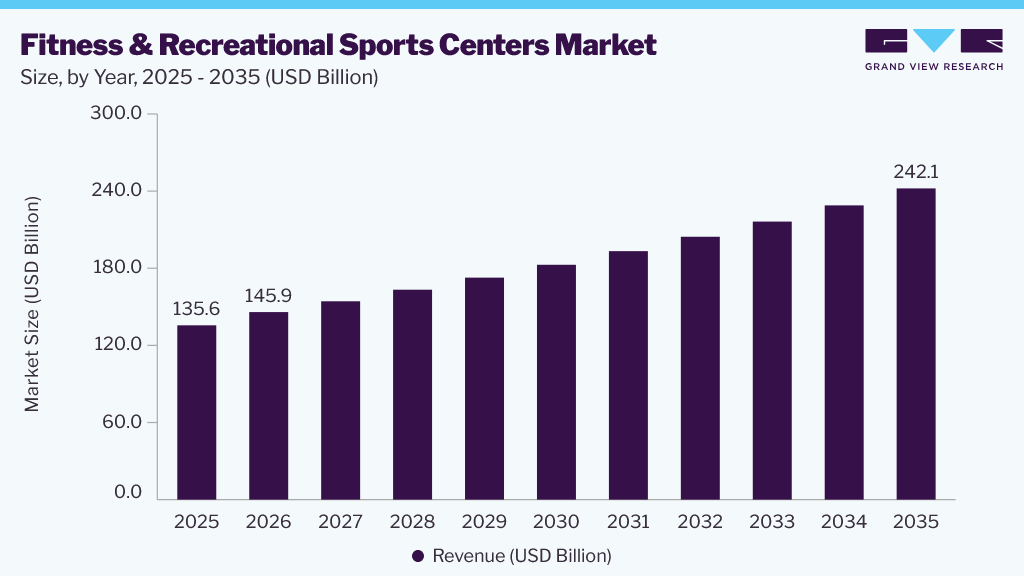 Source: Grand View Research, IR Documents, Primary Interviews, Paid DatabasesTo learn more about this report,
 Download Free Sample Report
Commercial expansion is supported by investments from international fitness chains, franchising models, corporate wellness initiatives, and public investments in recreational infrastructure. Employers are increasingly recognizing workplace wellness initiatives as a means of supporting employee well-being, productivity, and engagement, while governments in several countries are promoting physical activity through sports participation programs and community-based fitness infrastructure. In addition, the growing popularity of youth sports, family recreation, and senior fitness programs is broadening the customer base for fitness and recreational sports centers.
Ongoing innovation in fitness services, online interactions, and wellness products is expected to create new market opportunities. There are many innovative ways owners of fitness centers are earning extra income by offering personal training, group fitness, recovery sessions, nutrition consulting, and sports coaching. Rising penetration in suburban and emerging urban markets, along with rising demand for flexible membership and experience-oriented fitness services, is expected to create new opportunities. In view of growing awareness about health around the globe, fitness and recreational sports centers are expected to become an integral part of the overall preventive healthcare industry.
Analyst Perspective
The industry for fitness and recreational sports facilities is shifting from a traditional membership-based model to a comprehensive wellness ecosystem centered on personalized experiences and digitalization. Service providers use connected technology solutions and data-driven fitness training, as well as different types of membership programs, to boost customer loyalty and diversify their revenue streams. The customer base is broadening, with a significant increase in the number of female members, children, and seniors, as well as more wellness programs for corporate customers.
Facility Insights
The gymnasiums/health clubs segment accounted for the largest share of around 41.0% in 2025, owing to their broad service portfolios, extensive membership bases, and recurring subscription revenues. These facilities provide strength and cardiovascular training, functional fitness, group exercise classes, recovery amenities, and personalized coaching under one roof, making them the preferred choice for a wide range of consumers. Large domestic and international fitness chains continue to expand through franchising, acquisitions, and premium club formats. Corporate wellness partnerships and the increasing demand for comprehensive health and fitness services further reinforce the segment's leading position in both mature and emerging markets. For instance, in December 2024, Planet Fitness announced plans the expand strength-training options across the majority of its U.S. clubs by adding new plate-loaded equipment in response to evolving consumer demand for strength training.
The yoga studios segment is expected to register the fastest growth during the forecast period because of the increased inclination toward holistic health, stress management, flexibility, and psychological well-being on the part of customers. The increased popularity of mindfulness activities, combined with higher involvement of women, older individuals, and working professionals, is increasing the demand for yoga classes. Yoga studios are experiencing growth due to the provision of hybrid classes, meditation classes, prenatal yoga, therapy yoga, and yoga studio applications. Wellness coaching and personalized experience have increased the level of engagement of customers, and even employers and healthcare providers consider yoga to be preventive healthcare.
End Use Insights
The adults segment held the largest market share of over 80.0% in 2025 due to increased health awareness and a growing number of lifestyle-related diseases, along with more people joining fitness centers to maintain their health through various exercises. Working professionals and young adults have started going to the gym for weight loss, strength training, physical fitness, reducing stress, and maintaining good health. Also, corporate wellness programs, membership packages, and even fitness through digital media have resulted in increased interest from the adult side.
The kids/children segment is projected to witness the fastest growth as parents prioritize physical activity, sports participation, and healthy lifestyles from an early age. Rising concerns regarding childhood obesity, excessive screen time, and declining physical activity levels have accelerated enrollment in structured sports and recreational programs. Fitness centers are responding by introducing age-specific coaching, swimming lessons, gymnastics, martial arts, and multi-sport development programs. Government initiatives promoting youth sports participation and increasing investments in child-friendly recreational infrastructure are expected to further support long-term growth within this segment.
Service Insights
The membership fees segment held the largest market share of around 85.0% in 2025, as they ensure stable revenue streams and create loyal customers for fitness centers and recreational sports clubs. Subscription models bring steady revenue and promote regular facility visits. Fitness centers are increasingly providing their members with a variety of offerings ranging from access to online resources, group exercise classes, wellness programs, and luxury facilities to increase the retention rate of the customers. New pricing strategies and loyalty programs contributed greatly to the implementation of the subscription model.
The personal training & instruction services segment is anticipated to experience the fastest growth during the forecast period, driven by increasing demand for individualized fitness programs, measurable health outcomes, and expert guidance. Consumers increasingly seek customized exercise plans, rehabilitation support, sports performance coaching, and nutrition advice tailored to their personal goals. Fitness centers are investing in certified trainers, digital performance tracking, AI-assisted coaching tools, and specialized instruction to improve customer satisfaction and retention. The growing preference for personalized wellness experiences and higher-value fitness services is expected to sustain robust demand for professional training throughout the forecast period.
Regional Insights
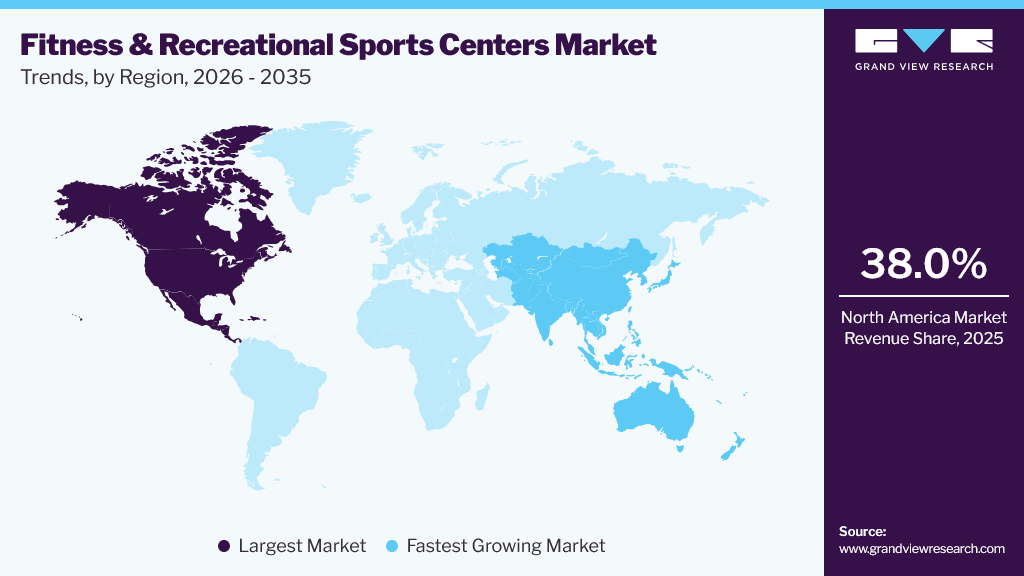
The North America fitness & recreational sports centers market accounted for around 38.0% of global revenue in 2025. The region’s leading position is supported by rising health consciousness, widespread gym memberships, established fitness center chains, and the presence of prominent fitness associations. Consumers are increasingly investing in preventive health, personalized fitness programs, and wellness services, while companies continue to expand employee wellness initiatives. The region also demonstrates strong adoption of fitness technologies, including connected equipment, digital platforms, wearable devices, and hybrid membership models. These trends, combined with high consumer spending on health and fitness, are expected to sustain North America’s leadership in the global market.
 To learn more about this report, Download Free Sample Report
Asia Pacific Fitness & Recreational Sports Centers Market Trends
The fitness & recreational sports centers market in Asia Pacific is expected to experience the fastest growth during the forecast period, driven by rapid urbanization, rising disposable incomes, growing health consciousness, and a growing middle class. Higher participation in physical exercises, sports, and fitness routines is prompting both domestic and international firms to expand into major metropolitan cities. Digital fitness programs, exclusive fitness studios, and affordable membership programs have proven effective at attracting young consumers. Physical exercise-oriented government policies and investments in commercial fitness and sports facilities are expected to prove beneficial for regional market expansion.
Key Fitness & Recreational Sports Centers Companies Insights
The fitness & recreational sports centers market is highly competitive, with leading players focusing on club expansion, franchise development, digital fitness platforms, and customized wellness solutions. Fitness providers are strengthening customer retention through hybrid memberships, AI-powered training, corporate wellness partnerships, and premium fitness programs, while expanding their presence across new geographic regions.
Key Fitness & Recreational Sports Centers Companies
The following key companies have been profiled for this study on the fitness & recreational sports centers market:
-
Planet Fitness
-
Life Time Group Holdings
-
Basic-Fit N.V.
-
PureGym Limited
-
Anytime Fitness
-
The Gym Group plc
-
Crunch Fitness
-
Equinox Holdings, Inc.
-
Xponential Fitness, Inc.
-
Virgin Active
-
Gold's Gym
-
UFC GYM
-
World Gym International LLC
-
24 Hour Fitness
Recent Developments
- In August 2026, Planet Fitness reported that it opened 23 new clubs during the second quarter of 2026, bringing its system-wide club count to 2,930 as of June 30, 2026, demonstrating continued network expansion in the fitness club market
- In May 2026, Xponential Fitness announced that it opened 66 new studios and sold 28 franchise licenses during the first quarter of 2026, while North America system-wide sales increased 2.0% year over year to USD 436.9 million, highlighting continued expansion across its boutique fitness network
- In January 2026, Planet Fitness announced that it ended 2025 with approximately 20.8 million members after opening 181 new clubs, highlighting its continued network expansion and leading position in the global fitness club industry
Fitness & Recreational Sports Centers Market Report Scope
Report Attribute
Details
Market size in 2025
USD 135.6 billion
Estimated market size in 2026
USD 145.9 billion
Projected market size by 2035
USD 242.1 billion
Growth rate
CAGR of 7.5% from 2026 to 2035
Base year for estimation
2025
Historical data
2021 - 2024
Forecast period
2026 - 2035
Quantitative units
Revenue in USD billion, and CAGR from 2026 to 2035
Report coverage
Revenue forecast, company ranking, competitive landscape, growth factors, and trends
Segments covered
Facility, service, end use, region
Regional scope
North America; Europe; Asia Pacific; Central & South America; Middle East & Africa
Country scope
U.S.; Canada; Mexico; UK; Germany; France; Italy; Spain; China; Japan; India; Australia; South Korea; Brazil; Argentina; South Africa; Saudi Arabia; UAE
Key companies profiled
Planet Fitness; Life Time Group Holdings; Basic-Fit N.V.; PureGym Limited; Anytime Fitness; The Gym Group plc; Crunch Fitness; Equinox Holdings, Inc.; Xponential Fitness, Inc.; Virgin Active; Gold's Gym; UFC GYM; World Gym International LLC; 24 Hour Fitness.
Customization scope
Free report customization (equivalent to 8 analyst working days) with purchase. Addition or alteration to country, regional & segment scope.
Pricing and purchase options
Avail of customized purchase options to meet your exact research needs. Explore purchase options
Fitness & Recreational Sports Centers Market Report Segmentation
This report forecasts revenue growth at the global, regional, and country levels and provides an analysis of the latest industry trends and opportunities across each sub-segment from 2021 to 2035. For this study, Grand View Research has segmented the global fitness & recreational sports centers market report based on facility, service, end use, & region:
-
Facility Outlook (Revenue, USD Billion, 2021 - 2035)
-
Gymnasiums/Health Clubs
-
Yoga Studios
-
Aerobic Dance & Group Fitness Studios
-
Indoor Sports Centers
-
Swimming & Aquatic Centers
-
Others
-
-
End Use Outlook (Revenue, USD Billion, 2021 - 2035)
-
Adults
-
Kids/Children
-
-
Service Outlook (Revenue, USD Billion, 2021 - 2035)
-
Membership Fees
-
Personal Training
-
Group Fitness Classes
-
Sports Coaching & Recreational Programs
-
Others
-
-
Regional Outlook (Revenue, USD Billion, 2021 - 2035)
-
North America
-
U.S.
-
Canada
-
Mexico
-
-
Europe
-
UK
-
Germany
-
France
-
Italy
-
Spain
-
-
Asia Pacific
-
China
-
Japan
-
India
-
Australia
-
South Korea
-
-
Central & South America
-
Brazil
-
Argentina
-
-
Middle East and Africa (MEA)
-
South Africa
-
Saudi Arabia
-
UAE
-
-
Frequently Asked Questions About This Report
The global fitness & recreational sports centers market size was valued at USD 135.6 billion in 2025 and is estimated at USD 145.9 billion in 2026.
The global fitness & recreational sports centers market is expected to grow at a CAGR of 7.5% from 2026 to 2035, reaching USD 242.1 billion by 2035.
North America dominated with approximately 38.0% revenue share in 2025.
The gymnasiums/health clubs accounted for the largest share of around 41.0% in 2025.
Key players in the market include Planet Fitness, Life Time Group Holdings, Basic-Fit N.V., PureGym Limited, Anytime Fitness, The Gym Group plc, Crunch Fitness, Equinox Holdings, Inc., Xponential Fitness, Inc., Virgin Active, Gold's Gym, UFC GYM, World Gym International LLC, 24 Hour Fitness, and others.
About the Author(s)
Beauty & Personal Care Research Team
Consumer Goods · Beauty & Personal CareThis report was authored by the beauty & personal care research team at Grand View Research - comprising two research analysts, one senior research analyst, and one industry expert - with specialized expertise in the beauty & personal care segment of the consumer goods industry. All findings are based on proprietary consumer goods databases, executive interviews, and regulatory analysis, subject to internal peer review prior to publication.
Last Updated:
Speak to Analyst

Customize this report to your needs - add regions, segments, or data points, with 20% free customization.
Or view our licence options:


ISO 9001:2015 & 27001:2022 Certified
We are GDPR and CCPA compliant! Your transaction & personal information is safe and secure. For more details, please read our privacy policy.


