
- Home
- »
- Consumer F&B
- »
-
Flavored Water Market Size And Share Report, 2026-2033GVR Report cover

Flavored Water Market (2026 - 2033)
Size, Share & Trends Analysis Report By Product (Sparkling, Still), By Distribution Channel (Supermarkets, Convenience Stores, Online), By Region (North America, Europe, Asia Pacific, Latin America, MEA), And Segment Forecasts
Market Size, 2025
$756.8MMarket Estimate, 2026
$826.5MMarket Forecast, 2033
$1,627.3MCAGR, 2026–2033
10.2%Flavored Water Market Summary
The global flavored water market size was valued at USD 756.8 million in 2025 and is projected to grow from USD 826.5 million in 2026 to USD 1,627.3 million by 2033, at a CAGR of 10.2% from 2026 to 2033. The market in Europe dominated with a revenue share of 30.8% in 2025. Consistently increasing demand for flavored, healthy, and functional drinks has been boosting the growth of the market across the globe.
 Source: Grand View Research, IR Documents, Primary Interviews, Paid DatabasesTo learn more about this report,
 Download Free Sample Report
 Key Market Trends & Insights
- By product: Sparkling segment held the largest market share of 73.9% in 2025.
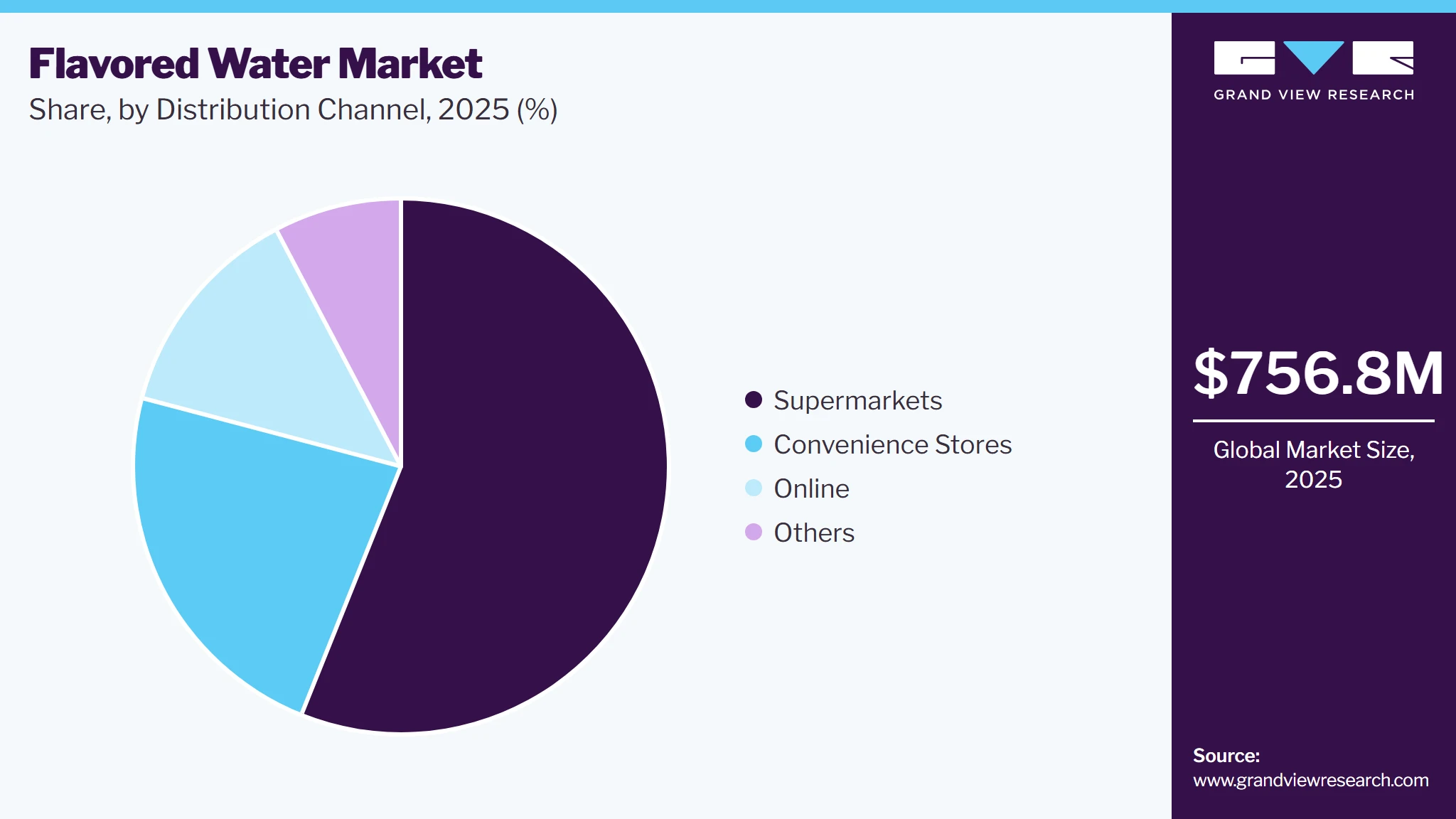
- By distribution channel: Supermarkets segment held the largest market share of 56.1% in 2025.
Regional Highlights
- Largest regional market: Europe (30.8% revenue share, 2025)
- Fastest-growing regional market: Asia Pacific (highest CAGR, 2026-2033)
- By country: U.S. held the largest market share in 2025
Market Size & Forecast
- Market size in 2025: USD 756.8 Million
- Estimated market size in 2026: USD 826.5 Million
- Projected market size by 2033: USD 1,627.3 Million
- CAGR (2026-2033): 10.2%
Three ways to get this report
Buy it, customize it, or ask a question.Ask an Analyst
Analyst response in 1 business day
- AccessReport author, directly
- Reply timeWithin 1 working day
- No sales callDirect answer only
- FormatEmail reply
- CostFree, no cost
Get the Full Report
What the study covers
- FormatsPDF · Excel · Dashboard
- Timeline2026–2033 annual, 2025 base
- Coverage20+ countries, 5 regions
- Companies10+ key players profiled
Customize the Report
20% free customization
- IncludeCountries, segments, points
- TailorTo your product definition
- ExtendDeeper competitor detail
- OrA fully bespoke study
- Turnaround5–10 working days
Consumers are showing interest in exploring innovative beverages infused with fruits, herbs, other healthy ingredients. The demand is particularly strong among health-conscious individuals in the mid- to high-income segments, who are looking for flavorful hydration options that support their overall well-being. Consumers are increasingly looking for healthier alternatives to traditional sugary drinks such as juices and sodas. Flavored water infused with natural ingredients offers low low-calorie, refreshing alternative to traditional, bland water that helps consumers to stay hydrated and enjoy flavors. Global beverage brands including Nestlé, PepsiCo, and Coca-Cola have popularized the category by offering a variety of fruit-infused flavors with no added sugars or artificial ingredients. The appeal lies in the product’s ability to combine the refreshing fizz of soda with the health-conscious profile of water, making it especially attractive to the younger consumer group. To learn more about this report, Download Free Sample Report
 Consumers, especially millennials and Gen Z, in developed economies are spending more on flavored water. The trend of zero-calorie, zero-sugar, and low-carb soft drinks is rising across the globe, which is also boosting market growth. Citrus and berry flavors are gaining traction among consumers due to their refreshing tastes. Natural flavors are gaining traction due to their health benefits and refreshing tastes. As a result, producers have been launching beverages with multiple flavors that help improve physical and mental health.
The continuous introduction of new flavors, innovative packaging, and incorporation of functional ingredients have helped shape and boost the global market. Companies are adding vitamins and minerals to their drinks to attract modern consumers. With consumers' growing awareness of sustainability and the environment, industry players are increasingly offering flavored waters in sustainable packaging. Several brands offer their drinks in aluminum cans to appeal to environmentally conscious consumers. Furthermore, consumers are looking for drinks that are sourced and produced sustainably, which has created growth opportunities for the market players.
Market Dynamics
The flavored water market is expanding steadily as consumers increasingly seek refreshing beverages that offer taste without the high sugar content associated with traditional soft drinks. Rising interest in hydration-focused products, coupled with growing demand for clean-label formulations, is encouraging manufacturers to introduce naturally flavored and fortified water variants. The market is also benefiting from evolving consumption patterns among fitness enthusiasts and health-conscious individuals who prefer low-calorie beverage options. Additionally, advancements in flavor technology, the incorporation of functional ingredients such as vitamins and electrolytes, and the growing availability of convenient on-the-go packaging are strengthening product appeal and supporting market growth across both developed and emerging economies.
The increasing demand for low-calorie beverages is driven by growing health awareness among consumers. People are becoming more conscious of the risks associated with excessive sugar intake, such as obesity, diabetes, and heart disease. As a result, many consumers are choosing low-calorie drinks as a healthier alternative to sugary beverages. The rise of fitness trends and weight-management goals has further boosted the popularity of these products. Additionally, beverage companies are introducing innovative low-calorie options with improved taste and natural ingredients to meet changing consumer preferences.
Higher product prices compared to plain bottled water act as a significant restraint on the market. Functional, flavored, or enhanced beverages often contain additional ingredients, specialized formulations, and premium packaging, which increase their production costs. As a result, these products are typically sold at higher prices than regular bottled water. Price-sensitive consumers may be reluctant to switch to or regularly purchase these beverages, especially in developing markets. This cost difference can limit market penetration and slow overall sales growth despite rising consumer interest in healthier drink options.
The growing demand for healthier lifestyle choices creates significant opportunities for the low-calorie beverage market. Manufacturers can expand their product portfolios by introducing innovative flavors, natural sweeteners, and functional ingredients such as vitamins and probiotics. Rising urbanization and increasing disposable incomes in emerging economies provide access to a larger consumer base. The expansion of e-commerce and online grocery platforms also helps brands reach consumers more effectively. Additionally, the increasing preference for clean-label and plant-based products offers new avenues for product development and market growth.
Analyst Perspective
The flavored water market is experiencing sustained growth as consumers increasingly move away from sugar-laden carbonated drinks toward healthier hydration alternatives. Demand is being driven by rising awareness of obesity, diabetes, and overall wellness, leading to strong preference for low-calorie and zero-sugar beverages. The category is also benefiting from the clean-label movement, with consumers favoring products that use natural flavors, minimal ingredients, and no artificial sweeteners.
Product Insights
Based on product, the sparkling flavored water segment led the market with the largest revenue share of 73.9% in 2025. The increase in demand for flavored bubbly and fizzy hydration products is projected to drive segment growth. The sparkling variants are increasingly preferred owing to their taste, fizz, and health benefits. Several brands, including Nestlé Pure Life, offer a range of zero-calorie and zero-sweetener-flavored products in different fruit flavors.
Key players are launching new products on the market in accordance with the changing demands from health-conscious consumers. For instance, on 19 March 2024, PepsiCo launched a brand-new product, Bubbly Burst. The new sparkling water is flavor-forward, lightly sweetened with bold fruit flavors, bright colors, zero added sugar, and minimal calories. Such launches are estimated to augment the segment growth over the forecast period.
Still flavored water market is expected to grow at a significant growth rate over the forecast period. It is evolving rapidly, driven by growing consumer interest in healthier and more customized hydration. The availability of a wide range of still water products enriched with minerals, antioxidants, vitamins, and caffeine is estimated to boost the growth of segment in the years to come. Furthermore, the perception that sparkling drinks cause low bone mineral density and tooth decay has encouraged many consumers to shift towards still alternatives.
The increasing availability of the still variants infused with various fruits, such as watermelon, blueberry, blackberry, lemon, mango, pomegranate, and mandarin orange, is boosting the consumption of the products. In March 2024, Essentia® Hydroboost launched flavored and functional water, offering a blend of B-complex vitamins and 400mg of electrolytes—30 times more than the leading premium still water available in lemon-lime, peach mango, and raspberry pomegranate flavors.
Distribution Channel Insights
Based on distribution channel, the supermarkets channels led the market with the largest revenue share of 56.1% in 2025. Many consumers prefer buying bottled water from supermarkets due to the shopping experience. Services, such as home delivery and click & collect, at several supermarkets have also been attracting consumers. Walmart, Carrefour, Woolworths, Magnit, and Edeka are among the leading supermarket chains across the globe.
 To learn more about this report, Download Free Sample Report
 The online distribution channel segment is expected to register the fastest CAGR over the forecast period. The provision of competitive pricing and hassle-free home delivery is driving the growth of this sales channel. Furthermore, the high penetration of the Internet across the globe is expected to boost product sales via online platforms over the coming years. The post-pandemic era has fundamentally changed the shopping patterns of consumers. Nowadays, more and more customers are willing to buy their essentials, including water and coffee, through online platforms. This has resulted in online portals becoming one of the most important distribution channels among manufacturers, distributors, retailers, and customers.
Regional Insights
North America accounted for a significant revenue share in 2025. Health-conscious consumers are constantly seeking alternatives to soft sugary drinks. Flavored water offers low-calorie and sugar-free options, aligning with their preferences. Many brands came with flavored waters which are keto-friendly, vegan, and free from allergens, which align perfectly with dietary preferences and restrictions popular among consumers. For instance, ‘Hint’ a popular flavored water brand in the United States offers vegan, kosher, and gluten-free products.
U.S. Flavored Water Market Trends
The flavored water market in the U.S. held the largest share in the North America region in 2025. Younger generations, especially Millennials and Gen-Zs, prioritize health and convenience. They also prefer innovative flavors and sustainable brands; this makes them a vital consumer segment for flavored water companies. Social media plays a greater role in influencing their decisions. Trends like ‘Watertok’ which showcases creative flavor water recipes gained popularity.
Europe Flavored Water Market Trends
Europe dominated the flavored water market with the largest revenue share of 30.8% in 2025 due to the rising product consumption as a healthy alternative to other carbonated drinks. Several popular brands, such as Bubbly, Volvic, Nestlé Pure Life, Perrier, Schweppes, and LaCroix, offer a wide range of products in the region. Thus, the increased accessibility of the product has been boosting product adoption in the region. Natural flavored and naturally carbonated waters with high levels of minerals make it more appealing to health-conscious consumers. The flavors added to the drinks are often obtained from natural fruit extracts. The product sales are strong in several countries, such as Germany, the U.K., Italy, Spain, and France, where the product is often served with meals in restaurants.
 To learn more about this report, Download Free Sample Report
 Germany accounted for the largest share of the region, driven by health-conscious consumers, innovative product offerings, and a shift towards sustainable practice. Innovation is a significant driver here. For instance, a Munich-based startup called ‘Air Up’ has developed innovative water bottles that utilize scent pods to create a perception of flavor, enabling consumers to experience flavored water without adding actual flavor or sugar.
Asia Pacific Flavored Water Market Trends
Asia Pacific is estimated to be the fastest-growing regional market during the forecast period. Increasing consumer preference for the product, coupled with the expansion of quick-service and full-service restaurants, is likely to create a positive outlook for the market in the region. Rising consumer awareness about the benefits of following a healthy lifestyle has fueled the demand for healthy foods and beverages which, in turn, will support the regional market growth.
Furthermore, the surge in disposable income of consumers has changed their food and beverage consumption patterns globally. Consumers are highly inclined toward the consumption of healthy foods and beverages and limiting the intake of sugary drinks that have adverse health effects. Many restaurants and bars have been serving the product, resulting in an optimistic outlook for the growth of flavored water over the forecast period.
Key Flavored Water Company Insights
The key players have been implementing various expansion strategies, such as mergers & acquisitions and new product launches, to strengthen their market share. For example, in November 2024, Primo Water Corporation and BlueTrion Brands completed merger, forming Primo Brands Corporation, which will focus Primo’s sustainable practices with BlueTrion’s robust portfolio, including Poland Spring, Deer Park & Pure Life.
-
Spindrift Beverages CO. is a privately held company founded in Massachusetts, USA specializing in sparkling waters made with real fruits. The company distinguishes itself by using whole fruits, to flavor beverages, offering an authentic taste.
-
Talking Rain is a privately owned beverage company based in Washington . Its flagship product,' Sparkling Ice,' has a strong presence in the flavored water market. It’s zero-sugar sparkling water infused with natural fruit flavors and also contains vitamins and antioxidants, catering to health-conscious consumers. It offers flavors such as Black Cherry, Peach Nectarine, and kiwi Strawberry.
Key Flavored Water Companies
The following key companies have been profiled for this study on the flavored water market.
-
Nestlé
-
Talking Rain
-
PepsiCo
-
The Coca‑Cola Company
-
Hint Inc.
-
Spindrift Beverage Co.
-
National Beverage Corp.
-
Sanpellegrino S.p.A.
-
KeurigDr Pepper, Inc.
-
Saratoga Spring Water Company
Competitive Benchmarking
Category
Operating Strategies
Competitive Edge
Weakness
Established Players (Nestlé, PepsiCo, The Coca-Cola Company, Keurig Dr Pepper, National Beverage Corp., Sanpellegrino S.p.A., Talking Rain Beverage Company)
- Strong dominance in global RTD beverage distribution; expansion into flavored still and sparkling water through brand extensions and acquisitions; focus on zero-sugar, functional, and premium hydration products.
- Strong global distribution networks, high brand recognition, strong retail and convenience channel penetration, and ability to scale new beverage sub-categories quickly.
- Heavy dependence on legacy carbonated and sugary beverage portfolios, slower innovation cycles in niche functional waters, and pricing constraints in emerging markets.
Emerging Players (Hint Inc., Spindrift Beverage Co., Saratoga Spring Water Company)
- Focus on clean-label, naturally flavored, and functional hydration products; strong presence in e-commerce, specialty retail, and direct-to-consumer models; positioning around wellness and zero-sugar lifestyles.
- Strong innovation in natural ingredients and functional beverages, high brand authenticity, strong alignment with health-conscious consumers, and agile product development.
- Limited global scale, weaker retail shelf dominance compared to multinationals, and constrained production and distribution capacity.
Recent Developments
-
On 25 February 2025, LaCroix Sparkling Water by National Beverage Corp. introduced its new flavor ‘Sunshine’, blending citrus & tropical zest.
-
On 25 February 2025, Waterloo Sparkling Water launched two new flavors: Guava Berry and Ruby Red Tangerine. Both flavors will be available throughout the year and contain no calories, sugar, or sweetness.
-
On 19 February 2025, Culligan Quench announced its acquisition of Stonybrook Water, strengthening its presence in New England where Stonybrook has operated for over 40 years. This combination gives Stonybrook access to expand product line while maintaining comprehensive service and support.
-
In March 2024, Essentia launched ‘Hydroboost’ functional flavored water. It offers hydration with B-complex vitamins and 400mg of electrolytes. It comes in Lemon Lime, Peach Mango, and Raspberry Pomegranate flavors.
Flavored Water Market Report Scope
Report Attribute
Details
Market size in 2025
USD 756.8 million
Estimated market size in 2026
USD 826.5 million
Projected market size by 2033
USD 1,627.3 million
Growth rate
CAGR of 10.2% from 2026 to 2033
Base year for estimation
2025
Historical data
2021 - 2024
Forecast period
2026 - 2033
Quantitative units
Revenue in USD million/billion and CAGR from 2026 to 2033
Report coverage
Revenue forecast, company ranking, competitive landscape, growth factors, and trends
Segments covered
Product, distribution channel, region
Regional scope
North America; Europe; Asia Pacific; Latin America; MEA
Country scope
U.S.; Canada; Mexico; UK; Germany; France; Italy; Spain; China; Japan; India; Australia & New Zealand; Brazil; Argentina; South Africa; UAE
Key companies profiled
Nestlé, Talking Rain, PepsiCo, The Coca‑Cola Company, Hint Inc., Spindrift Beverage Co., National Beverage Corp., Sanpellegrino S.p.A., KeurigDr Pepper, Inc., Saratoga Spring Water Company
Customization scope
Free report customization (equivalent up to 8 analysts' working days) with purchase. Addition or alteration to country, regional & segment scope.
Pricing and purchase options
Avail customized purchase options to meet your exact research needs. Explore purchase options
Global Flavored Water Market Report Segmentation
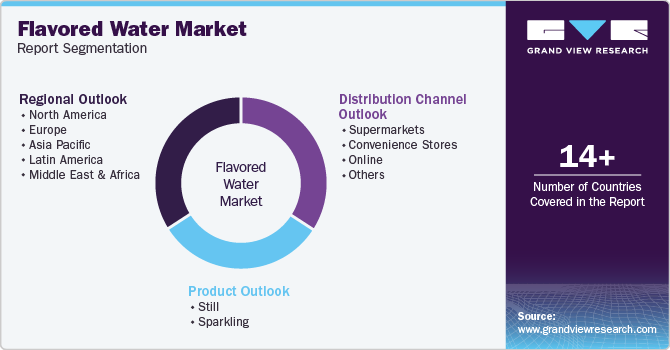
This report forecasts revenue growth at global, regional, and country levels and provides an analysis of the latest industry trends in each of the sub-segments from 2021 to 2033. For this study, Grand View Research has segmented the global flavored water market report based on product, distribution channel, and region:
 To learn more about this report, Download Free Sample Report
 -
Product Outlook (Revenue, USD Million, 2021 - 2033)
-
Still
-
Sparkling
-
-
Distribution Channel Outlook (Revenue, USD Million, 2021 - 2033)
-
Supermarkets
-
Convenience Stores
-
Online
-
Others
-
-
Regional Outlook (Revenue, USD Million, 2021 - 2033)
-
North America
-
U.S.
-
Canada
-
Mexico
-
-
Europe
-
Germany
-
UK
-
France
-
Italy
-
Spain
-
-
Asia Pacific
-
China
-
India
-
Japan
-
Australia & New Zealand
-
-
Latin America
-
Brazil
-
Argentina
-
-
Middle East and Africa (MEA)
-
South Africa
-
UAE
-
-
Research Methodology
The flavored water market figures in this report are based on a proven research process that combines executive interviews with secondary research from proprietary databases, company filings, and recognized regulatory and institutional sources. Market size is built through value-chain sizing - reconciling supply-side and demand-side estimates - and triangulated with bottom-up and top-down approaches. Every estimate passes multiple levels of expert validation before publication, with each flavored water segment quantified using the revenue-capture definitions in the table below.
Segment Definition
Segment - Product
Revenue capture definition
Still Flavored Water
Still flavored water is non-carbonated water enhanced with natural or artificial flavors, and may contain added vitamins, minerals, or functional ingredients. It provides a refreshing beverage option with little or no sugar and calories, making it popular among health-conscious consumers seeking hydration with added taste.
Sparkling Flavored Water
Sparkling flavored water is carbonated water infused with natural or artificial flavors to create a fizzy and refreshing drinking experience. It is often marketed as a healthier alternative to sugary soft drinks, offering flavor and carbonation with low or zero calories and sugar content.
Estimation Model
Layer Name
Key Question
Description
Hydration Consumer Universe Layer
Who consumes flavored beverages globally?
Represents the broad population of consumers seeking convenient, refreshing, and healthier beverage alternatives to traditional soft drinks.
Access & Availability Layer
Who can access flavored water products?
Covers consumers who have access to flavored water through supermarkets, convenience stores, vending channels, foodservice outlets, online retailers, and direct-to-consumer platforms.
Purchase & Usage Layer
Who regularly purchases flavored water?
Includes consumers who actively choose flavored water as part of their daily hydration routine, driven by taste preferences, sugar reduction goals, functional benefits, or lifestyle choices.
Revenue Conversion Layer
How is revenue generated from flavored water consumers?
Revenue is generated through recurring purchases of premium still and sparkling flavored water products, including enhanced, functional, and naturally flavored variants.
Delivered Customizations
This report has been delivered with the following In-depth customizations
Client Request
Customization Delivered
Value Adds
Flavored Water Product Innovation & Premiumization Trends
Evaluated innovation in sparkling water, functional flavored water (vitamins, electrolytes, botanicals), natural flavor infusions, and premium positioning through sustainable packaging and clean-label formulations.
Supports identification of differentiation opportunities, premium product development, and alignment with health, wellness, and sustainability-driven consumer preferences.
Flavored Water Distribution Channel Dynamics
Assessed performance across supermarkets, convenience stores, online grocery platforms, vending machines, and foodservice outlets, along with the rising role of e-commerce and direct-to-consumer hydration brands.
Provides insights into channel expansion opportunities, changing purchasing behavior, and strategies to improve accessibility and product visibility.
Flavored Water Market Consumption & Lifestyle Trends
Analyzed rising shift toward low-sugar, zero-calorie, and naturally flavored beverages driven by increasing health awareness, weight management goals, and preference for clean-label hydration solutions across urban populations.
Helps identify evolving wellness-driven consumption patterns and growing demand for healthier beverage substitutes to carbonated soft drinks.
Frequently Asked Questions About This Report
Asia Pacific is the fastest-growing region over the forecast period.
Key factors include rising consumer demand for healthier beverage alternatives, increasing awareness of hydration and wellness, and a growing preference for low-calorie, sugar-free drinks. Product innovation with natural flavors, vitamins, and functional ingredients is also attracting health-conscious consumers. Additionally, expanding retail availability and effective marketing strategies are supporting the growth of the flavored water market.
The global flavored water market is expected to grow at a CAGR of 10.2% from 2026 to 2033, reaching USD 1,627.3 million by 2033.
The sparkling flavored water segment led with a 73.9% revenue share in 2025, driven by strong consumer preference for refreshing, low-calorie carbonated beverages that offer a healthier alternative to traditional soft drinks.
The global flavored water market size was valued at USD 756.8 million in 2025 and is estimated at USD 826.5 million for 2026.
Key players include Nestlé, Talking Rain, PepsiCo, The Coca‑Cola Company, Hint Inc., Spindrift Beverage Co., National Beverage Corp., Sanpellegrino S.p.A., KeurigDr Pepper, Inc., and Saratoga Spring Water Company.
Europe dominated with a 30.8% revenue share in 2025.
The supermarkets channel held the largest share (over 56.0%) in 2025, and the online distribution channel is the fastest-growing.
About the Author(s)
Consumer F&B Research Team
Consumer Goods · Consumer F&BThis report was authored by the consumer f&b research team at Grand View Research - comprising two research analysts, one senior research analyst, and one industry expert - with specialized expertise in the consumer f&b segment of the consumer goods industry. All findings are based on proprietary consumer goods databases, executive interviews, and regulatory analysis, subject to internal peer review prior to publication.
Last Updated:
Speak to Analyst

Customize this report to your needs - add regions, segments, or data points, with 20% free customization.
Or view our licence options:


ISO 9001:2015 & 27001:2022 Certified
We are GDPR and CCPA compliant! Your transaction & personal information is safe and secure. For more details, please read our privacy policy.


