
- Home
- »
- Plastics, Polymers & Resins
- »
-
Flexible Paper Packaging Market Size Report, 2026-2033GVR Report cover
![Flexible Paper Packaging Market (2026 - 2033)Report]()
Flexible Paper Packaging Market (2026 - 2033)
Size, Share & Trends Analysis Report By Material (Kraft Paper, Sulfite Paper, Greaseproof Paper, Parchment Paper, Glassine Paper, Others), By Product, By Application, By Region, And Segment Forecasts
Market Size, 2025
$65.9BMarket Estimate, 2026
$69.7BMarket Forecast, 2033
$96.5BCAGR, 2026–2033
4.8%Flexible Paper Packaging Market Summary
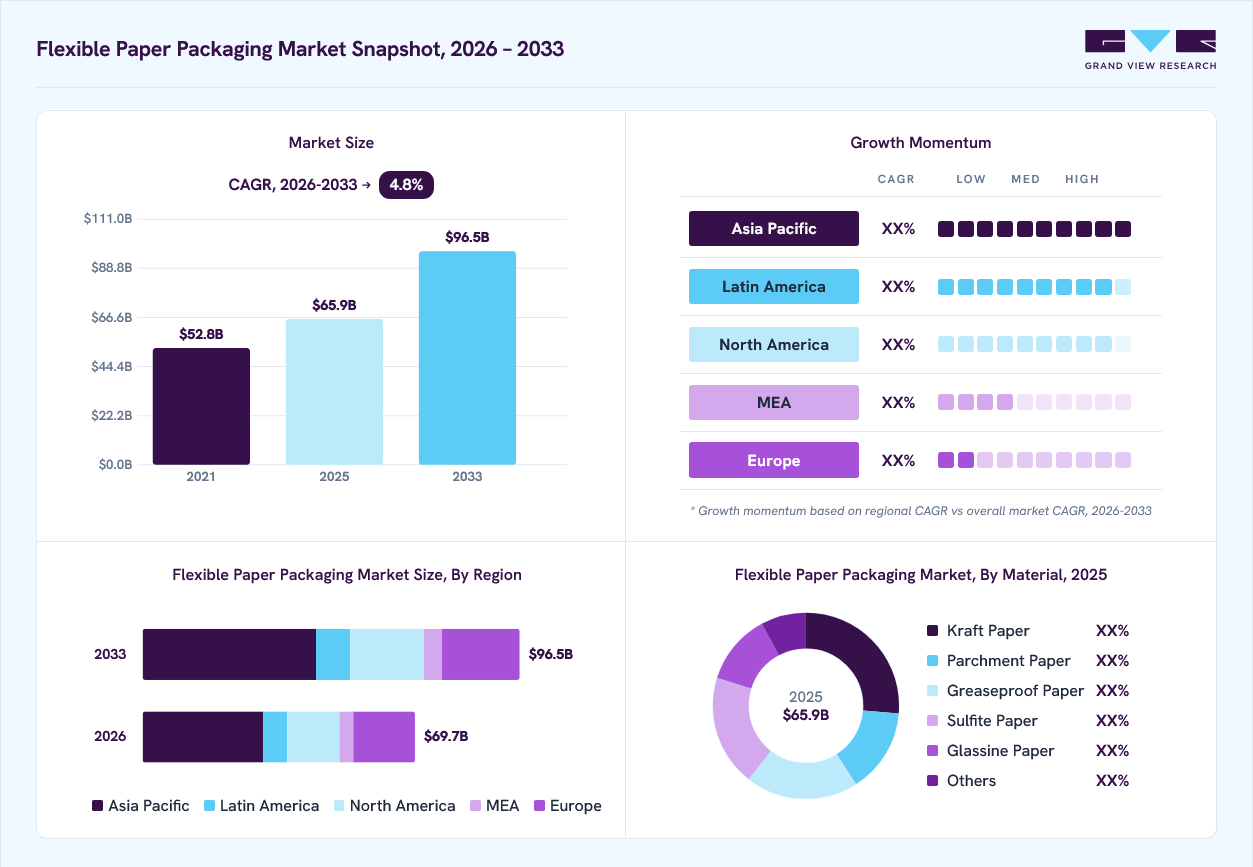
The global flexible paper packaging market size was estimated at USD 65.9 billion in 2025 and is projected to reach USD 96.5 billion by 2033, growing at a CAGR of 4.8% from 2026 to 2033. The flexible paper packaging industry is primarily driven by increasing consumer and regulatory demand for sustainable, recyclable, and plastic-free packaging solutions across food, beverage, personal care, and e-commerce sectors.
Key Market Trends & Insights
- Asia Pacific led the flexible paper packaging market in 2025, accounting for the largest revenue share of 44.0%.
- Based on material, the greaseproof paper segment is anticipated to expand at a CAGR of 5.2% from 2026 to 2033 in revenue terms.
- Based on product, the rollstocks segment is forecast to grow at a CAGR of 5.1% from 2026 to 2033 in terms of revenue.
- By application, the pharmaceutical segment is expected to witness a CAGR of 5.2% from 2026 to 2033 in revenue terms.
Market Size & Forecast
- 2025 Market Size: USD 65.9 Billion
- 2033 Projected Market Size: USD 96.5 Billion
- CAGR (2026-2033): 4.8%
- Asia Pacific: Largest Market in 2025
The flexible paper packaging industry is driven by the global shift toward sustainable and circular packaging solutions. Governments, brand owners, and consumers are increasingly prioritizing recyclable, biodegradable, and plastic-reduction Products, encouraging the replacement of conventional plastic pouches and wraps with paper-based flexible alternatives. Regulatory restrictions on single-use plastics across regions such as Europe and North America, along with corporate sustainability commitments from food, beverage, and consumer goods companies, are accelerating demand for renewable fiber-based packaging materials. Advancements in barrier coatings and paper-converting technologies are also enabling flexible paper packaging to deliver improved moisture, grease, and oxygen resistance, making it suitable for a wider range of applications.
Rapid growth in the food & beverage, e-commerce, and personal care industries is further supporting market expansion. Flexible paper packaging offers advantages such as lightweight structure, lower transportation costs, high printability, and ease of customization, making it attractive for packaged foods, snacks, bakery products, dry goods, and takeaway applications. The rise of online retail and direct-to-consumer delivery models has increased the need for protective yet sustainable secondary packaging solutions, including paper mailers, pouches, and wraps. In addition, changing consumer preferences toward convenience packaging and environmentally responsible products are encouraging manufacturers to adopt flexible paper formats that combine functionality with sustainability branding.
Technological innovation and investments in sustainable packaging infrastructure are also contributing significantly to industry growth. Packaging manufacturers are developing high-performance recyclable paper laminates, mono-material paper structures, and compostable flexible packaging solutions to meet evolving regulatory and consumer requirements. Improvements in digital printing and lightweight packaging design are helping companies enhance shelf appeal while reducing material usage and carbon emissions. Furthermore, increasing investments by major packaging companies in fiber-based packaging production capacity, particularly in emerging economies across the Asia Pacific and Latin America, are strengthening supply chains and expanding the commercial adoption of flexible paper packaging across multiple end-use sectors.
Market Dynamics
Growing environmental concerns and stricter regulations on single-use plastics are significantly boosting demand for flexible paper packaging solutions worldwide. Brand owners across food & beverages, personal care, e-commerce, and retail industries are increasingly shifting toward recyclable and renewable packaging materials to meet sustainability commitments and consumer expectations. Flexible paper packaging has emerged as an attractive alternative due to its biodegradability, recyclability, lightweight structure, and lower environmental impact compared to conventional plastic packaging. As governments continue implementing policies aimed at reducing plastic waste, manufacturers are expanding investments in paper-based packaging technologies and sustainable material innovation.
At the same time, changing consumer purchasing behavior is encouraging companies to adopt eco-friendly packaging formats that enhance brand image and improve product appeal. Consumers are becoming more conscious of packaging waste and actively preferring products packaged in recyclable or fiber-based materials. This trend is driving demand for paper pouches, wraps, sachets, and flexible paper laminates across various consumer applications. In addition, advancements in barrier coating technologies, sealability improvements, and lightweight paper engineering are enabling flexible paper packaging to offer better product protection, printability, and shelf performance. The rapid growth of online retail and food delivery services is further contributing to market expansion by increasing demand for lightweight and sustainable shipping-friendly packaging solutions.
Despite strong sustainability advantages, flexible paper packaging still faces limitations in applications requiring superior moisture resistance, oxygen barriers, grease protection, and extended shelf life. Certain industries, particularly pharmaceuticals, frozen foods, and liquid packaging, continue to rely heavily on plastic-based or multilayer packaging structures because paper materials may not consistently deliver the required protective performance under demanding storage and transportation conditions. These functional limitations can restrict the wider adoption of flexible paper packaging across high-performance packaging segments.
Maintaining strong packaging performance while improving recyclability remains one of the biggest challenges for the flexible paper packaging industry. Customers increasingly demand sustainable packaging formats that can provide durability, heat sealability, moisture protection, and visual appeal while remaining fully recyclable or compostable. Developing paper-based packaging solutions that meet these expectations without depending heavily on plastic coatings or non-recyclable layers continues to require significant material innovation and technical development.
Market Concentration & Characteristics
The flexible paper packaging industry is characterized by strong sustainability orientation, high material innovation, and growing regulatory influence. The industry is increasingly focused on developing recyclable, biodegradable, and renewable packaging solutions as governments and consumers push for reduced plastic consumption. Manufacturers continuously invest in advanced barrier coatings, lightweight paper structures, and fiber-based laminates to improve product protection while maintaining environmental compliance. Regulatory standards related to food safety, recyclability, and packaging waste management play a significant role in shaping product development and market competitiveness.
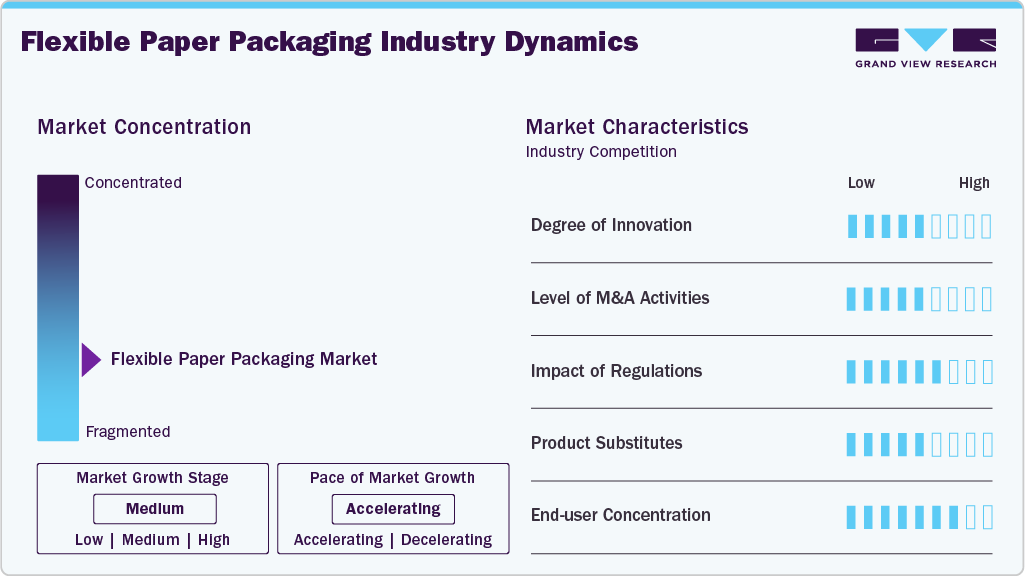
Moreover, a key characteristic of the industry is its close dependence on raw material availability and fluctuations in pulp and paper prices. Supply chain efficiency, access to certified sustainable paper sources, and production scalability significantly impact profitability. The industry also exhibits high demand variability linked to consumer goods consumption patterns, retail trends, and e-commerce growth. Additionally, technological advancements in digital printing, flexible converting equipment, and high-speed packaging machinery are enabling faster production cycles, enhanced product aesthetics, and greater packaging customization, supporting the industry’s transition toward premium and sustainable packaging solutions.
Material Insights
The kraft paper segment dominated the flexible paper packaging market in 2025 with a 26.3% revenue share due to its high strength, durability, and excellent printability, making it suitable for food, retail, industrial, and e-commerce packaging applications. Its recyclable and biodegradable nature aligns with increasing global demand for sustainable packaging alternatives and regulatory restrictions on plastic packaging. Additionally, cost-effectiveness, wide raw material availability, and growing adoption of paper-based bags, pouches, and wraps by consumer goods manufacturers further supported the segment’s market leadership.
The greaseproof paper segment is emerging as a growing material segment in the flexible paper packaging market due to increasing demand for oil and moisture-resistant sustainable packaging solutions in the food & beverage industry. It is widely used for bakery products, fast food, confectionery, and takeaway packaging because it prevents grease penetration while maintaining product freshness and hygiene. Rising consumer preference for eco-friendly food packaging, combined with the expansion of quick-service restaurants, online food delivery, and premium bakery products, is further accelerating the adoption of greaseproof paper packaging globally.
Product Insights
The pouches segment accounted for 59.0% of the market share in 2025, driven by its lightweight structure, convenience, and strong demand across food, beverage, personal care, and household product packaging applications. Paper-based pouches offer advantages such as easy storage, resealability, high printability, and reduced transportation costs, making them highly preferred by manufacturers and retailers. Additionally, the growing shift toward sustainable stand-up and flat-bottom pouches as alternatives to plastic flexible packaging significantly contributed to the segment’s market dominance.
The rollstocks segment is expected to witness significant growth in the flexible paper packaging market due to its high efficiency in automated packaging operations and increasing adoption in large-scale food and consumer goods manufacturing. Rollstock paper materials enable faster filling, sealing, and form-fill-seal processing, helping manufacturers reduce packaging costs and improve production speed. The rising demand for sustainable, high-volume packaging solutions for snacks, frozen foods, confectionery, and dry products is further driving the adoption of paper-based rollstocks globally.
Application Insights
The food segment dominated the flexible paper packaging market in 2025, accounting for 32.6% of total market share, due to the rising demand for sustainable and convenient packaging solutions for snacks, bakery products, frozen foods, confectionery, and ready-to-eat meals. Flexible paper packaging offers strong printability, lightweight handling, and improved shelf appeal, while supporting growing consumer preference for recyclable, plastic-free food packaging. Additionally, expanding food delivery services, increasing packaged food consumption, and stricter regulations on single-use plastics further accelerated the adoption of paper-based flexible packaging in the food industry.
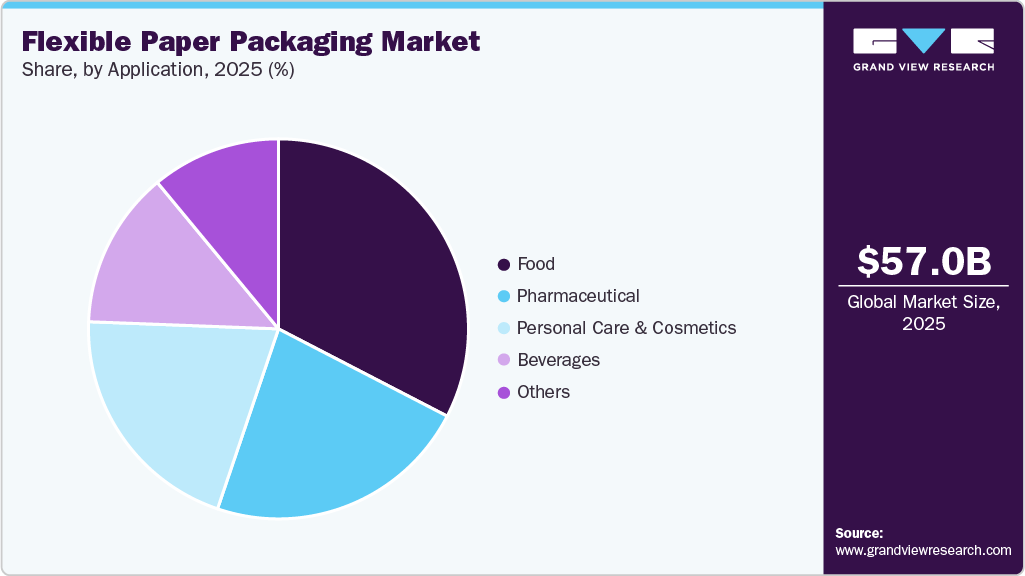
The pharmaceutical segment is emerging as a growing application segment in the flexible paper packaging market due to increasing demand for sustainable and lightweight packaging solutions for medical products, over-the-counter drugs, and healthcare supplies. Flexible paper packaging is adopted for sachets, pouches, wraps, and secondary packaging applications due to its printability, cost efficiency, and compatibility with eco-friendly packaging initiatives. Rising pharmaceutical production, stricter sustainability targets, and growing consumer preference for recyclable healthcare packaging are further driving the segment’s global expansion.
Regional Insights
The Asia Pacific flexible paper packaging industry dominated the global market in 2025 due to rapid growth in the food & beverage, e-commerce, personal care, and pharmaceutical industries across countries such as China, India, Japan, and South Korea. Rising urbanization, an expanding middle-class population, and increasing consumer preference for sustainable, convenient packaging solutions significantly boosted demand for paper-based flexible packaging products. Besides, strong manufacturing capabilities, abundant raw material availability, growing investments in sustainable packaging technologies, and tightening regulations on plastic packaging further strengthened the region’s market leadership.

China Flexible Paper Packaging Market Trends
The flexible paper packaging industry in China led the Asia Pacific market due to its massive food processing, e-commerce, pharmaceutical, and consumer goods manufacturing base, which generates strong demand for sustainable and cost-effective packaging solutions. The country’s rapid shift toward environmentally friendly packaging, supported by government restrictions on plastic waste and growing investments by companies such as Nine Dragons Paper, Lee & Man Paper, and APP China, has accelerated the adoption of flexible paper packaging products. Additionally, expanding online retail, rising packaged food consumption, and strong domestic production capabilities continue to strengthen China’s dominance in the regional market.
North America Flexible Paper Packaging Market Trends
Theflexible paper packaging industry in North America is witnessing strong growth in the market due to increasing demand for sustainable packaging solutions across the food & beverage, healthcare, personal care, and e-commerce sectors. Strict regulations on single-use plastics, rising consumer awareness regarding recyclable packaging, and corporate sustainability commitments are encouraging companies such as International Paper, Smurfit Westrock, Packaging Corporation of America, and ProAmpac to expand their fiber-based flexible packaging portfolios. Additionally, advanced packaging technologies, strong retail infrastructure, and growing adoption of paper-based pouches and mailers in e-commerce applications are supporting regional market expansion.
Theflexible paper packaging industry in the U.S. dominated the North American market due to high consumption of packaged food, strong e-commerce activity, and increasing adoption of sustainable packaging solutions across consumer goods industries. Rising corporate sustainability commitments and consumer preference for recyclable packaging have encouraged major end-user brands such as Amazon, Walmart, PepsiCo, and Procter & Gamble to increase the use of paper-based flexible packaging formats. Additionally, stringent EPR regulations, plastic reduction policies, and recyclability mandates are accelerating the transition from plastic to paper-based flexible packaging across the U.S. and other major markets.
Europe Flexible Paper Packaging Market Trends
Theflexible paper packaging industry in Europe is a major market due to strong sustainability regulations, high consumer awareness regarding eco-friendly packaging, and the rapid adoption of circular economy practices across the region. Strict policies aimed at reducing single-use plastics and improving packaging recyclability are encouraging leading consumer brands such as Nestle, Unilever, L'Oreal, and Aldi to increase the use of paper-based pouches, wraps, and flexible packaging formats. Besides, strong food processing industries, growing demand for sustainable retail packaging, and continuous innovation in recyclable barrier paper technologies are supporting the expansion of the flexible paper packaging market across Europe.
Key Flexible Paper Packaging Company Insights
The flexible paper packaging market is highly competitive and moderately fragmented, with global packaging companies, regional converters, and sustainable packaging startups competing based on material innovation, sustainability performance, pricing, and customization capabilities. Major companies are focusing on developing recyclable barrier papers, lightweight packaging structures, and plastic-free flexible packaging solutions to strengthen their market position and meet evolving regulatory requirements.
Strategic partnerships with food, beverage, personal care, e-commerce, and pharmaceutical brands, along with mergers, acquisitions, and investments in advanced converting and digital printing technologies, are common competitive strategies across the industry. In addition, increasing consumer demand for eco-friendly packaging and tightening regulations on plastic waste are encouraging continuous innovation and expansion of production capacities, particularly in the Asia Pacific, Europe, and North America.
-
In May 2026, UPM Specialty Papers, Michelman, and BOBST collaborated to develop recyclable and SUPD-compliant paper-based food packaging solutions with enhanced moisture, oil, and oxygen barrier properties. The solutions help brands replace plastic packaging with sustainable paper alternatives for products such as tea bags, sugar sachets, cookies, and chocolates while maintaining heat-sealability and production efficiency.
-
In April 2026, Mondi expanded its U.S. presence by opening an advanced paper bags production facility in Pittsburgh, Pennsylvania, to address rising demand from e-commerce and industrial sectors. The automated plant enhances production efficiency, supports innovative paper mailer bag manufacturing, and is expected to reach an annual capacity of 300 million paper bags.
Key Flexible Paper Packaging Companies:
The following key companies have been profiled for this study on the flexible paper packaging market.
- Amcor plc
- Pregis LLC
- ProAmpac
- Mondi
- Stora Enso
- International Paper
- Smurfit Westrock
- DS Smith
- Packaging Corporation of America
- Georgia-Pacific
- Nippon Paper Industries Co., Ltd.
- Huhtamaki
- CarePac
Competitive Benchmarking
Operating Strategies
Competitive Edge
Weakness
Mature Players: Amcor plc, Mondi, International Paper, Smurfit Westrock, DS Smith
- Mature companies are focusing on expanding recyclable and fiber-based flexible packaging portfolios across food, beverages, retail, and consumer goods sectors.
- Significant investments are being made in barrier paper technologies, lightweight packaging solutions, and plastic-reduction initiatives.
- Established players benefit from strong paper sourcing capabilities, advanced R&D infrastructure, and extensive manufacturing networks.
- Large-scale production capacity and diversified sustainable packaging portfolios strengthen their global market presence.
- Large operational structures can increase fixed costs and reduce agility in responding to rapidly evolving packaging trends.
- High investment requirements for advanced barrier coatings and recyclable packaging technologies may pressure profit margins.
Emerging Players: Pregis LLC, ProAmpac, Nippon Paper Industries Co., Ltd., Huhtamaki, CarePac
- Emerging companies focus on innovative paper-based flexible packaging, customized sustainable packaging solutions, and niche application development.
- Many players are investing in compostable packaging, specialty coatings, and lightweight flexible paper formats to strengthen sustainability positioning.
- Emerging players are generally more agile in adopting sustainable packaging technologies and responding to changing customer preferences.
- Specialized expertise in eco-friendly packaging formats and flexible manufacturing capabilities supports strong product differentiation.
- Limited global manufacturing presence and smaller production scale may reduce competitiveness against larger multinational companies.
- Rising pulp prices, sustainability compliance costs, and technology investment requirements can create operational and profitability challenges.
Flexible Paper Packaging Market Report Scope
Report Attribute
Details
Market size value in 2026
USD 69.7 billion
Revenue forecast in 2033
USD 96.5 billion
Growth Rate
CAGR of 4.8% from 2026 to 2033
Base year for estimation
2025
Historical data
2021 - 2024
Forecast period
2026 - 2033
Quantitative units
Revenue in USD million/billion, volume in kilotons, and CAGR from 2026 to 2033
Report coverage
Revenue forecast, volume forecast, company ranking, competitive landscape, growth factors, and trends
Segments covered
Material, product, application, region
Regional Scope
North America; Europe; Asia Pacific; Latin America;Middle East & Africa
Country Scope
U.S.; Canada; Mexico; Germany; France; UK; Italy; Spain; China; India; Japan; South Korea; Australia; Brazil; Argentina; Saudi Arabia; UAE; South Africa
Key companies profiled
Amcor plc; Pregis LLC; ProAmpac; Mondi; Stora Enso; International Paper; Smurfit Westrock; DS Smith; Packaging Corporation of America; Georgia-Pacific; Nippon Paper Industries Co., Ltd.; Huhtamaki; CarePac
Customization scope
Free report customization (equivalent up to 8 analysts working days) with purchase. Addition or alteration to country, regional & segment scope.
Pricing and purchase options
Avail of customized purchase options to meet your exact research needs. Explore purchase options
Global Flexible Paper Packaging Market Report Segmentation
This report forecasts revenue growth at the regional, and country levels and provides an analysis on the latest industry trends and opportunities in each of the sub-segments from 2021 to 2033. For this study, Grand View Research has segmented the global flexible paper packaging market report on the basis of material, product, application, and region:

-
Material Outlook (Volume, Kilotons; Revenue, USD Million, 2021 - 2033)
-
Kraft Paper
-
Sulfite Paper
-
Greaseproof Paper
-
Parchment Paper
-
Glassine Paper
-
Others
-
-
Product Outlook (Volume, Kilotons; Revenue, USD Million, 2021 - 2033)
-
Pouches
-
Rollstocks
-
Shrink Sleeves
-
Wraps
-
Others
-
-
Application Outlook (Volume, Kilotons; Revenue, USD Million, 2021 - 2033)
-
Food
-
Pharmaceutical
-
Personal Care & Cosmetics
-
Beverages
-
Others
-
-
Regional Outlook (Volume, Kilotons; Revenue, USD Million, 2021 - 2033)
-
North America
-
U.S.
-
Canada
-
Mexico
-
-
Europe
-
Germany
-
France
-
UK
-
Italy
-
Spain
-
-
Asia Pacific
-
China
-
India
-
Japan
-
South Korea
-
Australia
-
-
Latin America
-
Brazil
-
Argentina
-
-
Middle East & Africa
-
Saudi Arabia
-
UAE
-
South Africa
-
-
Delivered Customizations
This report has been delivered with the following In-depth customizations
Client Request
Customization Delivered
Value Adds
Regional Segmentation
Comprehensive assessment of the global flexible paper packaging market across North America, Europe, Asia Pacific, Latin America, and Middle East & Africa, including country-level sustainability trends, paper packaging consumption, retail demand patterns, manufacturing activity, recycling infrastructure, and environmental regulations.
Help identify high-growth regional markets, emerging production hubs, and region-specific packaging opportunities. Support strategic expansion planning through evaluation of sustainability policies, consumer preferences, and competitive market conditions.
Cross-Segmentation
Detailed segmentation analysis by material type, product format, packaging structure, end-use industry, application, and distribution channel, including both value and volume evaluation across major countries and regions. The study further examines recyclable paper packaging demand, barrier paper technologies, and flexible packaging innovation trends.
Enable identification of high-potential product categories and fast-growing application segments. Support product development strategies, portfolio optimization, and investment prioritization by understanding evolving customer and industry requirements.
Trade Assessment
In-depth analysis of global trade activity, pulp and specialty paper supply dynamics, import-export trends, tariff impacts, sustainability regulations, and regional sourcing dependencies affecting the flexible paper packaging industry. The assessment also includes logistics trends, raw material procurement challenges, and manufacturing shifts across global markets.
Support informed sourcing and supply chain planning by identifying procurement risks, key supplier regions, and trade opportunities. Help strengthen operational resilience, supplier diversification strategies, and long-term international expansion planning.
Frequently Asked Questions About This Report
The food segment led the flexible paper packaging market in 2025 due to rising demand for sustainable, lightweight, and convenient packaging solutions for snacks, bakery products, ready-to-eat meals, and takeaway food applications.
The key players in the flexible paper packaging market include Amcor plc; Pregis LLC; ProAmpac; Mondi; Stora Enso; International Paper; Smurfit Westrock; DS Smith; Packaging Corporation of America; Georgia-Pacific; Nippon Paper Industries Co., Ltd.; Huhtamaki; and CarePac.
Growth in online retail, rising preference for lightweight and cost-effective packaging, and advancements in barrier coating technologies are accelerating the adoption of flexible paper packaging globally.
The global flexible paper packaging market was estimated at around USD 57.0 billion in the year 2025 and is expected to reach around USD 60.3 billion in 2026.
The global flexible paper packaging market is expected to grow at a compound annual growth rate of 4.8% from 2026 to 2033 to reach around USD 83.5 billion by 2033.
About the Author(s)
Plastics, Polymers & Resins Research Team
Bulk Chemicals · Plastics, Polymers & ResinsThis report was authored by the plastics, polymers & resins research team at Grand View Research - comprising two research analysts, one senior research analyst, and one industry expert - with specialized expertise in the plastics, polymers & resins segment of the bulk chemicals industry. All findings are based on proprietary bulk chemicals databases, executive interviews, and regulatory analysis, subject to internal peer review prior to publication.
Last Updated:
Speak to Analyst


Customize this report to your needs — add regions, segments, or data points, with 20% free customization.
Or view our licence options:


ISO 9001:2015 & 27001:2022 Certified
We are GDPR and CCPA compliant! Your transaction & personal information is safe and secure. For more details, please read our privacy policy.


