
- Home
- »
- Distribution & Utilities
- »
-
Floating Power Plant Market Size And Share Report, 2033GVR Report cover

Floating Power Plant Market (2026 - 2033)
Size, Share & Trends Analysis Report By Power Source (Non-renewable, Renewable), By Power Rating (Low, Medium, High), By Region (North America, Europe, Asia Pacific), And Segment Forecasts
Market Size, 2025
$1.7BMarket Estimate, 2026
$1.9BMarket Forecast, 2033
$5.2BCAGR, 2026–2033
15.7%Floating Power Plant Market Summary
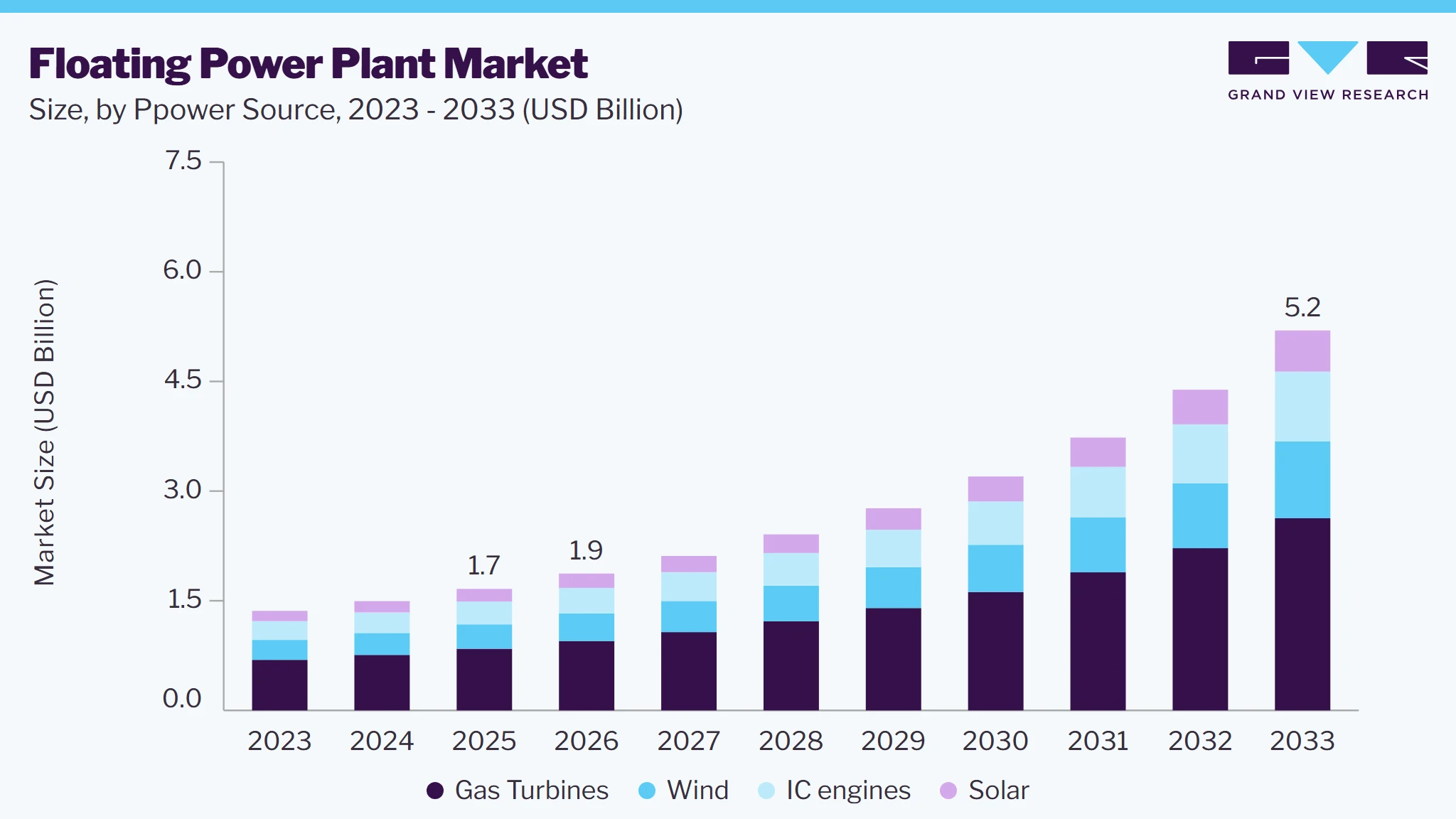
The global floating power plant market size was valued at USD 1.7 billion in 2025 and is projected to grow from USD 1.9 billion in 2026 to USD 5.2 billion by 2033, at a CAGR of 15.7% from 2026 to 2033. Asia Pacific dominated the market, accounting for a revenue share of 41.3% in 2025. The increasing pace of clean energy requirements among end-use sectors, coupled with a lack of optimal power infrastructure across several emerging and underdeveloped nations, are factors leading to the expansion of this industry.
 Source: Grand View Research, IR Documents, Primary Interviews, Paid DatabasesTo learn more about this report,
 Download Free Sample Report
Key Market Trends & Insights
- By power source: Non-renewable segment led the market with the largest revenue share of 69.5% in 2025.
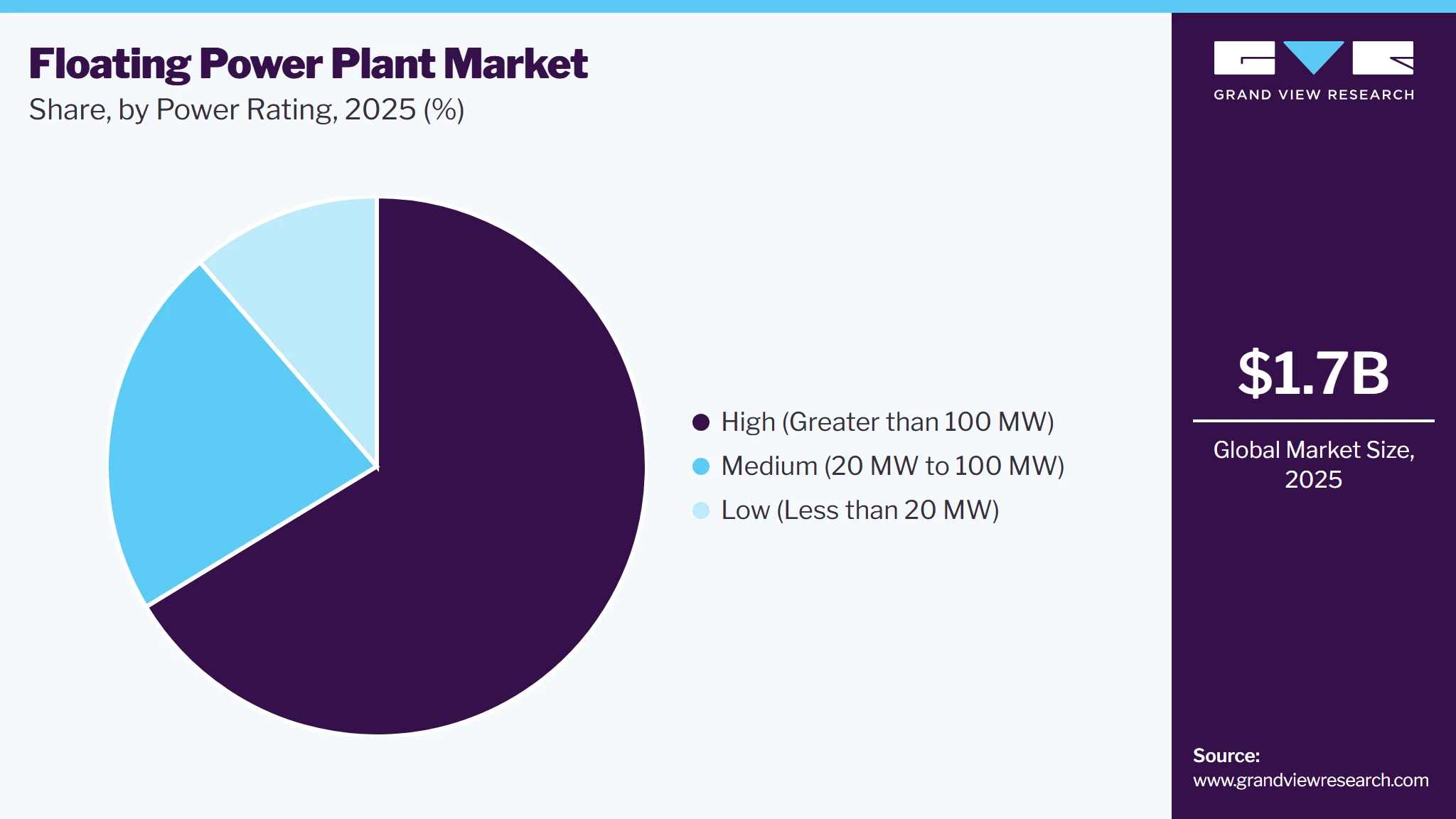
- By power rating: High (greater than 100 MW) segment led the market with the largest revenue share of 66.3% in 2025.
Regional Highlights
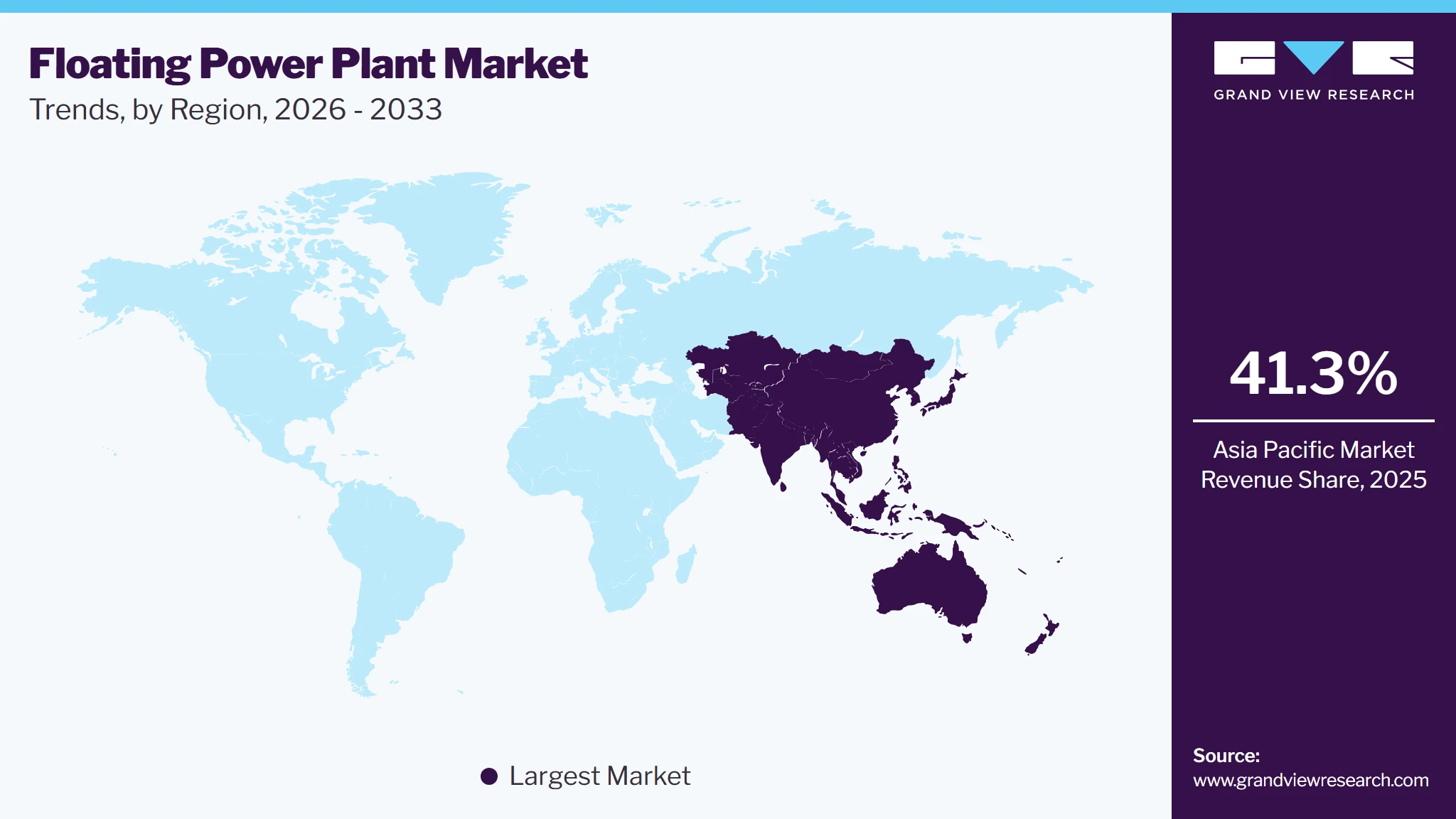
- Largest regional market: Asia Pacific (41.3% revenue share, 2025)
- By country: China held the largest market share in 2025.
Market Size & Forecast
- Market size in 2025: USD 1.7 Billion
- Estimated market size in 2026: USD 1.9 Billion
- Projected market size by 2033: USD 5.2 Billion
- CAGR (2026-2033): 15.7%
Prism AI by Grand View Research Free to tryAsk a question about the floating power plant marketTry asking✓Every figure cited from GVR research Prefer the report? Download free sample →Floating power plants have emerged as an innovative solution to meet electricity demand, especially in areas where traditional land-based facilities face logistical, environmental, or regulatory challenges. These plants function as a distributed power source with high stability and efficiency, efficiently responding to steep load fluctuations and offering quick start-up.
 To learn more about this report, Download Free Sample Report
Floating power plants (FPPs) present an effective and rapid mode of electricity supply to regions with limited power infrastructure, driving their appeal. Moreover, they offer other notable advantages, such as high mobility that ensures easy relocation, efficient sizing that does not require a large site, and providing a secure power supply during natural disasters. Stringent government regulations regarding environmental protection are expected to boost the deployment of FPPs across several regions. Compared to conventional land-based systems, these facilities have a minimal environmental impact as only a small coastal or up-river land area is required to set up their operations. They are thus considered a suitable solution for addressing energy demands in sensitive or ecologically rich locations. The steadily increasing usage of renewable energy as a reliable source of power generation in floating power plants is expected to ensure sustained expansion of this market in the coming years.
Floating power plants can enhance grid reliability by providing power closer to where it is needed. They can be integrated into local energy systems or act as independent power sources during grid disruption, improving energy security. Additionally, floating power plants can be used in offshore oil and gas fields to provide energy for extraction operations. This helps in reducing the need for long-distance energy transmission and supports energy independence. Advances in marine technology, including more efficient and durable floating platforms, have made deploying floating power plants increasingly feasible and cost-effective. Companies in this market aim to expand their operations through partnerships and funding initiatives. Favorable regulations and increasing government investments in clean energy projects are accelerating the adoption of FPPs. Authorities are promoting the use of clean fuels for power generation, which aligns with global efforts to combat climate change. These factors are expected to positively shape the growth of the floating power plant industry.
Market Dynamics
The floating power plant market is witnessing growth, driven by increasing demand for flexible and rapidly deployable power generation solutions in regions facing electricity shortages and limited land availability. Rising investments in offshore renewable energy, particularly floating solar and floating wind projects, are further supporting market expansion. Governments and utilities are also adopting floating power plants to improve energy access for remote islands, coastal communities, and disaster-affected areas. However, high installation costs, complex marine operations, and environmental permitting requirements continue to present challenges for widespread deployment.
The market is primarily driven by the growing need to provide reliable electricity to remote islands, coastal regions, and underserved communities where building conventional power plants is costly and time-consuming. Floating power plants offer a fast, flexible, and scalable solution that can be deployed near demand centers without requiring extensive land acquisition or transmission infrastructure. Their ability to supply continuous power makes them particularly valuable for island nations, emergency power needs, and regions with weak or unreliable grids. As governments focus on improving energy access and resilience, floating power plants are gaining wider adoption.
In August 2025, Karpowership signed an agreement with Iraq's Ministry of Electricity and the General Company for Electric Energy Production / Southern to deploy two Powerships with a combined installed capacity of 590 MW. By January 2026, one Powership remained operational, supplying 290 MW to Iraq's national grid. The company continues to meet approximately 3.5% of Iraq's total electricity demand, demonstrating how floating power plants provide rapid, reliable, and cost-effective power solutions to strengthen energy security in regions with infrastructure constraints.
The market faces a major restraint due to the high upfront investment required for deployment and installation. Unlike conventional land-based power plants, floating facilities require specialized marine engineering, offshore anchoring systems, subsea transmission cables, and floating platforms that significantly increase project costs. Ongoing maintenance in harsh marine environments and compliance with maritime regulations add to operational expenses. These high capital requirements can delay project approvals and limit adoption, particularly in cost-sensitive and developing markets.
The growing deployment of offshore wind farms and floating solar projects is creating strong opportunities for the floating power plant market. Floating power plants can provide reliable electricity in coastal and island regions where land availability is limited and grid connectivity is weak. They can also be integrated with renewable energy systems to deliver stable power by combining renewable generation with flexible backup capacity or energy storage. As countries invest in offshore renewable energy and clean electricity infrastructure, demand for floating power plants that support renewable integration and improve energy security is expected to increase.
Analyst Perspective
The floating power plant market is growing as countries look for faster and more flexible ways to generate electricity. Demand is increasing in regions with limited land, weak grid infrastructure, and rising power needs. Floating solar and offshore wind projects are creating new growth opportunities for the market. Although high installation costs remain a challenge, continued technology improvements and government support are expected to increase adoption over the coming years. An emerging trend is the increasing development of hybrid floating power plants that combine renewable energy with conventional power systems to improve reliability.
Power Source Insights
Based on power source, the non-renewable segment led the market with the largest revenue share of 69.5% in 2025. This type of power source, comprising gas turbines and internal combustion (IC) engines, has witnessed high demand owing to the benefits offered, such as high power density, reliability, and low operating costs. Gas turbines can efficiently convert fuel into electricity while providing fast response times and flexibility in operations. Combined-cycle gas turbine systems achieve high thermal efficiency by utilizing waste heat to generate additional electricity. Meanwhile, the use of IC engines as a power source provides a high degree of operational flexibility. These plants can quickly start up, shut down, or adjust their output based on changing demand, making them suitable for areas with fluctuating energy requirements.
On the other hand, the renewable source segment is expected to grow at the highest CAGR in the market from 2025 to 2030. Implementing favorable environmental policies that support using clean fuels for power generation has helped drive segment appeal. Solar, wind, and wave energy are the three most widely used renewable sources for power generation on floating power plants. Floating wind farms can be deployed in deeper waters, where wind speeds tend to be more consistent and powerful. This leads to higher energy production compared to conventional fixed-bottom turbines. The large land area required for setting up solar sites has compelled energy firms and governments to explore other locations, which has driven developments in the floating power plant industry. By placing solar panels on reservoirs or lakes used for hydroelectric plants, floating solar systems can complement hydropower by generating additional electricity without taking up more land.
Power Rating Insights
Based on power rating, the high (greater than 100 MW) segment led the market with the largest revenue share of 66.3% in 2025 owing to the large-scale power demand in various South Asian nations such as India, China, Malaysia, and Singapore. Continued population expansion in emerging economies, urbanization, and rapid infrastructural developments in verticals such as healthcare, manufacturing, and construction are likely to boost market growth through this segment. Floating power plants often supply electricity to offshore oil and gas platforms. As the energy demands for these operations continue to grow, FPPs with capacities of over 100 MW are becoming very common, especially in regions where traditional grid infrastructure cannot be implemented.
 To learn more about this report, Download Free Sample Report
The medium (20 MW to 100 MW) segment is expected to grow at the highest CAGR during the forecast period. These mid-scale floating power plants offer a flexible and scalable solution for energy generation in regions where large-scale power plants may not be feasible due to land availability, environmental concerns, or economic constraints. They can be deployed in modular units, with the ability to increase capacity by adding more units as demand grows. This makes them ideal for regions where energy demand is expected to rise gradually but needs to be met with scalable solutions. Establishing several projects in this segment is expected to aid the expansion of the floating power plant industry. For instance, in September 2023, Zonal Renewables Corporation and A.M. Hijos Incorporation signed an agreement to develop a 100 MW floating solar power plant in Cadiz City, Philippines. The facility would be located on a 90-hectare pond in northern Negros Occidental and strengthen the country’s clean energy initiatives.
Regional Insights
Asia Pacific dominated the floating power plant market with the largest revenue share of 41.3% in 2025. The industry expansion in this region has been enabled by a number of factors, including rising energy needs, environmental concerns, and technological advancements. Economies such as India, Japan, and China are witnessing increased energy demands due to industrialization, urbanization, and rising populations. Floating power plants offer a scalable solution to meet these requirements in areas where land is scarce or difficult to develop for conventional power plants. Moreover, various countries are looking for ways to improve energy security, which floating power plants can address, as they offer a decentralized and resilient energy source.
 To learn more about this report, Download Free Sample Report
China Floating Power Plant Market Trends
The floating power plant market in China held the largest share in the Asia Pacific region in 2025. The economy has been a significant player in developing floating solar power plants and is investing heavily in renewable energy technologies. Additionally, China’s steadily growing energy demand and commitment to reducing carbon emissions make floating power plants attractive for power generation. In December 2024, CHN Energy, the state-owned energy and mining company, started operations on the 1-gigawatt floating solar power plant that would connect it to the grid in the Shandong province. The project occupies a total of 1,223 hectares and is expected to generate 1.78 terawatt-hours of electricity annually. Thus, the country’s continued focus on building large-scale projects is expected to aid market expansion.
North America Floating Power Plant Market Trends
North America floating power plant market accounted for a substantial revenue share in the global market in 2024. The demand for FPPs has gradually increased in regional economies such as the U.S. and Canada, driven by the need for sustainable energy solutions, innovations in renewable technologies, and a shift towards cleaner energy sources. These countries are noted for their vast coastlines, especially along the East and West Coasts, which offer significant potential for floating offshore wind power. Furthermore, favorable government policies and funding initiatives are helping accelerate the deployment of clean energy technologies, including floating power plants.
The U.S. floating power plant market accounted for the largest revenue share in the regional market in 2024. The U.S. government has been actively promoting offshore wind development as part of its clean energy strategy, which is anticipated to create growth opportunities for energy companies. In July 2024, the Department of the Interior approved the ‘Atlantic Shores South’ project for offshore wind energy, the ninth commercial-scale project in the country. The Biden administration has set a goal to deploy 30 GW of offshore wind energy by 2030, and floating wind technology is key to achieving this target. Thus, the increasing implementation of such initiatives is expected to boost industry expansion in the U.S.
Latin America Floating Power Plant Market Trends
Latin America is expected to grow at a substantial CAGR in the market during the forecast period. The region is experiencing rapid urbanization and economic growth, especially in countries such as Brazil, Argentina, and Chile. Floating power plants offer scalable and flexible solutions that can effectively meet rising energy requirements without needing significant land resources. FPPs, particularly floating solar and wind farms, provide an innovative solution to generate energy without competing with agricultural or residential land use, thus addressing limited land availability concerns. International companies and investors are increasingly looking to Latin America as a promising market for renewable energy projects, including developing floating power plants.
Brazil floating power plant market accounted for the largest revenue share in the Latin American market in 2024 and is anticipated to maintain its position in the coming years. The economy’s vast natural resources, including its extensive coastlines, large reservoirs, and commitment to sustainable energy, have created an ideal environment to establish floating power plants. Local and global organizations are increasingly investing in renewable energy projects in the economy to cater to the rising energy demand and expand their footprint. In January 2024, the first phase of the UFF Araucária project, stated to be the biggest floating solar facility in the country, was unveiled in São Paulo. The facility, situated at the Billings dam and developed by KWP Energia and Empresa Metropolitana de Águas e Energia, can produce a maximum of 10 GWh annually, which equals the power consumption of 4,000 Brazilian households.
Key Floating Power Plant Company Insights
Some major companies involved in the global floating power plant industry include Wärtsilä, Floating Power Plant A/S, and Siemens Energy, among others.
-
Wärtsilä is a multinational company specializing in the manufacturing and servicing power sources and equipment for the marine and energy sectors. The company offers products and solutions in the energy segment, including energy storage, engine power plants, and hybrid power plants. The company also provides floating power plant solutions such as floating power barges, energy storage solutions (GridSolv Max), floating regasification units (FSRUs), and barge-mounted power plants.
-
Floating Power Plant A/S is a Danish clean technology company that develops innovative floating platforms for renewable energy generation. The company has developed a patented floating platform that combines wind and wave energy generation. This technology is designed to be offshore-proven, allowing it to deliver power to the grid efficiently.
Key Floating Power Plant Companies:
The following key companies have been profiled for this study on the floating power plant market.
-
Wärtsilä
-
Siemens Energy
-
Kawasaki Heavy Industries, Ltd.
-
MITSUBISHI HEAVY INDUSTRIES, LTD.
-
GE Vernova
-
Ciel et Terre International, SAS
-
Floating Power Plant A/S
-
Karadeniz Holding
-
CHN ENERGY Investment Group Co. LTD
-
Swimsol
Competitive Benchmarking
Category
Operating Strategies
Competitive Edge
Weakness
Established Players (Wärtsilä; Siemens Energy; Kawasaki Heavy Industries, Ltd.; MITSUBISHI HEAVY INDUSTRIES, LTD.; GE Vernova; Ciel et Terre International; Karadeniz Holding; CHN ENERGY Investment Group Co. LTD)
- Expand large-scale floating power plant deployments through partnerships with utilities, governments, and independent power producers.
- Invest in advanced floating power technologies, including gas turbine, hybrid, and offshore renewable power solutions.
- Strengthen engineering, procurement, and long-term operation & maintenance (O&M) capabilities to support large utility-scale projects.
- Strong global presence with proven experience in executing large-scale energy infrastructure projects.
- Diverse portfolio of power generation technologies serving both renewable and non-renewable floating power applications.
- obust financial resources, engineering expertise, and well-established global service networks.
- High capital requirements and longer project development timelines.
- Complex regulatory approvals and compliance requirements across different regions.
- Lower flexibility in addressing niche and small-scale floating power applications.
Emerging Players (Floating Power Plant A/S; Swimsol)
- Focus on developing innovative floating solar, wind, and hybrid power technologies for niche applications.
- Expand project pipelines through collaborations with local developers, utilities, and government agencies.
- Invest in modular floating platform designs to enable faster deployment and lower installation costs.
- Strong specialization in floating renewable energy technologies and platform design.
- Greater agility in adopting new technologies and responding to evolving customer requirements.
- Ability to deliver customized solutions for islands, reservoirs, and remote coastal regions.
- Limited manufacturing capacity and financial resources compared to established competitors.
- Smaller commercial project portfolio and lower global market presence.
- Dependence on strategic partnerships and external funding for large-scale project expansion.
Recent Developments
-
In June 2024, Floating Power Plant announced that it had received a 4.3 megawatt SWT-DD-120 Wind Turbine Generator from the Siemens Gamesa Renewable Energy company. This development enables the company to advance its flagship demonstrator project off the Gran Canaria coast in Spain. The generator performs a vital function of integrating wave and wind power, along with hydrogen storage technologies, as part of this initiative. The project had earlier received a grant of over USD 27 million from the European Union (EU) Innovation Fund, showcasing its importance in moving forward the clean energy objectives of the EU.
-
In February 2024, Ciel & Terre Taiwan, which develops floating solar PV products, along with HEXA Renewables, an Asian renewable energy company, announced the completion of a near-shore floating solar project in Taiwan. The project, located in Changhua County’s Changbin Industrial Park, has a capacity of around 440MWp, of which Ciel & Terre Taiwan accounts for 280MWp of floating photovoltaic (FPV). Ciel & Terre have also created the New Pillar anchoring solution, which minimizes the movement of the FPV in any condition.
Floating Power Plant Market Report Scope
Report Attribute
Details
Market Definition
The floating power plant market represents the revenue generated from the sale of floating power generation systems, including renewable and non-renewable power plants, across low, medium, and high power rating categories.
Market size in 2025
USD 1.7 billion
Estimated market size in 2026
USD 1.9 billion
Projected market size by 2033
USD 5.2 billion
Growth rate
CAGR of 15.7% from 2026 to 2033
Base year for estimation
2025
Historical data
2021 - 2024
Forecast period
2026 - 2033
Quantitative units
Revenue in USD Million and CAGR from 2026 to 2033
Report coverage
Revenue forecast, company ranking, competitive landscape, growth factors, and trends
Segments covered
Power source, power rating, region
Regional scope
North America, Europe, Asia Pacific, Latin America, Middle East & Africa
Country scope
U.S., Canada, Mexico, Germany, UK, France, Spain, China, Japan, India, Australia, Brazil, Argentina, Saudi Arabia, UAE
Key companies profiled
Wärtsilä, Siemens Energy, Kawasaki Heavy Industries, Ltd., MITSUBISHI HEAVY INDUSTRIES, LTD., GE Vernova, Ciel et Terre International, SAS, Floating Power Plant A/S, Karadeniz Holding, CHN ENERGY Investment Group Co. LTD, Swimsol
Customization scope
Free report customization (equivalent up to 8 analysts' working days) with purchase. Addition or alteration to country, regional & segment scope.
Pricing and purchase options
Avail customized purchase options to meet your exact research needs. Explore purchase options
Global Floating Power Plant Market Report Segmentation
This report forecasts revenue growth at the global, regional, and country levels and provides an analysis of the latest industry trends in each of the sub-segments from 2021 to 2033. For this study, Grand View Research has segmented the global floating power plant market report based on power source, power rating, and region:
 To learn more about this report, Download Free Sample Report
-
Power Source Outlook (Revenue, USD Million, 2021 - 2033)
-
Non-renewable
-
Gas Turbines
-
IC Engines
-
-
Renewable
-
Solar
-
Wind
-
-
-
Power Rating Outlook (Revenue, USD Million, 2021 - 2033)
-
Low (Less than 20 MW)
-
Medium (20 MW to 100 MW)
-
High (Greater than 100 MW)
-
-
Regional Outlook (Revenue, USD Million, 2021 - 2033)
-
North America
-
U.S.
-
Canada
-
Mexico
-
-
Europe
-
Germany
-
U.K.
-
France
-
Spain
-
-
Asia Pacific
-
China
-
India
-
Japan
-
Australia
-
-
Latin America
-
Brazil
-
Argentina
-
-
MEA
-
Saudi Arabia
-
UAE
-
-
Research Methodology
The floating power plant market figures in this report are based on a proven research process that combines executive interviews with secondary research from proprietary databases, company filings, and recognized regulatory and institutional sources. Market size is built through value-chain sizing - reconciling supply-side and demand-side estimates - and triangulated with bottom-up and top-down approaches. Every estimate passes multiple levels of expert validation before publication, with each floating power plant segment quantified using the revenue-capture definitions in the table below.
Segment Definition
Segment - Power Source
Revenue capture definition
Non-renewable
Non-renewable floating power plants utilize gas turbines or internal combustion engines to provide reliable electricity for grid support, industrial facilities, and emergency power applications. Revenue is generated from the sale of non-renewable floating power plants.
Renewable
Renewable floating power plants use solar or wind energy to generate clean electricity from floating platforms installed on water bodies or offshore locations. Revenue is generated from the sale of renewable floating power plants.
Segment - Power Rating
Revenue capture definition
Low (Less than 20 MW)
Low-capacity floating power plants are deployed for remote communities, islands, microgrids, and small industrial facilities requiring localized electricity generation. Revenue is generated from the sale of floating power plants with a capacity below 20 MW.
Medium (20 MW to 100 MW)
Medium-capacity floating power plants are used to supply electricity to utilities, commercial operations, and regional grids requiring moderate power generation. Revenue is generated from the sale of floating power plants with a capacity between 20 MW and 100 MW.
High (Greater than 100 MW)
High-capacity floating power plants are deployed for large-scale grid supply, national utilities, and regions with high electricity demand. Revenue is generated from the sale of floating power plants with a capacity greater than 100 MW.
Estimation Model
Layer Name
Key Question
Description
Power Generation Demand Layer
What forms the demand base for floating power plants?
Assess demand for floating power plants driven by rising electricity demand, limited land availability, remote and island electrification, grid reliability requirements, and offshore renewable energy deployment. Evaluate investments in temporary and emergency power generation, coastal infrastructure, energy security initiatives, and government support for floating energy solutions to determine the underlying demand for floating power plants.
Power Source Layer
Which power generation technologies are being adopted?
Analyze the adoption of non-renewable (gas turbines and IC engines) and renewable (solar and wind) floating power plants. Assess technology maturity, efficiency, deployment flexibility, fuel availability, operating costs, environmental performance, and project suitability to determine power source-wise market demand.
Power Rating Deployment Layer
Where are different floating power plant capacities being deployed?
Evaluate the deployment of low (<20 MW), medium (20-100 MW), and high (>100 MW) floating power plants across utilities, island communities, industrial facilities, offshore operations, and emergency power projects. Analyze project size, electricity demand, installation location, and end-user requirements to estimate power rating-wise market contribution.
Revenue Layer
How is market revenue generated?
Market revenue is quantified through the sale of floating power plants across different power sources and power rating categories. The overall market value is determined by floating power plant sales, installed generation capacity, technology type, project scale, system configuration, and pricing across utility, industrial, and offshore power generation projects.
Delivered Customizations
This report has been delivered with the following In-depth customizations
Client Request
Customization Delivered
Value Adds
Power Source Benchmarking Assessment
Compared gas turbine, IC engine, floating solar, and floating wind power plants based on installation cost, power generation efficiency, operating flexibility, and application suitability. Assessed the adoption of each power source across utility, industrial, island, and offshore power generation projects.
Helped identify the most suitable power source for different applications, understand technology-specific advantages, and support technology selection and investment decisions.
Regional Opportunity Assessment
Assessed floating power plant opportunities across major regions based on electricity demand, grid infrastructure, renewable energy investments, government initiatives, and deployment of offshore and island power projects. Compared regional growth potential and investment attractiveness across key countries.
Helped identify high-growth regional markets, prioritize expansion opportunities, and support market entry and investment strategies.
Competitive Landscape Assessment
Evaluated major floating power plant companies based on technology portfolio, power source focus, regional presence, project deployments, strategic partnerships, and recent business developments. Assessed competitive positioning across established and emerging market participants.
Helped benchmark key competitors, identify market leaders, understand competitive differentiation, and support strategic planning and partnership decisions.
Frequently Asked Questions About This Report
The floating power plant market size was estimated at USD 1.7 billion in 2025 and is expected to reach USD 1.9 billion in 2026.
The floating power plant market is expected to grow at a CAGR of 15.7% from 2026 to 2033 to reach USD 5.2 billion by 2033.
The Asia Pacific region dominated the floating power plant market with a revenue share of 41.3% in 2025.
The floating power plant market is primarily driven by the rising demand for rapid, flexible electricity generation in remote, coastal, and land-constrained regions, along with increasing investments in floating renewable energy projects.
The key players operating in the floating power plant market are Wärtsilä, Siemens Energy, Kawasaki Heavy Industries, Ltd., MITSUBISHI HEAVY INDUSTRIES, LTD., GE Vernova, Ciel et Terre International, Karadeniz Holding, CHN ENERGY Investment Group Co. LTD, Floating Power Plant A/S, Swimsol, and others.
Based on power rating, the high (greater than 100 MW) segment accounted for largest revenue share of 66.3% in 2025.
Based on power source, the non-renewable segment accounted for the largest revenue share of 69.5% in 2025.
About the Author(s)
Distribution & Utilities Research Team
Energy & Power · Distribution & UtilitiesThis report was authored by the distribution & utilities research team at Grand View Research - comprising two research analysts, one senior research analyst, and one industry expert - with specialized expertise in the distribution & utilities segment of the energy & power industry. All findings are based on proprietary energy & power databases, executive interviews, and regulatory analysis, subject to internal peer review prior to publication.
Last Updated:
Speak to Analyst

Customize this report to your needs - add regions, segments, or data points, with 20% free customization.
Or view our licence options:


ISO 9001:2015 & 27001:2022 Certified
We are GDPR and CCPA compliant! Your transaction & personal information is safe and secure. For more details, please read our privacy policy.


