
- Home
- »
- Bulk Chemicals
- »
-
Floating Production Storage & Offloading Market Report, 2035GVR Report cover
![Floating Production Storage And Offloading Market (2026 - 2035)Report]()
Floating Production Storage And Offloading Market (2026 - 2035)
Size, Share & Trends Analysis Report By Type (New Build, Converted), By Hull Type, By Propulsion Type, By Application, By Region, And Segment Forecasts
Market Size, 2025
$23.5BMarket Estimate, 2026
$25.1BMarket Forecast, 2035
$45.9BCAGR, 2026–2035
6.9%Floating Production Storage & Offloading Market Summary
The global floating production storage and offloading market size was valued at USD 23.5 billion in 2025 and is projected to grow from USD 25.1 billion in 2026 to USD 45.9 billion by 2035, at a CAGR of 6.9% from 2026 to 2035. Latin America dominated the market, accounting for the revenue share in 2025. The industry is expected to witness strong growth, driven by rising investments in offshore exploration and production (E&P) activities and increasing development of deepwater and ultra-deepwater oil and gas reserves.
Key Market Trends & Insights
- By type: The new build FPSO segment held the largest market share in 2025.
- By hull type: The double hull segment held the largest market share in 2025.
- By propulsion type: The self-propelled segment held the largest market share in 2025.
- By application: The deep-water segment held the largest market share in 2025.
Regional Highlights
- Largest regional market: Latin America (largest revenue share, 2025)
- Fastest-growing regional market: Asia Pacific (highest CAGR, 2026-2035)
Market Size & Forecast
- Market size in 2025: USD 23.5 Billion
- Estimated market size in 2026: USD 25.1 Billion
- Projected market size by 2035: USD 45.9 Billion
- CAGR (2026-2035): 6.9%
FPSOs enable the production, processing, storage, and offloading of hydrocarbons in remote offshore locations, making them well-suited for projects where fixed offshore infrastructure is technically or economically challenging. Increasing investments in complex offshore developments are also driving demand for advanced FPSOs equipped with specialized storage and processing systems. Although crude oil price volatility can influence offshore project economics and investment decisions, continued efforts to develop untapped offshore reserves, improve production efficiency, and deploy advanced offshore technologies are expected to support market growth.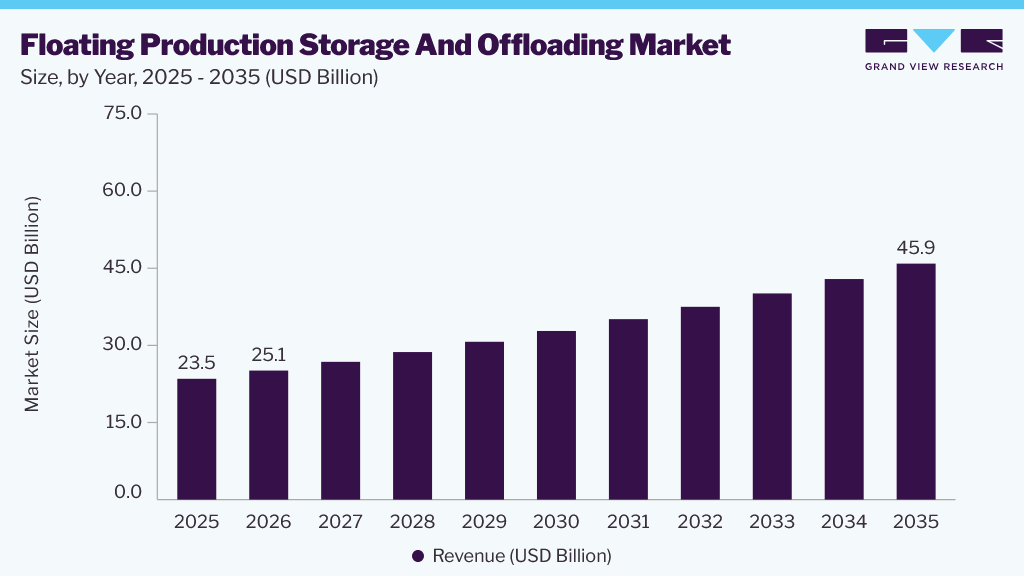
Analyst Perspective
FPSOs offer flexible production, storage, and offloading capabilities, making them suitable for offshore fields where fixed infrastructure is less practical. Rising investments in offshore exploration and production, particularly in South America and other emerging offshore regions, are supporting demand for new and converted FPSO units. Operators are also focusing on improving production efficiency, reducing operating costs, and extending the service life of existing vessels through upgrades and modernization. Companies with strong engineering capabilities, project execution expertise, and established relationships with offshore operators are likely to strengthen their market position. In the coming years, market growth will depend on offshore project development, new FPSO deployments, vessel conversion activity, and continued investment in deepwater oil and gas production.
Type Insights
The new-build FPSO segment held the largest market share in 2025, owing to burgeoning offshore oil and gas development that requires increased production capacity, improved durability, and longer field life, as well as stringent environmental and safety standards. The new build FPSO design is ideally suited for deep and ultra-deep waters, with large storage capacity, high-compression facilities, and improved operational efficiency to enhance oil and gas recovery. In addition to continued funding flows into Brazil, Guyana, and West Africa, the market is buoyant. For instance, in August 2025, SBM Offshore began producing oil from its new-build FPSO ONE GUYANA for ExxonMobil’s Yellowtail development.
The converted FPSO segment is expected to register the fastest growth over the forecast period. The growth is driven by advantages such as relatively low capital expenditure, faster project execution, and a growing preference for reusing tanker hulls for offshore activities. Oil and gas majors also prefer converted FPSOs, as they enable quicker deployment to boost production. Technological progress in vessel conversion and life extension schemes is also boosting demand.
Hull Type Insights
The double-hull segment accounted for the largest market share in 2025, driven by enhanced safety and environmental concerns with a double-hulled FPSO. High structural integrity and leakage prevention have increased the preference for double-hull designs for FPSOs. Double-hull structures drastically reduce the probability of oil spills and support safer operations. The growing inclination of offshore operators toward double hull structures, particularly in deep water projects, in the longer term. For instance, in September 2025, Yinson Production secured main scantling approval from DNV for its next-generation purpose-built meridian FPSO hull design.
The single-hull segment is expected to register the fastest CAGR over the forecast period. Tanker ships converted into FPSOs may offer economic benefits, reduced deployment time, and greater economic viability for independent operators engaged in the extraction of small offshore assets, particularly amid extensive redevelopment projects in maturing oilfields.
Propulsion Type Insights
The self-propelled segment held the largest share in the global industry in 2025, primarily due to increased maneuverability, the ability to shift easily between offshore fields, reduced towing costs, and shorter installation times. The increasing demand for self-propelled FPSOs, especially for deep-water applications, is due to greater ease of transportation and operations. Also, self-propelled vessels reduce logistics costs.
The towing segment is expected to witness the fastest CAGR over the forecast period, driven by growth in the utilization of modified FPSOs, in which vessels were towed offshore to production sites with the assistance of tugboats. The use of towed units offers a cost-effective deployment solution for marginal fields, thereby reducing upfront investment compared with building new vessels. Offshore production in underdeveloped regions supports the method's use.
Application Insights
The deep-water segment secured the largest market share in 2025 due to growth in offshore exploration activities in countries such as Brazil, Guyana, the Gulf of Mexico, and West Africa. Because deep-water fields have high production capacities, they attracted significant investment from companies in the form of high-capacity FPSOs, which enable prolonged operating life even in harsh offshore conditions. An increase in global oil demand and the steady expansion of offshore production infrastructure also emphasize the segment's growth.
The ultra-deepwater segment is expected to register the fastest CAGR over the forecast period, driven by increasing discoveries of large offshore reserves, advancements in subsea technologies, and rising investments in untapped offshore basins. Operators are increasingly deploying high-capacity FPSOs to efficiently and economically develop oil and gas reserves located at water depths of 1,500 meters or more.
Regional Insights
The Latin America floating production storage and offloading market accounted for the largest share in 2025. Large-scale investments by Petrobras and ExxonMobil, along with ample deepwater reserves, have made South America the world's epicenter for FPSO use. Continued expansion and the discovery of deepwater offshore resources in the region have largely driven demand. For instance, in August 2025, Brazil’s Petrobras announced its expansion into three floating offshore production platforms.
Asia Pacific Floating Production Storage and Offloading Market Trends
The floating production storage and offloading market in Asia Pacific is expected to register the fastest growth during the forecast period. With expanding offshore activity in regions such as China, India, Malaysia, and Australia, coupled with rising energy demand and infrastructure development in the Asia Pacific, the region is expected to grow at the fastest pace during the forecast period. Moreover, the presence of regional FPSO players, in addition to shipyards, has continued to strengthen its market position and technology, and offshore expansion in the region continues to play a key role in determining this growth.
Key Floating Production Storage and Offloading Companies Insights
The floating production storage and offloading market is characterized by global, regional, and niche solution providers competing through technological innovation, strategic partnerships, acquisitions, and product portfolio expansion. For instance, in November 2025, Drydocks World Dubai confirmed a sail-away ceremony for its new floating production, storage, and offloading vessel.
Key Floating Production Storage and Offloading Companies
The following key companies have been profiled for this study on the floating production storage and offloading market:
-
MODEC, Inc.
-
SBM Offshore N.V.
-
Yinson Holdings Berhad
-
Bumi Armada Berhad
-
Altera Infrastructure
-
MISC Berhad
-
Bluewater Energy Services B.V.
-
BW Offshore Limited
-
Petrobras
-
ExxonMobil Corporation
Recent Developments
-
In May 2026, SBM Offshore signed contracts with Petróleo Brasileiro S.A. (Petrobras) for two new FPSO projects, SEAP-I and SEAP-II. Under the agreements, SBM Offshore will be responsible for the design, construction, and operation of the FPSOs, supporting the development of Brazil’s offshore oil resources and reinforcing demand for large-scale floating production infrastructure.
-
In May 2025, Bumi Armada agreed with an Indian partner to provide services for an FPSO supporting offshore oil production in India. The contract strengthens Bumi Armada’s presence in the Indian offshore energy market and highlights continued investment in FPSO-based production infrastructure.
Global Floating Production Storage and Offloading Market Report Scope
Report Attribute
Details
Market size in 2025
USD 23.5 billion
Estimated market size in 2026
USD 25.1 billion
Projected market size by 2035
USD 45.9 billion
Growth rate
CAGR of 6.9% from 2026 to 2035
Base year for estimation
2025
Historical data
2021 - 2024
Forecast period
2026 - 2035
Quantitative units
Revenue in USD billion, and CAGR from 2026 to 2035
Report coverage
Revenue forecast, company ranking, competitive landscape, growth factors, and trends
Segments covered
Type, hull type, propulsion type, application, region
Regional scope
North America; Europe; Asia Pacific; Latin America; Middle East & Africa
Country scope
U.S.; Canada; Mexico; UK; Germany; France; Italy; Spain; China; Japan; India; Australia; South Korea; Brazil; Argentina; South Africa; Saudi Arabia; UAE.
Key companies profiled
MODEC, Inc.; SBM Offshore N.V.; Yinson Holdings Berhad; Bumi Armada Berhad; Altera Infrastructure; MISC Berhad; Bluewater Energy Services B.V.; BW Offshore Limited; Petrobras; ExxonMobil Corporation
Customization scope
Free report customization (equivalent to 8 analyst working days) with purchase. Addition or alteration to country, regional & segment scope.
Pricing and purchase options
Avail of customized purchase options to meet your exact research needs. Explore purchase options
Floating Production Storage And Offloading Market Report Segmentation
This report forecasts revenue growth at the global, regional, and country levels and provides an analysis of the latest industry trends and opportunities across each sub-segment from 2026 to 2035. For this study, Grand View Research has segmented the global floating production storage and offloading market report based on type, hull type, propulsion type, application, and region:
-
Type Outlook (Revenue, USD Billion, 2026 - 2035)
-
New Build
-
Converted
-
-
Hull Type Outlook (Revenue, USD Billion, 2026 - 2035)
-
Single Hull
-
Double Hull
-
Propulsion Type Outlook (Revenue, USD Billion, 2026 - 2035)
-
Self-propelled
-
Towed
-
-
Application Outlook (Revenue, USD Billion, 2026 - 2035)
-
Shallow water
-
Deepwater
-
Ultra-deep water
-
Others
-
-
Regional Outlook (Revenue, USD Billion, 2026 - 2035)
-
North America
-
U.S.
-
Canada
-
Mexico
-
-
Europe
-
UK
-
Germany
-
France
-
Italy
-
Spain
-
-
Asia Pacific
-
China
-
Japan
-
India
-
Australia
-
South Korea
-
-
Latin America
-
Brazil
-
Argentina
-
-
Middle East and Africa (MEA)
-
South Africa
-
Saudi Arabia
-
UAE
-
-
-
Frequently Asked Questions About This Report
The new-build FPSO segment accounted for the largest share of revenue in 2025.
Key players in the market include MODEC, Inc., SBM Offshore N.V., Yinson Holdings Berhad, Bumi Armada Berhad, Altera Infrastructure, MISC Berhad, Bluewater Energy Services B.V., BW Offshore Limited, Petrobras, and ExxonMobil Corporation, among others.
The global floating production storage and offloading market size was valued at USD 23.5 billion in 2025 and is estimated at USD 25.1 billion in 2026.
The global floating production storage and offloading market is expected to grow at a CAGR of 6.9% from 2026 to 2035, reaching USD 45.9 billion.
Latin America dominated the market, accounting for the largest revenue share in 2025.
About the Author(s)
Bulk Chemicals Research Team
Research · Bulk ChemicalsThis report was authored by the bulk chemicals research team at Grand View Research - comprising two research analysts, one senior research analyst, and one industry expert - with specialized expertise in the bulk chemicals segment of the research industry. All findings are based on proprietary research databases, executive interviews, and regulatory analysis, subject to internal peer review prior to publication.
Last Updated:
Speak to Analyst


Customize this report to your needs — add regions, segments, or data points, with 20% free customization.
Or view our licence options:


ISO 9001:2015 & 27001:2022 Certified
We are GDPR and CCPA compliant! Your transaction & personal information is safe and secure. For more details, please read our privacy policy.


