
- Home
- »
- Conventional Energy
- »
-
Floating Storage And Regasification Unit Market Report 2035GVR Report cover

Floating Storage And Regasification Unit Market (2026 - 2035)
Size, Share & Trends Analysis Report By Capacity, By Technology (Open Loop, Closed Loop, Hybrid), By Application (Industrial & Commercial, Power Generation), By Region, And Segment Forecasts
Market Size, 2025
$8.2BMarket Estimate, 2026
$8.8BMarket Forecast, 2035
$16.7BCAGR, 2026–2035
7.4%Floating Storage And Regasification Unit Market Summary
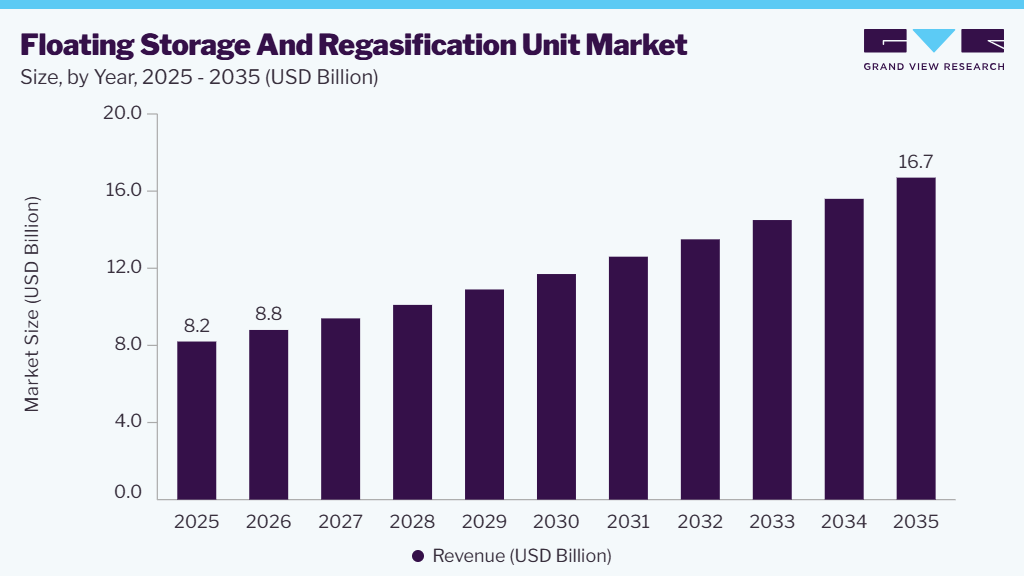
The global floating storage and regasification unit market size was valued at USD 8.2 billion in 2025 and is projected to grow from USD 8.8 billion in 2026 to USD 16.7 billion by 2035, at a CAGR of 7.4% from 2026 to 2035. Asia Pacific dominated the market, accounting for the largest revenue share of 45.0% in 2025. The market is witnessing growth as countries seek flexible and rapidly deployable LNG import infrastructure to strengthen energy security, diversify natural gas supplies, and address limitations associated with conventional onshore regasification terminals.
Key Market Trends & Insights
- By capacity: 100,000-150,000 m³ segment held the largest market share in 2025.
- By technology: Closed-loop segment held the largest market share in 2025.
- By application: Power generation segment held the largest market share in 2025.
Regional Highlights
- Largest regional market: Asia Pacific (45.0%, revenue share, 2025)
- Fastest-growing regional market: Europe (highest CAGR, 2026-2035)
Market Size & Forecast
- Market size in 2025: USD 8.2 Billion
- Estimated market size in 2026: USD 8.8 Billion
- Projected market size by 2035: USD 16.7 Billion
- CAGR (2026-2035): 7.4%
Prism AI by Grand View Research Free to tryAsk a question about the floating storage and regasification unit marketTry asking✓Every figure cited from GVR research Prefer the report? Download free sample →The floating storage and regasification units industry is mainly driven by an increase in demand for flexible liquefied natural gas (LNG) receiving terminals as countries focus on improving energy security and diversification of natural gas supplies. FSRUs are a platform having single or multiple units integrating LNG storage and regasification in one floating asset; thus, LNG-importing nations can create LNG receiving facilities with less land-based infrastructure than in traditional terminals.
 Source: Grand View Research, IR Documents, Primary Interviews, Paid DatabasesTo learn more about this report,
 Download Free Sample Report
Their relatively fast installation, operational adaptability, and appropriateness for new developing LNG markets are also enhancing the increased acceptance. Enhancement of the LNG trading, the development of gas-fired power generation, and the additional investment in the newbuild and converted FSRUs are anticipated to produce new market opportunities and will continue to do so.
Analyst Perspective
The floating storage and regasification unit (FSRU) sector is expected to experience a stable profile of growth as the markets for LNG-importing nations move to secure flexible, affordable, and quickly-commissioned gas infrastructures. The advantages posed by the FSRUs, such as combining storage and regasification functionalities within one floating asset, diminishing the need for large infrastructure, and enabling a more rapid development of these projects, represent an attractive alternative to traditional onshore terminals. As a result of increasing LNG trade, the penetration of gas-fired power plants, and the enhancement of energy security, the FSRU sector is anticipated to maintain robust demand levels in the coming years, mainly across developing nations. Furthermore, investments in newbuild and converted FSRUs, and advancements in regasification technology, are projected to bolster the sector through 2035.
Capacity Insights
The 100,000-150,000 m³ segment dominated the market and accounted for approximately 45% of revenue in 2025. This segment's predominant market position is primarily down to its storage capacity, flexible deployment, and meeting the needs of regional LNG import demands at an affordable cost. A recent industry example is Mitsui O.S.K. Lines' 2024 commencement of commercial operations of the Jawa Satu FSRU in Indonesia, which has a storage capacity of 170,000 m³ and demonstrates continued deployment of medium-to-large FSRUs for LNG import and power generation.
The above 150,000 m³ segment is anticipated to witness the fastest CAGR during the forecast period, owing to the rising demand for LNG imports and growing scale of energy infrastructure projects that demand higher storage and regasification capacities. For instance, in May 2025, Vopak announced plans for the Victorian Energy Terminal in Australia, which is being developed around a 170,000 m³ FSRU to provide flexible LNG import capacity for southeastern Australia, highlighting demand for higher-capacity floating units.
Technology Insights
The closed-loop segment accounted for the largest share of the market in 2025. Closed-loop FSRUs offer enhanced operational flexibility by utilizing a dedicated heat transfer fluid to facilitate regasification and can be beneficial in instances where access to seawater, temperature, or environmental constraints limit open-loop operation. The penetration of FSRU across markets with diverse location-specific conditions is propelling the demand for flexible regasification configurations.
The hybrid segment is anticipated to witness the fastest CAGR during the forecast period as FSRU operators look for the flexibility to switch between open- and closed-loop operating modes depending on seawater conditions and environment conditions. Hybrid systems can provide operational flexibility as well as keep the vessel's availability for regasification under different varying environmental or seawater conditions. MOL's 2024 FSRU activity in Indonesia, including the operation of the 170,000 m³ Jawa Satu, demonstrates the continuing development of flexible FSRU infrastructure in Asia's expanding LNG-to-power market.
Application Insights
The power generation segment dominated the market in 2025. Growing use of floating storage and regasification units as LNG receiving terminals, especially in countries requiring to enhance the electrical power supply and hence the diversification of fuel sources, has contributed to the growth of this segment. A recent example is Singapore's second LNG terminal project, for which Mitsui O.S.K. Lines signed a project finance agreement in December 2025 for a newbuild floating storage and regasification unit (FSRU) to be deployed at the terminal and operated by Singapore LNG Corporation. The project represents Singapore's first FSRU deployment and is intended to strengthen the country's LNG import capacity and energy security. Singapore relies on imported natural gas for approximately 95% of its electricity generation, highlighting the importance of reliable LNG and gas infrastructure for the power sector.
The industrial & commercial segment is anticipated to witness a notable CAGR during the forecast period, supported by the growing industrial & commercial usage of LNG, as it is increasingly used in manufacturing units, commercial buildings, and various gas intensive applications especially in the emerging regions where the gas distribution infrastructure is being constructed. FSRUs facilitate the flexible access of regasified LNG while avoiding the long development time lines for onshore terminals. The planned Longboard LNG Project in Hawaii, for which FERC staff approved entry into the pre-filing environmental review process in May 2026, is designed to connect a floating storage and regasification unit (FSRU) to new and existing pipelines operated by Hawai‘i Gas. The project illustrates the development of flexible LNG infrastructure to supply natural gas to power generation, industrial facilities, retail gas customers and LNG bunkering operations.
Regional Insights
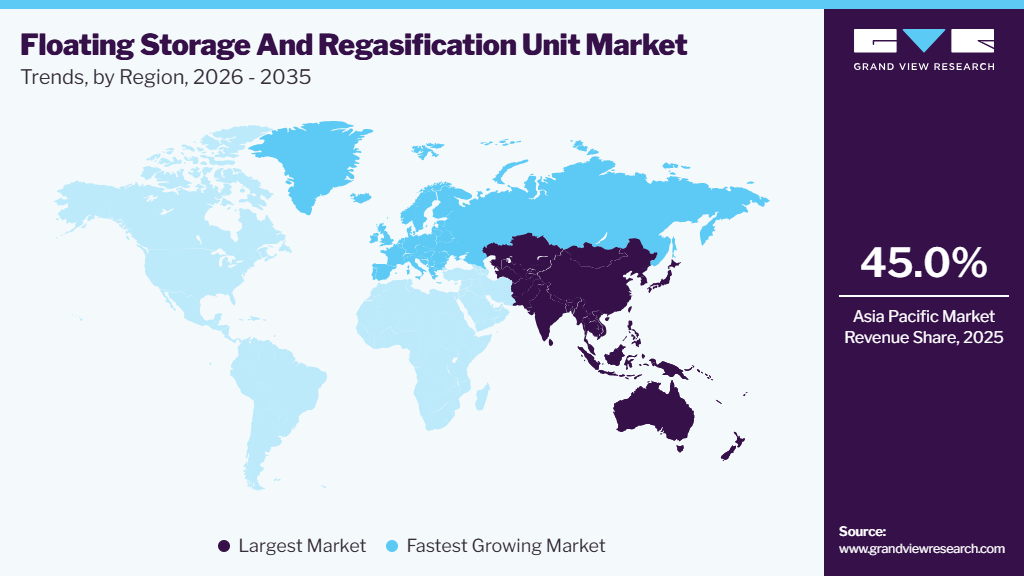
The floating storage and regasification unit industry in Asia Pacific dominated in 2025, accounting for approximately 45.0% of global revenue. The region's dominant position in the FSRU market is supported by rising LNG import demand, growing gas-fired power generation and the development of flexible LNG receiving infrastructure in China, India, Japan and Southeast Asia. Recent developments supporting regional FSRU deployment include Mitsui O.S.K. Lines' signing of a project finance agreement in December 2025 for a newbuild FSRU that will serve Singapore's second LNG terminal. The project represents Singapore's first FSRU deployment and is intended to support the country's LNG-based energy supply.
 To learn more about this report, Download Free Sample Report
Europe Floating Storage And Regasification Unit Market Trends
The floating storage and regasification unit industry in Europe is anticipated to witness strong growth during the forecast period, with the regional FSRU market projected to expand at approximately 8.9% from 2026 to 2035. The upward trend is characterized by sustained investments in LNG import capacity, diversification of gas supply sources and an increase in floating regasification capacity. For instance, in August 2025, Deutsche Energy Terminal commenced commercial operations at its second LNG terminal in Wilhelmshaven, Germany, using Excelerate Energy's Excelsior FSRU, adding further floating LNG import capacity in Germany.
Key Floating Storage And Regasification Unit Company Insights
Key companies of floating storage and regasification unit industry are focusing on expansion of FSRU fleets, further securing long-term charter and terminal deals, and upgrading existing FSRU operations. Moreover, they are also undertaking newbuild and converted FSRU projects, developing regasification and storage facilities and increasing presence throughout new emerging LNG-import markets. Market players are keen to enter into strategic partnerships with energy utilities, terminal operators, and shipyards to promote FSRU deployment and enhance the development of flexible LNG import infrastructure.
Key Floating Storage And Regasification Unit Companies:
The following key companies have been profiled for this study on the floating storage and regasification unit market.
-
Excelerate Energy, Inc.
-
Höegh LNG
-
BW LNG
-
Golar LNG Limited
-
Dynagas LNG Partners LP
-
Mitsui O.S.K. Lines, Ltd.
-
New Fortress Energy Inc.
-
Snam S.p.A.
-
Bumi Armada Berhad
-
Exmar NV
Recent Developments
-
In July 2025, New Fortress Energy Inc. executed a five-year agreement with the Egyptian Natural Gas Holding Company (EGAS) for the deployment of the 138,250 m³ Energos Winter floating storage and regasification unit (FSRU) at EGAS' LNG import terminal in Damietta, Egypt. The FSRU represented NFE's second unit deployed in Egypt and was expected to commence operations as early as August 2025.
-
In May 2025, Snam successfully completed commissioning activities for the BW Singapore floating storage and regasification unit (FSRU) at the Ravenna LNG terminal in Italy, with commercial operations commencing in May 2025.
Floating Storage And Regasification Unit Market Report Scope
Report Attribute
Details
Market size in 2025
USD 8.2 billion
Estimated market size in 2026
USD 8.8 billion
Projected market size by 2035
USD 16.7 billion
Growth Rate
CAGR of 7.4% from 2026 to 2035
Base year for estimation
2025
Actual data
2021 - 2024
Forecast period
2026 - 2035
Quantitative units
Revenue in USD billion and CAGR from 2026 to 2035
Report coverage
Revenue forecast, company ranking, competitive landscape, growth factors, and trends
Segments covered
Capacity, technology, application, region
Regional Scope
North America; Europe; Asia Pacific; Latin America; Middle East & Africa
Country Scope
U.S.; Canada; Mexico; UK; Germany; France; Italy; Spain; China; Japan; India; Australia; South Korea; Brazil; Argentina; South Africa; Saudi Arabia; UAE
Key companies profiled
Excelerate Energy, Inc.; Höegh LNG; BW LNG; Golar LNG Limited; Dynagas LNG Partners LP; Mitsui O.S.K. Lines, Ltd.; New Fortress Energy Inc.; Snam S.p.A.; Bumi Armada Berhad; Exmar NV
Customization scope
Free report customization (equivalent to 8 analyst working days) with purchase. Addition or alteration to country, regional & segment scope.
Pricing and purchase options
Avail of customized purchase options to meet your exact research needs. Explore purchase options
Global Floating Storage And Regasification Unit Market Report Segmentation
This report forecasts revenue growth at the global, regional, and country levels and provides an analysis of the latest industry trends and opportunities across each sub-segment from 2021 to 2035. For this study, Grand View Research has segmented the global floating storage and regasification unit market report based on capacity, technology, application, and region:
-
Capacity Outlook (Revenue, USD Billion, 2021 - 2035)
-
Below 100,000 m³
-
100,000-150,000 m³
-
Above 150,000 m³
-
-
Technology Outlook (Revenue, USD Billion, 2021 - 2035)
-
Open Loop
-
Closed Loop
-
Hybrid
-
-
Application Outlook (Revenue, USD Billion, 2021 - 2035)
-
Power Generation
-
Industrial & Commercial
-
Others
-
-
Regional Outlook (Revenue, USD Billion, 2021 - 2035)
-
North America
-
U.S.
-
Canada
-
Mexico
-
-
Europe
-
UK
-
Germany
-
France
-
Italy
-
Spain
-
-
Asia Pacific
-
China
-
Japan
-
India
-
Australia
-
South Korea
-
-
Latin America
-
Brazil
-
Argentina
-
-
Middle East and Africa (MEA)
-
South Africa
-
Saudi Arabia
-
UAE
-
-
Frequently Asked Questions About This Report
The global floating storage and regasification unit market size was valued at USD 8.2 billion in 2025 and is estimated at USD 8.8 billion for 2026.
The global floating storage and regasification unit market is expected to grow at a CAGR of 7.4% from 2026 to 2035, reaching USD 16.7 billion by 2035
The 100,000–150,000 m³ segment accounted for the largest revenue share in 2025.
Asia Pacific dominated with the largest revenue share in 2025.
Key players in the market include Excelerate Energy, Inc.; Höegh LNG; BW LNG; Golar LNG Limited; Dynagas LNG Partners LP; Mitsui O.S.K. Lines, Ltd.; New Fortress Energy Inc.; Snam S.p.A.; Bumi Armada Berhad; and Exmar NV.
About the Author(s)
Conventional Energy Research Team
Energy & Power · Conventional EnergyThis report was authored by the conventional energy research team at Grand View Research - comprising two research analysts, one senior research analyst, and one industry expert - with specialized expertise in the conventional energy segment of the energy & power industry. All findings are based on proprietary energy & power databases, executive interviews, and regulatory analysis, subject to internal peer review prior to publication.
Last Updated:
Speak to Analyst

Customize this report to your needs - add regions, segments, or data points, with 20% free customization.
Or view our licence options:


ISO 9001:2015 & 27001:2022 Certified
We are GDPR and CCPA compliant! Your transaction & personal information is safe and secure. For more details, please read our privacy policy.


