
- Home
- »
- Homecare & Decor
- »
-
Flower Delivery Service Market Size & Share Report, 2033GVR Report cover

Flower Delivery Service Market (2026 - 2033)
Size, Share & Trends Analysis Report By Product (Rose, Tulip, Orchid, Lily, Gerbera, Sunflower, Carnations), By Type, By Occasion (Corporate Event, Wedding), By Application, By Region, And Segment Forecasts
Market Size, 2025
$8.1BMarket Estimate, 2026
$8.6BMarket Forecast, 2033
$13.8BCAGR, 2026–2033
7.0%Flower Delivery Service Market Summary
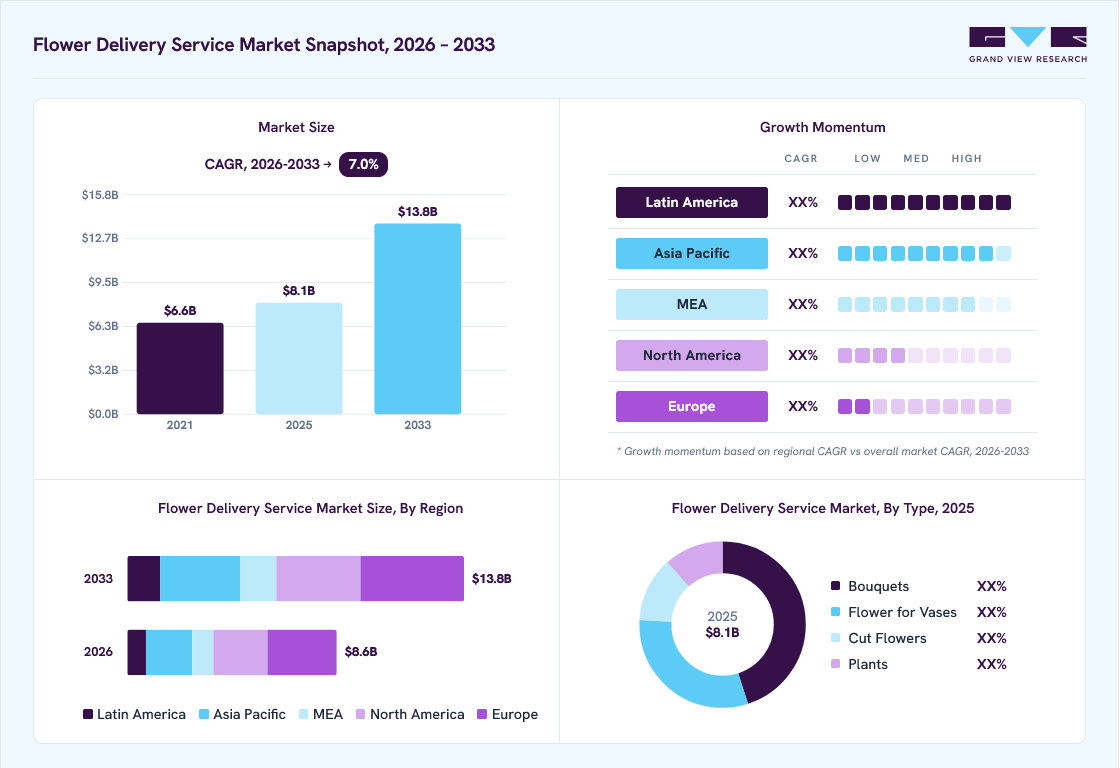
The global flower delivery service market size was valued at USD 8.1 billion in 2025 and is projected to grow from USD 8.6 billion in 2026 to USD 13.8 billion by 2033, at a CAGR of 7.0 % from 2026 to 2033. Europe dominated the market, accounting for a revenue share of 33.7% in 2025. The flower delivery service market has undergone a remarkable transformation, driven by evolving consumer expectations, technological advancements, and innovative business models.
 Source: Grand View Research, IR Documents, Primary Interviews, Paid DatabasesTo learn more about this report,
 Download Free Sample Report
Key Market Trends & Insights
- By product: Rose segment dominated the market, with a revenue share of 16.9% in 2025.
- By type: Bouquets segment held the largest market share of 39.6% in 2025.
- By occasion: Corporate segment held the largest revenue share of 42.0% in 2025.
- By application: Commercial segment accounted for the largest revenue share of 66.5% in 2025.
Regional Highlights
- Largest regional market: Europe (33.7% revenue share, 2025)
- By country: U.K. held the largest market share in 2025.
Market Size & Forecast
- Estimated market size in 2026: USD 8.6 Billion
- Projected market size by 2033: USD 13.8 Billion
- CAGR (2026-2033): 7.0%
- Market size in 2025: USD 8.1 Billion
Three ways to get this report
Buy it, customize it, or ask a question.Ask an Analyst
Analyst response in 1 business day
- AccessReport author, directly
- Reply timeWithin 1 working day
- No sales callDirect answer only
- FormatEmail reply
- CostFree, no cost
Get the Full Report
What the study covers
- FormatsPDF · Excel · Dashboard
- Timeline2026–2033 annual, 2025 base
- Coverage20+ countries, 5 regions
- Companies10+ key players profiled
Customize the Report
20% free customization
- IncludeCountries, segments, points
- TailorTo your product definition
- ExtendDeeper competitor detail
- OrA fully bespoke study
- Turnaround5–10 working days
The surge in popularity of online flower delivery services reflects broader shifts in shopping habits and the growing demand for convenience and personalization. This expansion is characterized by several key trends and initiatives that have reshaped the landscape of the flower delivery industry.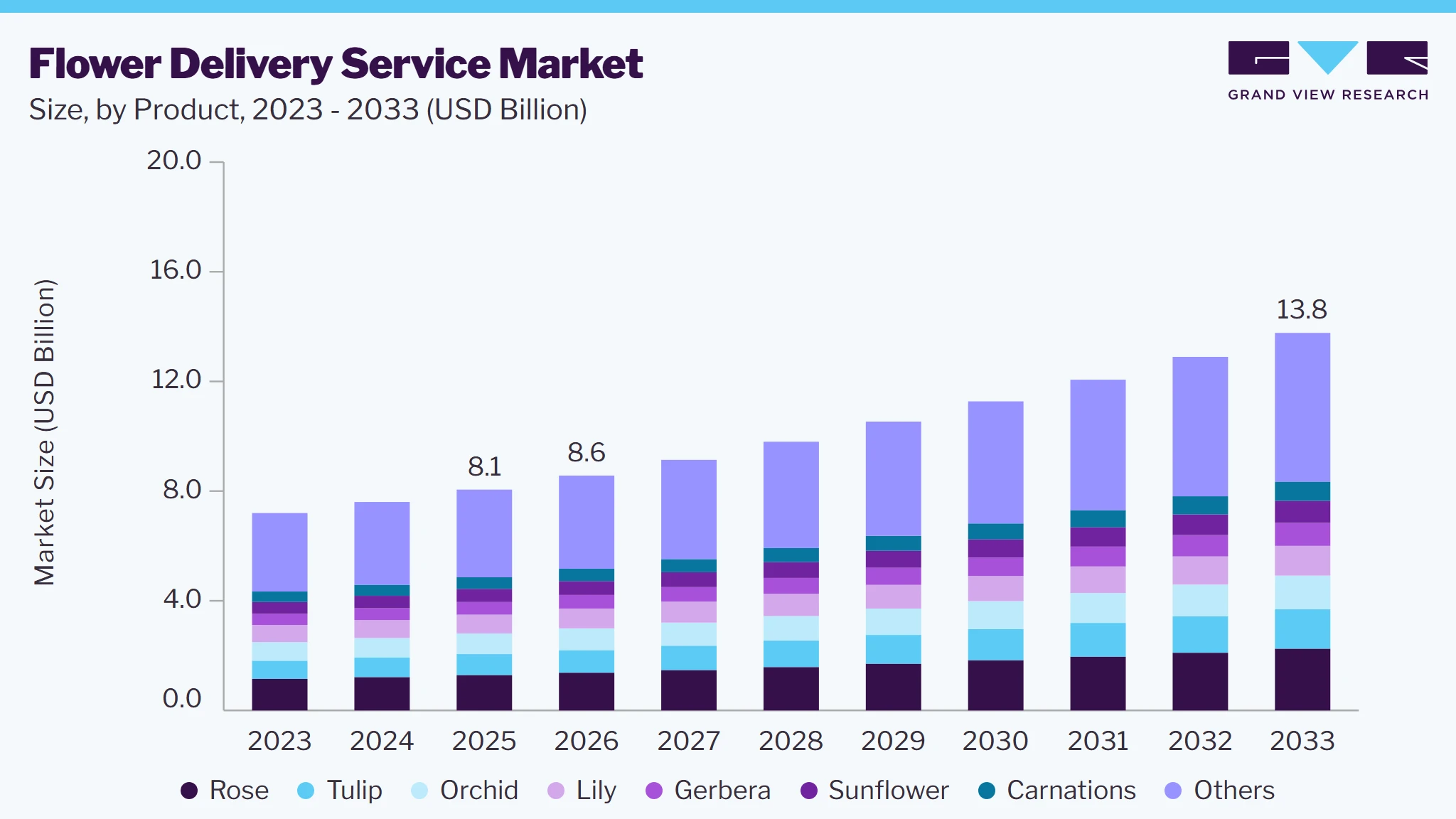 To learn more about this report, Download Free Sample Report
The rise of e-commerce has been a primary driver behind the growth of the flower delivery service market. Consumers increasingly prefer the convenience of online ordering, which offers a wide range of options and the ability to customize their selections from the comfort of their homes. According to a recent report from DoorDash in 2024, the online flower delivery sector has seen significant growth, with more consumers turning to digital platforms for their floral needs due to the ease of use and instant access to a diverse array of products. Major players in the industry, such as FTD and 1-800-Flowers, have capitalized on this trend by enhancing their online presence and mobile applications, making the process of ordering flowers more intuitive and user-friendly.
In response to the growing demand for personalized experiences, flower delivery services have embraced advanced technology to offer tailored solutions. Data analytics and artificial intelligence (AI) are now integral to many flower delivery platforms, enabling them to provide personalized recommendations and improve customer service. For example, AI-driven algorithms can suggest floral arrangements based on past purchases, user preferences, and special occasions, thereby enhancing the overall customer experience. This personalization not only meets the individual needs of consumers but also helps businesses build stronger customer relationships and drive repeat sales.
Another significant trend in the flower delivery market is the emphasis on sustainability. Consumers are increasingly conscious of environmental issues and are favoring companies that adopt eco-friendly practices. Many flower delivery services have responded by implementing sustainable packaging solutions, sourcing flowers from environmentally responsible growers, and minimizing waste. As per an article in Ecwid in 2024, companies such as Bloom & Wild have made strides in this area by using recyclable materials for their packaging and working with growers who prioritize sustainable farming practices. This shift towards sustainability not only aligns with consumer values but also helps companies differentiate themselves in a competitive market.
The subscription model has also emerged as a major trend in the flower delivery industry. Subscription services offer customers the convenience of regular, scheduled deliveries of flowers, which can range from weekly to monthly intervals. This model provides a steady revenue stream for businesses and fosters customer loyalty by offering a consistent and hassle-free floral experience. For instance, The Bougainvillea and Farmgirl Flowers have successfully implemented subscription services, offering perks such as discounts and exclusive arrangements to attract and retain subscribers. The subscription model caters to consumers who appreciate the convenience of automatic deliveries and the ability to enjoy fresh flowers on a regular basis without the need for repeated orders.
Innovation in the flower delivery sector extends beyond business models to include advancements in product offerings and delivery methods. Many companies are exploring new ways to enhance the freshness and longevity of their floral products. For example, some services now offer preserved or freeze-dried flowers that last significantly longer than traditional blooms, catering to consumers who value durability and longevity in their floral arrangements. In addition, advancements in logistics and delivery technology have improved the efficiency of flower delivery operations. Real-time tracking, optimized delivery routes, and contactless delivery options are now standard features that enhance the customer experience and streamline operations.
The role of social media and influencer marketing has also become increasingly important in promoting flower delivery services. Brands are leveraging platforms such as Instagram and TikTok to showcase their products, engage with consumers, and drive brand awareness. Influencers play a crucial role in shaping consumer perceptions and encouraging purchases by sharing their experiences with floral arrangements and highlighting the unique features of different flower delivery services. This approach helps companies reach a wider audience and build a strong online presence.
Market Dynamics
The flower delivery service market is experiencing steady growth, supported by increasing digital adoption, rising demand for convenient gifting solutions, and expanding e-commerce platforms. Growth is further driven by growing consumer preference for personalized gifting, same-day delivery services, and year-round demand for flowers across personal and corporate occasions.
Increasing consumer reliance on digital platforms for gifting and celebration purchases is driving market growth. Flower delivery services offer convenience, wide product selection, and timely fulfillment, making them a preferred choice for birthdays, anniversaries, festivals, and special occasions
The market faces challenges related to maintaining product freshness, managing cold-chain logistics, and ensuring timely deliveries. Supply chain disruptions and transportation delays can impact product quality and customer satisfaction.
Growing consumer interest in customized floral arrangements, subscription-based offerings, and premium gifting experiences is creating new growth opportunities. Service providers are focusing on product innovation, digital engagement, and value-added services to strengthen customer retention and expand revenue streams.
Analyst Perspective
The flower delivery service market is evolving through the integration of digital commerce, advanced logistics networks, and personalized gifting solutions. Market participants are focusing on enhancing delivery speed, expanding product assortments, and leveraging data-driven customer engagement strategies to strengthen consumer retention. Growing demand for convenience, premium floral arrangements, and occasion-based gifting continue to create opportunities for service differentiation and sustainable market expansion.
Product Insights
Based on product, the rose segment led the market with the largest revenue share of 16.9% in 2025. Roses have higher penetration in the flower delivery service market due to their timeless popularity and universal symbolism of love, admiration, and various emotions. Their wide range of colors, each carrying distinct meanings, makes them suitable for numerous occasions, from romantic gestures and anniversaries to celebrations and condolences. The strong cultural and historical significance of roses enhances their appeal, making them a go-to choice for both senders and recipients. In addition, the aesthetic beauty and classic elegance of roses ensure they remain a favored option in floral arrangements, driving consistent demand in the flower delivery market.
The tulip flower delivery service is projected to grow at a CAGR of 7.8% from 2024 to 2030. Tulips are gaining more popularity in the flower delivery service market due to their vibrant colors, variety of shapes, and the symbolism they carry, representing perfect love, elegance, and prosperity. Their seasonal availability adds a unique and fresh appeal, making them a sought-after choice for spring and special occasions. In addition, tulips are versatile and can be used in both casual and formal arrangements, appealing to a wide range of customers. Their affordability compared to other popular flowers such as roses also makes them an attractive option for consumers looking for beautiful, cost-effective floral gifts, contributing to their rising popularity in the market.
Occasion Insights
Based on occasion, the corporate led the market with the largest revenue share of 42.0% in 2025. The corporate segment has expanded as businesses increasingly use flowers to enhance workplace environments and foster client relationships. This segment's growth is driven by the demand for regular, elegant floral arrangements for office spaces and corporate events. Companies such as The Bougainvillea offer subscription-based services tailored to corporate clients, providing consistent and sophisticated floral displays.
The demand for flower delivery service for wedding is projected to grow at a CAGR of 7.2% from 2024 to 2030. This wedding flower delivery service thrives due to the high demand for bespoke floral designs for weddings. The trend includes personalized and elaborate floral arrangements, often incorporating the bride's preferences and wedding themes. Services such as The Flower Studio specialize in creating custom wedding flowers, offering consultation and design services to match specific themes and venues.
Type Insights
Based on type, the bouquets segment led the market with the largest revenue share of 39.6% in 2025. Bouquets can be customized to suit any occasion, from celebrations and congratulations to expressions of sympathy and love, making them a universally appropriate gift. The arrangement of multiple flowers and foliage in a bouquet creates a visually striking and thoughtful presentation, enhancing the recipient's experience. In addition, the ability to personalize bouquets with specific flower choices, colors, and designs allows consumers to tailor gifts to reflect individual tastes and sentiments, further solidifying the popularity of bouquets in the flower delivery market.
The cut flowers segment is projected to grow at a CAGR of 8.3% from 2024 to 2030. The cut flowers segment within the flower delivery services market represents a vibrant and diverse sector characterized by distinct consumer preferences and growth patterns. This segment encompasses a range of offerings, from everyday bouquets to premium arrangements for special occasions, catering to both individual consumers and businesses.
Application Insights
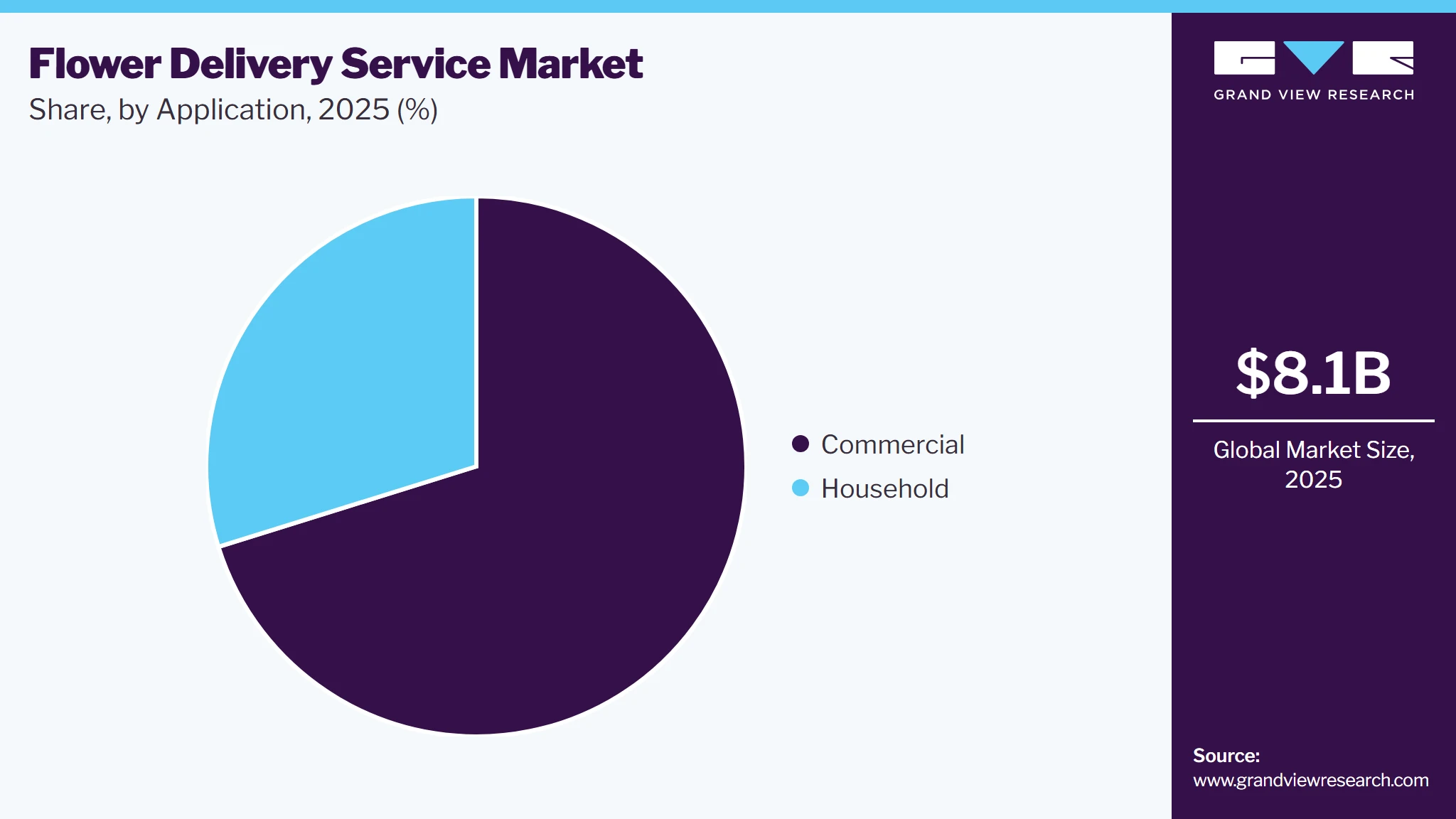
Based on applications, the commercial segment led the market with the largest revenue share of 66.5% in 2025. The demand for flower delivery services for commercial applications is driven by the desire to enhance workplace environments, create a welcoming ambiance for clients and customers, and mark corporate events or milestones. Businesses utilize flower arrangements to improve the aesthetics of office spaces, receptions, and meeting rooms, contributing to a positive and professional image. Regular floral deliveries can boost employee morale, increase productivity, and convey a company’s attention to detail and commitment to a pleasant work environment.
 To learn more about this report, Download Free Sample Report
The demand for flower delivery service for household application is estimated is projected to grow at a CAGR of 7.4% from 2024 to 2030. The household segment encompasses regular floral deliveries for home use, including seasonal and occasion-based arrangements. Trends include subscription services and personalized delivery options that cater to homeowners looking to maintain a fresh and vibrant living space. Companies such as Bloom & Wild offer flexible subscription models tailored to household needs, likely favoring the growth of the market.
Regional Insights
The flower delivery service market in North America accounted for revenue share of around 26% of the global revenue in 2023. In North America, the flower delivery market is characterized by a high demand for convenience and premium service options. The region's market is driven by the strong e-commerce infrastructure and consumer preference for personalized and high-quality floral arrangements.
U.S. Flower Delivery Service Market Trends
The flower delivery service market in the U.S. is expected to grow at a CAGR of 6.5% from 2024 to 2030. The U.S. flower delivery market is robust, with significant growth in online orders and same-day delivery services. The trend towards subscription models and eco-friendly practices is prominent, with companies such as Bloom & Wild and The Bougainvillea leading the charge in offering tailored and sustainable floral solutions.
Asia Pacific Flower Delivery Service Market Trends
Asia Pacific flower delivery service market accounted for revenue share of around 21% from 2024 to 2030. In Asia Pacific, the flower delivery market is growing rapidly due to increasing urbanization and rising disposable incomes. Countries such as China and India are seeing a surge in demand for both traditional and modern floral arrangements. Regional players such as Flower Delivery Singapore and Bloom & Grow are expanding their services to meet the diverse preferences of consumers in this dynamic market.
Europe Flower Delivery Service Market Trends
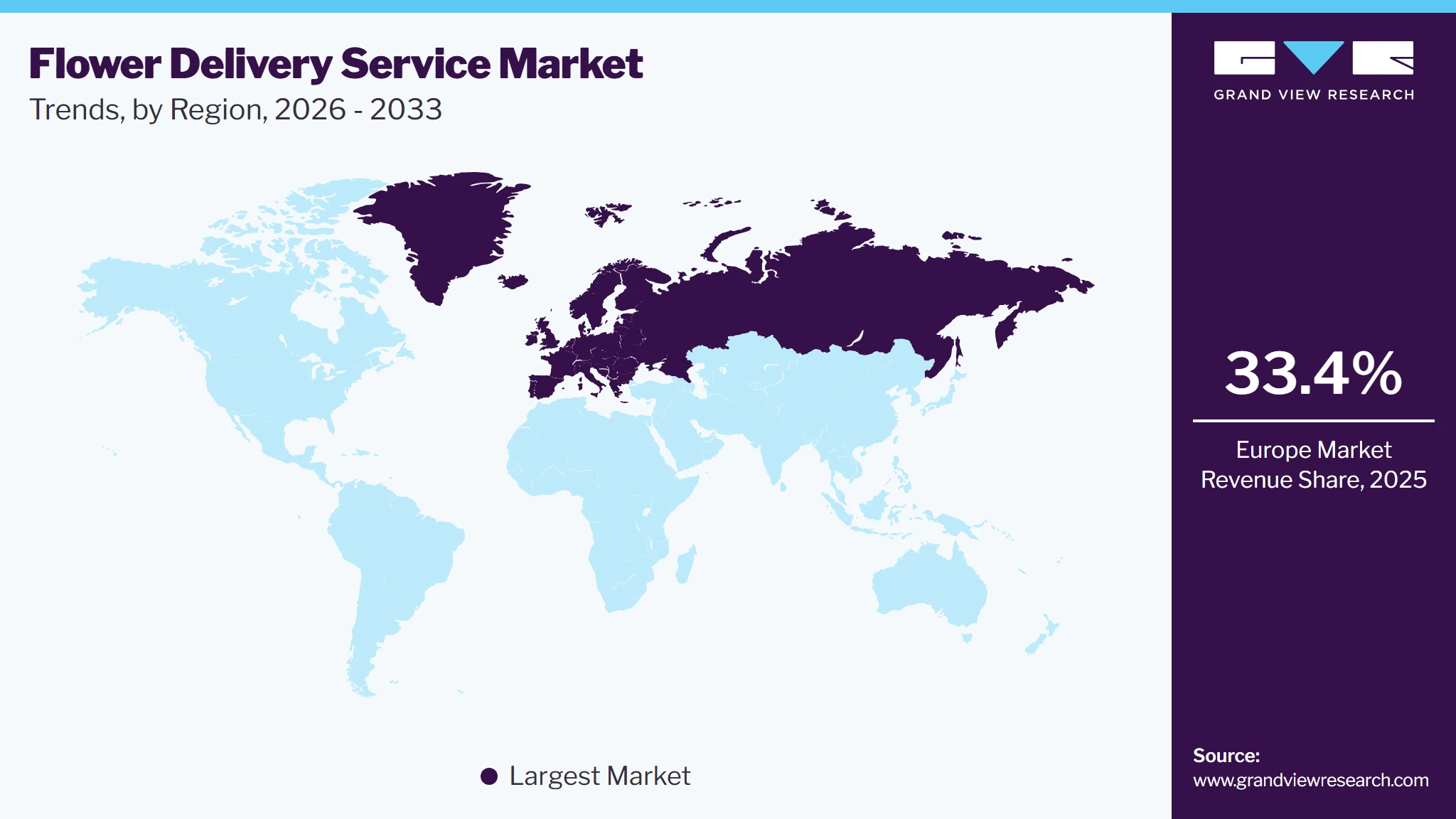
Europe dominated the flower delivery service market with the largest revenue share of 33.4 % in 2025. Europe's flower delivery market is influenced by a strong emphasis on artisanal and sustainable practices. There is a growing trend towards bespoke and locally sourced floral arrangements, with companies like Bloom & Wild and Interflora leading the market. The focus on sustainability and high-quality service is driving growth across various European countries.
 To learn more about this report, Download Free Sample Report
U.K. Flower Delivery Service Market Trends
The flower delivery service market in the U.K. held the largest share in the Europe region in 2025. The U.K. flower delivery service market is increasingly focused on digital ordering, convenience-driven delivery formats, subscription models, and flexible fulfillment networks. Online demand includes services such as same-day, next-day, and letterbox flower delivery, indicating the importance of convenience-oriented delivery options in the market. Subscription services are also creating recurring purchase opportunities beyond traditional gifting occasions. For instance, Interflora offers 3-month, 6-month, and 12-month subscription plans, with seasonal bouquets prepared by local florists and delivered monthly. Alongside these service innovations, providers are adapting their fulfillment models to expand delivery coverage. In June 2025, Interflora introduced its “Florist Boxed” model, enabling three florists to fulfill boxed flower orders nationwide through a third-party carrier and helping address temporary gaps in its florist network. This demonstrates the adoption of alternative fulfillment and logistics models to broaden geographic coverage and improve delivery flexibility.
Key Flower Delivery Service Company Insights
The market features both established global firms and emerging players. Key industry leaders prioritize product innovation, differentiation, and distinctive designs in line with evolving consumer preferences. Leveraging extensive global distribution networks, these major players effectively reach diverse customer bases and tap into emerging markets.
Key Flower Delivery Service Companies:
The following key companies have been profiled for this study on the flower delivery service market.
-
The Sill, Inc.
-
1-800-FLOWERS.COM Inc
-
Floward
-
Bloomex
-
The Wonderful Company LLC.
-
UrbanStems, Inc.
-
From You Flowers, LLC.
-
Venus ET Fleur
-
The Bouqs Company
-
FNP E Retail Private Limited
Competitive Benchmarking
Category
Operating Strategies
Competitive Edge
Weakness
Established Players (The Sill, Inc.; 1-800-FLOWERS.COM Inc.; Floward; Bloomex; FNP E Retail Private Limited; The Bouqs Company)
- Expand product portfolios by offering customized floral arrangements, gift bundles, and subscription-based flower delivery services.
- Strengthen market presence through extensive delivery networks, strategic partnerships, and investments in digital ordering platforms.
- Strong brand recognition and loyal customer base across domestic and international markets.
- Advanced logistics infrastructure and broad distribution capabilities enabling timely deliveries.
- High operational costs associated with sourcing, inventory management, and last-mile delivery services.
- Dependence on seasonal demand and fluctuations in flower supply chains.
Emerging Players (UrbanStems, Inc.; Venus ET Fleur; From You Flowers, LLC.; The Wonderful Company LLC.)
- Focus on premium, sustainable, and niche floral offerings to attract specific consumer segments.
- Build brand awareness through social media marketing, influencer collaborations, and personalized customer experiences.
- Ability to quickly respond to evolving consumer preferences and gifting trends.
- Greater flexibility in adopting innovative business models and digital-first strategies.
- Limited financial resources and lower brand recognition compared to established competitors.
- Smaller distribution networks and operational scale, restricting market reach.
Recent Developments
-
In May 2023, From You Flowers, LLC (FYF), a leading U.S. floral e-commerce company, and FTD, LLC, a historic innovator in the floral industry, have completed their merger. This strategic consolidation creates a new global platform in the floral and gifting sector. The merger aims to enhance the consumer experience by offering a broader selection of products and services. Additionally, FTD member florists are expected to benefit from increased business opportunities, improved support, and nearly double the volume of orders within their network.
-
In April, 2024, Walmart GoLocal offers route optimization and batched delivery capabilities, allowing 1-800-Flowers to process orders with greater efficiency and lower costs. This service also accelerates order handling. Furthermore, 1-800-Flowers leverages features like proof of delivery to improve service reliability and customer satisfaction. The platform provides customers with real-time order tracking from initiation to delivery, which helps decrease order cancellations and complaints. As a white-label service, Walmart GoLocal allows 1-800-Flowers to maintain complete control over the customer experience.
Flower Delivery Service Market Report Scope
Report Attribute
Details
Market size in 2025
USD 8.1 billion
Estimated market size in 2026
USD 8.6 billion
Projected market size by 2033
USD 13.8 billion
Growth rate
CAGR of 7.0 % from 2026 to 2033
Base year for estimation
2025
Historical data
2021 - 2024
Forecast period
2026 - 2033
Quantitative units
Revenue in USD million/billion and CAGR from 2026 to 2033
Report coverage
Revenue forecast, company ranking, competitive landscape, growth factors, and trends
Segments covered
Product, type, occasion, application, region
Regional scope
North America; Europe; Asia Pacific; Central & South America; Middle East & Africa.
Country scope
U.S.; Canada; Mexico; Germany; France; UK; Spain; Italy; China; Japan; India; South Korea; Australia; Brazil; South Africa
Key companies profiled
The sill, inc.; 1-800-flowers.com inc; floward; bloomex; the wonderful company llc.; urbanstems, inc.; from you flowers, llc.; venus et fleur; the bouqs company; fnp e retail private limited
Customization scope
Free report customization (equivalent up to 8 analysts' working days) with purchase. Addition or alteration to country, regional & segment scope.
Pricing and purchase options
Avail customized purchase options to meet your exact research needs. Explore purchase options
Global Flower Delivery Service Market Report Segmentation
This report forecasts revenue growth at global, regional & country levels and provides an analysis on the latest trends and opportunities in each of the sub-segments from 2021 to 2033. For the purpose of this study, Grand View Research has segmented the flower delivery service market on the basis of product, occasion, type, application, and region.
-
Product Outlook (Revenue, USD Billion, 2021 - 2033)
-
Rose
-
Tulip
-
Orchid
-
Lily
-
Gerbera
-
Sunflower
-
Carnations
-
Others
-
-
Occasion Outlook (Revenue, USD Billion, 2021 - 2033)
-
Corporate Event
-
Wedding
-
Personal & Gifting
-
Sympathy
-
-
Type Outlook (Revenue, USD Billion, 2021 - 2033)
-
Bouquets
-
Flower for Vases
-
Cut Flowers
-
Plants
-
-
Application Outlook (Revenue, USD Billion, 2021 - 2033)
-
Commercial
-
Household
-
-
Regional Outlook (Revenue, USD Billion, 2021 - 2033)
-
North America
-
U.S.
-
Canada
-
Mexico
-
-
Europe
-
UK
-
Germany
-
France
-
Italy
-
Spain
-
-
Asia Pacific
-
China
-
India
-
Japan
-
Australia & New Zealand
-
South Korea
-
-
Central & South America
-
Brazil
-
-
Middle East & Africa (MEA)
-
South Africa
-
-
Research Methodology
The flower delivery service market figures in this report are based on a proven research process that combines executive interviews with secondary research from proprietary databases, company filings, and recognized regulatory and institutional sources. Market size is built through value-chain sizing - reconciling supply-side and demand-side estimates - and triangulated with bottom-up and top-down approaches. Every estimate passes multiple levels of expert validation before publication, with each flower delivery service segment quantified using the revenue-capture definitions in the table below.
Segment Definition
Segment - Product
Revenue capture definition
Rose
This segment includes the sales of flower delivery services featuring roses, offered as bouquets, arrangements, and gifting solutions for various occasions.
Tulip
This segment includes the sales of flower delivery services featuring tulips, supplied through curated bouquets and floral arrangements for personal and corporate gifting.
Orchid
This segment includes the sales of flower delivery services featuring orchids, including premium floral arrangements designed for gifting, celebrations, and decorative purposes.
Lily
This segment includes the sales of flower delivery services featuring lilies, delivered as standalone bouquets or mixed floral arrangements for multiple occasions.
Gerbera
This segment includes the sales of flower delivery services featuring gerbera flowers, offered in vibrant floral arrangements for gifting and event-related applications.
Sunflower
This segment includes the sales of flower delivery services featuring sunflowers, provided through bouquets and customized arrangements for celebratory and decorative purposes.
Carnations
This segment includes the sales of flower delivery services featuring carnations, supplied in bouquets and floral displays for personal, festive, and ceremonial occasions.
Others
This segment includes the sales of flower delivery services featuring flowers such as chrysanthemums, daisies, hydrangeas, peonies, and other specialty blooms delivered through various floral arrangements.
Estimation Model
Layer Name
Key Question
Description
Occasion-Based Demand Layer
Who purchases flowers online?
Identify consumers purchasing flowers for birthdays, anniversaries, festivals, corporate gifting, sympathy occasions, and everyday appreciation. Increasing digital gifting culture supports demand.
Flower Purchasing Layer
Who regularly buys flowers?
Estimate consumers who purchase fresh flowers through florists, supermarkets, online platforms, and specialty stores.
Delivery Service Adoption Layer
Who uses flower delivery services?
Apply adoption rates for same-day delivery, scheduled delivery, subscription services, and long-distance gifting.
Revenue Layer
How much revenue is generated?
Multiply active flower delivery customers by average order value, delivery charges, and premium gifting purchases.
Delivered Customizations
This report has been delivered with the following In-depth customizations
Client Request
Customization Delivered
Value Adds
Cross-Segmentation Analysis for Flower Delivery Services Products Across Applications
Detailed assessment of flower delivery demand products such as rose, tulip, orchid, lily, gerbera, sunflower, carnations, and other flowers across commercial and household applications.
Identifies high-growth flower-application segments, supports portfolio optimization, highlights evolving consumer preferences, and enables targeted marketing and product positioning strategies.
Value Chain Analysis
Comprehensive evaluation of the flower delivery value chain, covering flower cultivation, sourcing, packaging, cold-chain logistics, online platforms, florists, distribution networks, and end-user delivery services. Analysis assesses operational efficiency, supply chain integration, cost structures, and key stakeholder roles.
Supports supply chain optimization, improves operational efficiency, identifies value creation opportunities, enhances delivery performance, and enables informed strategic decision-making.
Company Share Analysis
Detailed assessment of leading flower delivery service providers, including analysis of market share, service portfolio, delivery network strength, digital capabilities, geographic presence, and competitive positioning within the global flower delivery service market.
Enables competitive benchmarking, identifies market leaders and emerging players, supports strategic planning and investment decisions, and strengthens market positioning initiatives.
Frequently Asked Questions About This Report
The global flower delivery service market was estimated at USD 8.1 billion in 2025 and is estimated at USD 8.6 billion in 2026.
The global flower delivery service market is expected to grow at a CAGR of 7.0% from 2026 to 2033 to reach USD 13.8 billion by 2033.
Some of the key players operating in the flower delivery service market include The Sill, Inc.; 1-800-FLOWERS.COM Inc; Floward; Bloomex; The Wonderful Company LLC.; UrbanStems, Inc.; From You Flowers, LLC.; Venus ET Fleur; The Bouqs Company; FNP E Retail Private Limited
Key factors that are driving the flower delivery service market growth include the growing trend of e-commerce and the rising popularity of same-day and subscription-based delivery options. Additionally, increasing consumer preferences for unique and customizable floral arrangements contribute to market growth.
Europe dominated the flower delivery service market with a share of around 33.4% in 2025.
By application commercial segment held the largest share with a 66.5% in 2025.
By product rose held the largest share with a 16.9% in 2025, while tulip is the fastest growing segment.
By type bouquets held the largest share with a 39.6% in 2025, while cut flowers is the fastest growing segment.
By occasion corporate held the largest share with a 42.0% in 2025.
About the Author(s)
Homecare & Decor Research Team
Consumer Goods · Homecare & DecorThis report was authored by the homecare & decor research team at Grand View Research - comprising two research analysts, one senior research analyst, and one industry expert - with specialized expertise in the homecare & decor segment of the consumer goods industry. All findings are based on proprietary consumer goods databases, executive interviews, and regulatory analysis, subject to internal peer review prior to publication.
Last Updated:
Speak to Analyst

Customize this report to your needs - add regions, segments, or data points, with 20% free customization.
Or view our licence options:


ISO 9001:2015 & 27001:2022 Certified
We are GDPR and CCPA compliant! Your transaction & personal information is safe and secure. For more details, please read our privacy policy.


