
- Home
- »
- Advanced Interior Materials
- »
-
Fluid Dispensing Valves Market Size Report, 2026-2033GVR Report cover

Fluid Dispensing Valves Market (2026 - 2033)
Size, Share & Trends Analysis Report By Valve (Needle Dispensing Valves, Spray Valves), By Operation Mode (Manual, Automatic, Semi-automatic), By End-use, By Region, And Segment Forecasts
Market Size, 2025
$113.2MMarket Estimate, 2026
$120.0MMarket Forecast, 2033
$173.2MCAGR, 2026–2033
5.4%Fluid Dispensing Valves Market Summary
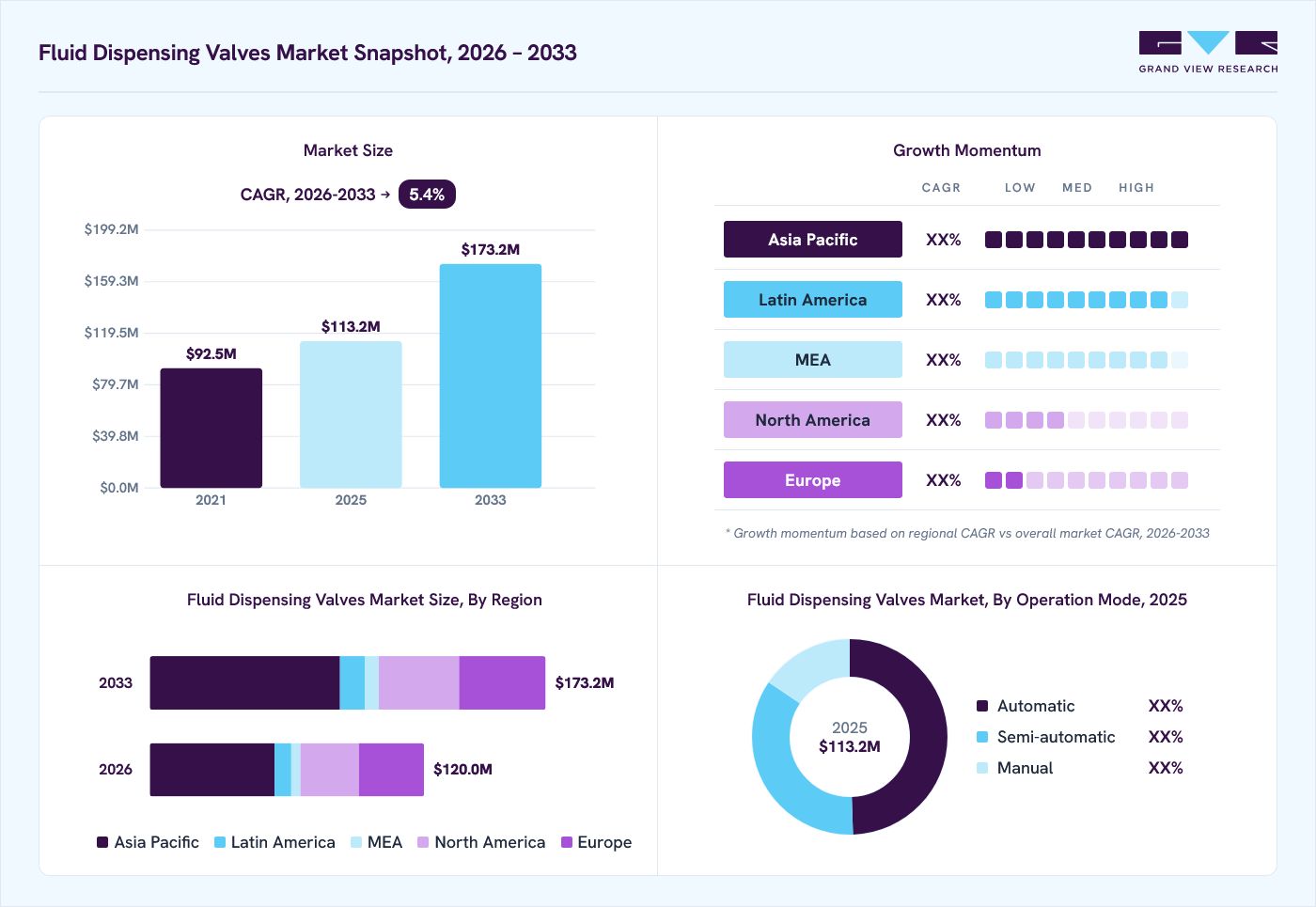
The global fluid dispensing valves market size was valued at USD 113.2 million in 2025 and is projected to grow from USD 120.0 million in 2026 to USD 173.2 million by 2033, at a CAGR of 5.4% from 2026 to 2033. Asia Pacific dominated the market, accounting for a revenue share of 45.1% in 2025. The global market is driven by the increasing adoption of automated manufacturing processes that require consistent and repeatable fluid delivery.
 Source: Grand View Research, IR Documents, Primary Interviews, Paid DatabasesTo learn more about this report,
 Download Free Sample Report
 Key Market Trends & Insights
- By valve: Spray valves segment is projected to grow at 6.0% CAGR during the forecast period.
- By operation mode: Automatic segment dominated the market in 2025, accounting for 49.4% market share.
- By end use: Automotive segment is expected to grow at 5.6% from 2026 to 2033.
Regional Highlights
- Largest regional market: Asia Pacific (45.1% revenue share, 2025)
- By country: China held the largest share in the Asia Pacific region in 2025.
Market Size & Forecast
- Market Size in 2025: USD 113.2 Million
- Estimated Market Size in 2026: USD 120.0 Million
- Projected Market Size by 2033: USD 173.2 Million
- CAGR (2026-2033): 5.4%
Three ways to get this report
Buy it, customize it, or ask a question.Ask an Analyst
A direct answer, usually in 1 working day
- AccessReport author, directly
- Reply timeWithin 1 working day
- No sales callDirect answer only
- FormatEmail reply
- CostFree, no cost
Get the Full Report
What the study covers
- FormatsPDF · Excel · Dashboard
- Timeline2026–2033 annual, 2025 base
- Coverage20+ countries, 5 regions
- Companies10+ key players profiled
Customize the Report
20% free customization
- IncludeCountries, segments, points
- TailorTo your product definition
- ExtendDeeper competitor detail
- OrA fully bespoke study
- Turnaround5–10 working days
Manufacturers are replacing manual dispensing operations with semi-automatic and automatic valve-based systems to improve cycle consistency, control material consumption, and maintain production throughput. This trend is particularly relevant across electronics, automotive, medical devices, and general manufacturing, where production lines increasingly incorporate automated dispensing into assembly and material-application processes.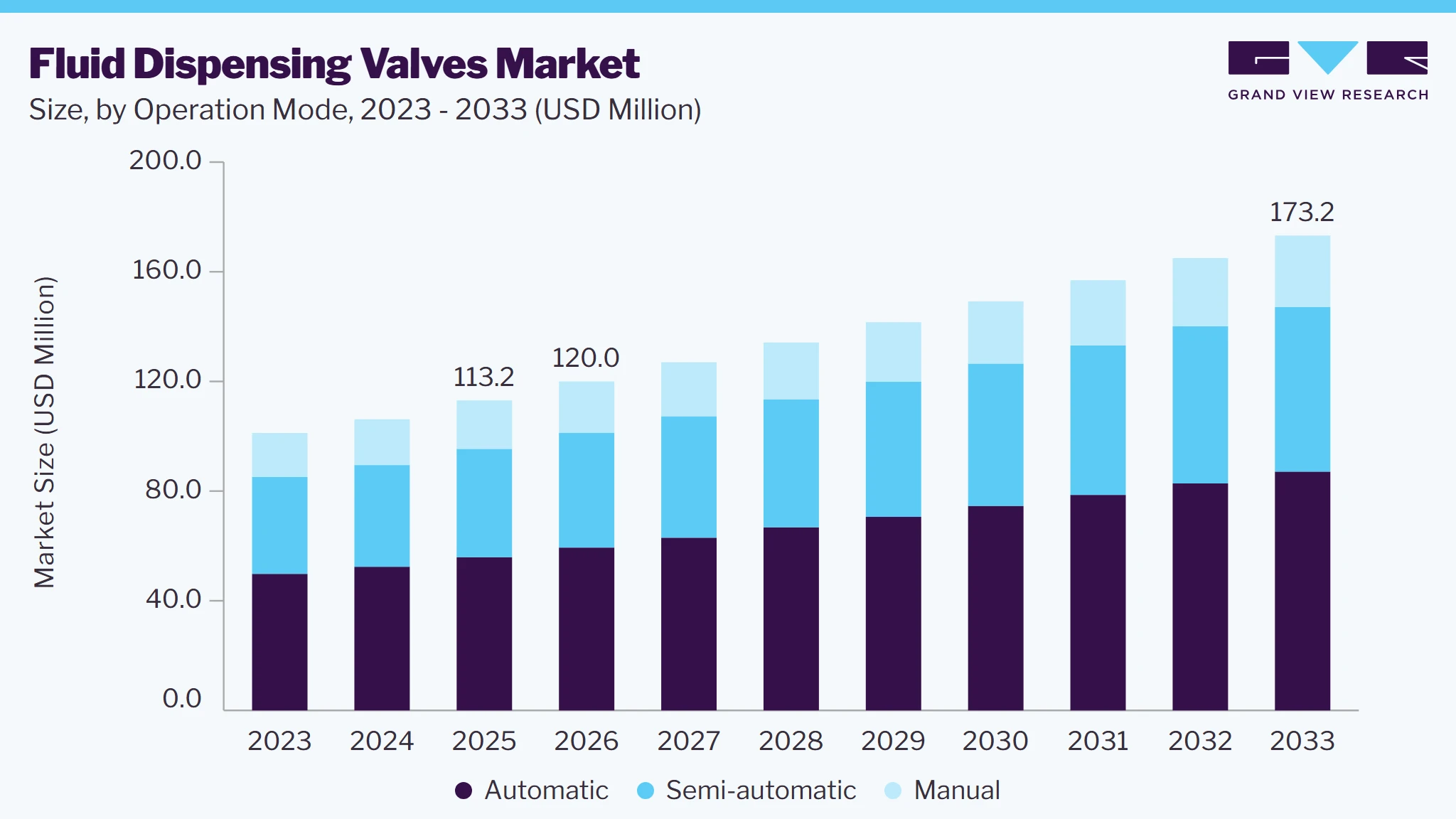 To learn more about this report, Download Free Sample Report
 In addition, the growing complexity and miniaturization of manufactured components are creating demand for valves capable of delivering small and accurately controlled fluid quantities. Applications involving adhesives, sealants, lubricants, coatings, and other specialty materials require valve configurations matched to specific viscosity, flow, pressure, and dispensing-volume requirements. Manufacturers are therefore developing needle, diaphragm, spray, spool, and other specialized valve designs with improved shutoff, response, and material compatibility, creating opportunities for higher-value dispensing solutions.
Market Dynamics
The global market for fluid dispensing valves is shaped by the increasing need for controlled fluid delivery, consistent dispensing performance, and greater process efficiency across industrial production environments. Market development is closely associated with the expansion of automated assembly, tighter material utilization requirements, and the need to manage fluids with varying viscosity, pressure, and chemical characteristics. Manufacturers are concentrating on valve designs that improve flow regulation, response time, sealing performance, and operational reliability.
The increasing integration of automation into production lines is creating sustained demand for automatic and semi-automatic fluid dispensing valves. Automated valve operation enables repeatable fluid delivery, consistent cycle performance, and improved control over dispensing volumes while reducing dependence on manual intervention. Growth in automated assembly, precision component manufacturing, and high-volume production is prompting manufacturers to replace conventional manual dispensing processes with equipment that delivers greater consistency and throughput.
Variations in fluid viscosity, temperature, chemical composition, pressure, and curing characteristics can affect valve performance and dispensing consistency. Different materials may require specific wetted components, sealing materials, actuation mechanisms, or flow-control arrangements to maintain reliable operation. This limits the applicability of standardized valve designs across diverse applications and can increase engineering, qualification, and procurement costs for specialized dispensing requirements.
Technological developments in valve actuation, electronic controls, sensors, and dispensing-system integration are creating opportunities for higher-performance products. Advanced valves can provide more precise flow regulation, faster response, improved repeatability, and greater control over dispensing parameters. Integration with digitally controlled production equipment can enable real-time process adjustment and monitoring, while compact and application-specific designs can address space constraints and specialized fluid-handling requirements. These developments create opportunities for manufacturers to differentiate through precision, reliability, customization, and automation compatibility.
Market Concentration & Characteristics
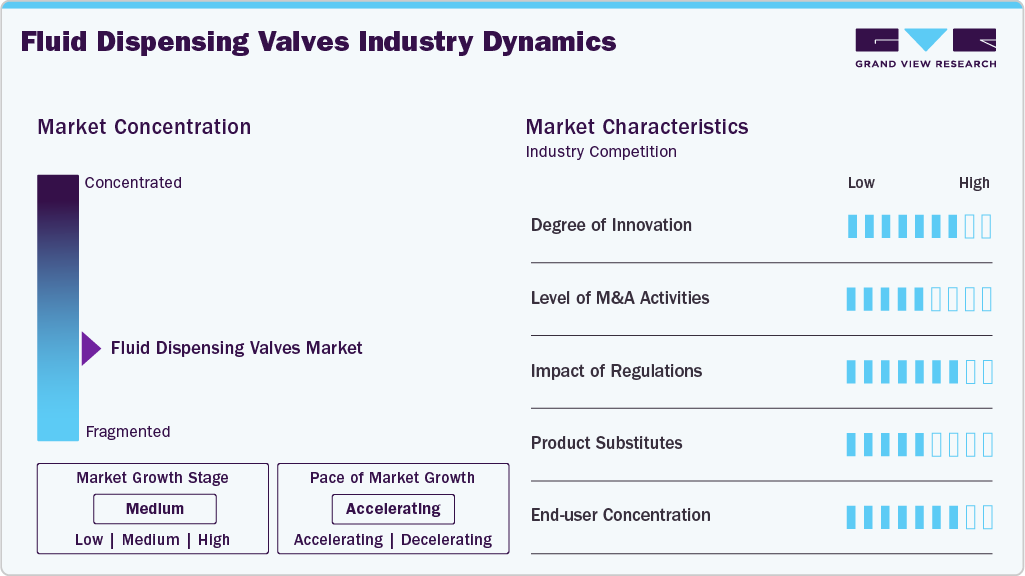
The global fluid dispensing valves industry comprises specialized valve manufacturers and diversified dispensing-equipment companies with dedicated valve product portfolios. Competition is structured around different valve architectures, including needle, spray, diaphragm, pinch tube, spool, and other configurations, each designed for specific dispensing patterns and fluid-handling requirements. Manufacturers differentiate their offerings through valve construction, actuation mechanism, flow-control characteristics, pressure capability, sealing design, and compatibility with different fluid types and viscosities.
Product portfolios are generally differentiated at the series and configuration level, with valves available in different sizes, flow capacities, operating pressures, wetted materials, and actuation arrangements. Manufacturers offer application-specific configurations for controlled deposition patterns such as dots, beads, sprays, coatings, and fills. Product selection is influenced by dispensing volume, fluid characteristics, required accuracy, operating conditions, cycle frequency, and compatibility with the associated dispensing equipment, creating distinct product niches within the valve market.
 To learn more about this report, Download Free Sample Report
 Competitive positioning also depends on manufacturers’ ability to provide customized valve configurations, application engineering, technical support, and consistent product quality. Suppliers with established manufacturing capabilities and broader valve portfolios can address varied dispensing requirements, while specialized companies differentiate through precision valve technologies, compact designs, high-speed operation, specialized fluid paths, and application-specific solutions. The market therefore exhibits competition based on valve design, configuration flexibility, technical specialization, product reliability, and application suitability, rather than solely on production scale or geographic presence.
Analyst Perspective
The market is moving toward specialized and automated solutions as manufacturers prioritize dispensing precision, process consistency, material efficiency, and production flexibility. Demand remains diversified across valve configurations, with product selection increasingly influenced by fluid properties, dispensing accuracy, operating pressure, cycle frequency, and equipment compatibility. Electronics, automotive, medical devices, and general manufacturing remain important demand areas, particularly where production processes require repeatable and controlled fluid delivery. Market opportunities are also expanding through automation upgrades and replacement of conventional valves, while manufacturers are differentiating through reliability, customization, integration capabilities, and compatibility with a broader range of fluids.
Operation Mode Insights
The automatic operation segment held the largest revenue share in 2025, reflecting its established use in production environments requiring controlled and repeatable valve actuation. Automatic valves are well suited to high-cycle applications, where precise timing, consistent material flow, and integration with automated equipment are required. Their adoption is particularly relevant in manufacturing processes involving continuous or repetitive dispensing operations.
Semi-automatic operation is projected to grow at a CAGR of 5.3% during the forecast period. This mode provides a practical balance between operator control and automated valve actuation, making it suitable for applications with variable production volumes, product configurations, or dispensing requirements. Semi-automatic setups can also accommodate a broad range of fluid viscosities while allowing operators to initiate and adjust individual dispensing cycles.
Valve Insights
The needle dispensing valves segment generated the largest revenue share of 29.3% in 2025. Their established use across precision fluid application processes is attributed to accurate material deposition, controlled flow, and dependable shutoff. The valves are suitable for dispensing adhesives, sealants, lubricants, and other process fluids in applications requiring consistent dot or bead formation. Their availability in varied needle sizes and configurations enables manufacturers to select products according to fluid properties, dispensing volume, and process specifications.
Spray valves are projected to register the fastest CAGR during the forecast period, reflecting their growing suitability for applications requiring controlled and uniform surface coverage. These valves enable the distribution of fluids in defined spray patterns and are applicable to coatings, lubricants, adhesives, and protective materials. Their compatibility with automated dispensing processes makes them suitable for production environments that require consistent coverage, controlled material usage, and repeatable application.
End Use Insights
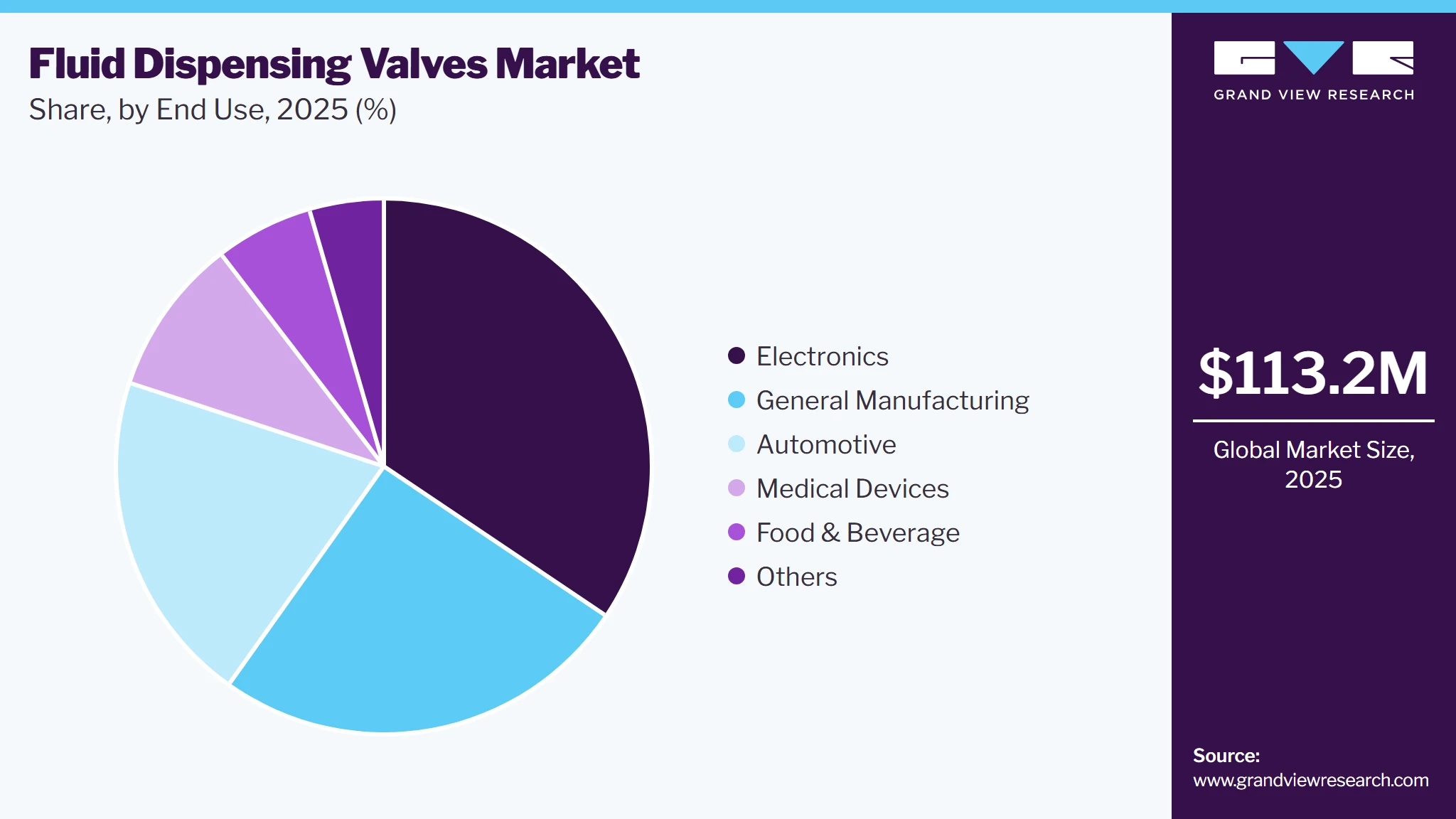
The electronics segment held the largest revenue share of 34.5% in the market in 2025. Fluid dispensing valves are extensively applied in electronic assembly and semiconductor-related processes for depositing adhesives, encapsulants, coatings, solder materials, and other functional fluids. The increasing density of electronic assemblies requires controlled deposition at small volumes and defined locations, making valve selection important for maintaining application accuracy and minimizing material variation.
 To learn more about this report, Download Free Sample Report
 The automotive sector is projected to register a strong CAGR during the forecast period, supported by the expanding use of dispensing valves in bonding, sealing, lubrication, coating, and thermal management processes. Applications extend across vehicle components, electronic modules, switches, lighting systems, and battery-related assemblies. The use of automated production equipment and tighter requirements for material placement are creating demand for valve configurations capable of handling different viscosities, pressures, and dispensing patterns.
Regional Insights
Asia Pacific Fluid Dispensing Valves Market Trends
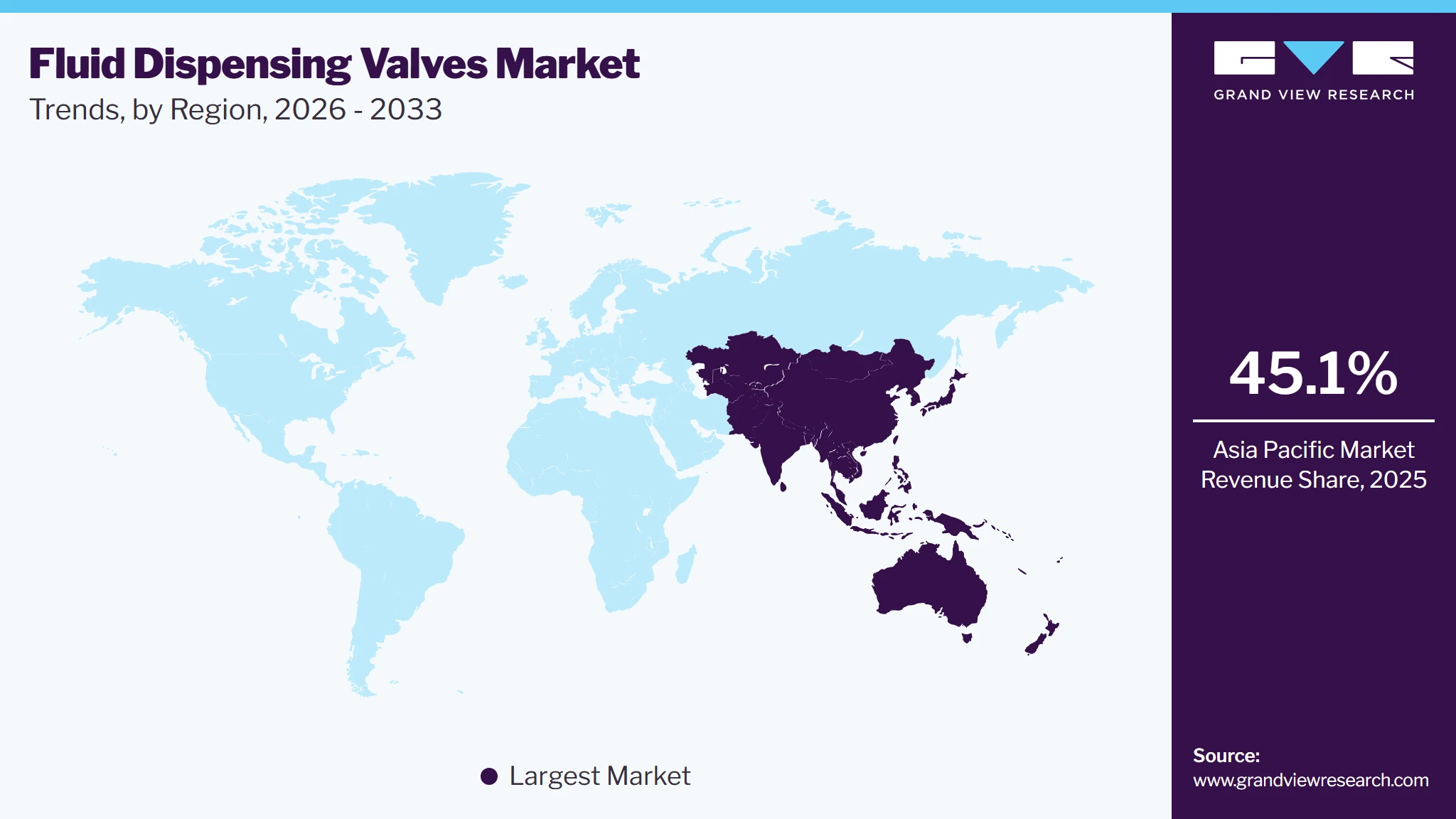
The fluid dispensing valves industry in Asia Pacific dominated the global market with a revenue share of 45.1% in 2025, and it is also expected to grow at the fastest CAGR over the forecast period. The Asia Pacific market presents substantial opportunities, supported by its extensive manufacturing base and continued expansion of electronics, automotive, medical device, food & beverage, and general industrial production. Increasing automation of assembly and material application processes is strengthening the need for valves capable of delivering consistent volumes and precise flow rates. The region's expanding industrial equipment ecosystem also supports the development and integration of dispensing solutions across diverse production environments.
 To learn more about this report, Download Free Sample Report
 China Fluid Dispensing Valves Market Trends
China fluid dispensing valves industry has significant potential for fluid dispensing valve suppliers because of its broad manufacturing base spanning electronics, automotive components, machinery, consumer products, and industrial equipment. Increasing automation across production facilities is encouraging the adoption of automatic and semi-automatic dispensing configurations, while electronics and precision manufacturing require tighter control over fluid deposition. Local availability of industrial components and established equipment manufacturing capabilities also support the development of competitively positioned valve solutions.
The fluid dispensing valves industry in India is benefiting from expanding manufacturing capacity across electronics, automotive, pharmaceuticals, medical devices, food processing, and general industrial production. Government-backed manufacturing initiatives and investments in automated production facilities are encouraging the integration of precision dispensing equipment into newer production lines. Demand is also developing as manufacturers modernize existing processes to improve throughput, reduce material losses, and achieve greater consistency in repetitive dispensing operations.
North America Fluid Dispensing Valves Market Trends
The fluid dispensing valves industry in North America is supported by a well-established industrial base with fluid dispensing valve demand linked to advanced manufacturing, electronics, automotive, medical devices, aerospace, and food processing. Manufacturers are increasingly incorporating automated material application and assembly processes that require accurate and repeatable fluid delivery. The presence of sophisticated production systems and emphasis on process control also creates demand for valves with enhanced precision, durability, and equipment-integration capabilities.
The fluid dispensing valves industry in the U.S. offers broad opportunities for fluid dispensing valve manufacturers across electronics, automotive, medical technology, aerospace, industrial machinery, and food & beverage production. Investment in advanced manufacturing facilities is increasing the integration of automated dispensing equipment, particularly in processes requiring consistent application volumes and high cycle repeatability. Demand for specialized valve configurations is also supported by the diversity of fluids and operating conditions encountered across U.S. manufacturing operations.
The Canada fluid dispensing valves industry is associated with its automotive, food processing, pharmaceutical, electronics, and general manufacturing activities. Adoption of automated production equipment is creating requirements for dispensing valves that can maintain reliable operation across repetitive manufacturing cycles. Opportunities are also emerging from facility modernization and equipment replacement, where manufacturers are upgrading dispensing processes to improve accuracy and production efficiency.
Europe Fluid Dispensing Valves Market Trends
The fluid dispensing valves industry in Europe represents an established market for fluid dispensing valves, supported by advanced manufacturing capabilities and strong activity in automotive, electronics, medical technology, machinery, food processing, and industrial production. The region's emphasis on manufacturing efficiency, resource optimization, and process automation is encouraging the use of precision dispensing equipment. Demand is particularly relevant for valve solutions that can integrate with automated production lines while maintaining consistent dispensing performance.
Germany fluid dispensing valves industry provides a strong addressable market through its automotive manufacturing, industrial machinery, electronics, medical technology, and engineering sectors. The country's highly automated production environment creates requirements for dispensing valves capable of precise, repeatable operation at high production frequencies. Development of advanced manufacturing systems is also creating demand for valves that can integrate with digitally controlled equipment and specialized dispensing platforms.
The fluid dispensing valves industry in France offers opportunities across automotive, aerospace, pharmaceuticals, food processing, electronics, and industrial manufacturing. Investments in production modernization and automated assembly are creating requirements for controlled fluid application and reliable valve operation. Demand is also supported by manufacturers seeking dispensing solutions that can accommodate application-specific fluid characteristics and production tolerances.
Middle East & Africa Fluid Dispensing Valves Market Trends
The fluid dispensing valves industry in Middle East & Africa is developing alongside investments in manufacturing, pharmaceuticals, food processing, packaging, automotive-related production, and industrial infrastructure. Expansion of localized production capabilities is creating requirements for equipment that can support consistent material application and automated manufacturing processes. Demand varies across countries according to the scale of industrialization, manufacturing investment, and adoption of automated production technologies.
Saudi Arabia fluid dispensing valves industry is creating opportunities for fluid dispensing valve suppliers through industrial diversification, development of manufacturing facilities, pharmaceutical production, food processing, and investments in advanced production infrastructure. The expansion of non-oil manufacturing activities is increasing the need for production equipment capable of controlled and repeatable material dispensing. Automated and semi-automatic valve configurations can address requirements associated with higher production consistency and reduced manual intervention.
Latin America Fluid Dispensing Valves Market Trends
Latin America's fluid dispensing valves industry is supported by manufacturing activity across food & beverage, automotive, pharmaceuticals, electronics, packaging, and general industrial production. Modernization of production facilities and gradual adoption of automated manufacturing technologies are creating demand for more consistent and controllable fluid application. Market opportunities differ across countries based on industrial output, manufacturing investment, and the pace of automation deployment.
The fluid dispensing valves industry in Brazil offers opportunities for manufacturers through its diversified food & beverage, automotive, pharmaceutical, chemical, electronics, and general manufacturing sectors. Expansion and modernization of production facilities are encouraging the use of automated equipment for repetitive dispensing processes. The country's broad industrial base also creates demand for multiple valve configurations capable of handling different fluid properties, dispensing volumes, and operating requirements.
Key Fluid Dispensing Valves Company Insights
Some of the key players operating in the market include Nordson Corporation, Fisnar, among others.
-
Nordson Corporation specializes in precision fluid dispensing technologies and offers a broad portfolio of dispensing valves for controlled application of adhesives, sealants, lubricants, coatings, and other process fluids. Its valve portfolio includes needle, diaphragm, piston, spray, auger, high-pressure, and jetting configurations designed to meet different dispensing volumes, fluid characteristics, and process requirements. The company serves diverse manufacturing applications, including electronics, automotive, medical devices, aerospace, and general industrial production, with an emphasis on dispensing accuracy, repeatability, reliability, and automated process integration.
-
Fisnar specializes in fluid dispensing technologies and provides a broad range of dispensing valves designed for different fluid properties, application patterns, and production requirements. Its portfolio includes needle, diaphragm, pinch tube, poppet, spool, spray, jetting, positive displacement, and progressive cavity valves, covering applications from low-volume precision dispensing to high-viscosity material handling. The company also offers valve controllers and related dispensing components, enabling its products to be configured for controlled and repeatable fluid application across industrial manufacturing processes.
Key Fluid Dispensing Valves Companies:
The following key companies have been profiled for this study on the fluid dispensing valves market.
-
Nordson Corporation
-
Fisnar
-
Graco Inc.
-
Techcon Systems
-
DOPAG
-
PVA
-
Musashi Engineering, Inc.
-
VERMES Microdispensing GmbH
-
MARCO System Analysis and Development GmbH
-
Iwashita Engineering, Inc.
-
SAN-EI TECH LTD.
-
Dymax Corporation
-
DAV Tech Srl
-
Axxon
-
SPX FLOW
Competitive Benchmarking
Category
Operating Strategies
Competitive Edge
Weakness
Established Players (e.g., Nordson Corporation; Fisnar; Graco Inc.; Techcon Systems; DOPAG; Musashi Engineering, Inc.; VERMES Microdispensing GmbH; MARCO System Analysis and Development GmbH; Iwashita Engineering, Inc.)
- Expand portfolios across needle, diaphragm, spray, pinch tube, spool, jetting, and other dispensing valve configurations for varied fluid and process requirements.
Strengthening application engineering, product development, technical support, distribution networks, and customized valve solutions.
- Broad valve portfolios established customer relationships, and extensive application expertise.
Strong capabilities in precision fluid control, valve customization, and integration with automated dispensing processes.
- High R&D, manufacturing, testing, and engineering costs can increase operating expenses.
Managing diverse valve technologies and configurations can increase product-development and operational complexity.
Emerging & Regional Players (e.g., PVA; SAN-EI TECH LTD.; Dymax Corporation; DAV Tech Srl; Axxon; SPX FLOW)
- Focus on specialized needle, diaphragm, spray, jetting, and other precision dispensing valve configurations.
Expand market access through customized product development, regional distribution partnerships, and targeted industrial applications.
- Strong specialization, flexible product development, and customization capabilities for application-specific requirements.
Ability to address niche dispensing applications involving specific fluid properties, dispensing patterns, and process conditions.
- More limited geographic coverage, manufacturing scale, and brand visibility than some multinational suppliers.
Narrower portfolios or distribution networks may constrain access to large multinational customers and high-volume applications.
Recent Developments:
-
On May 21, 2026, Graco Inc. announced an agreement to acquire Valco Melton for USD 447 million in cash. Valco Melton specializes in precision adhesive application and quality-assurance technologies for packaging and industrial manufacturing. The acquisition will broaden Graco’s capabilities in adhesive and sealant dispensing, complement its existing fluid-handling portfolio, and strengthen its position in precision dispensing applications. Valco Melton generated approximately USD 145 million in revenue in 2025, and the business is expected to become part of Graco’s Industrial division following completion of the transaction.
-
On March 2, 2026, ITT Inc. completed its acquisition of SPX FLOW for approximately USD 4.8 billion. SPX FLOW’s portfolio includes engineered fluid-handling technologies such as pumps, valves, mixing, separation, and thermal processing equipment. The acquisition expands ITT’s capabilities in fluid-management technologies and strengthens its product portfolio across industrial applications, including technologies relevant to controlled fluid flow and valve-based processes.
Fluid Dispensing Valves Market Report Scope
Report Attribute
Details
Market size in 2025
USD 113.2 million
Estimated Market size in 2026
USD 120.0 million
Projected Market Size by 2033
USD 173.2 million
Growth rate
CAGR of 5.4% from 2026 to 2033
Base year for estimation
2025
Historical data
2021-2024
Forecast period
2026 - 2033
Quantitative units
Revenue in USD million and CAGR from 2026 to 2033
Report coverage
Revenue forecast, company market position analysis, competitive landscape, growth factors, and trends
Segments covered
Valve, operation mode, end use, region
Regional scope
North America; Europe; Asia Pacific; Latin America; Middle East & Africa
Country Scope
U.S.; Canada; Mexico; Germany; UK; Italy; Spain; France; China; Japan; India; Australia; South Korea; Brazil; Argentina; Saudi Arabia; UAE; South Africa
Key companies profiled
Nordson Corporation; Fisnar; Graco Inc.; Techcon Systems; DOPAG; PVA; Musashi Engineering, Inc.; VERMES Microdispensing GmbH; MARCO System Analysis and Development GmbH; Iwashita Engineering, Inc.; SAN-EI TECH LTD.; Dymax Corporation; DAV Tech Srl; Axxon; SPX FLOW.
Customization scope
Free report customization (equivalent up to 8 analysts working days) with purchase. Addition or alteration to country, regional & segment scope.
Pricing and purchase options
Avail customized purchase options to meet your exact research needs. Explore purchase options
Global Fluid Dispensing Valves Market Report Segmentation
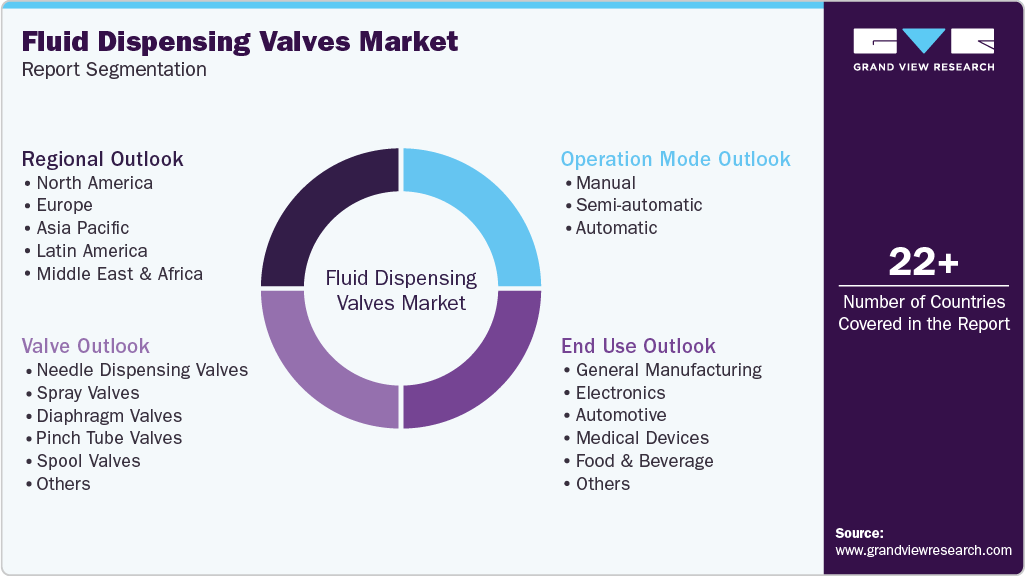
This report forecasts revenue growth at global, regional & country levels and provides an analysis on the industry trends in each of the sub-segments from 2021 to 2033. For this study, Grand View Research has segmented the global fluid dispensing valves market report based on valve, operation mode, end use, and region:
 To learn more about this report, Download Free Sample Report
 -
Valve Outlook (Revenue, USD Million, 2021 - 2033)
-
Needle Dispensing Valves
-
Spray Valves
-
Diaphragm Valves
-
Pinch Tube Valves
-
Spool Valves
-
Others
-
-
Operation Mode Outlook (Revenue, USD Million, 2021 - 2033)
-
Manual
-
Semi-automatic
-
Automatic
-
-
End Use Outlook (Revenue, USD Million, 2021 - 2033)
-
General Manufacturing
-
Electronics
-
Automotive
-
Medical Devices
-
Food & Beverage
-
Others
-
-
Regional Outlook (Revenue, USD Million, 2021 - 2033)
-
North America
-
U.S.
-
Canada
-
Mexico
-
-
Europe
-
Germany
-
France
-
UK
-
Spain
-
Italy
-
-
Asia Pacific
-
China
-
India
-
Japan
-
South Korea
-
Australia
-
-
Latin America
-
Brazil
-
Argentina
-
-
Middle East & Africa
-
Saudi Arabia
-
UAE
-
South Africa
-
-
Research Methodology
The fluid dispensing valves market figures in this report are based on a proven research process that combines executive interviews with secondary research from proprietary databases, company filings, and recognized regulatory and institutional sources. Market size is built through value-chain sizing—reconciling supply-side and demand-side estimates—and triangulated with bottom-up and top-down approaches. Every estimate passes multiple levels of expert validation before publication, with each fluid dispensing valves segment quantified using the revenue-capture definitions in the table below.
Segment Definition
Valve
Revenue Capture Definition
Needle Dispensing Valves
Revenue generated from the sale of needle dispensing valves that provide precise and controlled fluid delivery through a needle mechanism, including standalone units and standard assemblies.
Spray Valves
Revenue generated from the sale of spray valves designed to deliver fluids in controlled spray, mist, or atomized patterns, including commercially supplied valve units and assemblies.
Diaphragm Valves
Revenue generated from the sale of diaphragm valves that regulate fluid dispensing through a flexible membrane, covering standalone products and standard valve configurations.
Pinch Tube Valves
Revenue generated from the sale of pinch tube valves that control fluid flow by compressing or releasing a flexible tube, including complete valve units and standard assemblies.
Spool Valves
Revenue generated from the sale of spool valves that regulate fluid delivery through the movement of an internal spool, including standalone valves and commercially supplied configurations.
Others
Revenue generated from the sale of fluid dispensing valves outside the defined needle, spray, diaphragm, pinch tube, and spool categories.
Operation Mode
Revenue Capture Definition
Manual
Revenue generated from the sale of manually operated fluid dispensing valves that require direct operator control for valve actuation and fluid delivery.
Semi-automatic
Revenue generated from the sale of semi-automatic fluid dispensing valves that combine operator intervention with mechanical, pneumatic, or electronic actuation.
Automatic
Revenue generated from the sale of automatically actuated fluid dispensing valves that regulate fluid delivery through programmed, electronic, pneumatic, or sensor-based controls.
End Use
Revenue Capture Definition
General Manufacturing
Revenue generated from the sale of fluid dispensing valves to general manufacturing customers across production and assembly operations requiring controlled fluid delivery.
Electronics
Revenue generated from the sale of fluid dispensing valves to electronics manufacturers for precision fluid application and controlled material deposition during production.
Automotive
Revenue generated from the sale of fluid dispensing valves to automotive manufacturers and component producers for controlled fluid delivery within manufacturing operations.
Medical Devices
Revenue generated from the sale of fluid dispensing valves to medical device manufacturers requiring precise and consistent fluid delivery during device production and assembly.
Food & Beverage
Revenue generated from the sale of fluid dispensing valves to food and beverage manufacturers for controlled dispensing of liquid and semi-liquid materials during production and packaging.
Others
Revenue generated from the sale of fluid dispensing valves to end-use customers outside general manufacturing, electronics, automotive, medical devices, food & beverage.
Estimation Model
Layer No.
Layer Name
Key Question
Description
01
Fluid Dispensing Demand Layer
Where is demand for fluid dispensing valves generated?
Assess demand for fluid dispensing valves across general manufacturing, electronics, automotive, medical devices, food & beverage, and other end-use industries. Evaluate dispensing requirements based on fluid characteristics, viscosity, required volume, flow-rate precision, operating pressure, dispensing frequency, and production needs to establish the addressable demand for valve equipment.
02
Production & Equipment Investment Layer
Where is incremental valve demand being created?
Analyze investments in new manufacturing facilities, production-line expansions, automation initiatives, process upgrades, and dispensing equipment installations that create requirements for fluid dispensing valves. Account for new production capacity, modernization of existing lines, replacement of installed valves, and expansion of automated dispensing operations to quantify incremental equipment demand.
03
Valve Configuration & Operation Adoption Layer
What types of fluid dispensing valves are being adopted?
Evaluate adoption across needle dispensing, spray, diaphragm, pinch tube, spool, and other valves, along with manual, semi-automatic, and automatic operating modes. Adoption is assessed based on dispensing accuracy, fluid viscosity, material compatibility, flow-rate requirements, operating pressure, cycle frequency, automation level, and process-control specifications.
04
Revenue Generation Layer
How much revenue is generated from fluid dispensing valve sales?
Estimate annual unit sales and revenues for fluid dispensing valves by valve, operation mode, end-use industry, and region. Revenue is derived from manufacturer selling prices, product configuration, valve specifications, automation level, application requirements, and regional pricing variations.
Customization Table
This report has been delivered with the following In-depth customizations
CLIENT REQUEST
CUSTOMIZATION DELIVERED
VALUE ADDS
Competitive Benchmarking
A comprehensive competitive benchmarking assessment was conducted for prominent global fluid dispensing valve manufacturers, covering valve portfolios, operation modes, dispensing accuracy, flow-control capabilities, fluid compatibility, automation features, product specifications, application coverage, manufacturing capabilities, distribution reach, pricing approaches, strategic developments, and geographic presence.
Enabled stakeholders to assess competitive positioning, compare product and technology portfolios, identify areas of differentiation across valves and operation modes, evaluate manufacturer capabilities, and inform product positioning and competitive strategy.
Regional Segmentation
A detailed regional assessment was conducted across North America, Europe, Asia Pacific, Latin America, and the Middle East & Africa, evaluating fluid dispensing valve demand across general manufacturing, electronics, automotive, medical devices, food & beverage, and other end-use industries. The assessment considered manufacturing output, production capacity additions, industrial automation, investment in dispensing equipment, replacement requirements, and adoption of automated dispensing solutions.
Provided stakeholders with a structured view of regional market potential, variations in product adoption, end-use demand patterns, and competitive conditions, supporting geographic prioritization, distribution planning, and market expansion decisions.
Opportunity Assessment
A comprehensive opportunity assessment was conducted by analyzing production capacity expansion, manufacturing automation, process modernization, new facility investments, and replacement demand across key end-use industries. Opportunities were evaluated across needle dispensing, spray, diaphragm, pinch tube, spool, and other valves, as well as manual, semi-automatic, and automatic operation modes.
Helped stakeholders identify attractive revenue pools, prioritize high-potential valves and operation modes, assess opportunities arising from automation and equipment modernization, guide product development priorities, and support investment and market-entry decisions.
Frequently Asked Questions About This Report
The global fluid dispensing valves market size was valued at USD 113.2 million in 2025 and is projected to reach USD 120.0 million in 2026.
The global fluid dispensing valves market is projected to grow at a CAGR of 5.4% from 2026 to 2033, reaching USD 173.2 million by 2033.
Key factors include increasing adoption of automated manufacturing, growing use of adhesives, sealants, lubricants, coatings, and encapsulants, demand for controlled material deposition, and greater requirements for repeatable dispensing across industrial production processes.
Asia Pacific dominated the global fluid dispensing valves market with a revenue share of 45.1% in 2025, driven by its extensive electronics, automotive, and industrial manufacturing base and increasing adoption of automated production processes.
China led the Asia Pacific fluid dispensing valves market in 2025, reflecting its extensive electronics, automotive, machinery, and general manufacturing base and continued deployment of automated production equipment.
The spray valves segment is projected to grow at a CAGR of 6.0% during the forecast period, driven by its suitability for controlled and uniform application of coatings, lubricants, adhesives, and other process fluids.
The automatic segment dominated the market in 2025, accounting for a 49.4% revenue share.
The electronics segment is projected to grow at a CAGR of 5.8% from 2026 to 2033, driven by increasing use of dispensing valves in bonding, sealing, lubrication, coating, and other fluid-application processes.
Key players include Nordson Corporation, Fisnar, Graco Inc., Techcon Systems, DOPAG, PVA, Musashi Engineering, Inc., VERMES Microdispensing GmbH, MARCO System Analysis and Development GmbH, Iwashita Engineering, Inc., SAN-EI TECH LTD., Dymax Corporation, DAV Tech Srl, Axxon, and SPX FLOW.
About the Author(s)
Advanced Interior Materials Research Team
Advanced Materials · Advanced Interior MaterialsThis report was authored by the advanced interior materials research team at Grand View Research - comprising two research analysts, one senior research analyst, and one industry expert - with specialized expertise in the advanced interior materials segment of the advanced materials industry. All findings are based on proprietary advanced materials databases, executive interviews, and regulatory analysis, subject to internal peer review prior to publication.
Last Updated:
Speak to Analyst

Customize this report to your needs - add regions, segments, or data points, with 20% free customization.
Or view our licence options:


ISO 9001:2015 & 27001:2022 Certified
We are GDPR and CCPA compliant! Your transaction & personal information is safe and secure. For more details, please read our privacy policy.


