
- Home
- »
- Medical Devices
- »
-
Fluorescence Microscopy Market Size Report, 2026-2033GVR Report cover
![Fluorescence Microscopy Market (2026 - 2033)Report]()
Fluorescence Microscopy Market (2026 - 2033)
Size, Share & Trends Analysis Report By Type (Upright Fluorescence Microscopy, Inverted Fluorescence Microscopy), By Application (Life Science, Material Science, Semiconductors, Nanotechnology), By Region, And Segment Forecasts
Market Size, 2025
$567.1MMarket Estimate, 2026
$614.8MMarket Forecast, 2033
$1,124.9MCAGR, 2026–2033
9.0%Fluorescence Microscopy Market Summary
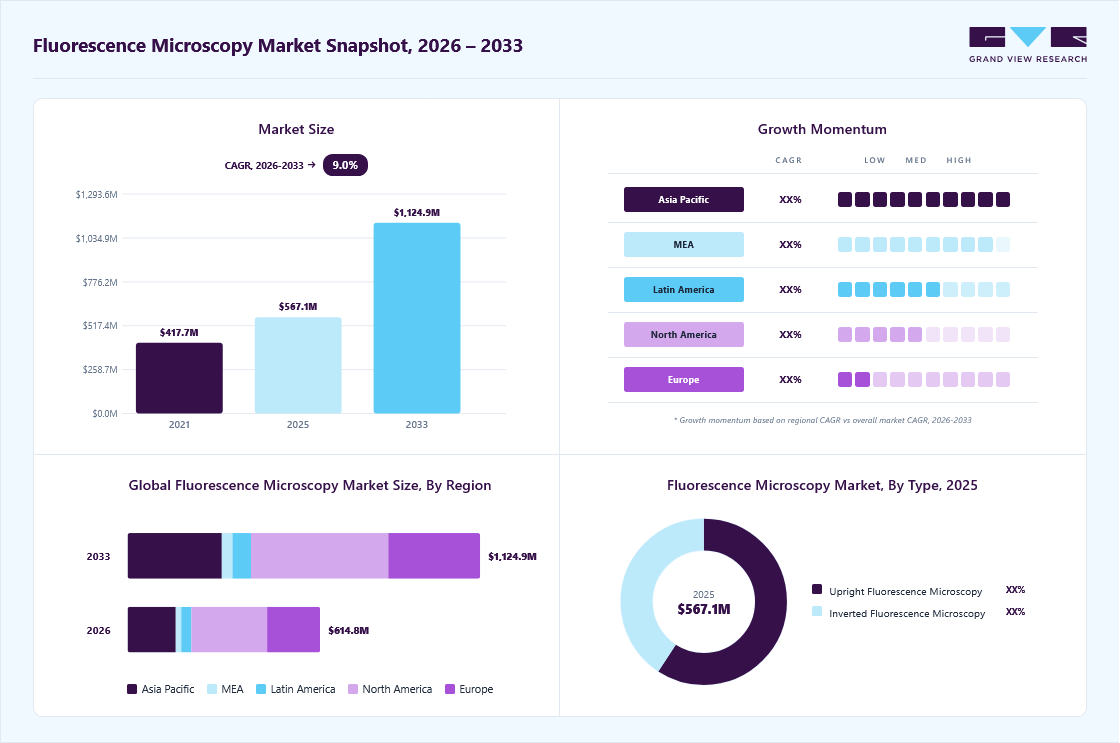
The global fluorescence microscopy market size was valued at USD 567.1 million in 2025 and is projected to grow from USD 614.8 million in 2026 to USD 1124.9 million by 2033, at a CAGR of 9.0% from 2026 to 2033. The North America held the largest share of 39.4% of the global market in 2025. Increasing investments in life sciences and biomedical research are driving demand for advanced imaging technologies, particularly for cellular and molecular analysis.
Key Market Trends & Insights
- By type: Upright fluorescence microscopy segment held the largest market share in 2025.
- By application: Semiconductors segment accounted for the largest market share of 32.4% in 2025.
Regional Highlights
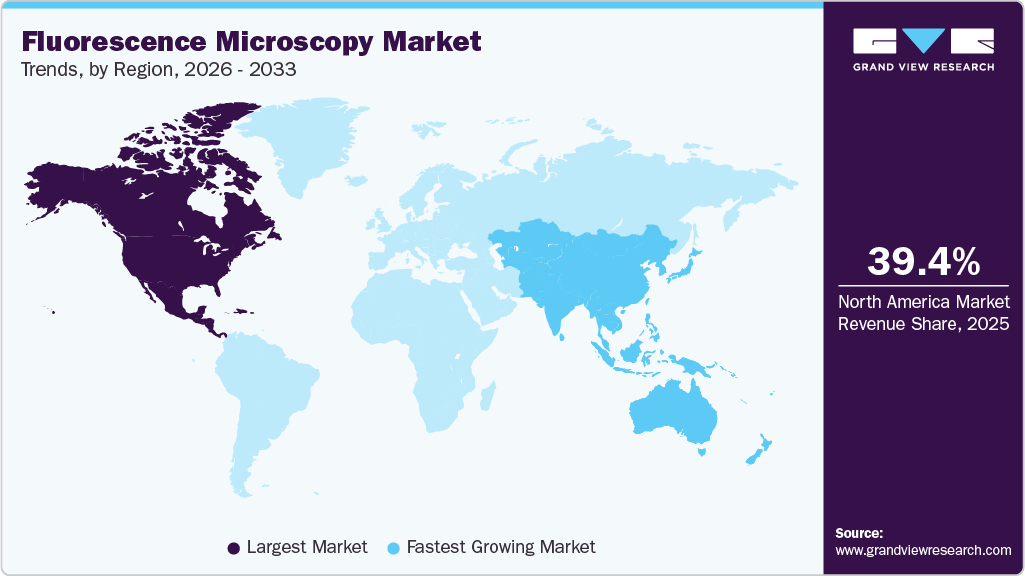
- Largest regional market: North America (39.4% market share, 2025)
- Fastest-growing regional market: Asia Pacific (highest CAGR, 2026-2033)
- By country: The U.S. held the largest market share in 2025.
Market Size & Forecast
- Market size in 2025: USD 567.1 Million
- Estimated market size in 2026: USD 614.8 Million
- Projected market size by 2033: USD 1124.9 Million
- CAGR (2026-2033): 9.0%
Three ways to get this report
Buy it, customize it, or ask a question.Ask an Analyst
A direct answer, usually in 1 working day
- AccessReport author, directly
- Reply timeWithin 1 working day
- No sales callDirect answer only
- FormatEmail reply
- CostFree, no cost
Get the Full Report
What the study covers
- FormatsPDF · Excel · Dashboard
- Timeline2026–2033 annual, 2025 base
- Coverage20+ countries, 5 regions
- Companies10+ key players profiled
Customize the Report
20% free customization
- IncludeCountries, segments, points
- TailorTo your product definition
- ExtendDeeper competitor detail
- OrA fully bespoke study
- Turnaround5–10 working days
The growing focus on precision medicine and early disease detection further supports adoption. The section below outlines the key factors driving the growth of the fluorescence microscopy market, highlighting the increasing investments in life sciences research, rising demand for high-resolution cellular imaging, and growing focus on early and accurate disease diagnosis. It also examines the role of technological advancements, such as super-resolution imaging and AI integration, as well as the expanding use of fluorescence microscopy in drug discovery, clinical diagnostics, and advanced research, in strengthening its adoption across healthcare and scientific communities.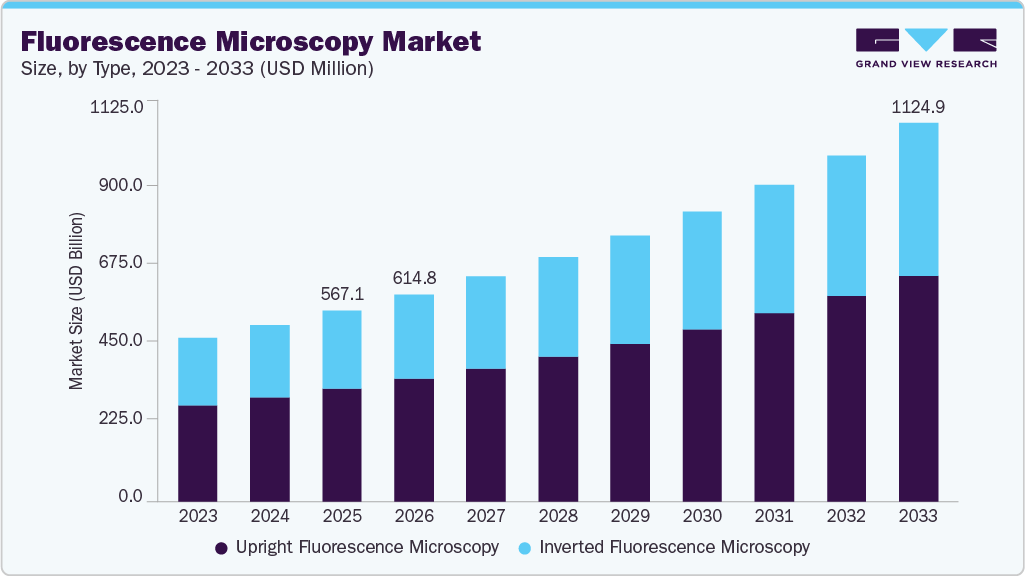
Rising life sciences and biomedical research activities
Rising government and organizational funding is driving demand for advanced imaging tools. Fluorescence microscopy enables detailed cellular and molecular analysis, making it essential in modern research. For instance, the National Institutes of Health (NIH) actively funds and supports advanced imaging infrastructure such as fluorescence microscopy through dedicated facilities and research grants. These centers provide researchers with access to high-end fluorescence imaging systems and training, accelerating biomedical discoveries.
Growing demand for advanced diagnostic techniques
The rising prevalence of diseases such as cancer and neurological disorders is boosting the need for high-precision imaging. Fluorescence microscopy supports early detection and accurate diagnosis, improving treatment outcomes. Deployment of advanced imaging systems by companies is improving access to high-precision diagnostics, driving demand for advanced imaging technologies, including fluorescence microscopy. For instance, in March 2026, Fujifilm India Pvt. Ltd. strengthened diagnostic infrastructure at Porunai Hospitals in Tamil Nadu by installing advanced imaging and diagnostic systems, enhancing access to high-precision diagnostics, improving clinical capabilities, and supporting the growing demand for technology-driven healthcare services in emerging regions.
Technological advancements in microscopy systems
Innovations such as super-resolution imaging, digital imaging, and AI integration are enhancing imaging capabilities. These advancements are improving efficiency and expanding applications across research, clinical, and industrial fields. In November 2023, Carl Zeiss AG introduced the Lattice SIM product family, including Lattice SIM 3 and 5, expanding super-resolution microscopy capabilities and enabling high-speed, high-resolution imaging across diverse applications from live-cell analysis to tissue and molecular-level research.
Market Characteristics & Concentration
The fluorescence microscopy market is moderately fragmented, with key players such as Carl Zeiss AG, Olympus Corporation, and Nikon Corporation. It is characterized by high innovation, moderate-to-high partnerships and M&A activity, and steady regional expansion, with regulatory impact remaining moderate to high.
The degree of innovation is high in the fluorescence microscopy industry, driven by advancements in super-resolution and live-cell imaging. These innovations enhance imaging accuracy, enable real-time cellular analysis, and expand applications across life sciences and clinical diagnostics. The growing integration of digital imaging platforms and automated workflows allows researchers to efficiently capture, process, and analyze complex biological data. For example, in April 2026, researchers at the University of Tokyo developed a pump-field-probe fluorescence microscopy technique that enabled real-time tracking of short-lived, non-emissive molecular intermediates under magnetic fields, significantly advancing high-sensitivity fluorescence imaging for quantum biology and biomedical research applications.
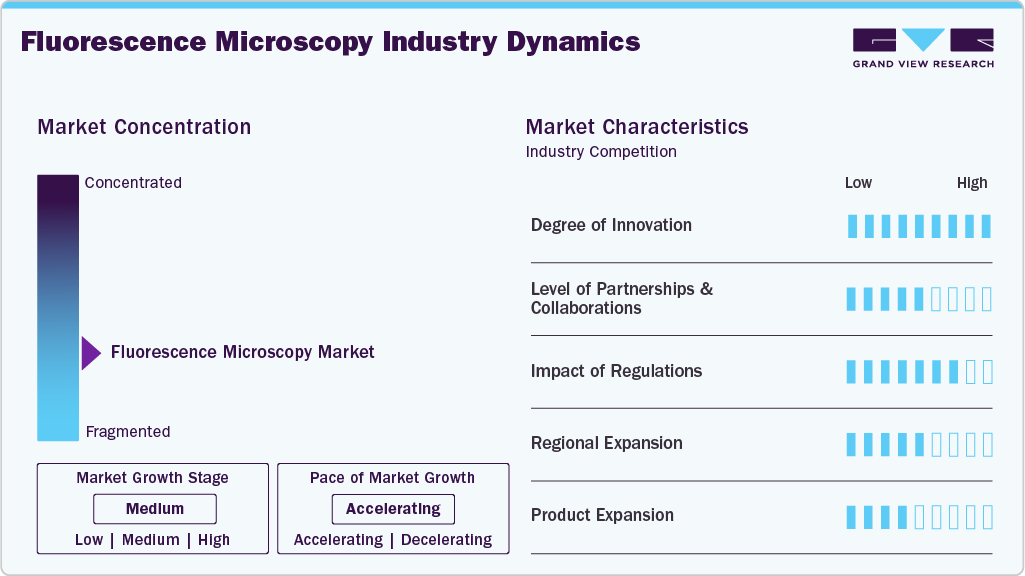
The level of partnerships and collaborations in the fluorescence microscopy market is moderate to high, driven by strategic alliances between key players such as Leica Microsystems and CrestOptics S.p.A., as well as collaborations between industry and academic institutions to accelerate technological innovation and expand application areas.
The impact of regulations is high as governments and research organizations play a critical role in supporting the market by providing funding, grants, and infrastructure support for advanced research. These initiatives encourage the adoption of high-end imaging technologies in academic and clinical settings, thereby accelerating innovation. In addition, regulatory frameworks, particularly in clinical and diagnostic applications, ensure quality standards and promote the use of advanced imaging systems, although compliance requirements may pose certain challenges for market players.
Regional Expansion is moderate as the market is driven by increasing investments in life sciences research, rising demand for advanced imaging technologies, and continuous technological advancements. For instance, in April 2024, Merck KGaA announced an investment of over €300 million (USD 325-330 million) in a new Advanced Research Center in Darmstadt, Germany, aimed at accelerating biopharmaceutical research and development in key areas such as antibodies, mRNA applications, and bioprocessing technologies, thereby strengthening global life sciences innovation and advanced imaging-based research demand.
Product expansion in the fluorescence microscopy market is moderate, driven by continuous advancements such as super-resolution imaging, confocal systems, fluorescence lifetime imaging (FLIM), and AI-integrated platforms, which are expanding application areas across life sciences, clinical diagnostics, and materials science.
Type Insights
The upright fluorescence microscopy segment accounted for the largest revenue share in 2025. These microscopes are widely used for fixed tissue imaging and slide-based analysis, making them essential in clinical diagnostics and research laboratories. In May 2025, Leica Microsystems launched the Visoria series of upright microscopes, enhancing workflow efficiency, digital integration, and ergonomic usability, thereby supporting the growing demand for advanced, user-friendly upright microscopy systems across clinical, life science, and industrial applications.
The inverted fluorescence microscopy segment is anticipated to grow at the fastest CAGR over the forecast period. These microscopes are ideal for observing living cells in culture, driving adoption in advanced biological studies. For instance, in 2023, Evident Corporation introduced the IXplore IX85 inverted microscope system, designed for high-speed live-cell imaging and advanced research applications. This is expected to further accelerate segment growth by enhancing research efficiency and expanding applications in live-cell imaging and advanced biological analysis.
Application Insights
The semiconductors segment led the fluorescence microscopy industry, accounting for the largest revenue share of 32.4% in 2025, and is expected to grow at the fastest CAGR during the forecast period. Shrinking node sizes and advanced chip architectures are driving the need for high-resolution imaging tools to analyze defects and material properties at the micro- and nanoscales.Fluorescence microscopes identify nanoscale contaminants (down to 20 nm) and process-induced defects on semiconductor wafers.
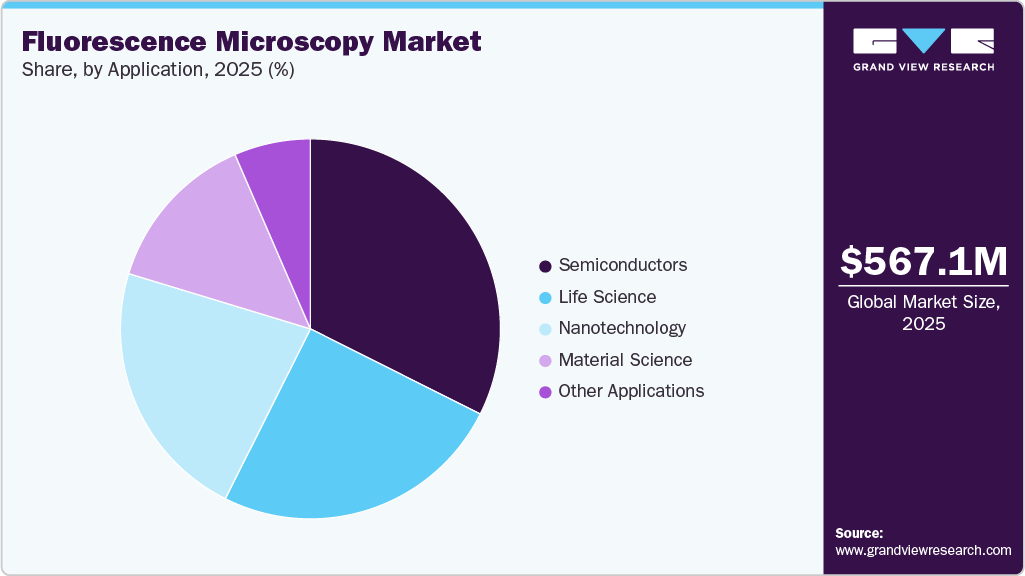
The nanotechnology segment is projected to grow at a substantial CAGR over the forecast period. The growing development of nanomaterials across healthcare and materials science is driving demand for high-resolution imaging tools, as fluorescence microscopy enables precise visualization and analysis of nanoscale structures, supporting innovation and research in the fluorescence microscopy market.In June 2025, the International Atomic Energy Agency supported research demonstrating that radiation processing enhanced nanomaterial development by enabling precise control over nano-architectures, facilitating advanced applications across healthcare, energy, and materials science through improved performance, stability, and functionality of nanoscale materials.
Regional Insights
The North America fluorescence microscopy market dominated with a global revenue share of 39.4%in 2025. The region led by, supported by strong R&D investment, advanced academic infrastructure, and leading biomedical research facilities, drives significant demand for high-resolution imaging technologies in cellular biology, life sciences, and diagnostic applications, thereby accelerating the adoption of fluorescence microscopy systems in research laboratories and clinical environments.
U.S. Fluorescence Microscopy Market Trends
The U.S. fluorescence microscopy industry accounted for the largest revenue share in 2025. The country’s strong leadership in biomedical research, supported by substantial R&D funding, well-established academic institutions, and advanced life sciences infrastructure, drives high demand for precision imaging technologies. This, in turn, supports widespread adoption of fluorescence microscopy systems across cellular biology research, materials science applications, and clinical diagnostic workflows in both laboratory and healthcare settings.
Europe Fluorescence Microscopy Market Trends
The growth of the Europe fluorescence microscopy industry is driven by strong academic and research infrastructure, rising demand for advanced diagnostic imaging in chronic disease management, substantial European Union and government R&D funding, and the presence of leading manufacturers such as Carl Zeiss AG and Leica Microsystems, which together support continuous technological innovation and adoption across life sciences and clinical applications.
The Germany fluorescence microscopy market is witnessing strong growth in Europe due to advancements in rapid 3D fluorescence imaging and live-cell analysis technologies were driving market growth by improving imaging speed, sensitivity, and sample viability for complex biological studies.In March 2026, Leica Microsystems commercialized the Viventis SCAPE system, based on oblique plane microscopy developed at Imperial College, enabling rapid, gentle 3D fluorescence imaging of live cells and tissues for advanced biological research.
The fluorescence microscopy market in Italy is growing due toincreasing demand for high-speed, high-resolution 3D fluorescence imaging in complex biological research was driving adoption of spinning disk microscopy, supported by technological integration and workflow automation advancements.In October 2024, Leica Microsystems collaborated with CrestOptics S.p.A. to launch the THUNDER Imager Cell Spinning Disk system, integrating CICERO technology to enhance fluorescence imaging speed and resolution, as well as 3D live-cell analysis capabilities, for advanced biological research applications.
Asia Pacific Fluorescence Microscopy Market Trends
The Asia Pacific fluorescence microscopy industry is expected to grow at the fastest CAGR during the forecast period. Driven by rapid adoption across research, healthcare, industrial, and educational sectors, the market is benefiting from accelerated industrialization and the expansion of manufacturing hubs. Growth in the electronics, semiconductor, and precision engineering industries has increased demand for high-precision visual inspection tools for quality control, defect analysis, and micro-assembly processes. This trend is particularly evident in countries such as China and Japan, where strong electronics and automotive sectors emphasize reliable, high-resolution imaging for detailed component inspection.
The Japan fluorescence microscopy market is growing, driven by demand for advanced fluorescence lifetime imaging (FLIM) and high-resolution molecular interaction analysis in life sciences research, which is driving the adoption of confocal fluorescence microscopy platforms with integrated real-time imaging capabilities. In June 2024, HORIBA Ltd. launched the InverTau platform, a confocal fluorescence lifetime imaging system integrated with inverted fluorescence microscopes, enabling real-time FLIM analysis, high-speed laser scanning, and enhanced visualization of molecular interactions for advanced cell biology research.
Key Fluorescence Microscopy Company Insights
Key players operating in the fluorescence microscopy market are undertaking various initiatives to strengthen their presence and increase the reach of their products and services. Strategies such as expansion activities and partnerships are key in propelling market growth.
Key Fluorescence Microscopy Companies:
The following key companies have been profiled for this study on the fluorescence microscopy market.
- Carl Zeiss AG
- EVIDENT
- Olympus Corporation
- Leica Microsystems
- Thermo Fisher Scientific Inc.
- Bruker Corporation
- PerkinElmer Inc.
- HORIBA Ltd.
- Keyence Corporation
- Oxford Instruments plc
Recent Developments
-
In May 2025, Evident Corporation launched the IXplore IX85 SpinXL and SpinSR spinning disk confocal microscopes, built on CrestOptics technology, enabling ultra-fast imaging, large field-of-view capture, and improved live-cell fluorescence imaging performance for advanced cellular research applications.
-
In March 2025, HORIBA Ltd. expanded its analytical portfolio by launching advanced fluorescence-based molecular fingerprinting and Raman screening systems, along with an AFM platform, strengthening applications in biopharma research, vaccine development, and biomolecular characterization through enhanced high-throughput analytical capabilities.
Fluorescence Microscopy Market Report Scope
Report Attribute
Details
Market size in 2025
USD 567.1 million
Estimated market size in 2026
USD 614.8 million
Projected market size by 2033
USD 1124.9 million
Growth rate
CAGR of 9.0% from 2026 to 2033
Actual data
2021 - 2025
Forecast period
2026 - 2033
Quantitative units
Revenue in USD million/billion and CAGR from 2026 to 2033
Report coverage
Revenue forecast, company ranking, competitive landscape, growth factors, and trends
Segments covered
Type, application, region
Country scope
U.S.; Canada; Mexico; Germany; UK; France; Italy; Spain; Norway; Denmark; Sweden; China; Japan; India; South Korea; Australia; Thailand; Brazil; Argentina; Saudi Arabia; South Africa; UAE; Kuwait
Key companies profiled
Carl Zeiss AG; EVIDENT; Olympus Corporation; Leica Microsystems; Thermo Fisher Scientific Inc.; Bruker Corporation; PerkinElmer Inc.; HORIBA Ltd; Keyence Corporation; Oxford Instruments plc
Customization scope
Free report customization (equivalent up to 8 analysts working days) with purchase. Addition or alteration to country, regional & segment scope.
Pricing and purchase options
Avail customized purchase options to meet your exact research needs. Explore purchase options
Global Fluorescence Microscopy Market Report Segmentation
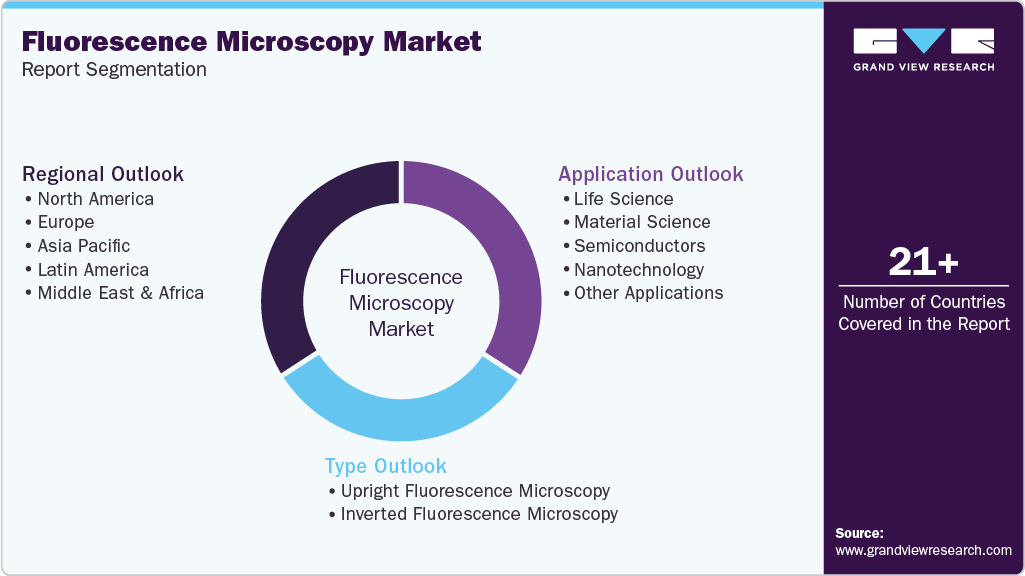
This report forecasts revenue growth at the global, regional & country levels and provides an analysis of the latest industry trends in each of the sub-segments from 2021 to 2033. For this study, Grand View Research has segmented the global fluorescence microscopy market report based on type, application, and region:
-
Type Outlook (Revenue, USD Million, 2021 - 2033)
-
Upright Fluorescence Microscopy
-
Inverted Fluorescence Microscopy
-
-
Application Outlook (Revenue, USD Million, 2021 - 2033)
-
Life Science
-
Material Science
-
Semiconductors
-
Nanotechnology
-
Other Applications
-
-
Regional Outlook (Revenue, USD Million, 2021 - 2033)
-
North America
-
U.S.
-
Canada
-
Mexico
-
-
Europe
-
UK
-
Germany
-
France
-
Italy
-
Spain
-
Norway
-
Sweden
-
Denmark
-
-
Asia Pacific
-
China
-
Japan
-
India
-
South Korea
-
Thailand
-
Australia
-
-
Latin America
-
Brazil
-
Argentina
-
-
Middle East & Africa
-
South Africa
-
South Arabia
-
UAE
-
Kuwait
-
-
Frequently Asked Questions About This Report
The semiconductors segment accounted for the largest revenue share of 32.4% in 2025, driven by increasing demand for high-resolution imaging tools for defect analysis and material inspection in advanced semiconductor manufacturing.
North America dominated the global fluorescence microscopy market with a revenue share of 39.4% in 2025, supported by strong R&D investments, advanced academic infrastructure, and leading biomedical research facilities.
Key factors driving the market include increasing investments in life sciences and biomedical research, growing demand for advanced diagnostic techniques, rising prevalence of chronic diseases, technological advancements such as super-resolution imaging and AI integration, and expanding applications in drug discovery, clinical diagnostics, and materials science.
Some of the key players operating in the fluorescence microscopy market include Carl Zeiss AG, EVIDENT, Olympus Corporation, Leica Microsystems, Thermo Fisher Scientific Inc., Bruker Corporation, PerkinElmer Inc., HORIBA Ltd., Keyence Corporation, and Oxford Instruments plc.
The global fluorescence microscopy market size was valued at USD 567.1 million in 2025 and is estimated at USD 614.8 million in 2026.
The global fluorescence microscopy market is expected to grow at a CAGR of 9.0% from 2026 to 2033, reaching USD 1124.9 million by 2033.
Asia Pacific is expected to be the fastest-growing regional market during the forecast period.
The upright fluorescence microscopy segment held the largest market share in 2025 due to its extensive use in fixed tissue imaging, slide-based analysis, clinical diagnostics, and research laboratories.
About the Author(s)
Medical Devices Research Team
Healthcare · Medical DevicesThis report was authored by the medical devices research team at Grand View Research - comprising two research analysts, one senior research analyst, and one industry expert - with specialized expertise in the medical devices segment of the healthcare industry. All findings are based on proprietary healthcare databases, executive interviews, and regulatory analysis, subject to internal peer review prior to publication.
Last Updated:
Speak to Analyst


Customize this report to your needs - add regions, segments, or data points, with 20% free customization.
Or view our licence options:


ISO 9001:2015 & 27001:2022 Certified
We are GDPR and CCPA compliant! Your transaction & personal information is safe and secure. For more details, please read our privacy policy.


