
- Home
- »
- Conventional Energy
- »
-
Flywheel Energy Storage Systems Market Report, 2026-2033GVR Report cover

Flywheel Energy Storage Systems Market (2026 - 2033)
Size, Share & Trends Analysis Report By Application (UPS, Distributed Energy Generation, Transport, Data Center, Others), By Region (North America, Europe, Asia Pacific, Central & South America, MEA), And Segment Forecasts
Market Size, 2025
$527.8MMarket Estimate, 2026
$580.8MMarket Forecast, 2033
$1,154.6MCAGR, 2026–2033
10.3%Flywheel Energy Storage Systems Market Summary
The global flywheel energy storage systems market size was value at USD 527.8 million in 2025 and is projected to grow from USD 580.8 million in 2026 to USD 1,154.6 million by 2033, at a CAGR of 10.3% from 2026 to 2033. North America dominated the flywheel energy storage systems market with the largest revenue share of 77.7% in 2025. The market for Flywheel Energy Storage Systems (FESS) is experiencing significant growth driven by several key factors.
 Source: Grand View Research, IR Documents, Primary Interviews, Paid DatabasesTo learn more about this report,
 Download Free Sample Report
 Key Market Trends & Insights
- By application: Distributed energy generation segment held the largest market share of 27.2% in 2025.
Regional Highlights
- Largest regional market: North America (77.7% revenue share, 2025)
- By country: The U.S. held the largest market share in 2025
Market Size & Forecast
- Market size in 2025: USD 527.8 Million
- Estimated market size in 2026: USD 580.8 Million
- Projected market size by 2033: USD 1,154.6 Million
- CAGR (2026-2033): 10.3%
Three ways to get this report
Buy it, customize it, or ask a question.Ask an Analyst
Analyst response in 1 business day
- AccessReport author, directly
- Reply timeWithin 1 working day
- No sales callDirect answer only
- FormatEmail reply
- CostFree, no cost
Get the Full Report
What the study covers
- FormatsPDF · Excel · Dashboard
- Timeline2026–2033 annual, 2025 base
- Coverage20+ countries, 5 regions
- Companies10+ key players profiled
Customize the Report
20% free customization
- IncludeCountries, segments, points
- TailorTo your product definition
- ExtendDeeper competitor detail
- OrA fully bespoke study
- Turnaround5–10 working days
Rising demand for reliable and clean energy sources is a primary catalyst as industries seek alternatives to fossil fuels amidst increasing regulatory support for clean power generation. The technology's ability to provide uninterrupted power supply (UPS) solutions is particularly appealing in regions with unreliable grid infrastructure, such as developing countries and remote areas. To learn more about this report, Download Free Sample Report
 In addition, integrating flywheel systems with renewable energy sources like wind and solar enhances grid stability by mitigating their variability. Flywheels' long lifespan, high efficiency, and low maintenance requirements compared to traditional batteries further contribute to their attractiveness in various applications, including data centers and distributed energy generation.
Market Dynamics
The flywheel energy storage systems (FESS) market is growing as utilities, data centers, transportation networks, and industrial facilities increasingly seek high-power, short-duration energy storage solutions that offer rapid response and long operational life. Unlike conventional battery technologies, flywheel systems deliver instant charge-discharge capability, high cycle durability, and minimal performance degradation, making them well suited for frequency regulation, uninterruptible power supply (UPS), and grid stabilization applications. Growing renewable energy integration, modernization of electricity grids, and increasing investments in resilient power infrastructure are supporting market expansion.
The increasing share of renewable energy sources such as solar and wind is reducing the natural grid inertia traditionally provided by coal, gas, and other rotating thermal power plants. This has increased the need for fast-response energy storage technologies that can instantly inject or absorb power to maintain grid frequency, stabilize voltage, and prevent outages. Flywheel energy storage systems are well-suited for these applications due to their millisecond response time, high cycling capability, and long operational life. As utilities continue to modernize power grids and integrate higher levels of renewable energy, demand for flywheel-based grid stabilization solutions is expected to grow steadily.
In May 2025, Amber Kinetics unveiled a containerized FESS designed for above-ground deployment and announced that the system would begin field testing at Marine Corps Air Station Miramar (California) in the second half of 2025. The modular installation is intended to deliver fast-response frequency regulation and grid stabilization services while supporting renewable energy integration, reflecting the growing commercial deployment of flywheel technology for modern power grids.
The widespread adoption of FESS is constrained by their high upfront capital cost and complex engineering requirements. These systems rely on precision-manufactured high-speed rotors, magnetic bearings, vacuum enclosures, and advanced control systems, all of which increase installation and maintenance costs compared with conventional lithium-ion batteries. Flywheels have relatively low energy density and experience standby energy losses due to friction and windage, making them less suitable for long-duration energy storage applications. As battery technologies continue to decline in cost, many utilities and commercial users favor electrochemical storage solutions for projects requiring extended discharge durations, limiting the broader deployment of flywheel systems.
The rapid expansion of AI computing and hyperscale data centers is creating a significant opportunity for flywheel energy storage systems as operators seek highly reliable, fast-response backup power solutions. AI workloads generate sudden, high-power demand spikes that require uninterrupted power to prevent downtime and protect sensitive computing infrastructure. Flywheel systems can deliver instant power within milliseconds, endure frequent charge-discharge cycles, and eliminate the safety and maintenance concerns associated with large chemical battery banks. In March 2026, Schneider Electric and NVIDIA announced new validated reference designs for gigawatt-scale AI factories, including advanced power distribution, cooling systems, and digital twin capabilities to support next-generation AI data centers.
Analyst Perspective
The flywheel energy storage systems market is gradually gaining traction as power grids require faster and more reliable solutions to maintain stability with increasing renewable energy integration. A key trend in the market is the growing adoption of flywheel systems in AI data centers and critical infrastructure, where uninterrupted power quality and rapid response are essential. As investments in grid modernization and resilient power infrastructure continue to grow, flywheel technology is expected to find wider adoption in applications requiring high-power, short-duration energy storage.
Application Insights
Based on application, the distributed energy generation segment led the market with the second-largest revenue share of 27.2% in 2025. Frequency regulation applications of flywheels are included in this segment. These applications are gaining importance due to the growing demand for uninterrupted power from commercial workstations and factories. Uninterruptible power supply (UPS) is one of the major application areas of flywheel energy storage systems. Power failures can cause huge losses in businesses and commercial workstations. Flywheel UPS systems can be used to overcome the problems faced by sudden dips or glitches in electric and voltage supplies. Also, since this technology does not involve using fossil fuels, it is environmentally friendly.
Distributed energy generation involves producing power at the place of consumption. This method has several advantages, such as eliminating costs, inefficiencies, and complexities related to power generation compared to centrally generated power. Further, distributed energy generation aids in providing faster power backup in case of natural disasters such as floods and earthquakes. This has been a major driver for deploying distributed energy generation sources in areas prone to natural disasters.
Regional Insights
North America dominated the flywheel energy storage systems market with the largest revenue share of 77.7% in 2025. The U.S. Batteries dominate the market in North America, and flywheels are the most commonly used energy storage systems in this region. The North American market is characterized by a growing demand for UPS systems to maintain a continuous supply of power intended for commercial and industrial applications. The market is driven by several key factors, including abundant natural gas reserves, significant infrastructure expansion, and increasing global demand for cleaner energy sources. The region's extensive shale gas resources provide a solid foundation for LNG production, enabling the U.S. to emerge as a leading exporter, with export capacity expected to double by 2028.
 To learn more about this report, Download Free Sample Report
 U.S. Flywheel Energy Storage Systems Market Trends
The flywheel energy storage systems market in the U.S. held the largest share in the North America region in 2025, fueled by the increasing need for efficient energy storage solutions and the integration of renewable energy sources. As the country emphasizes sustainable energy practices, flywheel systems are becoming essential for balancing the intermittent nature of renewables like solar and wind, providing reliable backup power, and enhancing grid stability.
Europe Flywheel Energy Storage Systems Market Trends
The flywheel energy storage systems market in Europe is growing due to the expansion of the automobile industry, particularly in countries such as Germany and Italy. This further increases the demand for flywheel energy storage systems in Europe. Germany is known as the automobile and engineering hub of Europe. Some major automobile manufacturers, such as Volkswagen, Mercedes Benz, and Porsche, are headquartered in this country. Thus, the growing automobile industry is one of Germany's biggest flywheel energy storage market drivers.
Germany flywheel energy storage systems market is positioned for significant growth, driven by the country's commitment to renewable energy and sustainability. As part of its broader energy transition strategy, Germany is increasingly integrating flywheel systems to enhance grid stability and support the variable output from renewable sources like wind and solar.
The flywheel energy storage systems market in the UK is characterized by a growing emphasis on renewable energy integration and grid stability, reflecting the country's commitment to reducing carbon emissions and enhancing energy efficiency. Flywheel systems are increasingly recognized for their ability to provide rapid energy discharge and absorption, making them ideal for applications that require quick response times, such as frequency regulation and power quality management.
Asia Pacific Flywheel Energy Storage Systems Market Trends
The flywheel energy storage systems market in Asia Pacific is set for significant expansion, driven by rapid industrialization and increasing energy demands. Countries such as China, India, Japan, and South Korea are increasingly adopting flywheel technology due to its efficiency and long service life, which are crucial for managing the intermittent nature of renewable energy sources like solar and wind. The market is characterized by a growing awareness of the benefits of flywheel systems, including their ability to provide grid stability, frequency regulation, and rapid energy discharge.
China growth of the flywheel energy storage systems market is gaining momentum, driven by the country's ambitious renewable energy goals and increasing energy storage demands. China's strategy to install substantial new energy storage capacity aligns with its commitment to enhancing grid stability and integrating more renewable sources like wind and solar. Recent developments, such as connecting the world's largest flywheel energy storage project in Shanxi Province, highlight the country's focus on innovative energy solutions.
The flywheel energy storage systems market in Japan is characterized by technological advancements, including improvements in efficiency and durability, which make flywheels a viable alternative to traditional battery storage solutions. In addition, government initiatives promoting clean energy technologies and investments in smart grid infrastructure are fostering a favorable environment for adopting flywheel systems. As Japan continues prioritizing sustainable energy practices, the FESS market is expected to support the nation's transition toward a more reliable and eco-friendly energy landscape.
Central & South America Flywheel Energy Storage Systems Market Trends
The flywheel energy storage systems market in Central and South America is emerging as a promising sector, driven by the region's ongoing energy transition and the increasing need for reliable power solutions. Countries such as Brazil, Argentina, and Chile are investing in energy storage technologies to address frequent power interruptions and enhance grid stability.
Middle East & Africa Flywheel Energy Storage Systems Market Trends
The flywheel energy storage systems market in the Middle East and Africa is poised for significant growth, driven by the increasing demand for reliable energy solutions and the integration of renewable energy sources. As many countries in the region seek to diversify their energy mix and enhance grid stability, flywheel systems are gaining traction due to their rapid response capabilities and efficiency in managing power fluctuations. The rising installation of data centers, particularly in Gulf Cooperation Council (GCC) countries, further fuels the demand for FESS, as these facilities require uninterrupted power supply to operate effectively.
Key Flywheel Energy Storage Systems Company Insights
The FESS market is characterized by a competitive landscape featuring several key players that are driving innovation and growth in the sector. Prominent companies include Active Power, Amber Kinetics, Beacon Power, and Stornetic, each contributing unique technologies and solutions tailored to various applications such as uninterruptible power supply (UPS), data centers, and distributed energy generation.
Key Flywheel Energy Storage Systems Companies:
The following are the leading companies in the flywheel energy storage systems market.
-
Langley Holdings plc
-
Amber Kinetics, Inc.
-
Stornetic GmbH
-
Energiestro
-
VYCON, Inc.
-
Bc New Energy (Tianjin) Co., Ltd. (BNE)
-
Beacon Power, LLC
-
PUNCH Flybrid
-
Kinetic Traction Systems, Inc.
Competitive Benchmarking
Category
Operating Strategies
Competitive Edge
Weakness
Established Players (Adaptive Balancing Power GmbH, Amber Kinetics, Inc., Beacon Power, LLC, Langley Holdings plc, STORNETIC GmbH, VYCON, Wernick Group)
- Expand utility-scale frequency regulation and grid stabilization projects through partnerships with utilities and transmission system operators.
- Invest in high-speed flywheel technologies, magnetic bearing systems, and digital monitoring to improve system efficiency and lifecycle performance.
- Strengthen presence in critical power applications such as data centers, hospitals, and industrial facilities through integrated UPS and energy storage solutions.
- Strong technological expertise with commercially proven flywheel energy storage installations across multiple end-use sectors.
- Established customer relationships, global service networks, and extensive project execution experience enhance market credibility.
- Broad product portfolios and proprietary engineering capabilities enable deployment across grid, industrial, and critical power applications.
- High manufacturing and deployment costs compared to lithium-ion battery systems can limit wider market adoption.
- Growth is constrained by the relatively niche nature of short-duration energy storage applications.
- Longer sales cycles for utility-scale projects due to regulatory approvals and capital-intensive procurement processes.
Emerging Players (Energiestro, SABERCHARGE, Torus, Inc.)
- Focus on specialized applications such as distributed renewable energy, microgrids, AI data centers, and commercial backup power.
- Develop modular and scalable flywheel systems that reduce installation complexity and improve deployment flexibility.
- Form strategic collaborations with renewable energy developers, EPC contractors, and technology partners to accelerate commercialization.
- Greater flexibility to develop application-specific solutions for emerging energy storage requirements.
- Agile product development enables rapid adoption of advanced materials, control software, and compact system designs.
- Ability to target underserved niche markets with customized flywheel solutions and innovative business models.
- Limited commercial deployment history and lower brand recognition compared to established market participants.
- Smaller manufacturing capacity and financial resources may restrict large-scale project execution.
- Dependence on pilot projects, external funding, and strategic partnerships to scale commercial operations.
Recent Developments
-
In September 2024, A project in China, recognized as the largest flywheel energy storage system globally developed byShenzen Energy Group, was successfully connected to the grid. Located in Changzhi City, Shanxi Province, the Dinglun Flywheel Energy Storage Power Station boasts a total installed capacity of 30 megawatts and features 120 high-speed magnetic levitation flywheel units. Each set of 12 flywheels forms an energy storage and frequency regulation unit, with these units collectively connecting to the grid at a voltage level of 110 kV. This innovative facility represents a significant advancement in energy storage technology.
Flywheel Energy Storage Systems Market Report Scope
Report Attribute
Details
Market Definition
The market comprises revenue generated from the sale of flywheel-based energy storage systems and related components used for grid stabilization, UPS, frequency regulation, renewable energy integration, and other energy storage applications.
Market size in 2025
USD 527.8 million
Estimated market size in 2026
USD 580.8 million
Projected market size by 2033
USD 1,154.6 million
Growth rate
CAGR of 10.3% from 2026 to 2033
Base year for estimation
2025
Historical data
2021 - 2024
Forecast period
2026 - 2033
Quantitative units
Revenue in USD Million, Volume in Kilo Watts and CAGR from 2026 to 2033
Report coverage
Revenue forecast, volume forecast, company ranking, competitive landscape, growth factors, and trends
Segments covered
Application, region
Regional scope
North America, Europe, Asia Pacific, Latin America, Middle East & Africa
Country scope
U.S., Canada, Mexico, Germany, France, UK, Italy, Spain, Russia, China, India, Japan, Australia, Brazil, Argentina, Saudi Arabia, South Africa, UAE
Key companies profiled
Adaptive Balancing Power GmbH, Amber Kinetics, Inc., Beacon Power, LLC, Energiestro, Langley Holdings plc, SABERCHARGE, STORNETIC GmbH, Torus, Inc., VYCON, Wernick Group
Customization scope
Free report customization (equivalent up to 8 analysts' working days) with purchase. Addition or alteration to country, regional & segment scope.
Pricing and purchase options
Avail customized purchase options to meet your exact research needs. Explore purchase options
Global Flywheel Energy Storage Systems Market Report Segmentation
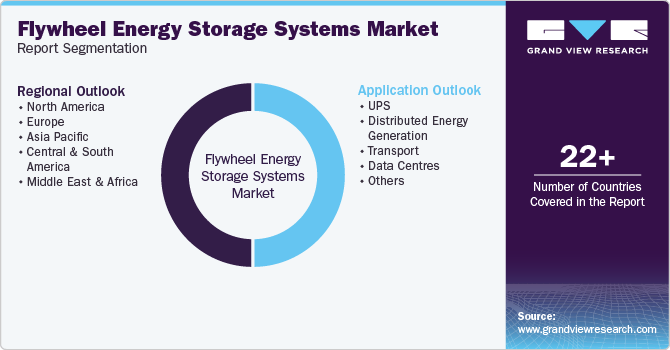
This report forecasts volume & revenue growth at global, regional, and country levels and provides an analysis of the latest industry trends in each of the sub-segments from 2021 to 2033. For this study, Grand View Research has segmented the global flywheel energy storage systems market report based on application and region:
 To learn more about this report, Download Free Sample Report
 -
Application Outlook (Volume, Kilo Watts; Revenue, USD Million, 2021 - 2033)
-
UPS
-
Distributed Energy Generation
-
Transport
-
Data Centres
-
Others
-
-
Regional Outlook (Volume, Kilo Watts; Revenue, USD Million, 2021 - 2033)
-
North America
-
U.S.
-
Canada
-
Mexico
-
-
Europe
-
Germany
-
UK
-
Italy
-
Spain
-
France
-
Russia
-
-
Asia Pacific
-
China
-
India
-
Japan
-
Australia
-
-
Central & South America
-
Brazil
-
Argentina
-
-
Middle East & Africa
-
Saudi Arabia
-
South Africa
-
UAE
-
-
Research Methodology
The flywheel energy storage systems market figures in this report are based on a proven research process that combines executive interviews with secondary research from proprietary databases, company filings, and recognized regulatory and institutional sources. Market size is built through value-chain sizing - reconciling supply-side and demand-side estimates - and triangulated with bottom-up and top-down approaches. Every estimate passes multiple levels of expert validation before publication, with each flywheel energy storage systems segment quantified using the revenue-capture definitions in the table below.
Segment Definition
Segment - Application
Revenue capture definition
UPS
Flywheel energy storage systems are widely used as uninterruptible power supply (UPS) solutions to provide instantaneous backup power for critical facilities. Revenue is generated through the sale of flywheel systems deployed in UPS applications across commercial, industrial, healthcare, and data center facilities.
Distributed Energy Generation
Flywheel energy storage systems support distributed energy generation by stabilizing power output and maintaining grid reliability alongside renewable energy sources. Revenue is generated through the sale of flywheel systems integrated with distributed energy resources, microgrids, and renewable power installations.
Transport
Flywheel energy storage systems are used in transportation applications to capture regenerative braking energy and provide rapid power assistance, improving overall energy efficiency. Revenue is generated through the sale of flywheel systems for rail, metro, automotive, and other transport applications.
Data Centers
Flywheel energy storage systems provide fast-response backup power and voltage stabilization to ensure the uninterrupted operation of critical data center infrastructure. Revenue is generated through the sale of flywheel systems installed in data centers for power quality management and UPS applications.
Others
Flywheel energy storage systems are used in applications such as frequency regulation, grid stabilization, voltage support, and industrial power quality management. Revenue is generated through the sale of flywheel systems for utility-scale and other specialized energy storage applications.
Estimation Model
Layer Name
Key Question
Description
Grid & Critical Power Demand Layer
What forms the demand base for flywheel energy storage systems?
Assess demand for grid stability, frequency regulation, voltage support, UPS, renewable energy integration, and power quality improvement across utility, commercial, industrial, transport, and data center sectors. Evaluate renewable energy penetration, grid modernization investments, electricity reliability requirements, and deployment of critical infrastructure to determine the underlying demand for flywheel energy storage systems.
Technology Adoption Layer
Which flywheel technologies are being deployed?
Analyze the adoption of low-speed and high-speed flywheel energy storage systems across different applications. Assess rotor material, bearing technology (magnetic or mechanical), power rating, energy capacity, response time, efficiency, lifecycle performance, and maintenance requirements to determine technology-wise market demand.
Application Deployment Layer
Where are flywheel energy storage systems being deployed?
Evaluate deployment across UPS systems, distributed energy generation, transport, data centers, and utility grid services. Analyze applications including frequency regulation, renewable energy integration, regenerative braking, backup power, voltage stabilization, and power quality management to estimate application-wise market contribution.
Revenue Layer
How is market revenue generated?
Market revenue is quantified through the sale of flywheel energy storage systems, associated power electronics, control systems, and related services. The overall market value is determined by system power rating, storage capacity, technology type, installation volume, application demand, project scale, and adoption across utility, commercial, industrial, transport, and data center sectors.
Delivered Customizations
This report has been delivered with the following In-depth customizations
Client Request
Customization Delivered
Value Adds
Competitive Landscape Assessment
Evaluated major FESS companies based on product portfolio, regional presence, technology capabilities, project deployments, strategic partnerships, and recent business developments. Assessed competitive positioning across established and emerging market participants.
Helped benchmark key competitors, identify market leaders, and understand competitive differentiation across the flywheel energy storage systems value chain.
Energy Storage Systems Market Benchmarking
Compared flywheel energy storage systems with battery energy storage systems and compressed air energy storage based on lifecycle, efficiency, cost, and application suitability. Assessed the positioning of flywheel technology within the broader energy storage systems market.
Helped identify the competitive position of flywheel energy storage, understand technology-specific advantages, and support investment and technology selection decisions.
Regional Policy & Ancillary Services Assessment
Assessed electricity market regulations, grid modernization policies, renewable energy integration targets, and ancillary service compensation mechanisms across major countries. Compared policy support and market accessibility across key regions.
Helped identify policy-driven growth opportunities, prioritize regions with favorable regulatory frameworks, and understand how ancillary service markets influence the commercial adoption of flywheel energy storage systems.
Frequently Asked Questions About This Report
The flywheel energy storage systems market size was estimated at USD 527.8 million in 2025 and is expected to reach USD 580.8 million in 2026.
The flywheel energy storage systems market is expected to grow at a CAGR of 10.3% from 2026 to 2033 to reach USD 1,154.6 million by 2033.
The North America region dominated the flywheel energy storage systems market with a revenue share of 77.7% in 2025.
U.S. dominated the North America region market with a revenue share of 86.4% in 2025.
Asia Pacific is anticipated to register the fastest CAGR of 11.4% over the forecast period.
Germany is expected to register the fastest CAGR of 11.2% from 2026 to 2033.
The key players operating in the flywheel energy storage systems market are Adaptive Balancing Power GmbH, Amber Kinetics, Inc., Beacon Power, LLC, Energiestro, Langley Holdings plc, SABERCHARGE, STORNETIC GmbH, Torus, Inc., VYCON, Wernick Group, and others.
The distributed energy generation is the most prominent application segment, accounting for a revenue share of 27.2% in 2025.
The flywheel energy storage systems market is primarily driven by the growing need for grid stability, frequency regulation, and uninterrupted power as renewable energy integration and critical power infrastructure continue to expand.
About the Author(s)
Conventional Energy Research Team
Energy & Power · Conventional EnergyThis report was authored by the conventional energy research team at Grand View Research - comprising two research analysts, one senior research analyst, and one industry expert - with specialized expertise in the conventional energy segment of the energy & power industry. All findings are based on proprietary energy & power databases, executive interviews, and regulatory analysis, subject to internal peer review prior to publication.
Last Updated:
Speak to Analyst

Customize this report to your needs - add regions, segments, or data points, with 20% free customization.
Or view our licence options:


ISO 9001:2015 & 27001:2022 Certified
We are GDPR and CCPA compliant! Your transaction & personal information is safe and secure. For more details, please read our privacy policy.


