
- Home
- »
- Food Additives & Nutricosmetics
- »
-
Food Coating Ingredients Market Size Report, 2026-2033GVR Report cover

Food Coating Ingredients Market (2026 - 2033)
Size, Share & Trends Analysis Report By Product (Cocoa & Chocolates, Fats & Oils), By Application (Bakery Products, Confectioneries, R.T.E. Cereals), By Region, And Segments Forecast
Market Size, 2025
$5.5BMarket Estimate, 2026
$5.9BMarket Forecast, 2033
$9.5BCAGR, 2026–2033
7.1%Food Coating Ingredients Market Summary
The global food coating ingredients market size was valued at USD 5.5 billion in 2025 and is projected to grow from USD 5.9 billion in 2026 to USD 9.5 billion by 2033, at a CAGR of 7.1% from 2026 to 2033. North America dominated the market, accounting for a revenue share of 42.9% in 2025. The growth of the global food coating ingredients market is primarily driven by the rising consumption of ready-to-eat and convenience food products, coupled with increasing demand for enhanced texture, taste, and visual appeal in processed foods.
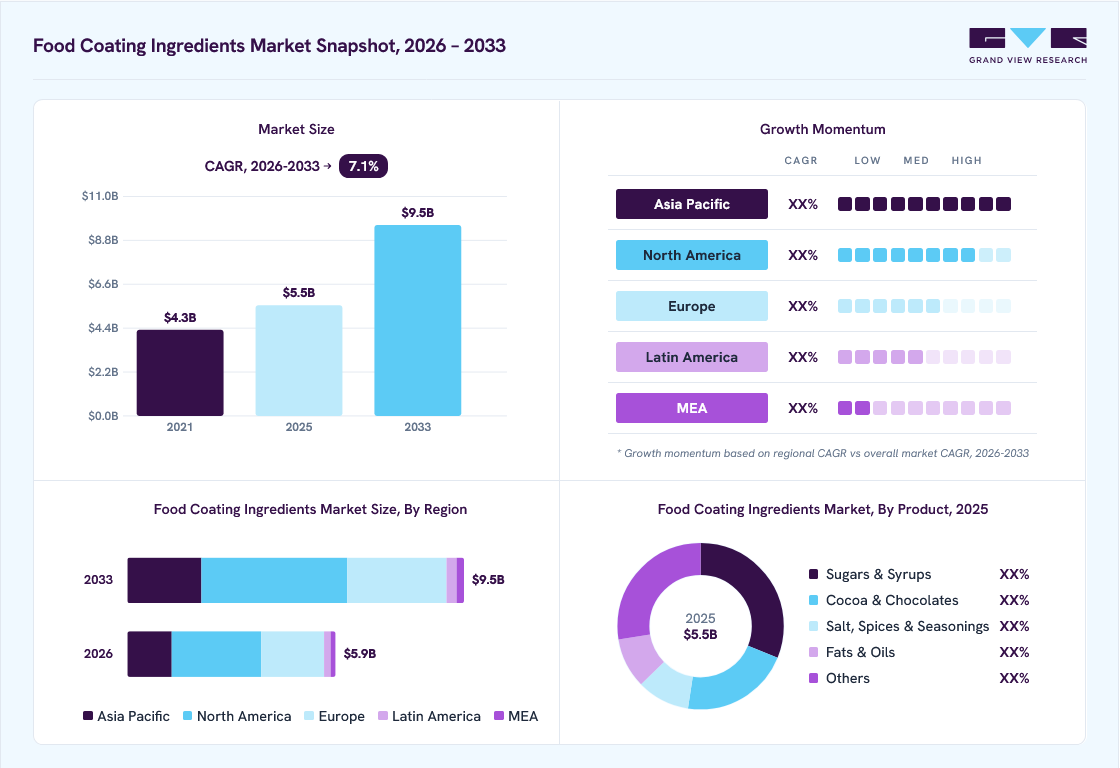 Source: Grand View Research, IR Documents, Primary Interviews, Paid DatabasesTo learn more about this report,
 Download Free Sample Report
Key Market Trends & Insights
- By product: Sugars & syrups segment dominated the market, with a revenue share of 31.1% in 2025.
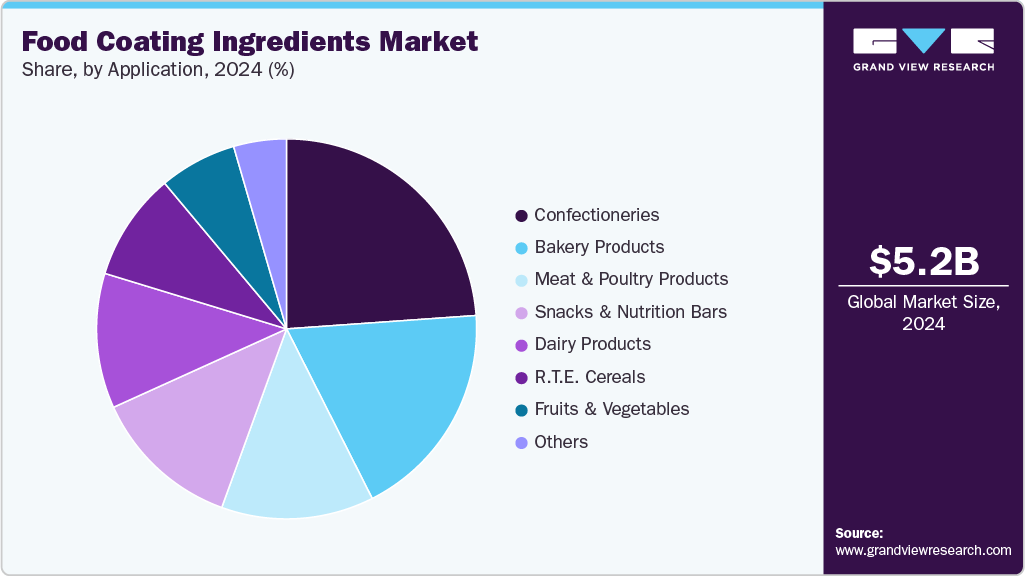
- By application: Confectioneries segment held the largest market share of 24.1% in 2025.
Regional Highlights
- Largest regional market: North America (42.9% revenue share, 2025)
- Fastest-growing regional market: Asia Pacific (highest CAGR, 2026-2033)
- By country: The U.S. held the largest market share in 2025.
Market Size & Forecast
- Market size in 2025: USD 5.5 Billion
- Estimated market size in 2026: USD 5.9 Billion
- Projected market size by 2033: USD 9.5 Billion
- CAGR (2026-2033): 7.1%
Three ways to get this report
Buy it, customize it, or ask a question.Ask an Analyst
Analyst response in 1 business day
- AccessReport author, directly
- Reply timeWithin 1 working day
- No sales callDirect answer only
- FormatEmail reply
- CostFree, no cost
Get the Full Report
What the study covers
- FormatsPDF · Excel · Dashboard
- Timeline2026–2033 annual, 2025 base
- Coverage20+ countries, 5 regions
- Companies10+ key players profiled
Customize the Report
20% free customization
- IncludeCountries, segments, points
- TailorTo your product definition
- ExtendDeeper competitor detail
- OrA fully bespoke study
- Turnaround5–10 working days
The rapid expansion of fast food chains and quick-service restaurants, particularly in emerging economies, is further accelerating the adoption of coating ingredients. The global food coating ingredients market is witnessing significant opportunities driven by the surging demand for clean-label, organic, and plant-based coating solutions that align with evolving consumer health preferences. Innovations in functional coatings, such as those enriched with proteins, fibers, and micronutrients, are opening new avenues across health-conscious and specialty food segments. Moreover, the growing popularity of gluten-free and allergen-free products presents a lucrative opportunity for manufacturers to diversify their product portfolios and cater to niche markets. Advancements in coating technologies, including microencapsulation and precision application, are also enhancing product performance and shelf life which is supporting the market’s growth. To learn more about this report, Download Free Sample Report
Despite promising growth prospects, the market faces several challenges, including the volatility in raw material prices and supply chain disruptions, which can impact production costs and pricing strategies. Additionally, increasing regulatory scrutiny around food safety, ingredient labeling, and allergen declarations across different regions creates compliance complexities for global players. Health concerns associated with high-fat, sugar-laden, and fried coatings also pose a challenge, compelling manufacturers to reformulate without compromising sensory attributes. Maintaining product consistency, shelf stability, and texture during large-scale production remains a technical hurdle for many food processors.
Market Dynamics
The global food coating ingredients Market is witnessing steady growth, driven by increasing demand for processed, convenience, and ready-to-eat food products across both developed and emerging economies. Food coating ingredients are widely used to enhance texture, appearance, flavor, moisture retention, and shelf life of products such as bakery items, snacks, meat, seafood, confectionery, and frozen foods. Rising consumer preference for premium-quality foods, coupled with advancements in coating technologies and growing demand for clean-label and functional ingredients, is encouraging manufacturers to develop innovative coating formulations. Additionally, expanding quick-service restaurant (QSR) chains and the increasing consumption of frozen and convenience foods continue to support market growth globally
The increasing consumption of processed, convenience, and ready-to-eat foods is one of the primary drivers of the food coating ingredients market. Urbanization, changing lifestyles, and busy work schedules have significantly increased demand for products that offer convenience without compromising on taste and quality. Food coating ingredients play a crucial role in improving product texture, crispiness, visual appeal, and moisture retention while extending shelf life. Their widespread use in bakery products, meat and poultry, seafood, snacks, and frozen foods continues to drive market demand.
Moreover, the rapid expansion of quick-service restaurants (QSRs), food delivery platforms, and the frozen food industry has further accelerated the adoption of advanced coating systems. Manufacturers are increasingly investing in innovative coating solutions that enhance product performance while meeting consumer expectations for healthier, low-oil, gluten-free, and clean-label food products. These evolving consumption patterns are expected to sustain long-term demand for food coating ingredients
Fluctuations in the prices of key raw materials, including starches, flours, vegetable oils, hydrocolloids, proteins, and specialty additives, pose a significant challenge to the food coating ingredients market. Raw material costs are influenced by factors such as agricultural output, climate conditions, geopolitical developments, supply chain disruptions, and changing commodity prices. These fluctuations increase manufacturing costs and create pricing uncertainties for ingredient suppliers and food processors, particularly in price-sensitive markets
The increasing consumer preference for clean-label, natural, and health-oriented food products presents a significant growth opportunity for the food coating ingredients market. Food manufacturers are developing coating formulations based on natural starches, plant proteins, fibers, and functional ingredients that provide improved texture, nutritional value, and reduced oil absorption while eliminating artificial additives and allergens. Additionally, the growing adoption of plant-based foods, gluten-free products, and sustainable food processing technologies is expected to create new opportunities for innovative coating ingredient manufacturers over the forecast period.
Market Concentration & Characteristics
The market is moderately fragmented, with a few global players such as Bowman Ingredients, Ashland Inc., E. I. DU Pont, DE Nemours and Company, Archer Daniels Midland Company (ADM), dominating the competitive landscape. These companies benefit from their scale of operations, competitive pricing, and diversified product offerings. They are actively investing in research and development, expanding production capacities, and focusing on sustainable practices to strengthen their positions in the competitive market.
 To learn more about this report, Download Free Sample Report
Key players in the global food coating ingredients market are adopting a multi-pronged strategy to strengthen their market position, focusing on product innovation, strategic acquisitions, and partnerships. Companies are increasingly investing in the development of clean-label, plant-based, and functional coating solutions to meet evolving consumer preferences. Strategic collaborations with food manufacturers and quick-service restaurant chains are helping expand application scope and customer reach. Additionally, leading players are enhancing their global footprint through mergers and acquisitions, while also optimizing their supply chains and production capabilities to improve cost efficiency and responsiveness to market demand.
Analyst Perspective
The food coating ingredients market is witnessing steady growth, fueled by rising demand for processed, convenience, and ready-to-eat foods across developed and emerging economies. Manufacturers are adopting advanced coating ingredients to improve texture, flavor, appearance, moisture retention, and shelf life while catering to clean-label and premium-quality preferences. Growing consumption of bakery products, snacks, confectionery, meat, poultry, and frozen foods continues to drive demand for functional ingredients such as starches, hydrocolloids, batters, breadcrumbs, edible oils, and specialty seasonings. Future growth will be supported by innovation in clean-label formulations, plant-based ingredients, and sustainable processing technologies. Asia Pacific is projected to be the fastest-growing region due to expanding food processing industries, higher disposable incomes, and evolving dietary habits. Although raw material price volatility and stringent food safety regulations may challenge profitability, companies investing in functional ingredient innovation, customized coating systems, and integrated supply chains are well-positioned to achieve long-term success.
Product Insights
Based on product, the sugars & syrups segment accounted for the highest market share, representing 31.1% of total revenue in 2025, driven by their widespread application in bakery, confectionery, and breakfast cereal products. These ingredients play a critical role in enhancing sweetness, gloss, texture, and moisture retention, making them indispensable for both taste and visual appeal. The increasing consumption of sugar-coated snacks, glazed pastries, and flavored cereals, particularly among children and young adults, has propelled demand. Moreover, the availability of a wide range of sugar alternatives and natural syrups such as honey, maple, and agave is catering to health-conscious consumers, sustaining the segment's growth.
Other key segments such as fats & oils, salt, spices & seasonings, and cocoa & chocolates are also witnessing steady demand due to their functional roles in flavor enhancement, texture modification, and improved mouth feel. Flour, Batters & Crumbs, and Starches are commonly used in the coating of meat, poultry, and seafood to provide crispy and uniform layers, especially in frozen and ready-to-eat meals. Hydrocolloids, though a smaller segment, are gaining attention for their role in improving coating adhesion and extending shelf life. The Others category, which includes dairy powders and emulsifiers, supports specialized applications and product differentiation. Collectively, these diverse product categories enable manufacturers to cater to a broad range of culinary applications, textures, and dietary preferences.
Application Insights
By application, confectioneries segment held a dominant position, contributing 24.1% of total revenue in 2025, primarily driven by the high consumption of coated candies, chocolates, toffees, and other sweet treats across all age groups. Coating ingredients such as sugars, syrups, cocoa, and fats are essential in enhancing the appearance, taste, and shelf stability of confectionery products. The growing trend of premium and artisanal confectionery, along with rising demand for seasonal and novelty sweets, has further fueled segment growth. Additionally, the expansion of distribution channels, including e-commerce and specialty stores, has boosted product availability and consumer reach.
 To learn more about this report, Download Free Sample Report
Other significant application segments include bakery products and snacks & nutritional bars, both of which are experiencing robust demand due to shifting consumer lifestyles and preferences for on-the-go, indulgent, and functional foods. R.T.E. Cereals continue to benefit from the convenience factor and the appeal of sweetened or flavored coatings. The Meat & Poultry Products segment relies heavily on flour, starch, and crumb coatings to deliver texture and flavor in frozen and ready meals. Dairy Products, Fruits & Vegetables, and the Others category, which includes plant-based and ethnic foods, are niche but growing segments, driven by innovation in flavor profiles, natural coatings, and better-for-you offerings. This diverse application base reflects the integral role coating ingredients play in enhancing product performance across both indulgent and health-conscious food categories.
Regional Insights
North America dominated the food coating ingredients market with the highest revenue share of 42.9% in 2025, driven by the region’s well-established processed food industry, high consumer demand for convenience and indulgent food products, and strong presence of multinational food manufacturers. The widespread consumption of ready-to-eat snacks, confectionery, and bakery goods, coupled with a high level of innovation in product formulation and clean-label offerings, has contributed to market dominance.
 To learn more about this report, Download Free Sample Report
U.S. Food Coating Ingredients Market Trends
The U.S. dominated the North America food coating ingredients market in 2025. The U.S. plays a pivotal role in shaping regional trends due to its large-scale production of processed foods, strong consumer preference for coated and flavored snacks, and continuous product innovation by key players. U.S. manufacturers are at the forefront of introducing new coating ingredients that align with evolving dietary trends, such as low-sugar, plant-based, and gluten-free options.
Europe Food Coating Ingredients Market Trends
Europe held the second largest revenue share of 30.4% in 2024, supported by strong demand for premium, clean-label, and artisanal food products across bakery, confectionery, and snack categories. The region’s well-developed food processing industry, combined with growing consumer interest in organic and natural coating ingredients, has driven steady growth. Additionally, rising health consciousness is encouraging reformulation efforts and the adoption of functional coating ingredients, such as low-sugar syrups and plant-based fats.
Food coating ingredients market in Germany is one of the leading markets in Europe, plays a critical role due to its robust food manufacturing base and high per capita consumption of baked goods and confectionery items. German consumers prioritize product quality, clean-label transparency, and health attributes, prompting food companies to focus on natural and allergen-free coating formulations.
Asia Pacific Food Coating Ingredients Market Trends
The food coating ingredients industry in the Asia Pacific is anticipated to grow at the fastest CAGR from 2026 to 2033, driven by rapid urbanization, rising disposable incomes, and shifting dietary patterns toward convenience and processed foods. The increasing popularity of Western-style bakery, confectionery, and snack products, particularly among the younger demographic, is fueling demand for a wide range of coating ingredients. Additionally, the region is witnessing strong growth in quick-service restaurants and packaged food sectors, creating a favorable environment for market expansion.
Food coating ingredients market in China plays a central role in the region’s growth trajectory, owing to its vast consumer base, expanding middle class, and growing appetite for both traditional and Western-style packaged foods. The Chinese market is experiencing robust demand for sugar-based coatings, batter & crumbs, and seasoning blends used in bakery, confectionery, and ready meals. Domestic and international food manufacturers are actively launching innovative coated products to cater to changing taste preferences and rising demand for premium, functional, and health-oriented food options.
Latin America Food Coating Ingredients Market Trends
Latin America is experiencing steady growth in the food coating ingredients market, driven by the expanding processed food sector, rising urbanization, and increasing consumer demand for affordable, flavorful, and ready-to-eat products. Countries such as Brazil and Mexico are key contributors, where local and international food manufacturers are introducing coated snacks, bakery items, and confectioneries tailored to regional tastes. The growing influence of Western food trends, combined with improvements in retail infrastructure and rising investments in food production technologies, is supporting the adoption of advanced coating ingredients.
Middle East & Africa Food Coating Ingredients Market Trends
Middle East & Africa is gradually emerging as a promising market for Food Coating Ingredients Market, supported by a growing population, changing dietary habits, and an increasing inclination toward packaged and convenience foods. The rising penetration of fast food outlets and quick-service restaurants, especially in the Gulf countries and South Africa, is driving the demand for batter, crumbs, seasonings, and fat-based coatings.
Key Food Coating Ingredients Company Insights
Key players, such as Bowman Ingredients, Ashland Inc., E. I. DU Pont, DE Nemours and Company, Archer Daniels Midland Company (ADM), are dominating the market.
-
Bowman Ingredients is a globally recognized manufacturer specializing in innovative food coating systems, including breadcrumbs, batters, marinades, and premixes, tailored to the needs of the quick-service restaurant (QSR), foodservice, and retail sectors. Headquartered in the United Kingdom, the company has established a strong international footprint with manufacturing facilities across Europe, Asia, Africa, and Australia. Bowman is known for its focus on quality, customization, and technical excellence, offering high-performance coating solutions that enhance texture, flavor, and visual appeal across a range of processed food applications. The company has positioned itself as a leader in “Free-From” product innovation, operating the UK’s first dedicated allergen-free facility for gluten-, egg-, and dairy-free coatings, compliant with the highest global food safety standards. Since its acquisition by Solina Group in 2020, Bowman has further strengthened its capabilities in R&D, scale, and market responsiveness, enabling it to deliver clean-label, functional, and trend-aligned coating systems to a diversified global client base.
Key Food Coating Ingredients Companies:
The following key companies have been profiled for this study on the food coating ingredients market.
-
Bowman Ingredients
-
Ashland Inc.
-
DE Nemours and Company
-
Archer Daniels Midland Company (ADM)
-
PGP International, Inc.
-
Sensory effects Ingredient Solutions
-
Tate & Lyle PLC
-
Agrana Beteiligungs-AG
-
Ingredion Inc.
-
Cargill Inc.
-
Newly Weds Foods
-
Kerry Group PLC
-
Dohler
Competitive Benchmarking
Category
Operating Strategies
Competitive Edge
Weakness
Established Players (Ashland Inc.; DuPont de Nemours, Inc.; Archer Daniels Midland Company (ADM); Tate & Lyle PLC; Ingredion Inc.; Cargill, Inc.; Kerry Group PLC; Döhler GmbH; Agrana Beteiligungs-AG)
- Invest in R&D to develop clean-label, functional, and application-specific food coating ingredients.
- Maintain vertically integrated supply chains with strong sourcing capabilities for starches, sweeteners, hydrocolloids, proteins, and specialty ingredients.
- Expand manufacturing capacities and global distribution networks to serve multinational food manufacturers.
- Focus on long-term partnerships with bakery, confectionery, snack, meat, and dairy processors while continuously expanding ingredient portfolios through innovation and acquisitions.
- Higher operating and compliance costs associated with large-scale global operations.
- Greater exposure to fluctuations in agricultural commodity prices such as corn, wheat, cocoa, sugar, and edible oils.
- Longer product development and commercialization cycles due to complex organizational structures.
- Premium product pricing may reduce competitiveness in highly price-sensitive regional markets.
Emerging Players (Bowman Ingredients; PGP International, Inc.; SensoryEffects Ingredient Solutions; Newly Weds Foods)
- Focus on specialized coating systems, batter & breadcrumb solutions, functional flours, and customized ingredient
- formulations.
Develop customer-specific coating technologies for meat, poultry, seafood, snacks, bakery, and plant-based food applications. - Strengthen regional presence through strategic partnerships with food processors and distributors.
- Emphasize rapid product innovation, technical collaboration, and flexible manufacturing to address niche customer requirements
- High flexibility in developing customized coating formulations and application-specific solutions.
- Strong technical expertise in food processing, texture enhancement, adhesion, and coating performance.
- Faster response to evolving consumer trends such as clean-label, gluten-free, and plant-based products.
Close customer relationships enable tailored product development and quicker commercialization.
- High flexibility in developing customized coating formulations and application-specific solutions.
- Strong technical expertise in food processing, texture enhancement, adhesion, and coating performance.
- Faster response to evolving consumer trends such as clean-label, gluten-free, and plant-based products.
- Close customer relationships enable tailored product development and quicker commercialization.
Food Coating Ingredients Market Report Scope
Report Attribute
Details
Market size in 2025
USD 5.5 billion
Estimated market size in 2026
USD 5.9 billion
Projected market size by 2033
USD 9.5 billion
Growth rate
CAGR of 7.1% from 2026 to 2033
Base year for estimation
2025
Historical data
2021 - 2024
Forecast period
2026 - 2033
Quantitative units
Revenue in USD million/billion, Volume in Kilotons and CAGR from 2026 to 2033
Report coverage
Revenue forecast, company ranking, competitive landscape, growth factors, and trends
Segments covered
product, application, region
Regional scope
North America; Europe; Asia Pacific; Latin America; Middle East & Africa
Country scope
U.S.; Canada; Mexico; UK; Germany; Italy; France; Spain; China; India; Japan; South Korea; Brazil; Argentina; Saudi Arabia; South Africa
Key companies profiled
Bowman Ingredients; Ashland Inc.; DE Nemours and Company; Archer Daniels Midland Company (ADM); PGP International, Inc.; Sensory effects Ingredient Solutions; Tate & Lyle PLC; Agrana Beteiligungs-AG; Ingredion Inc.; Cargill Inc.; Newly Weds Foods; Kerry Group PLC; Dohler
Customization scope
Free report customization (equivalent up to 8 analysts' working days) with purchase. Addition or alteration to country, regional & segment scope.
Pricing and purchase options
Avail customized purchase options to meet your exact research needs. Explore purchase options
Global Food Coating Ingredients Market Report Segmentation
This report forecasts revenue growth at global, regional, and country levels and provides an analysis of the latest industry trends in each of the sub-segments from 2021 to 2033. For this study, Grand View Research has segmented the global food coating ingredients market report based on product, application, and region.
 To learn more about this report, Download Free Sample Report
-
Product Outlook (Revenue, USD Million; Volume, Kilotons, 2021 - 2033)
-
Cocoa & Chocolates
-
Fats & Oils
-
Salt, Spices & Seasonings
-
Flours
-
Batter & Crumbs
-
Starches
-
Hydrocolloids
-
Sugars & Syrups
-
Others
-
-
Application Outlook (Revenue, USD Million; Volume, Kilotons, 2021 - 2033)
-
Bakery Products
-
Confectioneries
-
R.T.E. Cereals
-
Dairy Products
-
Snacks & Nutrition Bars
-
Fruits & Vegetables
-
Meat & Poultry Products
-
Others
-
-
Regional Outlook (Revenue, USD Million; Volume, Kilotons, 2021 - 2033)
-
North America
-
U.S.
-
Canada
-
Mexico
-
-
Europe
-
Germany
-
Italy
-
France
-
UK
-
Spain
-
-
Asia Pacific
-
China
-
India
-
Japan
-
South Korea
-
-
Latin America
-
Brazil
-
Argentina
-
-
Middle East & Africa
-
Saudi Arabia
-
South Africa
-
-
Research Methodology
The food coating ingredients market figures in this report are based on a proven research process that combines executive interviews with secondary research from proprietary databases, company filings, and recognized regulatory and institutional sources. Market size is built through value-chain sizing - reconciling supply-side and demand-side estimates - and triangulated with bottom-up and top-down approaches. Every estimate passes multiple levels of expert validation before publication, with each food coating ingredients segment quantified using the revenue-capture definitions in the table below.
Segment Definition
Segment - Product
Revenue capture definition
Cocoa & Chocolates
Revenue is generated through the supply of cocoa-based coatings and chocolate compounds used in confectionery, bakery, frozen desserts, and snack products. Demand is supported by premium chocolate products, seasonal confectionery, and innovative coating formulations that enhance flavor, appearance, and texture
Fats & Oils
Sales are driven by edible fats and oils used in coating formulations to improve adhesion, mouthfeel, moisture retention, and frying performance. Increasing consumption of processed foods and fried snacks continues to support demand for specialty fats and coating oils
Salt, Spices, and Seasonings
Revenue is derived from seasoning blends, spices, and flavoring ingredients incorporated into coated snack foods, meat products, ready-to-eat meals, and frozen foods. Growing consumer preference for ethnic, spicy, and premium flavors contributes to market growth.
Flours
Business income is generated through the use of wheat, rice, corn, and specialty flours as primary coating materials for meat, seafood, vegetables, and snack products. These ingredients provide structure, adhesion, and desired texture while supporting high-volume food processing applications.
Batter & Crumbs
Revenue is supported by the production of batter mixes and breadcrumb coatings that enhance crispiness, product appearance, and coating stability in fried and baked foods. Rising demand for convenience foods and quick-service restaurant offerings continues to drive consumption.
Starches
Sales are generated through native and modified starches used to improve coating adhesion, viscosity, moisture retention, and texture. Increasing demand for clean-label formulations and processed food products strengthens the adoption of starch-based coating ingredients.
Hydrocolloid
Revenue is generated from hydrocolloids such as xanthan gum, guar gum, carrageenan, and cellulose derivatives that improve coating stability, water binding, viscosity, and shelf life. Their functional benefits support growing demand across bakery, meat, and frozen food applications.
Sugars & Syrups
Business value is created through the supply of sugars and syrups used in confectionery, bakery, breakfast cereals, and snack coatings to enhance sweetness, gloss, caramelization, and product stability. Growing demand for premium coated products supports continued market expansion.
Other Products
Revenue is generated from specialty coating ingredients including proteins, fibers, emulsifiers, leavening agents, enzymes, and functional additives used to improve nutritional value, processing efficiency, texture, and shelf-life across a wide range of food applications.
Segment - Application
Revenue capture definition
Bakery Products
Revenue is generated through the use of coating ingredients that enhance texture, gloss, moisture retention, and product appearance in breads, pastries, cakes, biscuits, and baked snacks. Growing demand for premium bakery products and clean-label formulations supports market growth.
Confectioneries
Business income is derived from chocolate coatings, sugar coatings, glazes, and specialty ingredients used in candies, chocolates, chewing gum, and sugar confectionery. Product innovation and increasing demand for premium confectionery continue to drive revenue.
R.T.E. Cereals
Sales are supported by coating ingredients that improve flavor retention, sweetness, crispness, and nutritional fortification in ready-to-eat cereals and cereal-based snacks. Rising breakfast cereal consumption and demand for value-added products contribute to segment growth.
Dairy Products
Revenue is generated through coating ingredients used in frozen desserts, cheese products, yogurt inclusions, and dairy snacks to improve texture, stability, flavor delivery, and product appearance. Innovation in premium dairy products supports market expansion.
Snacks & Nutrition Bars
Business value is created through coatings that enhance crunchiness, flavor adhesion, moisture control, and visual appeal in chips, extruded snacks, protein bars, and nutrition bars. Increasing demand for convenient and functional snacks continues to drive consumption.
Fruits & Vegetables
Revenue is generated through edible coatings and protective ingredients that extend shelf life, reduce moisture loss, preserve freshness, and improve appearance of fresh-cut and processed fruits and vegetables. Rising food waste reduction initiatives support market demand.
Meat & Poultry Products
Sales are driven by batter systems, breadings, marinades, and functional coatings that improve adhesion, crispiness, cooking performance, and product quality in meat, poultry, and seafood products. Expanding consumption of processed and frozen meat products supports revenue growth.
Other Applications
Revenue is generated from food coating ingredients used in specialty applications such as nuts, pet food, frozen foods, seafood, plant-based products, and customized food formulations. Product innovation and expanding processed food consumption create additional commercial opportunities.
Estimation Model
Layer Name
Key Question
Description
Raw Material & Production Layer
What forms the supply base?
Assess the global production of food coating ingredients derived from cocoa, edible oils & fats, cereal flours, starches, hydrocolloids, sugars, syrups, seasonings, proteins, and other functional ingredients. The analysis evaluates raw material availability, agricultural production, ingredient processing technologies, manufacturing capacities, supplier networks, and major production hubs supporting the supply of coating systems used across the food industry.
Application Adoption Layer
Where are food coating ingredients utilized?
Evaluate the adoption of food coating ingredients across major food applications including bakery products, confectionery, ready-to-eat cereals, dairy products, snacks & nutrition bars, fruits & vegetables, meat & poultry products, and other processed foods. Adoption is driven by increasing demand for convenience foods, premium textures, enhanced product appearance, extended shelf life, and clean-label formulations.
Consumption Intensity Layer
How much food coating ingredients are utilized?
Quantify ingredient consumption across key food applications by analyzing formulation inclusion rates, coating thickness, production volumes, processing requirements, and coating system compositions. The assessment measures annual consumption intensity of cocoa & chocolate coatings, batter & breadcrumb systems, starches, hydrocolloids, edible oils, sugars & syrups, and specialty ingredients across major food categories and regional markets.
Revenue Layer
How is market revenue generated?
Market revenue is generated through the production, formulation, and commercialization of food coating ingredients supplied to food manufacturers, processors, and foodservice companies worldwide. Commercial performance is influenced by ingredient functionality, product quality, clean-label demand, raw material pricing, food processing innovations, regulatory compliance, and increasing consumption of processed, convenience, and premium food products across global markets.
Delivered Customizations
This report has been delivered with the following In-depth customizations
Client Request
Customization Delivered
Value Adds
Regional Segmentation
The study provides comprehensive country-level analysis across key food coating ingredient markets. The assessment covers raw material availability, food processing infrastructure, manufacturing capacities, consumption patterns, import-export dynamics, regulatory frameworks, and demand across bakery, confectionery, snacks, dairy, meat & poultry, fruits & vegetables, and other food applications.
Enables stakeholders to identify high-growth regional markets, evaluate food manufacturing ecosystems, understand demand distribution across applications, benchmark competitive positioning, and formulate expansion strategies aligned with regional consumption trends and regulatory environments.
Trade Assessment
The report provides a detailed analysis of historical and current trade flows for food coating ingredients, including imports, exports, major producing and consuming countries, raw material procurement patterns, pricing trends, logistics networks, and global supply chain dynamics. The assessment also evaluates regional production concentration, trade dependencies, and international distribution channels influencing market availability.
Supports procurement and sourcing decisions by identifying reliable supply regions, evaluating trade risks, strengthening supplier diversification, assessing export opportunities, and improving strategic planning through enhanced visibility into global trade and supply chain dynamics.
Opportunity Assessment
The study presents a comprehensive evaluation of growth opportunities across key product categories including cocoa & chocolates, fats & oils, flours, batters & crumbs, starches, hydrocolloids, sugars & syrups, and specialty coating ingredients. It also assesses emerging opportunities driven by clean-label products, plant-based foods, gluten-free formulations, functional ingredients, premium convenience foods, and technological advancements in food coating systems.
Assists organizations in identifying high-growth product segments and applications, prioritizing investment opportunities, aligning product development with evolving consumer preferences, strengthening innovation strategies, and capturing long-term value through premium, sustainable, and functional food coating ingredient solutions.
Frequently Asked Questions About This Report
Asia Pacific is the fastest-growing region over the forecast period.
North America dominated the food coating ingredients market with a share of 42.9% in 2025.
Key factors that are driving the market growth include increasing use of the product in dietary supplements to improve the organoleptic properties of ready to eat products, processed, fried and bakery & confectioneries.
Sugar & Syrups product segment dominated the segment market with a revenue share of 31.1% in 2025.
Confectioneries segment held the largest market share of 24.1% in 2025.
The global food coating ingredients market is expected to grow at a compound annual growth rate of 7.1% from 2026 to 2033 to reach USD 9.5 billion by 2033.
The global food coating ingredients market size was estimated at USD 5.5 billion in 2025 and is expected to reach USD 5.9 billion in 2026.
Some key players operating in the food coating ingredients market include Bowman Ingredients, Ashland Inc., E. I. DU Pont DE Nemours and Company, Archer Daniels Midland Company (ADM), PGP International, Inc., Sensory effects Ingredient Solutions, Tate & Lyle PLC, Agrana Beteiligungs-AG, Ingredion Inc., Cargill Inc., Newly Weds Foods, Kerry Group PLC, and Dohler.
About the Author(s)
Food Additives & Nutricosmetics Research Team
Specialty & Chemicals · Food Additives & NutricosmeticsThis report was authored by the food additives & nutricosmetics research team at Grand View Research - comprising two research analysts, one senior research analyst, and one industry expert - with specialized expertise in the food additives & nutricosmetics segment of the specialty & chemicals industry. All findings are based on proprietary specialty & chemicals databases, executive interviews, and regulatory analysis, subject to internal peer review prior to publication.
Last Updated:
Speak to Analyst

Customize this report to your needs - add regions, segments, or data points, with 20% free customization.
Or view our licence options:


ISO 9001:2015 & 27001:2022 Certified
We are GDPR and CCPA compliant! Your transaction & personal information is safe and secure. For more details, please read our privacy policy.


