
- Home
- »
- Consumer F&B
- »
-
Frozen Potato Market Size & Share Report, 2026-2033GVR Report cover
![Frozen Potato Market (2026 - 2033)Report]()
Frozen Potato Market (2026 - 2033)
Size, Share & Trends Analysis Report By Product (Frozen, Hash Browns/Patties, Potato Wedges), By Distribution Channel (B2B, B2C), By Region (North America, Europe, Asia Pacific, Central & South America, MEA), And Segment Forecasts
Market Size, 2025
$17.7BMarket Estimate, 2026
$18.0BMarket Forecast, 2033
$27.2BCAGR, 2026–2033
5.4%Frozen Potato Market Summary
The global frozen potato market size was valued at USD 17.7 billion in 2025 and is projected to grow from USD 18.0 billion in 2026 to USD 27.2 billion in 2033, at a CAGR of 5.4% from 2026 to 2033. North America dominated the market with a revenue share of 37.0% in 2025. The market is primarily driven by the growing demand for convenient and ready-to-cook food products.

Key Market Trends & Insights
- By product: The french fries market held the largest share of 72.0% in 2025.
- By distribution channel: The B2B channel held the largest share of 77.5% in 2025.
Regional Highlights
- Largest regional market: North America (37.0% revenue share, 2025)
- Fastest-growing regional market: Asia Pacific (highest CAGR, 2026-2033)
- By country: The U.S. held the largest market share in 2025
Key Market Trends & Insights
- Market size in 2025: USD 17.7 Billion
- Estimated market size in 2026: USD 18.0 Billion
- Projected market size by 2033: USD 27.2 Billion
- CAGR (2026-2033): 5.4%
Increasing urbanization and changing lifestyles are encouraging consumers to choose frozen potato products. In addition, the expansion of fast-food chains, restaurants, and foodservice industries is further boosting market growth. The market is also supported by the increasing availability of frozen potato products through supermarkets, hypermarkets, and online retail channels. Growing consumer preference for products with longer shelf life and easy preparation is further contributing to market demand. Product innovation and the introduction of new varieties are also creating opportunities for market expansion. In June 2025, Pepizo Foods launched frozen shredded hash browns made with five simple ingredients, offering four shapes and convenient packs for homes and food businesses. The product is designed for quick preparation, consistent quality, and easy bulk supply, with applications ranging from breakfast and snacks to restaurant menus.
The market is also benefiting from the growing popularity of fast food and quick-service meals. Increasing demand for products such as French fries, hash browns, and potato wedges is supporting market growth. According to data published in February 2025, France’s frozen chip market grew by around 25%, driven largely by younger consumers seeking convenient, ready-to-cook foods. The surge is also reshaping agriculture, as farmers switch from other crops to potatoes to meet the growing demand for frozen fries. In addition, improved cold-chain infrastructure and wider distribution networks are helping frozen potato products reach more consumers.
Consumer trends and preferences in the market are increasingly influenced by convenience, taste, affordability, and product quality. Consumers prefer frozen potato products that offer quick preparation and consistent taste and texture. Growing health awareness is also increasing interest in products with better nutritional profiles and cleaner ingredient lists. Product variety, attractive packaging, and convenient portion sizes are becoming important purchase considerations. The popularity of restaurant-style foods at home and changing eating habits are further supporting demand for frozen potato products.
Market Dynamics
Consumers are increasingly looking for food options that require less preparation time. Frozen potato products provide convenience and can be prepared quickly at home or in foodservice outlets. Products such as fries, wedges, and hash browns are easy to store and prepare. According to the Japan Frozen Food Association survey conducted among 1,250 consumers in February 2025, more than 70% of women found frozen vegetables easy and convenient to cook. Busy lifestyles are encouraging consumers to prefer simple meal and snack solutions. This changing preference is driving market growth.
Frozen potato products require continuous temperature-controlled storage throughout the supply chain. Refrigeration systems consume significant amounts of electricity, increasing operating expenses. Cold storage facilities and refrigerated transportation also require substantial investment. Higher energy costs can put pressure on manufacturers, distributors, and retailers. According to the Global Cold Chain Alliance’s Q4 2024 Cold Chain Index, refrigerated warehouse expenses increased 4.69% YoY, with rental costs rising 5.55%, labor costs 4.59%, and electricity costs 2.30%. These expenses may affect profitability and restrict market expansion in some regions.
Consumers are becoming more interested in food products that support healthier eating preferences. Manufacturers can develop products with reduced fat, lower sodium, or improved nutritional profiles. Air-fryer-friendly products can attract consumers seeking convenient, low-oil preparation. New flavors, shapes, and formulations can appeal to different consumer groups. In June 2026, McCain Foods India launched Air Fryer Masala Crispers, a frozen potato snack designed for air fryers and featuring bold masala seasoning. Its distinctive V-shaped design increases surface area for extra crunch, better flavor retention, and easy dipping, targeting India’s growing air-fryer snacking trend. Such innovations can help companies differentiate their products and reach new market segments.
Analyst Perspective
The market is expected to maintain steady growth, supported by rising demand for convenient, ready-to-prepare food products. Strong foodservice activity and expanding retail distribution are creating consistent demand across major regions. Product innovation, including new formats, flavors, and healthier alternatives, is helping manufacturers address changing consumer preferences. Emerging markets offer additional growth potential as modern retail and cold-chain infrastructure continue to develop. Overall, the market remains competitive, with companies focusing on product differentiation, distribution expansion, and operational efficiency.
Product Insights
The frozen french fries market accounted for the largest share of 72.0% of the revenue in 2025. The french fries segment is driven by their strong presence in fast-food restaurants, quick-service outlets, and foodservice establishments. Their standardized size, taste, and cooking performance make them convenient for commercial food preparation. The popularity of burgers, fried chicken, and other quick-service meals further supports demand for fries. Frozen French fries also offer consistent quality and reduce preparation time for foodservice operators. These factors make French fries a major product segment within the market.
The frozen hash browns/patties market is projected to grow significantly at a CAGR of 5.6% from 2026 to 2033. The hash browns/patties segment is supported by their growing use in breakfast menus across restaurants, hotels, cafés, and foodservice outlets. Their pre-formed shape allows easy portion control and consistent preparation. They can be served alongside eggs, sandwiches, and other breakfast foods, increasing their versatility. Frozen hash browns also provide convenience for foodservice operators by reducing preparation requirements. The growing availability of breakfast-focused food offerings is driving further demand in this segment.
Distribution Channel Insights
Frozen potato sales through the B2B channel account for the largest share of 77.5% in 2025. The B2B segment is driven by strong demand from restaurants, hotels, cafés, catering companies, and institutional foodservice providers. These businesses require reliable supplies of frozen potato products to maintain consistent menus and serving volumes. Bulk purchasing helps foodservice operators manage inventory and streamline procurement. Standardized products also support consistent portion sizes and preparation across multiple outlets. The expansion of organized foodservice networks is therefore supporting B2B demand.
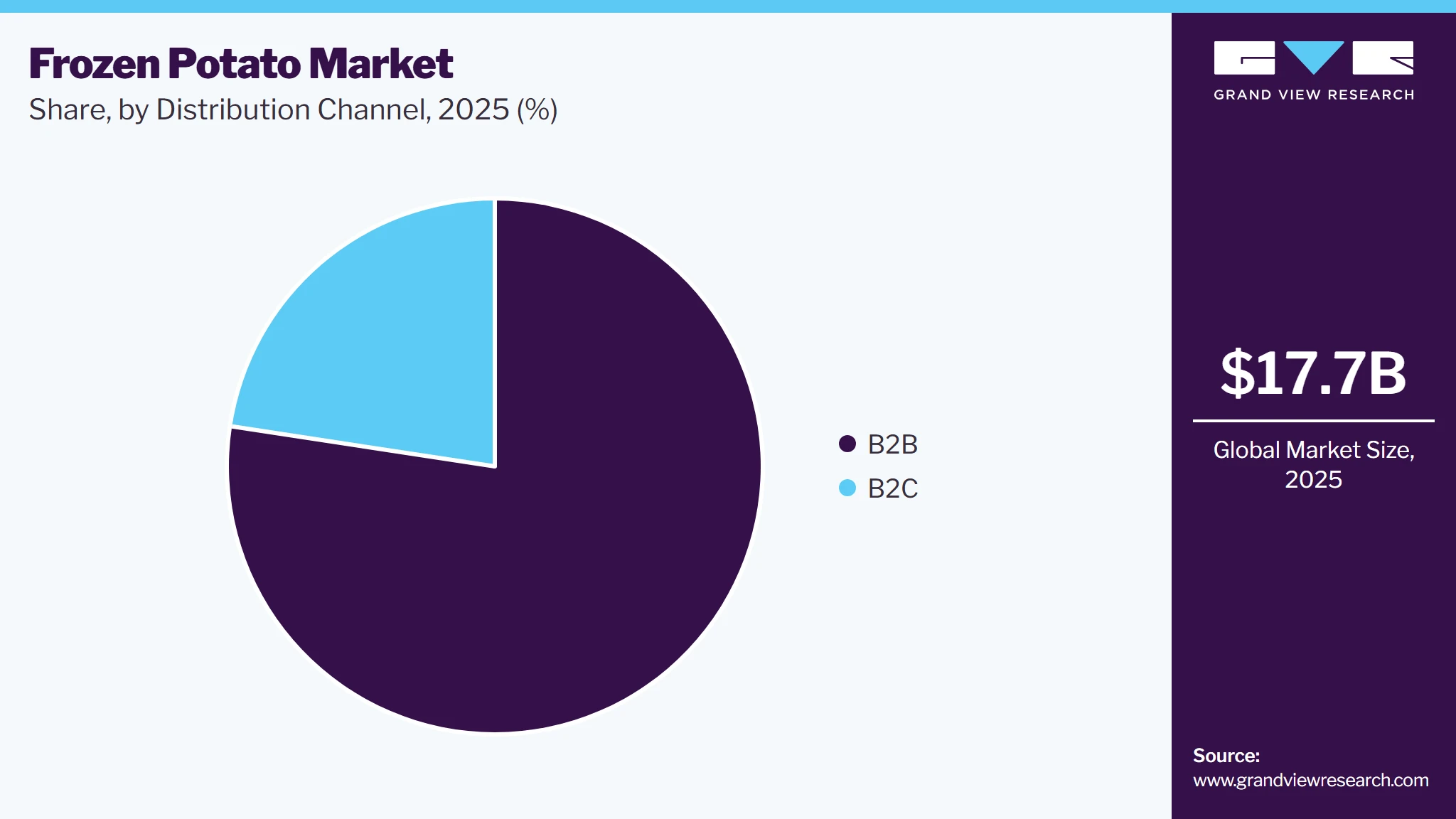
Frozen potato sales through the B2C channel is projected to grow at the fastest CAGR of 5.7% from 2026 to 2033. The B2C segment is supported by the increasing availability of frozen potato products in supermarkets, hypermarkets, convenience stores, and online grocery platforms. Consumers value the ability to purchase a variety of varieties and package sizes to suit their household needs. Attractive packaging and improved product visibility are helping brands reach more individual shoppers. Home cooking and snacking occasions also offer multiple opportunities for consumption. Wider retail access is consequently strengthening direct consumer sales.
Regional Insights
The North America frozen potato market accounted for the largest market share of 37.0% in 2025. The market is supported by the well-established foodservice industry and strong consumption of potato-based meals. Large-scale quick-service restaurant networks create steady demand for processed potato products. Advanced cold-storage and distribution systems enable efficient movement of frozen products across the region. Product variety across retail and foodservice channels also supports consumer choice. Established food processing capabilities further strengthen regional market development.

U.S. Frozen Potato Market Trends
The frozen potato market in the U.S. led North America in 2025, holding the largest market share with 76.9% of the region’s total revenue. The U.S. market is driven by the extensive presence of quick-service restaurants and large foodservice operators. French fries remain an important accompaniment to burgers, fried chicken, and other popular meals. The country also has a mature frozen-food retail network that offers broad product availability. Large domestic potato processing capabilities support a reliable product supply. Strong demand from institutional and commercial foodservice customers further contributes to market growth.
Europe Frozen Potato Market Trends
The frozen potato market in Europe is projected to grow at a CAGR of 5.3% from 2026 to 2033. Europe is driven by the strong integration of frozen potato products into restaurant, catering, and retail food channels. The region has a well-developed processed food industry with established manufacturing and distribution capabilities. Consumers have access to a broad range of potato formats, including fries, wedges, and specialty products. The presence of major food manufacturers supports continuous product development. Cross-border trade within the region also facilitates wider product availability.
The UK frozen potato market led Europe in 2025, holding the largest market share with 30.1% of the region’s total revenue. The UK market is supported by the strong role of potatoes in everyday meals and the popularity of takeaway and casual dining. Fish-and-chip shops and other foodservice businesses generate substantial demand for prepared potato products. Retailers provide consumers with a wide selection of frozen potato formats for home use. Established supermarket chains offer extensive freezer space and nationwide distribution. Demand from pubs, restaurants, and catering businesses further strengthens the segment.
Asia Pacific Frozen Potato Market Trends
The frozen potato market in the Asia Pacific is projected to grow at the fastest CAGR of 6.0% from 2026 to 2033. Asia Pacific is driven by the rapid development of modern foodservice and changing eating patterns in major economies. International restaurant chains are expanding their presence across urban markets, increasing demand for processed potato products. Rising exposure to Western-style foods is introducing frozen potato formats to new consumer groups. According to data published in June 2025, Gujarat, India, has emerged as a major hub for India’s processed potato industry, particularly frozen fries. The state’s frozen fries and other processed potato products are increasingly reaching global markets, strengthening India’s position in the international frozen potato industry. In addition, improvements in refrigerated logistics are making distribution more efficient.
China frozen potato market led the Asia Pacific in 2025, holding the largest market share with 43.3% of the region’s total revenue. The market is driven by the expansion of Western-style fast-food chains and modern casual dining outlets. Frozen French fries are increasingly used by commercial foodservice operators because of their consistent preparation characteristics. The growth of organized retail and online grocery platforms is improving access to frozen products. Domestic food processors are also expanding their capabilities to serve local demand. The increasing popularity of quick-service meals among younger urban consumers further supports the market.
Central & South America Frozen Potato Market Trends
The frozen potato market in CSA is projected to grow at a CAGR of 5.8% from 2026 to 2033. The market in Central & South America is supported by the growth of organized foodservice and quick-service restaurant outlets. Potatoes are widely incorporated into local diets, providing a strong base for processed potato consumption. The expansion of modern supermarkets is increasing the availability of frozen products. Improvements in food distribution networks are helping manufacturers reach a broader customer base. Growing tourism and hospitality activity also creates additional demand from commercial foodservice operators.
Middle East & Africa Frozen Potato Market Trends
The frozen potato market in MEA is expected to grow at a CAGR of 3.1% from 2026 to 2033. The Middle East & Africa market is driven by expanding hospitality, tourism, and foodservice industries. International restaurant brands are increasing their presence, creating demand for standardized frozen potato products. Hotels, catering companies, and institutional kitchens rely on frozen formats for efficient meal preparation. Modern retail development is gradually improving consumer access to frozen foods. Investments in cold-chain infrastructure are also supporting the wider distribution of temperature-sensitive products.
Key Frozen Potato Company Insights
The market is highly competitive, with market share concentrated among established global manufacturers and regional players. Leading companies compete through product quality, variety, pricing, and strong distribution networks. Large foodservice contracts and relationships with major retailers play an important role in maintaining market position. Companies are also focusing on product innovation and expanding their presence in emerging markets.
Key Frozen Potato Companies
The following key companies have been profiled for this study on the frozen potato market:
- McCain Foods Limited
- Lamb Weston Holdings, Inc.
- J.R. Simplot Company
- Aviko (Royal Cosun)
- Farm Frites International B.V.
- Agristo N.V.
- Cavendish Farms
- Mydibel Group
- Greenyard N.V.
- Ardo N.V.
Competitive Benchmarking
Category
Operating Strategies
Competitive Edge
Weakness
Established Players (McCain Foods, Lamb Weston, J.R. Simplot)
Expand processing capacity, strengthen supply chains, and diversify product portfolios.
Strong brand presence, global distribution, and long-term customer relationships.
High operating costs and exposure to potato price fluctuations.
Emerging Players (Agristo N.V., Mydibel Group)
Focus on product innovation, regional expansion, and specialized offerings.
Flexible operations, differentiated products, and faster market response.
Smaller global footprint and lower brand recognition.
Recent Developments
-
In June 2026, McCain launched SureCrisp Seaside Fries, designed to deliver boardwalk-style flavor with long-lasting crispiness for takeout and delivery. The new fries target the growing off-premise dining demand, helping foodservice operators maintain a crisp texture from the kitchen to the customer.
-
In March 2025, Lamb Weston launched Frenzy Fries, a unique three-sided, skin-on frozen fry designed to deliver a hand-crafted look and extra-crispy texture. Targeted at UK foodservice, the fries can stay hot and crispy for up to 20 minutes, helping operators reduce waste while offering a premium dining experience.
Frozen Potato Market Report Scope
Report Attribute
Details
Market size in 2025
USD 17.7 billion
Estimated market size in 2026
USD 18.0 billion
Projected market size by 2033
USD 27.2 billion
Growth rate (revenue)
CAGR of 5.4% from 2026 to 2033
Actuals
2021 - 2025
Forecast period
2026 - 2033
Quantitative (revenue) units
Revenue in USD billion, and CAGR from 2026 to 2033
Report coverage
Revenue forecast, company ranking, competitive landscape, growth factors, and trends
Segments covered
Product, distribution channel, region
Regional scope
North America; Europe; Asia Pacific; CSA; MEA
Country scope
U.S.; Canada; Mexico; UK; Germany; France; Italy; Spain; China; Japan; India; Australia & New Zealand; South Korea; Brazil; South Africa
Key companies profiled
McCain Foods Limited; Lamb Weston Holdings, Inc.; J.R. Simplot Company; Aviko (Royal Cosun); Farm Frites International B.V.; Agristo N.V.; Cavendish Farms; Mydibel Group; Greenyard N.V.; Ardo N.V.
Customization scope
Free report customization (equivalent up to 8 analysts’ working days) with purchase. Addition or alteration to country, regional & segment scope.
Pricing and purchase options
Avail customized purchase options to meet your exact research needs. Explore purchase options
Global Frozen Potato Market Report Segmentation
This report forecasts revenue growth at the regional and country levels and provides an analysis of the latest industry trends and opportunities in each of the sub-segments from 2021 to 2033. For this study, Grand View Research has segmented the global frozen potato market report based on product, distribution channel, and region:

-
Product Outlook (Revenue, USD Billion, 2021 - 2033)
-
French fries
-
Hash browns/patties
-
Potato Wedges
-
Others
-
-
Distribution Channel Outlook (Revenue, USD Billion, 2021 - 2033)
-
B2B
-
Foodservice
-
QSRs
-
Restaurants & Hotels
-
-
B2C
-
Supermarkets & Hypermarkets
-
Convenience Stores
-
Specialty Stores
-
Online
-
-
-
Regional Outlook (Revenue, USD Billion, 2021 - 2033)
-
North America
-
U.S.
-
Canada
-
Mexico
-
-
Europe
-
UK
-
Germany
-
France
-
Italy
-
Spain
-
-
Asia Pacific
-
China
-
Japan
-
India
-
Australia & New Zealand
-
South Korea
-
-
Central & South America
-
Brazil
-
-
Middle East & Africa
-
South Africa
-
-
Segment Definition
Segment - Product
Revenue capture definition
French Fries
Frozen potato companies generate revenue through the sale of French fries to households, restaurants, quick-service outlets, and foodservice operators. Revenue is captured through retail packs, bulk formats, and branded product ranges. Different cuts, thicknesses, and portion sizes allow companies to serve diverse customer requirements. Premium varieties and value-added preparations can support higher selling prices.
Hash Browns/Patties
Frozen potato companies generate revenue through the sale of hash browns and patties across retail and foodservice channels. Revenue is captured through individual packs, multipacks, and bulk formats for commercial customers. Different shapes, sizes, and formulations allow manufacturers to target varied consumption occasions. Premium recipes and specialty formulations can further increase revenue per unit.
Potato Wedges
Frozen potato companies generate revenue through the sale of potato wedges to households, restaurants, cafés, and catering businesses. Revenue is generated through retail packs as well as bulk foodservice formats. Seasoned, coated, and flavored wedges provide opportunities for product differentiation. Value-added varieties can command higher prices and improve revenue potential.
Others
Frozen potato companies generate revenue from products such as potato cubes, slices, spirals, and specialty potato preparations. These products are sold through retail, foodservice, and institutional channels in different package formats. Product customization and varied preparation styles help companies serve specific customer requirements. Innovative shapes and specialty offerings can create additional revenue opportunities.
Delivered Customizations
This report has been delivered with the following In-depth customizations
Client Request
Customization Delivered
Value Adds
Global Frozen Potato Market Size & Growth Assessment
Analyzed market size, growth trends, and future demand across key regions and product segments. Assessed regional demand patterns, consumption trends, and market development stages.
Identifies high-growth markets and supports expansion decisions. Highlights priority regions for investment and market entry.
Global Frozen Potato Competitive Landscape
Assessed key players, product portfolios, positioning, and competitive strategies. Compared market presence, product differentiation, and strategic focus across major competitors.
Highlights market gaps and differentiation opportunities. Supports competitive benchmarking and positioning strategy.
Global Frozen Potato Product & Format Assessment
Evaluated demand for fries, wedges, hash browns, and other frozen potato formats. Assessed format preferences across retail, foodservice, and QSR applications.
Identifies attractive product segments and portfolio opportunities. Supports product innovation and targeted category expansion.
Frequently Asked Questions About This Report
The global frozen potato market is expected to grow at a CAGR of 5.4% from 2026 to 2033, reaching USD 27.2 billion.
Key factors include rising demand for convenience and ready-to-cook foods, expanding quick-service restaurants (QSRs), urbanization, and changing consumer lifestyles.
The French fries segment led with a 72.0% revenue share in 2025.
The Hash browns/patties market is projected to grow at the fastest CAGR of 5.6% from 2026 to 2033.
The North America frozen potato market led with a 37.0% revenue share in 2025.
The sale of frozen potatoes through the B2B channel accounted for the largest share of 77.5% of the revenue in 2025.
The sale of frozen potatoes through the B2C channel is projected to grow at a CAGR of 5.7% from 2026 to 2033.
Key players include McCain Foods Limited, Lamb Weston Holdings, Inc., J.R. Simplot Company, Aviko (Royal Cosun), Farm Frites International B.V., Agristo N.V., Cavendish Farms, Mydibel Group, Greenyard N.V., and Ardo N.V.
The global frozen potato market size was valued at USD 17.7 billion in 2025 and is estimated at USD 18.0 billion for 2026.
About the Author(s)
Consumer F&B Research Team
Consumer Goods · Consumer F&BThis report was authored by the consumer f&b research team at Grand View Research - comprising two research analysts, one senior research analyst, and one industry expert - with specialized expertise in the consumer f&b segment of the consumer goods industry. All findings are based on proprietary consumer goods databases, executive interviews, and regulatory analysis, subject to internal peer review prior to publication.
Last Updated:
Speak to Analyst


Customize this report to your needs — add regions, segments, or data points, with 20% free customization.
Or view our licence options:


ISO 9001:2015 & 27001:2022 Certified
We are GDPR and CCPA compliant! Your transaction & personal information is safe and secure. For more details, please read our privacy policy.


