
- Home
- »
- Advanced Interior Materials
- »
-
Fuelwood Market Size, Share & Trends Report, 2026-2033GVR Report cover

Fuelwood Market (2026 - 2033)
Size, Share & Trends Analysis Report By Source Type (Natural Forests, Plantation Forests, Agroforestry), By End-use (Residential Heating & Cooking, Industrial Heating, Power Generation), By Region, And Segment Forecasts
Market Size, 2025
$38.4BMarket Estimate, 2026
$39.8BMarket Forecast, 2033
$50.6BCAGR, 2026–2033
3.5%Fuelwood Market Summary
The global fuelwood market size was valued at USD 38.4 billion in 2025 and is projected to grow from USD 39.8 billion in 2026 to USD 50.6 billion by 2033, at a CAGR of 3.5% from 2026 to 2033. Asia Pacific market dominated, with a revenue share of 43.2% in 2025. In countries across Asia and Africa, rapid population growth and urbanization have increased energy consumption in rural and peri-urban areas, where access to electricity and clean fuels remains limited.
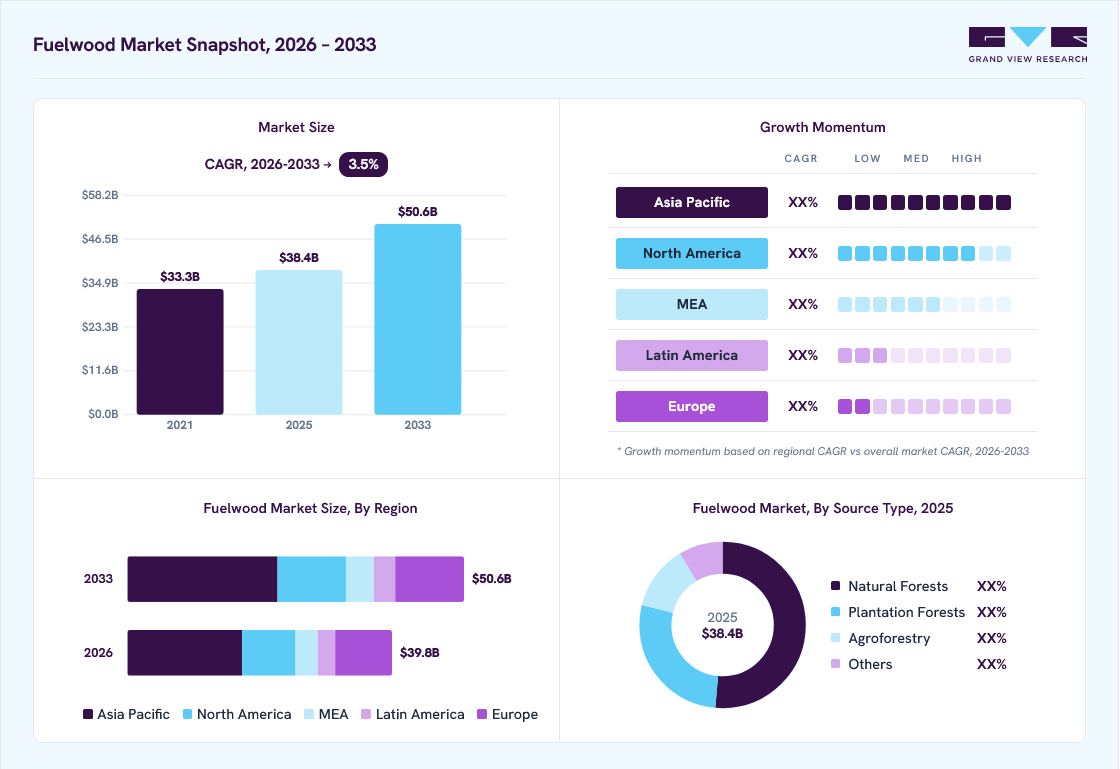 Source: Grand View Research, IR Documents, Primary Interviews, Paid DatabasesTo learn more about this report,
 Download Free Sample Report
Key Market Trends & Insights
- By source type: Natural forests segment led the market with the largest revenue share of 51.3% in 2025.
- By end-use: Residential heating & cooking segment led the market with the largest revenue share of 54.5% in 2025.
Regional Highlights
- Largest regional market: Asia Pacific (43.2% revenue share, 2025)
- By country: China held the largest market share in 2025.
Market Size & Forecasts
- Market size in 2025: USD 38.4 Billion
- Estimated market size in 2026: USD 39.8 Billion
- Projected market size by 2033: USD 50.6 Billion
- CAGR (2026-2033): 3.5%
Prism AI by Grand View Research Free to tryAsk a question about the fuelwood marketTry asking✓Every figure cited from GVR research Prefer the report? Download free sample →
Despite global efforts to transition to modern energy sources, fuelwood remains a reliable and affordable option for millions of households, particularly in nations like India, Nigeria, and Ethiopia, where traditional cooking practices and economic constraints sustain its widespread use. Several factors are driving the growing demand for fuelwood. Economic constraints and limited infrastructure in rural areas make fuelwood an accessible choice compared to electricity or LPG. Moreover, cultural practices and traditional cooking methods still rely heavily on wood-based fuels. In addition, the rising prices of alternative energy sources and the push for energy self-sufficiency in some regions have further supported the use of locally sourced biomass. In some cases, even urban communities are turning to wood pellets and briquettes for heating due to high electricity tariffs or supply instability. To learn more about this report, Download Free Sample Report
Recent innovations in the fuelwood industry aim to address environmental and efficiency concerns. Technologies such as improved cookstoves reduce emissions and increase combustion efficiency, significantly lowering fuel consumption. The development of compressed biomass briquettes and pellets as standardized fuel products has helped streamline distribution and storage. In addition, digital tools and mobile apps now enable better tracking of supply chains, while reforestation and sustainable harvesting programs are being integrated into policy frameworks to promote renewable sourcing. These upgrades are helping the fuelwood sector transition toward a more sustainable and regulated future.
Market Dynamics
The fuelwood market is influenced by the continued demand for affordable and accessible biomass energy, particularly in rural and developing regions where wood remains an important source of household and small-scale industrial fuel. Growing interest in renewable energy sources, increasing adoption of traditional biomass in off-grid areas, and rising focus on locally available energy resources are supporting market growth. Government initiatives promoting sustainable forestry practices, clean cooking solutions, and biomass utilization are also shaping the market landscape. However, concerns related to deforestation, carbon emissions from inefficient combustion, and competition from alternative energy sources are creating challenges for market expansion. Technological advancements in efficient wood-burning stoves, sustainable forest management, and certified fuelwood supply chains are expected to influence future market development.
Fuelwood continues to serve as a cost-effective renewable energy source, especially in regions with limited access to modern energy infrastructure. Rural households, agricultural communities, and small-scale industries rely on fuelwood for cooking, heating, and process applications due to its availability and lower upfront costs compared with conventional fuels. The growing need for decentralized energy solutions and rising energy costs are encouraging continued utilization of biomass-based fuels.
Additionally, the transition toward renewable and locally sourced energy resources is supporting fuelwood demand in several regions. Governments and organizations are promoting sustainable biomass utilization as part of broader energy diversification strategies, particularly where managed forests and plantation-based resources can provide a consistent supply of wood fuel without significant environmental degradation.
The fuelwood market faces challenges due to concerns regarding deforestation, forest degradation, and emissions generated from traditional wood combustion methods. Unsustainable harvesting practices can negatively impact ecosystems and biodiversity, leading to stricter regulations on forest resource utilization. In addition, inefficient burning technologies can contribute to indoor air pollution and carbon emissions, limiting fuelwood adoption in environmentally sensitive markets.
The growing emphasis on sustainable energy practices creates opportunities for the development of certified and responsibly sourced fuelwood markets. Increased adoption of sustainable forestry certifications, plantation-based wood production, and efficient supply chain management can improve market credibility while addressing environmental concerns. Organized fuelwood distribution networks and improved processing technologies can further enhance product quality and reliability.
Market Concentration & Characteristics
The fuelwood industry is largely fragmented, with a high concentration of small-scale and informal suppliers, especially in developing countries. Most of the production and distribution occur at the local or regional level, with limited presence of large, organized players. This results in varying pricing, inconsistent supply chains, and limited regulatory oversight. However, in some developed regions and urban centers, the market is becoming more structured with the emergence of biomass pellet producers and improved cookstove manufacturers. Government initiatives and NGOs are also playing a role in shaping the market through sustainable forestry programs and rural energy access projects.
 To learn more about this report, Download Free Sample Report
In terms of product substitutes, fuelwood faces growing competition from liquefied petroleum gas (LPG), electricity, biogas, and solar-powered cooking solutions. These alternatives are often cleaner and more efficient, but are not always accessible or affordable in remote or low-income regions. Compressed biomass products like briquettes and pellets are also emerging as popular substitutes, offering similar utility with reduced environmental impact. While modern energy options are gaining ground, fuelwood remains dominant in many areas due to cultural preferences, cost considerations, and infrastructure limitations. As awareness and access to cleaner alternatives increase, the fuelwood industry may gradually shift, but for now, it continues to be a critical energy source for millions.
Analyst Perspective
The fuelwood market is expected to grow steadily as many households, industries, and rural communities continue to use wood as a reliable and affordable source of energy. Growing awareness of renewable energy and sustainable forest management is encouraging the use of responsibly sourced fuelwood and improving supply chains. Although the increasing use of electricity, natural gas, and other cleaner fuels may reduce demand in some developed regions, fuelwood will continue to play an important role in many developing countries. Companies that focus on sustainable sourcing, better product quality, and efficient distribution are likely to strengthen their position and achieve long-term growth.
Source Type Insights
Based on source type, the natural forests segment led the market with the largest revenue share of 51.3% in 2025 and is expected to grow at a CAGR of 3.2% over the forecast period. In many developing regions, rural communities rely on nearby natural forests for wood collection, often through informal or subsistence-level harvesting. These forests offer a low-cost, readily available source of biomass fuel without the need for investment in cultivation or infrastructure. In addition, weak enforcement of forest management regulations in several countries has led to unchecked extraction from natural reserves, reinforcing their dominance in the fuelwood supply chain.
The plantation forests segment is anticipated to grow at the fastest CAGR of 4.1% during the forecast period, driven by increasing concerns over deforestation, biodiversity loss, and environmental degradation caused by over-reliance on natural forests. Governments and environmental agencies are promoting sustainable fuelwood production through managed plantations that offer predictable yields, reduced ecological impact, and better regulatory compliance. Plantation forests can be specifically cultivated with fast-growing species like eucalyptus or acacia, allowing for more efficient harvesting cycles. This controlled approach supports both environmental goals and growing fuelwood demand, making plantations a key focus area for sustainable biomass sourcing.
End Use Insights
Based on end-use, the residential heating & cooking segment led the market with the largest revenue share of 54.5% in 2025 and is expected to grow at a CAGR of 3.2% over the forecast period. In many parts of Asia, Africa, and Latin America, fuelwood remains the most accessible and affordable energy source for daily domestic needs. The cultural preference for wood-based cooking methods, coupled with limited access to clean energy alternatives like LPG or electricity, has further entrenched fuelwood use in residential settings. Government subsidies on improved cookstoves and community-level distribution systems have also reinforced their widespread adoption in the household segment.
 To learn more about this report, Download Free Sample Report
The industrial heating segment is anticipated to grow at the fastest CAGR during the forecast period. As industries, especially in agro-processing, textiles, and small-scale manufacturing, seek cost-effective and renewable energy sources, fuelwood and biomass are increasingly being adopted for thermal energy needs. Rising fossil fuel prices and stricter emission norms are also pushing industries to explore biomass-based heating as a sustainable alternative. With improved fuelwood processing methods (such as pellets and briquettes) offering consistent quality and higher combustion efficiency, the shift toward industrial applications is accelerating, driving rapid growth in this segment.
Regional Insights
The fuelwood market in North America is relatively niche but stable, primarily driven by residential heating in colder regions. The use of wood-burning stoves and fireplaces remains popular in rural areas and among environmentally conscious consumers seeking renewable heating alternatives. The market is more structured compared to developing regions, with regulated supply chains, sustainable forestry practices, and increased adoption of wood pellets and briquettes.
U.S. Fuelwood Market Trends
The fuelwood market in the U.S. is supported by demand for residential space heating, especially in the Northeast and Northwest regions. A growing segment of environmentally aware consumers and off-grid households continues to use wood as a renewable heating source. Furthermore, the U.S. leads in biomass pellet production, with a portion of it being exported for industrial use in Europe, positioning the country as a key player in the global biomass supply chain.
Europe Fuelwood Market Trends
Europe dominated the fuelwood market with the largest revenue share of 59.68% in 2024, as it is a major consumer of fuelwood and biomass products, largely due to strong government support for renewable energy and climate goals. Many European countries offer subsidies for biomass heating systems, driving the demand for fuelwood, pellets, and briquettes in both residential and industrial sectors. The region's focus on reducing carbon emissions has led to increased adoption of modern biomass technologies and stricter regulations around sustainable forestry and emissions control.
The fuelwood market in Germany plays a leading role in the European market, driven by its strong commitment to renewable energy and energy transition goals (Energiewende). Fuelwood is widely used for both residential heating and in district heating systems. The country also emphasizes sustainable forestry practices, ensuring a regulated supply of biomass. Continuous innovation in biomass boilers and efficient heating systems further fuels demand in both rural and urban sectors.
Asia Pacific Fuelwood Market Trends
Asia Pacific dominated the fuelwood market with the largest revenue share of 43.2% in 2025. The fuelwood market in Asia Pacific is driven largely by its large rural population, significant dependence on traditional biomass, and widespread use of wood for residential cooking and heating. Countries like India, Indonesia, and Bangladesh have millions of households that rely on fuelwood as a primary energy source due to limited access to modern fuels. Government-led clean cooking programs and the introduction of improved biomass technologies are gradually transforming the market. Still, traditional fuelwood usage remains deeply entrenched, especially in remote and low-income areas.
 To learn more about this report, Download Free Sample Report
The fuelwood market in China held the largest share in the Asia Pacific region in 2025, due to its vast rural landscape and historical reliance on biomass for domestic energy needs. While urbanization and modernization have reduced the use of fuelwood in cities, many rural and mountainous regions still depend on it for heating during the winter. In recent years, China has promoted biomass energy through renewable energy policies, leading to the growth of commercial wood pellet use for industrial heating and power generation.
Central & South America Fuelwood Market Trends
The fuelwood market in Central and South America remains an essential energy source for cooking and heating, particularly in rural and indigenous communities. Countries like Brazil, Peru, and Guatemala still rely heavily on wood due to limited infrastructure for electricity and clean fuels. While modern energy adoption is growing, the informal fuelwood industry remains strong, driven by affordability and cultural preferences.
Middle East & Africa Fuelwood Market Trends
The fuelwood market in the Middle East & Africa has a significant growth, particularly in Sub-Saharan Africa, where it remains a primary energy source for millions of households. In countries like Nigeria, Ethiopia, and Sudan, fuelwood is essential for daily cooking needs. The lack of energy infrastructure and high poverty levels contribute to continued reliance on traditional biomass. Efforts by NGOs and governments to introduce cleaner cooking solutions are underway, but face challenges in scaling across vast rural populations.
Key Fuelwood Company Insights
Some of the key players operating in the market include Enviva Inc. and Drax Group plc.
-
Enviva Inc. is one of the largest producers of industrial wood pellets, a refined form of fuelwood used primarily for renewable energy production. The company sources sustainably harvested wood from natural and plantation forests, converting it into pellets that serve as a cleaner alternative to coal in power plants globally. Enviva plays a crucial role in the fuelwood industry by promoting biomass as a key component of the global transition to renewable energy, especially in Europe and Asia.
-
Drax Group plc is a UK-based energy company heavily invested in biomass energy, including fuelwood in pellet form. Drax operates one of the world’s largest biomass power stations, using sustainably sourced wood pellets to generate renewable electricity. The company is pivotal in transforming traditional fuelwood into high-efficiency, low-carbon energy solutions, aligning with Europe’s climate goals and helping reduce dependence on fossil fuels.
Pinnacle Renewable Energy, Lignetics, Inc., are some of the emerging market participants in the fuelwood industry.
-
Pinnacle Renewable Energy is a leading North American producer of wood pellets, supplying both residential and industrial markets. Their pellets are derived from sustainably managed forests and provide a renewable substitute for traditional fuelwood. Pinnacle supports the fuelwood industry shift toward cleaner, more efficient biomass fuels by offering consistent-quality pellets used in heating systems and power generation across multiple continents.
-
Lignetics, Inc. is a prominent U.S. manufacturer and supplier of wood pellets, firelogs, and firewood products mainly targeting residential heating and recreational markets. The company emphasizes producing high-quality fuelwood products that burn efficiently and cleanly, appealing to consumers seeking affordable and renewable heating alternatives. Lignetics contributes to the fuelwood industry by enhancing product availability and encouraging the use of biomass fuels in homes.
Key Fuelwood Companies
The following key companies have been profiled for this study on the fuelwood market.
-
Enviva Inc.
-
Drax Group plc
-
Pinnacle Renewable Energy
-
Lignetics, Inc.
-
Energex
-
Green Energy Biofuel.
-
Pacific BioEnergy.
-
Fram Renewable Fuels
-
The Westervelt Company
-
West Oregon Wood Products
Competitive Benchmarking
Category
Operating Strategies
Competitive Edge
Weakness
Established Players (Enviva Inc.; Drax Group plc; Pinnacle Renewable Energy; Lignetics, Inc.; Pacific BioEnergy)
- Expand sustainable fuelwood and biomass fuel portfolios by securing long-term timber resources and certified forest feedstocks.
- Invest in pelletizing, drying, and biomass processing technologies to improve fuel quality, operational efficiency, and supply reliability.
- Strengthen global supply chains through strategic forestry partnerships, export infrastructure, and long-term supply agreements with utilities and industrial customers.
- Strong access to sustainable forestry resources and vertically integrated supply chains ensuring consistent raw material availability.
- Well-established international customer base supported by large-scale production facilities, logistics infrastructure, and long-term commercial contracts.
- Extensive expertise in biomass certification, sustainable forest management, and compliance with international renewable energy standards.
- High dependence on timber availability and fluctuations in wood feedstock prices, transportation costs, and harvesting expenses.
- Significant capital investment required for biomass processing plants, storage facilities, and export logistics infrastructure.
- Exposure to changing renewable energy policies, carbon regulations, and international trade restrictions affecting biomass demand.
Emerging Players (Energex; Green Energy Biofuel; Fram Renewable Fuels; The Westervelt Company; West Oregon Wood Products)
- Focus on regional fuelwood production, customized biomass solutions, and niche industrial heating applications.
- Expand market reach through partnerships with local forestry operators, distributors, municipalities, and commercial biomass users.
- Develop value-added fuelwood products with improved moisture control, higher energy density, and sustainable sourcing certifications to differentiate offerings.
- Strong regional market presence with the flexibility to respond quickly to local biomass demand and customer requirements.
- Ability to source feedstock locally, reducing transportation costs while supporting regional sustainable forestry initiatives.
- Agile operations enable faster product customization and expansion into specialized residential, commercial, and industrial biomass markets.
- Limited production capacity and geographic reach compared with multinational biomass producers.
- Lower financial resources for large-scale facility expansion, technology upgrades, and international market development.
- Greater dependence on regional forestry conditions, local regulations, and seasonal fluctuations in wood supply and customer demand.
Recent Developments
- In 2023, Enviva Inc. announced that it is constructing its 11th wood pellet production facility in Epes, Alabama. Once operational, this plant is projected to add 1.1 million metric tons per year to Enviva's production capacity, making it the world's largest wood pellet production plant.
Fuelwood Market Report Scope
Report Attribute
Details
Market size in 2025
USD 38.4 billion
Estimated market size in 2026
USD 39.8 billion
Projected market size by 2033
USD 50.6 billion
Growth rate
CAGR of 3.5% from 2026 to 2033
Base year for estimation
2025
Historical data
2021 - 2024
Forecast period
2026 - 2033
Quantitative units
Revenue in USD million/billion and CAGR from 2026 to 2033
Report coverage
Revenue forecast, company ranking, competitive landscape, growth factors, and trends
Segments covered
Source type, end-use, region
Regional scope
North America; Europe; Asia Pacific; Central & South America; Middle East & Africa
Country scope
U.S.; Canada; Mexico; UK; Germany; France; Italy; Spain; China; India; Japan; South Korea
Key companies profiled
Enviva Inc.; Drax Group plc; PINNACLE RENEWABLE ENERGY; LIGNETICS, INC.; Energex; Green Energy Biofuel; Pacific BioEnergy; Fram Renewable Fuels; West Oregon Wood Products and THE WESTERVELT COMPANY
Customization scope
Free report customization (equivalent up to 8 analysts' working days) with purchase. Addition or alteration to country, regional & segment scope.
Pricing and purchase options
Avail customized purchase options to meet your exact research needs. Explore purchase options
Global Fuelwood Market Report Segmentation
This report forecasts revenue growth at the global, regional, and country levels and provides an analysis of the latest industry trends in each of the sub-segments from 2021 to 2033. For this study, Grand View Research has segmented the global fuelwood market report based on source, end use, and region.
 To learn more about this report, Download Free Sample Report
-
Source Type Outlook (Revenue, USD Million, 2021 - 2033)
-
Natural Forests
-
Plantation Forests
-
Agroforestry
-
Others
-
-
End Use Outlook (Revenue, USD Million, 2021 - 2033)
-
Residential Heating & Cooking
-
Industrial Heating
-
Power Generation
-
Others
-
-
Regional Outlook (Revenue, USD Million, 2021 - 2033)
-
North America
-
U.S.
-
Canada
-
Mexico
-
-
Europe
-
Germany
-
UK
-
France
-
Italy
-
Spain
-
-
Asia Pacific
-
China
-
Japan
-
India
-
South Korea
-
-
Central & South America
-
Middle East & Africa
-
Research Methodology
The fuelwood market figures in this report are based on a proven research process that combines executive interviews with secondary research from proprietary databases, company filings, and recognized regulatory and institutional sources. Market size is built through value-chain sizing - reconciling supply-side and demand-side estimates - and triangulated with bottom-up and top-down approaches. Every estimate passes multiple levels of expert validation before publication, with each fuelwood segment quantified using the revenue-capture definitions in the table below.
Segment Definition
Segment - Application
Revenue capture definition
Natural Forests
Revenue generated from the sale of fuelwood harvested from naturally occurring forests for use in residential, commercial, industrial, and community energy applications. This includes firewood supplied through regulated forestry operations for heating, cooking, and biomass fuel purposes.
Plantation Forests
Revenue generated from the sale of fuelwood produced from dedicated plantation forests cultivated specifically for biomass energy. This includes sustainably managed wood supplied for household heating, industrial boilers, and power generation facilities.
Agroforestry
Revenue generated from the sale of fuelwood obtained from agroforestry systems where trees are integrated with agricultural crops or livestock. These products are supplied for residential heating, cooking, and small-scale commercial and industrial energy applications.
Others
Revenue generated from the sale of fuelwood sourced from woodlots, roadside plantations, orchard pruning, municipal tree maintenance, reclaimed wood, and other alternative biomass sources used for energy generation and heating applications.
Segment End Use
Revenue capture definition
Residential Heating & Cooking
Revenue generated from the sale of fuelwood used for household cooking, space heating, and water heating in residential settings. This includes firewood supplied to rural and urban households through retail, wholesale, and local distribution channels.
Industrial Heating
Revenue generated from the sale of fuelwood used as a biomass fuel in industrial heating applications, including boilers, kilns, furnaces, food processing, brick manufacturing, ceramics, and other thermal energy-intensive operations.
Power Generation
Revenue generated from the sale of fuelwood supplied to biomass power plants and combined heat and power (CHP) facilities for electricity and heat generation. This includes wood fuel used independently or co-fired with other biomass feedstocks.
Others
Revenue generated from the sale of fuelwood for miscellaneous applications such as commercial cooking, institutional heating, camping and recreational use, traditional ceremonies, and other specialized biomass energy uses not covered under the primary application segments.
Estimation Model
Layer Name
Key Question
Description
Raw Material & Resource Availability
How much fuelwood is sustainably available for commercial use?
Estimates the total supply of fuelwood from natural forests, plantation forests, agroforestry systems, and other sources by analyzing harvest volumes, forestry regulations, sustainable yield, and biomass resource availability across key producing regions.
Production & Supply Chain Assessment
How much fuelwood reaches the commercial market?
Evaluates fuelwood harvesting, processing, seasoning, storage, transportation, wholesale distribution, and retail channels to determine the commercially traded volume and supply efficiency across regional markets.
Application Demand Assessment
Which end-use sectors consume the most fuelwood?
Measures fuelwood consumption across residential heating & cooking, industrial heating, power generation, and other applications by assessing energy demand, biomass adoption rates, industrial utilization, and regional consumption patterns.
Revenue & Market Validation
What is the total market value generated from fuelwood sales?
Calculates market revenue by combining commercially traded fuelwood volumes with regional pricing, product mix, distribution channels, and end-use demand. Results are validated through supplier analysis, forestry statistics, trade data, and industry expert insights to ensure market accuracy.
Delivered Customizations
This report has been delivered with the following In-depth customizations
Client Request
Customization Delivered
Value Adds
Regional Market Analysis
Detailed country- and region-level analysis covering fuelwood production, consumption patterns, pricing trends, trade flows, regulatory framework, demand drivers, and growth opportunities across major markets.
Helps clients identify high-growth regions, evaluate investment opportunities, develop regional expansion strategies, and understand market-specific risks and demand trends.
Competitive Benchmarking
Comprehensive profiling of leading fuelwood producers, including product portfolio, production capacity, geographic presence, sourcing strategy, sustainability initiatives, recent developments, partnerships, and competitive positioning.
Enables clients to compare competitors, identify market gaps, benchmark business performance, evaluate partnership opportunities, and formulate effective competitive strategies.
Supply Chain & Sustainability Analysis
Detailed assessment of the complete value chain, including raw material sourcing, forestry management practices, harvesting, processing, transportation, distribution networks, certification standards, and sustainability initiatives affecting the fuelwood market.
Supports procurement planning, supply chain optimization, ESG compliance, risk mitigation, and the development of reliable and sustainable sourcing strategies.
Frequently Asked Questions About This Report
Asia Pacific market dominated, with a revenue share of 43.2% in 2025.
The fuelwood market size was valued at USD 38.4 billion in 2025 and is estimated at USD 39.8 billion in 2026.
The fuelwood market is expected to grow at a CAGR of 3.5% from 2026 to 2033, reaching USD 50.6 billion by 2033.
Some of the key players operating in the fuelwood market include Enviva Inc., Drax Group Plc, Pinnacle Renewable Energy, Lignetics, Inc., Energex, Green Energy Biofuel, Pacific Bioenergy, Fram Renewable Fuels, West Oregon Wood Products, and The Westervelt Company.
Key factors driving the fuelwood market include increasing demand for affordable renewable energy, widespread use in residential heating and cooking, and growing focus on sustainable biomass and forest management.
Natural forests segment led the market with the largest revenue share of 51.3% in 2025.
Residential heating & cooking segment led the market with the largest revenue share of 54.5% in 2025.
About the Author(s)
Advanced Interior Materials Research Team
Advanced Materials · Advanced Interior MaterialsThis report was authored by the advanced interior materials research team at Grand View Research - comprising two research analysts, one senior research analyst, and one industry expert - with specialized expertise in the advanced interior materials segment of the advanced materials industry. All findings are based on proprietary advanced materials databases, executive interviews, and regulatory analysis, subject to internal peer review prior to publication.
Last Updated:
Speak to Analyst

Customize this report to your needs - add regions, segments, or data points, with 20% free customization.
Or view our licence options:


ISO 9001:2015 & 27001:2022 Certified
We are GDPR and CCPA compliant! Your transaction & personal information is safe and secure. For more details, please read our privacy policy.


