
- Home
- »
- Organic Chemicals
- »
-
Fused Magnesia Market Size, Share & Trends Report, 2033GVR Report cover

Fused Magnesia Market (2026 - 2033)
Size, Share & Trends Analysis Report By Grade (Industrial Grade, Specialty Grade), By Application (Steel, Cement, Glass, Non-Ferrous Metals, Automotive & Electrical), By Source, By Region, And Segment Forecasts
Market Size, 2025
$2.3BMarket Estimate, 2026
$2.4BMarket Forecast, 2033
$3.7BCAGR, 2026–2033
6.5%Fused Magnesia Market Summary
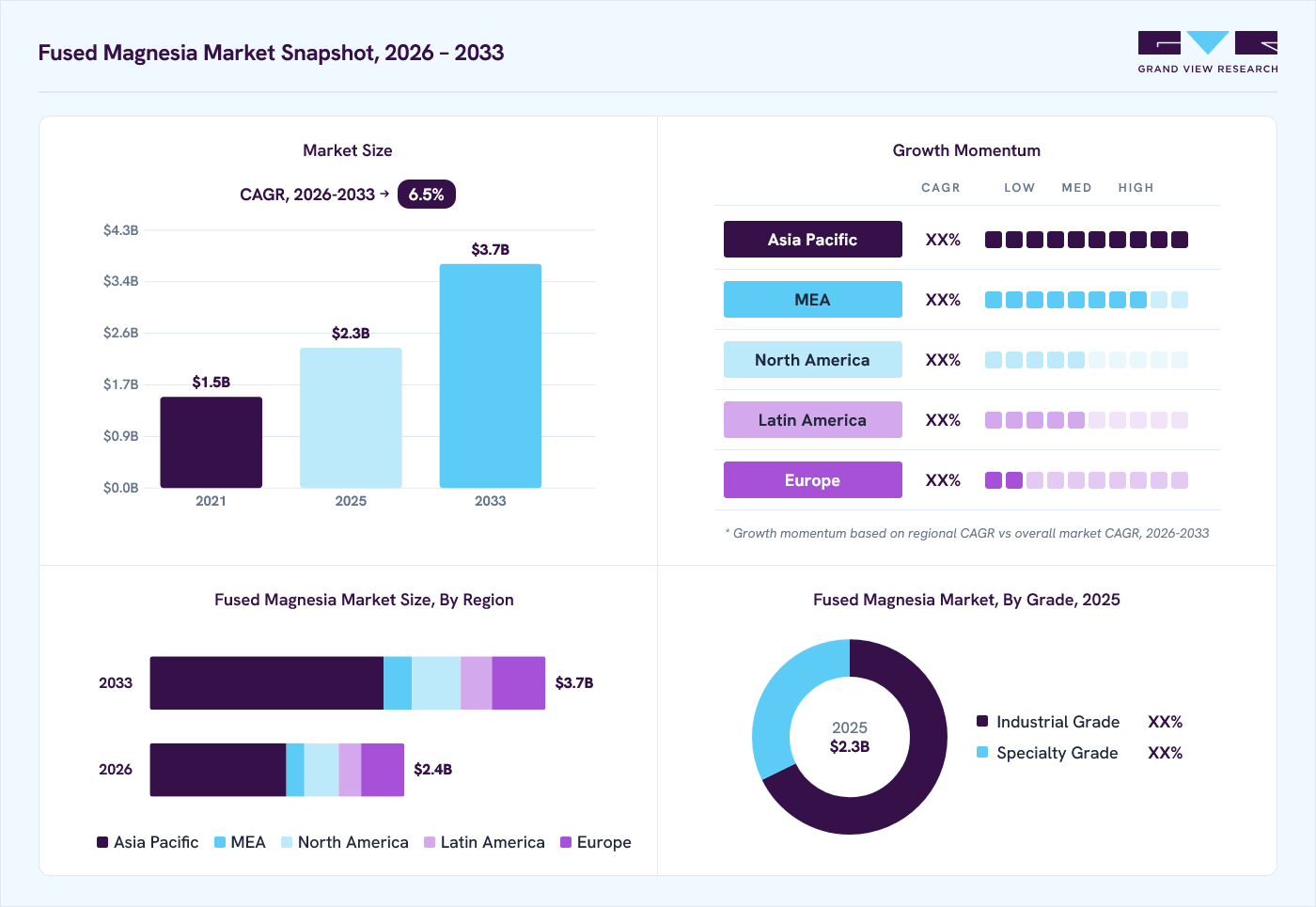
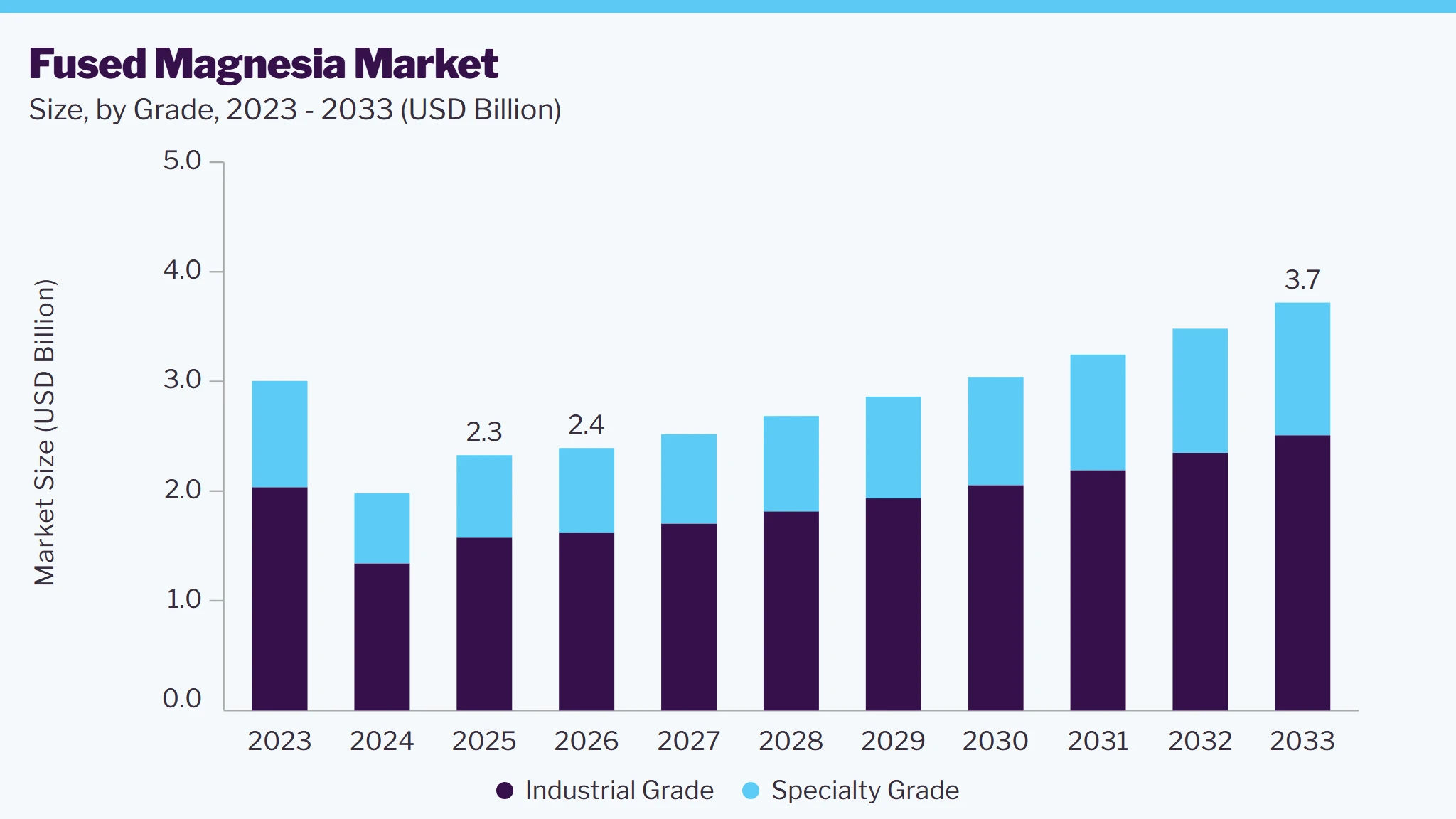
The global fused magnesia market size was valued at USD 2.3 billion in 2025 and is projected to grow from USD 2.4 billion in 2026 to USD 3.7 billion by 2033, at a CAGR of 6.5% from 2026 to 2033. Asia Pacific dominated the market, accounting for the largest revenue share of 52.9% in 2025. Rising steel production and demand for high-temperature refractories are driving fused magnesia consumption, supported by 2.35 billion tonnes of global crude steel production in 2025.
 Source: Grand View Research, IR Documents, Primary Interviews, Paid DatabasesTo learn more about this report,
 Download Free Sample Report
 Key Market Trends & Insights
- By grade: Industrial grade segment held the dominating revenue share of 67.7% in 2025.
- By application: Steel represented the largest segment capturing a 31.9% revenue share in 2025.
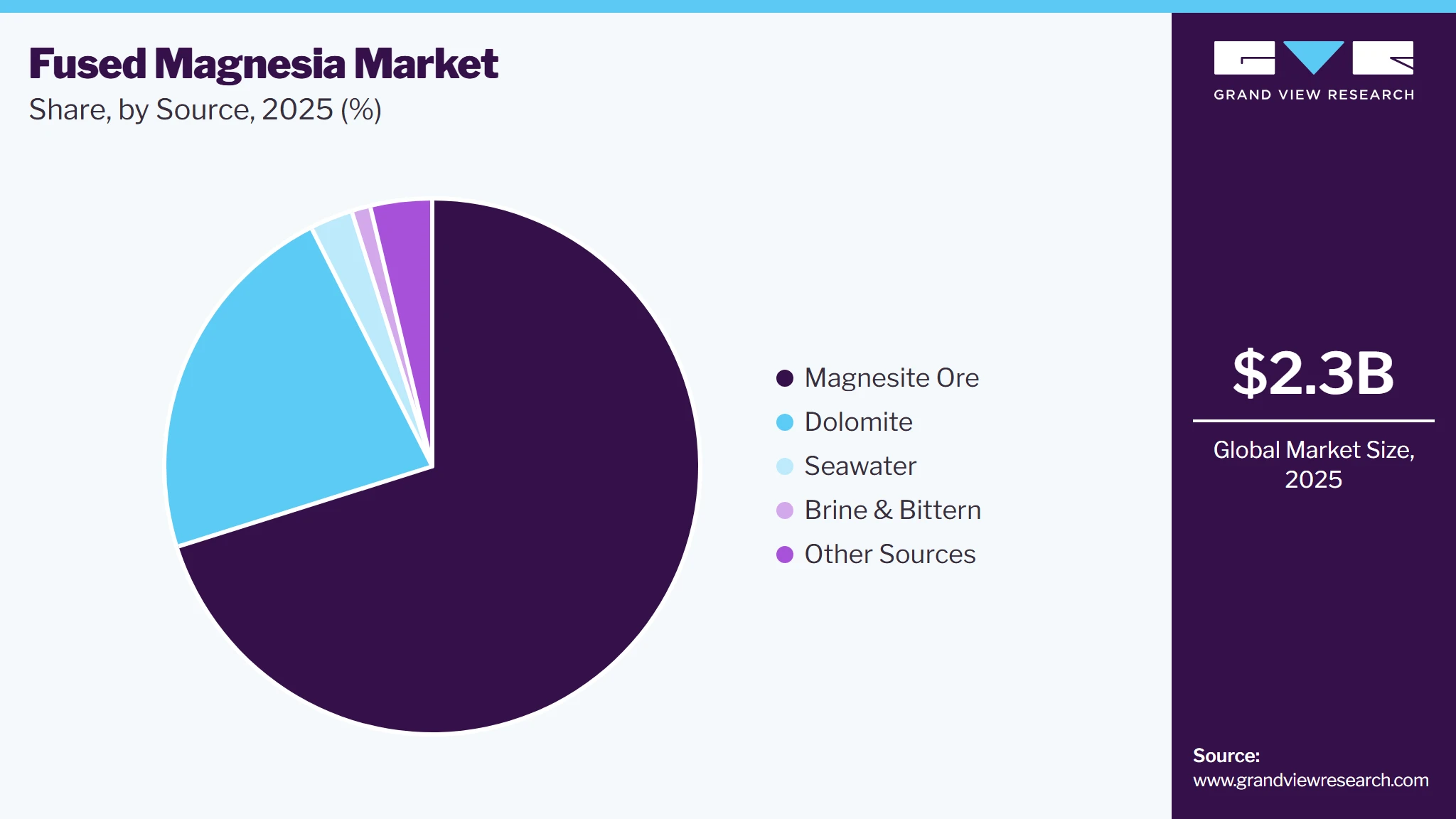
- By source: Magnesite ore segment dominated the market in 2025, accounting for 70.1% of total revenue.
Regional Highlights
- Largest Region: Asia Pacific (52.9% revenue share, 2025)
- By Country- India held the largest market share in 2025.
Market Size & Forecast
- Market size in 2025: USD 2.3 billion
- Estimated market size in 2026: USD 2.4 billion
- Projected market size by 2033: USD 3.7 billion
- CAGR (2026-2033): 6.5%
Three ways to get this report
Buy it, customize it, or ask a question.Ask an Analyst
Analyst response in 1 business day
- AccessReport author, directly
- Reply timeWithin 1 working day
- No sales callDirect answer only
- FormatEmail reply
- CostFree, no cost
Get the Full Report
What the study covers
- FormatsPDF · Excel · Dashboard
- Timeline2026–2033 annual, 2025 base
- Coverage20+ countries, 5 regions
- Companies10+ key players profiled
Customize the Report
20% free customization
- IncludeCountries, segments, points
- TailorTo your product definition
- ExtendDeeper competitor detail
- OrA fully bespoke study
- Turnaround5–10 working days
Fused magnesia’s high purity, thermal stability, dense crystal structure, and chemical resistance make it suitable for demanding refractory applications, while the development of high-purity and application-specific grades by manufacturers are expanding its use in specialized refractory and electrical applications. Growing investment in advanced steelmaking, electrical equipment, industrial heating systems, and high-temperature processing is creating opportunities for application-specific fused magnesia. Electro-fused magnesium oxide is used in electrical insulation, MgO ceramics, automotive brakes, and high-level basic refractories. The opportunity is particularly relevant for suppliers capable of delivering controlled particle sizes, high MgO purity, and specialized crystal characteristics for technically demanding applications.
 To learn more about this report, Download Free Sample Report
 Market Dynamics
The market is shaped by steel and refractory production, availability of suitable magnesium feedstock, electricity-intensive fusion costs, and product-grade requirements. China remains highly influential in traded refractory raw materials, while producers outside China increasingly emphasize backward integration and specialized grades.
Fused magnesia benefits from its use as a premium raw material in refractory formulations where conventional magnesia grades may not provide the required combination of density, crystal development, and thermal performance. This makes it relevant to demanding furnace and steel-processing environments where refractory failure can result in significant production losses.
The development of large crystal products is further strengthening this segment. Hengrui Magnesium reports 65,000 tonnes/year of combined large-crystal fused-magnesia capacity across its Xiuyan and Naiman facilities, with its Naiman project entering trial production in 2026.
Fused magnesia requires high-temperature electric fusion, making electricity consumption a key component of manufacturing costs. Producers, therefore, face greater exposure to power prices than suppliers of less energy-intensive magnesium products.
The cost pressure is particularly relevant when fused magnesia is traded internationally because electricity costs combine with transportation, export conditions, and raw-material prices. RHI Magnesita notes that Chinese raw-material pricing and trade flows strongly influence global refractory raw-material economics.
Improved mineral processing creates an opportunity to increase the availability of usable magnesium feedstock while reducing dependence on newly extracted ore. Grecian Magnesite commissioned a second X-ray-based mineral-processing line in 2025 to recover higher-purity magnesite from historical fine run-of-mine stockpiles.
Such processing technologies can improve raw-material recovery, reduce waste, and support more consistent feedstock quality. For fused-magnesia manufacturers, better beneficiation can translate into greater control over impurity levels and more consistent product specifications.
Market Concentration & Characteristics
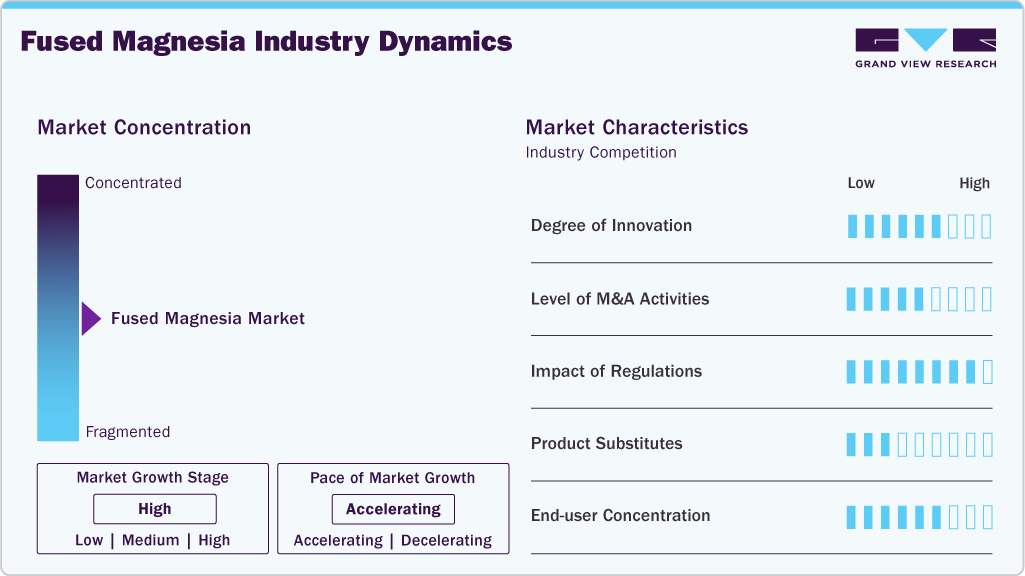
The market has a concentrated production base, with China playing a particularly important role in the global supply of refractory raw materials. RHI Magnesita reports that China accounts for more than 60% of global traded refractory raw materials and approximately 90% of global fused-magnesia exports.
 To learn more about this report, Download Free Sample Report
 Product differentiation is primarily specification-driven rather than purely volume-driven. Purity, crystal size, bulk density, particle distribution, impurity profile, and manufacturing consistency determine suitability for different refractory, electrical, and industrial applications.
Analyst Perspective
Fused magnesia is positioned between a volume-oriented refractory raw material and a specialty performance material. Steel remains the principal demand anchor, while higher-purity electrical and specialized refractory grades provide additional value opportunities. Recent capacity additions and technology upgrades, including Hengrui's large-crystal expansion, indicate continued investment in differentiated FM products.
Grade Insights
The industrial grade segment held the largest revenue share of 67.7% in 2025, because it serves established refractory formulations used in steelmaking, cement, glass, and non-ferrous metal processing. Its broader specification range and suitability for high-volume furnace applications support greater consumption than highly customized grades.
Specialty grade is the fastest-growing form segment, with a CAGR of 6.6% from 2026 to 2033, as users require tighter purity, particle-size, and crystal-structure specifications for demanding applications. Tateho's electro-fused portfolio demonstrates this trend, with separate grades designed for high-level refractories, electrical insulation, MgO ceramics, and automotive brake applications.
Application Insights
The steel segment held the largest revenue share of 31.9% in 2025. because fused magnesia provides a high-performance raw material for refractory systems exposed to molten metal, slag and severe thermal conditions. The scale of global steel production creates a substantial recurring requirement for refractory materials.
Automotive & electric vehicles is projected to grow with a CAGR of 9.7% from 2026 to 2033. Automotive-related demand is expanding through specialized electrical insulation, heating components, brake materials, and manufacturing equipment. Electro-fused MgO is a raw material for automotive brakes and electrical insulation, creating a direct pathway from fused magnesia into vehicle-related component applications.
Source Insights
The magnesite ore segment accounted for the largest revenue share of 70.1% in the fused magnesia market. Magnesite ore remains the principal feedstock route for fused magnesia because it provides an established mineral-to-magnesia production chain. Kümaş, for example, produces fused magnesia using calcined magnesia obtained from natural magnesite ore and supplies 96-98% MgO grades.
 To learn more about this report, Download Free Sample Report
 Seawater is growing at CAGR of 7.9% from 2026 to 2033. Growing interest in alternative magnesium feedstocks is supporting seawater-based fused magnesia production, as seawater provides a widely available magnesium source and reduces reliance on mined magnesite. Companies use seawater-derived magnesium hydroxide as an intermediate for magnesium oxide production, supporting the development of integrated seawater-to-magnesia processing routes.
Regional Insights
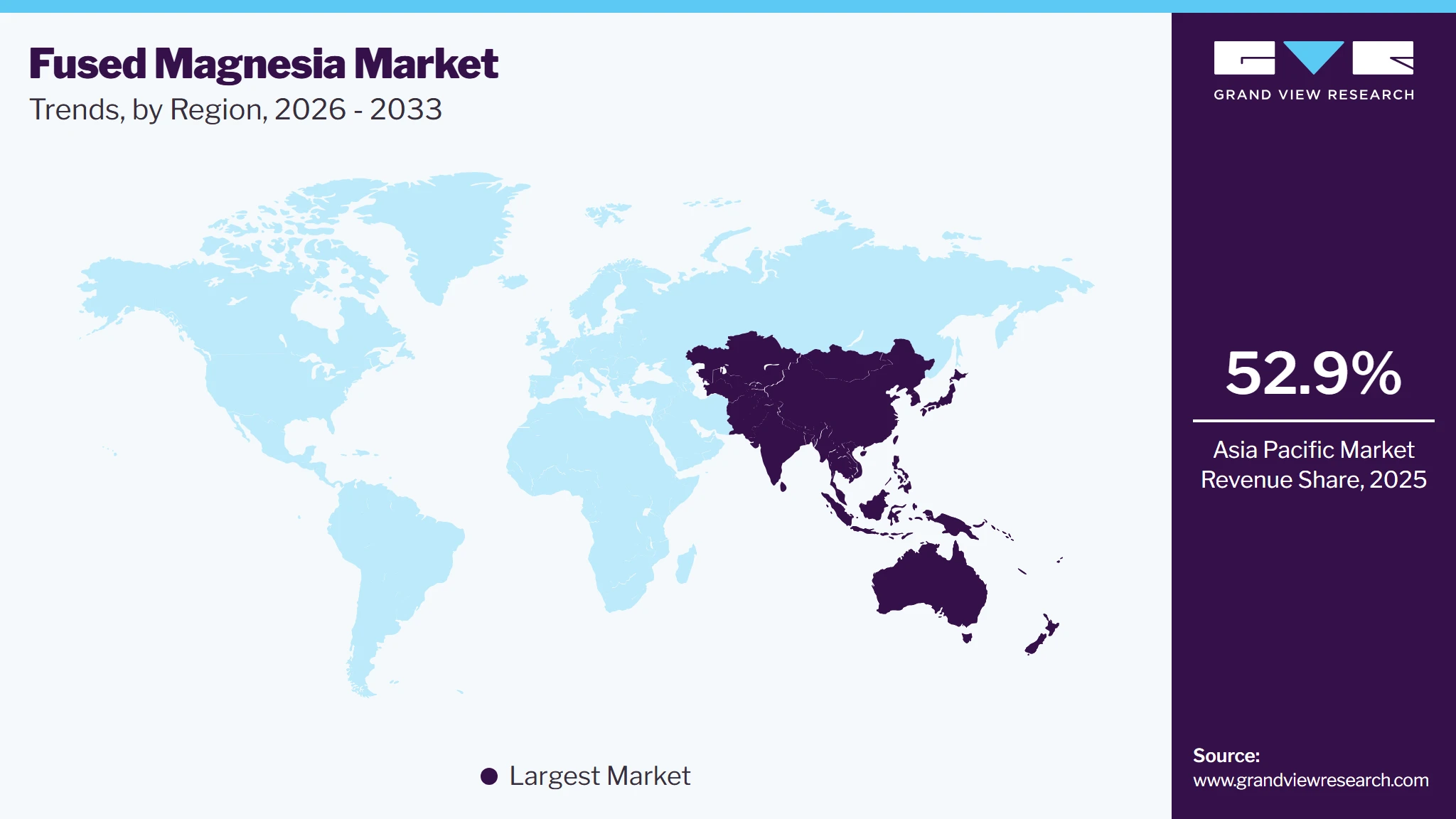
Asia Pacific held the largest revenue share of 52.9% in 2025, because of its extensive steel and refractory manufacturing base and its concentration of fused-magnesia production capacity. China alone produced 960.8 million tonnes of crude steel in 2025, more than half of global output, creating a substantial regional demand base.
 To learn more about this report, Download Free Sample Report
 China Fused Magnesia Market Trends
China combines substantial steel consumption with a highly developed refractory raw-material industry. Its large domestic manufacturing base and strong position in traded refractory raw materials give Chinese producers significant influence over fused-magnesia supply and pricing.
North America Fused Magnesia Market Trends
North American demand is supported by steel, industrial processing, automotive manufacturing and specialized refractory requirements. The region also provides an important market for technically differentiated materials as manufacturers seek reliable refractory performance and specialized electrical-grade products.
U.S. Fused Magnesia Market Trends
The U.S. market is growing at a revenue CAGR of 5.2% during the forecast period. The U.S. market benefits from its established steel, automotive, industrial equipment, and electrical manufacturing sectors. The country's 81.9 million tonnes of crude steel production in 2025 provides a substantial industrial foundation for refractory-material consumption.
Europe Fused Magnesia Market Trends
Europe represents a mature fused-magnesia market characterized by established steel, glass, cement, engineering and specialty manufacturing industries. The European steel industry remains closely connected with automotive, construction, electronics and mechanical engineering value chains, sustaining demand for high-temperature industrial materials.
Latin America Fused Magnesia Market Trends
Latin American demand is supported by steelmaking, cement production and mineral-processing activity, while regional raw-material availability provides opportunities for integrated magnesia and refractory production. RHI Magnesita identifies Latin America as one of its established markets and operates integrated mineral activities in the region.
Middle East & Africa Fused Magnesia Market Trends
Growing steel, cement, and non-ferrous metal production across the Middle East & Africa is supporting demand for fused magnesia, as these industries require high-temperature refractory materials for furnaces, kilns, and other processing equipment. Infrastructure expansion and industrial diversification are further increasing the need for durable refractory systems, creating a broader demand base for fused magnesia in the region.
Key Fused Magnesia Company Insights
The global fused magnesia market features a mix of established refractory-material producers and specialized fused magnesia manufacturers, with competition centered on product purity, crystal structure, grade consistency, production capacity, and application-specific formulations. Leading companies are strengthening their positions through capacity expansion, advanced processing, and development of high-purity grades for steel, electrical, and other demanding applications.
-
RHI Magnesita is a major global refractory-materials producer with an integrated magnesia raw-material portfolio and fused magnesia production capabilities. The company serves steel and other high-temperature industries, with its competitive position supported by vertical integration, global manufacturing infrastructure, and application-focused refractory solutions.
-
Grecian Magnesite is a vertically integrated magnesium-mineral producer with capabilities spanning magnesite mining, processing, calcination, and fused magnesia production. Its market position is supported by control over raw-material quality and the development of higher-purity magnesia products for specialized refractory, electrical, and industrial applications.
Key Fused Magnesia Companies
The following key companies have been profiled for the study on the global fused magnesia market.
-
RHI Magnesita N.V.
-
Grecian Magnesite S.A.
-
Tateho Chemical Industries Co., Ltd.
-
Hengrui Magnesium Products / Allied Rongda Group
-
Yingkou Kaining Industry Co., Ltd. / CMS
-
Dashiqiao Yutong Refractories Co., Ltd.
-
KÜMAŞ Manyezit Sanayi A.Ş.
-
SHINGMAG Mining Chemical (DL) Co., Ltd.
-
Haicheng Magnesite Refractory General Factory
-
Liaoning Jinding Magnesite Group
Competitive Benchmarking
Operating Strategies
Competitive Edge
Weaknesses
Mature Players: RHI Magnesita N.V., Grecian Magnesite S.A., Tateho Chemical Industries Co., Ltd., KÜMAŞ Manyezit Sanayi A.Ş.
- Focus on vertically integrated magnesia value chains covering raw-material sourcing, mineral processing, fusion, and specialty-grade production. These players are expanding high-purity and application-specific grades, strengthening technical support, and serving established customers across steel, refractory, electrical, and other high-temperature industries. They also emphasize process optimization, product consistency, and geographic diversification to strengthen long-term supply capabilities.
- Strong production infrastructure, established technical expertise, integrated access to magnesium-bearing raw materials, established customer relationships, and broader product portfolios. Their capabilities in high-purity, large-crystal, and electro-fused grades enable participation in both conventional refractory applications and higher-specification industrial uses.
- Energy-intensive production creates exposure to electricity and operating costs, while integrated mining and processing operations require substantial capital investment. These producers also face pressure from environmental requirements, raw-material price volatility, logistics costs, and competition from lower-cost regional manufacturers.
Emerging Players: Hengrui Magnesium Products / Allied Rongda Group, Yingkou Kaining Industry Co., Ltd. / CMS, Dashiqiao Yutong Refractories Co., Ltd., SHINGMAG Mining Chemical (DL) Co., Ltd., Haicheng Magnesite Refractory General Factory, Liaoning Jinding Magnesite Group
- Concentrate on expanding fused magnesia capacity, improving production efficiency, increasing export volumes, and broadening available MgO grades and particle specifications. These producers are also strengthening large-crystal and high-purity product capabilities while leveraging regional magnesite resources and established refractory manufacturing clusters. Greater focus is being placed on flexible order fulfillment, competitive pricing, and serving refractory manufacturers in domestic and international markets.
- Proximity to major magnesite resources, established regional processing infrastructure, competitive manufacturing economics, and flexibility in producing multiple purity and particle-size grades provide cost and supply advantages. Growing technical capabilities in large-crystal and specialty fused magnesia also create opportunities to move into higher-value applications.
- Comparatively narrower global distribution networks and brand recognition can limit access to premium international customers. Greater dependence on regional raw-material availability and export markets also increases exposure to trade policies, freight costs, energy-price fluctuations, environmental regulations, and changes in Chinese refractory demand.
Recent developments
- On September 28, 2026, Refwin reported a noticeable increase in China’s fused magnesia prices, with mainstream FOB prices for 96-96.5% and 97-97.5% grades rising from the previous month. The increase reflects higher production costs, including pressure from graphite electrode prices, supporting an upward pricing trend for fused magnesia.
Global Fused Magnesia Market Report Scope
Report Attribute
Details
Market size in 2025
USD 2.3 billion
Estimated market size in 2026
USD 2.4 billion
Projected market size by 2033
USD 3.7 billion
Growth rate
CAGR of 6.5% from 2026 to 2033
Base year for estimation
2025
Historical data
2021 - 2024
Forecast period
2026 - 2033
Quantitative units
Revenue in USD million/billion, volume in kilotons, and CAGR from 2026 to 2033
Report coverage
Revenue forecast, volume forecast, company ranking, competitive landscape, growth factors, and trends
Segments covered
Grade, source, application, region
Country scope
U.S.; Canada; Mexico; Germany; UK; France; Italy; Spain; China; India; Japan; South Korea; Brazil; Argentina; Saudi Arabia; South Africa
Key companies profiled
RHI Magnesita N.V.; Grecian Magnesite S.A.; Tateho Chemical Industries Co., Ltd.; Hengrui Magnesium Products/Allied Rongda Group; Yingkou Kaining Industry Co., Ltd./CMS; Dashiqiao Yutong Refractories Co., Ltd.; KÜMAŞ Manyezit Sanayi A.Ş.; SHINGMAG Mining Chemical (DL) Co., Ltd.; Haicheng Magnesite Refractory General Factory; Liaoning Jinding Magnesite Group
Customization scope
Free report customization (equivalent up to 8 analysts’ working days) with purchase. Addition or alteration to country, regional & segment scope.
Pricing and purchase options
Avail customized purchase options to meet your exact research needs. Explore purchase options
Global Fused Magnesia Market Report Segmentation
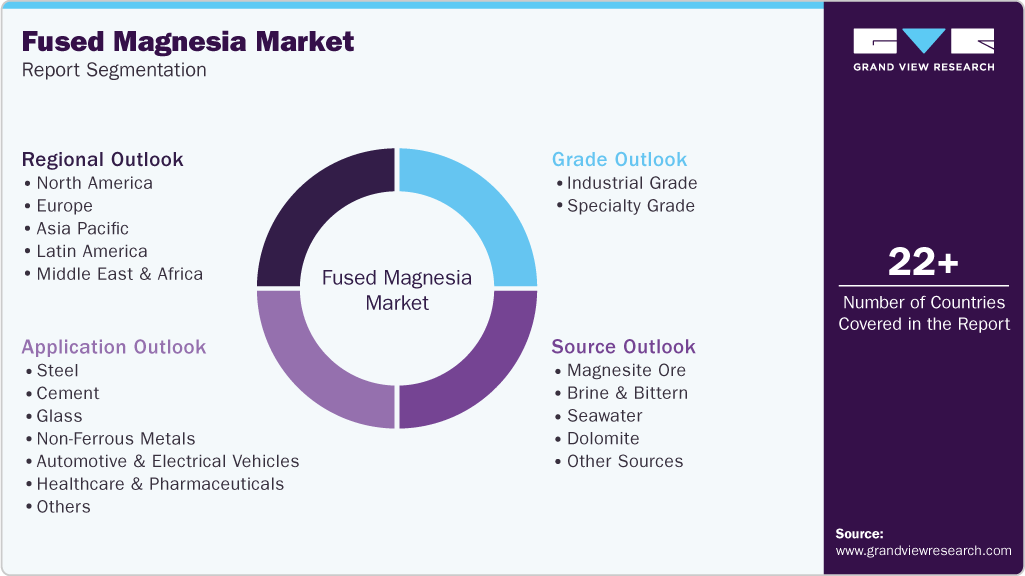
This report forecasts volume & revenue growth at regional, and country levels and provides an analysis of the latest industry trends in each of the sub-segments from 2021 to 2033. For this study, Grand View Research has segmented the global fused magnesia market report based on grade, application, source, and country:
 To learn more about this report, Download Free Sample Report
 -
Grade Outlook (Revenue, USD Billion; Volume, Kilotons; 2021 - 2033)
-
Industrial Grade
-
Specialty Grade
-
-
Application Outlook (Revenue, USD Billion; Volume, Kilotons; 2021 - 2033)
-
Steel
-
Cement
-
Glass
-
Non-Ferrous Metals
-
Automotive & Electrical Vehicles
-
Healthcare & Pharmaceuticals
-
Agriculture
-
Water & Environmental
-
Building & Construction
-
Consumer Goods
-
Chemical Manufacturing
-
Other Applications
-
-
Source Outlook (Revenue, USD Billion; Volume, Kilotons; 2021 - 2033)
-
Magnesite Ore
-
Brine & Bittern
-
Seawater
-
Dolomite
-
Other Sources
-
-
Region Outlook (Revenue, USD Billion; Volume, Kilotons; 2021 - 2033)
-
North America
-
U.S.
-
Canada
-
Mexico
-
-
Europe
-
Germany
-
UK
-
France
-
Italy
-
Spain
-
-
Asia Pacific
-
China
-
India
-
Japan
-
South Korea
-
-
Latin America
-
Brazil
-
Argentina
-
-
Middle East & Africa
-
Saudi Arabia
-
South Africa
-
-
Research Methodology
The fused magnesia market figures in this report are based on a proven research process that combines executive interviews with secondary research from proprietary databases, company filings, and recognized regulatory and institutional sources. Market size is built through value-chain sizing-reconciling supply-side and demand-side estimates-and triangulated with bottom-up and top-down approaches. Every estimate passes multiple levels of expert validation before publication, with each fused magnesia segment quantified using the revenue-capture definitions in the table below.
Segment Definition
Segment - Grade
Revenue capture definition
Industrial Grade
Revenue generated from fused magnesia products supplied for standard industrial applications, primarily refractory materials, furnace linings and high-temperature processing equipment used across steel, cement, glass, non-ferrous metals and other industrial operations.
Specialty Grade
Revenue generated from higher-purity or application-specific fused magnesia products designed for demanding applications requiring controlled chemical composition, crystal structure, electrical insulation, corrosion resistance or enhanced high-temperature performance.
Segment -Application
Revenue capture definition
Steel
Revenue generated from fused magnesia supplied for steelmaking refractories, including furnace linings, ladles, converters, electric-arc furnaces and other high-temperature steel-processing equipment.
Cement
Revenue generated from fused magnesia used in refractory linings and high-temperature equipment associated with cement manufacturing, including rotary kilns and related processing units.
Glass
Revenue generated from fused magnesia used in refractory components and furnace systems for glass melting and high-temperature glass-processing operations.
Non-Ferrous Metals
Revenue generated from fused magnesia used in refractory materials and high-temperature processing equipment for aluminum, copper, nickel, zinc and other non-ferrous metal production.
Automotive & Electrical Vehicles
Revenue generated from fused magnesia used in high-temperature processing, refractory systems and electrical-insulation components associated with automotive and electric-vehicle manufacturing and related industrial equipment.
Healthcare & Pharmaceuticals
Revenue generated from fused magnesia supplied for specialized high-temperature, refractory or technical applications within pharmaceutical and healthcare-related manufacturing.
Agriculture
Revenue generated from fused magnesia products sold for agricultural applications, including magnesium-containing soil and crop products.
Water & Environmental
Revenue generated from fused magnesia supplied for environmental-treatment applications, including water and wastewater treatment and other processes requiring magnesium-based materials.
Building & Construction
Revenue generated from fused magnesia used in construction-related refractory, high-temperature processing and specialized building-material applications.
Consumer Goods
Revenue generated from fused magnesia incorporated into consumer-oriented products or components, including specialized electrical, heating and household applications where high-temperature or insulation performance is required.
Chemical Manufacturing
Revenue generated from fused magnesia used in chemical-processing equipment, high-temperature reactors, furnaces and other industrial applications requiring refractory or chemically resistant materials.
Other Application
Revenue generated from fused magnesia applications not separately classified above, including ceramics, petrochemicals, welding-related applications, specialized electrical insulation and other niche industrial uses.
Segment -Source
Revenue capture definition
Magnesite Ore
Revenue generated from fused magnesia manufactured using naturally mined magnesite ore as the primary magnesium-bearing raw material, including products produced through calcination followed by electric-furnace fusion. Magnesite is the principal natural raw material for magnesia production.
Brine & Bittern
Revenue generated from fused magnesia produced using magnesium recovered from natural brines, well or lake brines, and salt-industry bitterns as the primary magnesium source before conversion into magnesia and subsequent fusion.
Seawater
Revenue generated from fused magnesia produced using seawater as the primary magnesium source, generally by recovering magnesium hydroxide or another intermediate magnesium compound before conversion into magnesia and fusion.
Dolomite
Revenue generated from fused magnesia manufactured using dolomite as a magnesium-bearing raw material or magnesium source, either directly or through an intermediate processing route. Dolomite is recognized as a commercially important magnesium mineral and can be used as a source for magnesia production.
Other Sources
Revenue generated from fused magnesia manufactured using magnesium-bearing raw materials other than magnesite ore, brine & bittern, seawater or dolomite, including other commercially viable mineral or synthetic magnesium sources.
Estimation Model
Layer Name
Key Question
Description
Market Scope & Definition
What is included in the fused magnesia market?
Defines the market boundary around commercially sold fused magnesia (FM) produced by electrically fusing magnesia feedstock, including material derived from magnesite, brine, seawater, dolomite, and other magnesium-bearing sources. The scope includes industrial and specialty fused magnesia grades, differentiated by purity, crystal structure, particle size, and other commercial specifications. Revenue from dead-burned magnesia (DBM), caustic-calcined magnesia (CCM), magnesium hydroxide, magnesium carbonate, magnesium metal, and other non-fused magnesium products is excluded. Revenue from downstream refractory products, finished components, and other products manufactured using fused magnesia is also excluded.
Production Volume Assessment
How much fused magnesia is produced?
Estimates fused magnesia production volumes by major producing country and region using producer disclosures, company production capacities, plant-level information, utilization rates, government statistics, customs and trade data, industry publications, and other validated producer-level information. Production estimates are adjusted where necessary to distinguish fused magnesia from CCM, DBM, and other forms of magnesia, avoiding double counting of intermediate feedstock and finished fused material.
End-Use Consumption Assessment
Where is fused magnesia consumed?
Maps fused magnesia consumption across the defined application categories, including Steel, Cement, Glass, Non-Ferrous Metals, Automotive & Electric Vehicles, Healthcare & Pharmaceuticals, Agriculture, Water & Environmental, Building & Construction, Consumer Goods, Chemical Manufacturing, and Other Applications. Consumption is allocated according to the primary industry using the fused magnesia product, with each volume assigned to one principal application to avoid double-counting across end-use industries.
Revenue Estimation
What is the market value?
Calculates fused magnesia market revenue by multiplying estimated fused magnesia sales volume by the corresponding average selling price (ASP). ASPs are differentiated, where sufficient evidence is available, by grade, purity, specification, particle size, application, and geography. The calculation captures revenue from the sale of fused magnesia itself only and excludes revenue from downstream refractory products, finished components, and other products manufactured using fused magnesia.
Delivered Customizations
This report has been delivered with the following In-depth customizations
Client Request
Customization Delivered
Value Adds
Cross-Segmentation Analysis
The relationship between Fused Magnesia grade and end-use application was assessed to evaluate demand across Industrial Grade and Specialty Grade fused magnesia. The analysis examined consumption across steel, cement, glass, non-ferrous metals, automotive & electric vehicles, healthcare & pharmaceuticals, agriculture, water & environmental, building & construction, consumer goods, chemical manufacturing, and other applications, with emphasis on grade-specific purity, crystal structure, particle size, thermal performance, chemical resistance, and application suitability.
Enables identification of high-demand grade-application combinations and consumption pockets. Supports product portfolio optimization, specification targeting, application development, customer targeting, and commercialization strategies.
Competitive Benchmarking
Leading fused magnesia manufacturers were benchmarked based on production capacity, fused magnesia product portfolio, grade and purity offerings, raw material access, vertical integration, manufacturing technology, electric-fusion capabilities, geographic footprint, plant locations, distribution reach, technical capabilities, sustainability initiatives, and strategic developments. Competitive positioning across major fused magnesia applications and geographic markets was also evaluated.
Help identify competitive strengths, manufacturing and cost advantages, product differentiation, raw-material security, technological capabilities, geographic positioning, and market gaps. Supports supplier evaluation, competitive differentiation, partnership assessment, capacity expansion, and market-entry planning.
Opportunity Assessment
Growth opportunities were assessed across steel, non-ferrous metals, cement, glass, automotive & electric vehicles, chemical manufacturing, building & construction, healthcare & pharmaceuticals, water & environmental, agriculture, consumer goods, and other fused magnesia applications. The assessment also examined opportunities associated with expansion of steel and non-ferrous metal production, increasing demand for high-performance refractory materials, electric-vehicle and electrical applications, higher-purity fused magnesia requirements, specialty-grade development, and capacity expansion in major producing regions.
Enables identification of high-potential end-use applications, grades, geographic markets, and emerging demand areas. Supports investment prioritization, capacity planning, product development, grade optimization, manufacturing expansion, geographic expansion, and long-term growth strategies.
Frequently Asked Questions About This Report
Industrial grade held the largest revenue share of 67.7% in 2025, because it serves established refractory formulations used in steelmaking, cement, glass and non-ferrous metal processing. Its broader specification range and suitability for high-volume furnace applications support greater consumption than highly customized grades.
Asia Pacific held the largest revenue share of 52.9% in 2025, because of its extensive steel and refractory manufacturing base and its concentration of fused-magnesia production capacity. China alone produced 960.8 million tonnes of crude steel in 2025, more than half of global output, creating a substantial regional demand base.
Rising demand for magnesium-based environmental treatment solutions is supporting CCM consumption across wastewater treatment, acid neutralization, and industrial emission-control applications. CCM's alkaline properties enable controlled neutralization and contaminant removal, supporting adoption where treatment efficiency and process control are priorities.
Key players include RHI Magnesita N.V.; Grecian Magnesite S.A.; Tateho Chemical Industries Co., Ltd.; Hengrui Magnesium Products / Allied Rongda Group; Yingkou Kaining Industry Co., Ltd. / CMS; Dashiqiao Yutong Refractories Co., Ltd.; KÜMAŞ Manyezit Sanayi A.Ş.; Haicheng Magnesite Refractory General Factory; Liaoning Jinding Magnesite Group
The fused magnesia market size was USD 2.3 billion in 2025 and is expected to reach 2.4 billion by 2026.
The fused magnesia market is anticipated to grow at a CAGR of 6.5% from 2026 to 2033 and is projected to reach 3.7 billion by 2033.
Magnesite ore segment dominated the market in 2025, accounting for 70.1% of total revenue.
Steel held the largest revenue share of 31.9% in 2025. because fused magnesia provides a high-performance raw material for refractory systems exposed to molten metal, slag and severe thermal conditions. The scale of global steel production creates a substantial recurring requirement for refractory materials.
About the Author(s)
Organic Chemicals Research Team
Bulk Chemicals · Organic ChemicalsThis report was authored by the organic chemicals research team at Grand View Research - comprising two research analysts, one senior research analyst, and one industry expert - with specialized expertise in the organic chemicals segment of the bulk chemicals industry. All findings are based on proprietary bulk chemicals databases, executive interviews, and regulatory analysis, subject to internal peer review prior to publication.
Last Updated:
Speak to Analyst

Customize this report to your needs - add regions, segments, or data points, with 20% free customization.
Or view our licence options:


ISO 9001:2015 & 27001:2022 Certified
We are GDPR and CCPA compliant! Your transaction & personal information is safe and secure. For more details, please read our privacy policy.


