
- Home
- »
- Advanced Interior Materials
- »
-
Gas Feed System Market Size & Share Report, 2026-2033GVR Report cover

Gas Feed System Market (2026 - 2033)
Size, Share & Trends Analysis Report By Operation Mode (Automatic, Semi-automatic), By Product Type (Vacuum-Regulated Gas Feed Systems, Integrated Automatic Gas Feed Systems), By End Use, By Region, And Segment Forecasts
Market Size, 2025
$1,162.4MMarket Estimate, 2026
$1,233.7MMarket Forecast, 2033
$1,919.3MCAGR, 2026–2033
6.5%Gas Feed System Market Summary
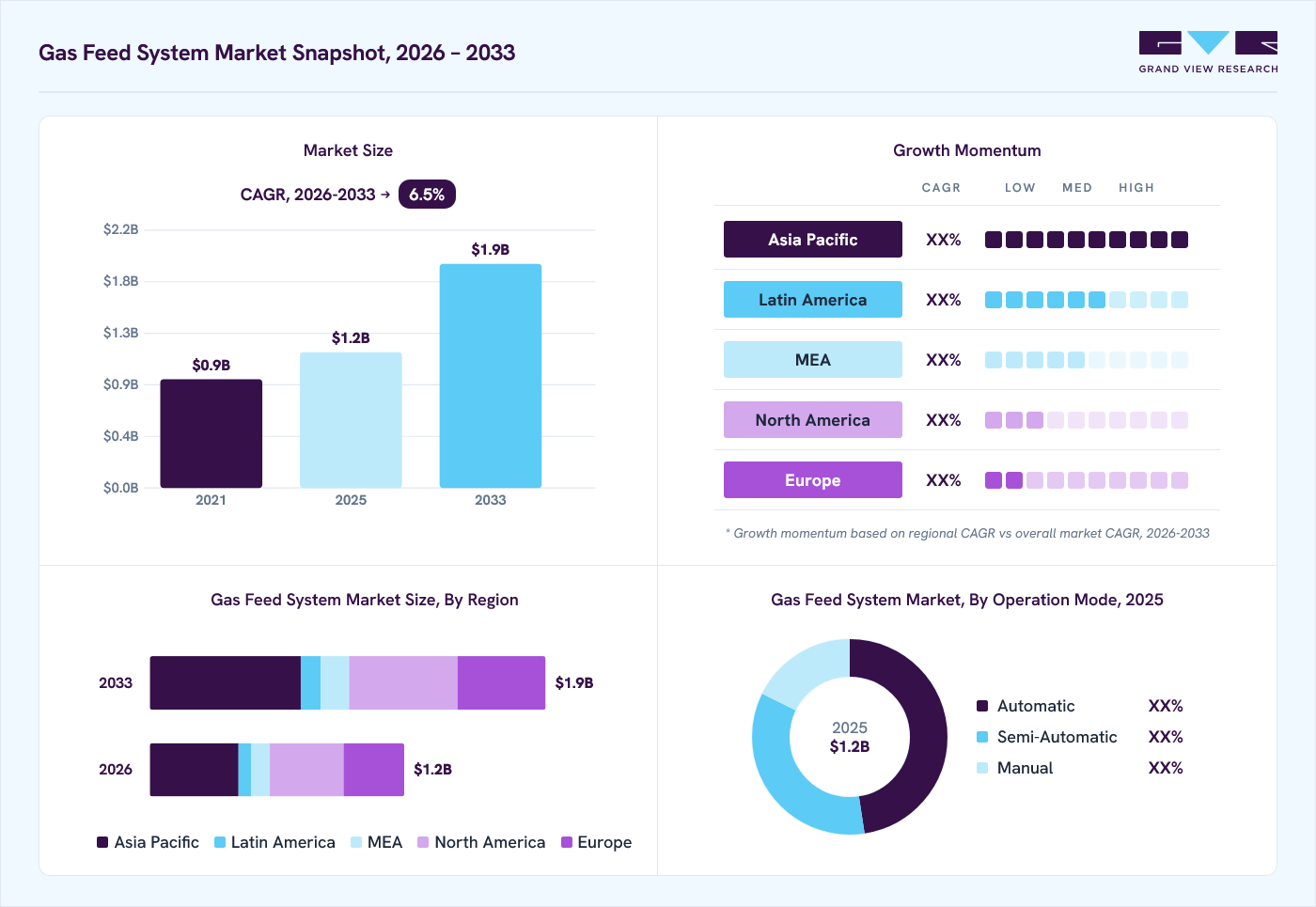
The global gas feed system market size was valued at USD 1,162.4 million in 2025 and is projected to grow from USD 1,233.7 million in 2026 to USD 1,919.3 million by 2033, at a CAGR of 6.5% from 2026 to 2033. Asia Pacific dominated the market, accounting for a revenue share of 34.4% in 2025. The market is driven by the need for precise and consistent gas dosing across water and wastewater treatment, chemicals and process industries, oil and gas, food and beverage, and power and utility applications.
 Source: Grand View Research, IR Documents, Primary Interviews, Paid DatabasesTo learn more about this report,
 Download Free Sample Report
 Key Market Trends & Insights
- By product type: Pressure-regulated gas feed systems segment is projected to grow at 7.0% CAGR during forecast period.
- By operation mode: Automatic segment dominated the market in 2025 accounting for 47.5% market share.
- By end use: Power & utilities segment is expected to grow at the fastest CAGR of 7.3% from 2026 to 2033.
Regional Highlights
- Largest regional market: Asia Pacific (34.4% revenue share, 2025)
- By country: China held the largest market share in 2025.
Market Size & Forecast
- Market Size in 2025: USD 1,162.4 Million
- Estimated Market Size in 2026: USD 1,233.7 Million
- Projected Market Size by 2033: USD 1,919.3 Million
- CAGR (2026-2033): 6.5%
Three ways to get this report
Buy it, customize it, or ask a question.Ask an Analyst
A direct answer, usually in 1 working day
- AccessReport author, directly
- Reply timeWithin 1 working day
- No sales callDirect answer only
- FormatEmail reply
- CostFree, no cost
Get the Full Report
What the study covers
- FormatsPDF · Excel · Dashboard
- Timeline2026–2033 annual, 2025 base
- Coverage20+ countries, 5 regions
- Companies10+ key players profiled
Customize the Report
20% free customization
- IncludeCountries, segments, points
- TailorTo your product definition
- ExtendDeeper competitor detail
- OrA fully bespoke study
- Turnaround5–10 working days
Stringent safety and process-control requirements are encouraging industrial and treatment facilities to adopt dedicated equipment for regulating gas flow and pressure, particularly where controlled dosing is essential to process performance. Additionally, modernization of industrial facilities and expansion of water treatment infrastructure are creating opportunities for automated and integrated gas feed solutions. The increasing use of automatic and semi-automatic operations, along with the integration of monitoring and control functions, is facilitating the replacement of manually operated equipment and supporting demand for more sophisticated gas-feeding configurations.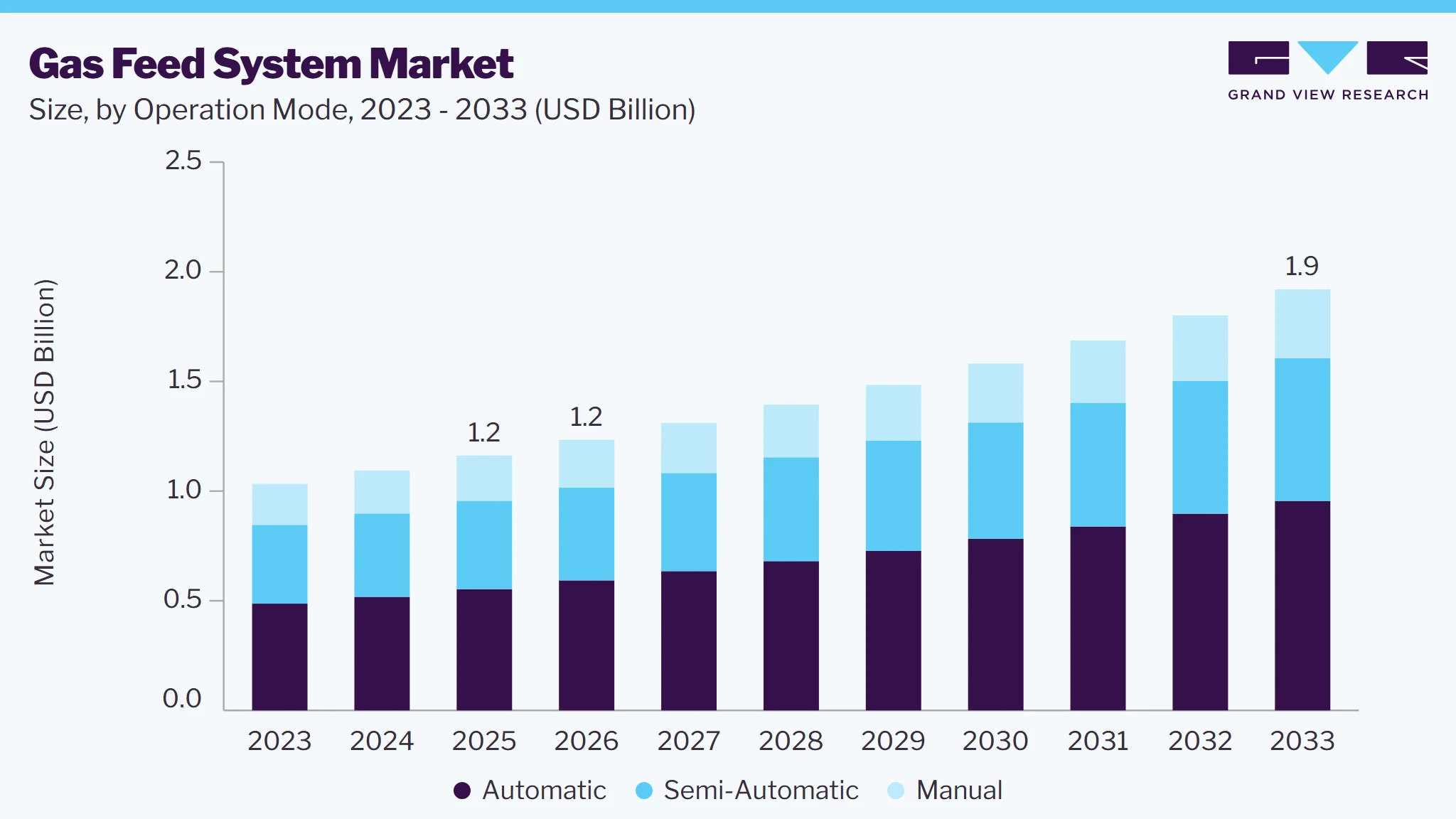 To learn more about this report, Download Free Sample Report
 Market Dynamics
The global gas feed system market is influenced by the growing need for regulated and dependable gas supply across water and wastewater treatment, chemicals and process industries, oil and gas, food and beverage, and power and utilities. Product development focuses on improving flow and pressure regulation, automation, monitoring, and system integration to accommodate diverse gas-feeding requirements. Demand also varies according to facility scale, operating conditions, gas type, and the level of control required within the installation.
The requirement to maintain specified gas feed rates and operating pressures is encouraging the adoption of dedicated gas feed systems across industrial and treatment applications. Accurate regulation is particularly relevant in processes where variations in gas dosing can affect treatment performance or operating conditions. The transition from manual adjustment toward automatic and semi-automatic operation is also creating demand for equipment capable of maintaining consistent feed parameters with limited operator intervention.
Gas feed systems may require specialized installation, safety measures, periodic inspections, and trained personnel, increasing the total cost of deployment and operation. Maintenance requirements can vary according to system configuration, gas characteristics, operating conditions, and facility requirements. These considerations may limit adoption in smaller facilities or applications where existing gas-feeding equipment continues to meet operational needs.
The integration of automated regulation, monitoring, and control functions presents an opportunity for manufacturers to expand their gas feed system offerings. Systems capable of continuously monitoring operating parameters and adjusting feed conditions can be used in applications requiring tighter process control and reduced manual intervention. Modernization of existing installations and development of new industrial and treatment infrastructure can further create opportunities for integrated gas feed configurations.
Market Concentration & Characteristics
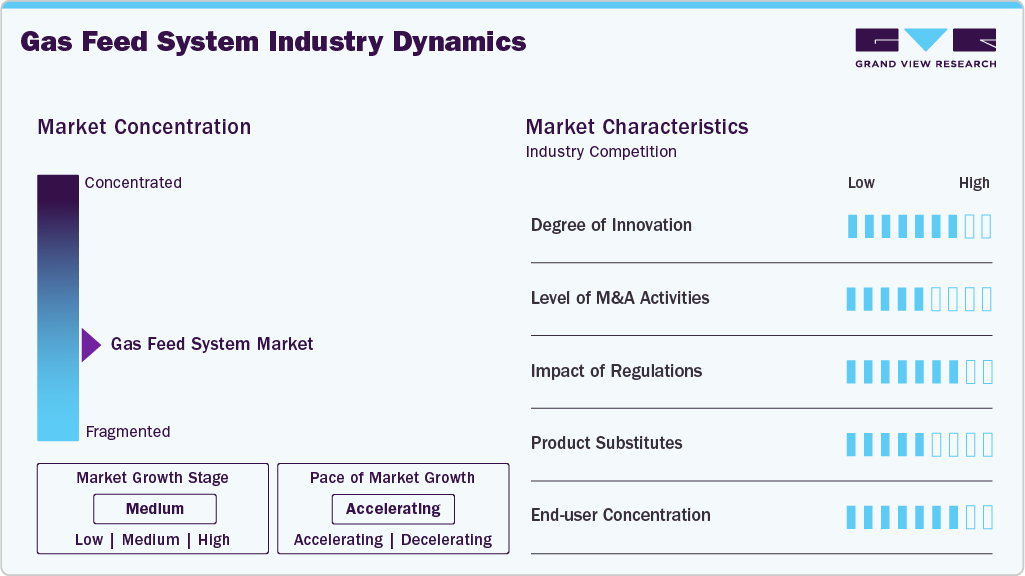
The global gas feed system market includes manufacturers offering equipment for controlled feeding and regulation of gaseous chemicals across industrial and treatment applications. The competitive landscape varies by product specialization, geographic coverage, and application expertise, with companies differentiating their offerings according to feed capacity, gas type, operating conditions, and system configuration. Market participation includes both internationally active manufacturers and regional companies focused on specific application requirements.
Product characteristics vary across automatic, semi-automatic, and manual operating configurations, as well as vacuum-regulated, pressure-regulated, and integrated automatic systems. Vacuum-based systems are commonly configured for applications requiring controlled withdrawal and feeding of gases, while pressure-regulated systems address applications where gas feed is maintained according to specified pressure conditions. Integrated configurations incorporate regulation and automated control functions within a consolidated system, providing options for facilities with more advanced operational requirements.
 To learn more about this report, Download Free Sample Report
 Purchasing decisions are influenced by the required gas feed rate, regulation method, automation level, installation conditions, and compatibility with existing process infrastructure. Safety considerations and operating reliability are also important when selecting equipment for applications involving gaseous chemicals. Demand therefore varies according to facility scale and process requirements, with system configurations ranging from manually operated equipment for simpler installations to automated solutions for applications requiring continuous control and monitoring.
Analyst Perspective
The global gas feed system market is characterized by demand for equipment that provides controlled gas feeding under varying operating conditions. Automatic and semi-automatic configurations are gaining relevance in applications that require consistent regulation and reduced manual intervention, while manual systems continue to serve applications with simpler operating requirements. Product differentiation is likely to center on regulation accuracy, automation, monitoring, system configuration, and suitability for specific gases and operating environments. Replacement of existing equipment and new facility installations are expected to remain important sources of market demand.
Product Type Insights
The vacuum-regulated segment accounted for the largest revenue share, at 52.0%, in 2025. These systems are used for controlled gas withdrawal and feeding in applications that require stable, regulated gas delivery. Their established deployment across water treatment and industrial processes contributes to their leading revenue position.
Pressure-regulated gas feed systems are projected to register the fastest CAGR during the forecast period. Their adoption is supported by applications requiring controlled gas delivery at specified pressure levels and consistent feed conditions. Increasing requirements for precise gas regulation across industrial and treatment processes are expected to create further demand for these systems.
Operation Mode Insights
The automatic segment accounted for the largest share of 47.5% in 2025. Automatic gas feed systems are widely used in applications requiring consistent gas delivery, precise flow regulation, and reduced manual intervention. Their suitability for continuous, controlled gas feeding contributes to their widespread adoption in industrial and treatment applications.
The semi-automatic segment is projected to grow at a CAGR of 6.3% during the forecast period. These systems combine automated regulatory functions with operator-controlled adjustments, providing flexibility in applications where specific gas-feeding parameters require manual intervention. Increasing adoption across facilities seeking greater control over gas feeding operations is expected to support segment growth.
End Use Insights
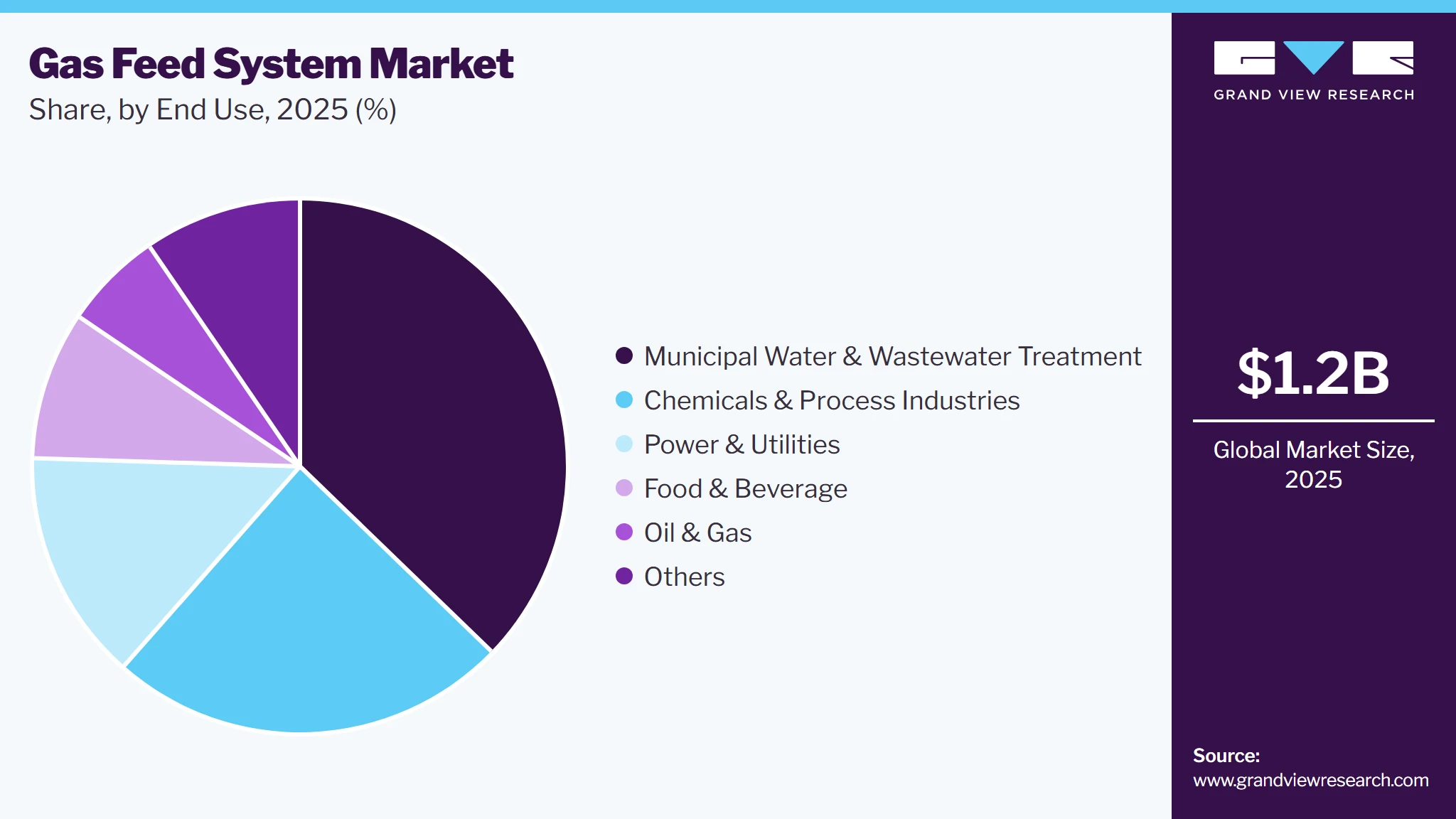
The municipal water & wastewater treatment segment accounted for the largest revenue share, at 37.2%, in 2025. Gas feed systems are used in treatment facilities to provide controlled and regulated gas delivery for various water and wastewater treatment processes. The need for consistent gas feeding and reliable flow regulation across treatment operations contributes to the segment's substantial market position.
 To learn more about this report, Download Free Sample Report
 The power & utilities segment is projected to register a growing CAGR during the forecast period. Demand for gas feed systems in this segment is associated with requirements for controlled gas delivery across power generation and utility operations. Increasing adoption of regulated and automated gas feeding systems in these facilities is expected to contribute to segment growth over the forecast period.
Regional Insights
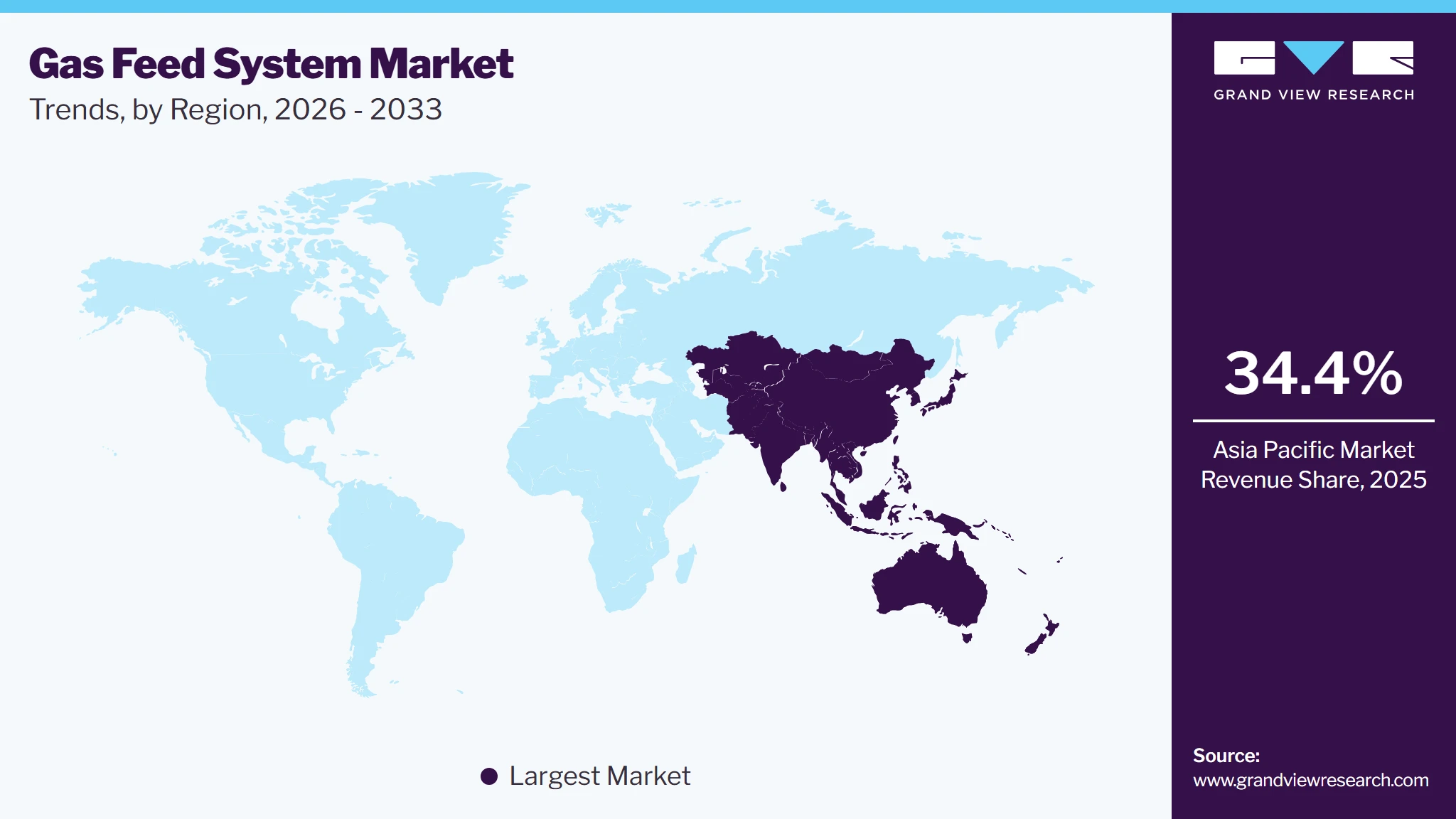
Asia Pacific dominated the market, accounting for the largest revenue share of 34.4% in 2025. The market is shaped by industrial expansion, urban development, and increasing investment in water and wastewater treatment infrastructure. The region includes both mature industrial markets and developing economies, resulting in varied requirements for gas feeding equipment. Demand differs according to facility scale, process complexity, gas handling requirements, and automation levels. Industrial expansion creates opportunities across chemical processing, utilities, food processing, and other applications requiring controlled gas delivery.
 To learn more about this report, Download Free Sample Report
 China Gas Feed System Market Trends
China accounted for 40.2% of the Asia Pacific gas feed system market in 2025. Demand is associated with the country's extensive chemical processing activities, municipal and industrial wastewater treatment also provide a broad application base for gas feeding equipment. Large facilities increasingly require automated and integrated configurations for continuous process control, while conventional regulated systems remain relevant across established installations. Strong domestic manufacturing capabilities contribute to a competitive supplier environment and wider equipment availability.
The India gas feed system market shaped by the expansion of urban infrastructure and increasing requirements for water and wastewater treatment capacity. New treatment projects are creating opportunities for gas feeding equipment, while industrial expansion is broadening demand beyond municipal applications. Capital expenditure remains an important consideration, particularly for smaller facilities, making equipment cost, installation complexity, and maintenance requirements relevant to purchasing decisions. Domestic suppliers and regional service providers can play an important role where customers require localized installation and technical assistance.
North America Gas Feed System Market Trends
The North American gas feed system market is characterized by a mature installed base across municipal and industrial facilities. Replacement of aging equipment and refurbishment of existing treatment assets represent important areas of market activity. Safety standards and regulatory requirements influence system design, particularly for installations handling hazardous gases. Users also place emphasis on equipment reliability, monitoring, and compatibility with existing plant infrastructure.
The U.S. gas feed system market is influenced by the large installed base of municipal treatment facilities and established industrial infrastructure. Replacement cycles and rehabilitation of aging assets provide recurring demand for gas feeding equipment. Regulatory requirements related to water treatment and hazardous gas handling affect equipment specifications and operating practices. Larger facilities increasingly incorporate monitoring and automated controls into gas feeding operations. Capital availability, infrastructure funding, and project timing can influence the pace of new installations and system upgrades.
The Canada gas feed system market demand is linked to its resource-oriented industrial base and geographically dispersed infrastructure. Oil and gas and mining operations can require equipment suited to demanding operating environments and remote locations. Municipal treatment facilities provide another source of demand, particularly where existing infrastructure requires renewal or capacity improvements. Geographic distance can increase the importance of equipment reliability, service accessibility, and maintenance requirements.
Europe Gas Feed System Trends
The European gas feed system market is shaped by established water infrastructure, industrial facilities, and stringent environmental and safety requirements. Replacement and refurbishment of existing installations represent important areas of market activity. Greater integration of monitoring, regulation, and plant-level controls is influencing equipment selection in modernized facilities. Technical standards and operating requirements vary across countries, creating differences in product specifications and procurement practices. Market development is therefore closely linked to infrastructure renewal, industrial modernization, and regulatory compliance.
The Germany gas feed system market is associated with technically advanced industrial base and established treatment infrastructure. Equipment selection is influenced by engineering requirements, process compatibility, safety, and integration with existing control systems. Industrial digitalization is increasing interest in gas feeding equipment with monitoring and automated control capabilities. Chemical processing and other process-intensive applications provide requirements for precise and reliable gas handling.
The France gas feed system market, refurbishment of existing facilities provides continuing demand alongside requirements from new treatment and industrial projects. Public infrastructure investment and environmental requirements influence procurement decisions. Equipment selection depends on process conditions, facility requirements, and compatibility with existing installations. Monitoring and automated regulation are becoming relevant where facilities undergo modernization and system upgrades.
Middle East & Africa Gas Feed System Trends
The Middle East & Africa gas feed system market varies considerably according to infrastructure development, industrial activity, and investment conditions across individual countries. Water treatment and wastewater infrastructure represent important areas of demand in markets facing water availability constraints. Oil and gas and industrial projects provide additional applications for gas feeding equipment. Large projects often require equipment configured to specific technical and safety specifications.
Saudi Arabia's gas feed system demand is associated with water security, desalination, wastewater treatment, and large industrial projects. Extensive investment in water infrastructure creates requirements for reliable gas feeding equipment across treatment processes. Oil and gas and petrochemical facilities provide additional demand for regulated gas handling systems. Large projects tend to favor integrated configurations with centralized monitoring and control functions. Harsh climatic conditions, localization requirements, and project-specific technical specifications also influence equipment selection.
Latin America Gas Feed System Trends
The Latin American gas feed system market is influenced by uneven infrastructure development and differing levels of industrialization across countries. Expansion of sanitation infrastructure creates opportunities for new gas feeding installations, while established facilities generate replacement and maintenance requirements. Industrial applications add demand that varies according to the concentration and type of processing activity in individual markets. Project financing, public-private participation, imported equipment costs, and local procurement practices can affect market development.
Brazil's gas feed system market is associated with uneven infrastructure development and differing levels of industrialization across countries. Expansion of sanitation infrastructure creates opportunities for new gas feeding installations, while established facilities generate replacement and maintenance requirements. Industrial applications add demand that varies according to the concentration and type of processing activity in individual markets. Project financing, public-private participation, imported equipment costs, and local procurement practices can affect market development..
Key Gas Feed System Company Insights
Some of the key players operating in the market include Xylem Inc., Hydro Instruments, among others.
-
Xylem Inc. offers gas feed systems under its Wallace & Tiernan portfolio, with solutions designed for controlled chlorine gas dosing and other gas-handling applications in water and wastewater treatment. Its product range includes vacuum-operated gas feeders, gas pressure-reducing valves, automatic changeover modules, injectors, evaporators, and safety equipment. The systems incorporate manual and automatic dosing options, flow control, gas release detection, and shutdown functions for regulated gas feeding operations.
-
Hydro Instruments manufactures gas feed and gas chlorination equipment for water treatment and industrial applications. Its portfolio includes vacuum regulators, gas feeders, remote flow meters, ejectors, switchover modules, automatic control valves, and gas detection equipment for chlorine, sulfur dioxide, ammonia, and carbon dioxide applications. The company offers gas feed systems across multiple capacities and configurations, including cylinder-, manifold-, ton-container-, and wall-mounted systems, addressing different gas feeding and flow regulation requirements.
Key Gas Feed System Companies
The following key companies have been profiled for this study on the gas feed system market.
-
Xylem Inc.
-
Hydro Instruments
-
Lutz-JESCO GmbH
-
ProMinent GmbH
-
Archer Instruments
-
Enchlor Inc.
-
Capco Water Solutions
-
IEC Fabchem Limited
-
M.A. Technologies
-
Chennai Chloro System
-
RSVP Chloro Tech
-
SM Polymers
-
Chloro Tech Equipments Pvt. Ltd.
-
Pathocleanser Systems LLP
-
Chlorination Systems
Competitive Benchmarking
Category
Operating Strategies
Competitive Edge
Weakness
Established Players (e.g., Xylem Inc.; Hydro Instruments; Lutz-JESCO GmbH; ProMinent GmbH; Archer Instruments; Enchlor Inc.; Capco Water Solutions; IEC Fabchem Limited)
- Develop vacuum-regulated, pressure-regulated, and automated gas feed systems for municipal and industrial applications.
- Expand system portfolios with gas feeders, regulators, ejectors, injectors, changeover equipment, monitoring systems, and safety components.
- Established technical capabilities in gas feeding, chlorination, and gas handling across different gas types, capacities, and operating conditions.
- Broader product and engineering capabilities enable configuration of systems according to automation, flow, pressure, and installation requirements.
- Higher engineering, manufacturing, compliance, and service requirements can increase system deployment costs.
- Broader organizational structures may involve longer project execution cycles for smaller or highly customized installations.
Emerging & Regional Players (e.g., M.A. Technologies; Chennai Chloro System; RSVP Chloro Tech; SM Polymers; Chloro Tech Equipments Pvt. Ltd.; Pathocleanser Systems LLP; Chlorination Systems)
- Focus on application-specific gas feed and chlorination equipment, customized configurations, and automation upgrades.
- Develop regional sales and service networks through direct customer engagement, distributors, installation, commissioning, and aftermarket support.
- Flexible configurations and localized technical support facilitate adaptation to site-specific gas feeding and treatment requirements.
- Regional application knowledge enables closer customer engagement for installation, servicing, and equipment modifications.
- More limited geographic coverage and manufacturing scale can restrict participation in projects requiring extensive international service capabilities.
- Narrower product portfolios and lower international visibility may constrain access to large multi-region procurement programs.
Recent Developments
-
In June 2026, Industrie De Nora acquired the assets of the ChlorGuard division from UK-based PSI Global. ChlorGuard provides safety systems for managing gases used in water treatment facilities. The acquisition enables De Nora to incorporate ChlorGuard’s technologies into its Capital Controls portfolio, which covers chlorine gas dosing and handling for municipal and industrial water treatment applications. The transaction expands De Nora’s capabilities in toxic-gas safety, monitoring, and containment and strengthens its integrated offering for water treatment and other industrial applications, including oil and gas and pharmaceutical facilities.
-
In 2025, Lutz-Jesco presented its water treatment technologies at IFAT 2025 in Johannesburg, South Africa, with a focus on solutions for African water infrastructure. The company showcased the C 2214 vacuum regulator, designed for controlled withdrawal of chlorine, hydrogen chloride, carbon dioxide, and sulfur dioxide from gas cylinders, along with safety features such as automatic gas shut-off and pressure protection. The company also presented the Memdos Smart dosing pump and Topax MC multi-channel controller, highlighting capabilities in controlled dosing, monitoring, and system integration for water treatment applications.
Gas Feed System Report Scope
Report Attribute
Details
Market size in 2025
USD 1,162.4 million
Estimated market size in 2026
USD 1,233.7 million
Projected market size by 2033
USD 1,919.3 million
Growth rate
CAGR of 6.5% from 2026 to 2033
Base year for estimation
2025
Historical data
2021 - 2024
Forecast period
2026 - 2033
Quantitative units
Revenue in USD million and CAGR from 2026 to 2033
Report coverage
Revenue forecast, company market position analysis, competitive landscape, growth factors, and trends
Segments covered
Operation mode, product type, end use, region
Regional scope
North America; Europe; Asia Pacific; Latin America; Middle East & Africa
Country Scope
U.S.; Canada; Mexico; Germany; UK; Italy; Spain; France; China; Japan; India; Australia; South Korea; Brazil; Argentina; Saudi Arabia; UAE; South Africa
Key companies profiled
Xylem Inc.; Hydro Instruments; Lutz-JESCO GmbH; ProMinent GmbH; Archer Instruments; Enchlor Inc.; Capco Water Solutions; IEC Fabchem Limited; M.A. Technologies; Chennai Chloro System; RSVP Chloro Tech; SM Polymers; Chloro Tech Equipments Pvt. Ltd.; Pathocleanser Systems LLP; Chlorination Systems
Customization scope
Free report customization (equivalent up to 8 analysts working days) with purchase. Addition or alteration to country, regional & segment scope.
Pricing and purchase options
Avail customized purchase options to meet your exact research needs. Explore purchase options
Global Gas Feed System Market Report Segmentation
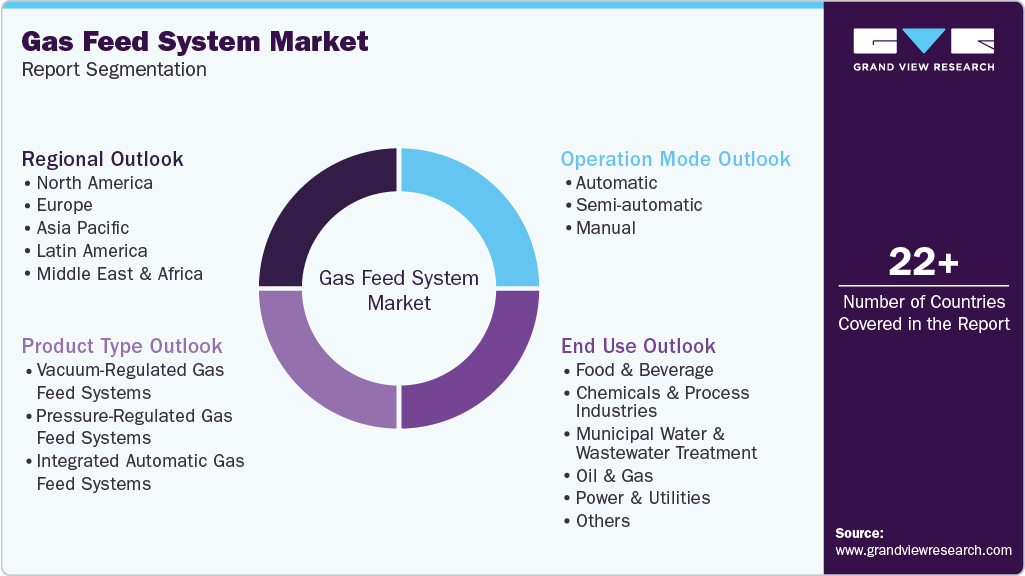
This report forecasts revenue growth at global, regional & country levels and provides an analysis on the industry trends in each of the sub-segments from 2021 to 2033. For the purpose of this study, Grand View Research has segmented the gas feed system market on the basis of operation mode, product type, end use, and region:
 To learn more about this report, Download Free Sample Report
 -
Operation Mode Outlook (Revenue, USD Million, 2021 - 2033)
-
Automatic
-
Semi-automatic
-
Manual
-
-
Product Type Outlook (Revenue, USD Million, 2021 - 2033)
-
Vacuum-Regulated Gas Feed Systems
-
Pressure-Regulated Gas Feed Systems
-
Integrated Automatic Gas Feed Systems
-
-
End Use Outlook (Revenue, USD Million, 2021 - 2033)
-
Food & Beverage
-
Chemicals & Process Industries
-
Municipal Water & Wastewater Treatment
-
Oil & Gas
-
Power & Utilities
-
Others
-
-
Regional Outlook (Revenue, USD Million, 2021 - 2033)
-
North America
-
U.S.
-
Canada
-
Mexico
-
-
Europe
-
Germany
-
France
-
UK
-
Spain
-
Italy
-
-
Asia Pacific
-
China
-
India
-
Japan
-
South Korea
-
Australia
-
-
Latin America
-
Brazil
-
Argentina
-
-
Middle East & Africa
-
Saudi Arabia
-
UAE
-
South Africa
-
-
Research Methodology
The gas feed system market figures in this report are based on a proven research process that combines executive interviews with secondary research from proprietary databases, company filings, and recognized regulatory and institutional sources. Market size is built through value-chain sizing - reconciling supply-side and demand-side estimates - and triangulated with bottom-up and top-down approaches. Every estimate passes multiple levels of expert validation before publication, with each gas feed system segment quantified using the revenue-capture definitions in the table below.
Segment Definition
Operation Mode
Revenue Capture Definition
Automatic
Revenue generated from the sale of automatic gas feed systems designed to regulate, control, and deliver gases with minimal manual intervention.
Semi-automatic
Revenue generated from the sale of semi-automatic gas feed systems that combine automated gas control functions with manual operator input.
Manual
Revenue generated from the sale of manually operated gas feed systems in which gas flow and feed parameters are controlled by operators.
Product Type
Revenue Capture Definition
Vacuum-Regulated Gas Feed Systems
Revenue generated from the sale of vacuum-regulated gas feed systems that control gas feeding through vacuum-based regulation mechanisms.
Pressure-Regulated Gas Feed Systems
Revenue generated from the sale of pressure-regulated gas feed systems designed to control and maintain gas delivery based on specified pressure conditions.
Integrated Automatic Gas Feed Systems
Revenue generated from the sale of integrated automatic gas feed systems combining gas regulation, control, monitoring, and automated feeding functions within a unified system.
End Use
Revenue Capture Definition
Food & Beverage
Revenue generated from the sale of gas feed systems supplied to food and beverage processing facilities for controlled gas feeding requirements.
Chemicals & Process Industries
Revenue generated from the sale of gas feed systems supplied to chemical and process industries for controlled gas feeding during industrial operations.
Municipal Water & Wastewater Treatment
Revenue generated from the sale of gas feed systems supplied to municipal water and wastewater treatment facilities for controlled gas feeding applications.
Oil & Gas
Revenue generated from the sale of gas feed systems supplied to oil and gas facilities for controlled gas feeding requirements across operational processes.
Power & Utilities
Revenue generated from the sale of gas feed systems supplied to power generation and utility facilities for controlled gas feeding requirements.
Others
Revenue generated from the sale of gas feed systems supplied to end-use industries and applications not covered under the specified segments.
Estimation Model
Layer Name
Key Question
Description
End-use Demand Layer
Where are gas feed systems required?
Analyze demand across food & beverage, chemicals & process industries, municipal water & wastewater treatment, oil & gas, power & utilities, and other applications. Assess gas feeding requirements across these industries to establish the addressable demand for gas feed systems.
Infrastructure & Investment Layer
Where is new system demand being created?
Evaluate investments in new industrial and treatment facilities, capacity expansions, infrastructure development, process-line modernization, replacement of existing systems, and automation projects. Assess how changes in industrial capacity and gas feeding requirements translate into demand for new gas feed systems across regions and end-use industries.
System Adoption Layer
Which gas feed systems are being deployed?
Segment system demand by operation mode, product type, end use, and region. Assess adoption based on automation requirements, gas flow and pressure control needs, operational scale, process requirements, system configuration, and suitability for specific gas feeding applications.
Revenue Generation Layer
How much market revenue is generated?
Estimate annual revenue from the sale of gas feed systems by operation mode, product type, end use, and region. Quantify revenues generated exclusively from the sale of gas feed systems to industrial facilities, treatment plants, utilities, and other system buyers, excluding downstream revenues generated from gases or processes using these systems.
Delivered Customizations
This report has been delivered with the following In-depth customizations
Client Request
Customization Delivered
Value Adds
Competitive Benchmarking
A competitive benchmarking analysis was conducted covering gas feed system manufacturers based on operation mode, product type, regulation method, automation level, system configuration, product portfolio, application coverage, distribution network, strategic developments, and geographic presence.
Provided a structured view of the competitive landscape, enabling stakeholders to compare manufacturer offerings, understand areas of product differentiation, and evaluate positioning across the gas feed system market.
Regional Segmentation
A regional assessment was conducted across North America, Europe, Asia Pacific, Latin America, and the Middle East & Africa, with market analysis by food & beverage, chemicals & process industries, municipal water & wastewater treatment, oil & gas, power & utilities, and other end-use applications.
Provided visibility into geographic and industry-specific demand patterns, helping stakeholders determine market priorities, assess regional requirements, and plan distribution and market coverage.
Opportunity Assessment
Market opportunities were assessed across automatic, semi-automatic, and manual systems, as well as vacuum-regulated, pressure-regulated, and integrated automatic gas feed systems. The assessment also considered replacement demand, automation adoption, infrastructure development, and requirements across major end-use industries.
Helped stakeholders identify areas of potential revenue expansion, evaluate product development priorities, assess investment opportunities, and formulate market-entry or expansion strategies.
Frequently Asked Questions About This Report
The municipal water & wastewater treatment segment accounted for the largest revenue share, at 37.2%, in 2025. Gas feed systems are used in treatment facilities to provide controlled and regulated gas delivery for various water and wastewater treatment processes.
Market growth is driven by increasing demand for packaged and convenience foods, expansion of pharmaceutical and healthcare packaging, adoption of automated production systems, demand for lightweight packaging, and the need for high-throughput and material-efficient manufacturing.
Asia Pacific dominated the market with a 40.2% revenue share in 2025.
The automatic segment accounted for the largest share of 47.5% in 2025.
Roll-fed gas feed system machines dominated the market with a 51.9% revenue share in 2025, supported by continuous processing, efficient material utilization, and suitability for high-volume production.
The global gas feed system market is expected to grow at a CAGR of 6.5% from 2026 to 2033, reaching USD 1,919.3 million by 2033.
The global gas feed system market size was valued at USD 1,162.4 million in 2025 and is estimated at USD 1,233.7 million in 2026
Major companies include Xylem Inc., Hydro Instruments, Lutz-JESCO GmbH, ProMinent GmbH, Archer Instruments, Enchlor Inc., Capco Water Solutions, IEC Fabchem Limited, M.A. Technologies, Chennai Chloro System, RSVP Chloro Tech, SM Polymers, Chloro Tech Equipments Pvt. Ltd., Pathocleanser Systems LLP, and Chlorination Systems
About the Author(s)
Advanced Interior Materials Research Team
Advanced Materials · Advanced Interior MaterialsThis report was authored by the advanced interior materials research team at Grand View Research - comprising two research analysts, one senior research analyst, and one industry expert - with specialized expertise in the advanced interior materials segment of the advanced materials industry. All findings are based on proprietary advanced materials databases, executive interviews, and regulatory analysis, subject to internal peer review prior to publication.
Last Updated:
Speak to Analyst

Customize this report to your needs - add regions, segments, or data points, with 20% free customization.
Or view our licence options:


ISO 9001:2015 & 27001:2022 Certified
We are GDPR and CCPA compliant! Your transaction & personal information is safe and secure. For more details, please read our privacy policy.


