
- Home
- »
- Agrochemicals & Fertilizers
- »
-
Gibberellins Market Size And Share, Industry Report, 2033GVR Report cover
![Gibberellins Market Size, Share & Trends Report]()
Gibberellins Market (2026 - 2033) Size, Share & Trends Analysis Report by By Application (Malting of Barley, Increasing Sugarcane Yield, Fruit Production, Seed Production), By Region, And Segment Forecasts
Market Size, 2025
$1.1BMarket Estimate, 2026
$1.2BMarket Forecast, 2033
$2.3BCAGR, 2026–2033
9.1%Gibberellins Market Summary
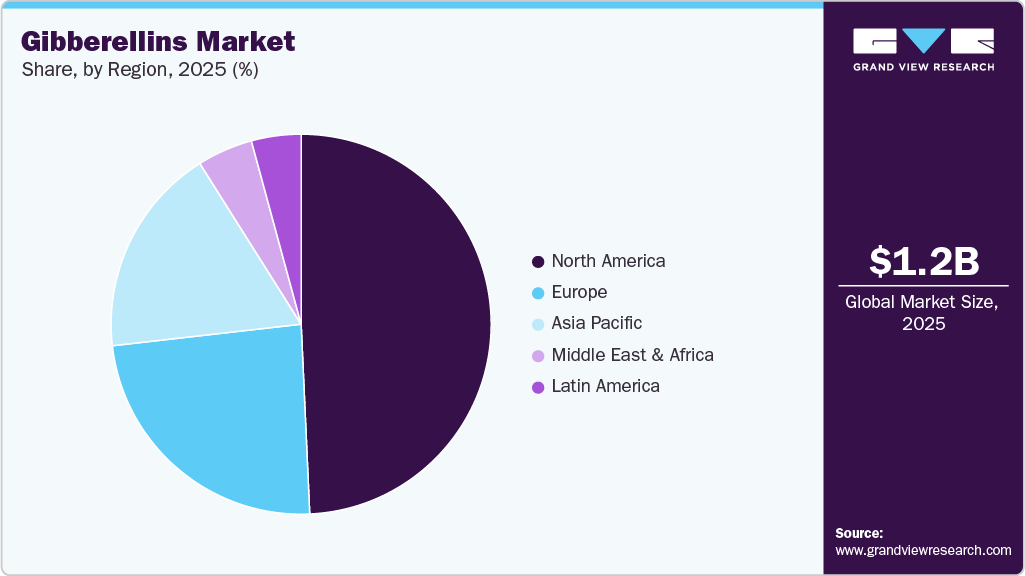
The global gibberellins market size was valued at USD 1.1 billion in 2025 and is projected to grow from USD 1.2 billion in 2026 to USD 2.3 billion by 2033, at a CAGR of 9.1% from 2026 to 2033. The market in North America dominated with a revenue share of 49.3% in 2025. The growing global population and decreasing area for cultivation are anticipated to drive the product demand over the forecast period.

Key Market Trends & Insights
- By application: Fruit production segment led the gibberellins industry, accounting for the largest revenue share of 71.4% in 2025.
Regional Highlights
- Largest regional market: North America (49.3% revenue share, 2025)
- Fastest-growing regional market: Asia Pacific (highest CAGR, 2026-2033)
- By country: The U.S. held the largest market share in 2025.
Market Size & Forecast
- Market size in 2025: USD 1.1 billion
- Estimated market size in 2026: USD 1.2 billion
- Projected market size by 2033: USD 2.3 billion
- CAGR (2026-2033): 9.1%
Gibberellins control cell elongation, stimulate the extension growth, delay aging, and increase the rate of fruit production in plants. The growing demand for fine quality vegetables & fruits has increased the utilization of gibberellin in the agriculture industry. Farmers prefer this product as it fosters the growth of plants under uncontrollable and unpredictable environments. Gibberellins are majorly used for the production of apples and grapes.As global population growth places increasing pressure on food supply systems, farmers are adopting plant growth regulators such as gibberellins to enhance seed germination, stem elongation, flowering, and fruit development. Gibberellins are widely used in cereals, fruits, and horticultural crops to improve yield uniformity and quality, making them an important input in modern agriculture.
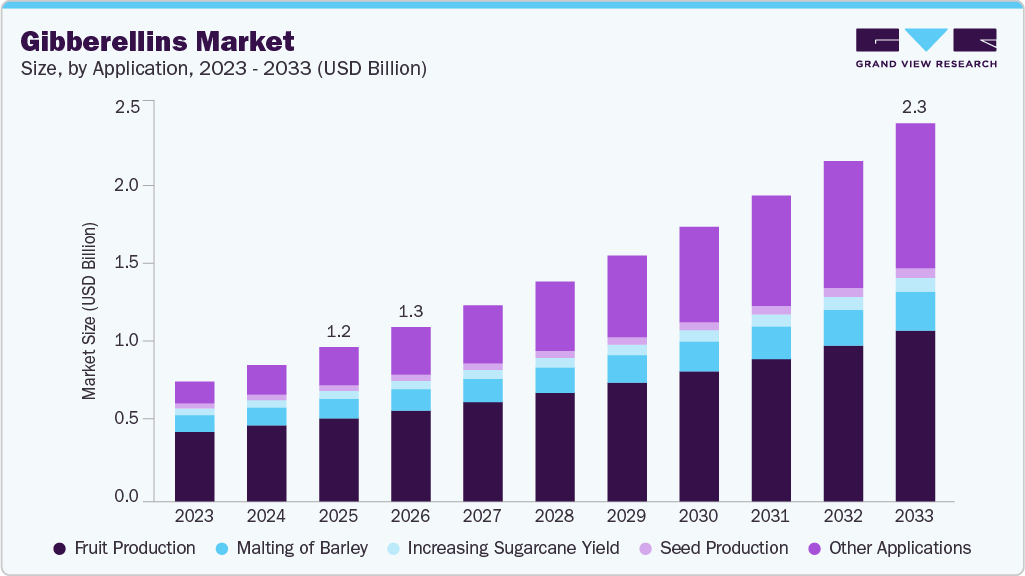
Another key driver is the rising adoption of precision and high-value agriculture, particularly in fruit and vegetable cultivation. Gibberellins are extensively applied in crops such as grapes, apples, citrus fruits, and rice to regulate plant growth stages, increase fruit size, and improve marketable yield. The expansion of protected cultivation, greenhouse farming, and export-oriented horticulture has further increased demand for consistent and predictable crop performance, supporting the use of gibberellin-based products.
Additionally, the shift toward sustainable and biologically derived agrochemicals is contributing to market growth. Gibberellins, being naturally occurring plant hormones, are increasingly viewed as environmentally compatible alternatives to certain synthetic growth stimulants. Regulatory restrictions on conventional agrochemicals and growing awareness of residue management are encouraging the adoption of plant growth regulators with favorable environmental profiles, positioning gibberellins as a key growth driver in the agricultural inputs market
Market Dynamics
The rising global production of fruits and vegetables is one of the key factors driving demand for gibberellins in the agricultural sector. Increasing population growth, changing dietary preferences, and growing awareness regarding nutritional food consumption have significantly increased demand for high-quality fruits and vegetables across both developed and developing economies. As a result, farmers are increasingly adopting plant growth regulators such as gibberellins to improve crop productivity, enhance fruit size, accelerate germination, stimulate flowering, and achieve uniform crop development. Gibberellins are particularly important in horticultural crops including grapes, citrus fruits, tomatoes, apples, and leafy vegetables, where quality, appearance, and yield directly influence market value and profitability.
In addition, the expansion of commercial farming and protected cultivation practices is further supporting the adoption of gibberellins globally. Greenhouse farming, precision agriculture, and high-value horticulture production systems require advanced crop management solutions to maximize output and reduce cultivation risks. Gibberellins improve crop consistency, extend fruit shelf life, and support off-season production, making them highly beneficial for export-oriented agricultural markets. Countries across Asia Pacific and Latin America are witnessing increased usage of plant growth regulators as governments and agricultural producers focus on improving agricultural productivity and food security, thereby contributing to the growth of the gibberellins market.
The availability of alternative plant growth regulators acts as a major restraint for the gibberellins market. Farmers and agricultural producers often utilize other growth regulators such as auxins, cytokinins, ethylene regulators, and synthetic agrochemical formulations depending on crop type, cultivation practices, and desired plant response. In several applications, these substitutes may offer comparable performance at lower costs or provide broader functionality, limiting the exclusive adoption of gibberellins. Additionally, increasing interest in organic farming practices and biological crop enhancement solutions may encourage the use of alternative bio-based products, creating competitive pressure on the gibberellins market.
Market Concentration & Characteristics
The gibberellins market is characterized by its specialty-driven nature and strong linkage to crop-specific applications. Demand is highly influenced by the cultivation of high-value crops such as fruits, vegetables, and cereals, where precise control over plant growth stages is critical. The market exhibits seasonal demand patterns, aligned with planting and crop growth cycles, and is dominated by formulated products tailored to specific crops and climatic conditions. Product performance, application timing, and dosage precision are key factors influencing purchasing decisions.
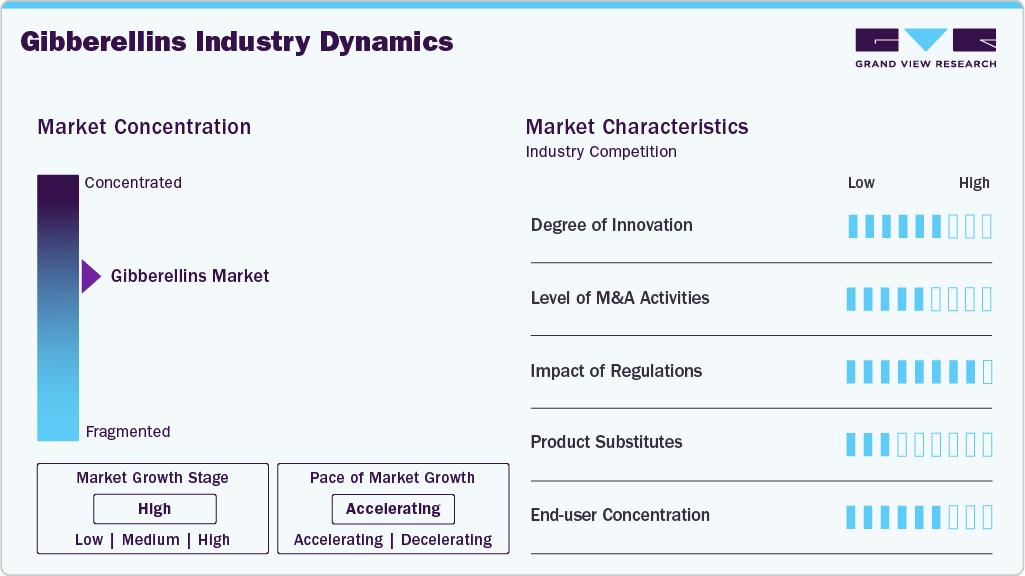
Another defining characteristic of the market is its regulatory and technical intensity. Gibberellin products are subject to agricultural input regulations related to safety, efficacy, and residue limits, which vary across regions. As a result, market participation requires strong R&D capabilities, regulatory compliance, and agronomic support, creating moderate entry barriers. The market also shows a gradual shift toward bio-based and fermentation-derived production, reflecting broader trends in sustainable agriculture and increasing preference for environmentally compatible plant growth regulators.
Application Insights
The fruit production segment led the gibberellins industry, accounting for the largest revenue share of 71.4% in 2025. This is driven by extensive use of gibberellins in high-value horticultural crops such as grapes, apples, citrus, and cherries. Gibberellins are widely applied to increase fruit size, improve uniformity, enhance coloration, and delay senescence, directly improving marketable yield. Export-oriented fruit farming and premium quality requirements further support high adoption. The strong return on investment for growers makes fruit production the dominant application segment.
The malting of barley segment is expected to grow with a CAGR of 8.9% during the forecast period. The growth is driven by rising global demand for beer, craft beverages, and malt-based food products. Gibberellins are used to stimulate uniform germination and enzyme activation during the malting process, improving malt quality and processing efficiency. Growth in the brewing industry, particularly premium and craft beer production, is accelerating adoption. Increasing focus on process consistency and yield optimization further supports segment expansion.
Regional Insights
The North America gibberellins market accounted for the largest revenue share of 49.3% in 2025. North America represents a mature and technology-driven gibberellins market, supported by advanced agricultural practices and high adoption of plant growth regulators in fruit and cereal crops. Demand is concentrated in horticulture, vineyards, and malting barley, where yield uniformity and quality enhancement are critical. Strong agronomic awareness and precision farming practices support consistent usage.
The U.S. gibberellins market is driven by extensive use in fruit production, vineyards, and malting barley. Advanced farming practices and strong integration with agronomic advisory services support consistent demand. Regulatory oversight ensures controlled usage, favoring high-quality formulations. Stable agricultural output underpins steady market growth.
Asia Pacific Gibberellins Market Trends
The Asia Pacific is expected to grow the fastest with a CAGR of 10.3% during the forecast period. The region’s growth is driven by expanding agricultural output, rising food demand, and increasing adoption of modern crop management techniques. Strong demand from fruit production, rice cultivation, and horticulture underpins growth across China, India, and Southeast Asia. Government initiatives supporting yield enhancement and crop quality improvement further accelerate adoption. The region benefits from a large farming base transitioning toward regulated plant growth regulator usage
The China gibberellins market represents one of the largest and fastest-growing national markets, supported by large-scale fruit and rice cultivation. Government focus on improving agricultural productivity and quality drives adoption of plant growth regulators. Increasing farmer awareness and modernization of agricultural inputs further support market expansion. Domestic production also enhances product availability.
Europe Gibberellins Market Trends
Europe’s gibberellins market is shaped by stringent agricultural regulations and sustainability-focused farming practices. Demand is strong in fruit cultivation and malting barley, particularly in Western and Central Europe. The market favors high-efficacy, low-residue formulations, aligning with strict environmental and food safety standards. Growth is steady but controlled, with innovation focused on application efficiency rather than volume expansion.
The Germany gibberellins market is specialty-oriented, with demand concentrated in malting barley and high-value horticulture. Strong presence of the brewing industry supports consistent usage in barley malting. Strict regulatory standards influence product selection and application practices. Germany also plays a role in R&D and formulation development within Europe.
Latin America Gibberellins Market Trends
Latin America’s gibberellins market is driven by export-oriented agriculture, particularly in fruits such as grapes, citrus, and berries. Countries in the region increasingly adopt gibberellins to improve fruit size, quality, and consistency for international markets. Favorable climatic conditions and expanding commercial farming support demand growth. However, adoption remains uneven due to varying regulatory frameworks and levels of agronomic awareness.
Middle East and Africa Gibberellins Market Trends
The Middle East & Africa market is emerging, supported by growing investments in horticulture and controlled-environment agriculture. Gibberellins are increasingly used to enhance crop performance under arid and semi-arid conditions, particularly in fruit and vegetable cultivation. Adoption is driven by food security initiatives and yield optimization efforts. Despite strong long-term potential, market growth is constrained by limited awareness and infrastructure in parts of the region.
Key Gibberellins Company Insights
Some of the key players operating in the market include BASF SE, Afton Chemical Corporation, Evonik Industries AG, and The Lubrizol Corporation.
-
Valent U.S.A. Corporation, The company is manufacturer, producer, and seller of pest management and crop protection products in agriculture market of the U.S. and Canada. The products are used to protect & enhance crop yield and improve quality of the crop. The company operates in various business segments including golf course, turf, nursery, landscape operations, industrial vegetation management, and greenhouse. It has its own research laboratory in Dublin, California. The company is based in Walnut Creek, California and has additional offices in Longwood, Florida; Fresno, California; Mahomet, Illinois; and Collierville, Tennessee.
Key Gibberellins Companies:
The following are the leading companies in the gibberellins market. These companies collectively hold the largest market share and dictate industry trends.
- Valent U.S.A. Corporation
- Jiangsu Fengyuan Bioengineering Co., Ltd.
- Nufarm Ltd.
- Sichuan Guoguang Agrochemical Co. Ltd.
- Xinyi (H.K.) Industrial Co., Ltd.
- Fine Americas, Inc.
- SePRO Corporation
- Zhejiang Qiangiang Biochemical Co., Ltd.
- Shanghai Fuang Agrochemical Co. Ltd.
- Biosynth AG
- Zodiac Brand Space Pvt. Ltd.
Competitive Benchmarking
Operating Strategies
Competitive Edge
Weakness
Mature Players: Valent U.S.A. Corporation; Nufarm Ltd.; Fine Americas, Inc.; SePRO Corporation; Peptech Biosciences Ltd.
- Strong focus on agricultural biotechnology and specialty crop solutions.
- Expansion of plant growth regulator portfolios.
- Strategic partnerships with distributors and agricultural cooperatives.
- Investment in R&D for crop-specific formulations and yield enhancement technologies.
- Focus on regulatory approvals and sustainable agriculture solutions.
- Strong brand recognition and established distribution networks.
- diversified agrochemical product portfolios.
- strong technical expertise and customer support capabilities.
- Extensive reach across commercial agriculture markets.
- Higher investment capability in product innovation and registrations.
- Higher operational and regulatory compliance costs.
- Slower penetration into niche/localized agricultural markets.
- Dependence on mature agricultural economies.
- Premium pricing compared to regional competitors.
Emerging Players: Jiangsu Fengyuan Bioengineering Co., Ltd.; Sichuan Guoguang Agrochemical Co. Ltd.; Xinyi (H.K.) Industrial Co. Ltd.; Zhejiang Qianjiang Biochemical Co., Ltd.; Shanghai Fuang Agrochemical Co. Ltd
- Cost-competitive manufacturing strategies.
- Focus on bulk production of gibberellins and plant growth regulators.
- Expansion in export-oriented markets. emphasis on local distributor partnerships and regional market penetration.
- Increasing focus on production capacity expansion.
- Competitive pricing advantage.
- Strong manufacturing base in China.
- Flexibility in serving regional and mid-sized agricultural customers.
- Growing export presence across Asia Pacific and Latin America.
- Ability to cater to high-volume agricultural demand.
- Limited global brand recognition.
- Comparatively weaker regulatory presence in developed markets.
- Lower investment capability in advanced R&D and product differentiation.
- Dependence on commodity-based competition and regional demand fluctuations.
Recent Developments
-
In November 2023, Researchers from the Singapore-MIT Alliance for Research and Technology (SMART) and the Temasek Life Sciences Laboratory, in collaboration with PepsiCo, have developed groundbreaking nanosensors that can detect and differentiate gibberellins (GAs), which are essential plant growth hormones. Unlike traditional methods, these non-destructive sensors have been successfully tested, offering a revolutionary approach for monitoring live plants and early-stage plant stress. The potential applications in crop management and precision agriculture, these nanosensors could provide farmers with valuable tools to optimize yields and enhance plant biotechnology.
Gibberellins Market Report Scope
Report Attribute
Details
Market size in 2025
USD 1.1 billion
Estimated market size in 2026
USD 1.2 billion
Projected market size by 2033
USD 2.3 billion
Growth rate
CAGR of 9.1% from 2026 to 2033
Base year for estimation
2025
Historical data
2018 - 2024
Forecast period
2026 - 2033
Quantitative units
Volume in kilotons, revenue in USD million, and CAGR from 2026 to 2033
Report coverage
Revenue forecast, volume forecast, competitive landscape, growth factors, and trends
Segments covered
Product, application, and region
Regional scope
North America; Europe; Asia Pacific: Latin America; Middle East & Africa
Country scope
U.S.; Canada; Mexico; Germany; UK; France; Italy; Spain; China; India; Japan; South Korea; Brazil; Argentina; Saudi Arabia; South Africa
Key companies profiled
Valent U.S.A. Corporation; Jiangsu Fengyuan Bioengineering Co., Ltd.; Nufarm Ltd.; Sichuan Guoguang Agrochemical Co. Ltd.; Xinyi (H.K.) Industrial Co., Ltd.; Fine Americas, Inc.; SePRO Corporation; Zhejiang Qiangiang Biochemical Co., Ltd.; Shanghai Fuang Agrochemical Co. Ltd.; Biosynth AG; Zodiac Brand Space Pvt. Ltd.
Customization scope
Free report customization (equivalent up to 8 analyst’s working days) with purchase. Addition or alteration to country, regional, and segment scope.
Pricing and purchase options
Avail customized purchase options to meet your exact research needs. Explore purchase options
Global Gibberellins Market Report Segmentation
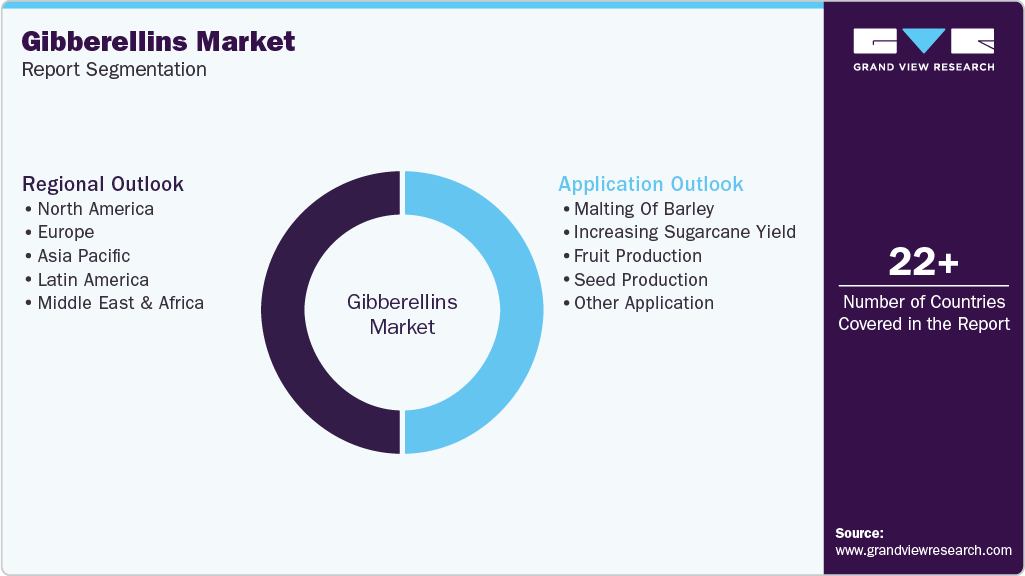
This report forecasts volume & revenue growth at the global level and provides an analysis of the latest industry trends in each of the sub-segments from 2018 to 2033. For this study, Grand View Research has segmented the global gibberellins market report based on application, and region:
-
Application Outlook (Volume, Kilotons; Revenue, USD Million; 2018 - 2033)
-
Malting Of Barley
-
Increasing Sugarcane Yield
-
Fruit Production
-
Seed Production
-
Other Application
-
-
Regional Outlook (Volume, Kilotons; Revenue, USD Million; 2018 - 2033)
-
North America
-
U.S.
-
Canada
-
Mexico
-
-
Europe
-
Germany
-
UK
-
France
-
Italy
-
Spain
-
-
Asia Pacific
-
China
-
India
-
Japan
-
South Korea
-
-
Latin America
-
Brazil
-
Argentina
-
-
Middle East & Africa
-
Saudi Arabia
-
South Africa
-
-
Delivered Customizations
This report has been delivered with the following In-depth customizations
Client Request
Customization Delivered
Value Adds
Regional Segmentation
Assessment of global and regional gibberellins market dynamics, including production capacities, raw material and fermentation substrate availability, import-export analysis, regulatory framework, and supply-demand trends across major regions such as North America, Europe, Asia Pacific, Latin America, and Middle East & Africa. The customization can also include country-level analysis for key agricultural markets such as Brazil, China, India, Australia, Spain, South Africa, and others depending on requirement. Additionally, the analysis evaluates crop-specific demand trends across fruits & vegetables, cereals & grains, turf & ornamentals, plantation crops, and greenhouse cultivation applications
Enable identification of high-growth agricultural markets, crop-specific demand hotspots, and regional adoption trends for plant growth regulators. Support expansion planning, localization strategies, distributor identification, and procurement optimization through enhanced visibility into commercial farming practices, horticulture production trends, and agricultural modernization initiatives across key regions.
Competitive Benchmarking
Comparative assessment of key gibberellins manufacturers based on product portfolio, fermentation and production capabilities, formulation expertise, distribution network, crop application specialization, innovation capabilities, sustainability initiatives, pricing positioning, regulatory approvals, and regional presence. Additional company profiling can be incorporated based on client requirements, including benchmarking across technical-grade, liquid formulation, powder formulation, and specialty plant growth regulator products.
Support supplier benchmarking and strategic evaluation by identifying leading gibberellins manufacturers, formulation capabilities, crop-specific product differentiation, and portfolio gaps across regions and agricultural applications. Enable informed decision-making related to supplier partnerships, product development strategies, regional expansion, regulatory positioning, and competitive assessment within the plant growth regulators value chain.
Pricing Analysis
Detailed pricing analysis for gibberellins by formulation type, crop application, and regional market. The assessment includes raw material and fermentation substrate price trends, production and extraction cost structures, regional pricing variations, supply-demand impact analysis, distribution margins, and pricing fluctuations associated with agricultural seasonality, crop demand cycles, and specialty horticulture applications. Pricing analysis can also be customized for specific crop segments, formulation types, or regional agricultural markets depending on data availability and client requirement.
Support procurement optimization, pricing strategy development, and supplier negotiations through enhanced understanding of gibberellins cost structures and regional pricing dynamics. Help identify pricing volatility risks linked to agricultural cycles and raw material availability, premium product opportunities in specialty crop applications, and regional sourcing advantages across the plant growth regulators value chain.
Frequently Asked Questions About This Report
Asia Pacific is the fastest-growing region over the forecast period.
The fruit production segment held the highest market share of 71.4% in 2025.
The global gibberellins market size was estimated at USD 1.1 billion in 2025 and is expected to reach USD 1.2 billion in 2026.
The global gibberellins market is expected to grow at a compound annual growth rate of 9.1% from 2026 to 2033 to reach USD 2.3 billion by 2033.
The North America gibberellins market accounted for the largest revenue share of 49.3% in 2025.
Some key players operating in the gibberellins market include Valent U.S.A. Corporation; Nufarm Ltd.; Sichuan Guoguang Agrochemical Co. Ltd.; and Fine Americas, Inc.
Key factors include growing global population, decreasing area for cultivation and ability of the gibberellins to control cell elongation, stimulate the extension growth, delay aging, and increase the rate of fruit production in plants.
About the Author(s)
Agrochemicals & Fertilizers Research Team
Bulk Chemicals · Agrochemicals & FertilizersThis report was authored by the agrochemicals & fertilizers research team at Grand View Research - comprising two research analysts, one senior research analyst, and one industry expert - with specialized expertise in the agrochemicals & fertilizers segment of the bulk chemicals industry. All findings are based on proprietary bulk chemicals databases, executive interviews, and regulatory analysis, subject to internal peer review prior to publication.
Last Updated:
Speak to Analyst


Need a Tailored Report?
Customize this report to your needs — add regions, segments, or data points, with 20% free customization.
Or view our licence options:


ISO 9001:2015 & 27001:2022 Certified
We are GDPR and CCPA compliant! Your transaction & personal information is safe and secure. For more details, please read our privacy policy.












