
- Home
- »
- Plastics, Polymers & Resins
- »
-
Glass Filled Nylon Market Size, Share & Trends Report, 2033GVR Report cover

Glass Filled Nylon Market (2026 - 2033)
Size, Share & Trends Analysis Report By Glass Fiber Content (20%-30%, 31%-40%, Below 20%, Above 40%), By Application (Automotive Components, Electrical & Electronic Components, Industrial Components), By Region, And Segment Forecasts
Market Size, 2025
$11.6BMarket Estimate, 2026
$12.1BMarket Forecast, 2033
$16.8BCAGR, 2026–2033
4.8%Glass Filled Nylon Market Summary
The global glass filled nylon market size was valued at USD 11.6 billion in 2025 and is projected to grow from USD 12.1 billion in 2026 to reach USD 16.8 billion by 2033, at a CAGR of 4.8% from 2026 to 2033. Asia Pacific dominated the market, accounting for the largest revenue share of 55.1% in 2025. The market is driven by increasing demand for lightweight, high-strength materials in automotive, electrical and electronics, industrial, and consumer applications.
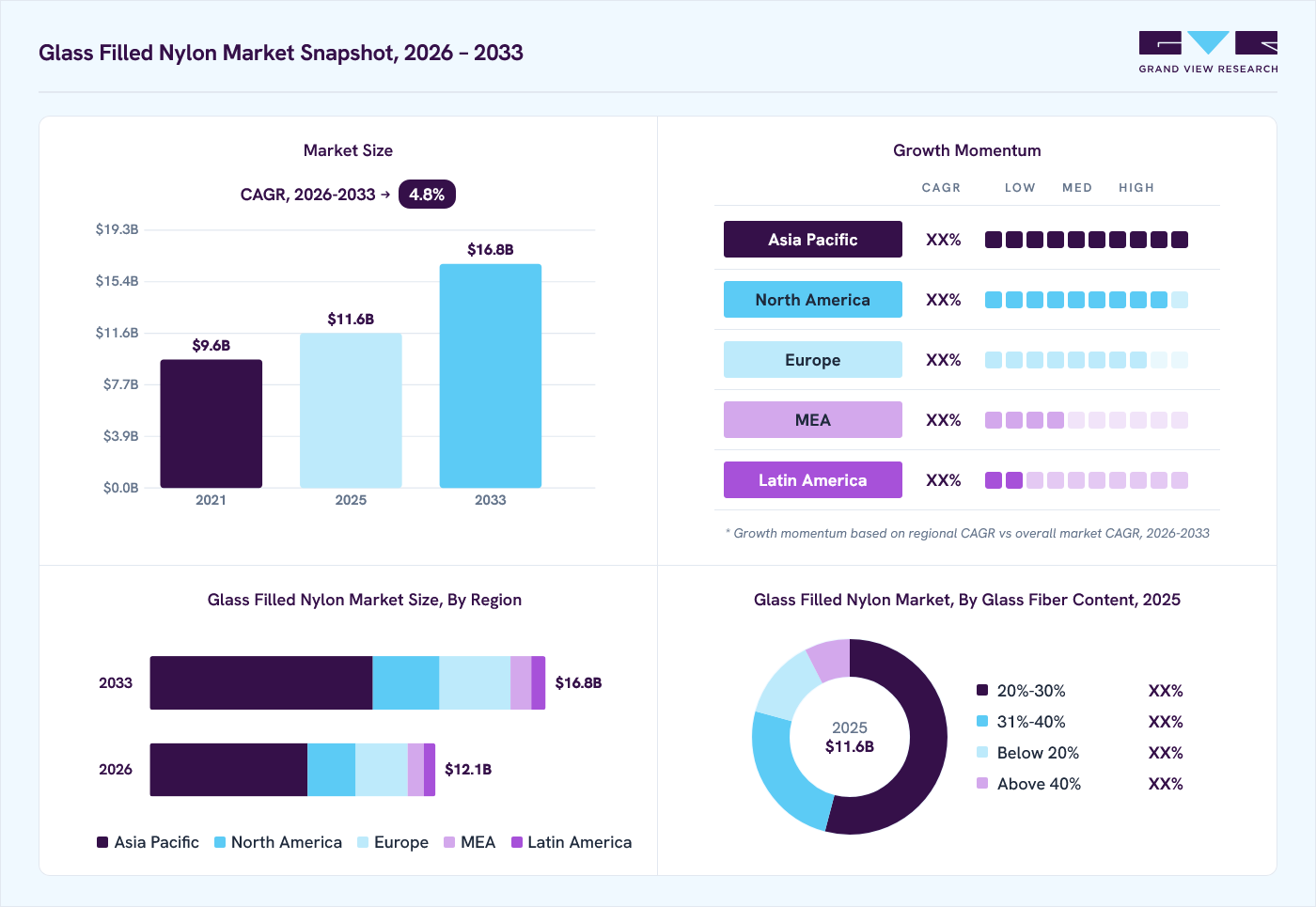 Source: Grand View Research, IR Documents, Primary Interviews, Paid DatabasesTo learn more about this report,
 Download Free Sample Report
 Key Market Trends & Insights
- By glass fiber content: The 31%-40% segment is anticipated to grow at a CAGR of 5.2% in the glass fiber content segment.
- By application: Electrical & electronic components segment is expected to grow at a 5.5% CAGR in revenue from 2026 to 2033.
Regional Highlights
- Largest regional market: Asia Pacific (55.1% revenue share, 2025)
- By country: India held the largest market share in 2025.
Market Size & Forecast
- Market size in 2025: USD 11.6 billion
- Estimated market size in 2026: USD 12.1 billion
- Projected market size by 2033: USD 16.8 billion
- CAGR (2026 - 2033): 4.8%
Three ways to get this report
Buy it, customize it, or ask a question.Ask an Analyst
A direct answer, usually in 1 working day
- AccessReport author, directly
- Reply timeWithin 1 working day
- No sales callDirect answer only
- FormatEmail reply
- CostFree, no cost
Get the Full Report
What the study covers
- FormatsPDF · Excel · Dashboard
- Timeline2026–2033 annual, 2025 base
- Coverage20+ countries, 5 regions
- Companies10+ key players profiled
Customize the Report
20% free customization
- IncludeCountries, segments, points
- TailorTo your product definition
- ExtendDeeper competitor detail
- OrA fully bespoke study
- Turnaround5–10 working days
Growing vehicle lightweighting initiatives are encouraging metal replacement with reinforced polymers to improve fuel efficiency and reduce component weight. Rising demand for durable components with enhanced stiffness, dimensional stability, and heat resistance further supports adoption. Expanding electric vehicle production and increasing use of engineering plastics in electronic components are creating additional market opportunities.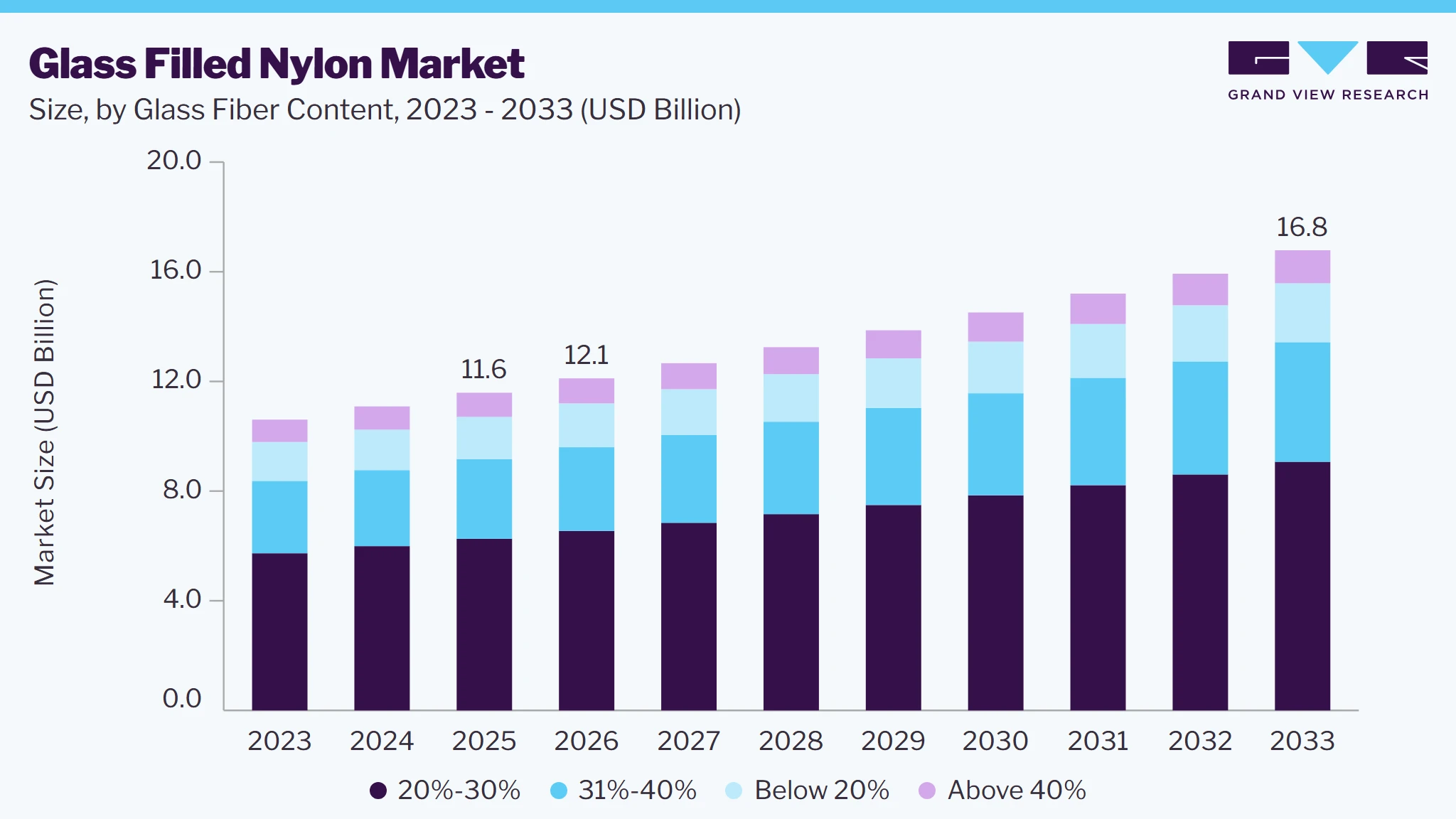 To learn more about this report, Download Free Sample Report
 A key trend in the glass-filled nylon market is the shift toward higher-performance and application-specific grades. Manufacturers are developing long-glass-fiber, heat-stabilized, flame-retardant, and impact-modified polyamide formulations for demanding components. Automotive applications are moving beyond conventional under-the-hood parts toward structural, battery, thermal-management, and high-voltage components. This trend is supported by advances in lightweight composite design and injection molding, which enable greater metal replacement while maintaining mechanical and thermal performance.
Market Dynamics
Automotive lightweighting remains a major demand driver for glass-filled nylon, as PA6 and PA66 reinforced with glass fibers provide high stiffness, tensile strength, dimensional stability, and heat resistance at lower weight than many metallic materials. Automakers are increasingly replacing metal components with glass-filled nylon in air-intake systems, engine covers, housings, brackets, cooling components, and structural parts. Its durability and resistance to temperature and mechanical stress support broader adoption across vehicle platforms.
Electrification is further strengthening demand for glass-filled nylon because electric vehicles require weight optimization to offset battery-related mass and improve driving efficiency. The material is increasingly used in battery housings, electrical connectors, charging components, and thermal-management systems. Meanwhile, expanding electronics production is creating additional applications in connectors, switches, housings, and insulating components. Growing requirements for lightweight, durable, electrically insulating, and heat-resistant materials are supporting market expansion.
Raw-material price volatility and processing complexity remain important constraints for the glass-filled nylon market. Nylon resin and glass fiber costs can fluctuate with feedstock prices, energy costs, and supply conditions. Glass fibers also increase equipment wear during compounding and molding, while fiber orientation can create directional differences in mechanical properties. Moisture absorption in polyamide further affects dimensional stability and processing consistency. These factors can increase conversion costs and limit substitution in applications where conventional plastics or metals provide a simpler cost structure.
A key opportunity for the glass-filled nylon market lies in expanding applications across industrial automation and robotics, where lightweight, rigid, and durable components are required. Glass-filled nylon offers high mechanical strength, dimensional stability, wear resistance, and temperature tolerance, supporting its use in housings, gears, brackets, rollers, and structural parts. Increasing automation across manufacturing, logistics, and warehousing is driving demand for engineering plastics that can withstand repeated mechanical loads, reduce component weight, and support reliable operation in demanding industrial environments.
Market Concentration & Characteristics
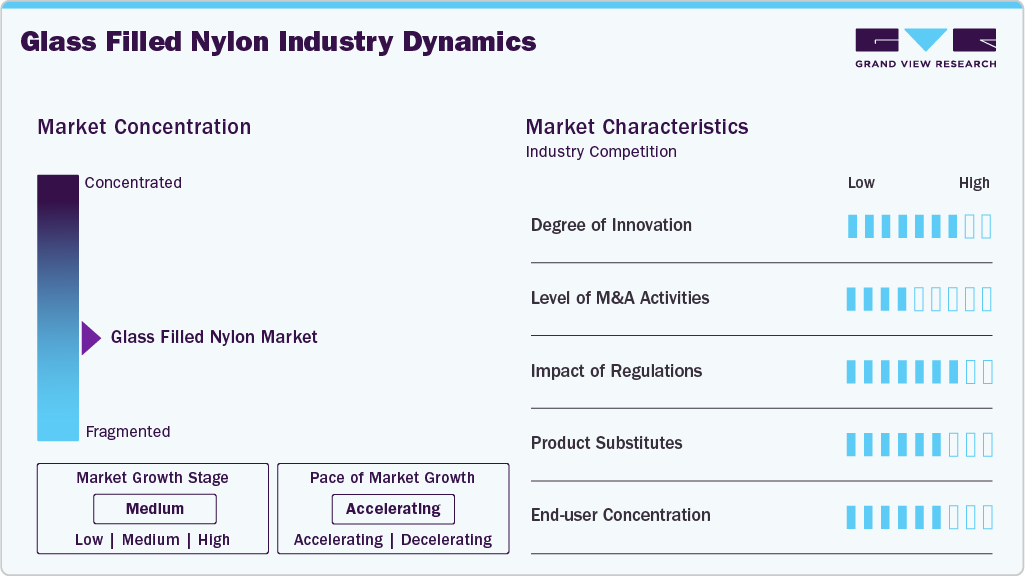
The market growth stage is medium, and growth is accelerating. The market exhibits fragmentation, with key players dominating the industry landscape. Major companies such as BASF, Envalior, Celanese, Syensqo, Toray Industries, Daicel-Evonik, TOYOBO, UBE Corporation, Kuraray, Avient, and others play a significant role in shaping the market dynamics. These leading players often drive innovation in the market by introducing new products, technologies, and materials to meet the industry's evolving demands.
 To learn more about this report, Download Free Sample Report
 Innovation in the glass-filled nylon market is increasingly focused on application-specific performance and material efficiency. Manufacturers are developing reinforced PA6 and PA66 grades with improved heat resistance, impact strength, dimensional stability, flame retardancy, and processing behavior. Longer glass-fiber reinforcement is also being used where higher structural performance is required. Development is extending toward recycled-content polyamides and formulations that support metal replacement in automotive and electrical components. This shifts competition from standard reinforcement toward engineered grades tailored to demanding component requirements.
Regulatory requirements are increasingly influencing material selection, formulation, and end-of-life strategies for glass-filled nylon. European chemical and circular-economy policies are encouraging manufacturers to improve substance management, recyclability, and recycled-material use. Restrictions on certain substances can also complicate recycling when regulated chemicals are present in polymer components. For automotive suppliers, these requirements increase the importance of traceable formulations, compliant additives, and recyclable grades. Regulatory pressure, therefore, supports innovation while increasing qualification and compliance costs across the value chain.
Analyst Perspective
The glass-filled nylon market is expected to shift from volume-led growth toward value-driven, application-specific innovation over the next few years. Automotive lightweighting, EVs, electrical and electronic components, industrial automation, and power equipment will remain key demand sectors. High-reinforcement, flame-retardant, hydrolysis-resistant, and recycled-content grades will gain importance. Sustainability requirements and chemical regulations will increasingly influence material selection, formulation, and end-of-life strategies. Market leaders will differentiate through advanced compounding, application engineering, global production networks, and customer co-development. Supply chain risks related to nylon resin, glass fiber, and specialty additives will continue to affect production economics. Pricing pressure from standard grades and alternative materials may constrain margins, increasing the need for differentiated products. Long-term value creation will depend on combining performance, cost efficiency, circularity, and application-specific solutions.
Glass Fiber Content Insights
The 20%-30% dominated the market across glass fiber content segmentation in terms of revenue, accounting for 54.0% market share in 2025, and is forecast to grow at an 4.8% CAGR from 2026 to 2033. The 20%-30% glass fiber range benefits from a balance between reinforcement and processability. These grades provide meaningful improvements in stiffness, strength, dimensional stability, and heat resistance without the higher material loading associated with heavily reinforced compounds. BASF’s 30% glass-fiber PA6 grade is positioned for industrial and electrical insulating applications, illustrating the range’s suitability for components requiring structural performance with manageable molding characteristics. Demand is supported by the broader substitution of conventional plastics in moderately loaded automotive, electrical, and industrial parts.
The 31%-40% segment is expected to expand at a 5.2% CAGR in the glass filled nylon market over the forecast period. Demand for 31%-40% glass-filled nylon is closely linked to components facing higher mechanical loads and tighter dimensional requirements. The additional reinforcement increases rigidity and load-bearing capability, making these grades suitable for structural and under-the-hood applications. BASF identifies 35% glass-fiber reinforced polyamide grades for automotive applications requiring high toughness and heat stabilization. This segment also benefits from engineering efforts to replace metal components with lighter molded parts while retaining functional strength and durability.
Application Insights
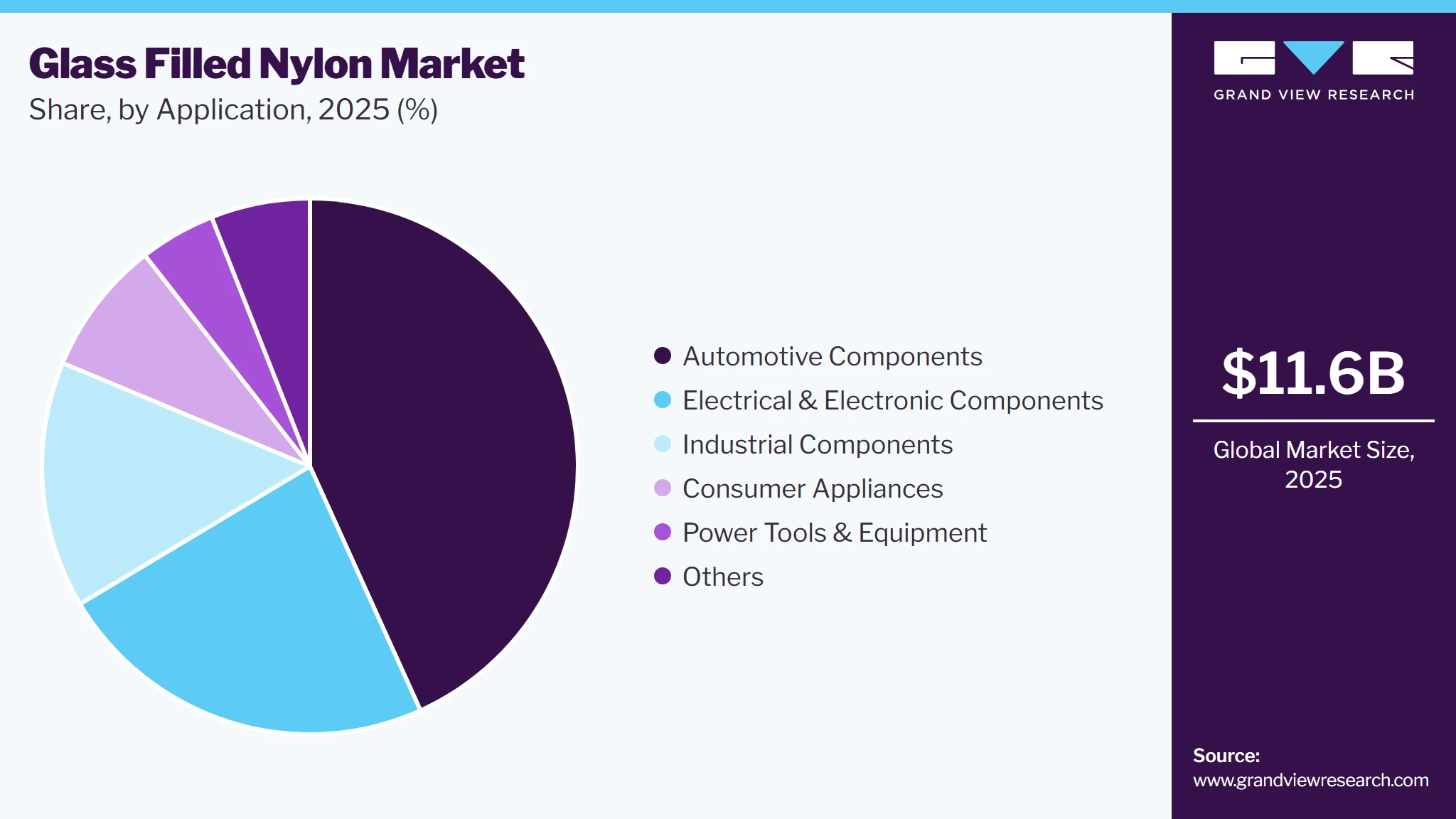
The automotive components segment led the market by application, accounting for 43.2% of revenue in 2025, and is projected to grow at an 4.7% CAGR from 2026 to 2033. Automotive demand is shifting toward reinforced nylon components that withstand higher thermal, chemical, and mechanical stresses, particularly as vehicle architectures become more electrified. Glass-filled polyamide is being used in housings, air-management components, pumps, valves, motor systems, and other under-the-hood applications.
 To learn more about this report, Download Free Sample Report
 The electrical & electronic components segment is expected to grow at the fastest CAGR of 5.5% over the forecast period. Electrical and electronic applications are generating demand for glass-filled nylon through miniaturization, higher operating temperatures, and stricter safety requirements. Reinforcement provides dimensional stability and mechanical strength, while specialized formulations can deliver flame retardancy and electrical performance. Current product development is increasingly focused on high-voltage connectors, circuit breakers, motor housings, relays, and other compact components. In 2025, Envalior showcased glass-fiber-reinforced Durethan PA6 compounds for electrical and electronic applications, including high-voltage connectors. The company presented 30% glass-fiber grades with halogen-free flame retardancy, combining mechanical strength, electrical performance, and sustainability for demanding E&E components.
Regional Insights
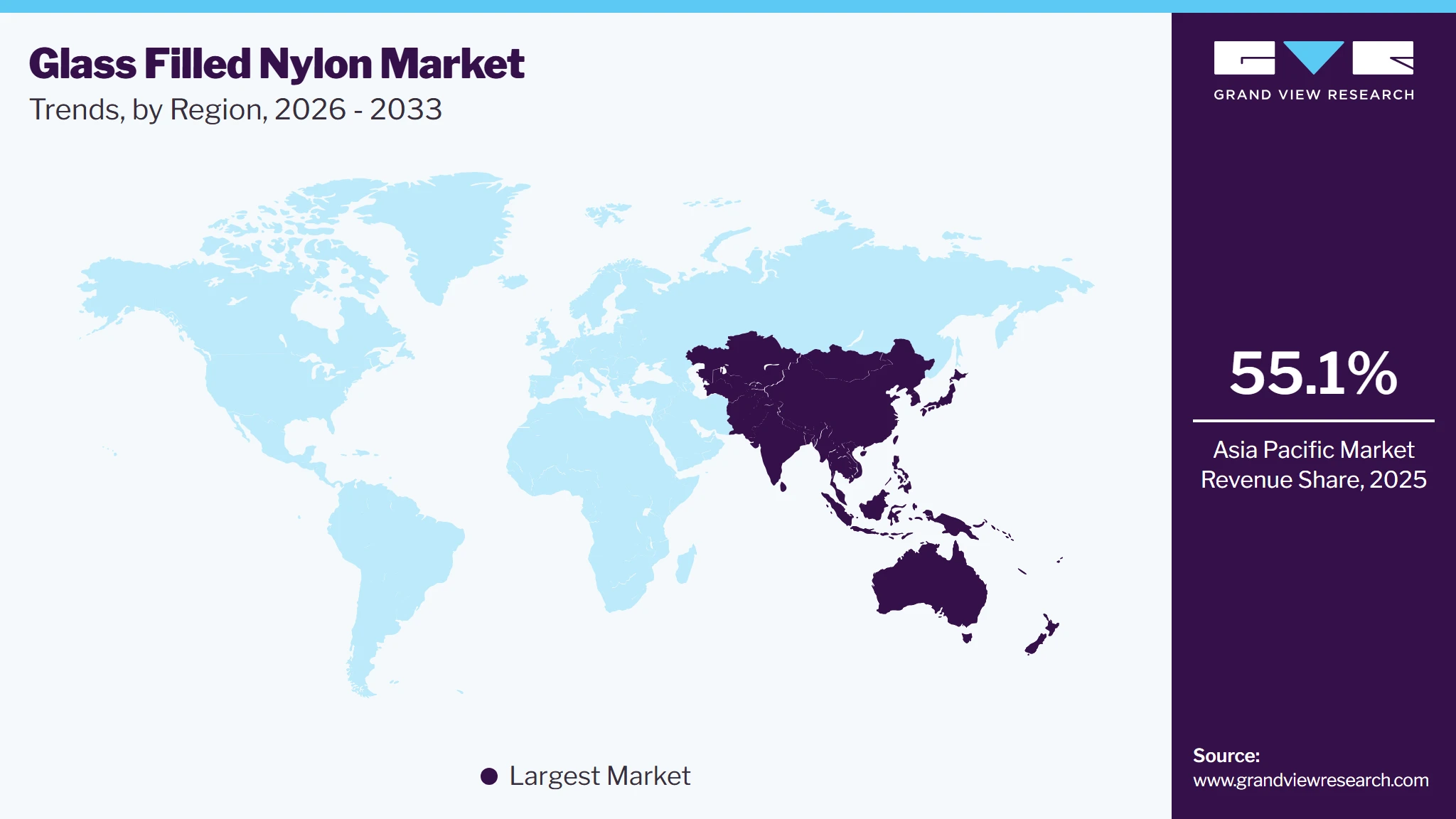
The Asia Pacific glass filled nylon industry held the largest revenue share of 55.1% in 2025. Asia Pacific is driven by its concentration of automotive production, electronics manufacturing, and polymer processing capacity. China, Japan, South Korea, and Southeast Asia provide large downstream markets for glass-filled nylon used in connectors, housings, automotive systems, and industrial equipment. The region’s expanding EV ecosystem is particularly relevant because lightweight materials can support vehicle efficiency while meeting mechanical and thermal requirements. In 2025, Toray Industries continued advancing glass-fiber-reinforced polyamide materials for automotive and electrification applications in Asia, targeting lightweight components requiring high strength, heat resistance, and dimensional stability. The company’s engineering plastics portfolio supports the increasing use of reinforced nylon in electric vehicle components and other demanding applications across Asian manufacturing networks.
 To learn more about this report, Download Free Sample Report
 China Glass Filled Nylon Market Trends
China is a particularly strong demand center because of its scale in automotive and new-energy-vehicle manufacturing. Government data show that NEV production reached 16.626 million units in 2025, with production increasing 29% year on year. This rapid vehicle electrification expands requirements for lightweight materials in electrical housings, connectors, structural supports, and thermal-management components. China’s extensive electronics and appliance manufacturing base provides an additional outlet. Localized engineering-plastics development and sophisticated injection-molding capabilities further support adoption of glass-filled nylon.
North America Glass Filled Nylon Market Trends
North America’s glass-filled nylon demand is supported by the region’s established automotive and industrial manufacturing base. Vehicle manufacturers are increasing the use of lightweight engineering plastics in thermal-management, powertrain, structural, and electrical components. Electrification is adding applications in battery and high-voltage systems. Celanese continues to develop glass-fiber-reinforced nylon solutions for automotive and eMobility applications in North America, supporting components that require high stiffness, dimensional stability, thermal resistance, and electrical performance. Its reinforced polyamide portfolio addresses applications such as connectors, electrical components, and battery-related systems, highlighting the growing role of engineered nylon in the region’s evolving automotive supply chain.
The U.S. glass filled nylon market benefits from continued investment in domestic automotive, electronics, and advanced manufacturing capacity. Glass-filled nylon is positioned to replace heavier materials in molded components that require stiffness, dimensional stability, and heat resistance. The expansion of EV and battery manufacturing also creates demand for reinforced polyamide in housings, connectors, cooling systems, and electrical components. U.S. manufacturers are simultaneously increasing emphasis on lightweight and resource-efficient materials, supporting the use of engineering plastics across transportation and industrial applications.
Europe Glass Filled Nylon Market Trends
Europe’s demand is increasingly shaped by vehicle electrification, lightweighting, and stricter resource-efficiency requirements. Glass-filled nylon supports metal replacement in automotive and electrical components while providing the stiffness and thermal performance required for demanding applications. The region’s circular-economy agenda is also encouraging polymer suppliers to develop recycled-content and more recyclable engineering materials. EU-backed programs are actively supporting industrial circularity and advanced materials development, creating a favorable environment for innovation in sustainable polymer solutions and higher-value reinforced polyamide grades.
Latin America Glass Filled Nylon Market Trends
Latin American demand is closely linked to automotive assembly, industrial equipment, electrical products, and growing regional manufacturing activity. Mexico provides an important automotive manufacturing base, while Brazil supports substantial vehicle and industrial production. Glass-filled nylon is gaining relevance where manufacturers require lighter molded components with higher stiffness and dimensional stability. Increasing localization of automotive components can further support compound consumption because locally produced reinforced polymers reduce dependence on imported engineered materials and enable suppliers to develop application-specific solutions for regional production requirements.
Middle East and Africa Glass Filled Nylon Market Trends
The Middle East & Africa market is supported by industrial diversification, automotive assembly initiatives, electrical infrastructure development, and expanding manufacturing activity. Demand for glass-filled nylon is concentrated in applications requiring durable, lightweight, and heat-resistant components. Gulf countries are also investing in downstream manufacturing and advanced materials as part of broader economic diversification programs. These developments can expand opportunities for reinforced polyamide in electrical equipment, industrial machinery, automotive components, and consumer products as regional manufacturing capabilities become more developed.
Key Glass Filled Nylon Company Insights
Some of the key players operating in the market include BASF and Celanese
-
BASF maintains a strong position in the glass-filled nylon market through its broad Ultramid portfolio, covering glass-fiber-reinforced PA6, PA66, PA6/66, and specialty polyamides. The company is expanding performance for automotive and eMobility applications through enhanced hydrolysis resistance, heat stability, and lightweighting. Its 2026 developments target demanding vehicle components, while its global production and application-development network supports customers across automotive, electrical, and industrial markets.
-
Celanese maintains a strong position in the glass-filled nylon market through its broad PA6 and PA66 portfolio, including Celanyl, Zytel, and Frianyl grades. Its compounds offer glass reinforcement, high stiffness, dimensional stability, heat resistance, and low warpage for automotive, electrical, and industrial applications. In 2026, the company announced strategic nylon business optimization to strengthen competitiveness and supply resilience while continuing investment in specialty polymer capabilities.
Daicel-Evonik and TOYOBO are some of the emerging participants in the glass filled nylon market.
-
Daicel-Evonik has a specialized position in glass-filled nylon through its VESTAMID PA12 portfolio. Its grades include 23% and 30% glass-fiber-reinforced PA12 for automotive and general industrial applications, offering high heat resistance, rigidity, dimensional stability, and chemical resistance. The company also supports application-specific polymer solutions and sustainability-focused PA12 development, strengthening its presence in higher-performance engineering applications.
-
TOYOBO offers the GLAMIDE high-performance polyamide portfolio, including glass-fiber-reinforced PA6 and PA66 grades with different reinforcement levels and performance characteristics. Its portfolio targets automotive components, electrical parts, and industrial applications requiring high strength, stiffness, dimensional accuracy, and heat resistance. The company also develops specialized low-warpage and high-strength grades, supporting metal replacement and lightweight component design.
Key Glass Filled Nylon Companies
The following key companies have been profiled for this study on the glass filled nylon market.
-
BASF
-
Envalior
-
Celanese
-
Syensqo
-
Toray Industries
-
Daicel-Evonik
-
TOYOBO
-
UBE Corporation
-
Kuraray
-
Avient
Competitive Benchmarking
Operating Strategies
Competitive Edge
Weakness
Mature Players: BASF, Envalior, Celanese, Syensqo, Toray Industries, UBE Corporation, Kuraray, Avient
- Maintain broad engineering thermoplastic portfolios covering glass-reinforced PA6, PA66, specialty polyamides, long-glass-fiber compounds, and application-specific grades for automotive, electrical and electronics, industrial, consumer, and mobility applications.
- Invest in reinforcement technology, heat stabilization, flame retardancy, impact modification, dimensional stability, lightweighting, and recycled-content formulations.
- Expand through global manufacturing, application development centers, technical support, customer co-development, and localized production to support automotive and electronics qualification programs.
- Established polymer expertise enables consistent mechanical strength, stiffness, thermal resistance, dimensional stability, and processing performance across demanding applications.
- Extensive product portfolios allow suppliers to address both general engineering requirements and specialized applications requiring higher temperature resistance, flame retardancy, impact performance, or long-term durability.
- Global production and technical networks support material qualification, application engineering, supply continuity, and large-scale customer programs across major automotive and electronics markets.
- Large global manufacturing and R&D infrastructures can increase operating costs and make portfolio management more complex than for specialized compounders.
- Broad engineering-material portfolios expose companies to competition from other reinforced thermoplastics, metal alternatives, and regional low-cost compound manufacturers.
- Automotive and electrical applications require extensive testing, certification, and customer qualification, which can lengthen commercialization cycles.
Emerging Players: Daicel-Evonik and TOYOBO
- Focus on specialty polyamides, reinforced engineering plastics, high-performance polymers, and application-specific materials for automotive, electrical and electronics, industrial, and mobility applications.
- Develop formulations targeting improved heat resistance, mechanical performance, dimensional stability, lightweighting, and processing characteristics.
- Expand through technology development, customer-specific material solutions, regional manufacturing capabilities, technical collaboration, and integration of specialty polymer expertise into higher-value applications.
- Specialized materials capabilities enable development of application-specific reinforced polymers for demanding thermal, mechanical, and dimensional requirements.
- Access to broader specialty-chemical and high-performance material technologies supports formulation development beyond conventional glass-filled nylon grades.
- Established relationships across automotive, electronics, and industrial value chains provide opportunities to qualify engineered materials in specialized applications.
- Comparatively narrower positioning in glass-filled nylon can limit scale advantages relative to the largest global engineering thermoplastic suppliers.
- Smaller or more specialized portfolios may provide less comprehensive coverage across standard and highly reinforced nylon grades.
- Regional concentration in selected manufacturing and customer markets can increase exposure to demand fluctuations and qualification requirements.
Recent Developments
-
In May 2026, Celanese announced a strategic transformation of its global nylon business, aimed at creating a more competitive and resilient engineered-materials platform. The initiative includes portfolio and manufacturing changes intended to improve cost competitiveness and strengthen the company’s position in nylon applications, including reinforced grades used across automotive, electrical, and industrial markets.
-
In March 2025, Envalior showcased new high-performance thermoplastic solutions for automotive applications, focusing on electromobility, lightweighting, sustainability, and safety. Its portfolio included reinforced engineering materials designed for demanding mobility applications, reflecting continued development of glass-filled nylon and related thermoplastic solutions for electric and lightweight vehicle components.
Glass Filled Nylon Market Report Scope
Report Attribute
Details
Market size in 2025
USD 11.6 billon
Estimated market size in 2026
USD 12.1 billion
Projected market size by 2033
USD 16.8 billion
Growth rate
CAGR of 4.8% from 2026 to 2033
Historical data
2021 - 2025
Forecast period
2026 - 2033
Quantitative units
Revenue in USD million/billion, volume in Kilotons, and CAGR from 2026 to 2033
Report coverage
Revenue & volume forecast, competitive landscape, growth factors, and trends
Segments covered
Glass fiber content, application, region
Regional scope
North America; Europe; Asia Pacific; Latin America; Middle East & Africa
Country Scope
U.S.; Canada; Mexico; Germany; UK; France; Italy; Spain; China; India; Japan; South Korea; Australia; Brazil; Argentina; Saudi Arabia; UAE; South Africa
Key companies profiled
BASF; Envalior; Celanese; Syensqo; Toray Industries; Daicel-Evonik; TOYOBO; UBE Corporation; Kuraray; Avient
Customization scope
Free report customization (equivalent to up to 8 analyst working days) with purchase. Addition or alteration to country, regional & segment scope
Pricing and purchase options
Avail customized purchase options to meet your exact research needs. Explore purchase options
Global Glass Filled Nylon Market Report Segmentation
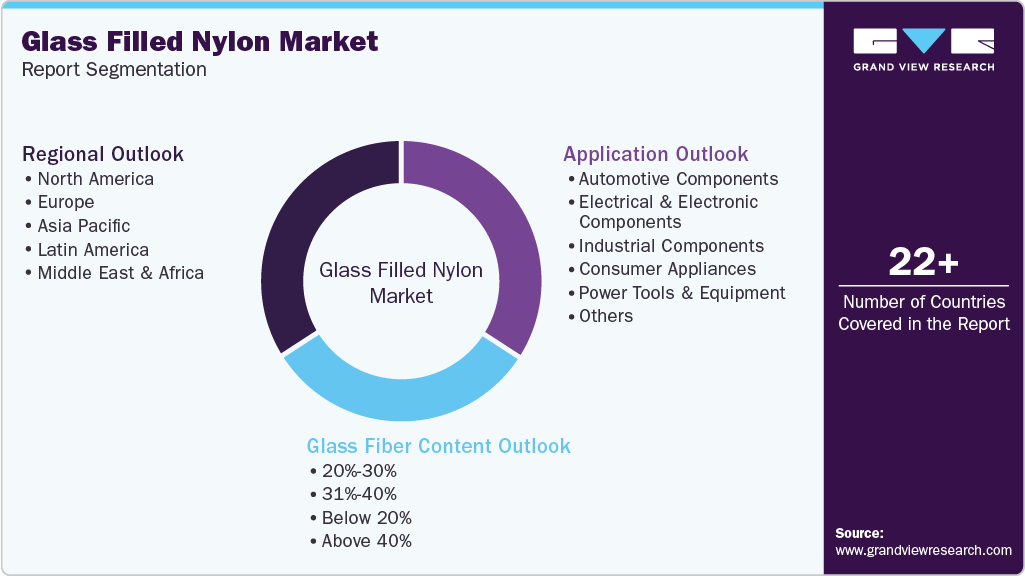
This report forecasts revenue growth at the global, regional, and country levels and provides an analysis of the latest industry trends across sub-segments from 2021 to 2033. For this study, Grand View Research has segmented the global glass filled nylon market report based on glass fiber content, application, and region:
 To learn more about this report, Download Free Sample Report
 -
Glass Fiber Content Outlook (Volume, Kilotons; Revenue, USD Million; 2021 - 2033)
-
20%-30%
-
31%-40%
-
Below 20%
-
Above 40%
-
-
Application Outlook (Volume, Kilotons; Revenue, USD Million; 2021 - 2033)
-
Automotive Components
-
Electrical & Electronic Components
-
Industrial Components
-
Consumer Appliances
-
Power Tools & Equipment
-
Others
-
-
Regional Outlook (Volume, Kilotons; Revenue, USD Million; 2021 - 2033)
-
North America
-
U.S.
-
Canada
-
Mexico
-
-
Europe
-
Germany
-
UK
-
France
-
Italy
-
Spain
-
-
Asia Pacific
-
China
-
India
-
Japan
-
South Korea
-
Australia
-
-
Latin America
-
Brazil
-
Argentina
-
-
Middle East & Africa
-
Saudi Arabia
-
UAE
-
South Africa
-
-
Research Methodology
The glass filled nylon market figures in this report are based on a proven research process that combines executive interviews with secondary research from proprietary databases, company filings, and recognized regulatory and institutional sources. Market size is built through value-chain sizing-reconciling supply-side and demand-side estimates-and triangulated with bottom-up and top-down approaches. Every estimate passes multiple levels of expert validation before publication, with each glass filled nylon segment quantified using the revenue-capture definitions in the table below.
Segment Definition
Segment - Glass Fiber Content
Revenue capture definition
20%-30%
Revenue is captured through glass-filled nylon compounds containing 20%-30% glass fiber by weight. These grades provide a balanced combination of stiffness, tensile strength, dimensional stability, impact performance, and processability. Demand comes from automotive brackets, housings, electrical connectors, industrial components, and consumer appliances requiring moderate reinforcement. Manufacturers use these formulations where improved mechanical performance and cost efficiency are required without the higher reinforcement levels and processing considerations associated with heavily filled compounds.
31%-40%
Revenue is generated through glass-filled nylon grades containing 31%-40% glass fiber, designed for applications requiring higher rigidity, load-bearing capability, and dimensional accuracy. Increased reinforcement supports demanding automotive, electrical, industrial, and mechanical components exposed to sustained stress and elevated temperatures. Applications include structural brackets, housings, engine-bay components, and equipment parts. Demand is supported by metal replacement initiatives and the need for lightweight materials with improved mechanical strength, thermal stability, and resistance to deformation under operating loads.
Below 20%
Revenue is captured through glass-filled nylon compounds containing less than 20% glass fiber, offering moderate reinforcement while preserving relatively favorable flow characteristics, surface finish, and impact performance. These grades serve applications where limited increases in stiffness and dimensional stability are sufficient. Demand comes from consumer appliances, electrical housings, automotive interior parts, and industrial components requiring improved performance over unfilled nylon. Lower reinforcement levels can support component design flexibility and cost-conscious material selection where extreme structural performance is not required.
Above 40%
Revenue is generated through highly glass-reinforced nylon compounds containing more than 40% glass fiber, developed for demanding structural and engineering applications. High reinforcement levels provide enhanced stiffness, tensile strength, dimensional stability, and creep resistance, supporting metal replacement in load-bearing components. Applications include automotive structural parts, industrial machinery components, power equipment, and specialized electrical housings. Demand depends on requirements for high mechanical performance, long-term dimensional accuracy, and resistance to deformation under sustained mechanical and thermal loads.
Segment - Application
Revenue capture definition
Automotive Components
Revenue is captured through glass-filled nylon used in automotive components requiring lightweight construction, mechanical strength, heat resistance, and dimensional stability. Applications include engine-bay components, brackets, housings, air-intake systems, cooling components, and structural parts. Demand is supported by vehicle lightweighting, metal replacement, and electrification, which create requirements for reinforced polymers in battery-related systems, electrical components, and thermal-management applications. Specialized grades provide improved hydrolysis resistance, flame retardancy, and long-term durability for demanding vehicle operating conditions.
Electrical & Electronic Components
Revenue is generated through glass-filled nylon used in electrical and electronic components requiring mechanical rigidity, dimensional accuracy, insulation, and thermal performance. Applications include connectors, circuit breaker housings, switches, relays, terminal blocks, and high-voltage components. Demand is linked to electronics miniaturization, increasing component density, electrification, and the development of power-management systems. Flame-retardant, low-warpage, and heat-resistant formulations support applications requiring electrical safety, reliable assembly, and dimensional stability under operating temperatures and mechanical loads.
Industrial Components
Revenue is captured through glass-filled nylon used in industrial components requiring high strength, wear resistance, dimensional stability, and resistance to mechanical stress. Applications include gears, bearings, rollers, machine housings, pump components, brackets, and automation equipment parts. Demand is supported by industrial automation, robotics, machinery modernization, and the replacement of metal components with engineered plastics. Manufacturers select reinforced nylon grades based on load requirements, operating temperatures, friction, chemical exposure, and the need for reliable performance in repetitive industrial operations.
Consumer Appliances
Revenue is generated through glass-filled nylon used in consumer appliances requiring mechanical durability, heat resistance, dimensional stability, and cost-effective molded construction. Applications include appliance housings, internal supports, motor components, brackets, handles, and structural parts in washing machines, kitchen equipment, and other household products. Demand is supported by the increasing use of engineered plastics to reduce component weight and improve functional performance. Reinforced grades enable manufacturers to meet mechanical and thermal requirements while supporting efficient injection molding and product design flexibility.
Power Tools & Equipment
Revenue is captured through glass-filled nylon used in power tools and equipment requiring high impact performance, rigidity, wear resistance, and resistance to heat generated during operation. Applications include drill housings, saw components, gear housings, handles, battery housings, and internal mechanical parts. Demand is supported by cordless tool adoption, professional equipment usage, and the need for lightweight components that withstand repeated mechanical loads and vibration. Glass reinforcement improves structural performance and dimensional stability in demanding tool operating environments.
Others
Revenue is generated through glass-filled nylon used in additional applications, including transportation equipment, sports equipment, medical devices, construction tools, and specialized machinery. These applications require combinations of stiffness, strength, thermal resistance, dimensional stability, and processing efficiency. Demand varies according to component design, operating conditions, regulatory requirements, and material substitution opportunities. Manufacturers develop application-specific formulations to address mechanical loading, impact exposure, chemical resistance, surface requirements, and durability expectations across specialized end-use industries.
Estimation Model
Layer Name
Key Question
Description
Top-Down Glass-Filled Nylon Demand Assessment Layer
What defines overall market demand?
Establishes overall global demand for glass-filled nylon across glass fiber content ranges, including below 20%, 20%-30%, 31%-40%, and above 40%. The layer assesses consumption across automotive components, electrical and electronic components, industrial components, consumer appliances, power tools and equipment, and other applications. It considers demand for reinforced PA6, PA66, and other polyamide grades based on mechanical performance, thermal resistance, dimensional stability, lightweighting, and metal replacement requirements.
Application Demand Validation Layer
Where is demand concentrated?
Maps demand across automotive components, electrical and electronic components, industrial components, consumer appliances, power tools and equipment, and other applications. The assessment considers component requirements such as tensile strength, stiffness, heat resistance, impact performance, creep resistance, dimensional accuracy, electrical insulation, and wear resistance. It validates application demand through automotive production, EV component manufacturing, electronics assembly, industrial automation, machinery production, and consumer product manufacturing.
Consumption-to-Revenue Conversion Layer
How is demand monetized?
Converts glass-filled nylon consumption into market revenue using glass fiber content, polyamide type, grade specifications, reinforcement performance, application requirements, production scale, manufacturing costs, supplier positioning, and prevailing pricing structures. The layer considers price variations between standard and specialty compounds, including heat-stabilized, flame-retardant, impact-modified, long-glass-fiber, and recycled-content grades. Premiums associated with high-performance automotive, electrical, and industrial formulations are also evaluated.
Regional Demand Verification Layer
Where is demand validated?
Validates glass-filled nylon demand across North America, U.S., Asia Pacific, India, Europe, Latin America, and Middle East & Africa. The assessment considers automotive and EV production, electrical and electronics manufacturing, industrial machinery output, consumer appliance production, polymer compounding capabilities, import and supply patterns, raw material availability, and regional manufacturing investments. It also examines material qualification requirements, sustainability initiatives, and supplier localization strategies influencing the adoption of reinforced polyamide compounds.
Delivered Customizations
This report has been delivered with the following In-depth customizations
Client Request
Customization Delivered
Value Adds
Regional segmentation
Analyzed the glass-filled nylon market across North America, U.S., Asia Pacific, India, Europe, Latin America, and Middle East & Africa, with region-specific demand drivers covering automotive manufacturing, EV production, electronics, industrial activity, and local polymer processing capabilities.
Identifies regional demand patterns, manufacturing hotspots, application opportunities, and factors influencing market development across mature and developing economies.
Cross-segmentation
Assessed demand across glass fiber content ranges of 20%-30% and 31%-40%, alongside key applications including automotive components and electrical & electronic components. The analysis links reinforcement levels with stiffness, dimensional stability, thermal performance, and component requirements.
Provides a more granular view of demand by connecting material formulation with end-use requirements. This supports identification of higher-value application areas and product specifications.
Competitive benchmarking
Benchmarked BASF, Envalior, Celanese, Syensqo, Toray Industries, UBE Corporation, Kuraray, Avient, Daicel-Evonik, and TOYOBO based on operating strategies, competitive edge, product portfolio, geographical presence, and market positioning.
Clarifies competitive positioning and differentiates mature and emerging participants based on product breadth, technical capabilities, application coverage, and geographic reach.
Frequently Asked Questions About This Report
The glass filled nylon market is expected to grow at a compound annual growth rate of 4.8% from 2026 to 2033 to reach around 16.8 billion by 2033.
The 31%-40% segment is anticipated to grow at a CAGR of 5.2% in the glass fiber content segment.
The Asia Pacific Glass Filled Nylon market accounted for the largest share of 55.1% market size in 2025.
The glass filled nylon market was estimated at around USD 11.6 billion in the year 2025 and is expected to reach around USD 12.1 billion in 2026.
The key players in the glass filled nylon market are BASF, Envalior, Celanese, Syensqo, Toray Industries, Daicel-Evonik, TOYOBO, UBE Corporation, and Kuraray, Avient.
The glass-filled nylon market is supported by growing demand for lightweight, durable materials across automotive, electronics, industrial, and consumer applications. Vehicle lightweighting, metal replacement, rising EV production, and increasing requirements for stiffness, dimensional stability, and heat resistance are strengthening material adoption.
India held the largest market share in 2025.
Electrical & electronic components segment is expected to grow at a 5.5% CAGR in revenue from 2026 to 2033.
About the Author(s)
Plastics, Polymers & Resins Research Team
Bulk Chemicals · Plastics, Polymers & ResinsThis report was authored by the plastics, polymers & resins research team at Grand View Research - comprising two research analysts, one senior research analyst, and one industry expert - with specialized expertise in the plastics, polymers & resins segment of the bulk chemicals industry. All findings are based on proprietary bulk chemicals databases, executive interviews, and regulatory analysis, subject to internal peer review prior to publication.
Last Updated:
Speak to Analyst

Customize this report to your needs - add regions, segments, or data points, with 20% free customization.
Or view our licence options:


ISO 9001:2015 & 27001:2022 Certified
We are GDPR and CCPA compliant! Your transaction & personal information is safe and secure. For more details, please read our privacy policy.


