
- Home
- »
- Display Technologies
- »
-
Golf Simulator Market Size And Share Report, 2026-2033GVR Report cover

Golf Simulator Market (2026 - 2033)
Size, Share & Trends Analysis Report By Offering (Hardware, Software, Services), By Type (Built-in, Portable, Free Standing), By Simulator Type, By Installation Type, By End Use, By Region, And Segment Forecasts
Market Size, 2025
$2.1BMarket Estimate, 2026
$2.3BMarket Forecast, 2033
$4.1BCAGR, 2026–2033
8.7%Golf Simulator Market Summary
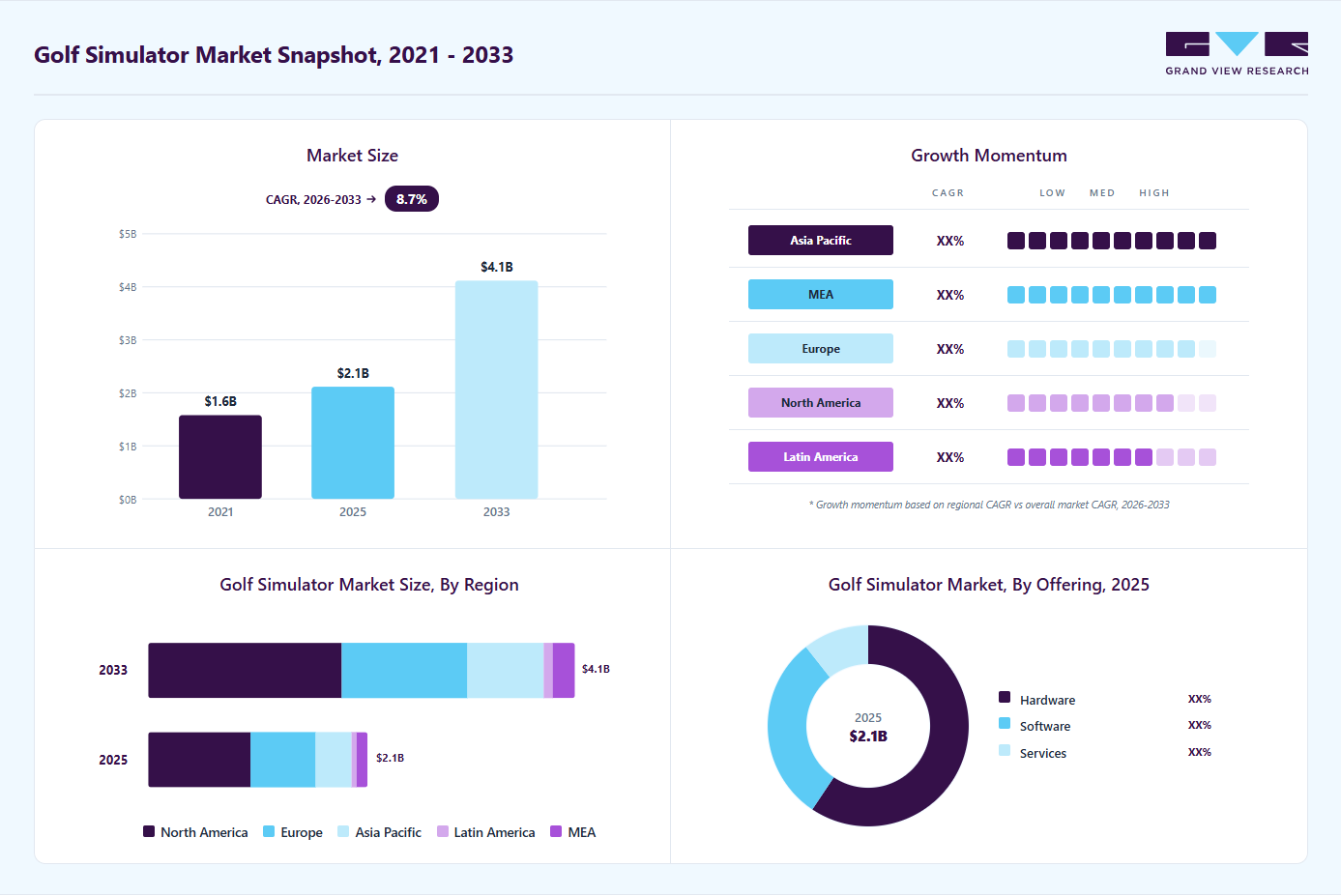
The global golf simulator market size was valued at USD 2.1 billion in 2025 and is projected to grow from USD 2.3 billion in 2026 to USD 4.1 billion by 2033, at a CAGR of 8.7% from 2026 to 2033. The market in North America dominated with a revenue share of 46.6%% in 2025. The rising popularity of indoor and home-based sports experiences is driving the golf simulator market growth.
 Source: Grand View Research, IR Documents, Primary Interviews, Paid DatabasesTo learn more about this report,
 Download Free Sample Report
 Key Market Trends & Insights
- By offering: Hardware segment accounted for a market share of over 59% in 2025.
- By type: portable segment accounted for the largest market share in 2025.
- By simulator type: Full swing simulator segment accounted for the largest market share in 2025.
- By installation type: Indoor segment accounted for the largest market share in 2025.
Regional Highlights
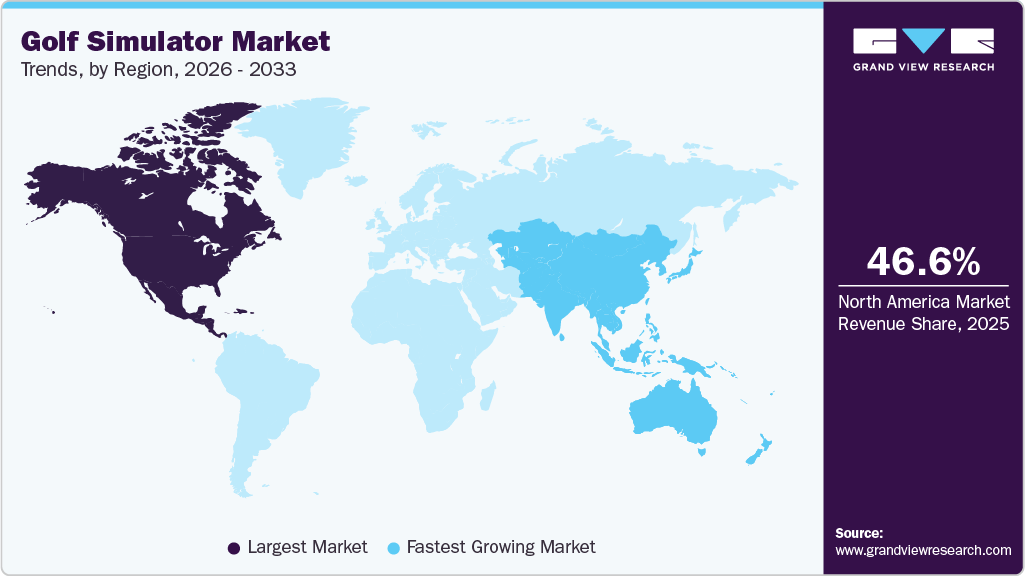
- Largest regional market: North America (46.6%% revenue share, 2025)
- Fastest-growing regional market: Asia Pacific (highest CAGR, 2026-2033)
- By country: U.S. held the largest market share in 2025
Market Size & Forecast
- Market size in 2025: USD 2.1 Billion
- Estimated market size in 2026: USD 2.3 Billion
- Projected market size by 2033: USD 4.1 Billion
- CAGR (2026-2033): 8.7%
Three ways to get this report
Buy it, customize it, or ask a question.Ask an Analyst
Analyst response in 1 business day
- AccessReport author, directly
- Reply timeWithin 1 working day
- No sales callDirect answer only
- FormatEmail reply
- CostFree, no cost
Get the Full Report
What the study covers
- FormatsPDF · Excel · Dashboard
- Timeline2026–2033 annual, 2025 base
- Coverage20+ countries, 5 regions
- Companies10+ key players profiled
Customize the Report
20% free customization
- IncludeCountries, segments, points
- TailorTo your product definition
- ExtendDeeper competitor detail
- OrA fully bespoke study
- Turnaround5–10 working days
Golf simulators provide a convenient alternative, allowing players to practice and play the sport from the comfort of their homes or in commercial indoor facilities. Golf simulators provide a convenient alternative, allowing players to practice and play the sport from the comfort of their homes or in commercial indoor facilities. Technological advancements have revolutionized the golf simulator market, enhancing realism, accuracy, and user experience. Artificial Intelligence (AI) plays a key role by analyzing swing mechanics, ball trajectory, and player performance in real time, providing personalized feedback and coaching insights. AI-powered simulators can track minute details such as club speed, ball spin, launch angle, and shot dispersion, helping golfers refine their skills with precision. 4K graphics and high-definition projectors have significantly improved the visual experience, making virtual golf courses more immersive and lifelike. Players can experience famous real-world courses with stunning detail, from terrain textures to weather effects, creating a near-authentic golfing environment. Motion tracking technology has also advanced, using high-speed cameras and infrared sensors to capture player movements with extreme accuracy. This ensures precise simulation of swings, putting strokes, and ball impact, making the experience more realistic.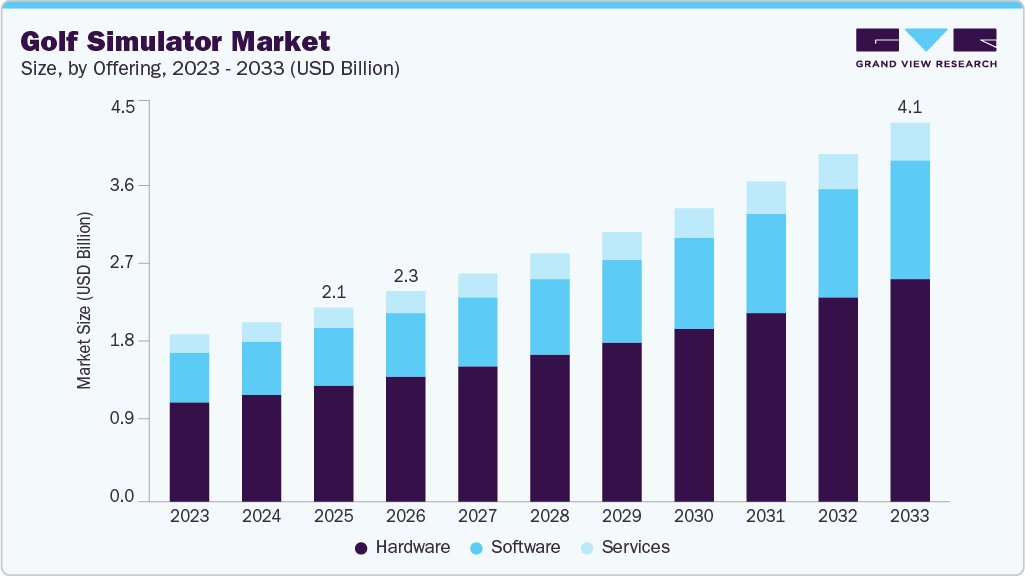 To learn more about this report, Download Free Sample Report
 The commercial sector is increasingly adopting golf simulators as businesses recognize their potential to attract customers and enhance engagement. Golf academies leverage simulators for professional training, offering advanced swing analysis and virtual course play. Sports bars and entertainment centers integrate them to create interactive experiences, drawing in patrons looking for social and competitive gaming options. Luxury hotels and resorts use simulators as premium amenities, catering to high-end clientele seeking indoor recreation. In addition, corporate spaces install golf simulators for employee wellness programs and team-building activities. In cold-weather regions such as Canada, Northern Europe, and parts of Asia, where outdoor golfing is restricted during winter, simulators provide a year-round alternative, boosting their demand in both residential and commercial settings.
The high initial cost of golf simulators is a major challenge, especially for individuals and small businesses. Premium models with advanced sensors, high-definition projectors, and sophisticated tracking systems can cost tens of thousands of dollars, making them unaffordable for budget-conscious consumers. These high-end simulators offer superior accuracy, realistic ball physics, and detailed performance analysis, which are essential for professional training. While mid-range and entry-level models provide a more affordable option, they often lack precision, realistic graphics, and advanced swing analysis, limiting their appeal to serious golfers. The significant upfront investment required for premium systems remains a key restraint, preventing wider adoption in the residential and commercial markets.
Market Dynamics
The rising demand for year-round sporting experiences drives the golf simulator market, as virtual sports eliminate weather-related disruptions that often affect traditional outdoor golf. Golf is highly dependent on favorable weather conditions, but extreme temperatures, rain, and seasonal changes can limit playtime for enthusiasts. Simulators provide a consistent and controlled environment where golfers can practice or compete at any time of the year. This reliability is particularly valuable in regions with harsh winters or unpredictable climates, where outdoor golf courses may be closed for extended periods. By offering uninterrupted access to the sport, golf simulators are gaining traction among individuals, training academies, and commercial entertainment centers looking to maximize user engagement. In November 2024, The City of Farmington Hills Special Services Department announced the installation of golf simulators at The Hawk. These state-of-the-art Full Swing brand simulators will offer an exceptional indoor practice experience, along with new year-round golf programs, leagues, and lessons. This will complement the seasonal offerings at the Farmington Hills Golf Club.
The high operating costs associated with their installation, maintenance, and day-to-day operation are significant barriers to market growth. Businesses that incorporate golf simulators, such as entertainment centers, golf lounges, sports bars, hotels, and high-end resorts, must invest significantly in advanced technology, spacious venues, and regular upkeep, which can create financial barriers. Unlike personal home-use simulators, commercial golf simulators require larger-scale, high-performance hardware and premium software licenses that come at a hefty price. Additionally, these businesses must ensure constant system upgrades, software updates, and customer support to maintain a seamless user experience, adding to the overall operational burden. According to Yardstick Golf, the cost of a commercial-grade golf simulator typically ranges from USD 18,000 to USD 70,000, depending on the brand, model, and features. High-end options can exceed USD 70,000 for a single bay, while a full setup with multiple bays, including installation and space build-out, can easily surpass USD 200,000.
The rapid expansion of golf tourism in emerging markets is significantly driving demand for golf simulators. While golf has traditionally been associated with regions such as North America and Europe, the sport is gaining traction in countries across Western Europe, Asia, the Middle East, and Latin America. Governments and private investors in these regions are recognizing the economic benefits of golf tourism and are investing heavily in golf courses, resorts, and related infrastructure. However, many of these emerging markets still face challenges, including limited access to high-quality golf courses, unpredictable weather, and high maintenance costs for real golf facilities. Golf simulators offer an attractive solution, providing a cost-effective, space-efficient, technology-driven alternative that lets tourists experience premium golf courses virtually. This is particularly beneficial in densely populated areas where land constraints make traditional golf courses unfeasible. As golf tourism continues to expand into new markets, the demand for simulators will rise, providing golf enthusiasts with a seamless and immersive experience regardless of location.
Market Concentration & Characteristics
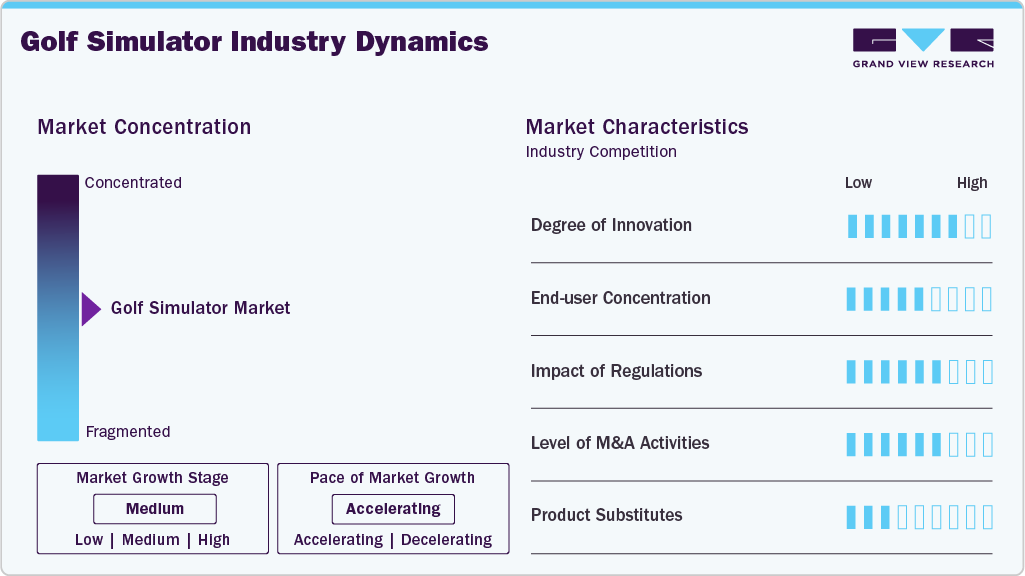
The golf simulator market is moderately fragmented, with a mix of specialized simulator manufacturers, sports technology firms, and gaming/VR solution providers competing across commercial and residential segments. Leading players such as TrackMan and Foresight Sports dominate the premium segment due to their highly accurate ball-tracking systems, advanced physics modeling, and strong adoption among golf academies and professional training centers. Entry barriers are moderate, driven by high R&D requirements in sensor accuracy, optical tracking systems, and software realism, along with strong brand trust in performance accuracy.
 To learn more about this report, Download Free Sample Report
 The market is strongly experience-driven and technology-enabled, with increasing adoption of high-precision sensors, radar tracking, infrared systems, and immersive 3D simulation environments. Demand is primarily driven by rising interest in indoor sports entertainment, year-round training needs, and limited access to golf courses in urban regions. Growth in home entertainment spending and premium fitness experiences is also expanding residential adoption of compact simulator systems. Integration with analytics and swing performance data further enhances the training value for both amateur and professional users.
The industry is characterized by high installation customization, space requirements, and dependence on hardware-software integration for realistic simulation experiences. Commercial setups such as golf academies, sports clubs, and entertainment venues require significant upfront investment, whereas residential users often prioritize modular, space-efficient systems. Seasonal dependency is relatively low compared to outdoor sports, but adoption is influenced by discretionary spending trends and premium lifestyle consumption patterns. Software updates, course libraries, and subscription-based content models are increasingly important for maintaining user engagement.
Offering Insights
The hardware segment accounted for a market share of over 59% in 2025. With the rising popularity of indoor golf facilities, sports bars, and entertainment venues, businesses are investing in high-end simulator hardware to attract customers. High-resolution screens, realistic turf mats, and advanced swing analysis systems provide an immersive experience, making golf simulators a profitable investment for businesses in the hospitality and leisure industries. This trend is further supported by the increasing appeal of recreational golf among younger demographics, who prefer social and tech-driven experiences over traditional outdoor golf.
The software segment is anticipated to grow at a significant CAGR during the forecast period. The rising popularity of multiplayer and online gaming features is also propelling the software segment of the golf simulator market. Many simulator platforms offer online connectivity, allowing users to compete in virtual tournaments, challenge friends remotely, and join global leaderboards. This social gaming element has expanded the appeal of golf simulators beyond traditional golf enthusiasts to include younger players and competitive e-sports participants. Cloud-based software solutions enable seamless multiplayer gameplay with minimal lag, enhancing the interactive and competitive aspects of virtual golf. As the demand for social and connected gaming experiences continues to grow, software developers are focusing on improving network stability, matchmaking algorithms, and real-time data synchronization.
Type Insights
The portable segment accounted for the largest market share in 2025. The rise of eSports and virtual golf tournaments is playing a crucial role in the expansion of the portable golf simulator market. Many portable systems allow players to participate in online golf competitions, where they can compete against others from around the world. These tournaments often feature leaderboards, skill-based rankings, and rewards, creating an engaging experience for players. As virtual sports gain popularity, golf simulator manufacturers are enhancing their software capabilities to support competitive gameplay, further driving demand for portable systems that enable users to participate in these events from anywhere.
The built-in segment is expected to grow at a significant rate during the forecast period. Commercial establishments such as sports clubs, fitness centers, and corporate entertainment venues are installing built-in golf simulators to attract customers and enhance their service offerings. These systems provide year-round golfing experiences in controlled environments, making them ideal for regions with extreme weather conditions or limited access to outdoor courses. Built-in simulators are often integrated into larger entertainment spaces, offering a premium experience that combines golf with social and competitive gaming elements. This trend is particularly strong in urban areas, where space constraints make traditional golf courses less accessible.
Simulator Type Insights
The full swing simulator segment accounted for the largest market share in 2025. The influence of celebrity endorsements and professional golfer partnerships is fueling growth in full swing simulators. Leading golf simulator brands are collaborating with top-tier PGA Tour professionals, influencers, and celebrities to showcase the benefits of simulator-based training. High-profile endorsements help build credibility and generate excitement around full swing simulators, catering to both aspiring golfers and recreational players. Some brands even offer signature models co-developed with professional golfers, featuring specialized swing analysis tools tailored to mimic real-world tour conditions.
The virtual reality simulator segment is expected to grow at a significant CAGR during the forecast period. The expanding presence of VR arcades, entertainment venues, and eSports competitions is further accelerating the adoption of VR golf simulators. Many entertainment centers are incorporating VR golf experiences as part of their offerings to attract customers looking for unique and engaging activities. In addition, the rise of eSports and competitive gaming has opened new opportunities for VR golf tournaments, where players can compete in high-stakes competitions from anywhere in the world. These developments are increasing the exposure of VR golf simulators and driving demand across different segments of the market.
Installation Type Insights
The indoor segment accounted for the largest market share in 2025. The growing adoption of subscription-based and pay-per-use business models is driving the expansion of the indoor golf simulator market. Many companies are now offering flexible pricing models, allowing users to access high-end golf simulation experiences without the need for a large upfront investment. Golf enthusiasts can subscribe to simulator services, paying monthly or per session, instead of purchasing expensive equipment outright. This model is particularly attractive to casual golfers, beginners, and businesses looking to add golf simulators to their entertainment offerings without a significant capital expenditure. As the demand for on-demand and flexible gaming experiences grows, subscription-based golf simulation services are expected to become increasingly popular.
The outdoor segment is expected to grow at a significant CAGR during the forecast period. The expansion of outdoor golf simulator tournaments and eSports competitions is a major factor driving market growth. With advancements in internet connectivity and cloud-based leaderboards, outdoor simulators allow players to compete in real-time tournaments, whether at local driving ranges or across different locations worldwide. These virtual competitions provide an opportunity for golfers of all skill levels to engage in structured gameplay without the need to travel to physical golf courses.
End Use Insights
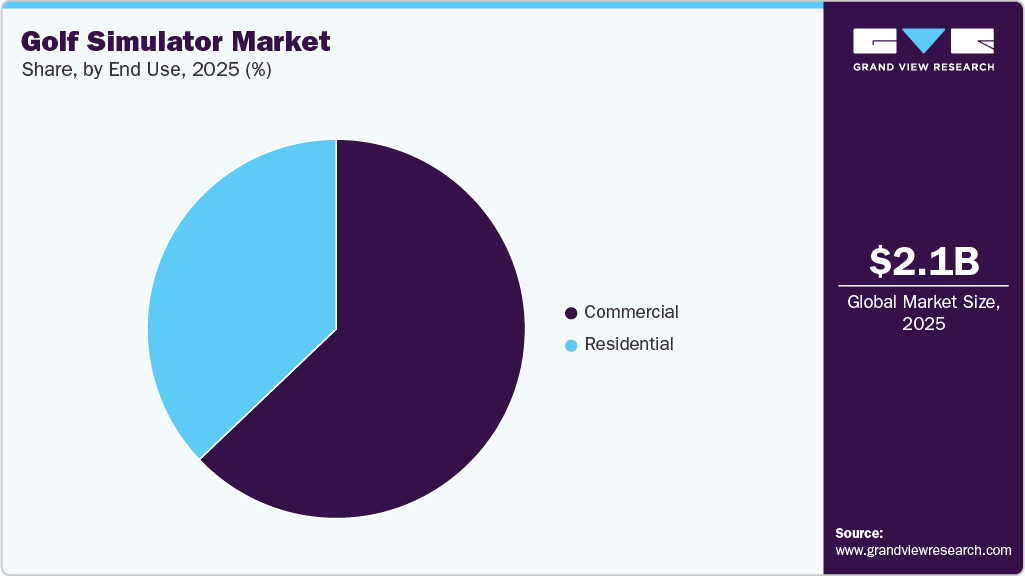
The commercial segment accounted for the largest market share in 2025. The increasing popularity of indoor golf entertainment venues propels market expansion. Businesses such as golf lounges and simulator-based entertainment centers are leveraging golf simulation technology to cater to customers and enhance their service offerings. These venues provide a social and competitive golfing experience in an indoor environment, allowing patrons to play, practice, and compete regardless of weather conditions. As consumer demand for interactive and tech-driven entertainment experiences grows, more commercial establishments are integrating golf simulators to differentiate themselves from traditional entertainment options.
 To learn more about this report, Download Free Sample Report
 The residential segment is expected to grow at a significant CAGR during the forecast period. The rise of family-oriented recreational activities and multi-user gaming experiences is driving the segment growth. Unlike traditional golf, which requires traveling to a course and spending long hours on the greens, residential golf simulators offer a fun and engaging alternative that family members of all ages can enjoy. Many simulators now feature multiplayer modes, mini-games, and virtual challenges that make them suitable for casual players and non-golfers. Families looking for interactive indoor entertainment options are increasingly turning to golf simulators, as they provide a versatile and social gaming experience that can be played year-round.
Regional Insights
North America held the significant share of 46.6% of the golf simulator industry in 2025. The North America golf simulator marketis witnessing significant growth due to its increasing adoption in corporate and hospitality sectors. Hotels, resorts, and corporate spaces are integrating golf simulators as luxury amenities, enhancing guest experiences and providing interactive entertainment options. Businesses are also using simulators for team-building activities, networking events, and executive leisure, making them a valuable investment.
 To learn more about this report, Download Free Sample Report
 U.S. Golf Simulator Market Trends
The golf simulator industry in the U.S. is expected to grow significantly from 2026 to 2033. The expansion of indoor golf centers and entertainment venues, such as Five Iron Golf, X-Golf, and Topgolf Swing Suites, has significantly contributed to market growth. These venues attract both dedicated golfers and social entertainment seekers, making simulators more mainstream. For instance, in September 2024, X-Golf America has announced the grand opening of X-Golf Nationals Park, bringing its advanced indoor golf simulation experience to Washington, D.C. The venue features cutting-edge technology, realistic gameplay, and social entertainment, catering to golfers of all levels. This expansion enhances urban golf accessibility and immersive sports entertainment. With continued technological advancements and rising consumer interest, the U.S. golf simulator market is poised for sustained expansion in both residential and commercial sectors.
Europe Golf Simulator Market Trends
The golf simulator marketin Europe is growing significantly from 2026 to 2033. Advancements in golf simulator technology have significantly improved the realism and accuracy of indoor golfing experiences. Innovations in launch monitors, 3D course visualization, AI-driven analytics, and VR technology allow players to receive precise data on their swings, ball trajectory, and course conditions. Many Northern and Central European countries experience unpredictable weather, making year-round play difficult. Golf simulators provide an indoor alternative, enabling golfers to practice, train, and compete regardless of external conditions, further driving market growth.
The UK golf simulator industry is expected to grow rapidly in the coming years. With increasing urbanization in major UK cities like London, Manchester, and Birmingham, access to outdoor golf courses is becoming more limited due to space constraints and rising land costs. As a result, indoor golf facilities are gaining popularity, offering a convenient and immersive golfing experience without the need for large outdoor spaces. Golf simulators provide realistic course play, swing analysis, and AI-driven performance tracking, making them appealing to both casual and professional players.
The Germany golf simulator market held a substantial market share in 2025. The expansion of indoor golf centers and entertainment venues is further fueling market growth. The rise of sports bars and simulator-based golf clubs has made indoor golf more social and appealing to a wider audience. Leading brands like TrackMan, Golfzon, and Foresight Sports are partnering with golf academies, coaching centers, and entertainment venues, enhancing training capabilities and making simulators more accessible to both professionals and casual players.
Asia Pacific Golf Simulator Market Trends
The golf simulator marketin the Asia Pacific is growing significantly from 2026 to 2033. The rising popularity of golf as a recreational and professional sport in Asia-Pacific is driving the growth of the golf simulator market. Countries such as Japan, South Korea, China, and India have seen a significant increase in golf participation, driven by expanding middle-class wealth, government support for sports development, and global exposure through international tournaments.
The China golf simulator industry held a substantial market share in 2025. The growing trend of sports-themed entertainment venues and high-end leisure centers is contributing to the expansion of the golf simulator market in China. Upscale entertainment hubs, sports bars, and luxury fitness clubs are incorporating golf simulators to cater to an affluent clientele seeking premium recreational experiences. These venues offer a blend of socializing, competition, and high-tech sports entertainment, making them attractive to business executives, corporate teams, and social groups.
The Japan golf simulator industry held a substantial market share in 2025. The rising interest in home-based entertainment and private golfing experiences is boosting the demand for residential golf simulators in Japan. With the impact of lifestyle changes brought about by remote work and the COVID-19 pandemic, more individuals are investing in premium home entertainment solutions. Affluent homeowners and golf enthusiasts who previously played on outdoor courses are now opting to install golf simulators in their residences to play the sport at their convenience.
In India, the golf simulator industry is growing due to the trend of experiential entertainment and premium leisure activities. As India's urban population expands and lifestyle preferences shift toward exclusive, high-end experiences, there is a greater demand for interactive entertainment solutions that blend sports, technology, and social engagement. The younger generation, particularly millennials and Gen Z, are increasingly looking for recreational options beyond conventional activities such as cinemas and dining out. High-end entertainment zones, luxury malls, and private clubs are incorporating golf simulators as part of their premium offerings, allowing individuals to play the game in an immersive and technologically advanced environment.
Key Golf Simulator Company Insights
The key market players in the global golf simulator market include aboutGOLF, BenQ, Bushnell Golf, ErnestSports, Foresight Sports, Full Swing Golf, GOLFZON, Optishot Golf, SKYTRAK, GOLFJOY LIMITED, X-GOLF AMERICA, Garmin Ltd., Toptracer, FlightScope Golf, and Rapsodo Inc. The companies are focusing on various strategic initiatives, including new product development, partnerships & collaborations, and agreements to gain a competitive advantage over their rivals. The following are some instances of such initiatives.
-
In February 2025, Canopy, a provider of remote monitoring and management (RMM) software for connected products, partnered with Full Swing to enhance the performance and reliability of its golf simulator products. Through this collaboration, Full Swing’s software teams leverage Canopy’s RMM capabilities to remotely monitor, manage, and automate support processes across its global product fleet. As Full Swing continues to expand its market presence, Canopy aims to extend RMM support to thousands of Full Swing golf simulators by the end of the year.
-
In February 2025, Rapsodo Inc. partnered with TruGolf’s E6 APEX, bringing expanded simulation capabilities to its Mobile Launch Monitor 2 Pro (MLM2PRO) for premium members. This integration enhances Rapsodo’s product offerings, allowing athletes of all skill levels to experience realistic playing conditions and refine their abilities through practice rounds and skill-based games. The collaboration follows a recent update to the MLM2PRO, which improved graphical quality and introduced junior tee locations to Rapsodo’s simulated courses, enhancing the overall gaming experience and making it more family-friendly. These advancements reflect Rapsodo’s ongoing commitment to enhancing and evolving its golf technology.
-
In February 2025, BenQ launched the AK700ST, the latest addition to its ACE Series and its most advanced golf simulator projector to date. Featuring a 4,000-lumen 4K laser light source, the AK700ST enhances golf simulation with lifelike detail, vibrant colors, and superior texture richness. Designed for seamless installation, it minimizes ambient light interference to deliver an immersive, play-like-you’re-there experience. As the first brand to develop a dedicated projector lineup for golf simulation, BenQ continues to expand its portfolio with models ranging from 1080p to 4K, catering to golf enthusiasts seeking high-quality, realistic gameplay.
-
In January 2025, Bushnell Golf launched the Bushnell Launch Pro Indoor (LPi), a cutting-edge indoor golf simulation system developed in collaboration with Foresight Sports. Designed to deliver professional-grade ball and club tracking, the LPi enhances accessibility, bringing Tour-level technology to everyday golfers. Building on the success of Bushnell Golf’s previous Launch Pro devices, this new model is optimized for indoor use, offering superior accuracy, advanced features, and an improved user experience, all at a more affordable price.
Key Golf Simulator Companies:
The following key companies have been profiled for this study on the golf simulator market.
- aboutGOLF
- BenQ
- Bushnell Golf
- ErnestSports
- Foresight Sports
- Full Swing Golf
- GOLFZON
- Optishot Golf
- SKYTRAK
- GOLFJOY LIMITED
- X-GOLF AMERICA
- Garmin Ltd.
- Toptracer
- FlightScope Golf
- Rapsodo Inc.
Competitive Benchmarking
Operating Strategies
Competitive Edge
Weakness
Mature Players: TrackMan; Full Swing Golf; Foresight Sports; SkyTrak; OptiShot Golf
- Mature players in the golf simulator market focus on high-precision tracking systems and immersive simulation software. They invest in advanced radar, camera, and sensor technologies for accurate ball and swing analysis.
- Their solutions target professional training centers, golf academies, and premium home users. They also expand through partnerships with golf clubs and sports facilities.
- Mature players benefit from a strong brand reputation in professional golf training. Their systems offer high accuracy in swing and ball flight simulation.
- Advanced analytics help players improve performance and technique. Wide adoption in coaching environments strengthens market dominance.
- These systems are often expensive and targeted toward premium users. Setup requires dedicated space and technical calibration.
- Software updates and hardware upgrades can add ongoing costs. Accessibility for casual or beginner golfers remains limited.
Emerging Players: Rapsodo; Golfzon; Ernest Sports; Phigolf; VIRTUAL GOLF SYSTEMS
- Emerging players focus on affordable and portable golf simulation systems. They integrate mobile apps, sensors, and cloud-based analytics for accessibility.
- Many target home users, entertainment venues, and recreational golfers. Their strategy emphasizes compact design and user-friendly setup.
- Emerging players offer lower-cost alternatives to premium simulator systems. Their products are easier to install and use in small spaces.
- Strong focus on gamification improves user engagement. They also innovate quickly in mobile-based golf training tools.
- Emerging players have lower accuracy compared to professional-grade systems. Their brand recognition in elite training markets is limited.
- Hardware durability may be lower in high-intensity usage environments. Limited enterprise adoption restricts large-scale commercial growth.
Golf Simulator Market Report Scope
Report Attribute
Details
Market size in 2025
USD 2.1 billion
Estimated Market size in 2026
USD 2.3 billion
Projected Market size by 2033
USD 4.1 billion
Growth rate
CAGR of 8.7% from 2026 to 2033
Actual data
2021 - 2024
Base year
2025
Forecast period
2026 - 2033
Quantitative units
Revenue in USD million/billion and CAGR from 2026 to 2033
Report coverage
Revenue forecast, company share, competitive landscape, growth factors, and trends
Segments covered
Offering, type, simulator type, installation type, end use, and region
Regional scope
North America; Europe; Asia Pacific; Latin America; MEA
Country scope
U.S.; Canada; Mexico UK; Germany; France; China; India; Japan; Australia; South Korea; Brazil; UAE; Saudi Arabia; South Africa
Key companies profiled
aboutGOLF; BenQ; Bushnell Golf; ErnestSports; Foresight Sports; Full Swing Golf; GOLFZON; Optishot Golf; SKYTRAK; GOLFJOY LIMITED; X-GOLF AMERICA; Garmin Ltd.; Toptracer; FlightScope Golf; Rapsodo Inc.
Customization scope
Free report customization (equivalent up to 8 analysts working days) with purchase. Addition or alteration to country, regional & segment scope.
Pricing and purchase options
Avail customized purchase options to meet your exact research needs. Explore purchase options
Global Golf Simulator Market Report Segmentation
This report forecasts market Size growth at global, regional, and country levels and provides an analysis of the latest industry trends in each of the sub-segments from 2021 to 2030. For this study, Grand View Research has segmented the golf simulator market report based on offering, type, simulator type, installation type, end use and region.
-
Offering Outlook (Revenue, USD Million, 2021 - 2033)
-
Hardware
-
Software
-
Services
-
-
Type Outlook (Revenue, USD Million, 2021 - 2033)
-
Built-in
-
Portable
-
Free Standing
-
-
Simulator Type Outlook (Revenue, USD Million, 2021 - 2033)
-
Full Swing Simulator
-
Virtual Reality (VR) Simulator
-
-
Installation Type Outlook (Revenue, USD Million, 2021 - 2033)
-
Indoor
-
Outdoor
-
-
End Use Outlook (Revenue, USD Million, 2021 - 2033)
-
Residential
-
Commercial
-
-
Regional Outlook (Revenue, USD Million, 2021 - 2033)
-
North America
-
U.S.
-
Canada
-
Mexico
-
-
Europe
-
Germany
-
UK
-
France
-
-
Asia Pacific
-
China
-
India
-
Japan
-
South Korea
-
Australia
-
-
Latin America
-
Brazil
-
-
Middle East & Africa
-
U.A.E
-
Saudi Arabia
-
South Africa
-
-
Delivered Customizations
This report has been delivered with the following In-depth customizations
Client Request
Customization Delivered
Value Adds
Golf Simulator Market Opportunity Assessment for Sports Technology Provider
- Analysis of adoption trends across indoor golf studios, sports training academies, hospitality venues, and residential premium users
- Evaluation of demand drivers, including limited access to golf courses, rising interest in skill-based indoor sports, and weather-independent training needs
- Assessment of technology integration, such as motion sensors, high-speed cameras, swing analytics, and virtual course simulation systems
- Identified high-growth segments in urban indoor sports and premium residential entertainment
- Supported positioning around realistic training experience and performance improvement
- Enabled targeting of commercial venues seeking high-engagement customer entertainment solutions
Commercial Golf Simulation Deployment Strategy for Training & Entertainment Centers
- Study of use cases in coaching academies, driving ranges, sports clubs, and entertainment lounges using simulator-based training and gameplay
- Identification of operational challenges, including space requirements, calibration accuracy, and high initial equipment costs
- Evaluation of demand for multi-user simulator setups with real-time feedback, multiplayer modes, and virtual tournament features
- Improved training efficiency through data-driven swing analysis and feedback
- Increased revenue generation for venues through premium simulation-based entertainment offerings
- Enhanced customer engagement via immersive and interactive golf experiences
Residential & Hospitality Golf Simulator Commercialization Strategy
- Analysis of adoption in luxury homes, hotels, resorts, and corporate recreation spaces for leisure and guest engagement
- Evaluation of barriers such as high installation costs, space constraints, and maintenance complexity
- Assessment of demand for compact simulator systems, subscription-based virtual course access, and integrated gaming experiences
- Expanded premium market adoption through compact and scalable simulator solutions
- Improved customer experience in hospitality settings through differentiated entertainment offerings
- Enabled recurring revenue through subscription-based virtual course and analytics services
Frequently Asked Questions About This Report
Asia Pacific is the fastest-growing region over the forecast period.
Hardware segment accounted for a market share of over 59% in 2025, while software is growing significantly.
The portable segment held the highest market share in 2025, while built-in is growing significantly.
The full swing simulator segment accounted for the largest share in 2025, while virtual reality simulator is growing significantly.
The indoor segment accounted for the largest market share in 2025, while outdoor is growing significantly.
The key market players in the global golf simulator market include aboutGOLF, BenQ, Bushnell Golf, ErnestSports, Foresight Sports, Full Swing Golf, GOLFZON, Optishot Golf, SKYTRAK, GOLFJOY LIMITED, X-GOLF AMERICA, Garmin Ltd., Toptracer, FlightScope Golf, and Rapsodo Inc.
The rising popularity of indoor and home-based sports experiences is driving the golf simulator market growth. Golf simulators provide a convenient alternative, allowing players to practice and play the sport from the comfort of their homes or in commercial indoor facilities. The increasing demand for home entertainment Hardware, coupled with technological advancements that make golf simulators more user-friendly and interactive, is contributing to sustained market growth.
The global golf simulator market size was estimated at USD 2.1 billion in 2025 and is expected to reach USD 2.3 billion in 2026.
The global golf simulator market is expected to grow at a compound annual growth rate of 8.7% from 2026 to 2033 to reach USD 4.1 billion by 2033.
North America dominated with a revenue share of 46.6%% in 2025.
About the Author(s)
Display Technologies Research Team
Semiconductors & Electronics · Display TechnologiesThis report was authored by the display technologies research team at Grand View Research - comprising two research analysts, one senior research analyst, and one industry expert - with specialized expertise in the display technologies segment of the semiconductors & electronics industry. All findings are based on proprietary semiconductors & electronics databases, executive interviews, and regulatory analysis, subject to internal peer review prior to publication.
Last Updated:
Speak to Analyst

Customize this report to your needs - add regions, segments, or data points, with 20% free customization.
Or view our licence options:


ISO 9001:2015 & 27001:2022 Certified
We are GDPR and CCPA compliant! Your transaction & personal information is safe and secure. For more details, please read our privacy policy.


