
- Home
- »
- Advanced Interior Materials
- »
-
Granite Market Size, Share & Trends Report, 2026-2033GVR Report cover

Granite Market (2026 - 2033)
Size, Share & Trends Analysis Report By Product (Granite Slabs, Granite Tiles), By Application (Countertops, Flooring & Wall Cladding, Monuments & Memorials, Infrastructure & Construction), By Region, And Segment Forecasts
Market Size, 2025
$4.2BMarket Estimate, 2026
$4.4BMarket Forecast, 2033
$6.4BCAGR, 2026–2033
5.4%Granite Market Summary
The global granite market size was valued at USD 4.2 billion in 2025 and is projected to grow from USD 4.4 billion in 2026 to USD 6.4 billion by 2033, at a CAGR of 5.4% from 2026 to 2033. Asia Pacific dominated the market, accounting for a revenue share of 51.8% in 2025. Increasing investments in infrastructure development and the expansion of the construction industry are expected to drive the market's growth over the forecast period.
 Source: Grand View Research, IR Documents, Primary Interviews, Paid DatabasesTo learn more about this report,
 Download Free Sample Report
Key Market Trends & Insights
- By product: Slabs segment led the market with the largest revenue share of 53.8% in 2025.
- By application: Counter tops segment led the market with the largest revenue share of 37.9% in 2025.
Regional Highlights
- Largest regional market: Asia Pacific (51.8% revenue share, 2025)
- By country: The China held the largest market share in 2025.
Market Size & Forecast
- Market size in 2025: USD 4.2 Billion
- Estimated market size in 2026: USD 4.4 Billion
- Projected market size by 2033: USD 6.4 Billion
- CAGR (2026-2033): 5.4%
Three ways to get this report
Buy it, customize it, or ask a question.Ask an Analyst
Analyst response in 1 business day
- AccessReport author, directly
- Reply timeWithin 1 working day
- No sales callDirect answer only
- FormatEmail reply
- CostFree, no cost
Get the Full Report
What the study covers
- FormatsPDF · Excel · Dashboard
- Timeline2026–2033 annual, 2025 base
- Coverage20+ countries, 5 regions
- Companies10+ key players profiled
Customize the Report
20% free customization
- IncludeCountries, segments, points
- TailorTo your product definition
- ExtendDeeper competitor detail
- OrA fully bespoke study
- Turnaround5–10 working days
Due to its exceptional durability, aesthetic appeal, and resistance to weathering, granite is extensively used in the construction of commercial buildings, residential complexes, and public infrastructure such as bridges, pavements, and monuments. Granite slabs account for the largest share of the market due to their exceptional strength, long-lasting durability, and natural aesthetic appeal. Their wide availability in diverse colors, patterns, and finishes makes them a preferred choice for various architectural and structural applications. Whether used indoors or outdoors, granite slabs are favored in residential, commercial, and public projects for premium installations such as flooring, kitchen countertops, building facades, and memorial structures, areas where both durability and visual impact are essential.
 To learn more about this report, Download Free Sample Report
The growing complexity and scale of construction, especially in high-rise developments, urban infrastructure, and upscale real estate, further propels the demand for granite slabs. Their resistance to extreme weather conditions, heavy loads, and environmental wear makes them especially suitable for demanding applications such as pavements, bridges, railway platforms, and heavily trafficked public areas. In a market increasingly driven by sustainability, granite is gaining traction as a natural, eco-friendly material with a long service life and minimal maintenance needs, outpacing many synthetic substitutes.
Moreover, advances in fabrication and surface treatment technologies have enhanced its design versatility, enabling architects and designers to incorporate it into contemporary projects with greater precision and creativity. Its combination of functional resilience and timeless beauty ensures its continued relevance in shaping modern architecture and luxurious interiors. As the construction industry leans toward high-quality, sustainable, and visually distinct materials, slabs remain foundational, reinforcing their leading position in the market.
Market Dynamics
The granite market is experiencing steady growth due to increasing investments in residential, commercial, and public infrastructure projects across both developed and emerging economies. Granite is extensively used for flooring, wall cladding, countertops, facades, staircases, paving, and monuments because of its exceptional durability, weather resistance, and aesthetic appeal. Rapid urbanization, expanding smart city initiatives, and government spending on transportation, commercial buildings, and public infrastructure continue to generate sustained demand for granite products. Growing construction activities in countries such as India, China, Brazil, and the Middle East are further strengthening market expansion.
The growing preference for premium, long-lasting building materials is a key driver of demand in the granite market. Consumers and developers increasingly prioritize materials that offer a combination of visual appeal, structural strength, and durability over their lifecycle. Granite meets these requirements through its natural patterns, resistance to scratches, heat, moisture, and heavy foot traffic, making it a preferred choice for both interior and exterior applications. Its ability to maintain its appearance with minimal maintenance has made it particularly popular in residential kitchens, luxury bathrooms, commercial lobbies, hotels, and high-end retail spaces where aesthetics and performance are equally important.
The trend toward premium housing, luxury commercial developments, and upscale renovation projects is further accelerating worldwide granite consumption. Architects and interior designers continue to specify granite for countertops, flooring, wall cladding, staircases, and facades because it enhances property value while offering long-term reliability. In addition, advancements in stone processing technologies have expanded the availability of customized colors, finishes, and edge profiles, allowing granite to meet diverse design preferences. As consumers increasingly invest in high-quality construction materials that reduce replacement costs and improve building longevity, demand for granite is expected to remain strong across both new construction and renovation projects.
High extraction and processing costs remain a significant restraint for the granite market, as quarrying granite involves substantial investment in land acquisition, heavy machinery, skilled labor, blasting operations, and advanced cutting and polishing equipment. The production process is energy intensive and requires continuous expenditure on electricity, fuel, water, and equipment maintenance, increasing the overall cost of finished granite products. Additionally, the weight of granite results in high transportation and handling expenses, particularly for international shipments. These elevated production and logistics costs often translate into higher selling prices, reducing granite's competitiveness against lower cost alternatives such as engineered stone, ceramic tiles, and other manufactured surface materials, especially in price sensitive construction markets.
The increasing emphasis on sustainable construction and environmentally responsible building practices is creating significant growth opportunities for the granite market. As architects, developers, and homeowners seek durable materials with long service lives and lower lifecycle environmental impacts, granite is gaining preference as a natural building stone that requires minimal replacement and maintenance. Its durability, recyclability, and timeless appearance make it well suited for green building projects, while its ability to withstand decades of use reduces material consumption over time. Furthermore, the growing adoption of sustainable construction standards and rising consumer awareness of ecofriendly building materials are expected to strengthen demand for responsibly sourced granite across residential, commercial, and public infrastructure projects.
Analyst Perspective
The granite market is expected to witness steady long-term growth as demand for durable, premium, and naturally sourced construction materials continues to increase across residential, commercial, and infrastructure projects. Granite remains a preferred choice for countertops, flooring, wall cladding, facades, and monuments because of its exceptional strength, aesthetic appeal, and long service life. Rapid urbanization, luxury housing developments, renovation activities, and government investments in public infrastructure are driving sustained demand, particularly across the Asia-Pacific and the Middle East.
Product Insights
Based on product, slabs segment led the market with the largest revenue share of 53.8% in 2025. Granite Slabs are the most dominant product segment in the market. These large, polished stone pieces are commonly used in high-end applications such as kitchen countertops, bathroom vanities, flooring, and wall cladding. The appeal lies in their aesthetic finish, seamless appearance, and structural strength. Slabs are especially valued for their heat resistance, scratch resistance, and non-porous surface when appropriately sealed, making them ideal for spaces exposed to heat and moisture. Their large size enables continuous, grout-free surfaces, which are both visually appealing and hygienic, key reasons for their preference in luxury homes, hotels, and premium office interiors.
Tiles serve as a more affordable and flexible alternative to slabs. These smaller, pre-cut tiles are easier to transport, install, and replace. They are widely used in residential and commercial applications, especially for flooring, bathrooms, and walls. Granite tiles offer a range of finishes, including polished, flamed, and honed, catering to functional and decorative purposes. Due to their anti-skid and easy-maintenance properties, they are ideal for high-footfall areas like lobbies, corridors, and kitchens. Their versatility and cost-efficiency make them popular in mid-range construction and renovation projects.
Application Insights
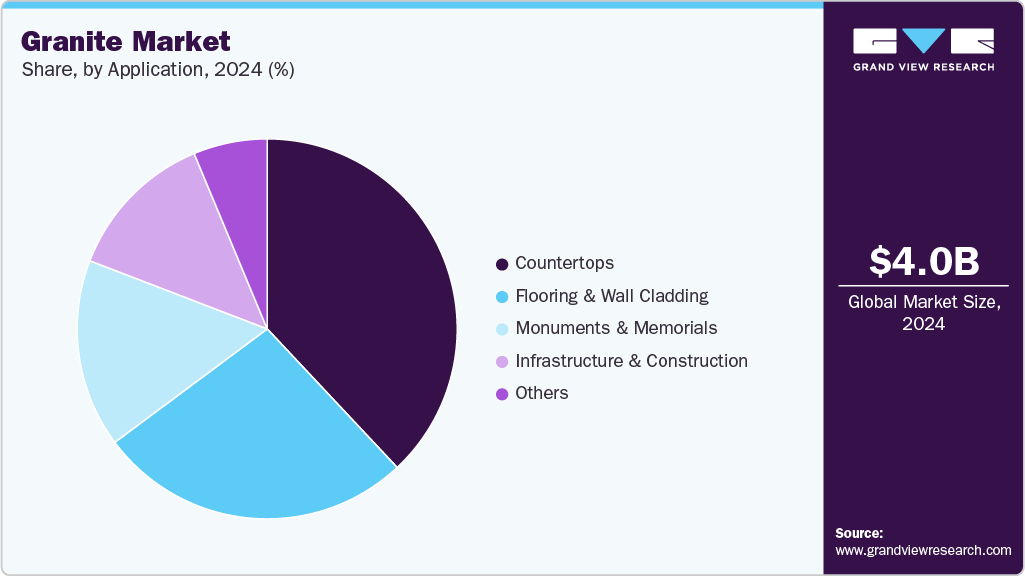
Based on application, counter tops segment led the market with the largest revenue share of 37.9% in 2025. Countertops, particularly in kitchens and bathrooms, are one of the most popular uses of granite. The natural stone is highly favored in this segment due to its non-porous nature, resistance to heat and acid, and ability to resist scratches and stains. These properties make it ideal for food preparation areas and spaces exposed to moisture. Additionally, the wide variety of colors and grain patterns available in slabs allows homeowners and designers to match them with various interior themes, adding elegance and functionality simultaneously.
Infrastructure and construction are a rapidly growing segment, driven by global investments in public works. Granite is used in constructing bridges, railway platforms, airport terminals, curbstones, and building facades. The stone’s strength, low maintenance requirements, and resistance to environmental stress (like extreme heat, cold, and pollution) make it suitable for demanding infrastructure applications. Its durability makes it cost-effective over the long term, despite its higher initial installation cost.
 To learn more about this report, Download Free Sample Report
Flooring and wall cladding form another primary application, especially in commercial buildings, luxury residences, and public spaces. Their durability under heavy foot traffic, moisture resistance, and availability in various finishes make them a practical and attractive option for flooring. It is particularly effective in hallways, entrances, hotel lobbies, and shopping malls. When used on walls, it enhances the aesthetics and adds a sense of permanence and luxury, often seen in institutional buildings and high-end interiors.
Regional Insights
North America remains a significant market driven by robust construction activity, urban redevelopment, and infrastructure investments across the United States and Canada. The U.S. dominates regional demand due to the widespread use of slabs in high-end residential and commercial projects. It is preferred for kitchen countertops, flooring, and wall cladding in upscale housing developments and renovation projects, especially in cities with aging infrastructure. Public infrastructure spending, such as the Biden administration’s focus on roads, public spaces, and government buildings, has increased the use of granite in pavements, monuments, and building facades.
U.S. Granite Market Trends
The U.S. granite market is driven by strong demand from the residential, commercial, and infrastructure sectors, making it the largest market in North America. Granite slabs are especially popular in upscale kitchen countertops, flooring, and wall applications due to their durability and natural elegance. With increasing investments in public infrastructure, including transport terminals, government buildings, and urban landscaping, it is widely used for pavements, facades, and monuments. The trend toward sustainable construction and premium interior design continues to boost the use of natural stone materials, while ongoing renovations and real estate developments further support granite consumption across key states like Texas, California, and New York.
Asia Pacific Granite Market Trends
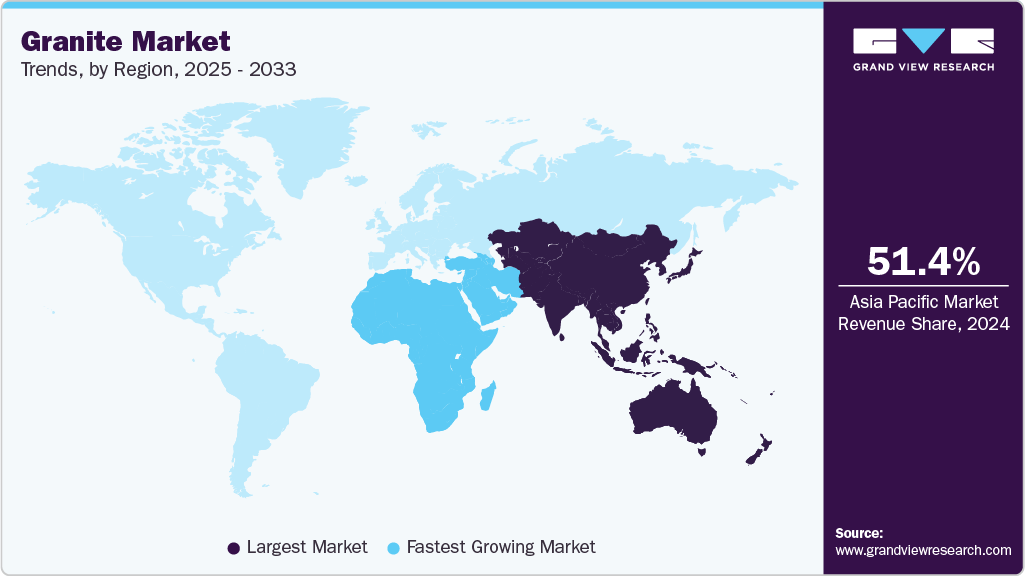
Asia Pacific dominated the granite market with the largest revenue share of 51.8% in 2025. The granite market in the China held the largest share in the Asia Pacific region in 2025. Asia Pacific is the fastest-growing region in the market, driven by rapid urbanization, growing middle-class incomes, and large-scale infrastructure development across India, China, and Southeast Asia. Countries like India, one of the largest producers and exporters of slabs and tiles, have seen strong domestic and international demand. The use of granite tiles in mid-to large-scale residential housing and public sector projects, such as airports, railways, and government buildings, is accelerating. China’s real estate and urban development sectors also continue to utilize it for structural and decorative purposes in commercial and cultural landmarks. The rise in commercial construction and luxury tourism infrastructure, including hotels and malls, further supports regional market growth. The availability of cost-effective labor and vast natural reserves also helps Asia Pacific become a major supplier globally.
 To learn more about this report, Download Free Sample Report
Europe Granite Market Trends
Architectural heritage preservation, sustainable construction standards, and demand for high-quality natural materials shape the Europe granite market. Countries such as Germany, France, Italy, and the UK emphasize using it in monuments, memorials, and historic restorations, given the stone’s long-lasting aesthetic and resistance to weathering. Slabs and cut-to-size products are widely used in public infrastructure, especially in urban planning projects, paving, and outdoor landscaping. The region also values locally sourced and eco-certified materials, which align well with its natural origin and low-maintenance profile. European architects often integrate green building designs, blending sustainability with luxury appeal.
Key Granite Company Insights
Some of the key players operating in the market include Able Group Berhad, Arizona Tile, Levantina, and Dakota Granite.
-
Able Group Berhad is a Malaysia-based company that processes, trades, and exports natural stones, including granite and marble. The company also undertakes installation and contracting for stone-related architectural works. Its vertically integrated operations cover quarrying, manufacturing, and property development. Able supplies materials to high-end residential, commercial, and infrastructure projects across Southeast Asia.
-
Founded in 1977, Arizona Tile is one of the largest independent stone and tile distributors in the United States. It offers over 230 varieties of granite, quartzite, marble, and other stones, as well as porcelain and ceramic tiles. Arizona Tile serves residential and commercial projects through showrooms and slab yards across multiple U.S. states.
-
Levantina is a global leader in natural stone production and distribution based in Spain. The company operates quarries in Spain and Brazil, producing granite, marble, and the popular sintered stone product Techlam. Levantina serves the construction, interior design, and architectural sectors worldwide.
-
Dakota Granite Company is a U.S.-based quarrier and fabricator of natural granite, known primarily for its signature Dakota Mahogany™. The company offers quarry blocks, slabs, memorials, and architectural products for domestic and international markets. It is vertically integrated with extraction, fabrication, and custom finishing capabilities.
Key Granite Companies:
The following key companies have been profiled for this study on the granite market.
-
Able Group Berhad
-
American Marazzi Tile Inc.
-
Arizona Tile
-
Cambria
-
Craig Baker Marble Co., Inc.
-
Dakota Granite Company
-
Granite Tops (Precision Tops)
-
Levantina
-
Precision Countertops
-
Vangura Surfacing Products
Competitive Benchmarking
Category
Operating Strategies
Competitive Edge
Weakness
Established Players (e.g. Able Group Berhad, American Marazzi Tile Inc.)
- Mature participants in the granite market primarily focus on vertically integrated operations that include quarry ownership, stone extraction, processing, fabrication, and global distribution.
- These companies emphasize securing long term access to premium granite reserves while investing in advanced cutting, polishing, and finishing technologies to improve production efficiency and product quality.
- Established players possess significant competitive advantages through ownership of high quality granite quarries, extensive processing infrastructure, and well established global distribution networks.
- Their integrated operations enable better control over raw material quality, production costs, and product consistency while ensuring reliable supply for large construction and architectural projects.
- Despite their strong market positions, mature players face challenges related to high operating costs, capital intensive quarry development, and transportation expenses.
- Granite extraction requires significant investments in mining equipment, processing facilities, environmental management, and logistics infrastructure.
Emerging & Regional Players (e.g., Craig Baker Marble Co. Inc., Precision Tops)
- Emerging participants in the granite market generally focus on regional quarry development, customized fabrication, and specialized product offerings.
- Rather than competing directly with established producers on production scale, these companies target niche applications such as luxury residential projects, designer interiors, bespoke countertops, and premium architectural stone.
- Emerging companies benefit from operational flexibility and the ability to respond quickly to changing architectural trends and customer requirements.
- Their smaller organizational structures support faster decision making, customized product development, and greater responsiveness to unique project specifications.
- Emerging participants face significant challenges related to limited quarry ownership, lower production capacities, and restricted financial resources.
- Many depend on third party quarry operators for raw material supply, increasing exposure to price fluctuations and supply disruptions.
Recent Developments
-
In January 2025, Able Group Berhad announced its continued investment in expanding processing capacity to support rising demand across Southeast Asia’s infrastructure and high-end residential sectors. The company highlighted its plans to strengthen in-house fabrication capabilities to reduce outsourcing costs and maintain competitive pricing. Subsequently, in March 2025, Able Group revealed upgrades to its Johor processing facility, including installing advanced stone-cutting and polishing machinery.
-
Arizona Tile continued to grow its U.S. presence by opening a new 60,000 sq ft showroom and distribution warehouse in Roseville, California, in June 2025. This facility marks a significant expansion in Northern California, offering access to over 130 natural stone varieties and 40+ porcelain and ceramic tile series. Earlier in the year, in February 2025, the company introduced a new line of granite products featuring anti-slip surface technology and quartz-infused options aimed at high-traffic commercial and outdoor applications.
-
In February 2025, Levantina Group finalized the sale of its O Porriño granite processing facility in Spain to Marcelino Group. The transaction followed extensive negotiations surrounding an employment restructuring process (ERE), ensuring continuity of granite operations under new management. This strategic move is part of Levantina’s broader effort to optimize its asset portfolio. Additionally, in April 2025, the company actively participated in Coverings 2025, a leading international stone and tile expo held in Orlando, Florida.
-
Dakota Granite Company entered 2025 with stable demand for its iconic Dakota Mahogany™ granite, particularly within North America's architectural and memorial segments. In January 2025, the company reported continued full-capacity operations, citing strong project pipelines in domestic public infrastructure and custom memorial orders. To support its expanding design offerings, Dakota Granite invested in new 5-axis CNC cutting equipment in May 2025, enhancing the precision and customization of architectural granite elements.
Granite Market Report Scope
Report Attribute
Details
Market definition
The market size represents the annual value of the apparent consumption of granite across various applications during a particular year.
Market size in 2025
USD 4.2 billion
Estimated market size in 2026
USD 4.4 billion
Projected market size by 2033
USD 6.4 billion
Growth rate
CAGR of 5.4% from 2026 to 2033
Base year for estimation
2025
Historical data
2021 - 2024
Forecast period
2026 - 2033
Quantitative units
Revenue in USD million, volume in kilotons, and CAGR from 2026 to 2033
Report coverage
Revenue forecast, volume forecast, company ranking, competitive landscape, growth factors, and trends
Segments covered
Product, application, and region.
Regional scope
North America; Europe; Asia Pacific; Latin America; Middle East & Africa
Country scope
U.S., Canada, Mexico, Germany, France, Italy, Russia, India, China, Japan, South Korea, Brazil, UAE, Saudi Arabia
Key companies profiled
Able Group Berhad; American Marazzi Tile Inc.; Arizona Tile; Cambria; Craig Baker Marble Co. Inc.; Dakota Granite Company; Precision Tops; Levantina; Precision Countertops; Vangura Surfacing Products
Customization scope
Free report customization (equivalent up to 8 analysts' working days) with purchase. Addition or alteration to country, regional & segment scope.
Pricing and purchase options
Avail customized purchase options to meet your exact research needs. Explore purchase options
Global Granite Market Report Segmentation
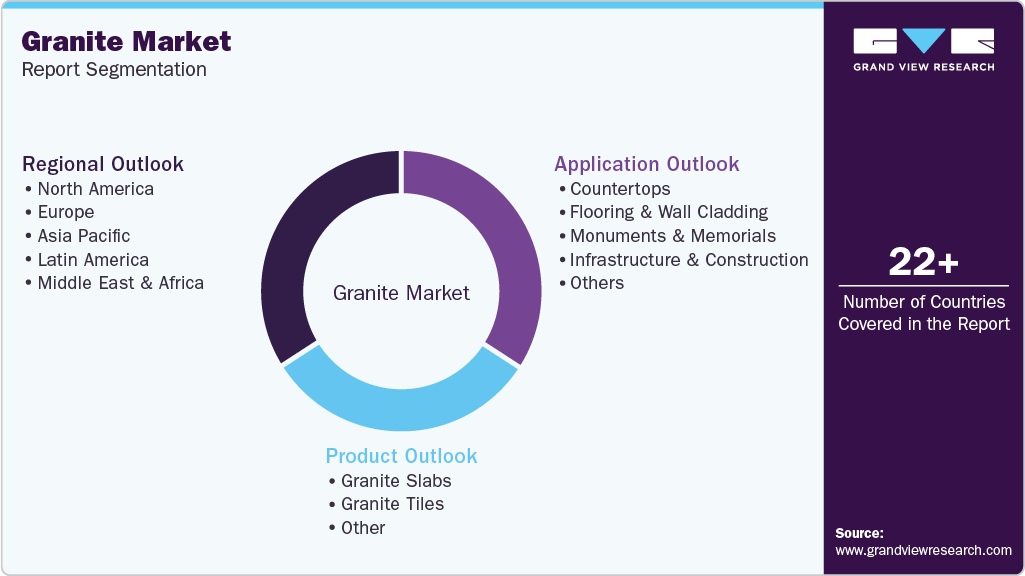
This report forecasts revenue growth at the global, regional, and country levels from 2021 to 2033 and analyzes the latest trends in each sub-segment. For this study, Grand View Research has segmented the global granite market report by product, application, and region:
 To learn more about this report, Download Free Sample Report
-
Product Outlook (Volume, Kilotons; Revenue, USD Billion; 2021 - 2033)
-
Granite Slabs
-
Granite Tiles
-
Other
-
-
Application Outlook (Volume, Kilotons; Revenue, USD Billion; 2021 - 2033)
-
Countertops
-
Flooring & Wall Cladding
-
Monuments & Memorials
-
Infrastructure & Construction
-
Others
-
-
Regional Outlook (Volume, Kilotons; Revenue, USD Billion; 2021 - 2033)
-
North America
-
U.S.
-
Canada
-
Mexico
-
-
Europe
-
Germany
-
France
-
Italy
-
Russia
-
-
Asia Pacific
-
China
-
India
-
Japan
-
South Korea
-
-
Latin America
-
Brazil
-
-
Middle East & Africa
-
Saudi Arabia
-
UAE
-
-
Research Methodology
The granite market figures in this report are based on a proven research process that combines executive interviews with secondary research from proprietary databases, company filings, and recognized regulatory and institutional sources. Market size is built through value-chain sizing - reconciling supply-side and demand-side estimates - and triangulated with bottom-up and top-down approaches. Every estimate passes multiple levels of expert validation before publication, with each granite segment quantified using the revenue-capture definitions in the table below.
Segment Definition
Product
Revenue Capture Definition
Slabs
Granite slabs account for the largest share of revenue in the granite market due to their extensive use in countertops, flooring, wall cladding, facades, staircases, and other architectural applications. Revenue is driven by strong demand from residential, commercial, and hospitality projects that require large, premium quality natural stone surfaces.
Tiles
Granite tiles generate significant market revenue owing to their widespread application in flooring, wall coverings, patios, and public infrastructure projects. Their ease of installation, lower material cost compared to slabs, and suitability for high traffic areas support consistent demand across new construction and renovation activities.
Others
The others segment includes granite products such as curbstones, paving stones, monuments, cobblestones, blocks, landscaping elements, and customized architectural products. Revenue from this segment is supported by infrastructure development, memorial construction, urban landscaping, and decorative outdoor applications.
Application
Revenue Capture Definition
Countertops
The countertops segment captures a significant share of granite market revenue due to widespread demand from residential kitchens, bathrooms, and commercial spaces. Granite's durability, heat resistance, and premium appearance make it a preferred material for high value countertop installations.
Flooring & Wall Cladding
Flooring and wall cladding represent a major revenue generating application, supported by the use of granite in residential, commercial, hospitality, and institutional buildings. Demand is driven by its long service life, low maintenance requirements, and ability to enhance architectural aesthetics.
Monuments & Memorials
The monuments and memorials segment contributes steady revenue through the use of granite in headstones, statues, commemorative structures, and public memorials. Its weather resistance, strength, and ability to retain polished finishes over decades make it well suited for these permanent applications.
Infrastructure & Construction
The infrastructure and construction segment accounts for substantial market revenue through the use of granite in bridges, pavements, curbstones, staircases, facades, public spaces, and transportation projects. Increasing investments in urban development and public infrastructure continue to support demand across this segment.
Others
The others segment includes applications such as landscaping, garden features, decorative stone, sculptures, fountains, and industrial uses. Revenue is supported by growing demand for customized natural stone products in residential, commercial, and public landscaping projects.
Estimation Model
Layer Name
Key Question
Description
Construction & Architectural Demand Base Layer
What forms the demand base?
Identify global demand from residential, commercial, industrial, and infrastructure construction activities. Assess investments in new construction, renovation, urban development, and architectural projects that require durable and decorative natural stone materials. This layer establishes the total addressable demand for granite products.
Granite Application Penetration Layer
Where is granite utilized?
Estimate the penetration of granite across key applications including countertops, flooring, wall cladding, facades, monuments & memorials, paving, landscaping, and infrastructure projects. Analyze the adoption of granite slabs, tiles, blocks, and customized stone products across residential, commercial, and public construction sectors in different regions.
Granite Consumption Intensity Layer
How much granite is consumed?
Analyze granite consumption intensity based on construction area, renovation activity, infrastructure development, and architectural design preferences. Evaluate granite usage per residential building, commercial project, public infrastructure, and monument application. Consumption intensity varies according to project scale, consumer preferences, building standards, and regional availability of natural stone.
Revenue Layer
How is market revenue generated?
Market revenue is quantified through sale of granite products including blocks, slabs, tiles, monuments, and customized architectural stone. Revenue generation is driven by demand from construction, interior design, landscaping, infrastructure, and memorial applications. Market value is influenced by granite quality, color, finish, processing technology, transportation costs, and regional construction activity.
Delivered Customizations
This report has been delivered with the following In-depth customizations
Client Request
Customization Delivered
Value Adds
Regional Segmentation
Detailed regional analysis of the granite market across North America, Europe, Asia Pacific, Latin America, and Middle East & Africa. Included evaluation of granite quarry production, processing capacities, construction activity, residential and commercial building demand, infrastructure investments, export competitiveness, and government policies influencing natural stone consumption.
Identified high growth construction markets, quarrying regions, and emerging demand centers. Enabled strategic expansion planning based on urbanization, infrastructure development, and premium building material demand. Supported regional demand forecasting and supply chain optimization.
Cross Segmentation
Comprehensive cross segmentation analysis by product type, application, and region, including granite slabs for countertops, granite tiles for flooring and wall cladding, dimensional stone for monuments and memorials, and other granite products across residential, commercial, infrastructure, and landscaping applications.
Enabled identification of the most attractive product application combinations and high growth market segments. Supported product portfolio optimization, customer targeting, and investment prioritization strategies.
Opportunity Assessment
Identification of high growth opportunities across premium residential construction, commercial real estate, hospitality projects, luxury interiors, urban landscaping, monuments, public infrastructure, and sustainable building materials.
Enabled prioritization of high return growth segments and emerging regional opportunities. Supported long term investment planning, quarry expansion decisions, processing capacity enhancement, and strategic business development initiatives aligned with evolving construction and architectural trends.
Frequently Asked Questions About This Report
The granite market size was estimated at USD 4.2 billion in 2025 and is expected to reach USD 4.4 billion in 2026.
Middle East & Africa is anticipated to register the fastest CAGR over the forecast period.
Based on product, slabs accounted for largest revenue share of 53.8% in 2025.
Based on application, countertops accounted for largest revenue share of 37.9% in 2025.
Some of the key vendors in the global granite market are Able Group Berhad, American Marazzi Tile Inc., Arizona Tile, Cambria, Craig Baker Marble Co. Inc., Dakota Granite Company, Precision Tops, Levantina, Precision Countertops, and Vangura Surfacing Products
The granite market is expected to grow at a compound annual growth rate of 5.4% from 2026 to 2033 to reach USD 6.4 billion by 2033.
The growth of the granite market is primarily driven by rapid urbanization, rising disposable incomes, and the increasing demand for durable and aesthetically pleasing building materials.
Asia Pacific dominated the market with revenue share of 51.8% in 2025.
China dominated the Asia Pacific market with revenue share of 53.8% in 2025.
About the Author(s)
Advanced Interior Materials Research Team
Advanced Materials · Advanced Interior MaterialsThis report was authored by the advanced interior materials research team at Grand View Research - comprising two research analysts, one senior research analyst, and one industry expert - with specialized expertise in the advanced interior materials segment of the advanced materials industry. All findings are based on proprietary advanced materials databases, executive interviews, and regulatory analysis, subject to internal peer review prior to publication.
Last Updated:
Speak to Analyst

Customize this report to your needs - add regions, segments, or data points, with 20% free customization.
Or view our licence options:


ISO 9001:2015 & 27001:2022 Certified
We are GDPR and CCPA compliant! Your transaction & personal information is safe and secure. For more details, please read our privacy policy.


